
Prsentation pour le ple Prvoyance de la Caisse
- Slides: 51
Présentation pour le pôle Prévoyance de la Caisse de Dépôt et de Gestion Rabat, Maroc. LIAM 2 Introduction and demo model 13/05/2013 Gijs Dekkers Gaëtan de Menten Raphaël Desmet plan. be
Introduction to Liam 2 • Tool for the development of dynamic microsimulation models with dynamic cross-sectional ageing. • ≠ a microsimulation model (<> Midas) • Simulation framework that allows for comprehensive modelling and various simulation techniques • Prospective / Retrospective simulation • Work in progress … • Immigration • Weights • More sophisticated regressions and simulation techniques • Speed optimisation • You get it for free! plan. be
How to get it. • Check http: //liam 2. plan. be • This website contains • The LIAM 2 executable. • A synthetic dataset of 20, 200 individuals grouped in 14, 700 households in HDF 5 format. • A small model containing • Fertility and mortality (aligned) • Educational attainment level • Some labour market characteristics • Documentation • A LIAM 2 user guide • A ready-to-use “bundle” of notepad integrated with LIAM 2 and the synthetic dataset. plan. be
Overview • Written in Python • High level open source language • Efficient libraries mostly C • Input • Model description: text file (YAML) • Alignment: CSV files • Internal data engine: HDF 5 file format and library for storing scientific data (meteorology, astronomy, …) • Output • HDF 5 file, CSV file on demand • Interactive console plan. be
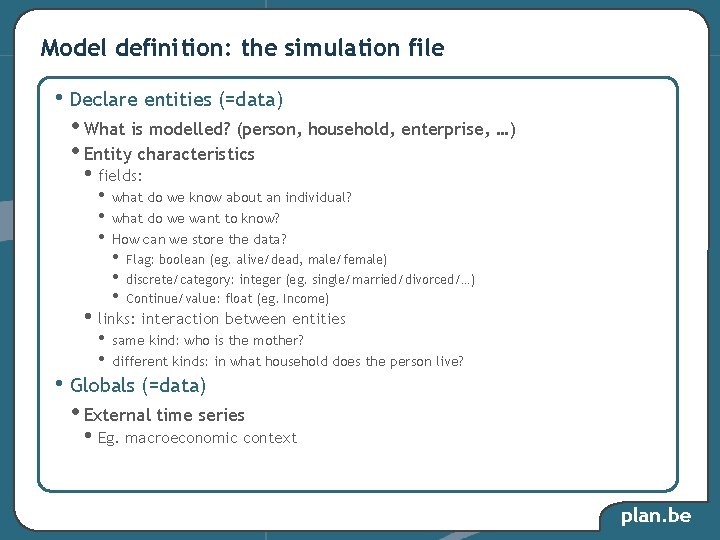
Model definition: the simulation file • Declare entities (=data) • What is modelled? (person, household, enterprise, …) • Entity characteristics • fields: • • • what do we know about an individual? what do we want to know? How can we store the data? • • • Flag: boolean (eg. alive/dead, male/female) discrete/category: integer (eg. single/married/divorced/…) Continue/value: float (eg. Income) • links: interaction between entities • • same kind: who is the mother? different kinds: in what household does the person live? • Globals (=data) • External time series • Eg. macroeconomic context plan. be
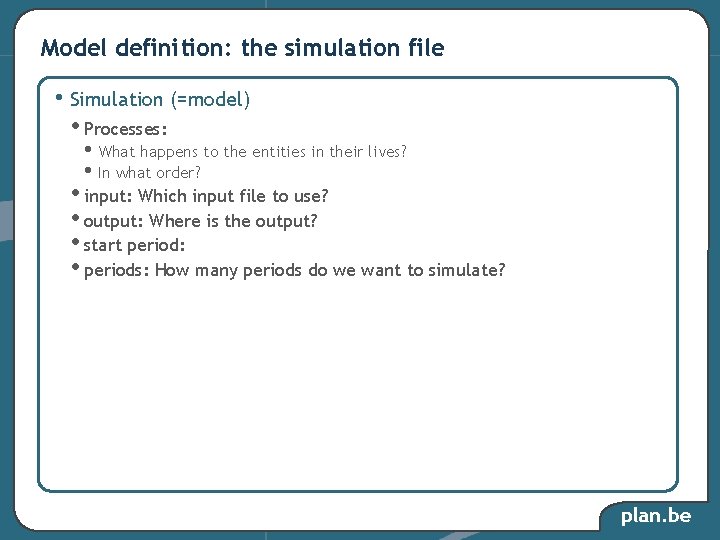
Model definition: the simulation file • Simulation (=model) • Processes: • What happens to the entities in their lives? • In what order? • input: Which input file to use? • output: Where is the output? • start period: • periods: How many periods do we want to simulate? plan. be
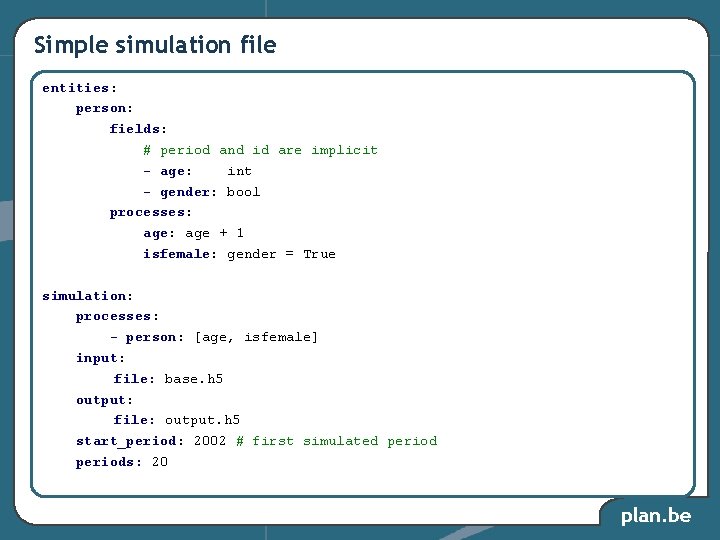
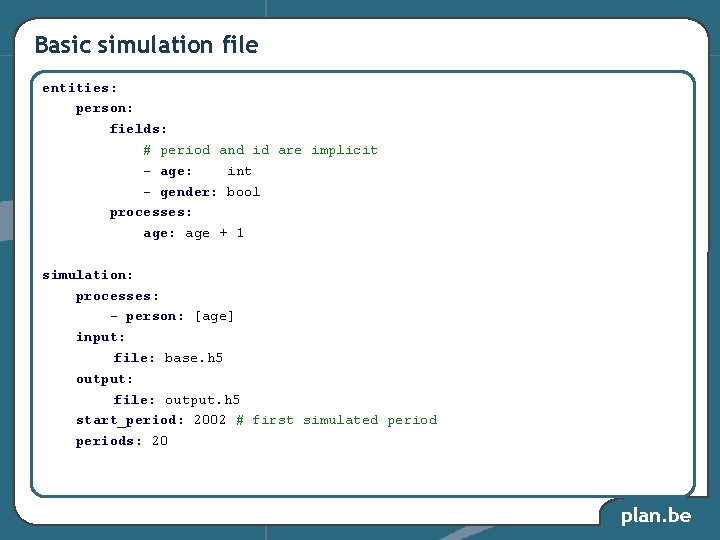
Simple simulation file entities: person: fields: # period and id are implicit - age: int - gender: bool processes: age + 1 isfemale: gender = True simulation: processes: - person: [age, isfemale] input: file: base. h 5 output: file: output. h 5 start_period: 2002 # first simulated periods: 20 plan. be
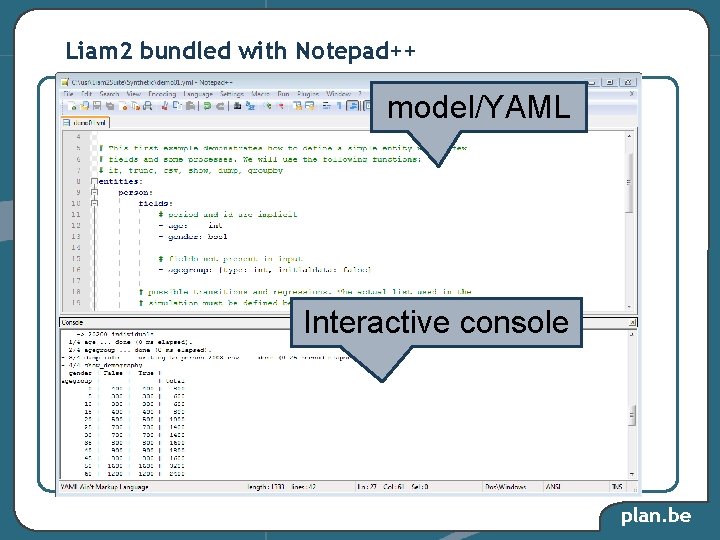
Liam 2 bundled with Notepad++ model/YAML Interactive console plan. be
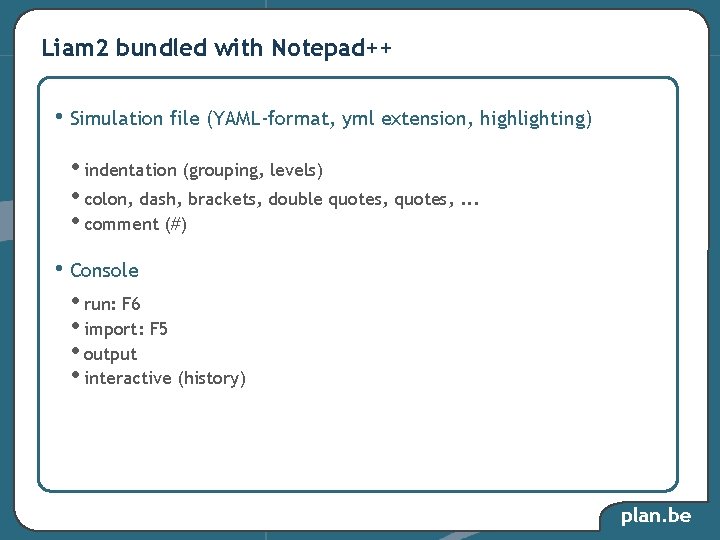
Liam 2 bundled with Notepad++ • Simulation file (YAML-format, yml extension, highlighting) • indentation (grouping, levels) • colon, dash, brackets, double quotes, . . . • comment (#) • Console • run: F 6 • import: F 5 • output • interactive (history) plan. be
LIAM 2 – demo model • First simulation • simple entity • simple functions • first run • some output plan. be
basic simulation setup demo 01. yml plan. be
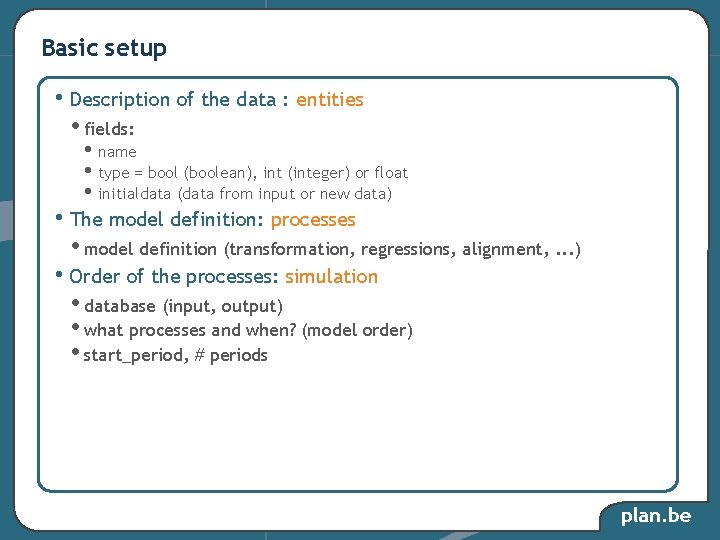
Basic setup • Description of the data : entities • fields: • name • type = bool (boolean), int (integer) or float • initialdata (data from input or new data) • The model definition: processes • model definition (transformation, regressions, alignment, . . . ) • Order of the processes: simulation • database (input, output) • what processes and when? (model order) • start_period, # periods plan. be
Basic simulation file entities: person: fields: # period and id are implicit - age: int - gender: bool processes: age + 1 simulation: processes: - person: [age] input: file: base. h 5 output: file: output. h 5 start_period: 2002 # first simulated periods: 20 plan. be
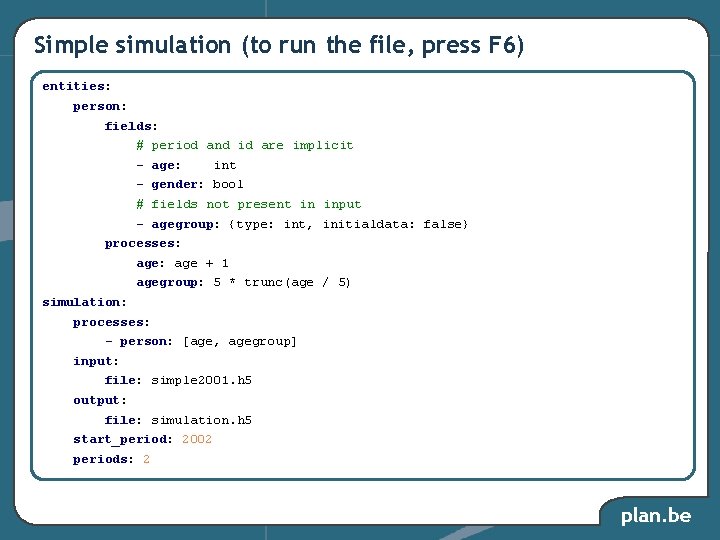
Simple simulation (to run the file, press F 6) entities: person: fields: # period and id are implicit - age: int - gender: bool # fields not present in input - agegroup: {type: int, initialdata: false} processes: age + 1 agegroup: 5 * trunc(age / 5) simulation: processes: - person: [age, agegroup] input: file: simple 2001. h 5 output: file: simulation. h 5 start_period: 2002 periods: 2 plan. be
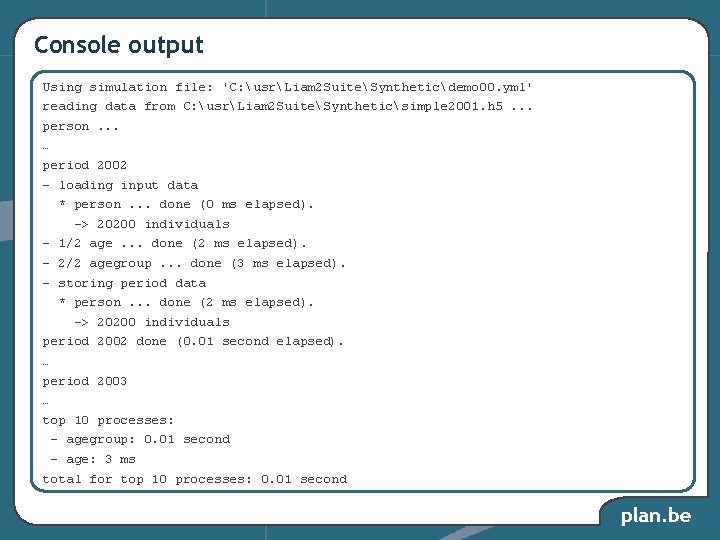
Console output Using simulation file: 'C: usrLiam 2 SuiteSyntheticdemo 00. yml' reading data from C: usrLiam 2 SuiteSyntheticsimple 2001. h 5. . . person. . . … period 2002 - loading input data * person. . . done (0 ms elapsed). -> 20200 individuals - 1/2 age. . . done (2 ms elapsed). - 2/2 agegroup. . . done (3 ms elapsed). - storing period data * person. . . done (2 ms elapsed). -> 20200 individuals period 2002 done (0. 01 second elapsed). … period 2003 … top 10 processes: - agegroup: 0. 01 second - age: 3 ms total for top 10 processes: 0. 01 second plan. be
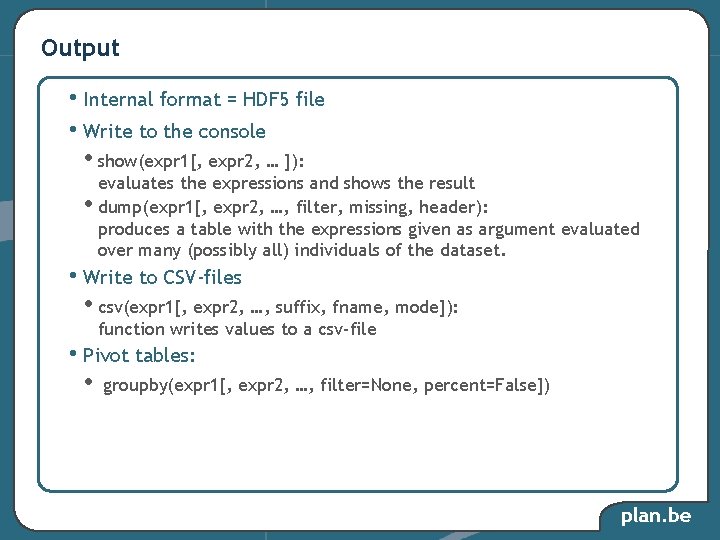
Output • Internal format = HDF 5 file • Write to the console • show(expr 1[, expr 2, … ]): evaluates the expressions and shows the result • dump(expr 1[, expr 2, …, filter, missing, header): produces a table with the expressions given as argument evaluated over many (possibly all) individuals of the dataset. • Write to CSV-files • csv(expr 1[, expr 2, …, suffix, fname, mode]): function writes values to a csv-file • Pivot tables: • groupby(expr 1[, expr 2, …, filter=None, percent=False]) plan. be
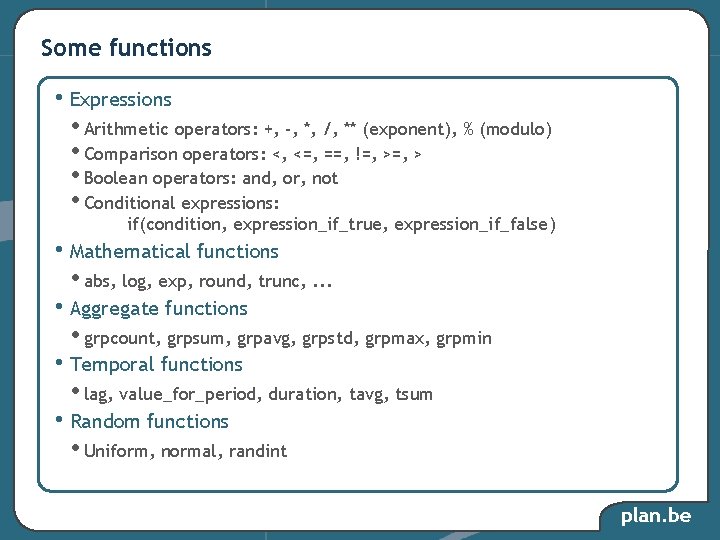
Some functions • Expressions • Arithmetic operators: +, -, *, /, ** (exponent), % (modulo) • Comparison operators: <, <=, ==, !=, > • Boolean operators: and, or, not • Conditional expressions: if(condition, expression_if_true, expression_if_false) • Mathematical functions • abs, log, exp, round, trunc, . . . • Aggregate functions • grpcount, grpsum, grpavg, grpstd, grpmax, grpmin • Temporal functions • lag, value_for_period, duration, tavg, tsum • Random functions • Uniform, normal, randint plan. be
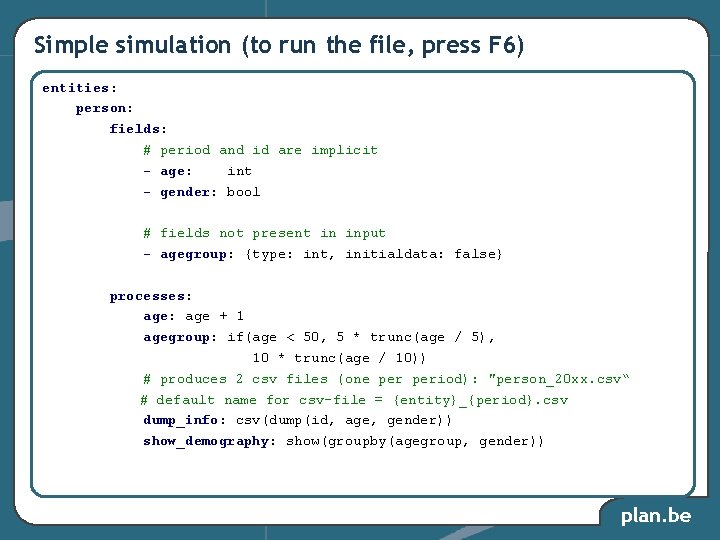
Simple simulation (to run the file, press F 6) entities: person: fields: # period and id are implicit - age: int - gender: bool # fields not present in input - agegroup: {type: int, initialdata: false} processes: age + 1 agegroup: if(age < 50, 5 * trunc(age / 5), 10 * trunc(age / 10)) # produces 2 csv files (one period): "person_20 xx. csv“ # default name for csv-file = {entity}_{period}. csv dump_info: csv(dump(id, age, gender)) show_demography: show(groupby(agegroup, gender)) plan. be
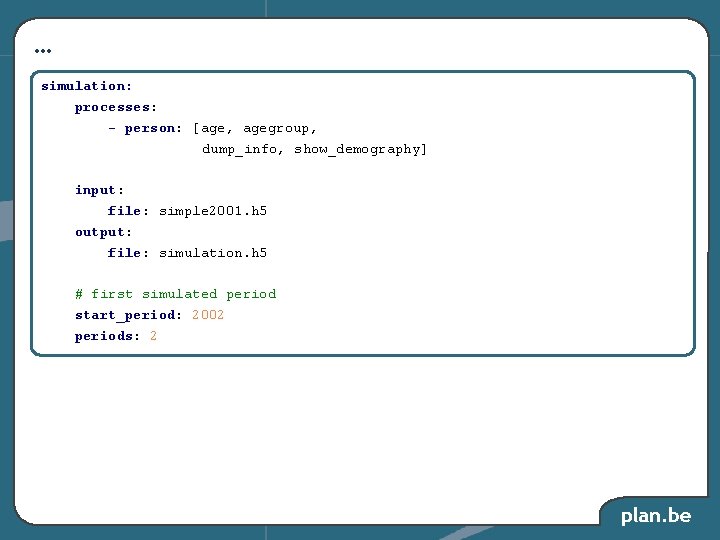
… simulation: processes: - person: [age, agegroup, dump_info, show_demography] input: file: simple 2001. h 5 output: file: simulation. h 5 # first simulated period start_period: 2002 periods: 2 plan. be
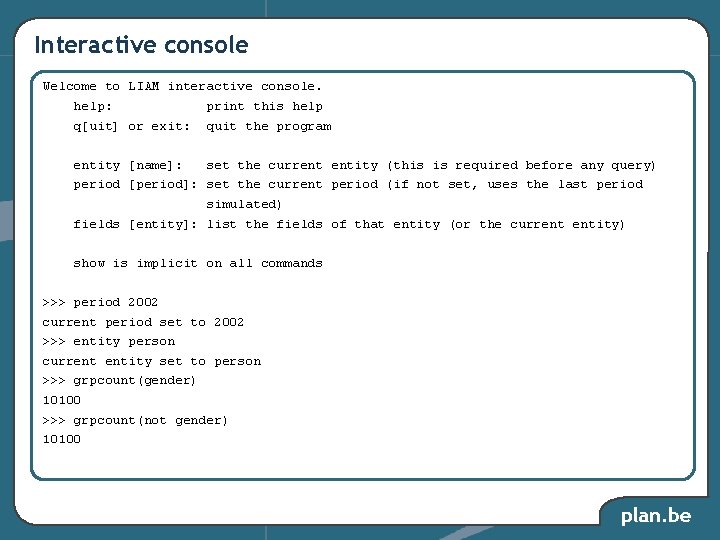
Interactive console Welcome to LIAM interactive console. help: print this help q[uit] or exit: quit the program entity [name]: set the current entity (this is required before any query) period [period]: set the current period (if not set, uses the last period simulated) fields [entity]: list the fields of that entity (or the current entity) show is implicit on all commands >>> period 2002 current period set to 2002 >>> entity person current entity set to person >>> grpcount(gender) 10100 >>> grpcount(not gender) 10100 plan. be
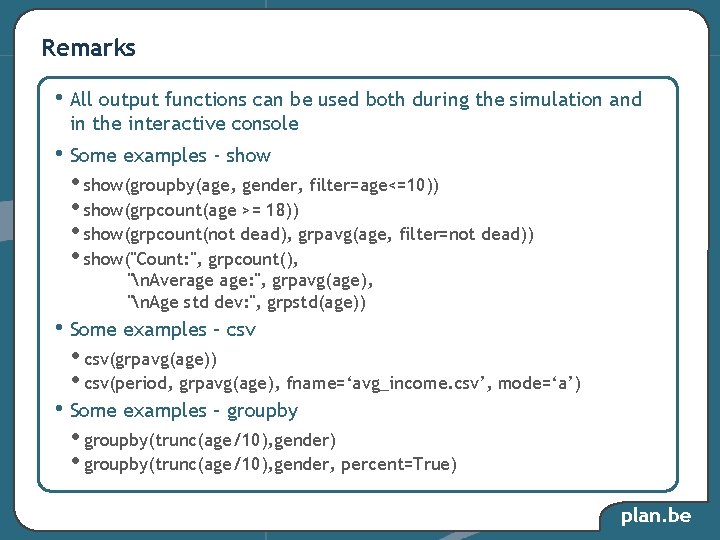
Remarks • All output functions can be used both during the simulation and in the interactive console • Some examples - show • show(groupby(age, gender, filter=age<=10)) • show(grpcount(age >= 18)) • show(grpcount(not dead), grpavg(age, filter=not dead)) • show("Count: ", grpcount(), "n. Average age: ", grpavg(age), "n. Age std dev: ", grpstd(age)) • Some examples – csv • csv(grpavg(age)) • csv(period, grpavg(age), fname=‘avg_income. csv’, mode=‘a’) • Some examples – groupby • groupby(trunc(age/10), gender) • groupby(trunc(age/10), gender, percent=True) plan. be
links, init, procedures, choice demo 02. yml plan. be
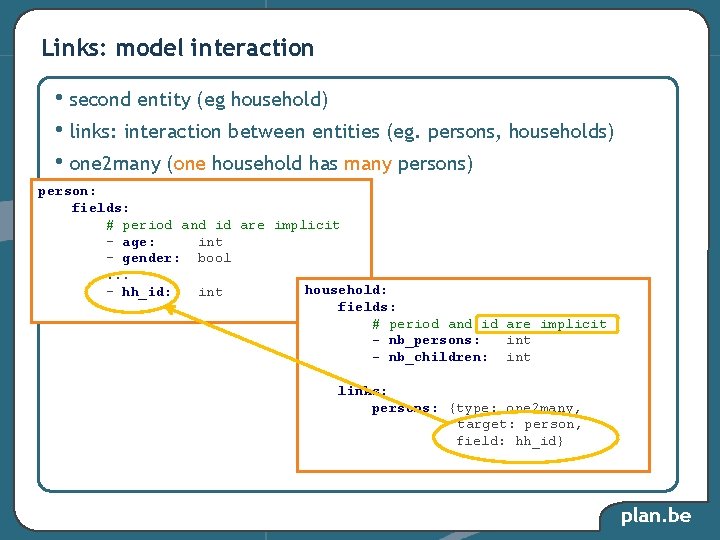
Links: model interaction • second entity (eg household) • links: interaction between entities (eg. persons, households) • one 2 many (one household has many persons) person: fields: # period and id are implicit - age: int - gender: bool . . . household: - hh_id: int fields: # period and id are implicit - nb_persons: int - nb_children: int links: persons: {type: one 2 many, target: person, field: hh_id} plan. be
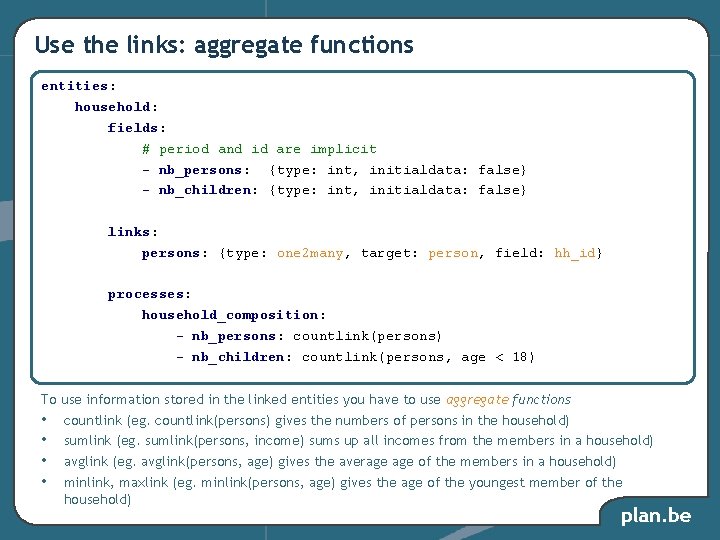
Use the links: aggregate functions entities: household: fields: # period and id are implicit - nb_persons: {type: int, initialdata: false} - nb_children: {type: int, initialdata: false} links: persons: {type: one 2 many, target: person, field: hh_id} processes: household_composition: - nb_persons: countlink(persons) - nb_children: countlink(persons, age < 18) To use information stored in the linked entities you have to use aggregate functions • countlink (eg. countlink(persons) gives the numbers of persons in the household) • sumlink (eg. sumlink(persons, income) sums up all incomes from the members in a household) • avglink (eg. avglink(persons, age) gives the average of the members in a household) • minlink, maxlink (eg. minlink(persons, age) gives the age of the youngest member of the household) plan. be
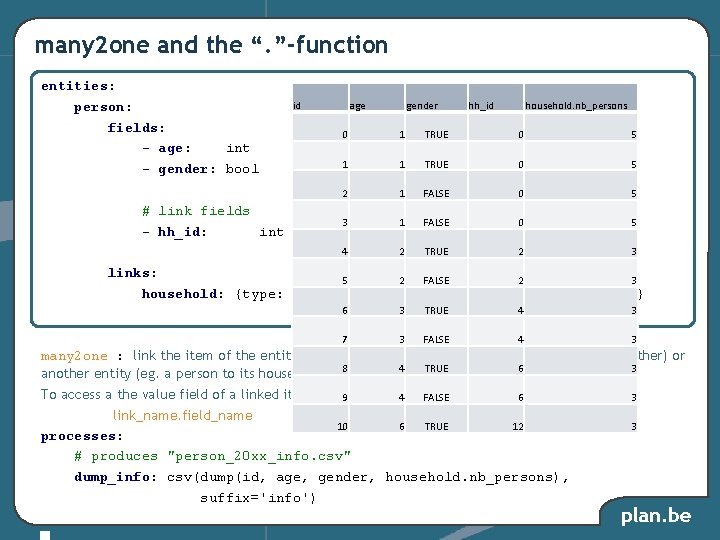
many 2 one and the “. ”-function entities: id age gender hh_id household. nb_persons person: fields: 0 1 TRUE 0 5 - age: int 1 1 TRUE 0 5 - gender: bool 2 1 FALSE 0 5 # link fields 3 1 FALSE 0 5 - hh_id: int 4 2 TRUE 2 3 links: 5 2 FALSE 2 3 household: {type: many 2 one, target: household, field: hh_id} 6 3 TRUE 4 3 7 3 FALSE 4 3 many 2 one : link the item of the entity to one other item in the same (eg. a person to its mother) or 4 TRUE 6 3 another entity (eg. a person to its household). 8 To access a the value field of a linked item, you 9 use: 4 FALSE 6 3 link_name. field_name 10 6 TRUE 12 3 processes: # produces "person_20 xx_info. csv" dump_info: csv(dump(id, age, gender, household. nb_persons), suffix='info') plan. be
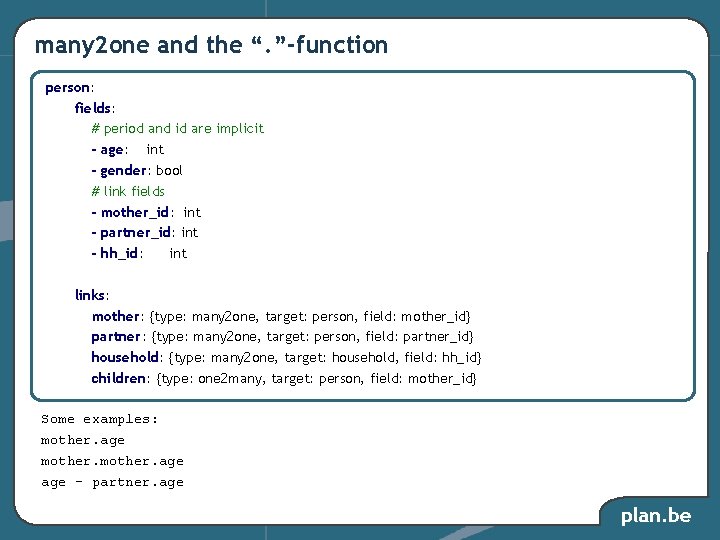
many 2 one and the “. ”-function person: fields: # period and id are implicit - age: int - gender: bool # link fields - mother_id: int - partner_id: int - hh_id: int links: mother: {type: many 2 one, target: person, field: mother_id} partner: {type: many 2 one, target: person, field: partner_id} household: {type: many 2 one, target: household, field: hh_id} children: {type: one 2 many, target: person, field: mother_id} Some examples: mother. age - partner. age plan. be
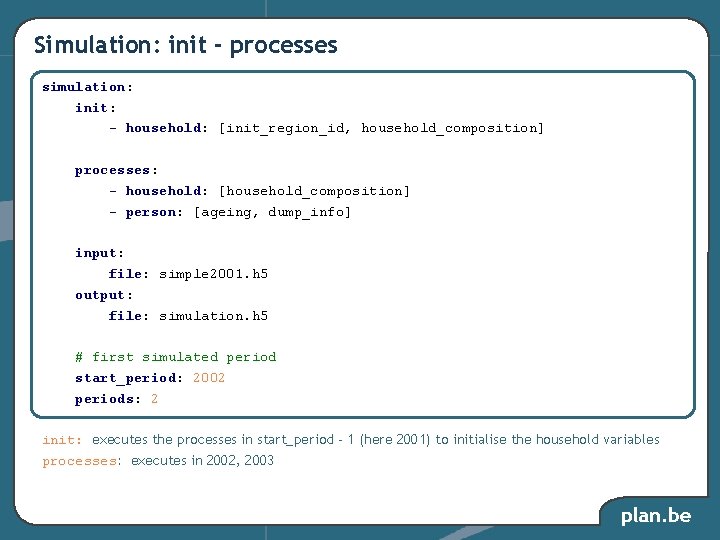
Simulation: init - processes simulation: init: - household: [init_region_id, household_composition] processes: - household: [household_composition] - person: [ageing, dump_info] input: file: simple 2001. h 5 output: file: simulation. h 5 # first simulated period start_period: 2002 periods: 2 init: executes the processes in start_period - 1 (here 2001) to initialise the household variables processes: executes in 2002, 2003 plan. be
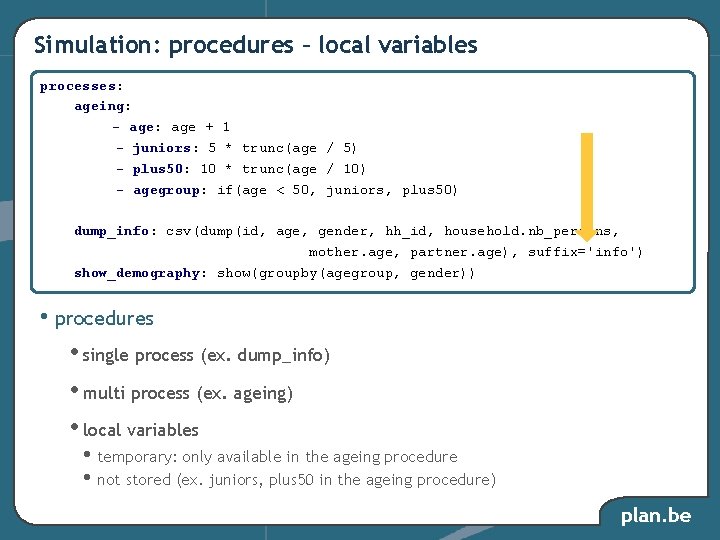
Simulation: procedures – local variables processes: ageing: - age: age + 1 - juniors: 5 * trunc(age / 5) - plus 50: 10 * trunc(age / 10) - agegroup: if(age < 50, juniors, plus 50) dump_info: csv(dump(id, age, gender, hh_id, household. nb_persons, mother. age, partner. age), suffix='info') show_demography: show(groupby(agegroup, gender)) • procedures • single process (ex. dump_info) • multi process (ex. ageing) • local variables • temporary: only available in the ageing procedure • not stored (ex. juniors, plus 50 in the ageing procedure) plan. be
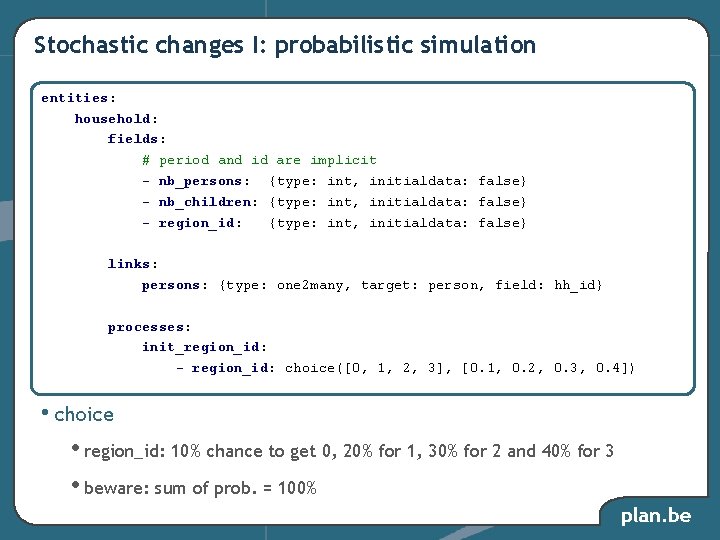
Stochastic changes I: probabilistic simulation entities: household: fields: # period and id are implicit - nb_persons: {type: int, initialdata: false} - nb_children: {type: int, initialdata: false} - region_id: {type: int, initialdata: false} links: persons: {type: one 2 many, target: person, field: hh_id} processes: init_region_id: - region_id: choice([0, 1, 2, 3], [0. 1, 0. 2, 0. 3, 0. 4]) • choice • region_id: 10% chance to get 0, 20% for 1, 30% for 2 and 40% for 3 • beware: sum of prob. = 100% plan. be
regressions, macros, new, remove demo 03. yml plan. be
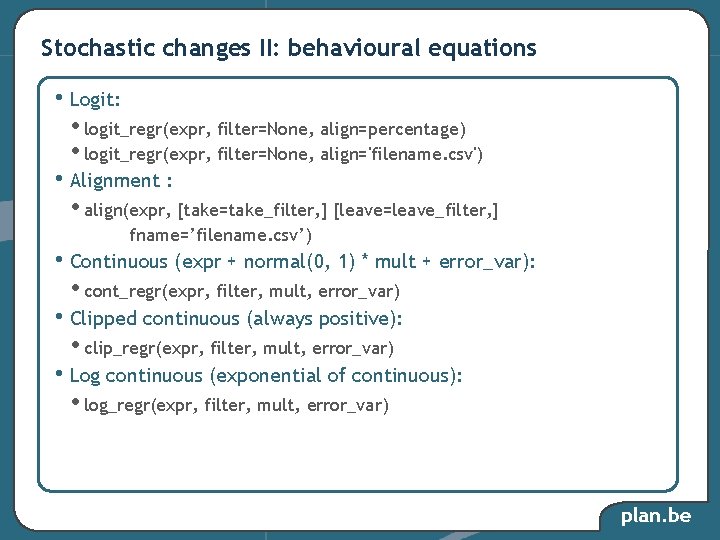
Stochastic changes II: behavioural equations • Logit: • logit_regr(expr, filter=None, align=percentage) • logit_regr(expr, filter=None, align='filename. csv') • Alignment : • align(expr, [take=take_filter, ] [leave=leave_filter, ] fname=’filename. csv’) • Continuous (expr + normal(0, 1) * mult + error_var): • cont_regr(expr, filter, mult, error_var) • Clipped continuous (always positive): • clip_regr(expr, filter, mult, error_var) • Log continuous (exponential of continuous): • log_regr(expr, filter, mult, error_var) plan. be
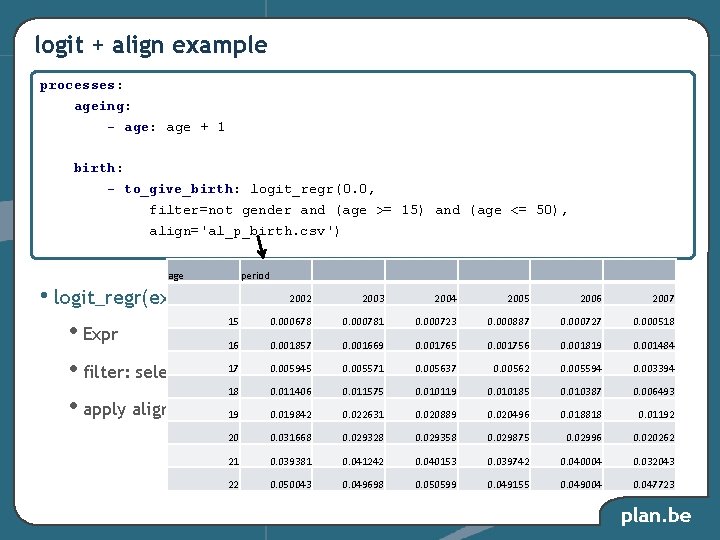
logit + align example processes: ageing: - age: age + 1 birth: - to_give_birth: logit_regr(0. 0, filter=not gender and (age >= 15) and (age <= 50), align='al_p_birth. csv') age period 2002 • logit_regr(expr, filter, align) 2003 2004 2005 2006 2007 15 0. 000678 0. 000781 0. 000723 0. 000887 0. 000727 0. 000518 16 0. 001857 0. 001669 0. 001765 0. 001756 0. 001819 0. 001484 17 0. 005945 0. 005571 0. 005637 0. 00562 0. 005594 0. 003394 18 0. 011406 0. 011575 0. 010119 0. 010185 0. 010387 0. 006493 19 0. 019842 0. 022631 0. 020889 0. 020496 0. 018818 0. 01192 20 0. 031668 0. 029328 0. 029358 0. 029875 0. 02996 0. 020262 21 0. 039381 0. 041242 0. 040153 0. 039742 0. 040004 0. 032043 22 0. 050043 0. 049698 0. 050599 0. 049155 0. 049004 0. 047723 • Expr • filter: select individuals from entity • apply alignment using al_p_birth. csv plan. be
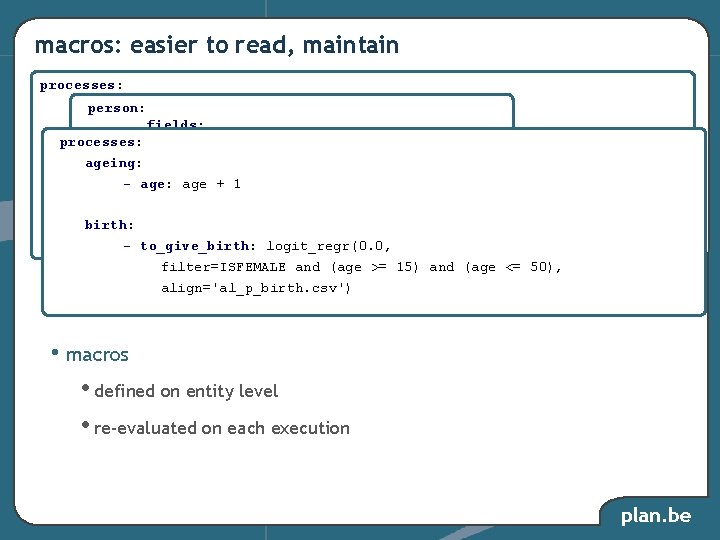
macros: easier to read, maintain processes: ageing: person: fields: - age: age + 1 - age: int processes: ageing: . . . birth: macros: age + 1 - to_give_birth: logit_regr(0. 0, MALE: True FEMALE: False filter=not gender and (age >= 15) and (age <= 50), birth: ISMALE: gender align='al_p_birth. csv') ISFEMALE: not gender - to_give_birth: logit_regr(0. 0, filter=ISFEMALE and (age >= 15) and (age <= 50), align='al_p_birth. csv') • macros • defined on entity level • re-evaluated on each execution plan. be
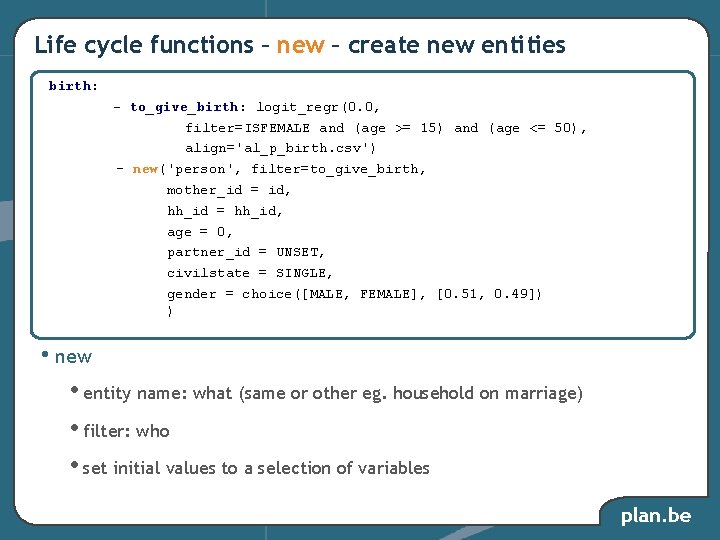
Life cycle functions – new – create new entities birth: - to_give_birth: logit_regr(0. 0, filter=ISFEMALE and (age >= 15) and (age <= 50), align='al_p_birth. csv') - new('person', filter=to_give_birth, mother_id = id, hh_id = hh_id, age = 0, partner_id = UNSET, civilstate = SINGLE, gender = choice([MALE, FEMALE], [0. 51, 0. 49]) ) • new • entity name: what (same or other eg. household on marriage) • filter: who • set initial values to a selection of variables plan. be
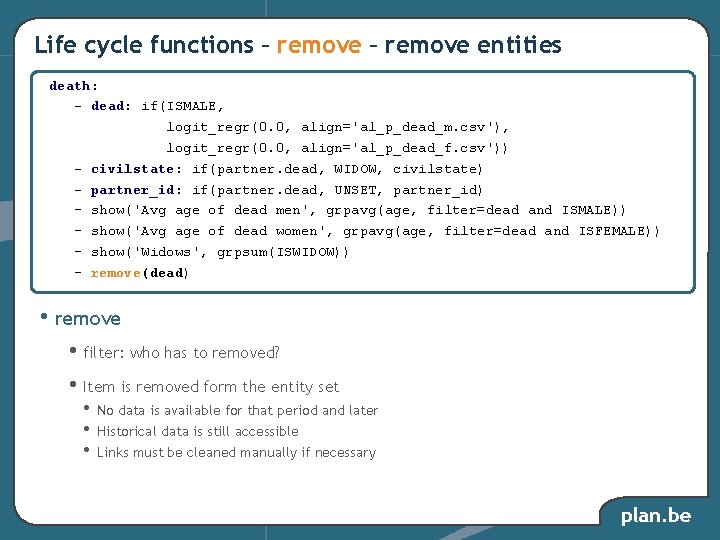
Life cycle functions – remove entities death: - dead: if(ISMALE, logit_regr(0. 0, align='al_p_dead_m. csv'), logit_regr(0. 0, align='al_p_dead_f. csv')) - civilstate: if(partner. dead, WIDOW, civilstate) - partner_id: if(partner. dead, UNSET, partner_id) - show('Avg age of dead men', grpavg(age, filter=dead and ISMALE)) - show('Avg age of dead women', grpavg(age, filter=dead and ISFEMALE)) - show('Widows', grpsum(ISWIDOW)) - remove(dead) • remove • filter: who has to removed? • Item is removed form the entity set • • • No data is available for that period and later Historical data is still accessible Links must be cleaned manually if necessary plan. be
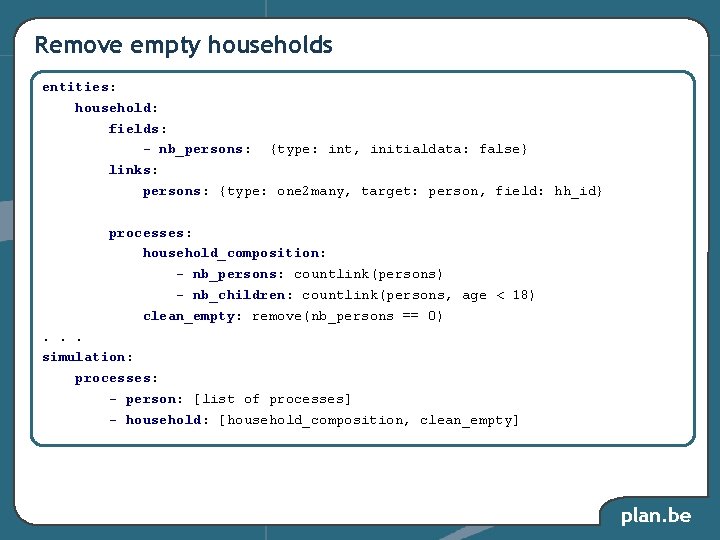
Remove empty households entities: household: fields: - nb_persons: {type: int, initialdata: false} links: persons: {type: one 2 many, target: person, field: hh_id} processes: household_composition: - nb_persons: countlink(persons) - nb_children: countlink(persons, age < 18) clean_empty: remove(nb_persons == 0). . . simulation: processes: - person: [list of processes] - household: [household_composition, clean_empty] plan. be
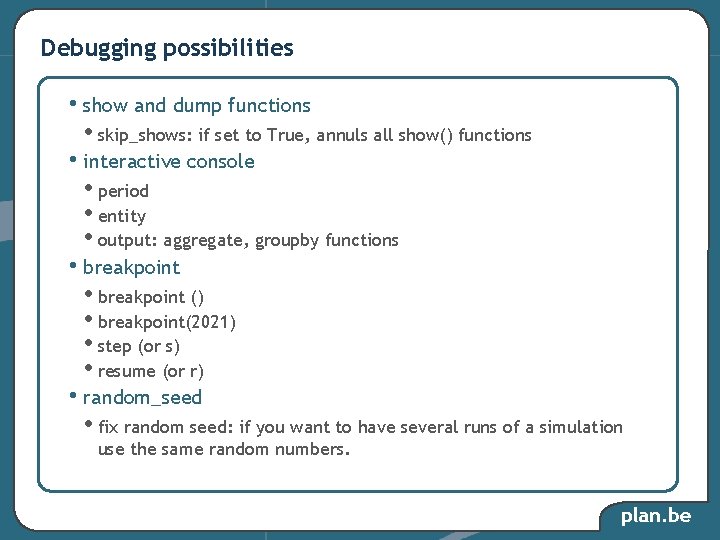
Debugging possibilities • show and dump functions • skip_shows: if set to True, annuls all show() functions • interactive console • period • entity • output: aggregate, groupby functions • breakpoint () • breakpoint(2021) • step (or s) • resume (or r) • random_seed • fix random seed: if you want to have several runs of a simulation use the same random numbers. plan. be
matching, change links demo 04. yml plan. be
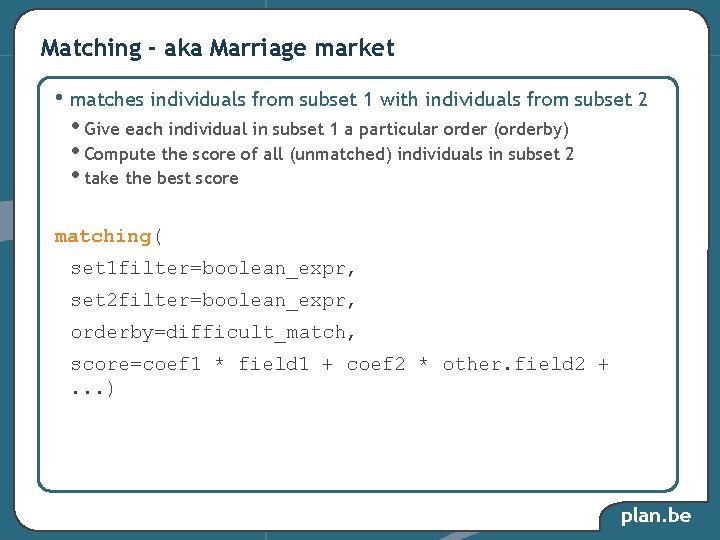
Matching - aka Marriage market • matches individuals from subset 1 with individuals from subset 2 • Give each individual in subset 1 a particular order (orderby) • Compute the score of all (unmatched) individuals in subset 2 • take the best score matching( set 1 filter=boolean_expr, set 2 filter=boolean_expr, orderby=difficult_match, score=coef 1 * field 1 + coef 2 * other. field 2 + . . . ) plan. be
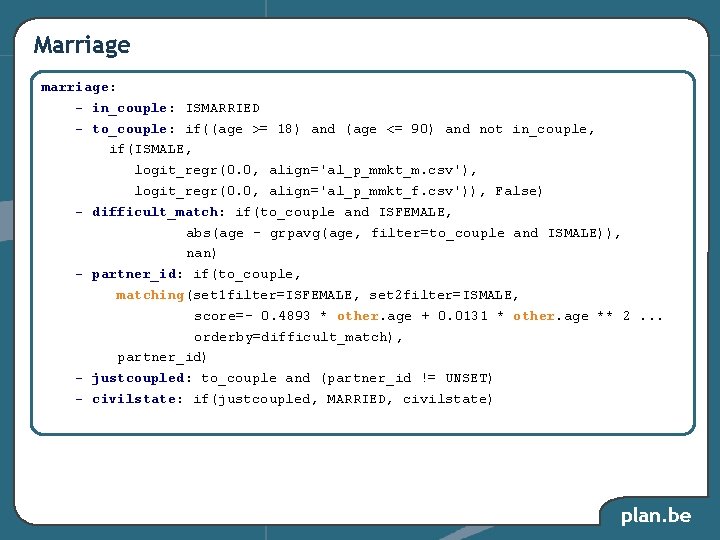
Marriage marriage: - in_couple: ISMARRIED - to_couple: if((age >= 18) and (age <= 90) and not in_couple, if(ISMALE, logit_regr(0. 0, align='al_p_mmkt_m. csv'), logit_regr(0. 0, align='al_p_mmkt_f. csv')), False) - difficult_match: if(to_couple and ISFEMALE, abs(age - grpavg(age, filter=to_couple and ISMALE)), nan) - partner_id: if(to_couple, matching(set 1 filter=ISFEMALE, set 2 filter=ISMALE, score=- 0. 4893 * other. age + 0. 0131 * other. age ** 2. . . orderby=difficult_match), partner_id) - justcoupled: to_couple and (partner_id != UNSET) - civilstate: if(justcoupled, MARRIED, civilstate) plan. be
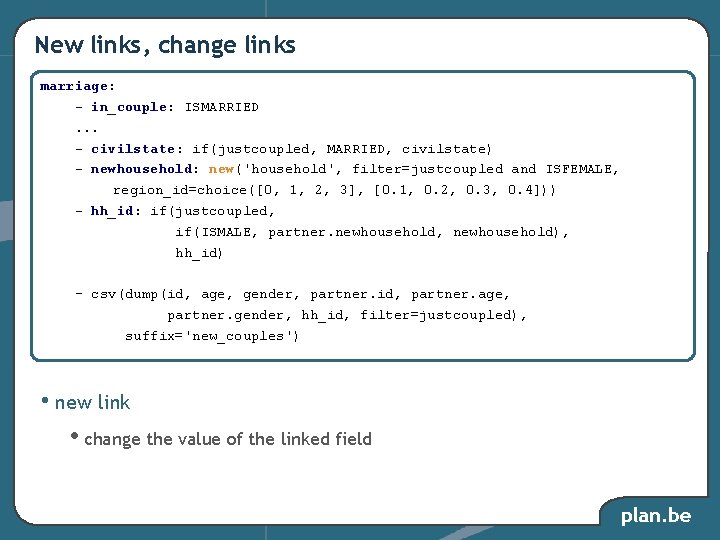
New links, change links marriage: - in_couple: ISMARRIED . . . - civilstate: if(justcoupled, MARRIED, civilstate) - newhousehold: new('household', filter=justcoupled and ISFEMALE, region_id=choice([0, 1, 2, 3], [0. 1, 0. 2, 0. 3, 0. 4])) - hh_id: if(justcoupled, if(ISMALE, partner. newhousehold, newhousehold), hh_id) - csv(dump(id, age, gender, partner. id, partner. age, partner. gender, hh_id, filter=justcoupled), suffix='new_couples') • new link • change the value of the linked field plan. be
break links, lag demo 05. yml plan. be
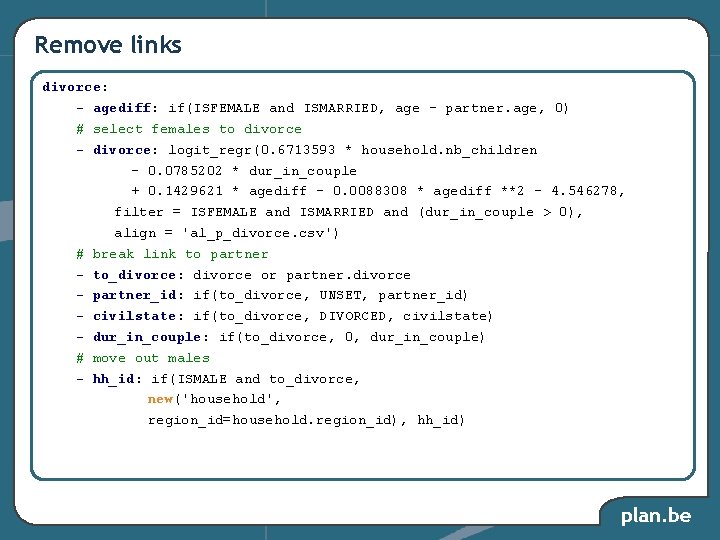
Remove links divorce: - agediff: if(ISFEMALE and ISMARRIED, age - partner. age, 0) # select females to divorce - divorce: logit_regr(0. 6713593 * household. nb_children - 0. 0785202 * dur_in_couple + 0. 1429621 * agediff - 0. 0088308 * agediff **2 - 4. 546278, filter = ISFEMALE and ISMARRIED and (dur_in_couple > 0), align = 'al_p_divorce. csv') # break link to partner - to_divorce: divorce or partner. divorce - partner_id: if(to_divorce, UNSET, partner_id) - civilstate: if(to_divorce, DIVORCED, civilstate) - dur_in_couple: if(to_divorce, 0, dur_in_couple) # move out males - hh_id: if(ISMALE and to_divorce, new('household', region_id=household. region_id), hh_id) plan. be
globals, regr + align demo 06. yml plan. be
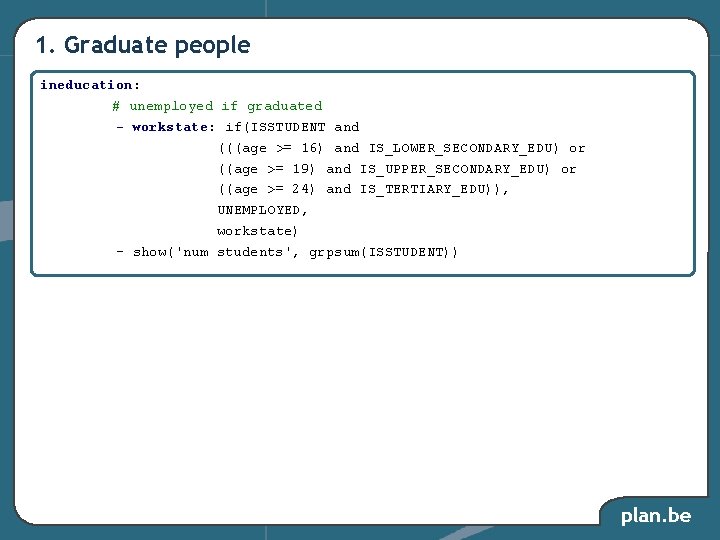
1. Graduate people ineducation: # unemployed if graduated - workstate: if(ISSTUDENT and (((age >= 16) and IS_LOWER_SECONDARY_EDU) or ((age >= 19) and IS_UPPER_SECONDARY_EDU) or ((age >= 24) and IS_TERTIARY_EDU)), UNEMPLOYED, workstate) - show('num students', grpsum(ISSTUDENT)) plan. be
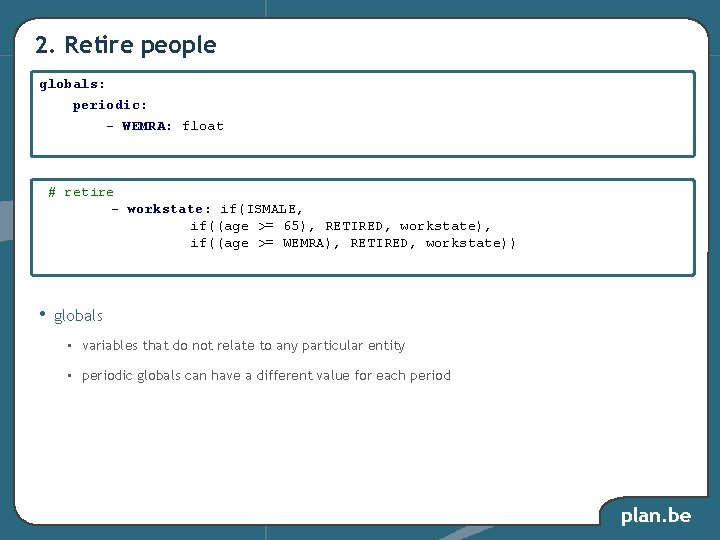
2. Retire people globals: periodic: - WEMRA: float # retire - workstate: if(ISMALE, if((age >= 65), RETIRED, workstate), if((age >= WEMRA), RETIRED, workstate)) • globals • variables that do not relate to any particular entity • periodic globals can have a different value for each period plan. be
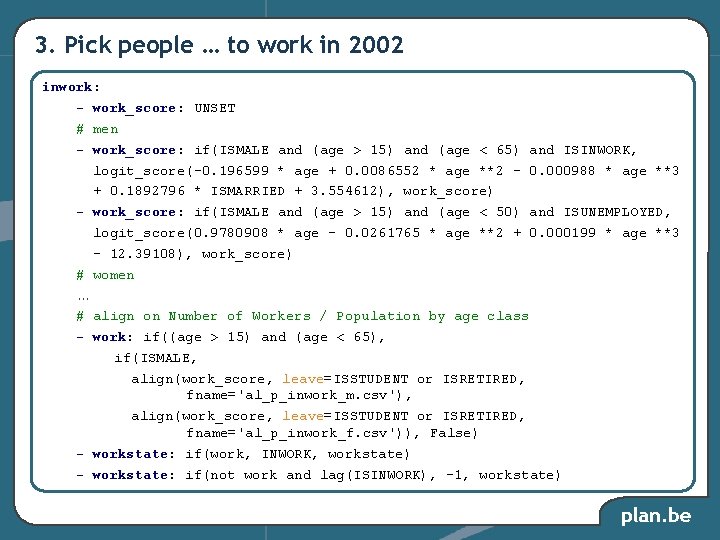
3. Pick people … to work in 2002 inwork: - work_score: UNSET # men - work_score: if(ISMALE and (age > 15) and (age < 65) and ISINWORK, logit_score(-0. 196599 * age + 0. 0086552 * age **2 - 0. 000988 * age **3 + 0. 1892796 * ISMARRIED + 3. 554612), work_score) - work_score: if(ISMALE and (age > 15) and (age < 50) and ISUNEMPLOYED, logit_score(0. 9780908 * age - 0. 0261765 * age **2 + 0. 000199 * age **3 - 12. 39108), work_score) # women … # align on Number of Workers / Population by age class - work: if((age > 15) and (age < 65), if(ISMALE, align(work_score, leave=ISSTUDENT or ISRETIRED, fname='al_p_inwork_m. csv'), align(work_score, leave=ISSTUDENT or ISRETIRED, fname='al_p_inwork_f. csv')), False) - workstate: if(work, INWORK, workstate) - workstate: if(not work and lag(ISINWORK), -1, workstate) plan. be
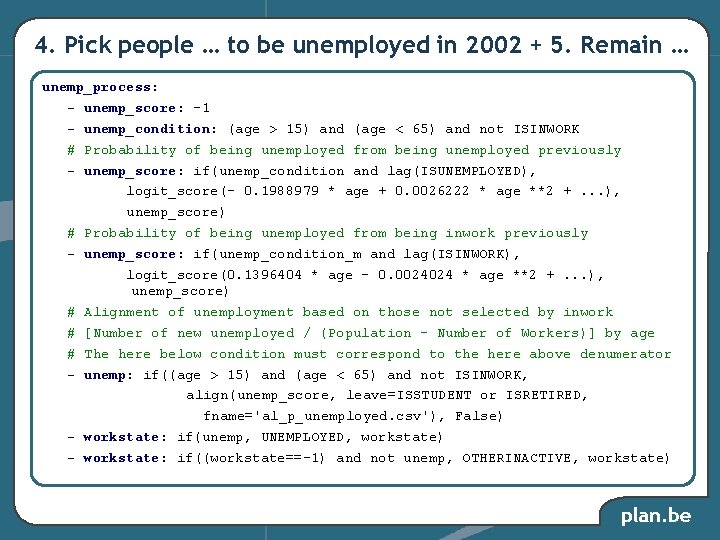
4. Pick people … to be unemployed in 2002 + 5. Remain … unemp_process: - unemp_score: -1 - unemp_condition: (age > 15) and (age < 65) and not ISINWORK # Probability of being unemployed from being unemployed previously - unemp_score: if(unemp_condition and lag(ISUNEMPLOYED), logit_score(- 0. 1988979 * age + 0. 0026222 * age **2 +. . . ), unemp_score) # Probability of being unemployed from being inwork previously - unemp_score: if(unemp_condition_m and lag(ISINWORK), logit_score(0. 1396404 * age - 0. 0024024 * age **2 +. . . ), unemp_score) # Alignment of unemployment based on those not selected by inwork # [Number of new unemployed / (Population - Number of Workers)] by age # The here below condition must correspond to the here above denumerator - unemp: if((age > 15) and (age < 65) and not ISINWORK, align(unemp_score, leave=ISSTUDENT or ISRETIRED, fname='al_p_unemployed. csv'), False) - workstate: if(unemp, UNEMPLOYED, workstate) - workstate: if((workstate==-1) and not unemp, OTHERINACTIVE, workstate) plan. be
import data demo_import. yml plan. be
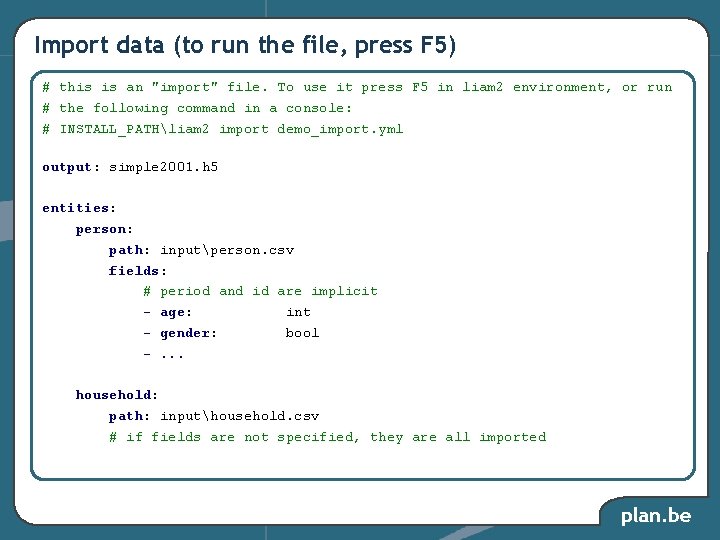
Import data (to run the file, press F 5) # this is an "import" file. To use it press F 5 in liam 2 environment, or run # the following command in a console: # INSTALL_PATHliam 2 import demo_import. yml output: simple 2001. h 5 entities: person: path: inputperson. csv fields: # period and id are implicit - age: int - gender: bool -. . . household: path: inputhousehold. csv # if fields are not specified, they are all imported plan. be
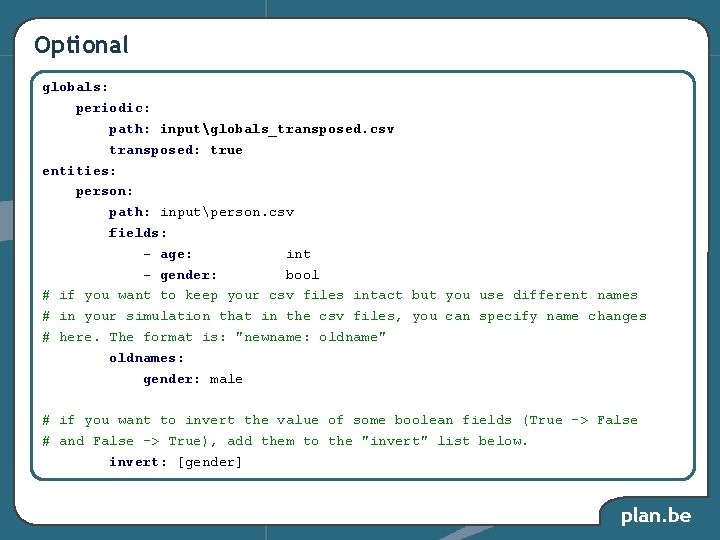
Optional globals: periodic: path: inputglobals_transposed. csv transposed: true entities: person: path: inputperson. csv fields: - age: int - gender: bool # if you want to keep your csv files intact but you use different names # in your simulation that in the csv files, you can specify name changes # here. The format is: "newname: oldname" oldnames: gender: male # if you want to invert the value of some boolean fields (True -> False # and False -> True), add them to the "invert" list below. invert: [gender] plan. be