
Proving Quark Gluon Plasma via Baryon Production at
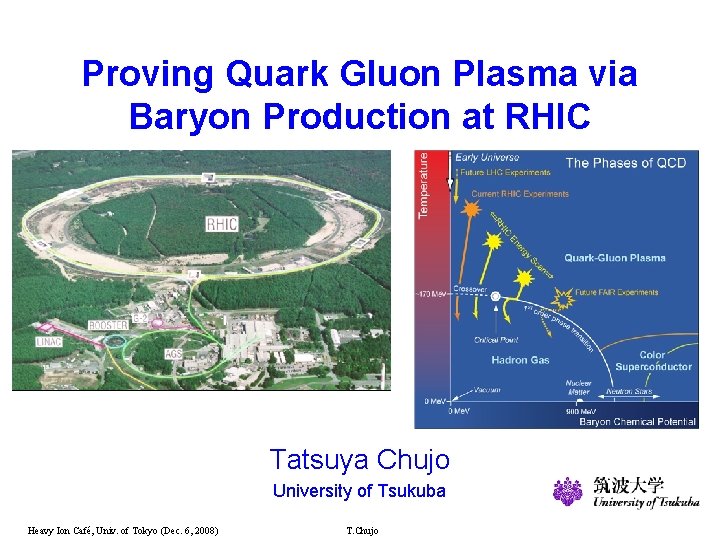
Proving Quark Gluon Plasma via Baryon Production at RHIC Tatsuya Chujo University of Tsukuba Heavy Ion Café, Univ. of Tokyo (Dec. 6, 2008) T. Chujo
Outline 1. 2. 3. 4. 5. 6. Introduction Overview of bulk properties at RHIC Systematic study of baryon enhancement What’s the origin of baryon enhancement? Exploring the QCD phase diagram at RHIC Summary 2 Heavy Ion Café, Univ. of Tokyo (Dec. 6, 2008) T. Chujo
1. INTRODUCTION 3 Heavy Ion Café, Univ. of Tokyo (Dec. 6, 2008) T. Chujo
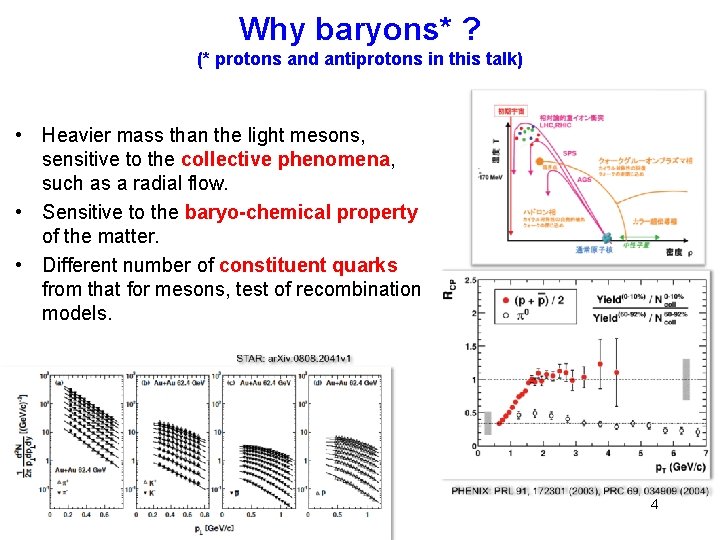
Why baryons* ? (* protons and antiprotons in this talk) • Heavier mass than the light mesons, sensitive to the collective phenomena, such as a radial flow. • Sensitive to the baryo-chemical property of the matter. • Different number of constituent quarks from that for mesons, test of recombination models. 4 Heavy Ion Café, Univ. of Tokyo (Dec. 6, 2008) T. Chujo
A lots of data and publications on baryons from RHIC experiments; 1 (spectra, yields, and jet correlations) • BRAHMS – Nuclear Stopping in Au+Au Collisions at √s. NN = 200 Ge. V, PRL 93, 102301 (2004). • PHENIX – Scaling Properties of Proton and Antiproton Production in √s. NN = 200 Ge. V Au Au Collisions, PRL 91, 172301 (2003). [TC] – Identified charged particle spectra and yields in Au+Au collisions at √s. NN=200 Ge. V, PRC 69, 034909 (2004). [TC] – Nuclear effects on hadron production in d + Au collisions at √s. NN = 200 Ge. V revealed by comparison with p + p data, PRC 74, 024904 (2006). [(TC)] – Jet structure of baryon excess in Au+Au collisions at √s. NN =200 Ge. V, PRC 71, 051902 (R) (2005). – Particle-Species Dependent Modification of Jet-Induced Correlations in Au+Au Collisions at √s. NN =200 Ge. V, PRL 101, 082301 (2008). – Correlated production of p and pbar in Au+ Au collisions at √s. NN = 200 Ge. V, PLB 649 (2007) 359 -369. – Au+Au 62. 4 Ge. V (preliminary) [TC], Cu+Cu 200 Ge. V (preliminary), to be published before QM 09 – Cu+Cu 22. 5, 62. 4 Ge. V (preliminary) [TC], p+p 62. 4 Ge. V (preliminary) [TC] (hopefully) – p+p 200 Ge. V (new data) 5 * note: not the complete list. Heavy Ion Café, Univ. of Tokyo (Dec. 6, 2008) T. Chujo
A lots of data and publications on baryons from RHIC experiments; 2 (spectra, yields, and jet correlations) • PHOBOS – Identified hadron transverse momentum spectra in Au+Au collisions at √s. NN = 62. 4 Ge. V, PRC 75, 024910 (2007). • STAR – Identified Baryon and Meson Distributions at Large Transverse Momenta from Au+Au Collisions at √s. NN = 200 Ge. V, PRL 97, 152301 (2006). – Energy dependence of ±, p and p-bar transverse momentum spectra for Au+Au collisions at √s. NN = 62. 4 and 200 Ge. V, ar. Xiv: nucl-ex/0703040. – Identified hadron spectra at large transverse momentum in p + p and d + Au collisions at √s. NN = 200 Ge. V, PLB 637 (2006) 161 -169. – Systematic Measurements of Identified Particle Spectra in pp, d+Au and Au+Au Collisions from STAR, ar. Xiv: 0808. 2041. * note: not the complete list. 6 Heavy Ion Café, Univ. of Tokyo (Dec. 6, 2008) T. Chujo
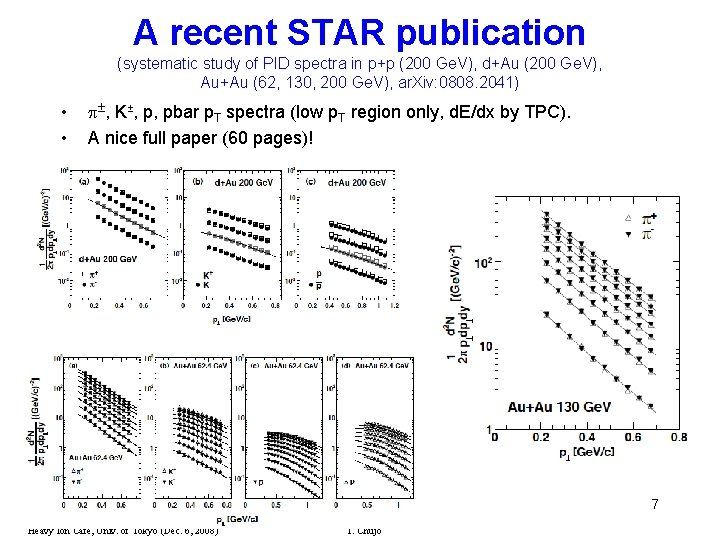
A recent STAR publication (systematic study of PID spectra in p+p (200 Ge. V), d+Au (200 Ge. V), Au+Au (62, 130, 200 Ge. V), ar. Xiv: 0808. 2041) • • ±, K±, p, pbar p. T spectra (low p. T region only, d. E/dx by TPC). A nice full paper (60 pages)! 7 Heavy Ion Café, Univ. of Tokyo (Dec. 6, 2008) T. Chujo
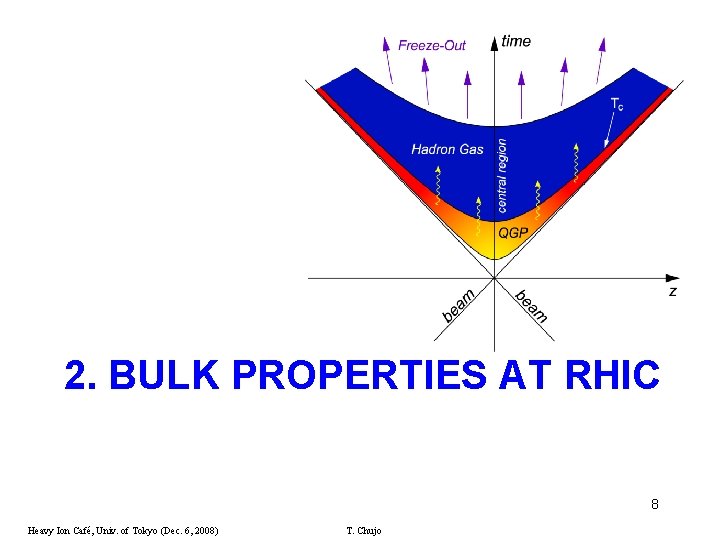
2. BULK PROPERTIES AT RHIC 8 Heavy Ion Café, Univ. of Tokyo (Dec. 6, 2008) T. Chujo
What are the bulk properties (EOS)? • • • • …. Energy density (e) Temperature (T): – critical temperature (Tc), initial temperature (Tini), chemical freeze-out temperature (Tch), kinetic freeze-out temperature (Tkin) Chemical potential (m): – baryon chemical potential (m. B), strangeness chemical potential (ms), strangeness suppression factor (gs) Collective flow velocity (<b. T>) Pressure gradient (DP), particle emission anisotropy (v 2) Particle multiplicity (d. N/dy, N) Transverse energy (d. ET/dy, ET) Transverse momentum distribution (Ed 3 N/dp 3) Particle abundance and ratio Average transverse momentum (<p. T>) HBT radii (Rout, Rside, Rlong, l) Velocity of sound (vs) Shear viscosity – entropy ratio (h/s) 9 Heavy Ion Café, Univ. of Tokyo (Dec. 6, 2008) T. Chujo
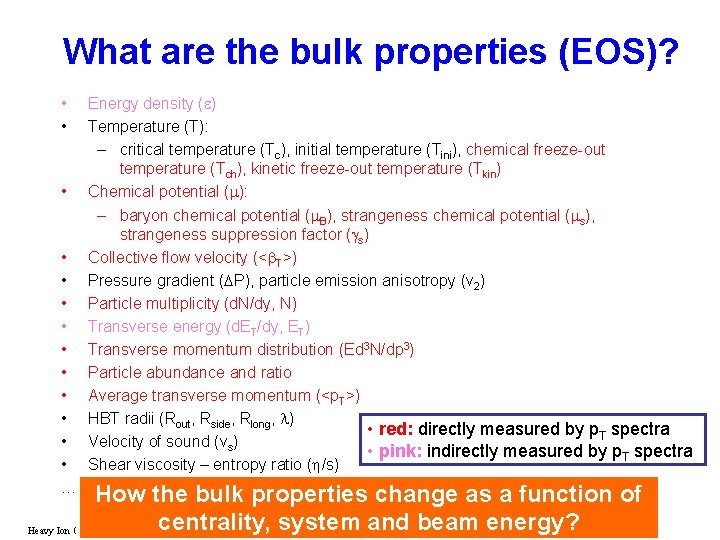
What are the bulk properties (EOS)? • • • • …. Energy density (e) Temperature (T): – critical temperature (Tc), initial temperature (Tini), chemical freeze-out temperature (Tch), kinetic freeze-out temperature (Tkin) Chemical potential (m): – baryon chemical potential (m. B), strangeness chemical potential (ms), strangeness suppression factor (gs) Collective flow velocity (<b. T>) Pressure gradient (DP), particle emission anisotropy (v 2) Particle multiplicity (d. N/dy, N) Transverse energy (d. ET/dy, ET) Transverse momentum distribution (Ed 3 N/dp 3) Particle abundance and ratio Average transverse momentum (<p. T>) HBT radii (Rout, Rside, Rlong, l) • red: directly measured by p. T spectra Velocity of sound (vs) • pink: indirectly measured by p. T spectra Shear viscosity – entropy ratio (h/s) How the bulk properties change as a function of 10 system and beam energy? Heavy Ion Café, Univ. of Tokyocentrality, (Dec. 6, 2008) T. Chujo
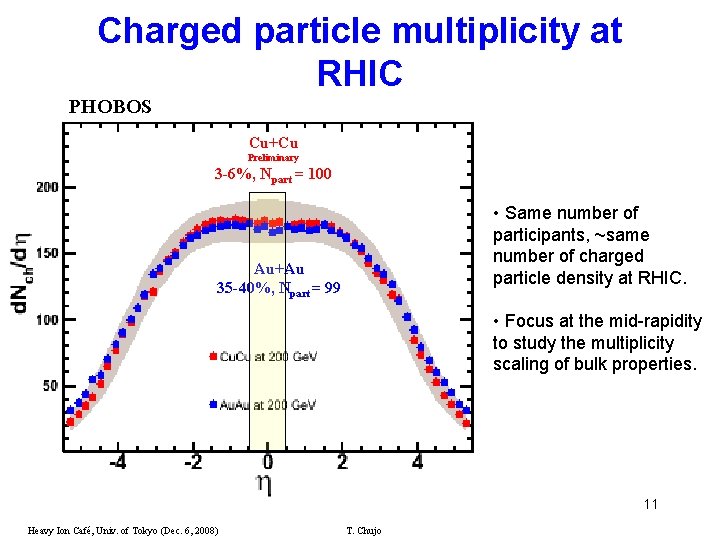
Charged particle multiplicity at RHIC PHOBOS Cu+Cu Preliminary 3 -6%, Npart = 100 • Same number of participants, ~same number of charged particle density at RHIC. Au+Au 35 -40%, Npart = 99 • Focus at the mid-rapidity to study the multiplicity scaling of bulk properties. 11 Heavy Ion Café, Univ. of Tokyo (Dec. 6, 2008) T. Chujo
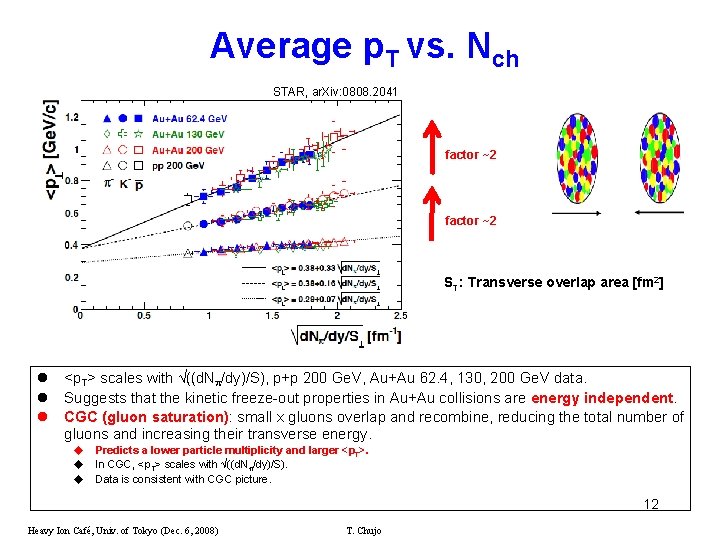
Average p. T vs. Nch STAR, ar. Xiv: 0808. 2041 factor ~2 ST: Transverse overlap area [fm 2] l <p. T> scales with √((d. N /dy)/S), p+p 200 Ge. V, Au+Au 62. 4, 130, 200 Ge. V data. l Suggests that the kinetic freeze-out properties in Au+Au collisions are energy independent. l CGC (gluon saturation): small x gluons overlap and recombine, reducing the total number of gluons and increasing their transverse energy. u Predicts a lower particle multiplicity and larger <p. T>. u In CGC, <p. T> scales with √((d. N /dy)/S). u Data is consistent with CGC picture. 12 Heavy Ion Café, Univ. of Tokyo (Dec. 6, 2008) T. Chujo
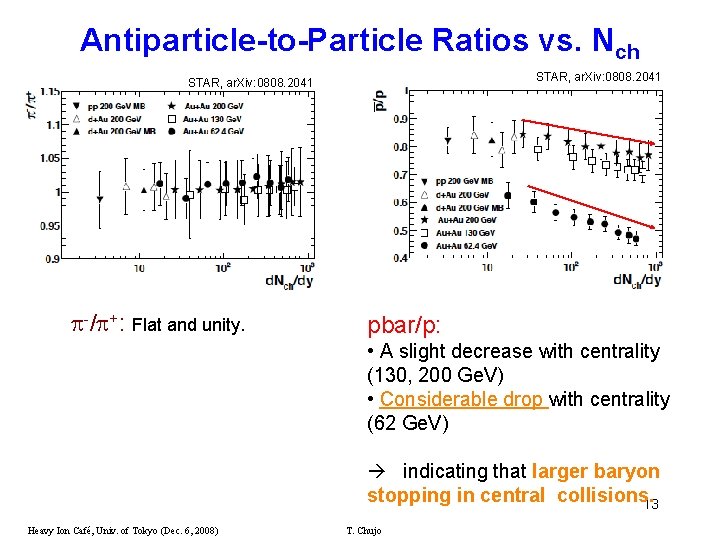
Antiparticle-to-Particle Ratios vs. Nch STAR, ar. Xiv: 0808. 2041 -/ +: Flat and unity. pbar/p: • A slight decrease with centrality (130, 200 Ge. V) • Considerable drop with centrality (62 Ge. V) indicating that larger baryon stopping in central collisions. 13 Heavy Ion Café, Univ. of Tokyo (Dec. 6, 2008) T. Chujo
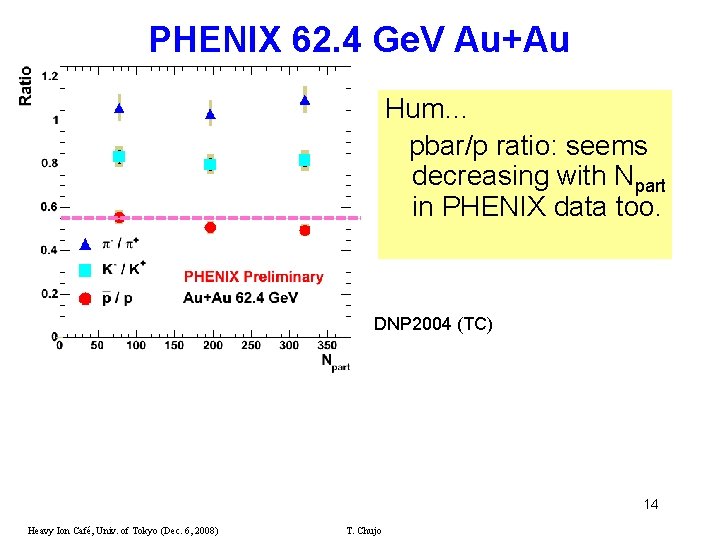
PHENIX 62. 4 Ge. V Au+Au Hum… pbar/p ratio: seems decreasing with Npart in PHENIX data too. DNP 2004 (TC) 14 Heavy Ion Café, Univ. of Tokyo (Dec. 6, 2008) T. Chujo
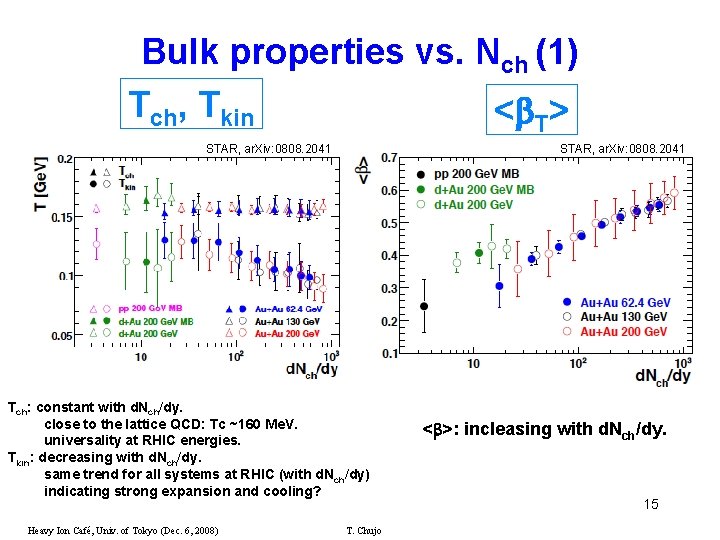
Bulk properties vs. Nch (1) Tch, Tkin <b. T> STAR, ar. Xiv: 0808. 2041 Tch: constant with d. Nch/dy. close to the lattice QCD: Tc ~160 Me. V. universality at RHIC energies. Tkin: decreasing with d. Nch/dy. same trend for all systems at RHIC (with d. Nch/dy) indicating strong expansion and cooling? Heavy Ion Café, Univ. of Tokyo (Dec. 6, 2008) T. Chujo <b>: incleasing with d. Nch/dy. 15
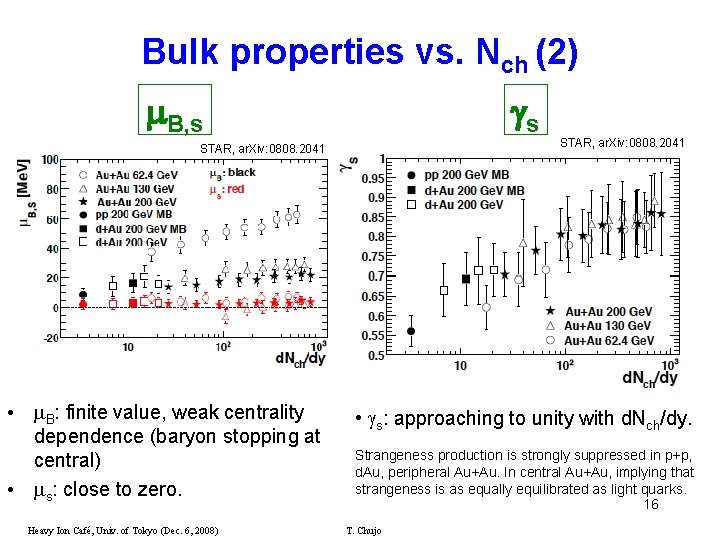
Bulk properties vs. Nch (2) m. B, s gs STAR, ar. Xiv: 0808. 2041 • m. B: finite value, weak centrality dependence (baryon stopping at central) • ms: close to zero. Heavy Ion Café, Univ. of Tokyo (Dec. 6, 2008) STAR, ar. Xiv: 0808. 2041 • gs: approaching to unity with d. Nch/dy. Strangeness production is strongly suppressed in p+p, d. Au, peripheral Au+Au. In central Au+Au, implying that strangeness is as equally equilibrated as light quarks. 16 T. Chujo
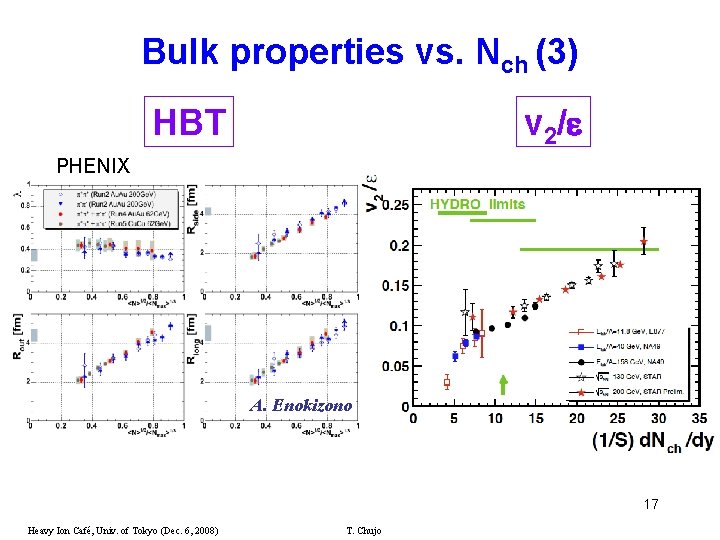
Bulk properties vs. Nch (3) HBT v 2/e PHENIX A. Enokizono 17 Heavy Ion Café, Univ. of Tokyo (Dec. 6, 2008) T. Chujo
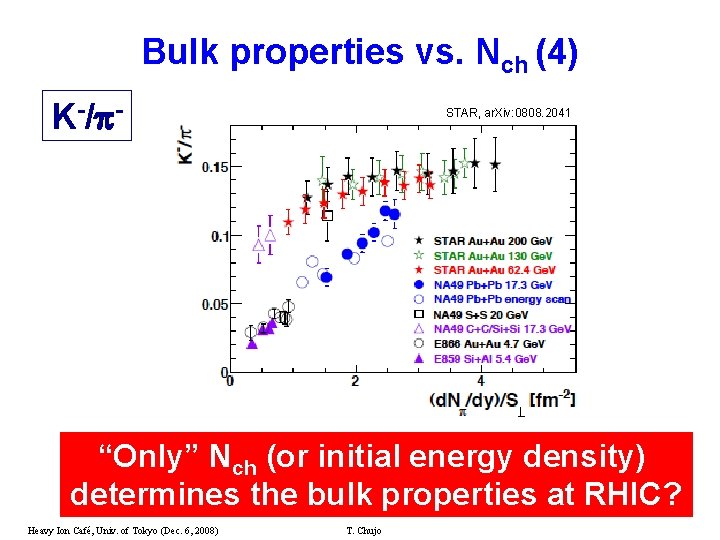
Bulk properties vs. Nch (4) K-/ - STAR, ar. Xiv: 0808. 2041 “Only” Nch (or initial energy density) determines the bulk properties at RHIC? 18 Heavy Ion Café, Univ. of Tokyo (Dec. 6, 2008) T. Chujo
3. SYSTEMATIC STUDY OF BARYON ENHANCEMENT
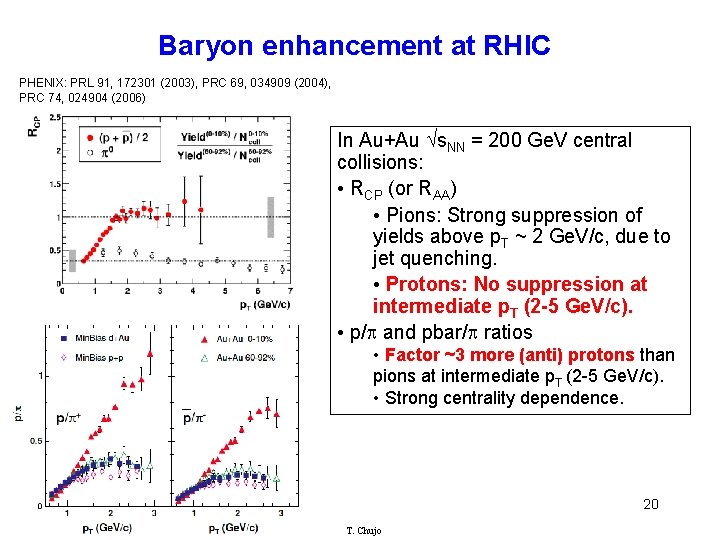
Baryon enhancement at RHIC PHENIX: PRL 91, 172301 (2003), PRC 69, 034909 (2004), PRC 74, 024904 (2006) In Au+Au s. NN = 200 Ge. V central collisions: • RCP (or RAA) • Pions: Strong suppression of yields above p. T ~ 2 Ge. V/c, due to jet quenching. • Protons: No suppression at intermediate p. T (2 -5 Ge. V/c). • p/ and pbar/ ratios • Factor ~3 more (anti) protons than pions at intermediate p. T (2 -5 Ge. V/c). • Strong centrality dependence. 20 Heavy Ion Café, Univ. of Tokyo (Dec. 6, 2008) T. Chujo
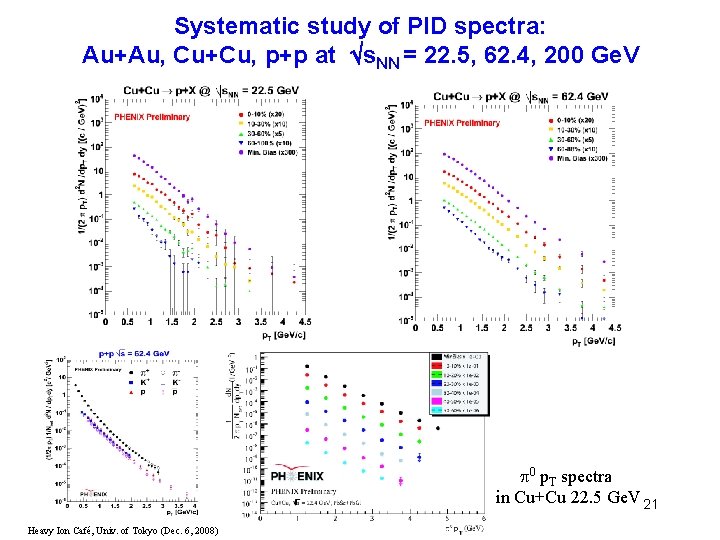
Systematic study of PID spectra: Au+Au, Cu+Cu, p+p at s. NN = 22. 5, 62. 4, 200 Ge. V 0 p. T spectra in Cu+Cu 22. 5 Ge. V 21 Heavy Ion Café, Univ. of Tokyo (Dec. 6, 2008) T. Chujo
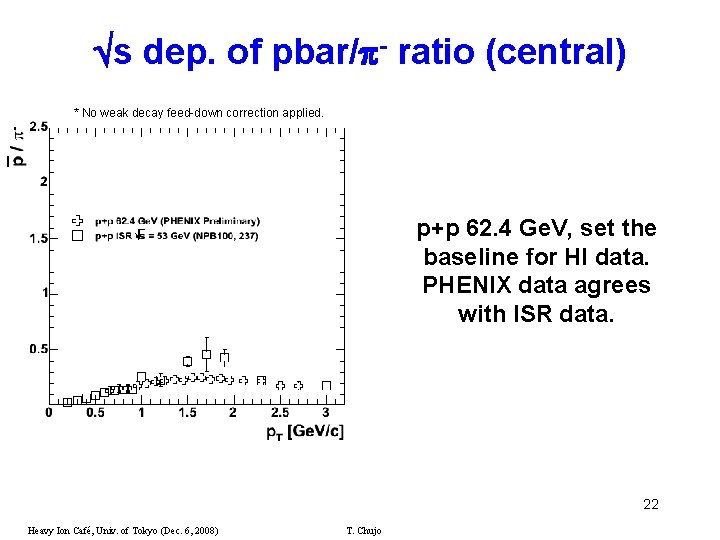
s dep. of pbar/ - ratio (central) * No weak decay feed-down correction applied. p+p 62. 4 Ge. V, set the baseline for HI data. PHENIX data agrees with ISR data. 22 Heavy Ion Café, Univ. of Tokyo (Dec. 6, 2008) T. Chujo
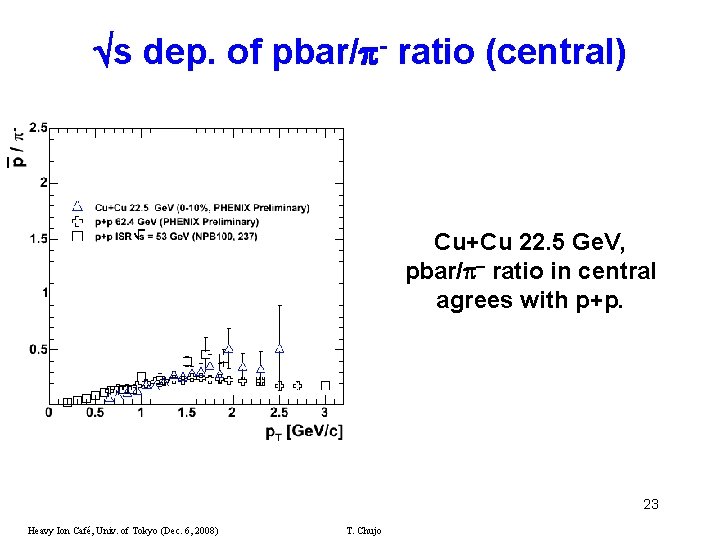
s dep. of pbar/ - ratio (central) Cu+Cu 22. 5 Ge. V, pbar/ ratio in central agrees with p+p. 23 Heavy Ion Café, Univ. of Tokyo (Dec. 6, 2008) T. Chujo
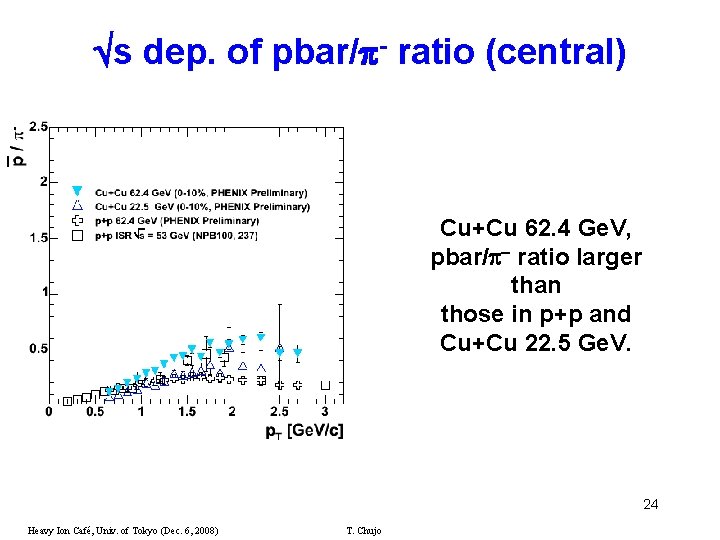
s dep. of pbar/ - ratio (central) Cu+Cu 62. 4 Ge. V, pbar/ ratio larger than those in p+p and Cu+Cu 22. 5 Ge. V. 24 Heavy Ion Café, Univ. of Tokyo (Dec. 6, 2008) T. Chujo
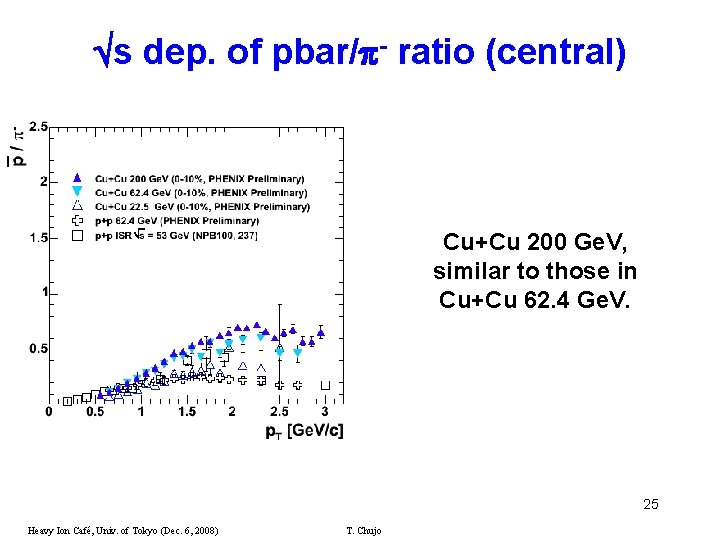
s dep. of pbar/ - ratio (central) Cu+Cu 200 Ge. V, similar to those in Cu+Cu 62. 4 Ge. V. 25 Heavy Ion Café, Univ. of Tokyo (Dec. 6, 2008) T. Chujo
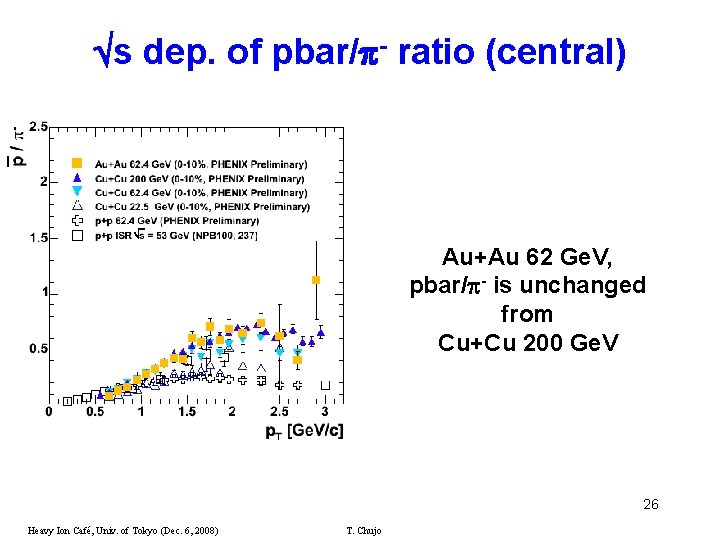
s dep. of pbar/ - ratio (central) Au+Au 62 Ge. V, pbar/ - is unchanged from Cu+Cu 200 Ge. V 26 Heavy Ion Café, Univ. of Tokyo (Dec. 6, 2008) T. Chujo
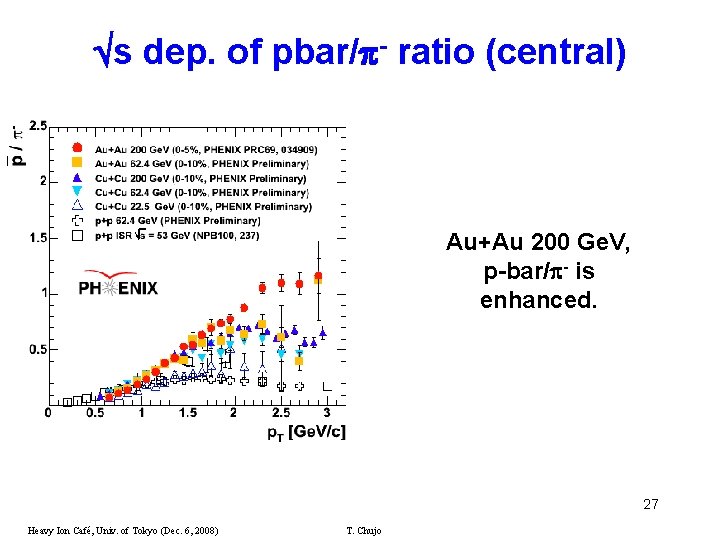
s dep. of pbar/ - ratio (central) Au+Au 200 Ge. V, p-bar/ - is enhanced. 27 Heavy Ion Café, Univ. of Tokyo (Dec. 6, 2008) T. Chujo
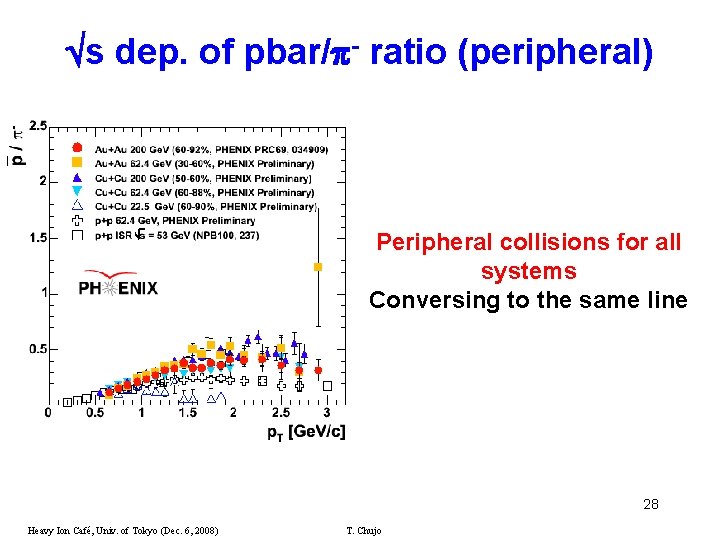
s dep. of pbar/ - ratio (peripheral) Peripheral collisions for all systems Conversing to the same line 28 Heavy Ion Café, Univ. of Tokyo (Dec. 6, 2008) T. Chujo
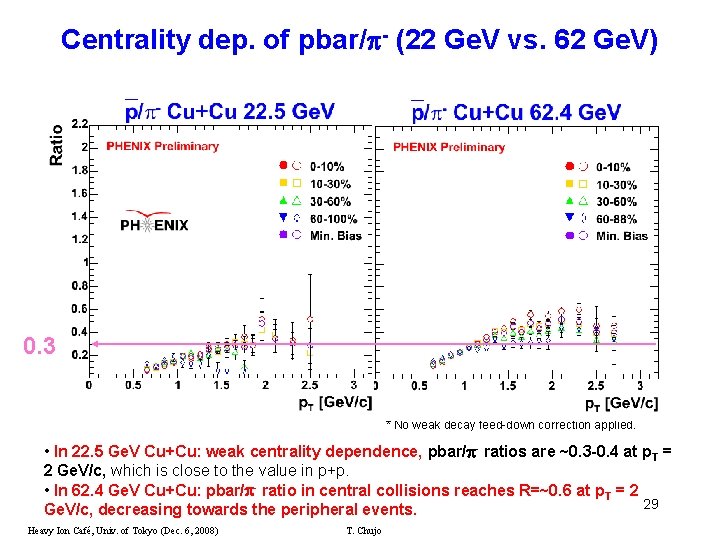
Centrality dep. of pbar/ - (22 Ge. V vs. 62 Ge. V) 0. 3 * No weak decay feed-down correction applied. • In 22. 5 Ge. V Cu+Cu: weak centrality dependence, pbar/ - ratios are ~0. 3 -0. 4 at p. T = 2 Ge. V/c, which is close to the value in p+p. • In 62. 4 Ge. V Cu+Cu: pbar/ - ratio in central collisions reaches R=~0. 6 at p. T = 2 29 Ge. V/c, decreasing towards the peripheral events. Heavy Ion Café, Univ. of Tokyo (Dec. 6, 2008) T. Chujo
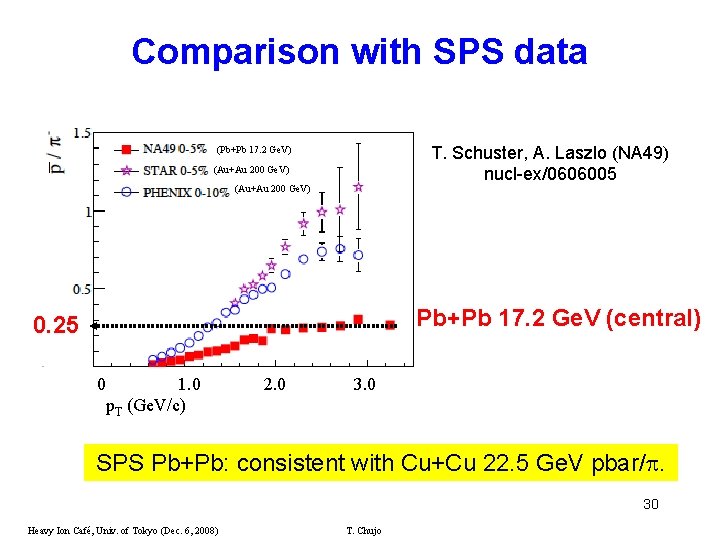
Comparison with SPS data T. Schuster, A. Laszlo (NA 49) nucl-ex/0606005 (Pb+Pb 17. 2 Ge. V) (Au+Au 200 Ge. V) Pb+Pb 17. 2 Ge. V (central) 0. 25 0 1. 0 p. T (Ge. V/c) 2. 0 3. 0 SPS Pb+Pb: consistent with Cu+Cu 22. 5 Ge. V pbar/. 30 Heavy Ion Café, Univ. of Tokyo (Dec. 6, 2008) T. Chujo
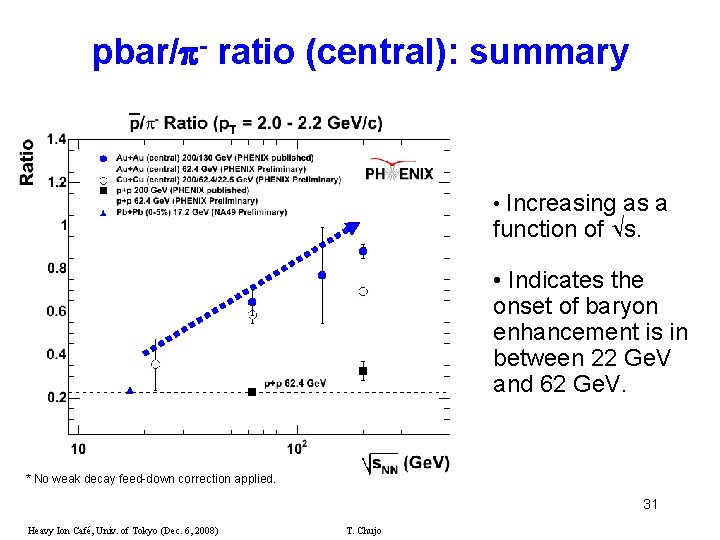
pbar/ - ratio (central): summary • Increasing as a function of s. • Indicates the onset of baryon enhancement is in between 22 Ge. V and 62 Ge. V. * No weak decay feed-down correction applied. 31 Heavy Ion Café, Univ. of Tokyo (Dec. 6, 2008) T. Chujo
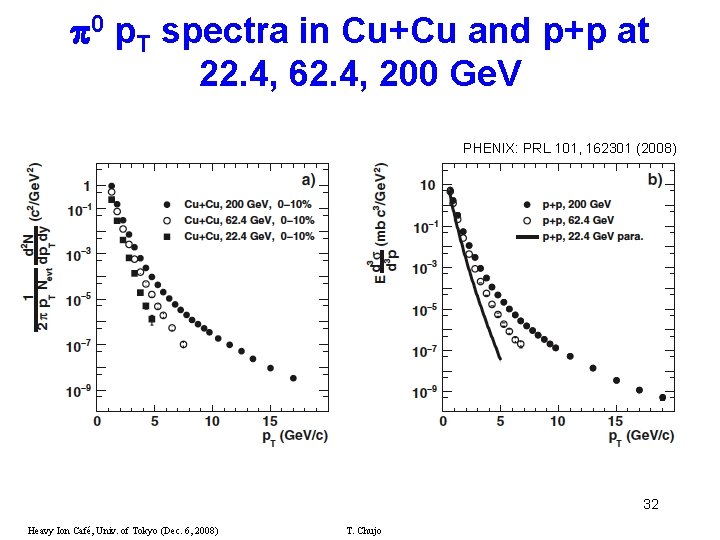
0 p. T spectra in Cu+Cu and p+p at 22. 4, 62. 4, 200 Ge. V PHENIX: PRL 101, 162301 (2008) 32 Heavy Ion Café, Univ. of Tokyo (Dec. 6, 2008) T. Chujo
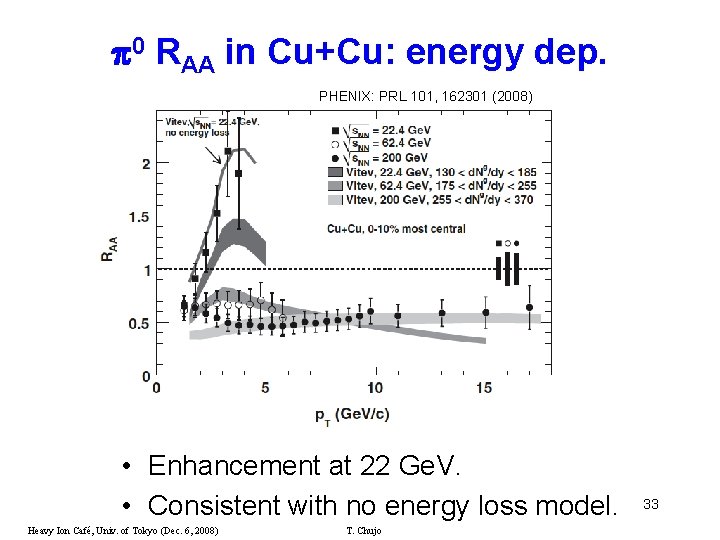
0 RAA in Cu+Cu: energy dep. PHENIX: PRL 101, 162301 (2008) • Enhancement at 22 Ge. V. • Consistent with no energy loss model. Heavy Ion Café, Univ. of Tokyo (Dec. 6, 2008) T. Chujo 33
4. WHAT’S THE ORIGIN OF BARYON ENHANCEMENT? 34 Heavy Ion Café, Univ. of Tokyo (Dec. 6, 2008) T. Chujo
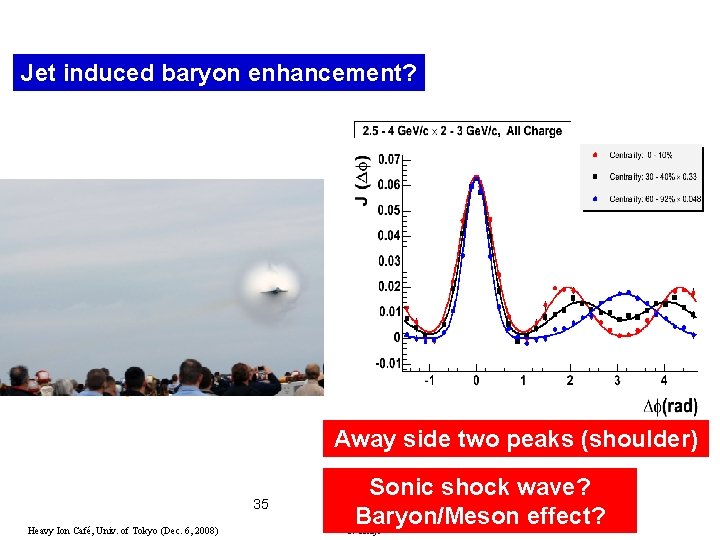
Jet induced baryon enhancement? Away side Near side Away side two peaks (shoulder) 35 Heavy Ion Café, Univ. of Tokyo (Dec. 6, 2008) Sonic shock wave? Baryon/Meson effect? T. Chujo
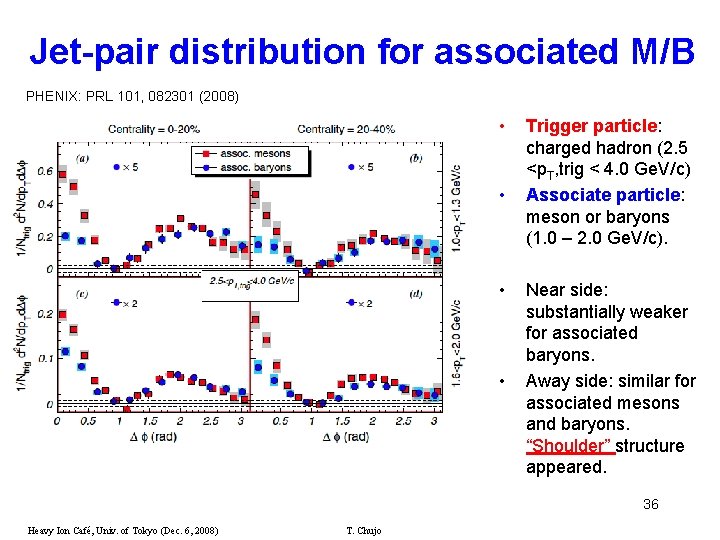
Jet-pair distribution for associated M/B PHENIX: PRL 101, 082301 (2008) • • Trigger particle: charged hadron (2. 5 <p. T, trig < 4. 0 Ge. V/c) Associate particle: meson or baryons (1. 0 – 2. 0 Ge. V/c). Near side: substantially weaker for associated baryons. Away side: similar for associated mesons and baryons. “Shoulder” structure appeared. 36 Heavy Ion Café, Univ. of Tokyo (Dec. 6, 2008) T. Chujo
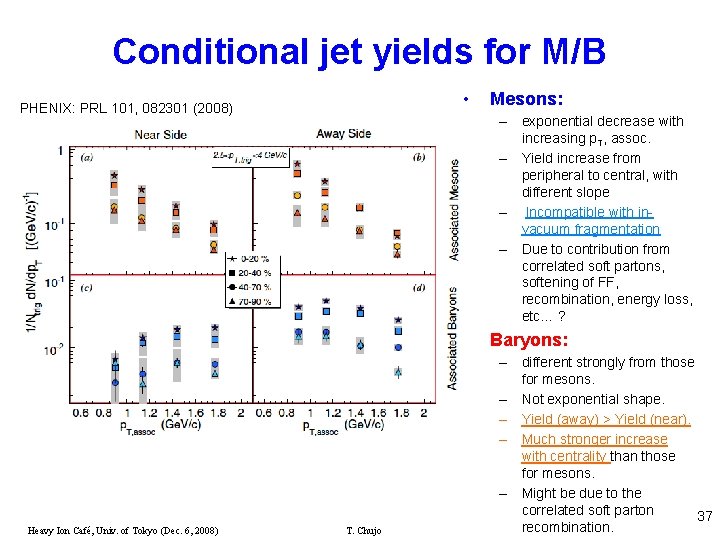
Conditional jet yields for M/B • PHENIX: PRL 101, 082301 (2008) – exponential decrease with increasing p. T, assoc. – Yield increase from peripheral to central, with different slope – Incompatible with invacuum fragmentation – Due to contribution from correlated soft partons, softening of FF, recombination, energy loss, etc… ? • Heavy Ion Café, Univ. of Tokyo (Dec. 6, 2008) Mesons: T. Chujo Baryons: – different strongly from those for mesons. – Not exponential shape. – Yield (away) > Yield (near). – Much stronger increase with centrality than those for mesons. – Might be due to the correlated soft parton 37 recombination.
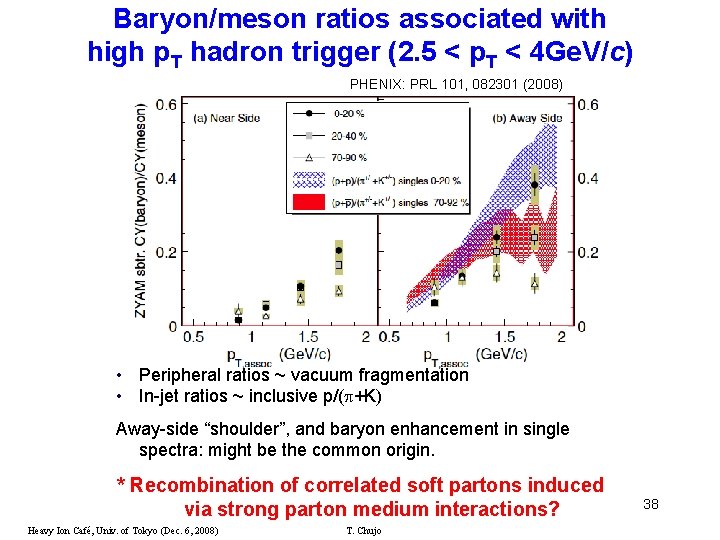
Baryon/meson ratios associated with high p. T hadron trigger (2. 5 < p. T < 4 Ge. V/c) PHENIX: PRL 101, 082301 (2008) • Peripheral ratios ~ vacuum fragmentation • In-jet ratios ~ inclusive p/( +K) Away-side “shoulder”, and baryon enhancement in single spectra: might be the common origin. * Recombination of correlated soft partons induced via strong parton medium interactions? Heavy Ion Café, Univ. of Tokyo (Dec. 6, 2008) T. Chujo 38
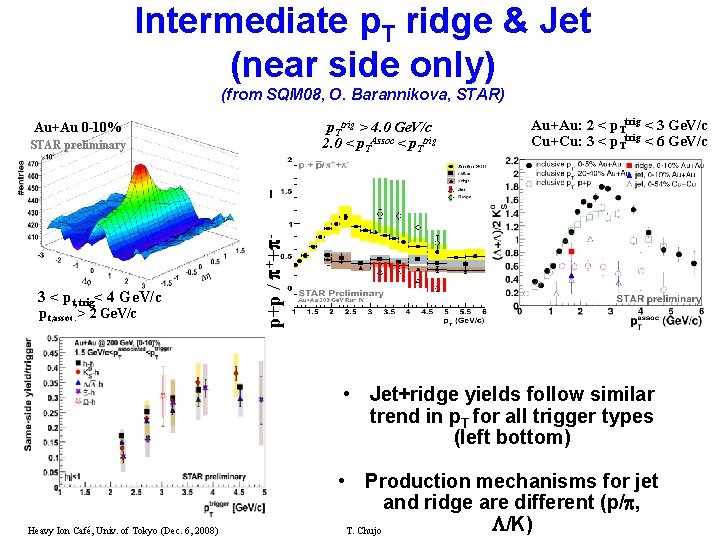
Intermediate p. T ridge & Jet (near side only) (from SQM 08, O. Barannikova, STAR) p. Ttrig > 4. 0 Ge. V/c 2. 0 < p. TAssoc < p. Ttrig Au+Au 0 -10% 3 < pt, trig< 4 Ge. V/c pt, assoc. > 2 Ge. V/c p+p / ++ - STAR preliminary Au+Au: 2 < p. Ttrig < 3 Ge. V/c Cu+Cu: 3 < p. Ttrig < 6 Ge. V/c • Jet+ridge yields follow similar trend in p. T for all trigger types (left bottom) Heavy Ion Café, Univ. of Tokyo (Dec. 6, 2008) • Production mechanisms for jet and ridge are different (p/ , L/K) T. Chujo
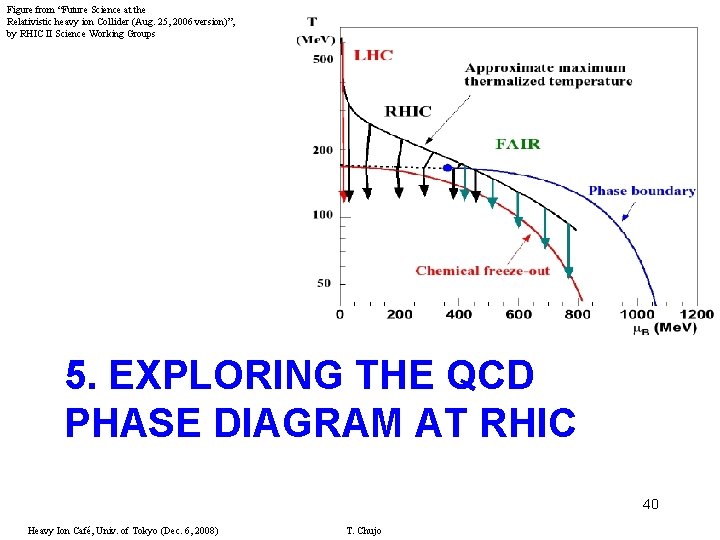
Figure from “Future Science at the Relativistic heavy ion Collider (Aug. 25, 2006 version)”, by RHIC II Science Working Groups 5. EXPLORING THE QCD PHASE DIAGRAM AT RHIC 40 Heavy Ion Café, Univ. of Tokyo (Dec. 6, 2008) T. Chujo
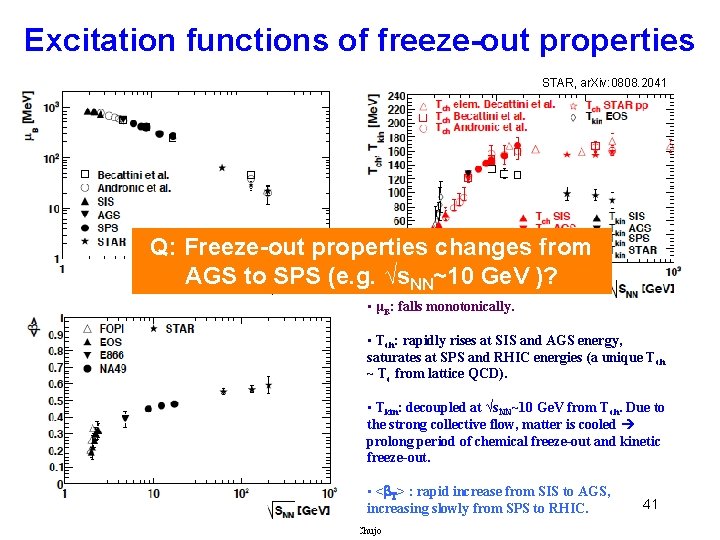
Excitation functions of freeze-out properties STAR, ar. Xiv: 0808. 2041 Q: Freeze-out properties changes from AGS to SPS (e. g. √s. NN~10 Ge. V )? • μB: falls monotonically. • Tch: rapidly rises at SIS and AGS energy, saturates at SPS and RHIC energies (a unique Tch ~ Tc from lattice QCD). • Tkin: decoupled at √s. NN~10 Ge. V from Tch. Due to the strong collective flow, matter is cooled prolong period of chemical freeze-out and kinetic freeze-out. • <b. T> : rapid increase from SIS to AGS, increasing slowly from SPS to RHIC. Heavy Ion Café, Univ. of Tokyo (Dec. 6, 2008) T. Chujo 41
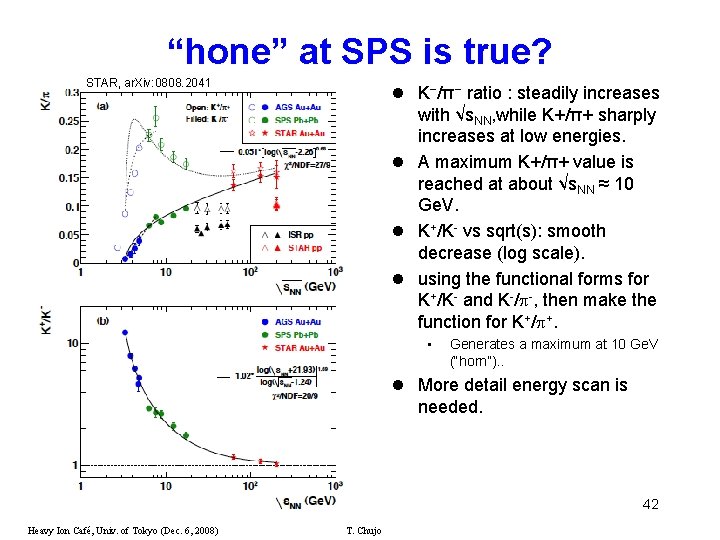
“hone” at SPS is true? STAR, ar. Xiv: 0808. 2041 l K−/π− ratio : steadily increases with √s. NN, while K+/π+ sharply increases at low energies. l A maximum K+/π+ value is reached at about √s. NN ≈ 10 Ge. V. l K+/K- vs sqrt(s): smooth decrease (log scale). l using the functional forms for K+/K- and K-/ -, then make the function for K+/ +. • Generates a maximum at 10 Ge. V (“horn”). . l More detail energy scan is needed. 42 Heavy Ion Café, Univ. of Tokyo (Dec. 6, 2008) T. Chujo
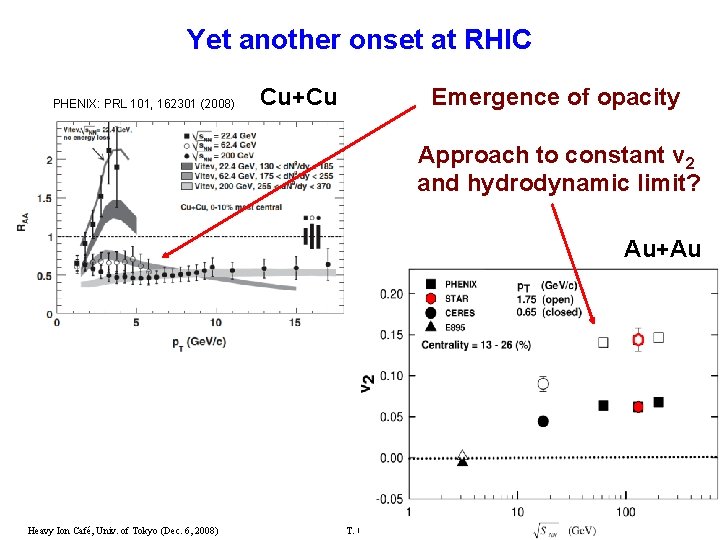
Yet another onset at RHIC PHENIX: PRL 101, 162301 (2008) Emergence of opacity Cu+Cu Approach to constant v 2 and hydrodynamic limit? Au+Au Heavy Ion Café, Univ. of Tokyo (Dec. 6, 2008) T. Chujo
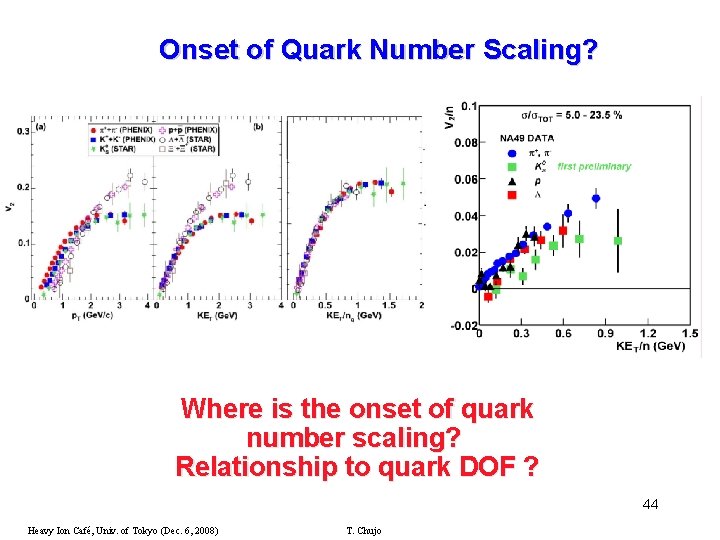
Onset of Quark Number Scaling? Where is the onset of quark number scaling? Relationship to quark DOF ? 44 Heavy Ion Café, Univ. of Tokyo (Dec. 6, 2008) T. Chujo
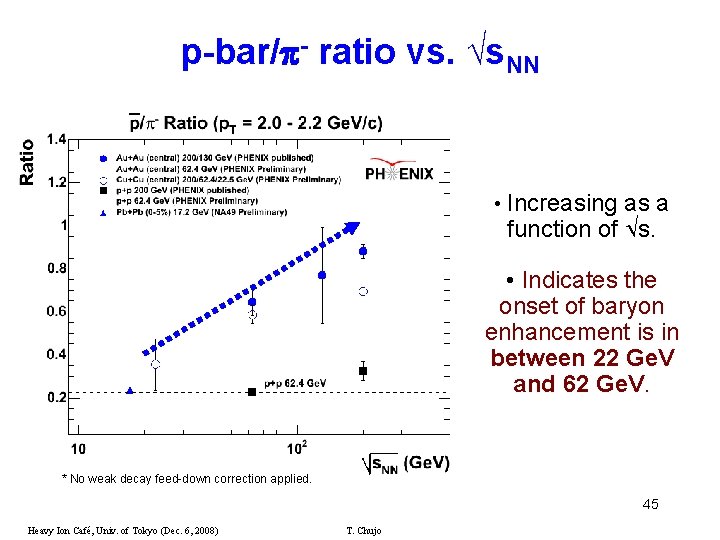
p-bar/ - ratio vs. √s. NN • Increasing as a function of s. • Indicates the onset of baryon enhancement is in between 22 Ge. V and 62 Ge. V. * No weak decay feed-down correction applied. 45 Heavy Ion Café, Univ. of Tokyo (Dec. 6, 2008) T. Chujo
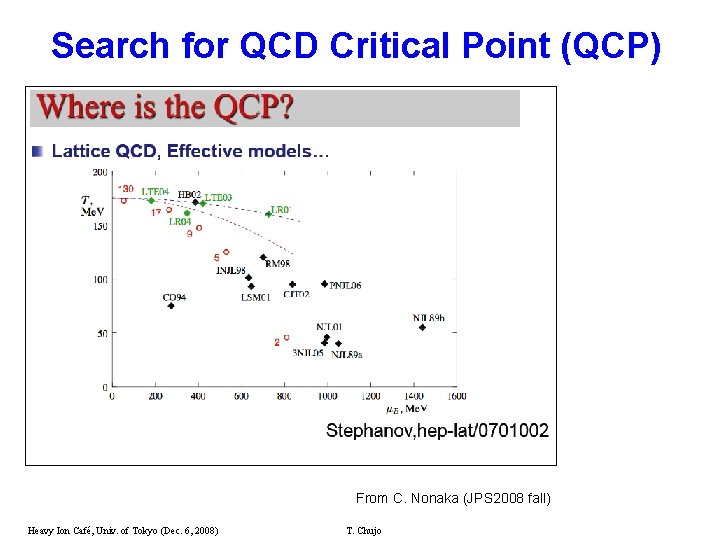
Search for QCD Critical Point (QCP) From C. Nonaka (JPS 2008 fall) Heavy Ion Café, Univ. of Tokyo (Dec. 6, 2008) T. Chujo
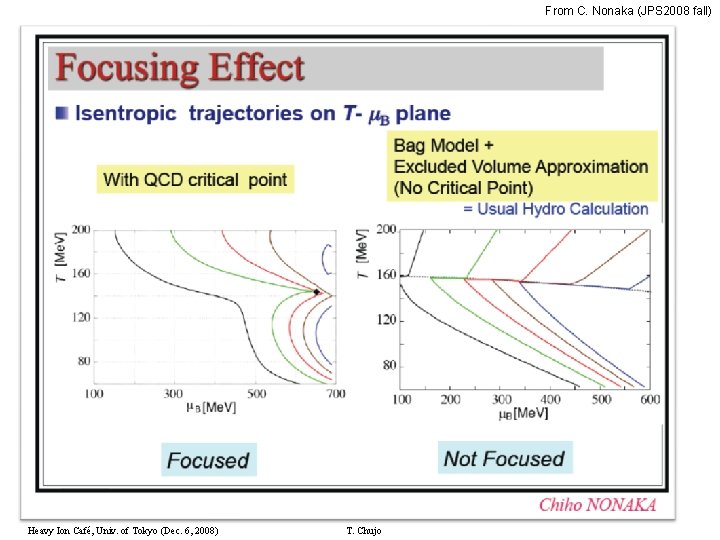
From C. Nonaka (JPS 2008 fall) 47 Heavy Ion Café, Univ. of Tokyo (Dec. 6, 2008) T. Chujo
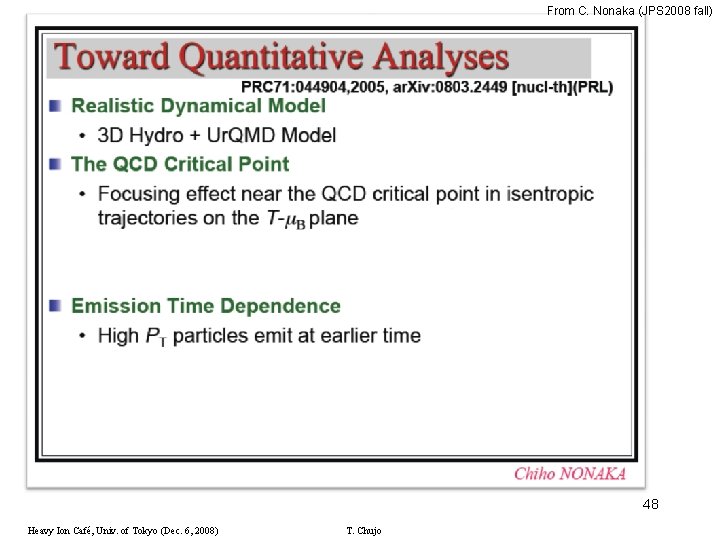
From C. Nonaka (JPS 2008 fall) 48 Heavy Ion Café, Univ. of Tokyo (Dec. 6, 2008) T. Chujo
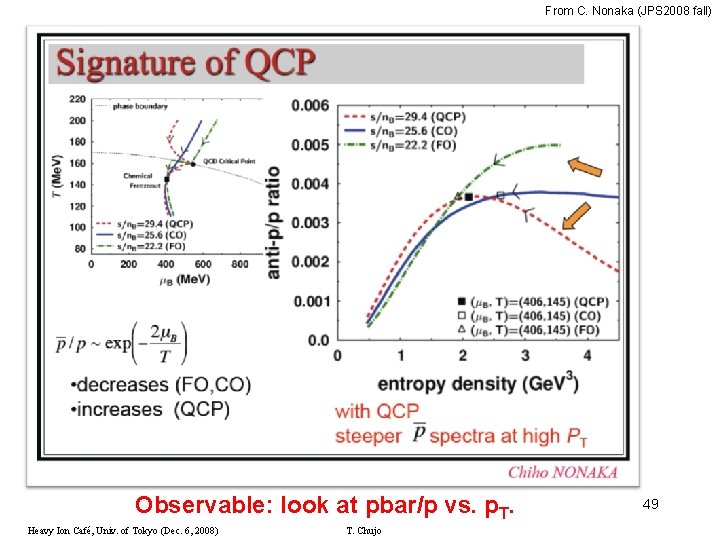
From C. Nonaka (JPS 2008 fall) Observable: look at pbar/p vs. p. T. Heavy Ion Café, Univ. of Tokyo (Dec. 6, 2008) T. Chujo 49
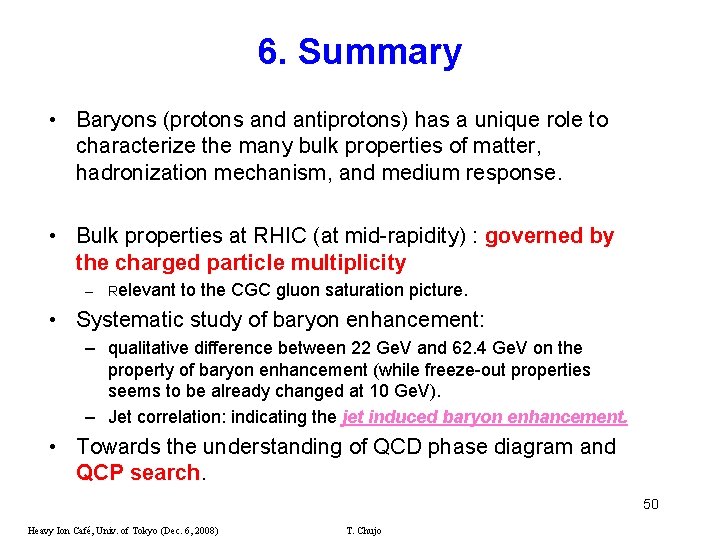
6. Summary • Baryons (protons and antiprotons) has a unique role to characterize the many bulk properties of matter, hadronization mechanism, and medium response. • Bulk properties at RHIC (at mid-rapidity) : governed by the charged particle multiplicity – Relevant to the CGC gluon saturation picture. • Systematic study of baryon enhancement: – qualitative difference between 22 Ge. V and 62. 4 Ge. V on the property of baryon enhancement (while freeze-out properties seems to be already changed at 10 Ge. V). – Jet correlation: indicating the jet induced baryon enhancement. • Towards the understanding of QCD phase diagram and QCP search. 50 Heavy Ion Café, Univ. of Tokyo (Dec. 6, 2008) T. Chujo
Backup Slides 51 Heavy Ion Café, Univ. of Tokyo (Dec. 6, 2008) T. Chujo
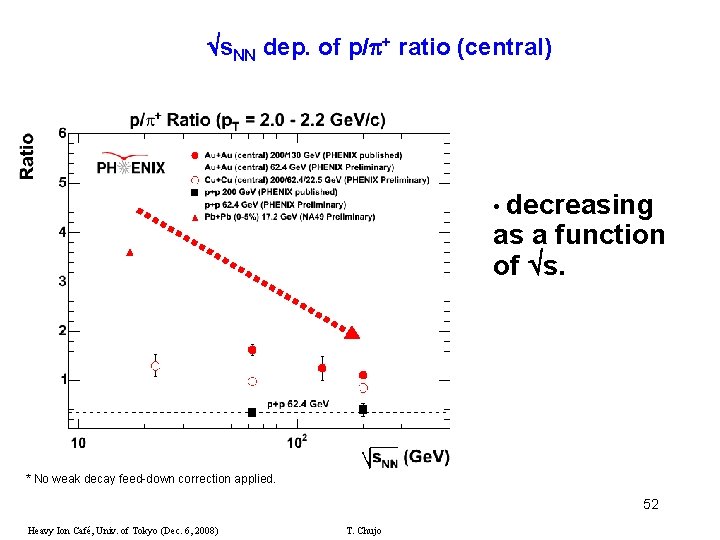
s. NN dep. of p/ + ratio (central) • decreasing as a function of s. * No weak decay feed-down correction applied. 52 Heavy Ion Café, Univ. of Tokyo (Dec. 6, 2008) T. Chujo
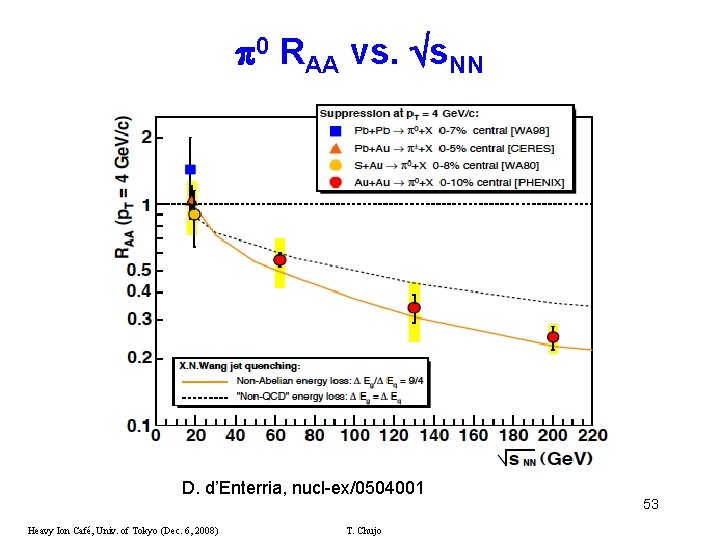
0 RAA vs. s. NN D. d’Enterria, nucl-ex/0504001 Heavy Ion Café, Univ. of Tokyo (Dec. 6, 2008) T. Chujo 53
54 Heavy Ion Café, Univ. of Tokyo (Dec. 6, 2008) T. Chujo
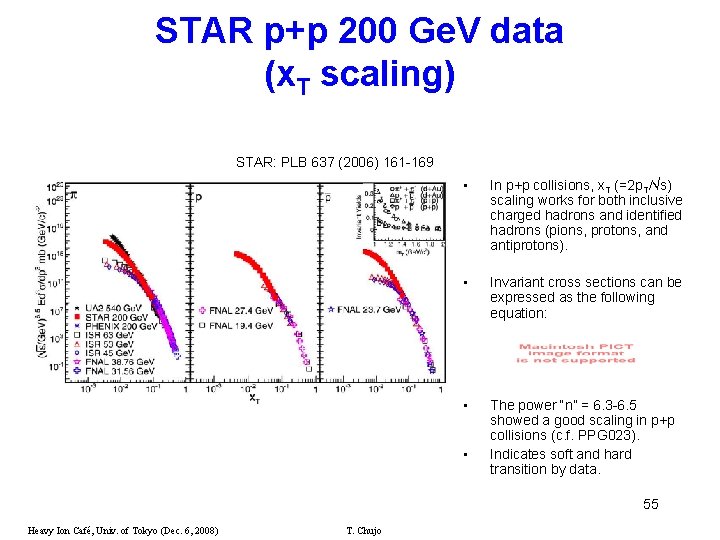
STAR p+p 200 Ge. V data (x. T scaling) STAR: PLB 637 (2006) 161 -169 • In p+p collisions, x. T (=2 p. T/ s) scaling works for both inclusive charged hadrons and identified hadrons (pions, protons, and antiprotons). • Invariant cross sections can be expressed as the following equation: • The power “n” = 6. 3 -6. 5 showed a good scaling in p+p collisions (c. f. PPG 023). Indicates soft and hard transition by data. • 55 Heavy Ion Café, Univ. of Tokyo (Dec. 6, 2008) T. Chujo
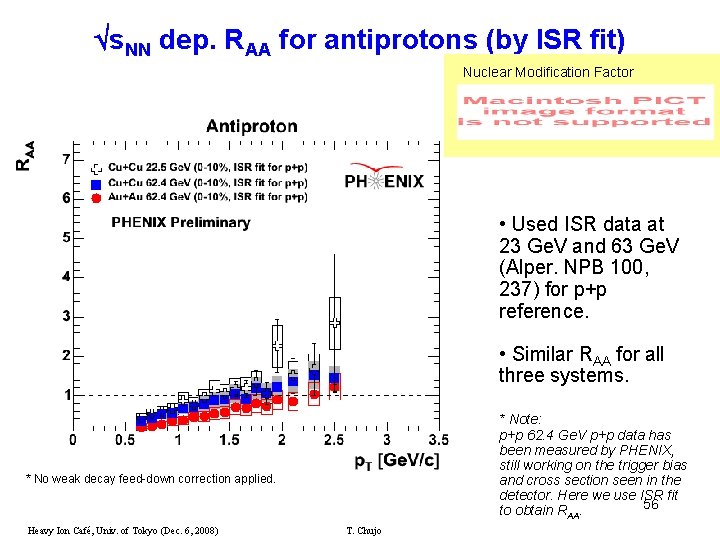
s. NN dep. RAA for antiprotons (by ISR fit) Nuclear Modification Factor • Used ISR data at 23 Ge. V and 63 Ge. V (Alper. NPB 100, 237) for p+p reference. • Similar RAA for all three systems. * Note: p+p 62. 4 Ge. V p+p data has been measured by PHENIX, still working on the trigger bias and cross section seen in the detector. Here we use ISR fit 56 to obtain RAA. * No weak decay feed-down correction applied. Heavy Ion Café, Univ. of Tokyo (Dec. 6, 2008) T. Chujo
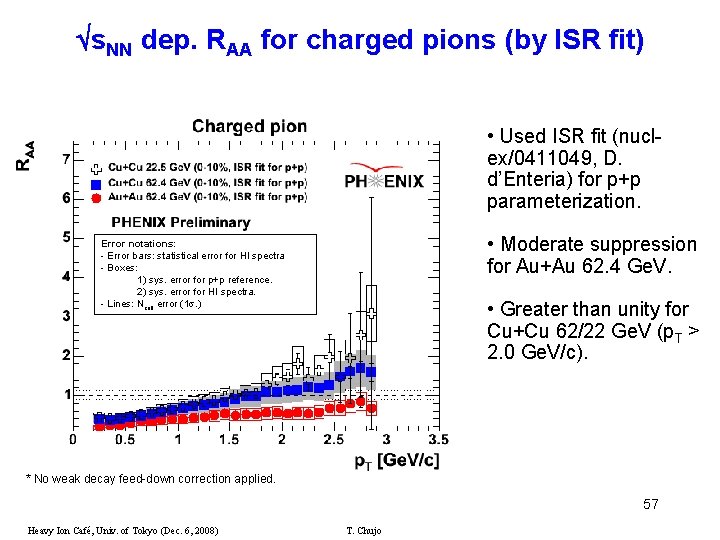
s. NN dep. RAA for charged pions (by ISR fit) • Used ISR fit (nuclex/0411049, D. d’Enteria) for p+p parameterization. • Moderate suppression for Au+Au 62. 4 Ge. V. Error notations: - Error bars: statistical error for HI spectra - Boxes: 1) sys. error for p+p reference. 2) sys. error for HI spectra. - Lines: Ncoll error (1. ) • Greater than unity for Cu+Cu 62/22 Ge. V (p. T > 2. 0 Ge. V/c). * No weak decay feed-down correction applied. 57 Heavy Ion Café, Univ. of Tokyo (Dec. 6, 2008) T. Chujo
- Slides: 57