
Proving compost heat recovery can be used to
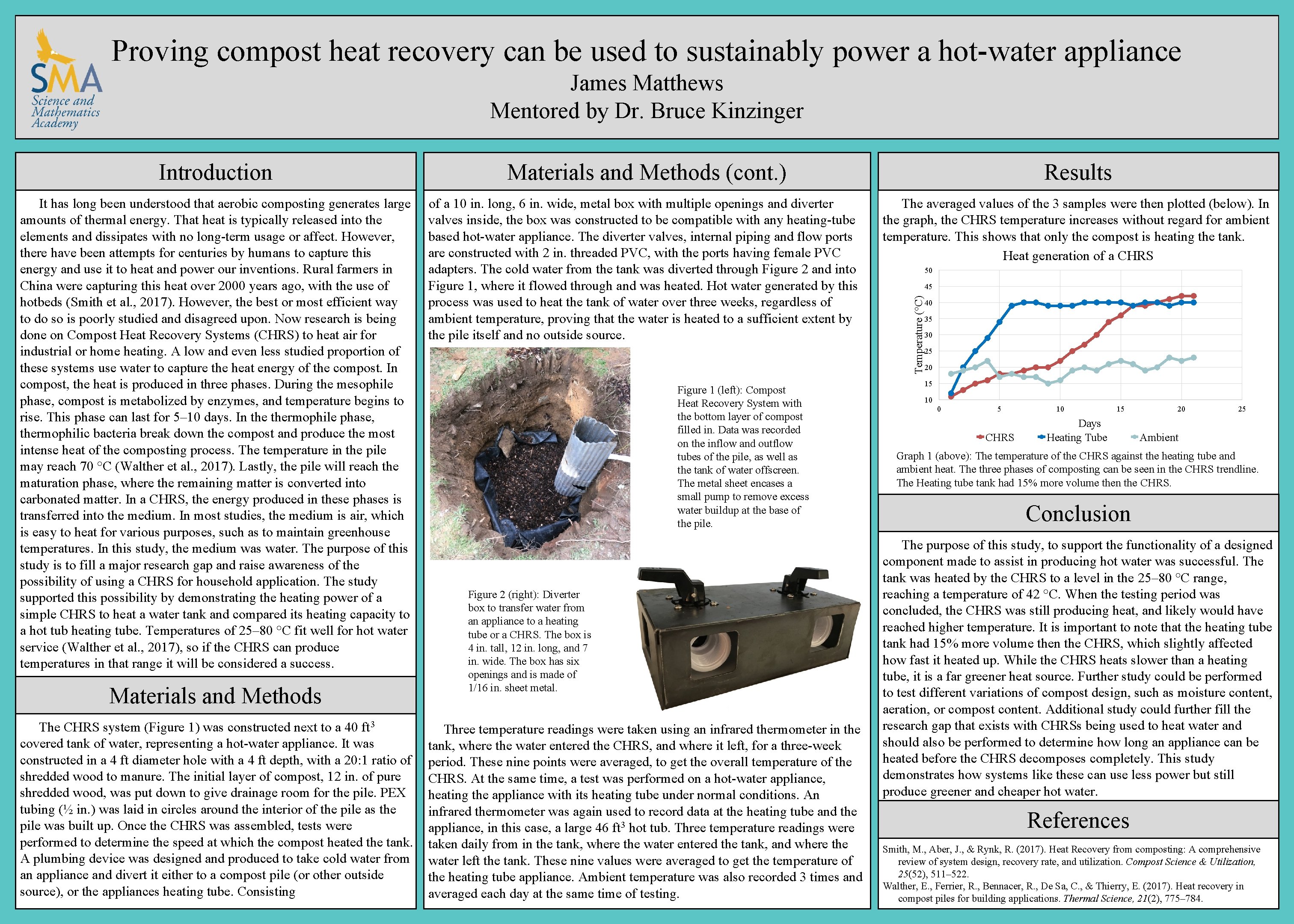
Proving compost heat recovery can be used to sustainably power a hot-water appliance James Matthews Mentored by Dr. Bruce Kinzinger Introduction Materials and Methods (cont. ) Results It has long been understood that aerobic composting generates large amounts of thermal energy. That heat is typically released into the elements and dissipates with no long-term usage or affect. However, there have been attempts for centuries by humans to capture this energy and use it to heat and power our inventions. Rural farmers in China were capturing this heat over 2000 years ago, with the use of hotbeds (Smith et al. , 2017). However, the best or most efficient way to do so is poorly studied and disagreed upon. Now research is being done on Compost Heat Recovery Systems (CHRS) to heat air for industrial or home heating. A low and even less studied proportion of these systems use water to capture the heat energy of the compost. In compost, the heat is produced in three phases. During the mesophile phase, compost is metabolized by enzymes, and temperature begins to rise. This phase can last for 5– 10 days. In thermophile phase, thermophilic bacteria break down the compost and produce the most intense heat of the composting process. The temperature in the pile may reach 70 °C (Walther et al. , 2017). Lastly, the pile will reach the maturation phase, where the remaining matter is converted into carbonated matter. In a CHRS, the energy produced in these phases is transferred into the medium. In most studies, the medium is air, which is easy to heat for various purposes, such as to maintain greenhouse temperatures. In this study, the medium was water. The purpose of this study is to fill a major research gap and raise awareness of the possibility of using a CHRS for household application. The study supported this possibility by demonstrating the heating power of a simple CHRS to heat a water tank and compared its heating capacity to a hot tub heating tube. Temperatures of 25– 80 °C fit well for hot water service (Walther et al. , 2017), so if the CHRS can produce temperatures in that range it will be considered a success. of a 10 in. long, 6 in. wide, metal box with multiple openings and diverter valves inside, the box was constructed to be compatible with any heating-tube based hot-water appliance. The diverter valves, internal piping and flow ports are constructed with 2 in. threaded PVC, with the ports having female PVC adapters. The cold water from the tank was diverted through Figure 2 and into Figure 1, where it flowed through and was heated. Hot water generated by this process was used to heat the tank of water over three weeks, regardless of ambient temperature, proving that the water is heated to a sufficient extent by the pile itself and no outside source. The averaged values of the 3 samples were then plotted (below). In the graph, the CHRS temperature increases without regard for ambient temperature. This shows that only the compost is heating the tank. Heat generation of a CHRS Materials and Methods The CHRS system (Figure 1) was constructed next to a 40 ft 3 covered tank of water, representing a hot-water appliance. It was constructed in a 4 ft diameter hole with a 4 ft depth, with a 20: 1 ratio of shredded wood to manure. The initial layer of compost, 12 in. of pure shredded wood, was put down to give drainage room for the pile. PEX tubing (½ in. ) was laid in circles around the interior of the pile as the pile was built up. Once the CHRS was assembled, tests were performed to determine the speed at which the compost heated the tank. A plumbing device was designed and produced to take cold water from an appliance and divert it either to a compost pile (or other outside source), or the appliances heating tube. Consisting Figure 1 (left): Compost Heat Recovery System with the bottom layer of compost filled in. Data was recorded on the inflow and outflow tubes of the pile, as well as the tank of water offscreen. The metal sheet encases a small pump to remove excess water buildup at the base of the pile. Figure 2 (right): Diverter box to transfer water from an appliance to a heating tube or a CHRS. The box is 4 in. tall, 12 in. long, and 7 in. wide. The box has six openings and is made of 1/16 in. sheet metal. Three temperature readings were taken using an infrared thermometer in the tank, where the water entered the CHRS, and where it left, for a three-week period. These nine points were averaged, to get the overall temperature of the CHRS. At the same time, a test was performed on a hot-water appliance, heating the appliance with its heating tube under normal conditions. An infrared thermometer was again used to record data at the heating tube and the appliance, in this case, a large 46 ft 3 hot tub. Three temperature readings were taken daily from in the tank, where the water entered the tank, and where the water left the tank. These nine values were averaged to get the temperature of the heating tube appliance. Ambient temperature was also recorded 3 times and averaged each day at the same time of testing. 50 Temperature (°C) 45 40 35 30 25 20 15 10 0 5 CHRS 10 15 Days Heating Tube 20 25 Ambient Graph 1 (above): The temperature of the CHRS against the heating tube and ambient heat. The three phases of composting can be seen in the CHRS trendline. The Heating tube tank had 15% more volume then the CHRS. Conclusion The purpose of this study, to support the functionality of a designed component made to assist in producing hot water was successful. The tank was heated by the CHRS to a level in the 25– 80 °C range, reaching a temperature of 42 °C. When the testing period was concluded, the CHRS was still producing heat, and likely would have reached higher temperature. It is important to note that the heating tube tank had 15% more volume then the CHRS, which slightly affected how fast it heated up. While the CHRS heats slower than a heating tube, it is a far greener heat source. Further study could be performed to test different variations of compost design, such as moisture content, aeration, or compost content. Additional study could further fill the research gap that exists with CHRSs being used to heat water and should also be performed to determine how long an appliance can be heated before the CHRS decomposes completely. This study demonstrates how systems like these can use less power but still produce greener and cheaper hot water. References Smith, M. , Aber, J. , & Rynk, R. (2017). Heat Recovery from composting: A comprehensive review of system design, recovery rate, and utilization. Compost Science & Utilization, 25(52), 511– 522. Walther, E. , Ferrier, R. , Bennacer, R. , De Sa, C. , & Thierry, E. (2017). Heat recovery in compost piles for building applications. Thermal Science, 21(2), 775– 784.
- Slides: 1