
Providing Care for people at End of Life

- Slides: 8
Providing Care for people at End of Life Caring for terminal patients & families Chapter 20
Class Exercise • https: //youtu. be/v 8 PMPv 2 ZPig
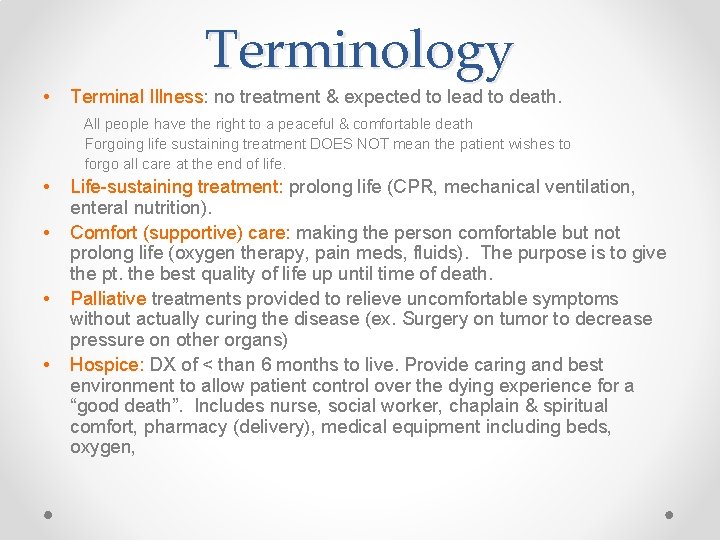
Terminology • Terminal Illness: no treatment & expected to lead to death. All people have the right to a peaceful & comfortable death Forgoing life sustaining treatment DOES NOT mean the patient wishes to forgo all care at the end of life. • • Life-sustaining treatment: prolong life (CPR, mechanical ventilation, enteral nutrition). Comfort (supportive) care: making the person comfortable but not prolong life (oxygen therapy, pain meds, fluids). The purpose is to give the pt. the best quality of life up until time of death. Palliative treatments provided to relieve uncomfortable symptoms without actually curing the disease (ex. Surgery on tumor to decrease pressure on other organs) Hospice: DX of < than 6 months to live. Provide caring and best environment to allow patient control over the dying experience for a “good death”. Includes nurse, social worker, chaplain & spiritual comfort, pharmacy (delivery), medical equipment including beds, oxygen,
Stages of Coping • Grief • Sadness • Fear • Anger • Denial • Hope • Acceptance • Pages 330 -331
Physical Support • • • Pain Shortness of breath Digestive problems Repositioning and good skin care Frequent mouth care Report any new problems (nausea, difficulty breathing) or plain that’s not working (pain med) • Create a comfortable environment (physically, emotionally, for patient & family members.
Signs of Approaching Death • • • Rapid, weak or irregular pulse Decreased blood pressure Cool moist and pale skin Coolness and mottling (patchy red/white discoloring) of the hands, feet & lower legs. Incontinence Periods of increased shallow breathing (may result toward end as Chyene-Stokes. A gargling sound with breathing (cause by increased fluid & mucus in airways) Loss of or a drifting in & out of consciousness (sleeping increases & majority of time) Loss of movement Loss of ability to communicate
Postmortem Care • Cleaning (washing) changing and positioning patient, due to bowel & bladder emptying when muscles relax. • Wrapped in a shroud (tags with patient name attached) • Rigor mortis: stiffening of the muscles of the body develops 6 -8 hours after death. • Discoloration of person’s skin, nail beds, & facial features get a sharp look as muscle, skin, and fluid no longer circulates but becomes limp and drawn inwards. • All belongings including teeth, glasses, hearing aids, prosthetic limbs/eyes etc. clothing, pictures, jewelry etc. are packed and labeled for coroner or family. • Family may want to come in for goodbyes, spending several hours with deceased—in this case we do no place in shroud until family has left. • Some family members (and ethnic traditions) wish do do the washing and dressing of the deceased.
Death & Dying • • https: //youtu. be/Ah. WE 4 y. MO 8 cc https: //youtu. be/sl. Sgr. Rl. PQww https: //youtu. be/w. WPOG_hxk. TE https: //youtu. be/n. Mr_sapdq. Y? list=PLZHd 4 SMmogu. ETNNSFOrqha 1 Gd. Vcts. ZKLk