
Providing ALL Students A 21 st Century Mathematics
- Slides: 30
Providing ALL Students A 21 st Century Mathematics Education
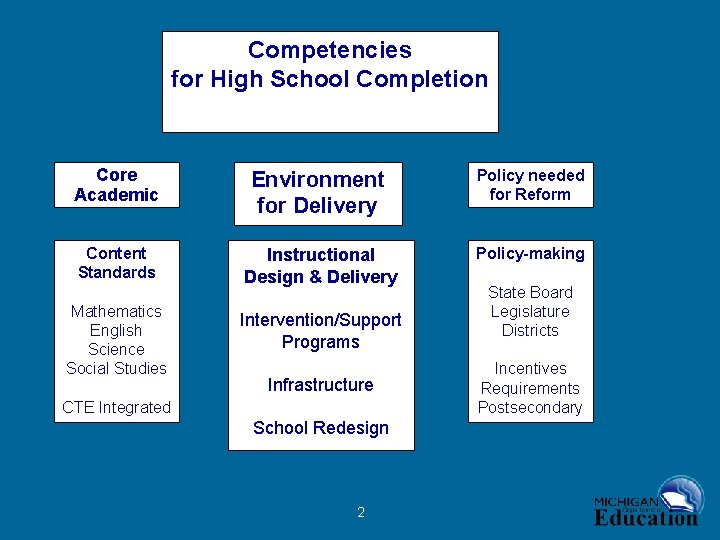
Competencies for High School Completion Core Academic Environment for Delivery Policy needed for Reform Content Standards Instructional Design & Delivery Policy-making Mathematics English Science Social Studies Intervention/Support Programs Infrastructure CTE Integrated School Redesign 2 State Board Legislature Districts Incentives Requirements Postsecondary
§ So how do we create an environment for delivering a 21 st century mathematics education for students? 3
Agenda § Content § Instruction § Assessment § Organization of content and instruction, or Is a PC necessary? 4
Content § The Michigan Merit Curriculum requirements for the first time provide: – Michigan schools with a common set of graduation requirements and – Teachers a common set of learning expectations. § A diploma means students learned the content required by the MMC. 5
Content § The mathematics HSCE=3 credits – Legislation says students need 4 mathematics credits not Algebra I &II, and Geometry credit § Credit is based on demonstrated proficiency with the content – Not seat time or course 6
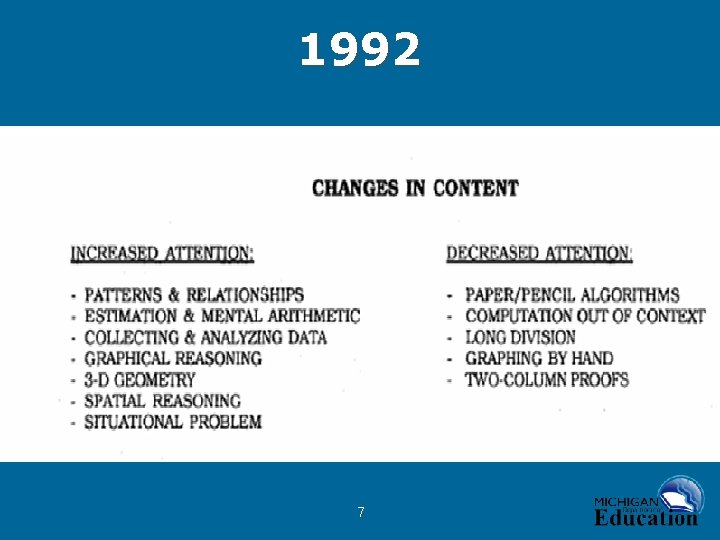
1992 7
Content – “Technological advances affect what us possible to learn, and what is necessary to learn” (High School Mathematics Content Expectations, pg. 2) 8
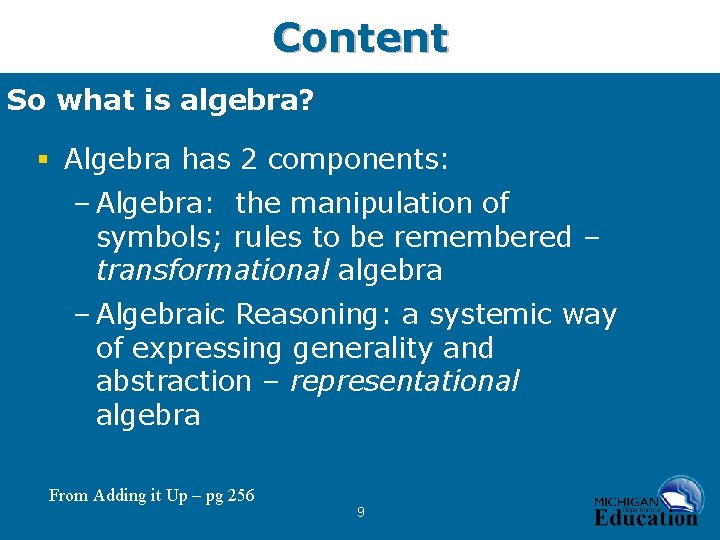
Content So what is algebra? § Algebra has 2 components: – Algebra: the manipulation of symbols; rules to be remembered – transformational algebra – Algebraic Reasoning: a systemic way of expressing generality and abstraction – representational algebra From Adding it Up – pg 256 9
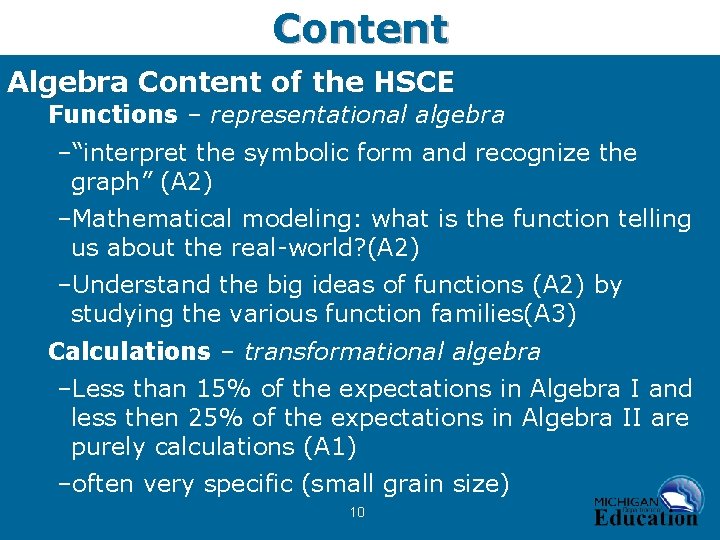
Content Algebra Content of the HSCE Functions – representational algebra –“interpret the symbolic form and recognize the graph” (A 2) –Mathematical modeling: what is the function telling us about the real-world? (A 2) –Understand the big ideas of functions (A 2) by studying the various function families(A 3) Calculations – transformational algebra –Less than 15% of the expectations in Algebra I and less then 25% of the expectations in Algebra II are purely calculations (A 1) –often very specific (small grain size) 10
ideas § Avoiding a PC § Insert stuff from NCTM regarding intervention for struggling students § More on technology § PD for teachers § Base this on the need to have students get a coherent differentiated curriculum § Grading and failing. 11
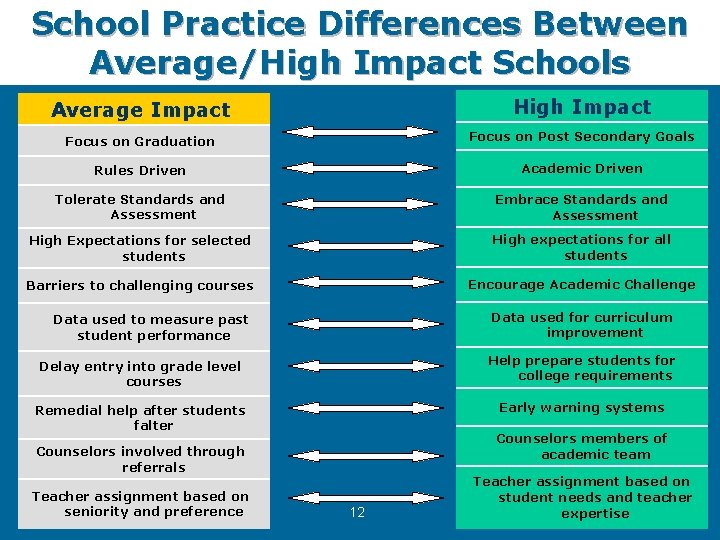
School Practice Differences Between Average/High Impact Schools Average Impact High Impact Focus on Graduation Focus on Post Secondary Goals Rules Driven Academic Driven Tolerate Standards and Assessment Embrace Standards and Assessment High Expectations for selected students High expectations for all students Barriers to challenging courses Encourage Academic Challenge Data used for curriculum improvement Data used to measure past student performance Delay entry into grade level courses Help prepare students for college requirements Remedial help after students falter Early warning systems Counselors members of academic team Counselors involved through referrals Teacher assignment based on seniority and preference 12 Teacher assignment based on student needs and teacher expertise
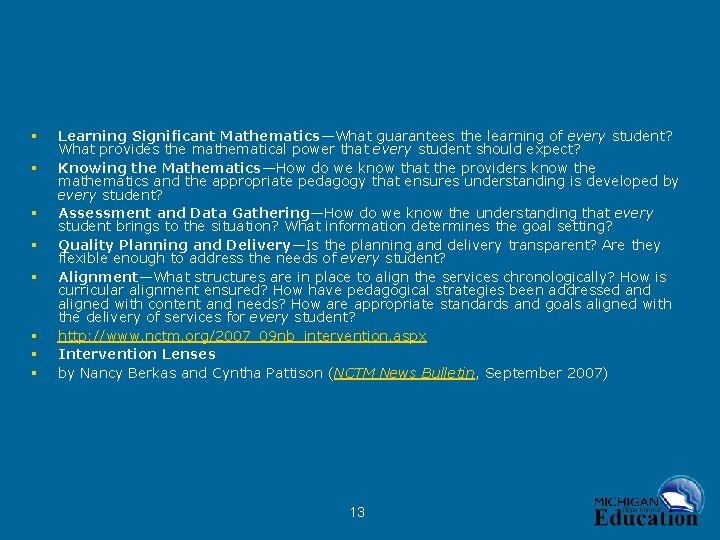
§ § § § Learning Significant Mathematics—What guarantees the learning of every student? What provides the mathematical power that every student should expect? Knowing the Mathematics—How do we know that the providers know the mathematics and the appropriate pedagogy that ensures understanding is developed by every student? Assessment and Data Gathering—How do we know the understanding that every student brings to the situation? What information determines the goal setting? Quality Planning and Delivery—Is the planning and delivery transparent? Are they flexible enough to address the needs of every student? Alignment—What structures are in place to align the services chronologically? How is curricular alignment ensured? How have pedagogical strategies been addressed and aligned with content and needs? How are appropriate standards and goals aligned with the delivery of services for every student? http: //www. nctm. org/2007_09 nb_intervention. aspx Intervention Lenses by Nancy Berkas and Cyntha Pattison (NCTM News Bulletin, September 2007) 13
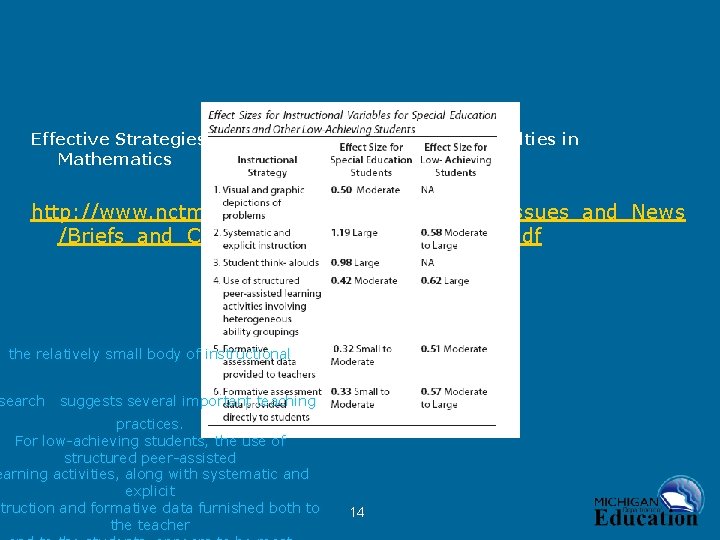
Effective Strategies for Teaching Students with Difficulties in Mathematics http: //www. nctm. org/uploaded. Files/Research_Issues_and_News /Briefs_and_Clips/brief_students_difficulties. pdf the relatively small body of instructional search suggests several important teaching practices. For low-achieving students, the use of structured peer-assisted earning activities, along with systematic and explicit struction and formative data furnished both to the teacher 14
§ http: //www. ascd. org/portal/site/ascd/template. MAXIMIZE/me nuitem. 459 dee 008 f 99653 fb 85516 f 762108 a 0 c/? javax. portlet. t pst=d 5 b 9 c 0 fa 1 a 493266805516 f 762108 a 0 c_ws_MX&javax. por tlet. prp_d 5 b 9 c 0 fa 1 a 493266805516 f 762108 a 0 c_journaltypehe aderimage=%2 FASCD%2 Fimages%2 Fmultifiles%2 Fpublicatio ns%2 Felmast. gif&javax. portlet. prp_d 5 b 9 c 0 fa 1 a 49326680551 6 f 762108 a 0 c_view. ID=article_view&javax. portlet. prp_d 5 b 9 c 0 f a 1 a 493266805516 f 762108 a 0 c_journalmoid=50 a 524448 f 0061 10 Vgn. VCM 1000003 d 01 a 8 c 0 RCRD&javax. portlet. prp_d 5 b 9 c 0 fa 1 a 493266805516 f 762108 a 0 c_articlemoid=0 ad 524448 f 00611 0 Vgn. VCM 1000003 d 01 a 8 c 0 RCRD&javax. portlet. prp_d 5 b 9 c 0 fa 1 a 493266805516 f 762108 a 0 c_journal. Type. Personalization=ASC D_EL&javax. portlet. beg. Cache. Tok=token&javax. portlet. end. Ca che. Tok=token § Nine Ways to Catch Kids Up 15
Personal Curriculum § The legislative intent of a Personal Curriculum is to increase the rigor and relevance of the educational experience and provide a tool to help all students succeed with the MMC. 16
Four Reasons for a Personal Curriculum There are four reasons for a PC. 1. To additional math, English, science or world language courses. 2. Transferred from out of state or from a non-public school. 3. Modify the Algebra II requirement 4. Modify the credit requirements based on a student’s disability. 17
§ Provide a coherent curriculum, incorporating technology wherever possible § Consider an integrated approach to mathematics instruction, including incorporating into science, social studies and CTE programs where possible § Use the 4 th mathematics credit to provide supports for struggling students § Use formative assessment and unit 18
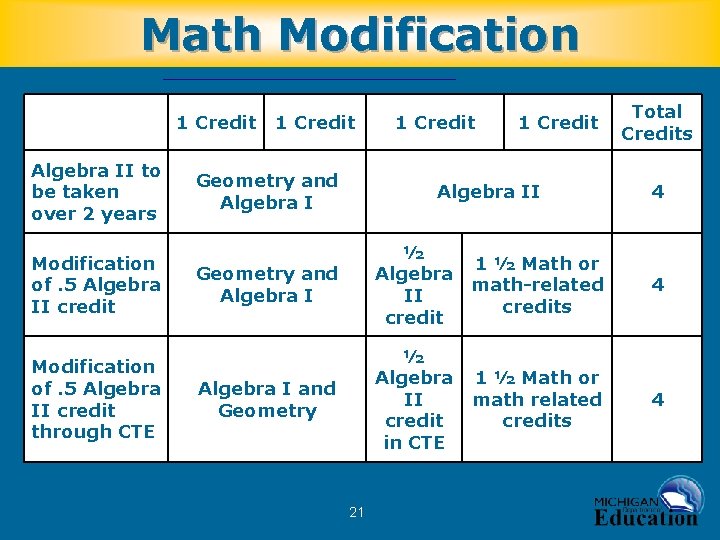
#3 -Algebra II Modification § Algebra II content for two credits or § ½ credit of Algebra II – Prior to requesting this option a student must have earned 2 mathematics credits. – Students must still earn 4 credits of mathematics 19
#3 -Algebra II Modification § Students must still earn a total of 4 math credits, and, take a math or math -related credit in their senior year. 20
Math Modification 1 Credit Algebra II to be taken over 2 years Modification of. 5 Algebra II credit through CTE 1 Credit Total Credits Geometry and Algebra II 4 Geometry and Algebra I ½ 1 ½ Math or Algebra math-related II credits credit 4 Algebra I and Geometry ½ Algebra II credit in CTE 4 21 1 ½ Math or math related credits
#4 Students With Disabilities This only applies to students with disabilities who are on track for a diploma. 22
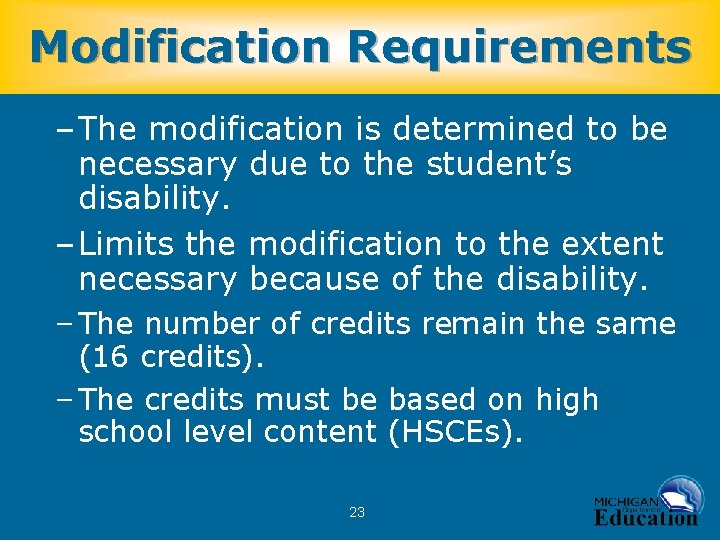
Modification Requirements – The modification is determined to be necessary due to the student’s disability. – Limits the modification to the extent necessary because of the disability. – The number of credits remain the same (16 credits). – The credits must be based on high school level content (HSCEs). 23
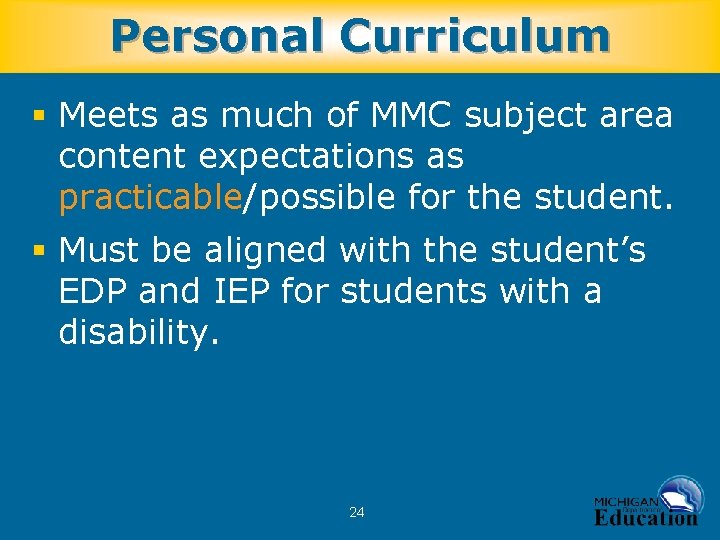
Personal Curriculum § Meets as much of MMC subject area content expectations as practicable/possible for the student. § Must be aligned with the student’s EDP and IEP for students with a disability. 24
Students With Disabilities § The pupil's IEP: –Identifies supports, accommodations, and modifications necessary for achievement in the general curriculum. –It is not the purpose of the IEP to determine or modify the students graduation requirements. 25
What’s Practicable Mean? Practicable content is the mix of existing MMC content expectations and modifications to those expectations driven by student need, that when achieved, will assure the student progresses towards his or her identified post-secondary goal/s and career pathway. 26
Accountability § IDEA states: - Section 300. 102(a)(3), regarding exceptions to FAPE, has been changed to clarify that a regular high school diploma does not include an alternative degree that is not fully aligned with the State’s academic standards, such as a certificate or a general educational development credential (GED). 27
Key Points § We cannot substitute an alternative curriculum and count achievement within that curriculum towards the 16 credit requirements. § We cannot reduce the number of credits. § The IEP supports but does not trump the graduation requirements. 28
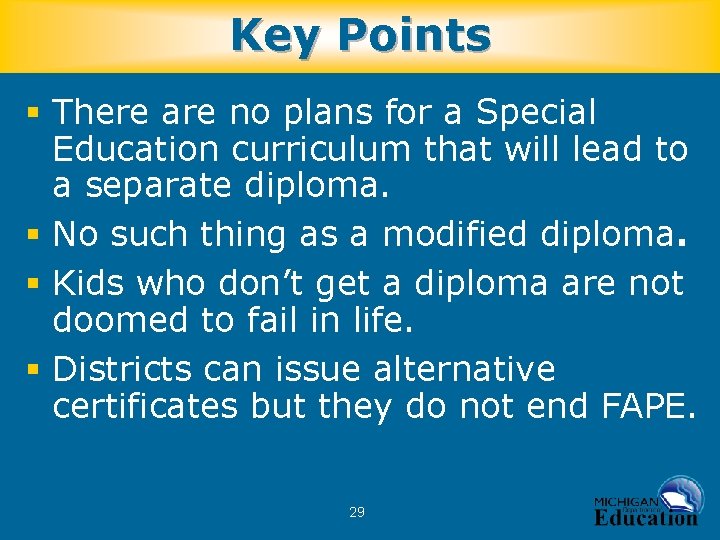
Key Points § There are no plans for a Special Education curriculum that will lead to a separate diploma. § No such thing as a modified diploma. § Kids who don’t get a diploma are not doomed to fail in life. § Districts can issue alternative certificates but they do not end FAPE. 29
Contact Information Ruth Anne Hodges hodgesr 3@michigan. gov www. michigan. gov/mathematics www. mdepersonalcurriculum. wikispaces. com 30