
Protozoa Objective w To know the basic cytology
Protozoa Objective: w To know the basic cytology and characteristics of protozoa. w Understand their importance in the ecology of water treatment and significance as pathogens in water supply. References Sleigh, M. Protozoa and other Protists Curds, C. R. Protozoa in the Water Industry Mitchell, R Environmental Microbiology Gray, N F Biology of Wastewater Treatment Outline Introduction, Classification, Characteristics, Water Ecology, Water Pathogens.

Protozoa - Introduction w Members of Protista kingdom w Eukaryotic mostly Unicellular w Reproduce - sexually (Conjugation) asexually (Binary Fission) w Motile (not all) – swimming, gliding, crawling w May have Plastids (Algae? ) – these can be lost w Size 5 m - > 500 m w Extremely Diverse Morphology – c. f. bacteria, fungi
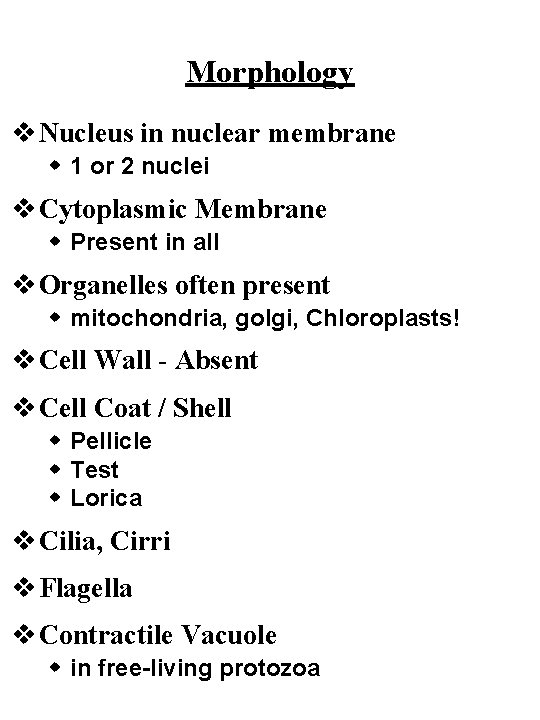
Morphology v Nucleus in nuclear membrane w 1 or 2 nuclei v Cytoplasmic Membrane w Present in all v Organelles often present w mitochondria, golgi, Chloroplasts! v Cell Wall - Absent v Cell Coat / Shell w Pellicle w Test w Lorica v Cilia, Cirri v Flagella v Contractile Vacuole w in free-living protozoa

Feeding v Autotrophs (Phototrophic) w Primary producers like Algae v Heterotrophs w Saprobic - dead and decaying matter w Holozoic - whole live organisms – bacteria, algae, other protozoa v Raptorial Feeding w Actively seek prey (Didinium) v Filtration w Cilia beat, cilia trap (Vorticella) w Buccal Cavity (Mouth region) w Cytostome - Phagocytosis v Stick to Prey w Suctoria tentacles with haptocyst (Acineta) w suck contents of cell v Pinocytosis - cell drinking w soluble organics
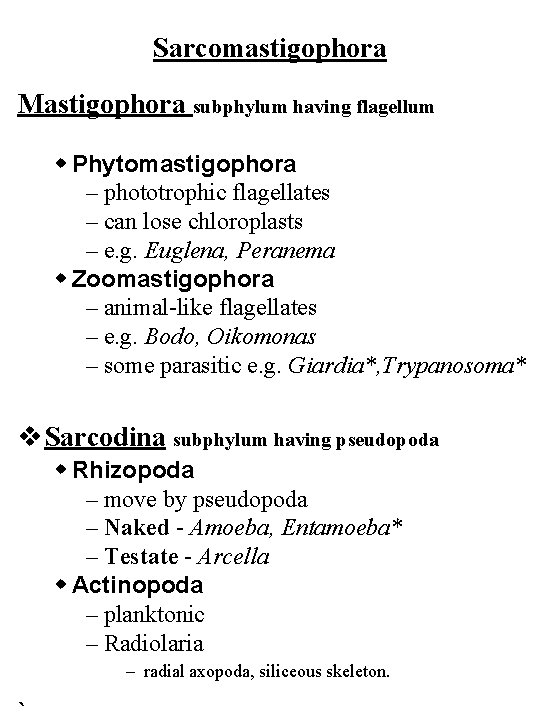
Sarcomastigophora Mastigophora subphylum having flagellum w Phytomastigophora – phototrophic flagellates – can lose chloroplasts – e. g. Euglena, Peranema w Zoomastigophora – animal-like flagellates – e. g. Bodo, Oikomonas – some parasitic e. g. Giardia*, Trypanosoma* v Sarcodina subphylum having pseudopoda w Rhizopoda – move by pseudopoda – Naked - Amoeba, Entamoeba* – Testate - Arcella w Actinopoda – planktonic – Radiolaria – radial axopoda, siliceous skeleton.
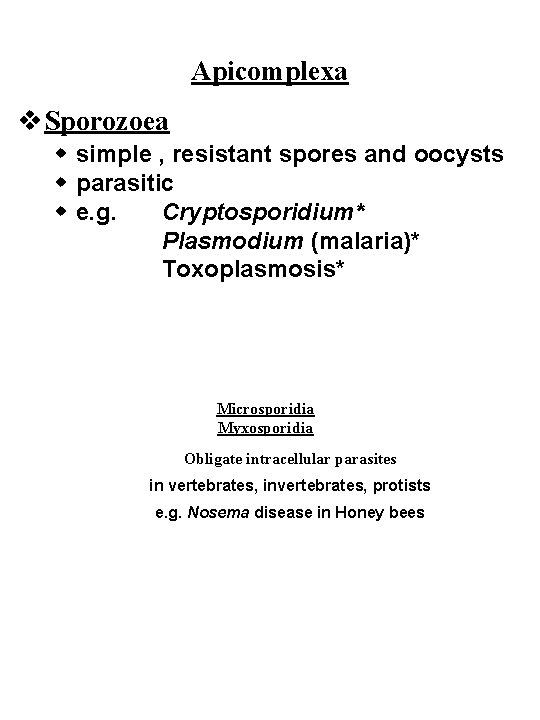
Apicomplexa v Sporozoea w simple , resistant spores and oocysts w parasitic w e. g. Cryptosporidium* Plasmodium (malaria)* Toxoplasmosis* Microsporidia Myxosporidia Obligate intracellular parasites in vertebrates, invertebrates, protists e. g. Nosema disease in Honey bees

Ciliophora The major Phylum in terms of diversity and actual numbers in Aquatic Environments. A number of sub-classes, all have cilia or ciliary organelles. Most are free-living. Four types are of most interest. v 1. Suctoria w Predatory on other protozoa, sessile. w no cilia, but have tentacles. w e. g. Acineta, Podophyra v 2. Peritrichia w w Sessile usually stalked. Bell-shaped pellicle, some have lorica. Cilia bands. e. g. Vorticella Carchesium Opercularia
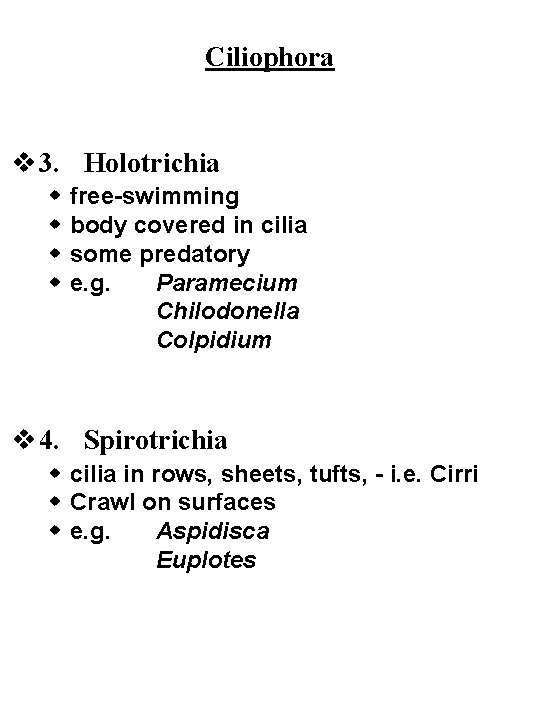
Ciliophora v 3. Holotrichia w w free-swimming body covered in cilia some predatory e. g. Paramecium Chilodonella Colpidium v 4. Spirotrichia w cilia in rows, sheets, tufts, - i. e. Cirri w Crawl on surfaces w e. g. Aspidisca Euplotes
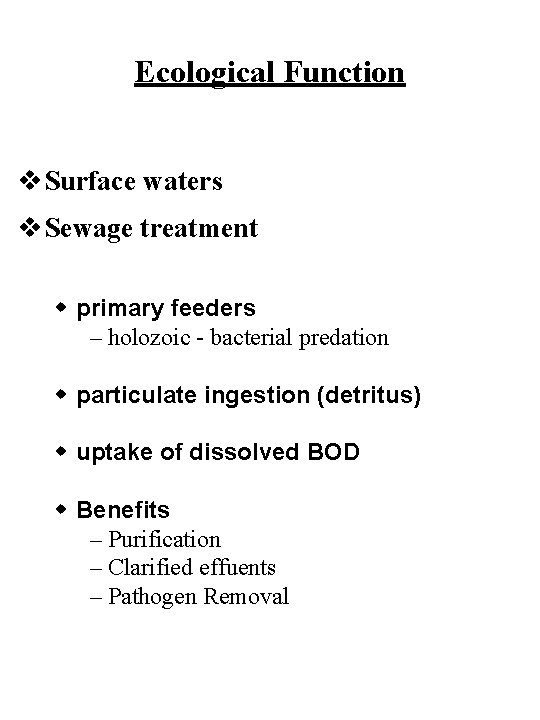
Ecological Function v Surface waters v Sewage treatment w primary feeders – holozoic - bacterial predation w particulate ingestion (detritus) w uptake of dissolved BOD w Benefits – Purification – Clarified effuents – Pathogen Removal
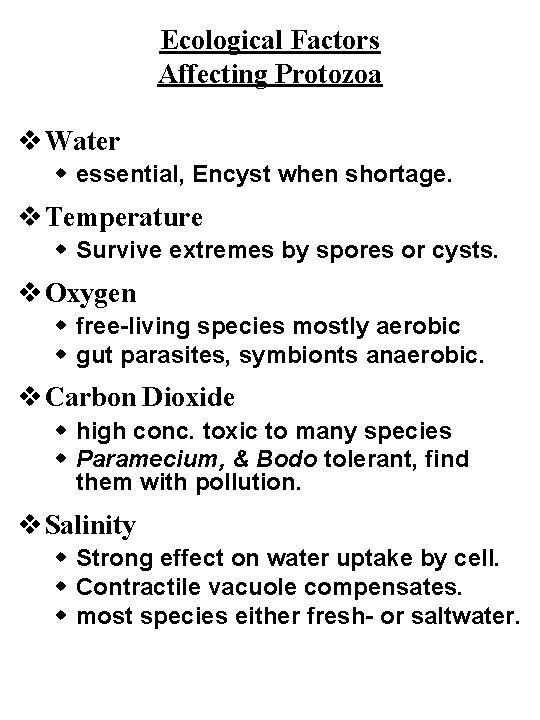
Ecological Factors Affecting Protozoa v Water w essential, Encyst when shortage. v Temperature w Survive extremes by spores or cysts. v Oxygen w free-living species mostly aerobic w gut parasites, symbionts anaerobic. v Carbon Dioxide w high conc. toxic to many species w Paramecium, & Bodo tolerant, find them with pollution. v Salinity w Strong effect on water uptake by cell. w Contractile vacuole compensates. w most species either fresh- or saltwater.

Saprobic Zones - Protozoa scheme of Kolkwitz & Marsson (1902) v 1. Polysaprobic (large numbers small diversity) Bodo, Oikomonas, Paramecium BOD (10 - 50 mg/l) v 2. Mesosaprobic (greater diversity, + pigmented flagellates) - BOD (5 - 10 mg/l) - BOD (2. 5 - 5 mg/l) Chladydomonas (pigmented flagellate) Chilomonas (flagellate) Colpidium (ciliate) Arcella (amoebae) v 3. Oligosaprobic BOD (< 2. 5 mg/l) photosynthetic protozoa Dinobryon Ceratium + ciliates and amoebae (limited application due to the lengthy identification process)
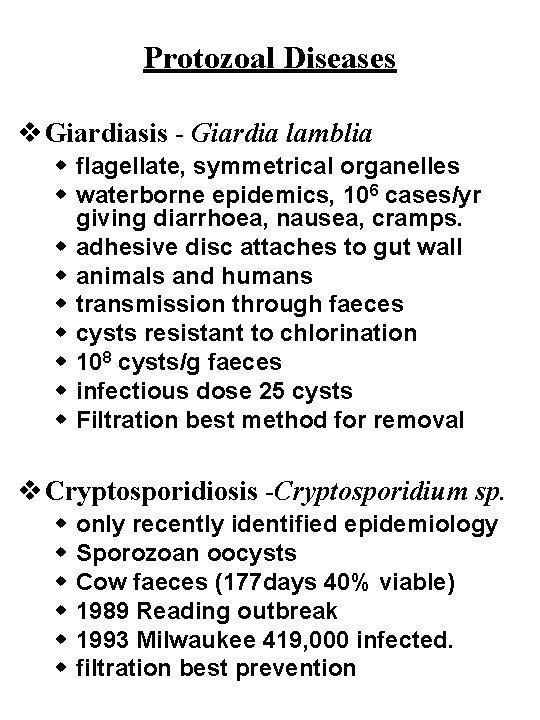
Protozoal Diseases v Giardiasis - Giardia lamblia w flagellate, symmetrical organelles w waterborne epidemics, 106 cases/yr giving diarrhoea, nausea, cramps. w adhesive disc attaches to gut wall w animals and humans w transmission through faeces w cysts resistant to chlorination w 108 cysts/g faeces w infectious dose 25 cysts w Filtration best method for removal v Cryptosporidiosis -Cryptosporidium sp. w w w only recently identified epidemiology Sporozoan oocysts Cow faeces (177 days 40% viable) 1989 Reading outbreak 1993 Milwaukee 419, 000 infected. filtration best prevention
Protozoal Diseases v Trypanosomes flagellates w T. cruzi Chagas Disease – South America – animals and man – Bugs faeces enters. Infants Eyes – fatal w T. brucei African Sleeping Sickness – Tsetse fly vector – invade cerebrospinal fluid and brain – fatal v Amoebic Dysentery – Rhizopod Entamoeba histolytica – mild infection (gut lumen) – severe (gut wall) – abscess, metastases in liver – warm climates increase incidence of the latter condition.
Protozoal Diseases v Malaria Plasmodium malariae w Sporozoan w Complex life cycle Mosquito vector, liver cells and blood cells. w Synchronised erythrocyte lysis w 72 hourcycle of fever w Prophylactic drugs for blood cells w Liver infection resistant - recurrent v Leishmanias (flagellates) w Oriental Sore - Sand Fly vector –local abscess w Kala-azar –tissue parasite –liver, spleen, bone marrow v Naegleria fowleri w Primary Amoebic Meningoencephalitis PAM –Watersports, Roman Baths + sewage contamination –death 7 days , headaches, fever, encephalitis w Can harbour Legionella in water tanks
- Slides: 14