
PROTOZOA GENERAL CHARACTERS CLASSIFICATION Dr P RAVI SEKHAR

- Slides: 33
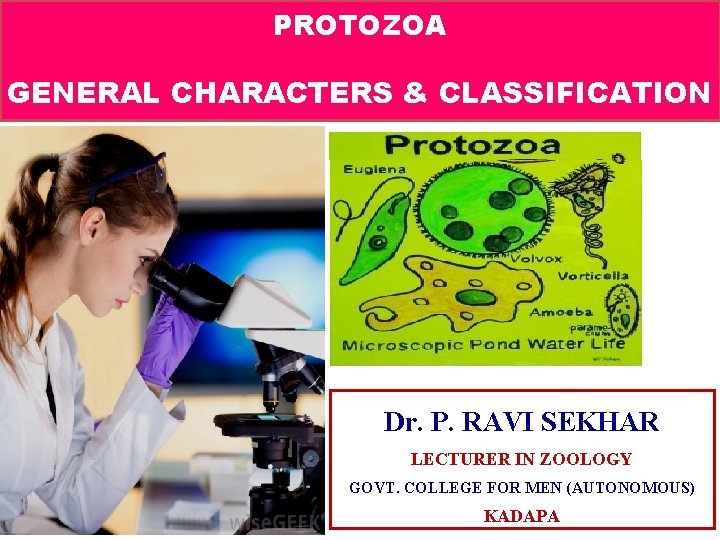
PROTOZOA GENERAL CHARACTERS & CLASSIFICATION Dr. P. RAVI SEKHAR LECTURER IN ZOOLOGY GOVT. COLLEGE FOR MEN (AUTONOMOUS) KADAPA
PROTOZOA GENERAL CHARACTERS & CLASSIFICATION The animals kingdom is often distinguished into two major categories, is based on a singular character, the notochord. Animals without notochord are called Non – Chordates. Animals possessing notochord are called Chordates.
Major and minor Phyla • Invertebrates are divided into major and minor phyla. The concept of major and minor phyla depends upon two factors. 1. Number of species and individuals in the phyla 2. Participation of Phyla in ecological communities • On the basis of these two factors Major phyla : 9 Minor phyla : 21
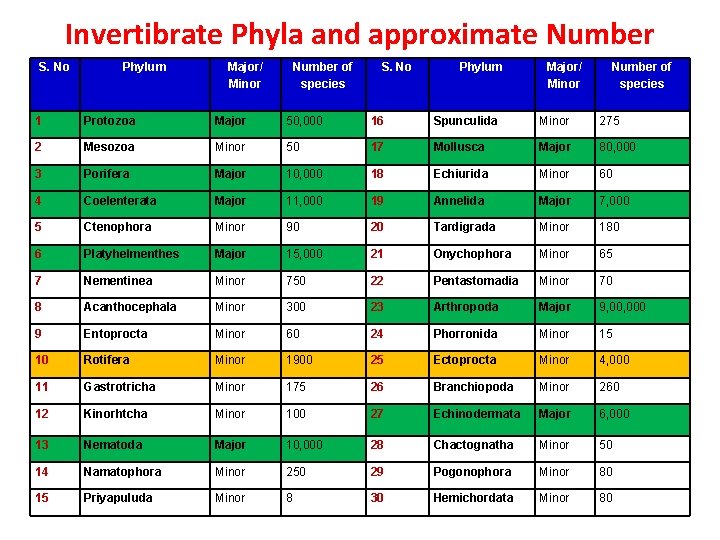
Invertibrate Phyla and approximate Number S. No Phylum Major/ Minor Number of species 1 Protozoa Major 50, 000 16 Spunculida Minor 275 2 Mesozoa Minor 50 17 Mollusca Major 80, 000 3 Porifera Major 10, 000 18 Echiurida Minor 60 4 Coelenterata Major 11, 000 19 Annelida Major 7, 000 5 Ctenophora Minor 90 20 Tardigrada Minor 180 6 Platyhelmenthes Major 15, 000 21 Onychophora Minor 65 7 Nementinea Minor 750 22 Pentastomadia Minor 70 8 Acanthocephala Minor 300 23 Arthropoda Major 9, 000 9 Entoprocta Minor 60 24 Phorronida Minor 15 10 Rotifera Minor 1900 25 Ectoprocta Minor 4, 000 11 Gastrotricha Minor 175 26 Branchiopoda Minor 260 12 Kinorhtcha Minor 100 27 Echinodermata Major 6, 000 13 Nematoda Major 10, 000 28 Chactognatha Minor 50 14 Namatophora Minor 250 29 Pogonophora Minor 80 15 Priyapuluda Minor 8 30 Hemichordata Minor 80
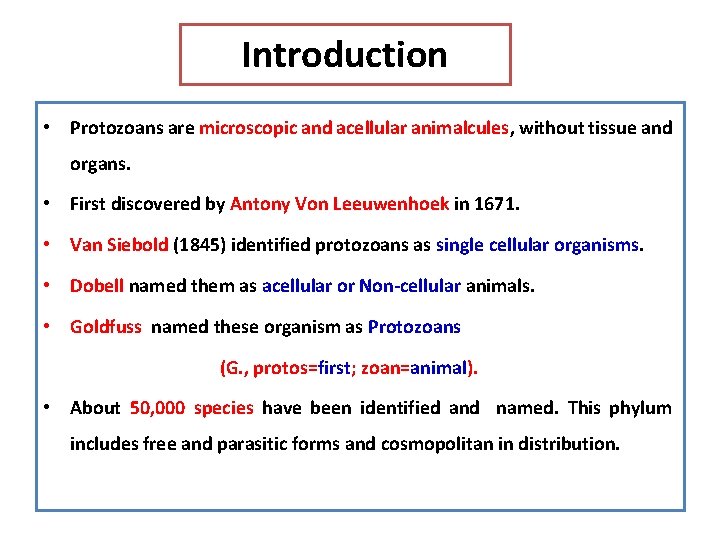
Introduction • Protozoans are microscopic and acellular animalcules, without tissue and organs. • First discovered by Antony Von Leeuwenhoek in 1671. • Van Siebold (1845) identified protozoans as single cellular organisms. • Dobell named them as acellular or Non-cellular animals. • Goldfuss named these organism as Protozoans (G. , protos=first; zoan=animal). • About 50, 000 species have been identified and named. This phylum includes free and parasitic forms and cosmopolitan in distribution.
PROTOZOA GENERAL CHARACTERS
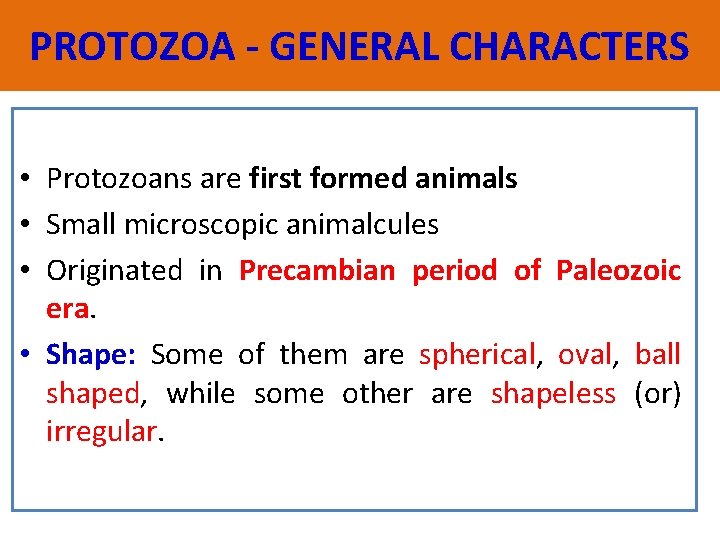
PROTOZOA - GENERAL CHARACTERS • Protozoans are first formed animals • Small microscopic animalcules • Originated in Precambian period of Paleozoic era. • Shape: Some of them are spherical, oval, ball shaped, while some other are shapeless (or) irregular.
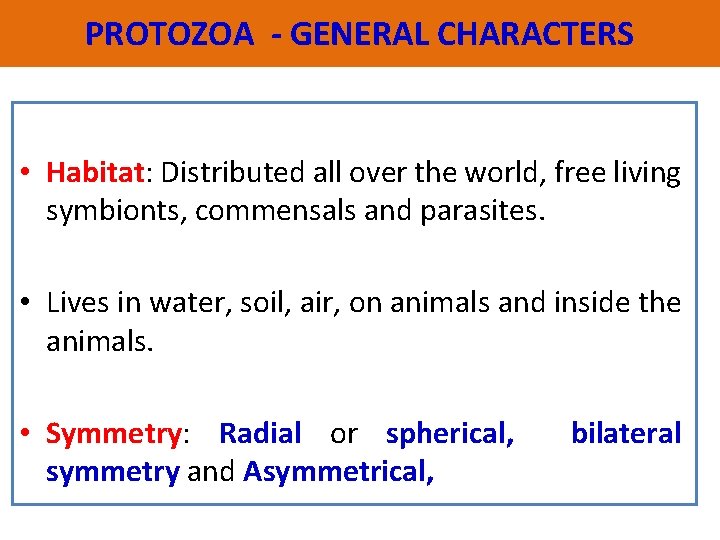
PROTOZOA - GENERAL CHARACTERS • Habitat: Distributed all over the world, free living symbionts, commensals and parasites. • Lives in water, soil, air, on animals and inside the animals. • Symmetry: Radial or spherical, symmetry and Asymmetrical, bilateral
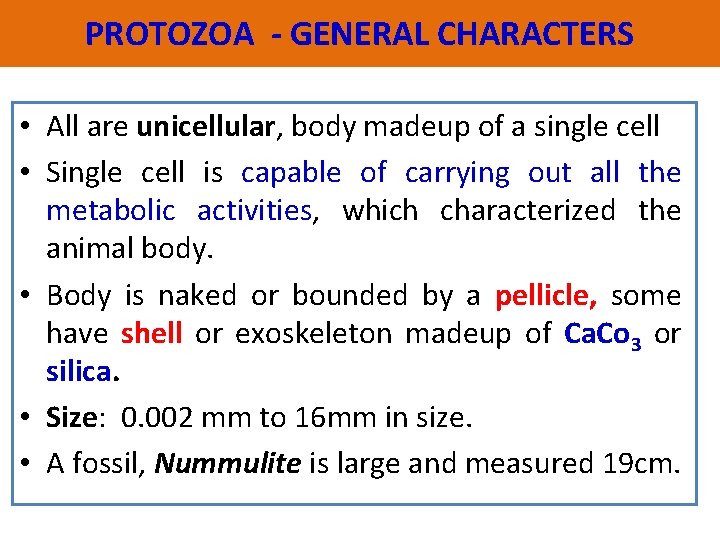
PROTOZOA - GENERAL CHARACTERS • All are unicellular, body madeup of a single cell • Single cell is capable of carrying out all the metabolic activities, which characterized the animal body. • Body is naked or bounded by a pellicle, some have shell or exoskeleton madeup of Ca. Co 3 or silica. • Size: 0. 002 mm to 16 mm in size. • A fossil, Nummulite is large and measured 19 cm.
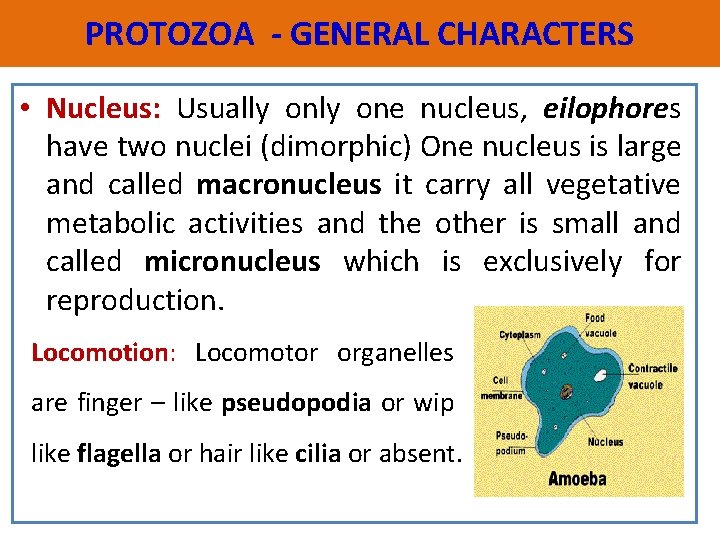
PROTOZOA - GENERAL CHARACTERS • Nucleus: Usually one nucleus, eilophores have two nuclei (dimorphic) One nucleus is large and called macronucleus it carry all vegetative metabolic activities and the other is small and called micronucleus which is exclusively for reproduction. Locomotion: Locomotor organelles are finger – like pseudopodia or wip like flagella or hair like cilia or absent.
• Nutrition: holozoic (animal like), holophytic (plant like), saprozoic or parasitic. Digestion occurs intracellular inside of food vacuoles. • Respiration: No special respiratory organs, Respiration is carried by general body surface through diffusion. • Excretion: Through diffusion or through contractile vacuoles which serves mainly for osmoregulation.
PROTOZOA - GENERAL CHARACTERS • Reproduction: Asexually and Sexually • Asexual reproduction by binary fusion, multiple fusion or budding. • Sexual reproduction by conjugation or by fusion of gametes (syngamy). • Life history often completed with alternation of asexual and sexual phases. • Encystment is a common protective phase, commonly occurs to resist the unfavorable conditions of food.
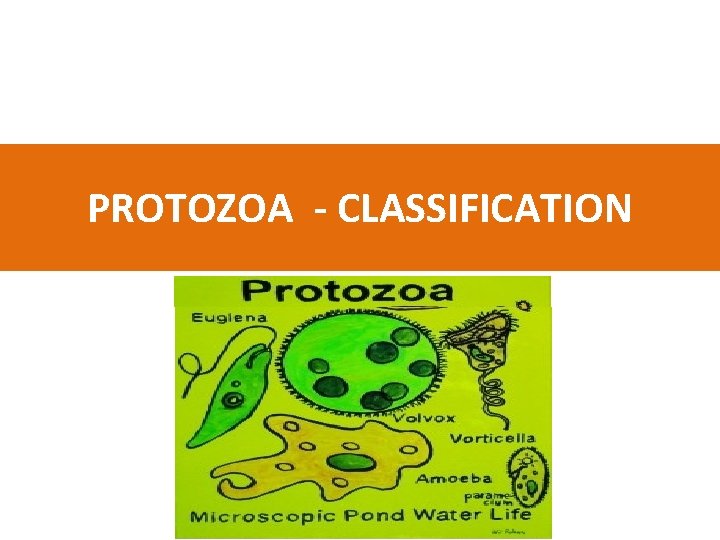
PROTOZOA - CLASSIFICATION
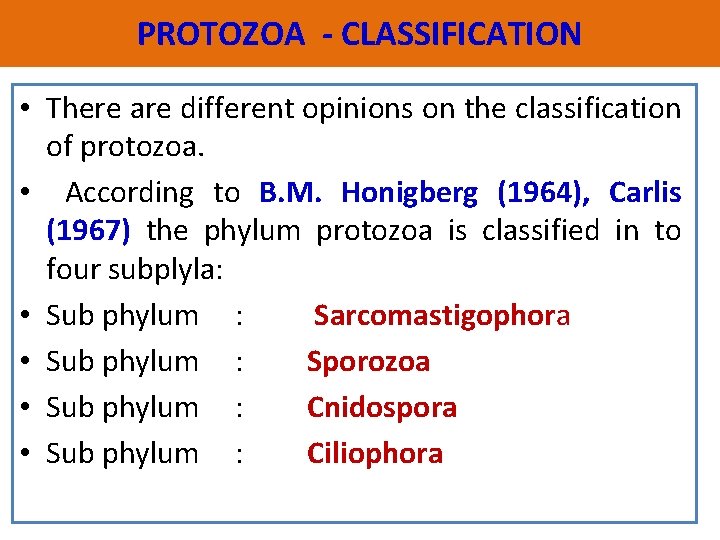
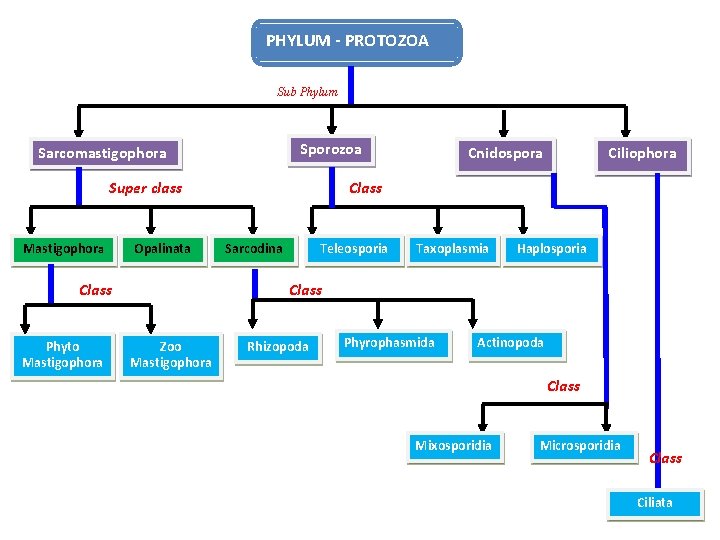
PROTOZOA - CLASSIFICATION • There are different opinions on the classification of protozoa. • According to B. M. Honigberg (1964), Carlis (1967) the phylum protozoa is classified in to four subplyla: • Sub phylum : Sarcomastigophora • Sub phylum : Sporozoa • Sub phylum : Cnidospora • Sub phylum : Ciliophora
PHYLUM - PROTOZOA Sub Phylum Sporozoa Sarcomastigophora Super class Mastigophora Opalinata Class Phyto Mastigophora Cnidospora Ciliophora Class Sarcodina Teleosporia Taxoplasmia Haplosporia Class Zoo Mastigophora Rhizopoda Phyrophasmida Actinopoda Class Mixosporidia Microsporidia Class Ciliata
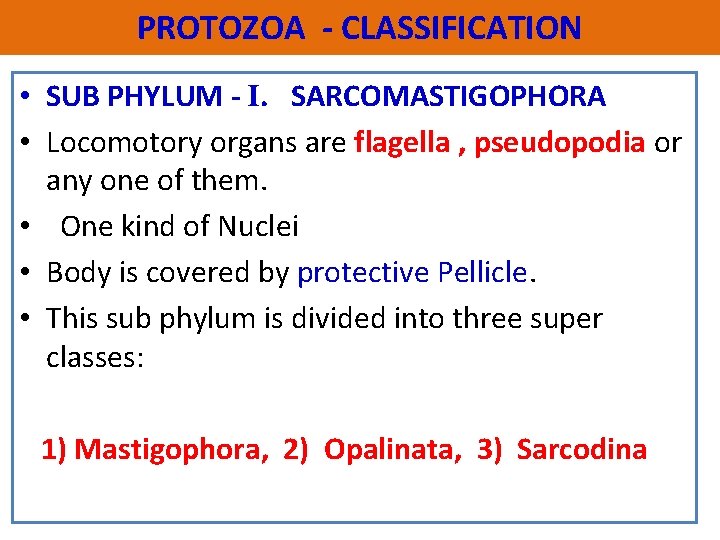
PROTOZOA - CLASSIFICATION • SUB PHYLUM - I. SARCOMASTIGOPHORA • Locomotory organs are flagella , pseudopodia or any one of them. • One kind of Nuclei • Body is covered by protective Pellicle. • This sub phylum is divided into three super classes: 1) Mastigophora, 2) Opalinata, 3) Sarcodina
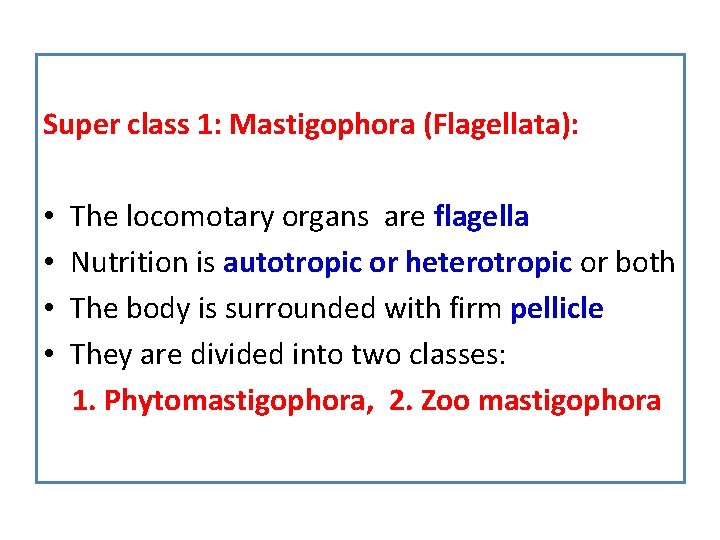
Super class 1: Mastigophora (Flagellata): • The locomotary organs are flagella • Nutrition is autotropic or heterotropic or both • The body is surrounded with firm pellicle • They are divided into two classes: 1. Phytomastigophora, 2. Zoo mastigophora
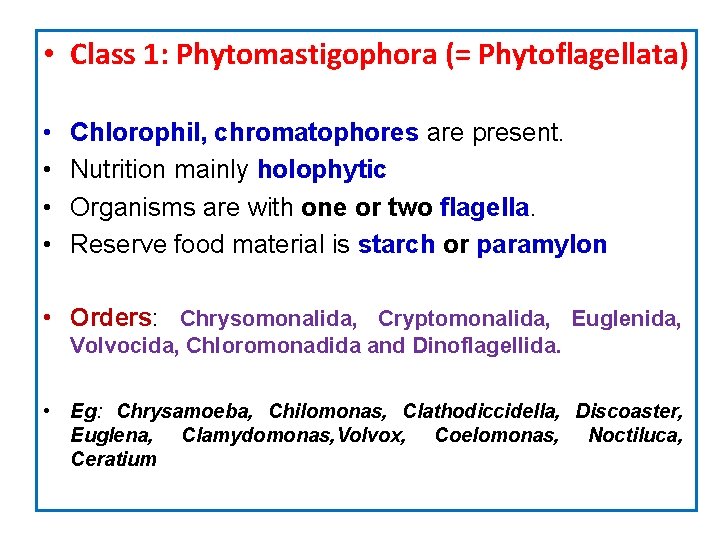
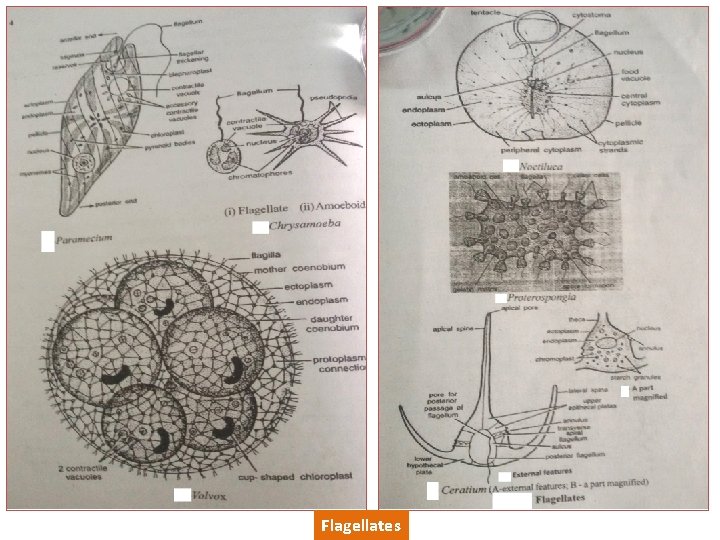
• Class 1: Phytomastigophora (= Phytoflagellata) • • Chlorophil, chromatophores are present. Nutrition mainly holophytic Organisms are with one or two flagella. Reserve food material is starch or paramylon • Orders: Chrysomonalida, Cryptomonalida, Euglenida, Volvocida, Chloromonadida and Dinoflagellida. • Eg: Chrysamoeba, Chilomonas, Clathodiccidella, Discoaster, Euglena, Clamydomonas, Volvox, Coelomonas, Noctiluca, Ceratium
Flagellates
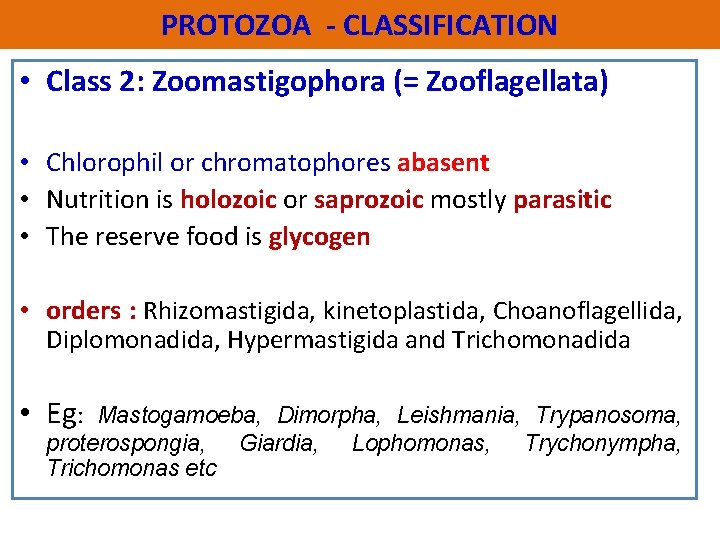
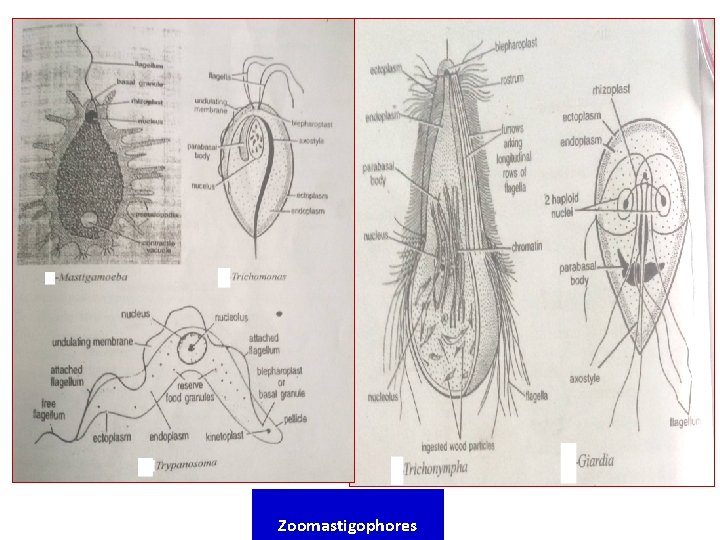
PROTOZOA - CLASSIFICATION • Class 2: Zoomastigophora (= Zooflagellata) • Chlorophil or chromatophores abasent • Nutrition is holozoic or saprozoic mostly parasitic • The reserve food is glycogen • orders : Rhizomastigida, kinetoplastida, Choanoflagellida, Diplomonadida, Hypermastigida and Trichomonadida • Eg: Mastogamoeba, Dimorpha, Leishmania, Trypanosoma, proterospongia, Giardia, Lophomonas, Trychonympha, Trichomonas etc
Zoomastigophores
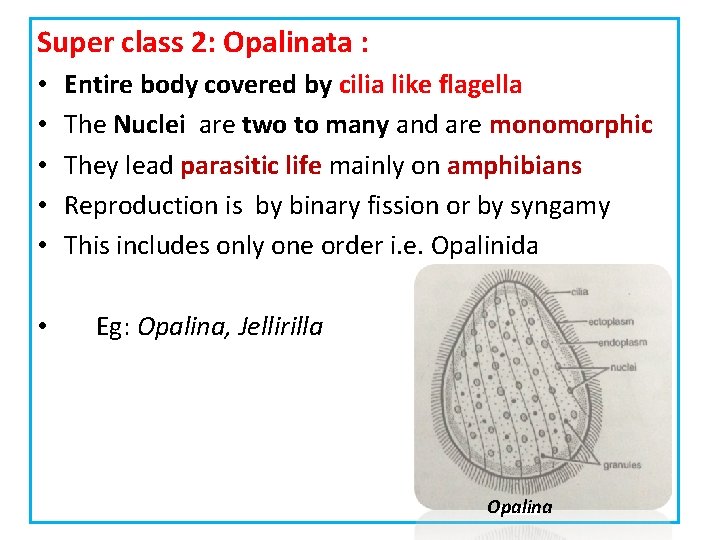
Super class 2: Opalinata : • • • Entire body covered by cilia like flagella The Nuclei are two to many and are monomorphic They lead parasitic life mainly on amphibians Reproduction is by binary fission or by syngamy This includes only one order i. e. Opalinida Eg: Opalina, Jellirilla Opalina
PROTOZOA - CLASSIFICATION • Super class 3: Sarcodina • locomotary organs are Pseudopodia and help in food capturing • Mostly free living some are parasitic • Nutrition is holozoic or saprozoic • Food vacuoles, contractile vacuoles are present. Marine forms lack contractile vacuoles. • Encystment takes place in unfavorable conditions • They are divided into three classes: Rhizopoda, Actinopoda, Pyroplasmida
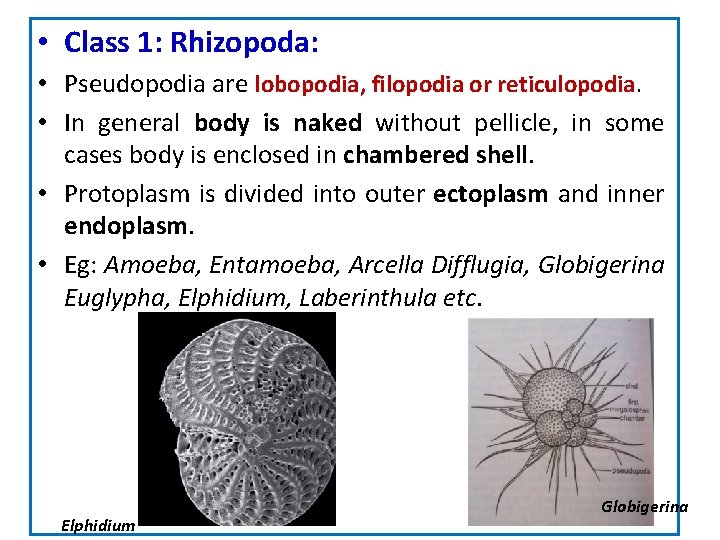
• Class 1: Rhizopoda: • Pseudopodia are lobopodia, filopodia or reticulopodia. • In general body is naked without pellicle, in some cases body is enclosed in chambered shell. • Protoplasm is divided into outer ectoplasm and inner endoplasm. • Eg: Amoeba, Entamoeba, Arcella Difflugia, Globigerina Euglypha, Elphidium, Laberinthula etc. Elphidium Globigerina
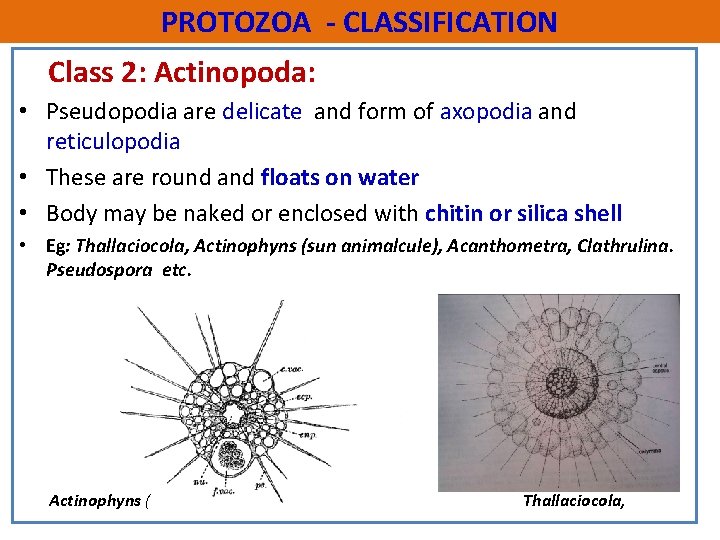
PROTOZOA - CLASSIFICATION Class 2: Actinopoda: • Pseudopodia are delicate and form of axopodia and reticulopodia • These are round and floats on water • Body may be naked or enclosed with chitin or silica shell • Eg: Thallaciocola, Actinophyns (sun animalcule), Acanthometra, Clathrulina. Pseudospora etc. Actinophyns ( Thallaciocola,
• Class 3: Phyrophasmida: • • Blood parasites in vertebrate blood. Cilia and flagella are absent Gliding locomotion Eg: Thilaria, Babesia
PROTOZOA - CLASSIFICATION • SUB PHYLUM - II. SPOROZOA: Locomotory organelles are absent Exclusively endoparasites Body is covered by protective pellicle Asexual reproduction - multiple fission. Sexual reproduction - fusion of micro and macro gametes. • It is divided in to three classes : Teleosporia, Texoplasmia, Haplosporia • • •
• • Class 1: Teleosporia: Monogenetic or digenetic parasites Produce spores without polar capsule of filament Locomotary organelles are absent - gliding locomotion • Ex: Celenadium, Monocystis, Gregarina, Neina, Ophiocystis, Eimeria, Plasmodium etc. • Class 2 : Texoplasmia: • They lead parasitic life on Humans, Birds and Reptiles • Only asexual reproduction - binary fission Ex: Sarcocystis, Taxoplasma
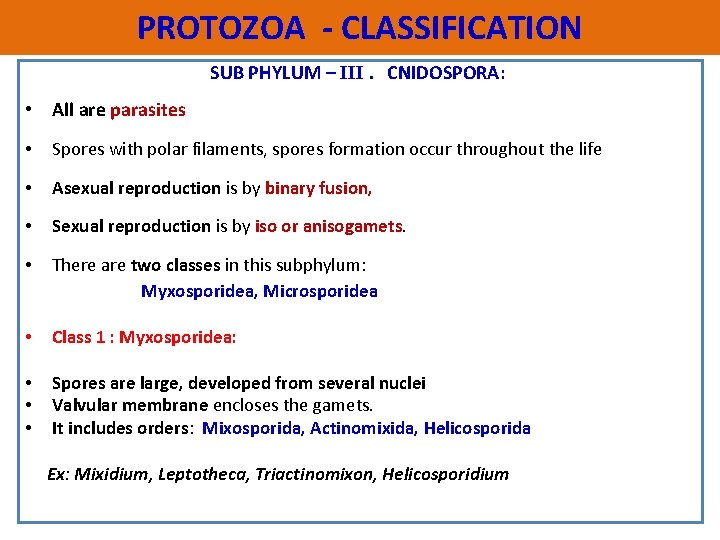
PROTOZOA - CLASSIFICATION SUB PHYLUM – III. CNIDOSPORA: • All are parasites • Spores with polar filaments, spores formation occur throughout the life • Asexual reproduction is by binary fusion, • Sexual reproduction is by iso or anisogamets. • There are two classes in this subphylum: Myxosporidea, Microsporidea • • Class 1 : Myxosporidea: Spores are large, developed from several nuclei Valvular membrane encloses the gamets. It includes orders: Mixosporida, Actinomixida, Helicosporida Ex: Mixidium, Leptotheca, Triactinomixon, Helicosporidium
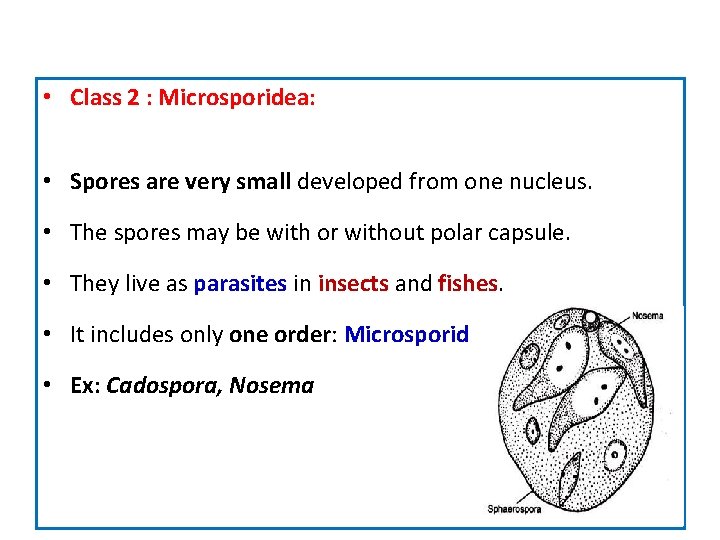
• Class 2 : Microsporidea: • Spores are very small developed from one nucleus. • The spores may be with or without polar capsule. • They live as parasites in insects and fishes. • It includes only one order: Microsporidia • Ex: Cadospora, Nosema
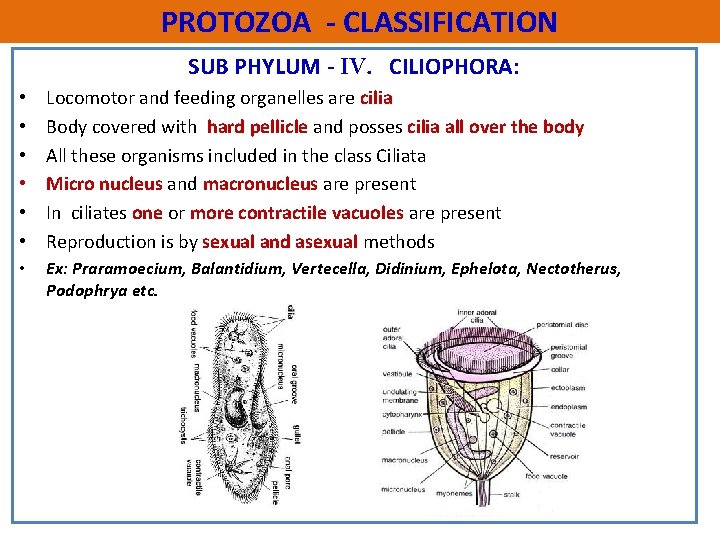
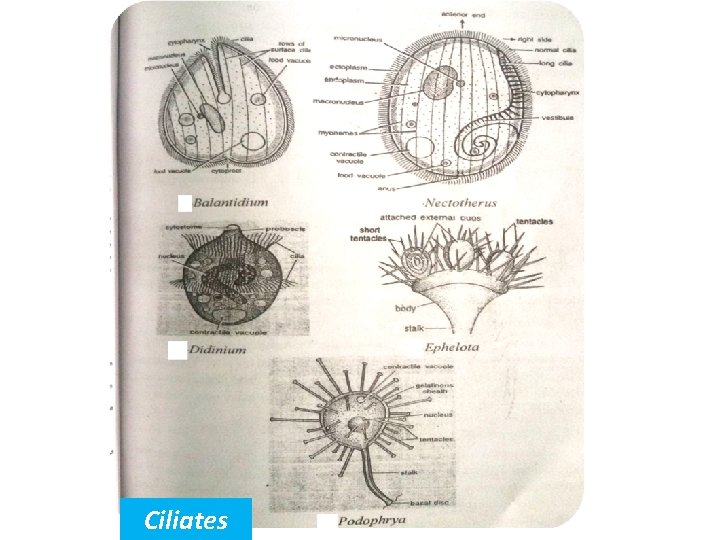
PROTOZOA - CLASSIFICATION SUB PHYLUM - IV. CILIOPHORA: • • • Locomotor and feeding organelles are cilia Body covered with hard pellicle and posses cilia all over the body All these organisms included in the class Ciliata Micro nucleus and macronucleus are present In ciliates one or more contractile vacuoles are present Reproduction is by sexual and asexual methods • Ex: Praramoecium, Balantidium, Vertecella, Didinium, Ephelota, Nectotherus, Podophrya etc.
Ciliates