
Prototyping Recommender Systems in j COLIBRI Juan A
Prototyping Recommender Systems in j. COLIBRI Juan A. Recio-García U. Complutense Madrid, Spain Belén Díaz-Agudo U. Complutense Madrid, Spain Pedro A. González-Calero U. Complutense Madrid, Spain Rec. Sys '08: Proceedings of the 2008 ACM conference on Recommender systems 1
INTRODUCTION �jcolibri is conceived to help application designers to develop and quickly prototype CBR systems. �jcolibri has been designed as a wide spectrum framework able to support several types of CBR systems from the simple nearestneighbor approaches based on flat or simple structures to more complex Knowledge Intensive ones. 2
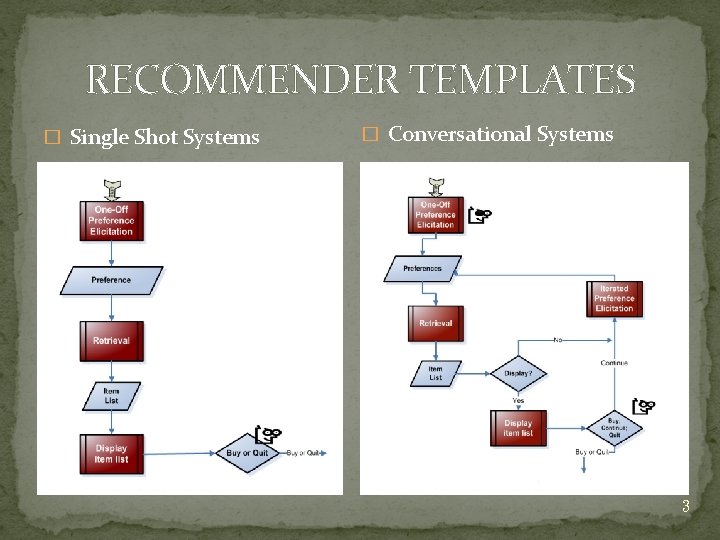
RECOMMENDER TEMPLATES � Single Shot Systems � Conversational Systems 3
RECOMMENDER TEMPLATES (One-Off Preference Elicitation) � We can identify three templates by which the user’s initial preferences may be elicited: � One possibility is Profile Identification where the user identifies him/herself, e. g. by logging in, enabling retrieval of a user profile from a profile database. � An alternative is Initial Query Elicitation: Form-Filling and Navigation-by-Asking (i. e. choosing and asking a question). � The third possibility is Profile Identification & Query Elicitation, in which the previous two tasks are combined. 4
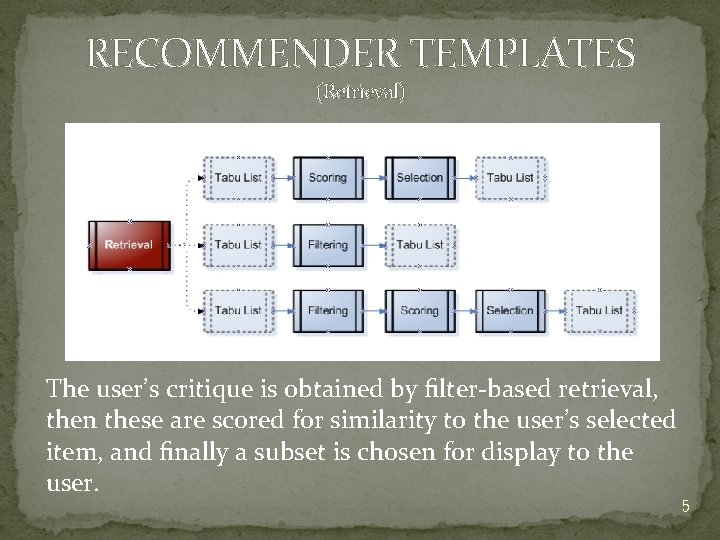
RECOMMENDER TEMPLATES (Retrieval) The user’s critique is obtained by filter-based retrieval, then these are scored for similarity to the user’s selected item, and finally a subset is chosen for display to the user. 5
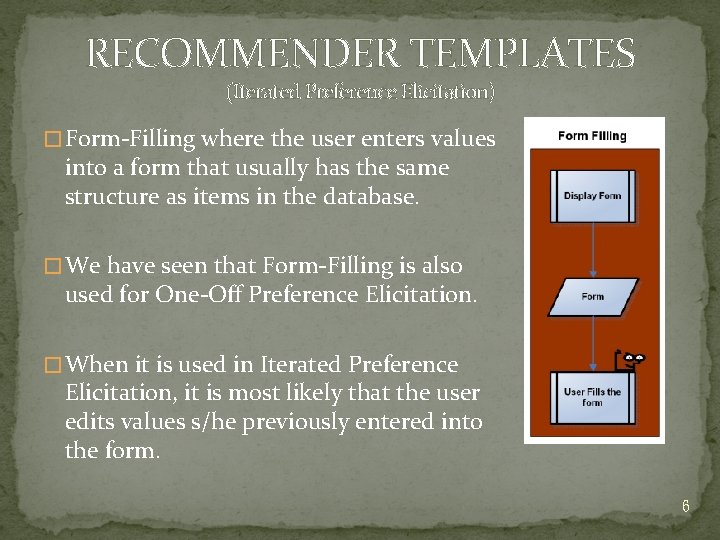
RECOMMENDER TEMPLATES (Iterated Preference Elicitation) � Form-Filling where the user enters values into a form that usually has the same structure as items in the database. � We have seen that Form-Filling is also used for One-Off Preference Elicitation. � When it is used in Iterated Preference Elicitation, it is most likely that the user edits values s/he previously entered into the form. 6
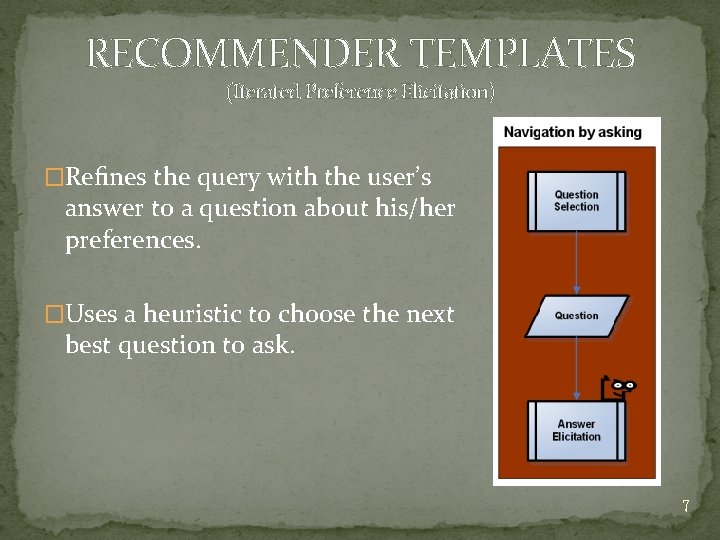
RECOMMENDER TEMPLATES (Iterated Preference Elicitation) �Refines the query with the user’s answer to a question about his/her preferences. �Uses a heuristic to choose the next best question to ask. 7
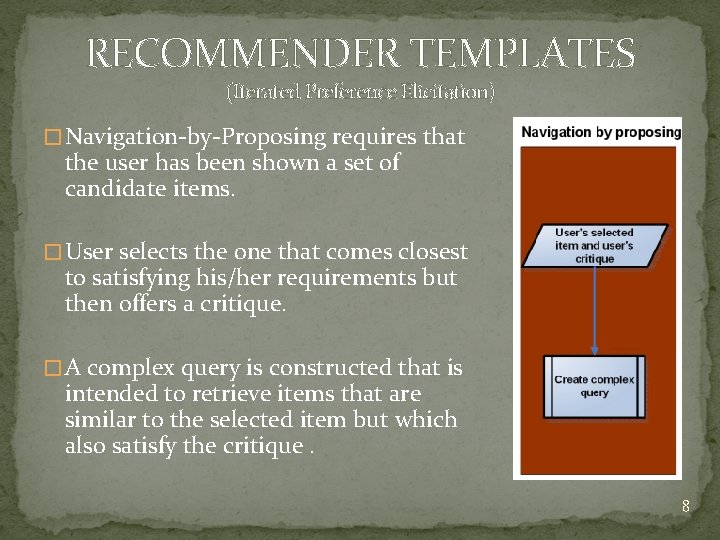
RECOMMENDER TEMPLATES (Iterated Preference Elicitation) � Navigation-by-Proposing requires that the user has been shown a set of candidate items. � User selects the one that comes closest to satisfying his/her requirements but then offers a critique. � A complex query is constructed that is intended to retrieve items that are similar to the selected item but which also satisfy the critique. 8
EVALUATION OF THE APPROACH � To achieve this goal we used a group of 50 students of an Artificial Intelligence and Knowledge Based Systems course at the Complutense University of Madrid, and proposed them to: � 1. Design a recommender system. � 2. Choose a development process: independent, jcolibri ’s method-based design, or jcolibri ’s template-based design. � 3. Implement the recommender and provide feedback about its development. 9
EVALUATION OF THE APPROACH (Results) �The intermediate survey measured the development process followed by the students. Surprisingly, all the students chose to use our framework: 62, 5% by adapting the examples (template-based design) and the remaining by reusing the methods (method-based design). � Find two main reasons to use this second approach. �The first one, is the design of a incorrect recommender which behaviour could drive. �Another reason was the incorporation of special features or methods required by the domain. 10

Implications of Psychological Phenomenons for Recommender Systems Erich Christian Teppan University of Klagenfurt Rec. Sys '08: Proceedings of the 2008 ACM conference on Recommender systems 11
INTRODUCTION �Recommender systems can substantially alleviate typically complex task, but it was widely ignored by the recommender community so far are the potentials and impacts of psychological and decision theoretical phenomenons, so this paper concentrates on two classes of phenomenons, which are decoy effects and serial position effects. 12
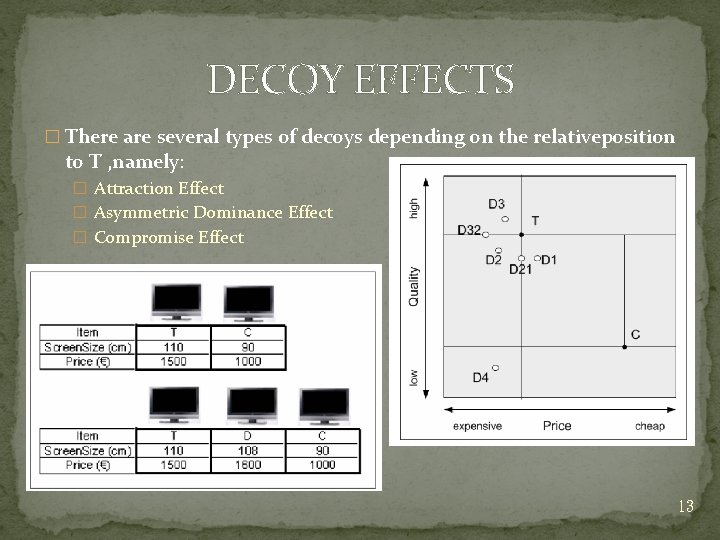
DECOY EFFECTS � There are several types of decoys depending on the relativeposition to T , namely: � Attraction Effect � Asymmetric Dominance Effect � Compromise Effect 13
SERIAL POSITION EFFECTS �Serial position effects are related to biases which are dependent on the position and ordering of items. �Two of the most well known effects of this class are the Primacy and the Recency effect (PRE). �The Primacy effect says that the first items in a list remembered better than the rest, whereas the Recency effect says that the items at the end of a list a remembered better. 14
Primacy Recency Effect �Firstly, PRE in the result set. � Depending on the position in the result set the perceived value of a result item may change. �Secondly, PRE in the ordering of item features. � The information about the importance of the various interest dimensions and the information about to which extend item features contribute to those interest dimensions form the basis to put the most informative attributes for a certain user on salient positions. 15
Primacy Recency Effect �Thirdly, PRE in explanation orderings. � Explanations in knowledge-based recommenders typically give some additional information about result items or repair alternatives. �Fourthly, PRE in the context of repair mechanisms. � Knowledge-based recommenders offer repair mechanisms in order to adapt user input in case of inconsistent user requirements 16
CONCLUSIONS � In this paper various psychological phenomenons have been introduced and their implications for recommender systems have been revealed. � Which repairs and items should be treated privileged � Which position effect to use for items � Which position effect to use for explanations � Which position effect to use for repairs � Which dimensions the decoy should be dominated by the target � Fixed item feature ordering or dynamic 17
UTA-Rec: A Recommender System based on Multiple Criteria Analysis Kleanthi Lakiotaki Stelios Tsafarakis Nikolaos Matsatsinis Dept. Production & Management Engineering Technical University of Crete Rec. Sys '08: Proceedings of the 2008 ACM conference on Recommender systems 18
INTRODUCTION � Multiple Criteria Analysis aims to assist a decision maker in choosing the best alternative, when multiple criteria conflict and compete with each other. � According to the general modeling methodology of decision-making problems as proposed by Roy , there are four distinct levels through which a decision maker is driven to a final decision. � Level 1: Object of the decision, including the definition of the set of potential actions A and the determination of a problem statement on A. � Level 2: Modelling of a consistent family of criteria assuming that these criteria are non-decreasing value functions. � Level 3: Development of a global preference model, to aggregate the marginal preferences on the criteria. � Level 4: Decision-aid, based on the results of level 3 and the problem statement of level 1. 19
![METHODOLOGICAL FRAMEWORK [Data acquisition and representation (Step 1)] �For the initial step of UTA-Rec](http://slidetodoc.com/presentation_image/12d6d531e418a423c6ebdcd5a5e8286e/image-20.jpg "METHODOLOGICAL FRAMEWORK [Data acquisition and representation (Step 1)] �For the initial step of UTA-Rec")
METHODOLOGICAL FRAMEWORK [Data acquisition and representation (Step 1)] �For the initial step of UTA-Rec system, users have to rate a sample set of items upon specific criteria satisfying the properties of monotonicity, exhaustiveness and non-redundancy. �The four criteria upon which each user is asked to rate a movie, are: � 1. story (C 1), � 2. acting (C 2), � 3. direction (C 3) , � 4. visuals (C 4). 20
![METHODOLOGICAL FRAMEWORK [Data set configuration (Step 2) ] �The first ensures that the number](http://slidetodoc.com/presentation_image/12d6d531e418a423c6ebdcd5a5e8286e/image-21.jpg "METHODOLOGICAL FRAMEWORK [Data set configuration (Step 2) ] �The first ensures that the number")
METHODOLOGICAL FRAMEWORK [Data set configuration (Step 2) ] �The first ensures that the number of rated movies for each user in the training set is five. �The secondition ensures a maximum dispersion of the overall rating for these set of five movies. 21
![METHODOLOGICAL FRAMEWORK [Modelling user preferences (Step 3)] 22](http://slidetodoc.com/presentation_image/12d6d531e418a423c6ebdcd5a5e8286e/image-22.jpg "METHODOLOGICAL FRAMEWORK [Modelling user preferences (Step 3)] 22")
METHODOLOGICAL FRAMEWORK [Modelling user preferences (Step 3)] 22
![METHODOLOGICAL FRAMEWORK [Recommendation process (Step 4) ] �In combination with the performances of these](http://slidetodoc.com/presentation_image/12d6d531e418a423c6ebdcd5a5e8286e/image-23.jpg "METHODOLOGICAL FRAMEWORK [Recommendation process (Step 4) ] �In combination with the performances of these")
METHODOLOGICAL FRAMEWORK [Recommendation process (Step 4) ] �In combination with the performances of these movies upon all four criteria, an overall utility score for the specific movie for each user is calculated and compared to the actual score. 23
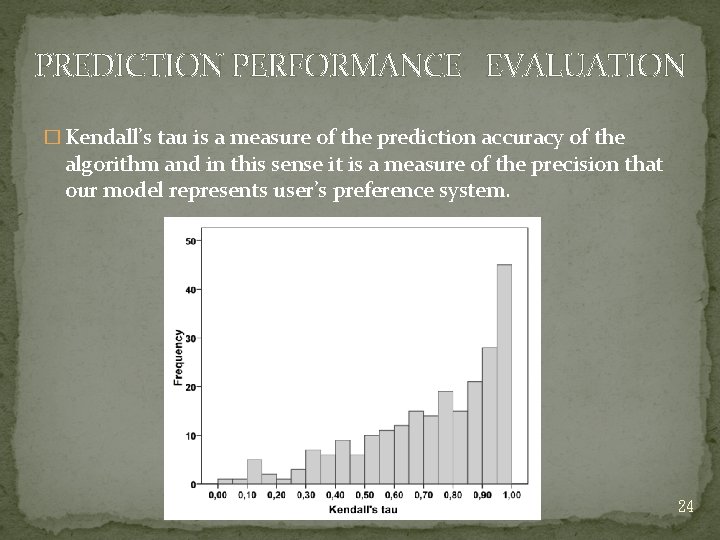
PREDICTION PERFORMANCE EVALUATION � Kendall’s tau is a measure of the prediction accuracy of the algorithm and in this sense it is a measure of the precision that our model represents user’s preference system. 24
RESULTS �To measure MRCF’s accuracy and compare it to UTARec’s, the measure of Mean Absolute Error (MAE), the comparison was made as follows: � MRCF : For every user and for the entire set of candidate for recommendation movies, a score was calculated as the average rating of current user’s neighbours. � UTA-Rec : The overall score of the same movies was calculated as a linear combination of the criteria weights with the performance of these movies on each criterion. 25
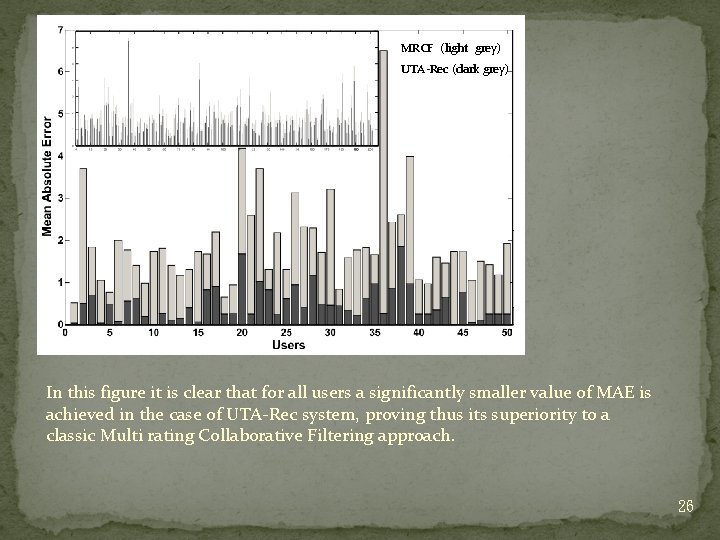
MRCF (light grey) UTA-Rec (dark grey) In this figure it is clear that for all users a significantly smaller value of MAE is achieved in the case of UTA-Rec system, proving thus its superiority to a classic Multi rating Collaborative Filtering approach. 26
Each to His Own: How Different Users Call for Different Interaction Methods in Recommender Systems Bart P. Knijnenburg Niels J. M. Reijmer Martijn C. Willemsen Depart me nt of Info rmatics Human- Techno lo gy Int eracti on gr oup Huma n-Te ch nol ogy Inte rac tio n group Un iversity of Ca lifo rnia , I rvine Eindhoven Univ er si ty o f Techno lo gy Eindh ove n U nivers ity o f Te ch nol ogy Rec. Sys '11: Proceedings of the fifth ACM conference on Recommender systems 27
INTRODUCTION � The way users interact with a recommender system seems to have an impact on their satisfaction with the system. � In the current paper we consider explicit, implicit and hybrid preference elicitation methods, but we also include a fixed Top. N and a sortable in our comparison. � Moreover, this paper also consider how the best interaction method may differ for users with different levels of persistence and trusting propensity. 28
THEORY (Five Interaction Methods ) � Top. N � In Top. N, users do not have to decide on attribute weights. There is virtually no interaction, as the user cannot change the order of the recommendations. � Sort � Users may sort recommendations on any attribute and change the sort-attribute as many times as they want during the interaction. � Explicit � Users can directly set their preferences by indicating the weight they assign to each of the attributes. � Implicit � Whenever users preview or select a recommended item, a set of rules analyzes this behavior and updates attribute weights accordingly. � Hybrid � The Hybrid method combines the Explicit and Implicit approaches by automatically updating the attribute weights while at the same time offering users the option to change the weights themselves. 29
THEORY (User Characteristics) �Domain Knowledge � Experts’ knowledge of attributes makes them better equipped to use a personalized attribute-based recommender system, leading to better outcomes. �Trusting Propensity � A recommender system is in essence a persuasive system; it tries to persuade its users to follow its recommendations. 30
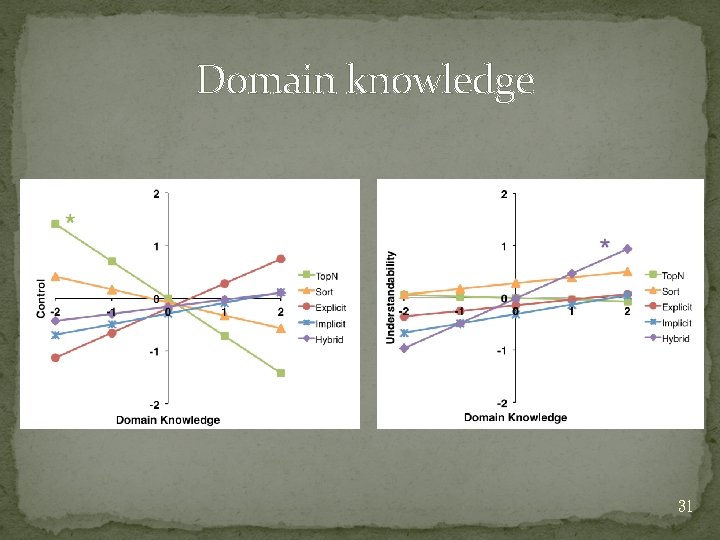
Domain knowledge 31
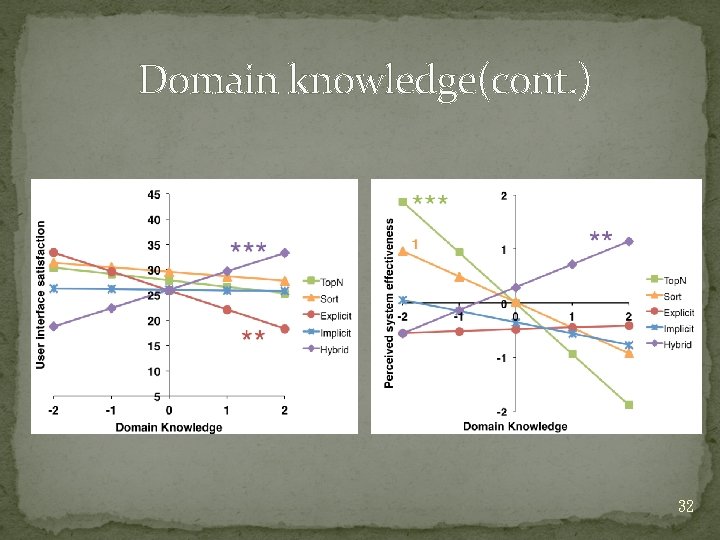
Domain knowledge(cont. ) 32
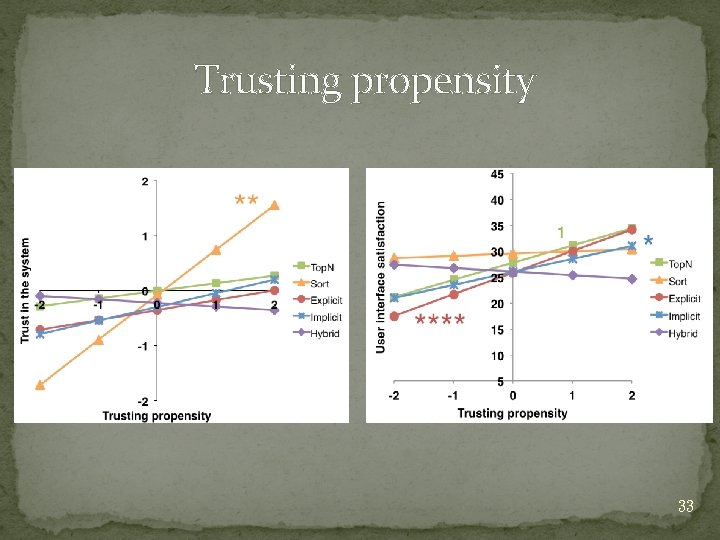
Trusting propensity 33
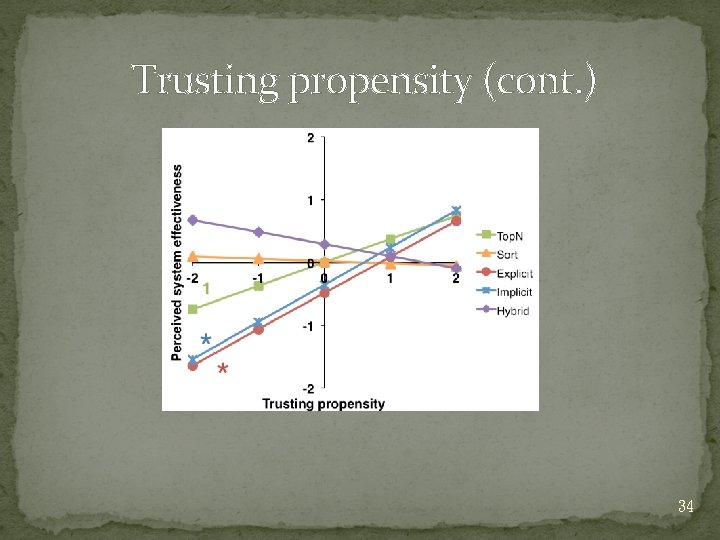
Trusting propensity (cont. ) 34
CONCLUSION � First option is to combine the Top. N and the Hybrid : � Top. N system may be preferred in some cases and hybrid recommender may be too complex for novices, designers seem to have to find a way to combine the simplest method (Top. N) and the most complex method (Hybrid), while avoiding their respective downsides. � Second option is to temporally separate them: � Start with the Top. N, carefully introduce Implicit recommendations, and then introduce Explicit controls as well. � Third option is assign the correct method to each user: � Try to discover before or during the interaction what the user’s characteristics are, and then tailor the interface to her specific needs. 35

Efficient Service Recommendation System for Cloud Computing Market Seung-Min Han Mohammad Mehedi Chang-Woo Yoon Eui-Nam Huh Hassan Department of Computer Engineering Kyunghee University. Department of Computer Electronics and Engineering Telecommunications Kyunghee University. Research Institute Department of Computer Engineering Kyunghee University. ICIS '09: Proceedings of the 2 nd International Conference on Interaction Sciences 36
INTRODUCTION In this paper present a Cloud service selection framework in the Cloud market that uses a recommendation system (RS) which helps a user to select the optimal services from different Cloud providers (CP) that matches requirements of the user. The RS creates ranks of different services with providers and present to the user so that they can select the appropriate or optimal services. 37
RELATED WORK (Recommendation System) �Content-based Recommender Systems � The Content–based filtering (CBF) uses the description of the items that were previously watched or purchased by the customer and evaluated by them in a positive way. �Collaborative Recommender Systems � The system recommends to the targeted customer products (or people), which have been evaluated in plus by another people, whose ratings are similar to the ratings of the targeted user. (hobbies, interests, etc. ) �Hybrid Recommender Systems � The hybrid approach to recommendation system combines the Content–based and Collaborative filtering. There are many different ways to combine the Content–based and Collaborative filtering. 38
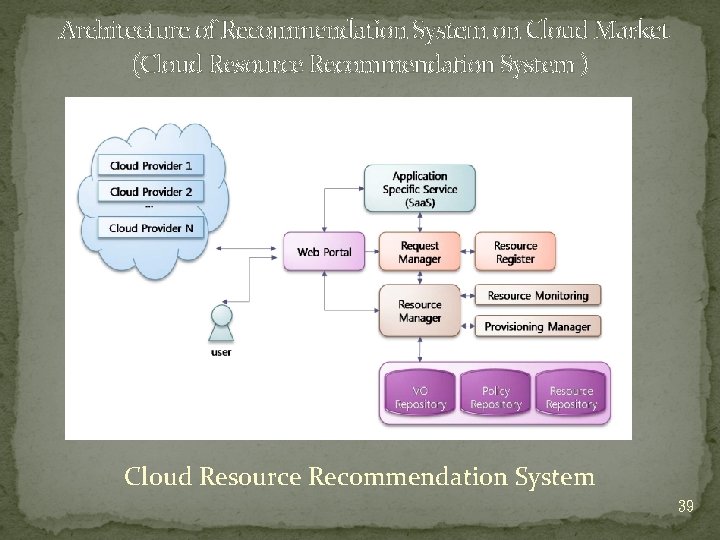
Architecture of Recommendation System on Cloud Market (Cloud Resource Recommendation System ) Cloud Resource Recommendation System 39
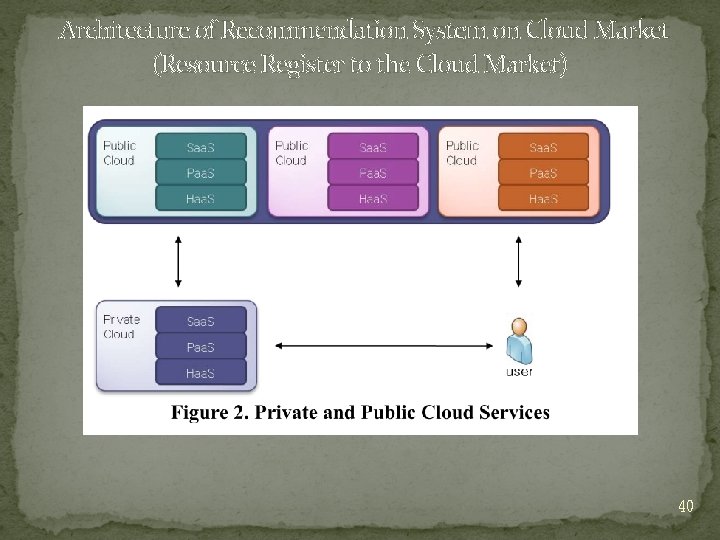
Architecture of Recommendation System on Cloud Market (Resource Register to the Cloud Market) 40
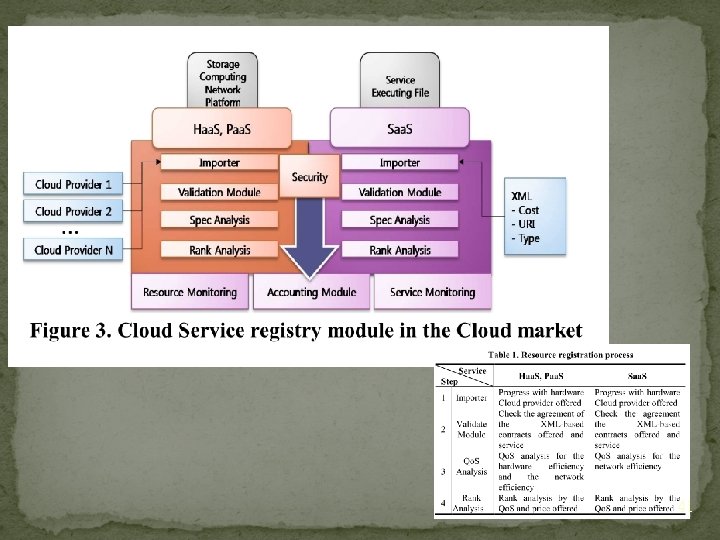
41
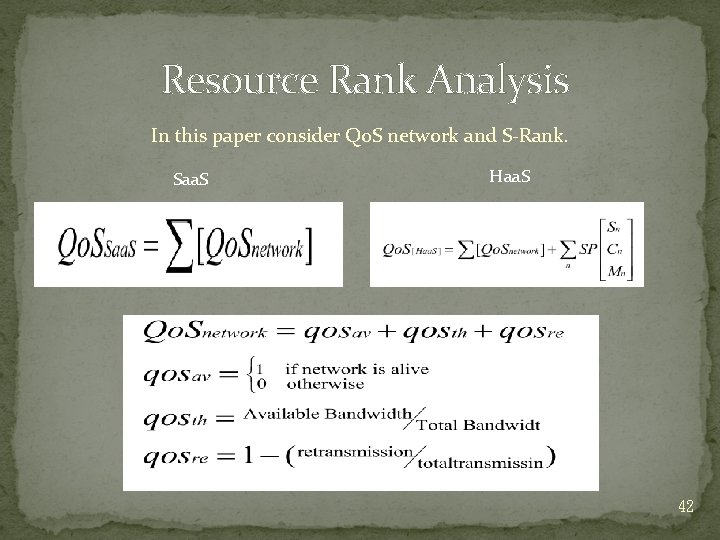
Resource Rank Analysis In this paper consider Qo. S network and S-Rank. Saa. S Haa. S 42
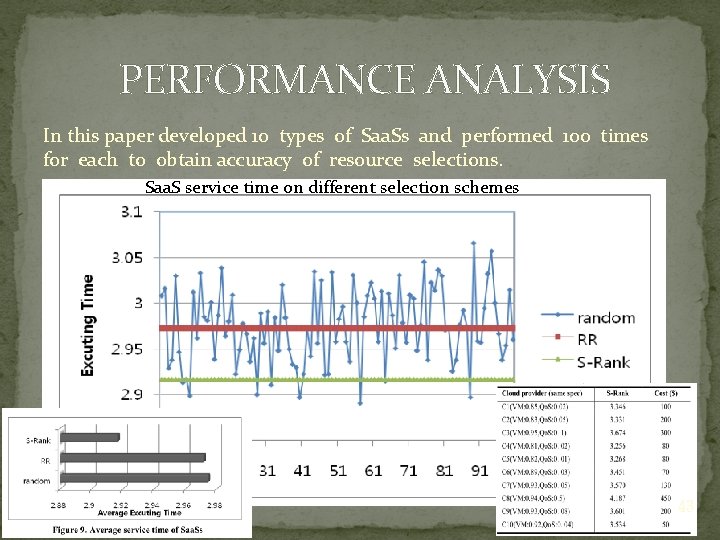
PERFORMANCE ANALYSIS In this paper developed 10 types of Saa. Ss and performed 100 times for each to obtain accuracy of resource selections. Saa. S service time on different selection schemes 43
CONCLUSION In this paper propose a Cloud service recommendation system in the Cloud market that helps a user to select the best combination of services from different Cloud providers that match his/her requirements. 44
- Slides: 44