
Prototyping Advanced Military Sensor Systems Using FPGAtoASIC Design
- Slides: 4
Prototyping Advanced Military Sensor Systems Using FPGA-to-ASIC Design Flow J Ryan Kenny Jeff Wills Rick Pancoast Ellis Taliaferro Altera Corporation 101 Innovation Drive San Jose, CA 95134 Lockheed Martin MS 2 199 Borton Landing Road Moorestown, NJ 08057 High Performance Embedded Computing Workshop 18 -20 September 2007
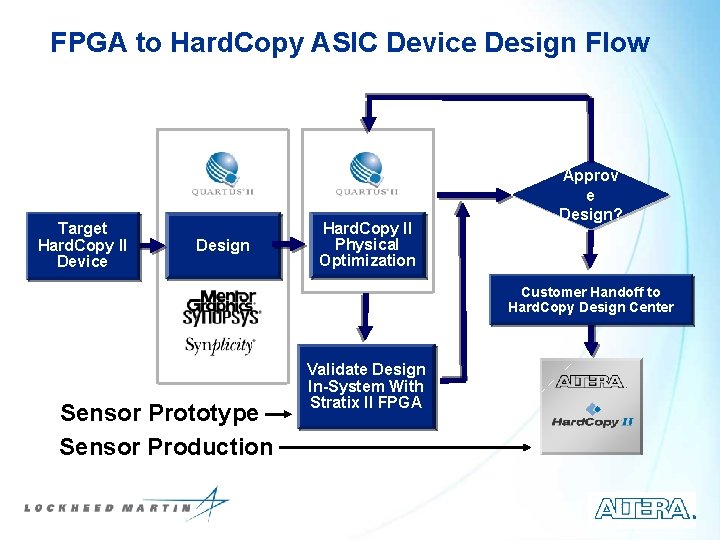
FPGA to Hard. Copy ASIC Device Design Flow Target Hard. Copy II Device Design Hard. Copy II Physical Optimization Approv e Design? Customer Handoff to Hard. Copy Design Center Sensor Prototype Sensor Production Validate Design In-System With Stratix II FPGA
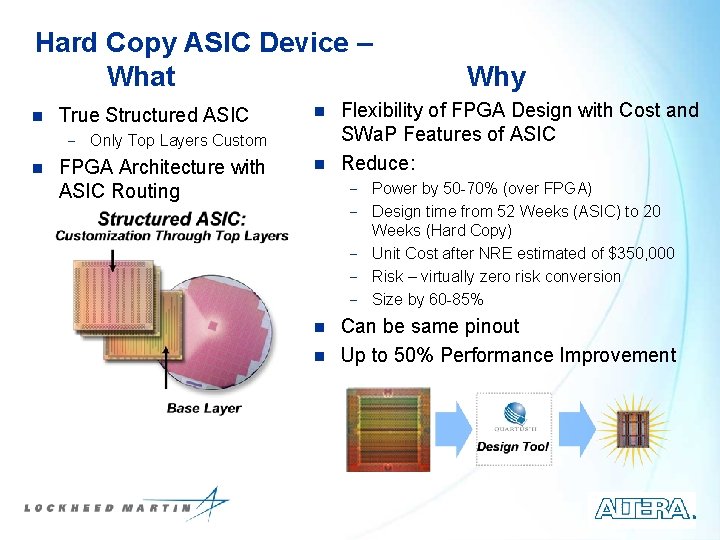
Hard Copy ASIC Device – What n True Structured ASIC n - Only Top Layers Custom n FPGA Architecture with ASIC Routing n Why Flexibility of FPGA Design with Cost and SWa. P Features of ASIC Reduce: - Power by 50 -70% (over FPGA) - Design time from 52 Weeks (ASIC) to 20 Weeks (Hard Copy) - Unit Cost after NRE estimated of $350, 000 - Risk – virtually zero risk conversion - Size by 60 -85% n n Can be same pinout Up to 50% Performance Improvement
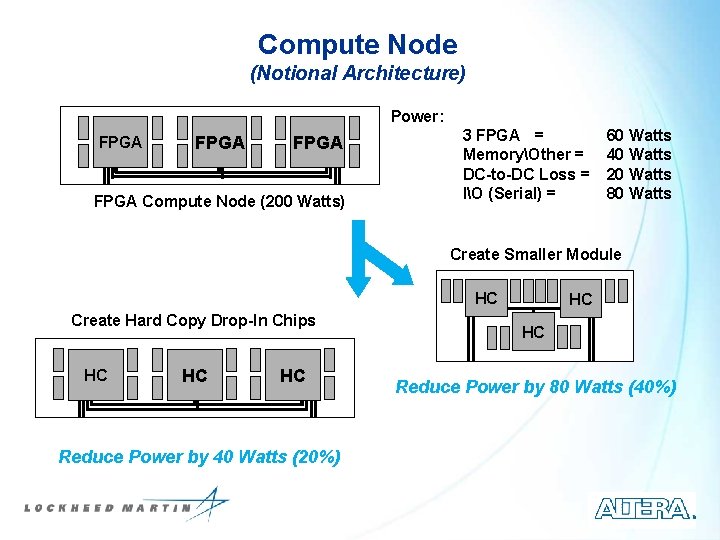
Compute Node (Notional Architecture) Power: FPGA Compute Node (200 Watts) 3 FPGA = MemoryOther = DC-to-DC Loss = IO (Serial) = 60 Watts 40 Watts 20 Watts 80 Watts Create Smaller Module HC Create Hard Copy Drop-In Chips HC HC HC Reduce Power by 40 Watts (20%) HC HC Reduce Power by 80 Watts (40%)