
Prototyping a new hightemperature SQUID magnetometer system J
- Slides: 1
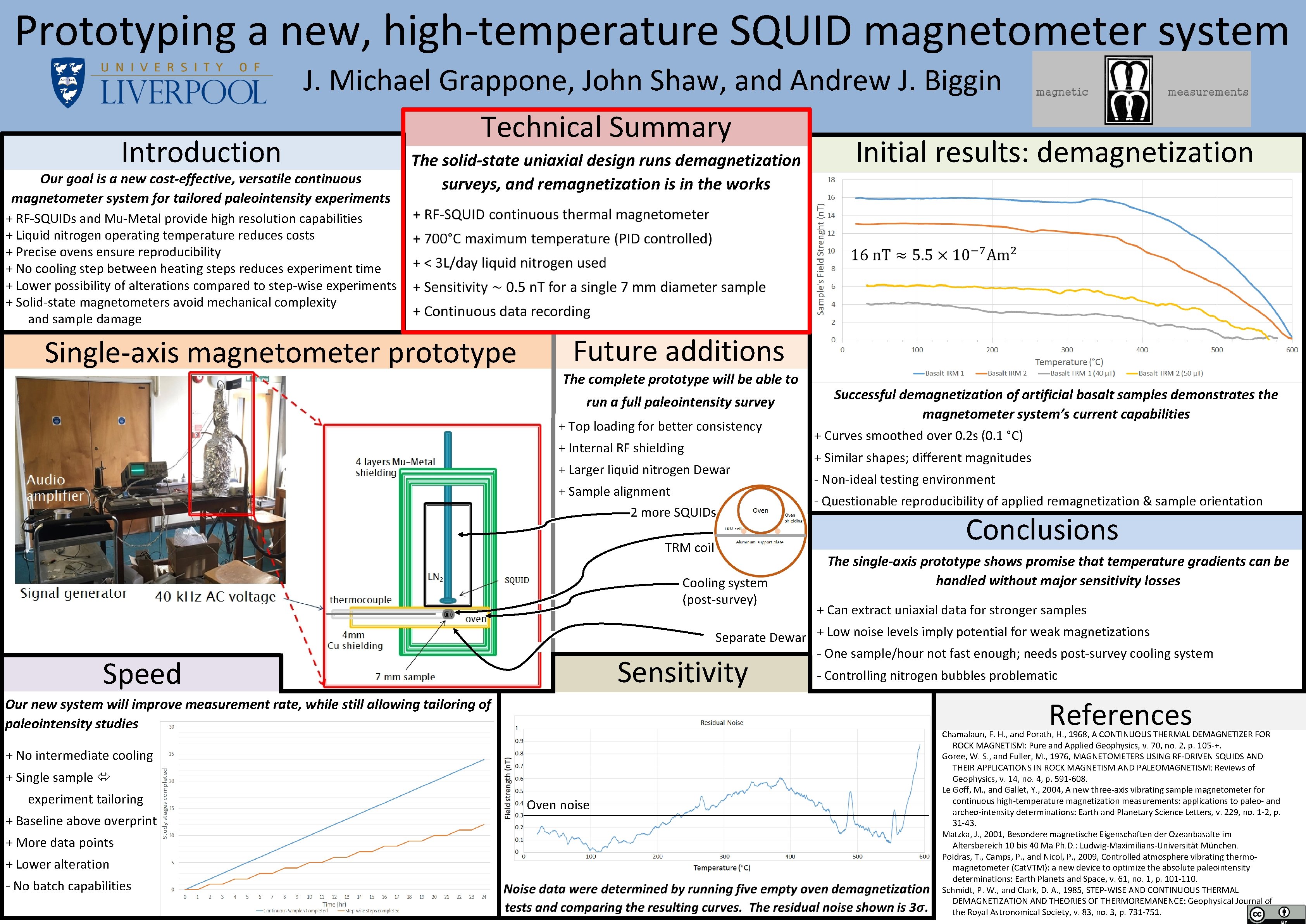
Prototyping a new, high-temperature SQUID magnetometer system J. Michael Grappone, John Shaw, and Andrew J. Biggin Technical Summary Introduction Initial results: demagnetization The solid-state uniaxial design runs demagnetization Our goal is a new cost-effective, versatile continuous magnetometer system for tailored paleointensity experiments surveys, and remagnetization is in the works + RF-SQUIDs and Mu-Metal provide high resolution capabilities + Liquid nitrogen operating temperature reduces costs + Precise ovens ensure reproducibility + No cooling step between heating steps reduces experiment time + Lower possibility of alterations compared to step-wise experiments + Solid-state magnetometers avoid mechanical complexity and sample damage Single-axis magnetometer prototype Future additions The complete prototype will be able to run a full paleointensity survey + Top loading for better consistency + Internal RF shielding + Larger liquid nitrogen Dewar + Sample alignment 2 more SQUIDs TRM coil Cooling system (post-survey) Sensitivity + No intermediate cooling + Single sample + More data points + Lower alteration - No batch capabilities + Similar shapes; different magnitudes - Non-ideal testing environment - Questionable reproducibility of applied remagnetization & sample orientation Conclusions The single-axis prototype shows promise that temperature gradients can be handled without major sensitivity losses + Can extract uniaxial data for stronger samples - Controlling nitrogen bubbles problematic References Our new system will improve measurement rate, while still allowing tailoring of paleointensity studies + Baseline above overprint + Curves smoothed over 0. 2 s (0. 1 °C) + Low noise levels imply potential for weak magnetizations Separate Dewar - One sample/hour not fast enough; needs post-survey cooling system Speed experiment tailoring Successful demagnetization of artificial basalt samples demonstrates the magnetometer system’s current capabilities Oven noise Chamalaun, F. H. , and Porath, H. , 1968, A CONTINUOUS THERMAL DEMAGNETIZER FOR ROCK MAGNETISM: Pure and Applied Geophysics, v. 70, no. 2, p. 105 -+. Goree, W. S. , and Fuller, M. , 1976, MAGNETOMETERS USING RF-DRIVEN SQUIDS AND THEIR APPLICATIONS IN ROCK MAGNETISM AND PALEOMAGNETISM: Reviews of Geophysics, v. 14, no. 4, p. 591 -608. Le Goff, M. , and Gallet, Y. , 2004, A new three-axis vibrating sample magnetometer for continuous high-temperature magnetization measurements: applications to paleo- and archeo-intensity determinations: Earth and Planetary Science Letters, v. 229, no. 1 -2, p. 31 -43. Matzka, J. , 2001, Besondere magnetische Eigenschaften der Ozeanbasalte im Altersbereich 10 bis 40 Ma Ph. D. : Ludwig-Maximilians-Universität München. Poidras, T. , Camps, P. , and Nicol, P. , 2009, Controlled atmosphere vibrating thermomagnetometer (Cat. VTM): a new device to optimize the absolute paleointensity determinations: Earth Planets and Space, v. 61, no. 1, p. 101 -110. Schmidt, P. W. , and Clark, D. A. , 1985, STEP-WISE AND CONTINUOUS THERMAL DEMAGNETIZATION AND THEORIES OF THERMOREMANENCE: Geophysical Journal of the Royal Astronomical Society, v. 83, no. 3, p. 731 -751.