
Prototype of a Muon Tomography Station with GEM


- Slides: 18
Prototype of a Muon Tomography Station with GEM Detectors for Detection of Shielded Nuclear Contraband Michael Staib 1 V. Bhopatkar 1, W. Bittner 1, K. Gnanvo 1, 2, L. Grasso 1, M. Hohlmann 1, J. B. Locke 1, J. Twigger 1 1 Dept. of Physics & Space Sciences, Florida Institute of Technology 2 now at University of Virginia 2012 April APS Meeting, Atlanta, GA
Outline Muon Tomography Cubic-foot MTS with GEMs Experimental Results • Concept of Muon Tomography and previous work. • Prototype cubic-foot Muon Tomography Station (MTS) with GEM Detectors. • The Gas Electron Multiplier (GEM) detector. • DAQ electronics and analysis software. • Experimental tomographic reconstructions of shielded and unshielded high-Z materials using this prototype. Future Work
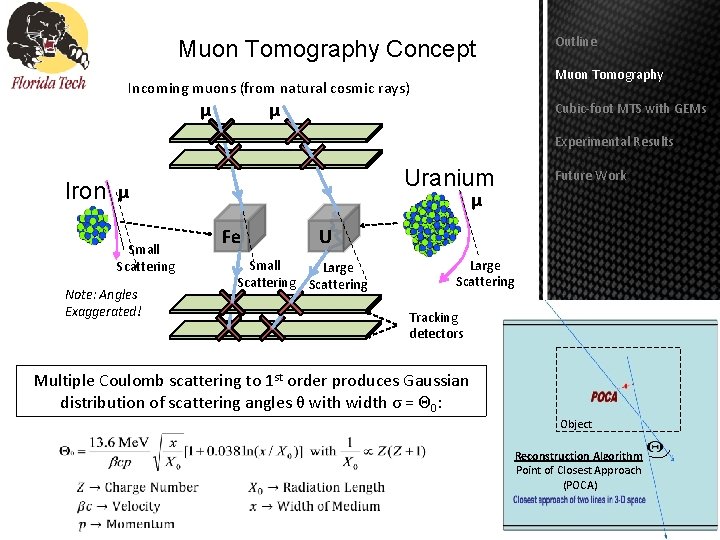
Muon Tomography Concept Muon Tomography Incoming muons cosmic rays) μ (from natural μ μ μ Outline Cubic-foot MTS with GEMs Experimental Results Uranium Iron μ Small Scattering Note: Angles Exaggerated! Future Work μ Fe U Small Large Scattering Tracking detectors Multiple Coulomb scattering to 1 st order produces Gaussian distribution of scattering angles θ with width σ = Θ 0: Object Reconstruction Algorithm Point of Closest Approach (POCA)
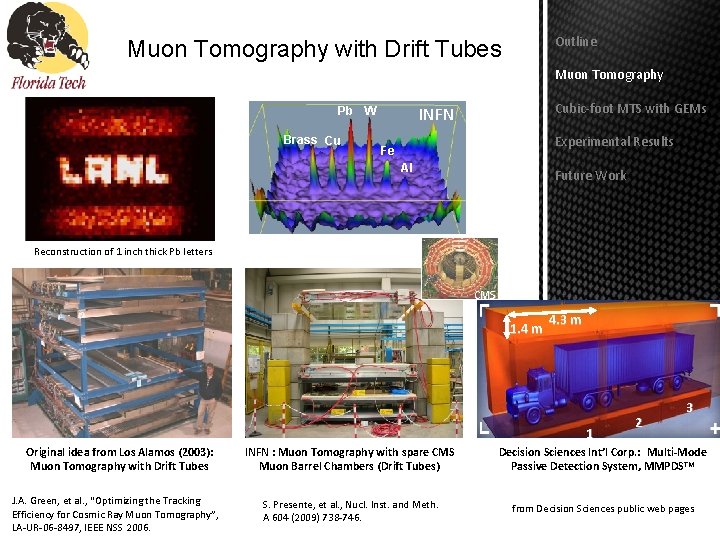
Outline Muon Tomography with Drift Tubes Muon Tomography Brass Cu Cubic-foot MTS with GEMs INFN Pb W Experimental Results Fe Al Future Work Reconstruction of 1 inch thick Pb letters CMS 1. 4 m 4. 3 m 1 Original idea from Los Alamos (2003): Muon Tomography with Drift Tubes J. A. Green, et al. , “Optimizing the Tracking Efficiency for Cosmic Ray Muon Tomography”, LA-UR-06 -8497, IEEE NSS 2006. 2 3 INFN : Muon Tomography with spare CMS Muon Barrel Chambers (Drift Tubes) Decision Sciences Int’l Corp. : Multi-Mode Passive Detection System, MMPDSTM S. Presente, et al. , Nucl. Inst. and Meth. A 604 (2009) 738 -746. from Decision Sciences public web pages
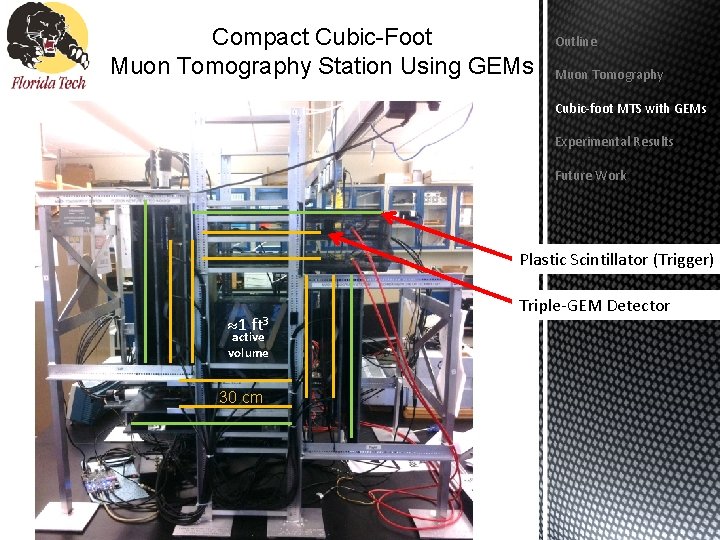
Compact Cubic-Foot Muon Tomography Station Using GEMs Outline Muon Tomography Cubic-foot MTS with GEMs Experimental Results Future Work Plastic Scintillator (Trigger) 1 ft 3 active volume 30 cm Triple-GEM Detector
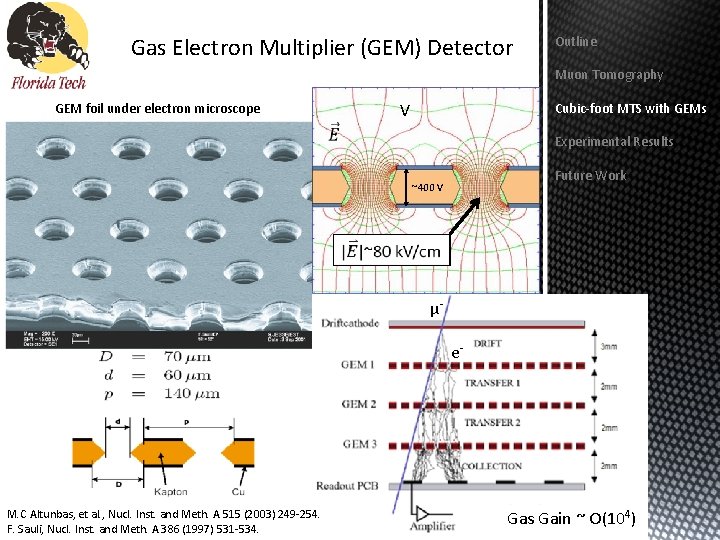
Gas Electron Multiplier (GEM) Detector Outline Muon Tomography GEM foil under electron microscope V Cubic-foot MTS with GEMs Experimental Results Future Work ~400 V μe- M. C Altunbas, et al. , Nucl. Inst. and Meth. A 515 (2003) 249 -254. F. Sauli, Nucl. Inst. and Meth. A 386 (1997) 531 -534. Gas Gain ~ O(104)
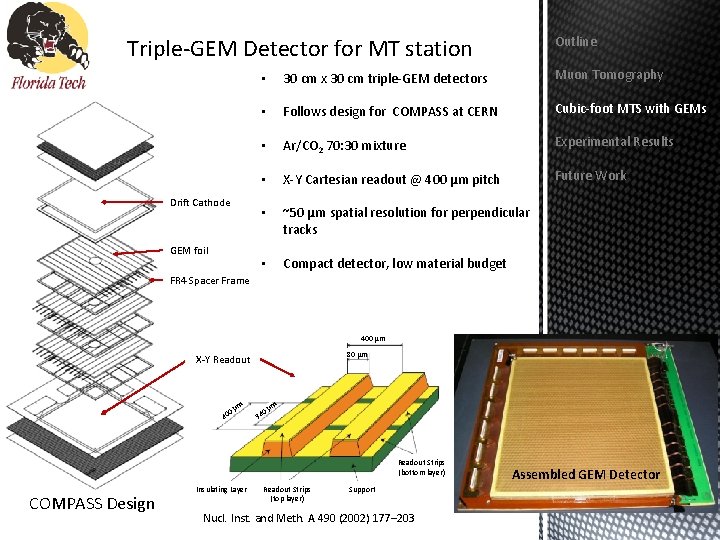
Outline Triple-GEM Detector for MT station Drift Cathode GEM foil • 30 cm x 30 cm triple-GEM detectors Muon Tomography • Follows design for COMPASS at CERN Cubic-foot MTS with GEMs • Ar/CO 2 70: 30 mixture Experimental Results • X-Y Cartesian readout @ 400 μm pitch Future Work • ~50 µm spatial resolution for perpendicular tracks • Compact detector, low material budget FR 4 Spacer Frame 400 μm 80 μm X-Y Readout m 0μ 40 m 0μ 34 Readout Strips (bottom layer) COMPASS Design Insulating Layer Readout Strips (top layer) Support Nucl. Inst. and Meth. A 490 (2002) 177– 203 Assembled GEM Detector
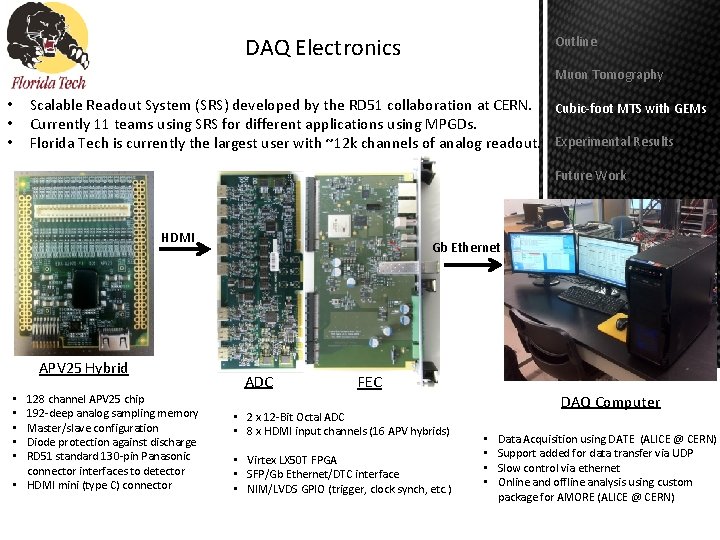
DAQ Electronics Outline Muon Tomography Scalable Readout System (SRS) developed by the RD 51 collaboration at CERN. Cubic-foot MTS with GEMs Currently 11 teams using SRS for different applications using MPGDs. Florida Tech is currently the largest user with ~12 k channels of analog readout. Experimental Results • • • Future Work HDMI APV 25 Hybrid 128 channel APV 25 chip 192 -deep analog sampling memory Master/slave configuration Diode protection against discharge RD 51 standard 130 -pin Panasonic connector interfaces to detector • HDMI mini (type C) connector • • • Gb Ethernet ADC FEC • 2 x 12 -Bit Octal ADC • 8 x HDMI input channels (16 APV hybrids) • Virtex LX 50 T FPGA • SFP/Gb Ethernet/DTC interface • NIM/LVDS GPIO (trigger, clock synch, etc. ) DAQ Computer • • Data Acquisition using DATE (ALICE @ CERN) Support added for data transfer via UDP Slow control via ethernet Online and offline analysis using custom package for AMORE (ALICE @ CERN)
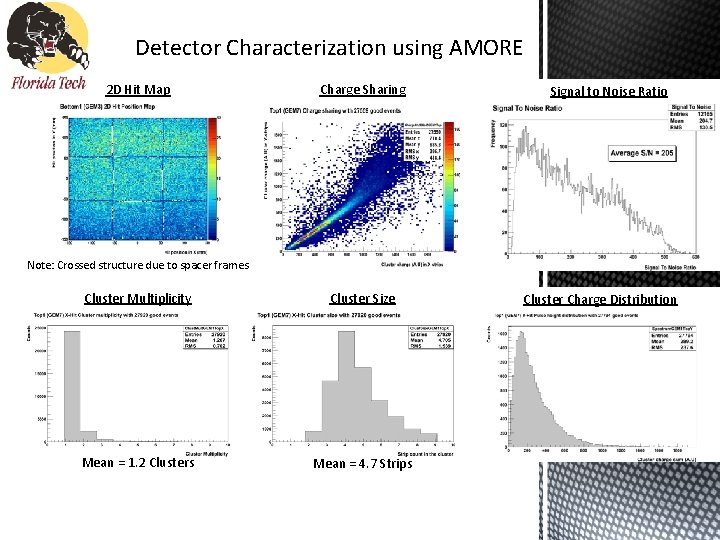
Detector Characterization using AMORE 2 D Hit Map Charge Sharing Signal to Noise Ratio Note: Crossed structure due to spacer frames Cluster Multiplicity Cluster Size Mean = 1. 2 Clusters Mean = 4. 7 Strips Cluster Charge Distribution
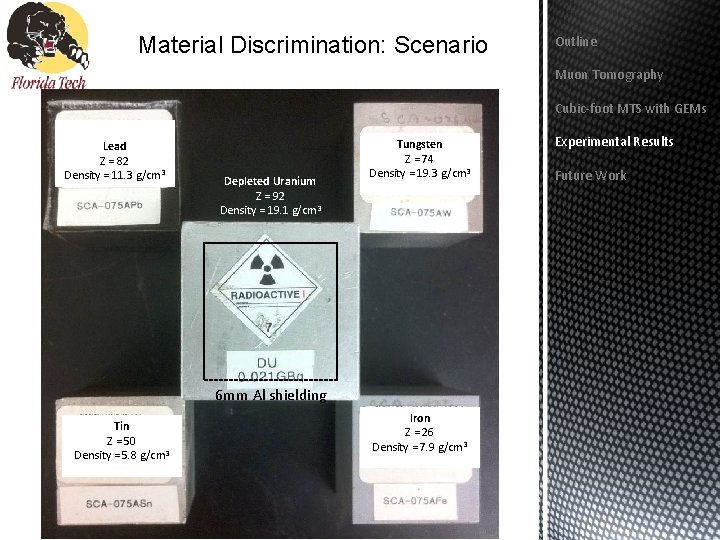
Material Discrimination: Scenario Outline Muon Tomography Cubic-foot MTS with GEMs Lead Z = 82 Density = 11. 3 g/cm 3 Depleted Uranium Z = 92 Density = 19. 1 g/cm 3 Tungsten Z = 74 Density = 19. 3 g/cm 3 6 mm Al shielding Tin Z = 50 Density = 5. 8 g/cm 3 Iron Z = 26 Density = 7. 9 g/cm 3 Experimental Results Future Work
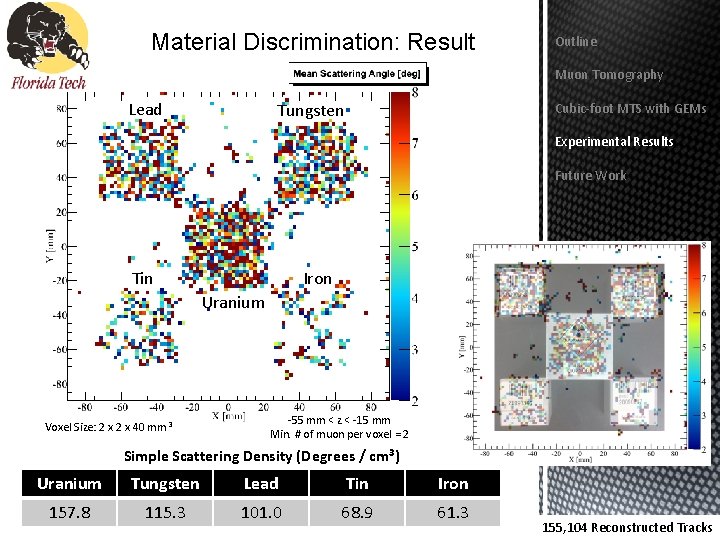
Material Discrimination: Result Outline Muon Tomography Lead Tungsten Cubic-foot MTS with GEMs Experimental Results Future Work Tin Iron Uranium Voxel Size: 2 x 40 mm 3 -55 mm < z < -15 mm Min. # of muon per voxel = 2 Simple Scattering Density (Degrees / cm 3) Uranium Tungsten Lead Tin Iron 157. 8 115. 3 101. 0 68. 9 61. 3 155, 104 Reconstructed Tracks
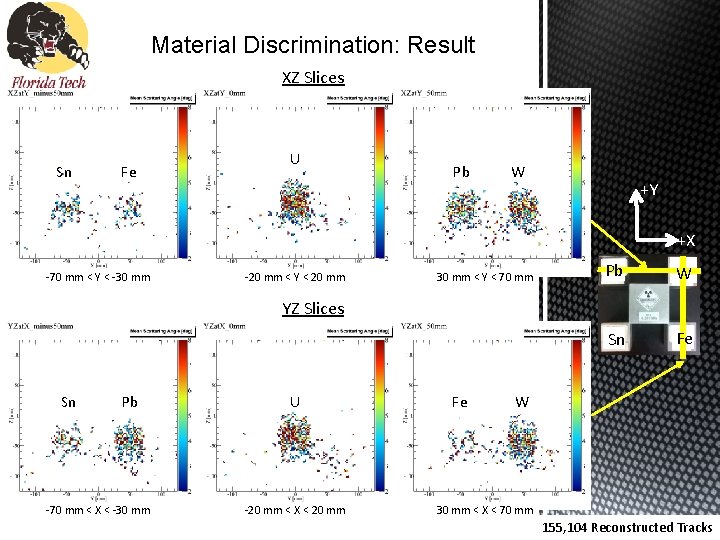
Material Discrimination: Result XZ Slices Sn Fe U Pb W +Y +X -70 mm < Y < -30 mm -20 mm < Y < 20 mm 30 mm < Y < 70 mm Pb W Sn Fe YZ Slices Sn Pb -70 mm < X < -30 mm U -20 mm < X < 20 mm Fe W 30 mm < X < 70 mm 155, 104 Reconstructed Tracks
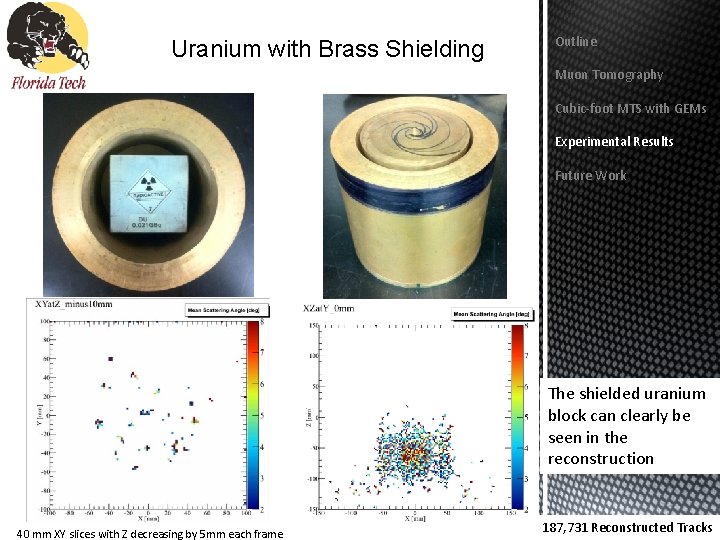
Uranium with Brass Shielding Outline Muon Tomography Cubic-foot MTS with GEMs Experimental Results Future Work The shielded uranium block can clearly be seen in the reconstruction 40 mm XY slices with Z decreasing by 5 mm each frame 187, 731 Reconstructed Tracks
Future Work Outline Muon Tomography Cubic-foot MTS with GEMs • Increase the number of GEM detectors per tracking module to improve reconstruction. • Redesign support structure to allow more freedom in detector orientation. • Implement statistical reconstruction methods and POCA clustering algorithms. • Improve tracking and sensor alignment methods in the AMORE analysis package. • Include a measurement of muon momentum in the reconstruction. • Scale up! (Next goal is ~1 m 3 active volume) Experimental Results Future Work
Thanks! Questions? Disclaimer: This material is based upon work supported in part by the U. S. Department of Homeland Security under Grant Award Number 2007 -DN-077 -ER 0006 -02. The views and conclusions contained in this document are those of the authors and should not be interpreted as necessarily representing the official policies, either expressed or implied, of the U. S. Department of Homeland Security.
Backup Slides
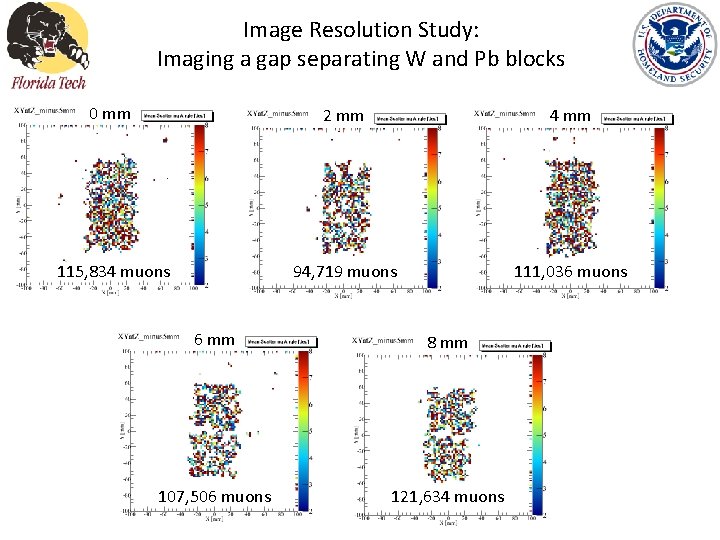
Image Resolution Study: Imaging a gap separating W and Pb blocks 0 mm 2 mm 4 mm 115, 834 muons 94, 719 muons 111, 036 muons 6 mm 8 mm 107, 506 muons 121, 634 muons
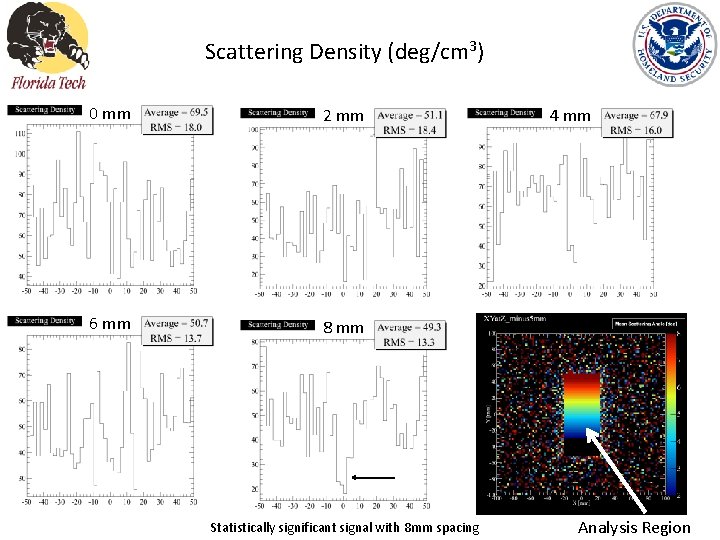
Scattering Density (deg/cm 3) 0 mm 2 mm 6 mm 8 mm Statistically significant signal with 8 mm spacing 4 mm Analysis Region