
Proton Transfer and LowBarrier Hydrogen Bonding Shifting Vibrational
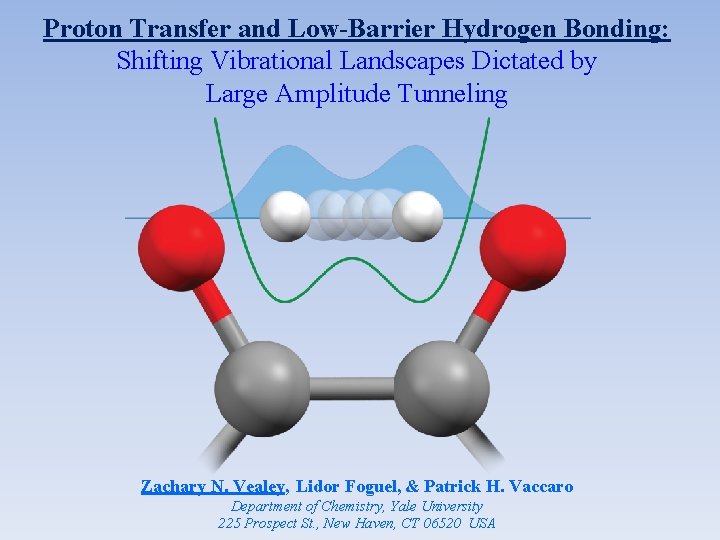
Proton Transfer and Low-Barrier Hydrogen Bonding: Shifting Vibrational Landscapes Dictated by Large Amplitude Tunneling Zachary N. Vealey, Lidor Foguel, & Patrick H. Vaccaro Department of Chemistry, Yale University 225 Prospect St. , New Haven, CT 06520 USA
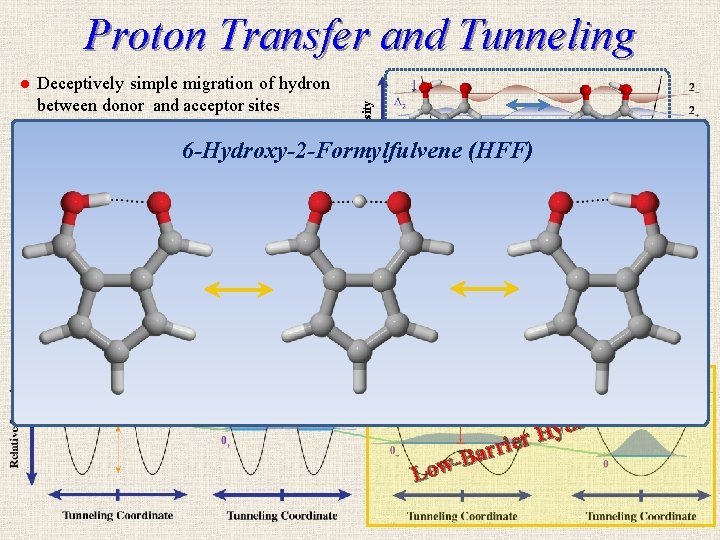
● Deceptively simple migration of hydron between donor and acceptor sites Relative Intensity Proton Transfer and Tunneling ● Unimolecular transformation represents a 6 -Hydroxy-2 -Formylfulvene prototypical chemical reaction ● Model systems provide valuable insight for dynamics in much larger entities ● Tunneling-mediated pathways promoted by the small mass of labile proton MA (HFF) Tr. OH Tunneling Coordinate Proton-Transfer Rate: Continuum of Hydrogen Bonding and Tunneling Dynamics nd o B n e g o dr y H er i r r a B w Lo
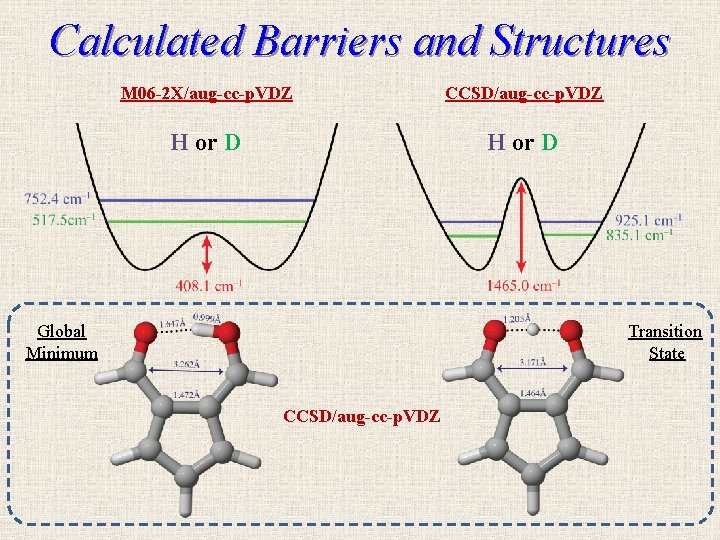
Calculated Barriers and Structures M 06 -2 X/aug-cc-p. VDZ CCSD/aug-cc-p. VDZ H or D Global Minimum Transition State CCSD/aug-cc-p. VDZ
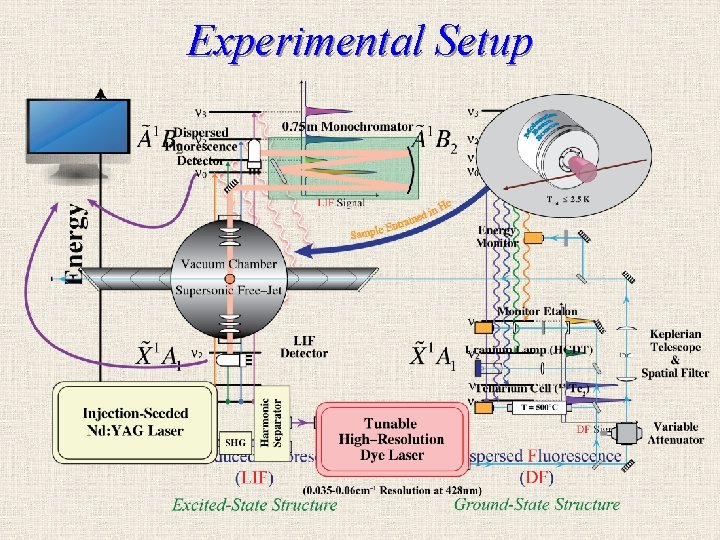
Experimental Setup
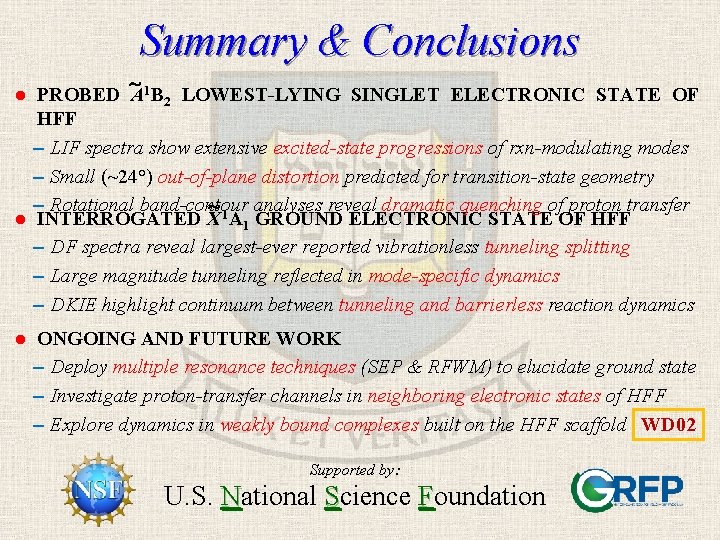
Summary & Conclusions ~ ● PROBED A 1 B 2 LOWEST-LYING SINGLET ELECTRONIC STATE OF HFF – LIF spectra show extensive excited-state progressions of rxn-modulating modes – Small (~24°) out-of-plane distortion predicted for transition-state geometry – Rotational band-contour ~ 1 analyses reveal dramatic quenching of proton transfer ● INTERROGATED X A 1 GROUND ELECTRONIC STATE OF HFF – DF spectra reveal largest-ever reported vibrationless tunneling splitting – Large magnitude tunneling reflected in mode-specific dynamics – DKIE highlight continuum between tunneling and barrierless reaction dynamics ● ONGOING AND FUTURE WORK – Deploy multiple resonance techniques (SEP & RFWM) to elucidate ground state – Investigate proton-transfer channels in neighboring electronic states of HFF – Explore dynamics in weakly bound complexes built on the HFF scaffold WD 02 Supported by: U. S. National Science Foundation
- Slides: 5