
PROTON PUMP INHIBITOR AND HISTAMINE 2 RECEPTOR ANTAGONIST
PROTON PUMP INHIBITOR AND HISTAMINE 2 RECEPTOR ANTAGONIST USE AND VITAMIN B 12 DEFICIENCY Tamara Lallier, Pharm. D, MBA PGY-1 Resident Pharmacist Northeast Iowa Family Practice Center Waverly Health Center
ARTICLE INFORMATION Lam J, Schneider JL, Zhao W, Corley DA. (December 2013) Proton Pump Inhibitor and Histamine 2 Receptor Antagonist Use and Vitamin B 12 Deficiency. JAMA 310: 22, 2435 -2442. Funding: � Kaiser Permanente Community Benefit Grant
BACKGROUND Vitamin B 12 deficiency � Dementia, Risk neurologic damage, anemia factors � Chronic alcoholism � Atrophic gastritis � Pernicious anemia � H. pylori infection � Long-term use of biguanides � Vegetarian/Vegan diet
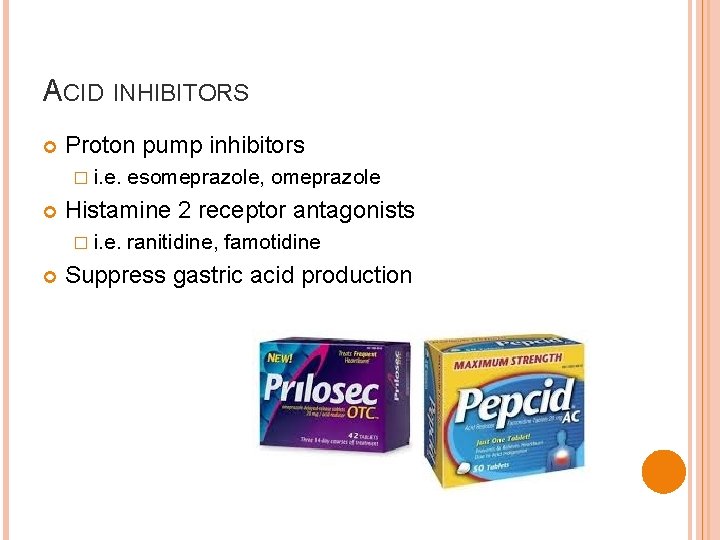
ACID INHIBITORS Proton pump inhibitors � i. e. Histamine 2 receptor antagonists � i. e. esomeprazole, omeprazole ranitidine, famotidine Suppress gastric acid production
PURPOSE To study the association between use of PPIs and H 2 RAs and vitamin B 12 deficiency in a communitybased setting in the United States
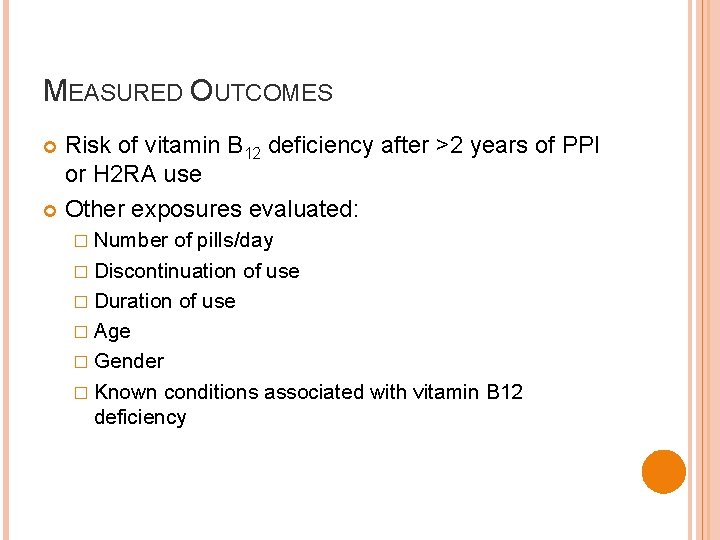
MEASURED OUTCOMES Risk of vitamin B 12 deficiency after >2 years of PPI or H 2 RA use Other exposures evaluated: � Number of pills/day � Discontinuation of use � Duration of use � Age � Gender � Known conditions associated with vitamin B 12 deficiency
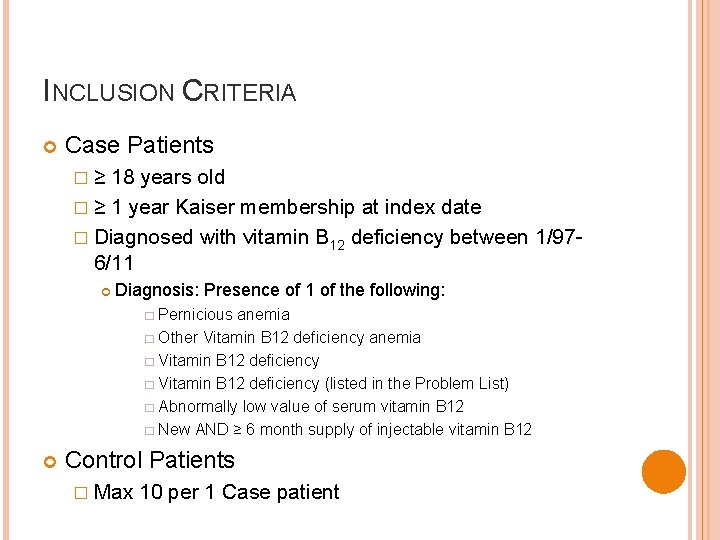
INCLUSION CRITERIA Case Patients �≥ 18 years old � ≥ 1 year Kaiser membership at index date � Diagnosed with vitamin B 12 deficiency between 1/976/11 Diagnosis: Presence of 1 of the following: � Pernicious anemia � Other Vitamin B 12 deficiency anemia � Vitamin B 12 deficiency (listed in the Problem List) � Abnormally low value of serum vitamin B 12 � New AND ≥ 6 month supply of injectable vitamin B 12 Control Patients � Max 10 per 1 Case patient
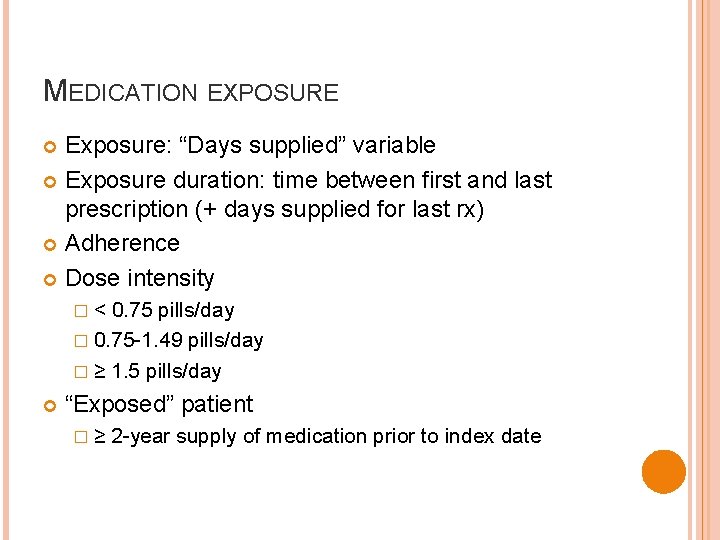
MEDICATION EXPOSURE Exposure: “Days supplied” variable Exposure duration: time between first and last prescription (+ days supplied for last rx) Adherence Dose intensity �< 0. 75 pills/day � 0. 75 -1. 49 pills/day � ≥ 1. 5 pills/day “Exposed” patient �≥ 2 -year supply of medication prior to index date
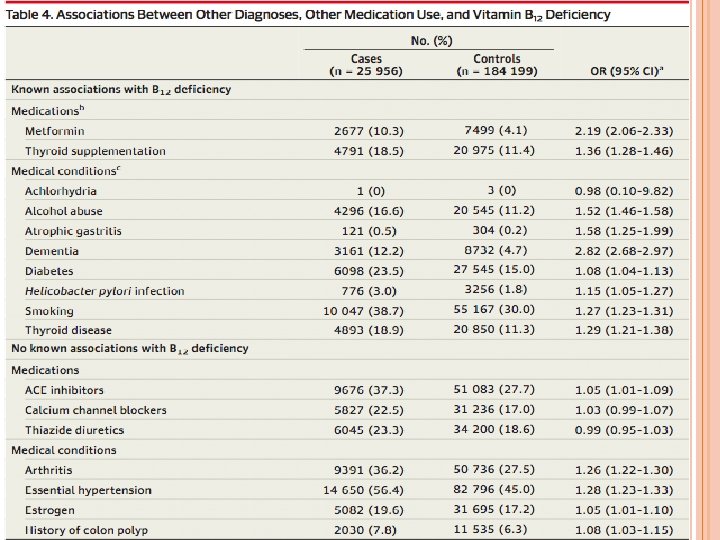
CONFOUNDING VARIABLES Other conditions Health care utilization Other commonly used medications � Estrogen, thiazides, ACE-Is, CCB GERD diagnosis Metformin exposure
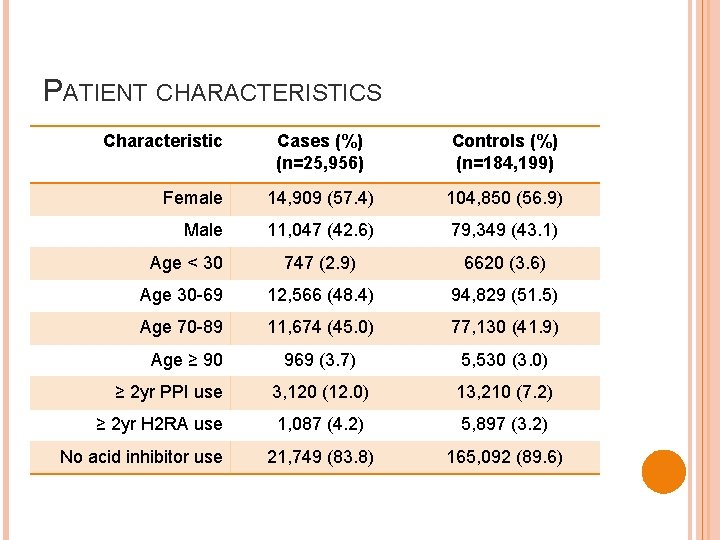
PATIENT CHARACTERISTICS Characteristic Cases (%) (n=25, 956) Controls (%) (n=184, 199) Female 14, 909 (57. 4) 104, 850 (56. 9) Male 11, 047 (42. 6) 79, 349 (43. 1) Age < 30 747 (2. 9) 6620 (3. 6) Age 30 -69 12, 566 (48. 4) 94, 829 (51. 5) Age 70 -89 11, 674 (45. 0) 77, 130 (41. 9) 969 (3. 7) 5, 530 (3. 0) ≥ 2 yr PPI use 3, 120 (12. 0) 13, 210 (7. 2) ≥ 2 yr H 2 RA use 1, 087 (4. 2) 5, 897 (3. 2) 21, 749 (83. 8) 165, 092 (89. 6) Age ≥ 90 No acid inhibitor use
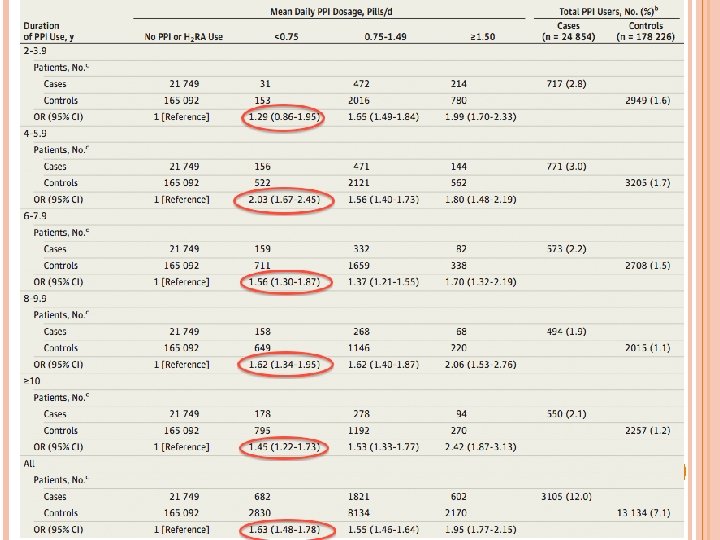
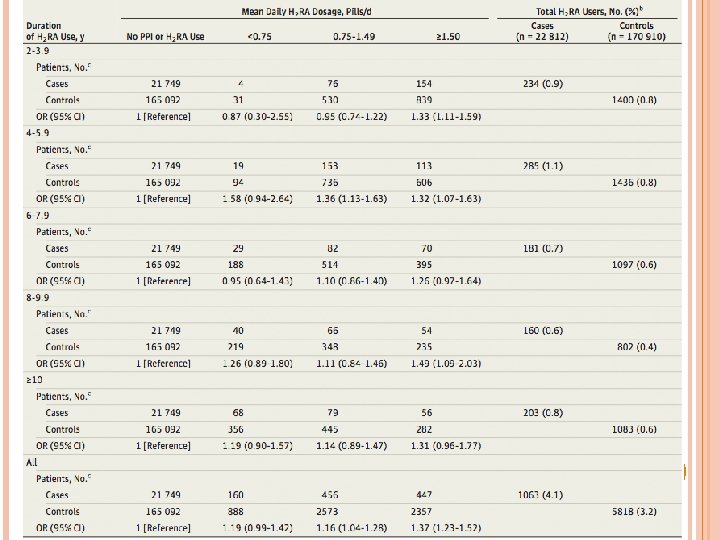
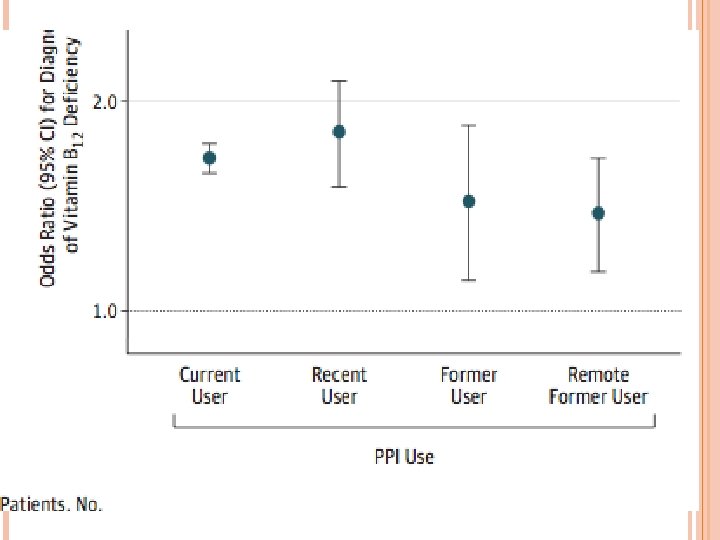
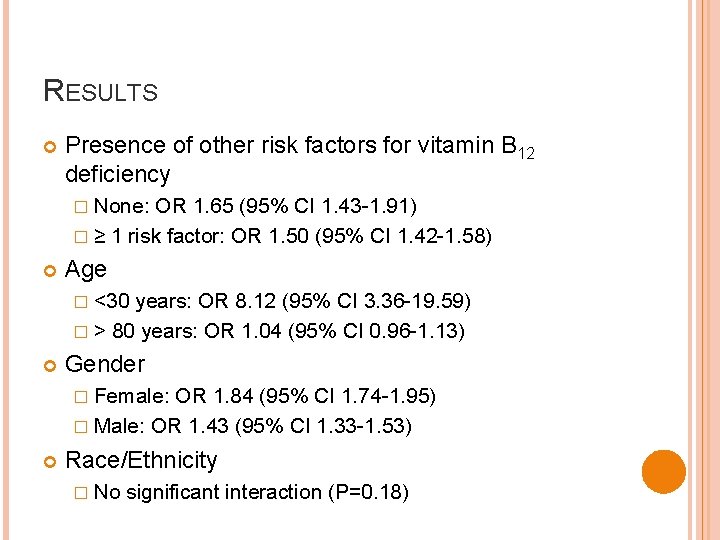
RESULTS Presence of other risk factors for vitamin B 12 deficiency � None: OR 1. 65 (95% CI 1. 43 -1. 91) � ≥ 1 risk factor: OR 1. 50 (95% CI 1. 42 -1. 58) Age � <30 years: OR 8. 12 (95% CI 3. 36 -19. 59) � > 80 years: OR 1. 04 (95% CI 0. 96 -1. 13) Gender � Female: OR 1. 84 (95% CI 1. 74 -1. 95) � Male: OR 1. 43 (95% CI 1. 33 -1. 53) Race/Ethnicity � No significant interaction (P=0. 18)
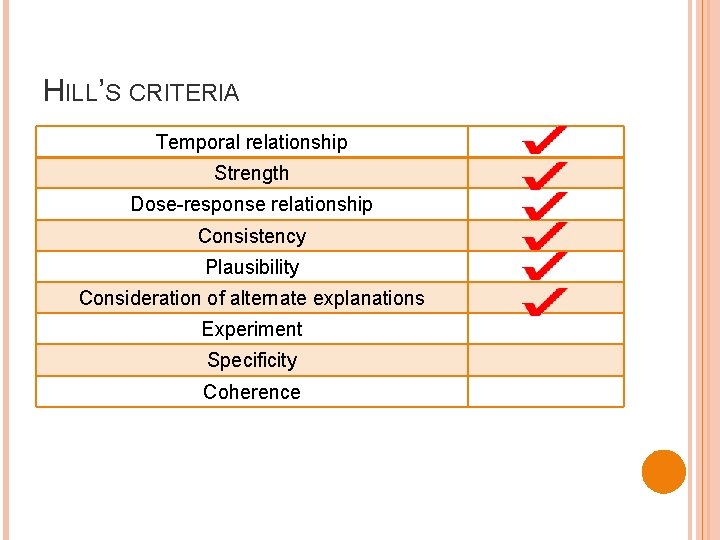
HILL’S CRITERIA Temporal relationship Strength Dose-response relationship Consistency Plausibility Consideration of alternate explanations Experiment Specificity Coherence
CONCLUSION Previous and current gastric acid inhibitor use was significantly associated with the presence of vitamin B 12 deficiency. These findings should be considered when balancing the risks and benefits of using these medications.
STRENGTHS Large size 15 years of data Retrieval of all recorded diagnoses Data for dispensed medication Generalizable control group Ability to evaluate several confounders
LIMITATIONS Case-control study Asymptomatic screening for patients No information on short-term or intermittent use Mean daily dose OTC product use Study location not generalizable
CLINICAL RELEVANCE ≥ 2 years of PPIs or H 2 RAs was associated with vitamin B 12 deficiency Screen symptomatic patients Continue use of these medications for patients who need them Recommend against higher doses Be aware of symptoms of B 12 deficiency
REFERENCES 1. Lam J, Schneider JL, Zhao W, Corley DA. (December 2013) Proton Pump Inhibitor and Histamine 2 Receptor Antagonist Use and Vitamin B 12 Deficiency. JAMA 310: 22, 24352442. Evatt MLMP, Bobo JK, Kimmons J, Williams J. Why Vitamin B 12 Deficiency Should be on Your Radar Screen. Centers for Disease Control and Prevention website. http: //www. cdc. gov/ncbddd/b 12/index. html. Accessed February 18, 2014. 3. Valuck RJ, Ruscin JM. A case-control study on adverse effects: H 2 blocker or proton pump inhibitor use and risks of vitamin B 12 deficiency in older adults. J Clin Epidemiol. 2004; 57(4): 422 -428.
QUESTIONS? PROTON PUMP INHIBITOR AND HISTAMINE 2 RECEPTOR ANTAGONIST USE AND VITAMIN B 12 DEFICIENCY Tamara Lallier, Pharm. D. , MBA PGY-1 Resident Pharmacist Northeast Iowa Family Practice Center Waverly Health Center
- Slides: 22