
Proton ID The Proton ID group led by
Proton ID The Proton ID group led by Gilvan Alves and Sergio Novaes has made substantial progress in many software areas: • Track reconstruction • Monte Carlo • Unpacking • Single Interaction Tool • Alignment • Database Regular Proton-ID meetings are held off-week Thursdays 11 -12: 30 in Black Hole using VRVS
Lessons Learned • Bigger project than you (I) might think: more manpower, time, cost, CABLES • Using other people’s electronics is risky • Need a budget and some level of priority (beyond the baseline syndrome) • Early integration is essential • Good contacts in the Accelerator Division are crucial • Halo not well-understood • Elastics or alignment, redundancy needed • Splicing fibers is painful
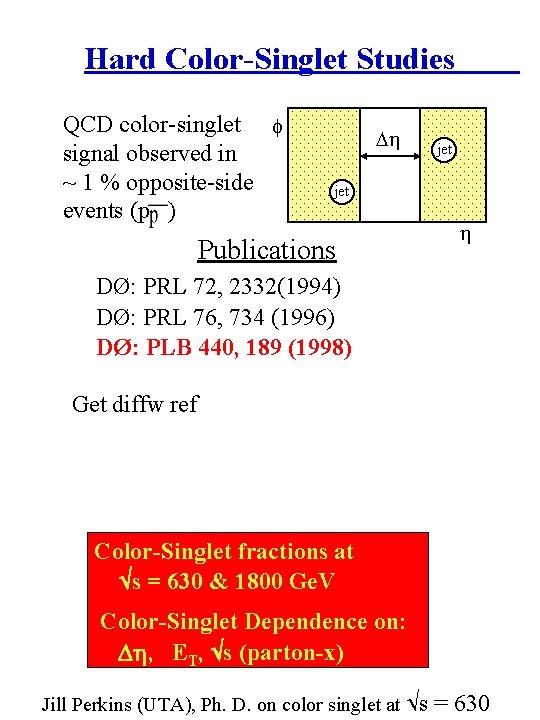
Hard Color-Singlet Studies QCD color-singlet f signal observed in ~ 1 % opposite-side events (p ) Dh jet Publications h DØ: PRL 72, 2332(1994) DØ: PRL 76, 734 (1996) DØ: PLB 440, 189 (1998) Get diffw ref Color-Singlet fractions at s = 630 & 1800 Ge. V Color-Singlet Dependence on: Dh, ET, s (parton-x) Jill Perkins (UTA), Ph. D. on color singlet at s = 630
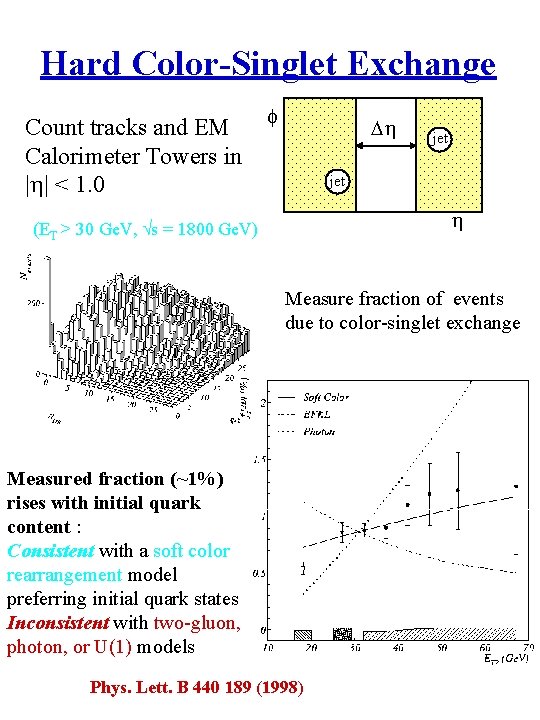
Hard Color-Singlet Exchange Count tracks and EM Calorimeter Towers in |h| < 1. 0 f Dh jet h (ET > 30 Ge. V, s = 1800 Ge. V) Measure fraction of events due to color-singlet exchange Measured fraction (~1%) rises with initial quark content : Consistent with a soft color rearrangement model preferring initial quark states Inconsistent with two-gluon, photon, or U(1) models Phys. Lett. B 440 189 (1998)
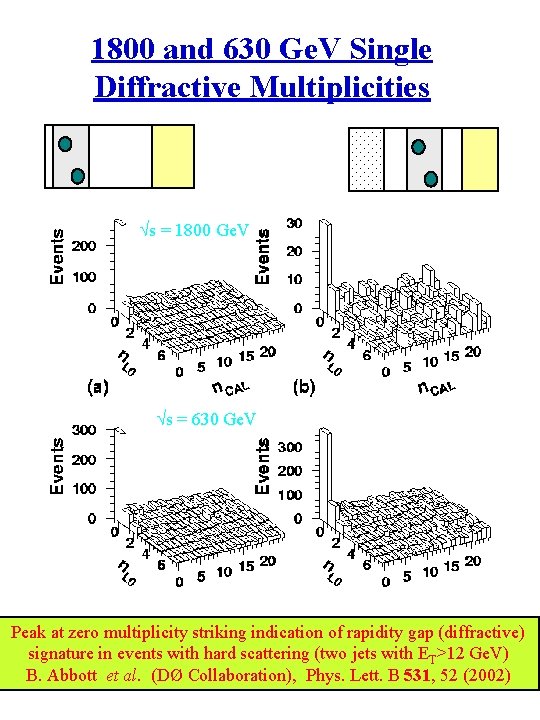
1800 and 630 Ge. V Single Diffractive Multiplicities s = 1800 Ge. V s = 630 Ge. V Peak at zero multiplicity striking indication of rapidity gap (diffractive) signature in events with hard scattering (two jets with ET>12 Ge. V) B. Abbott et al. (DØ Collaboration), Phys. Lett. B 531, 52 (2002)
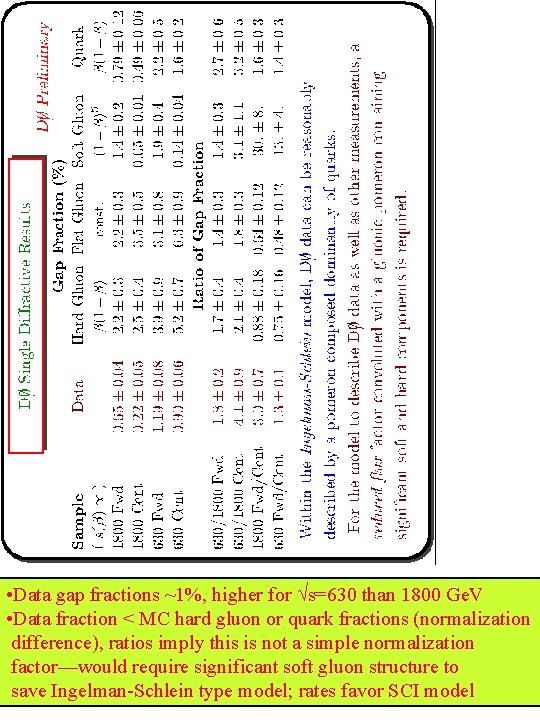
• Data gap fractions ~1%, higher for s=630 than 1800 Ge. V • Data fraction < MC hard gluon or quark fractions (normalization difference), ratios imply this is not a simple normalization factor—would require significant soft gluon structure to save Ingelman-Schlein type model; rates favor SCI model
- Slides: 6