
Protocols and the TCPIP Suite Lecture 12 Overview




- Slides: 50
Protocols and the TCP/IP Suite Lecture 12
Overview n n n n Requirement of Protocol Why Layered Approach is Adopted Key Features of a Protocol Simple Protocol Architecture Addressing TCP/IP and OSI model General Networking Terminology 2
The Need For Protocol Architecture 1. ) the source must activate communications path or inform network of destination 2. ) the source must make sure that destination is prepared to receive data To transfer data several tasks must be performed: 3. ) the file transfer application on source must confirm file management program at destination is prepared to accept and store file 4. ) a format translation function may need to be performed if the formats on systems are different 3
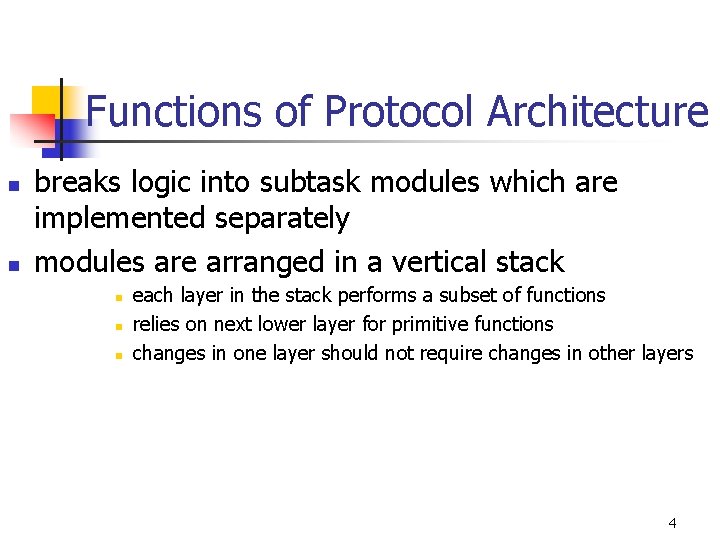
Functions of Protocol Architecture n n breaks logic into subtask modules which are implemented separately modules are arranged in a vertical stack n n n each layer in the stack performs a subset of functions relies on next lower layer for primitive functions changes in one layer should not require changes in other layers 4
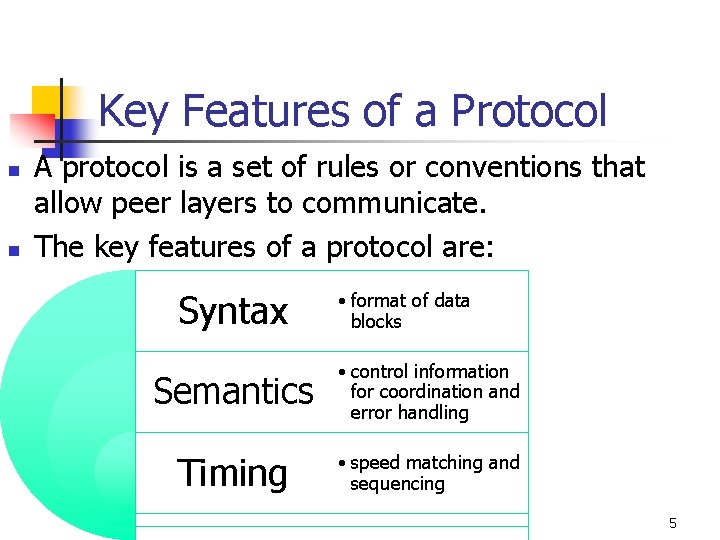
Key Features of a Protocol n n A protocol is a set of rules or conventions that allow peer layers to communicate. The key features of a protocol are: Syntax • format of data blocks Semantics • control information for coordination and error handling Timing • speed matching and sequencing 5
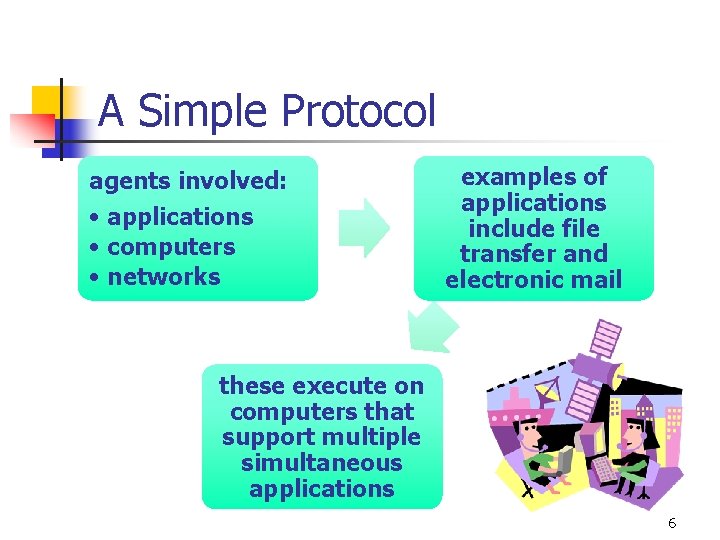
A Simple Protocol agents involved: • applications • computers • networks examples of applications include file transfer and electronic mail these execute on computers that support multiple simultaneous applications 6
Communication Layers n communication tasks are organized into three relatively independent layers: n n n Network access layer n concerned with the exchange of data Transport layer n provides reliable data transfer Application layer n Contains logic to support applications 7
Network Access Layer n n covers the exchange of data between an end system and the network that it is attached to concerned with issues like : n n n destination address provision invoking specific services like priority access to & routing data across a network for two end systems attached to the same network 8
Transport Layer concerned with providing reliable delivery of data essentially independent of the nature of the applications common layer shared by all applications 9
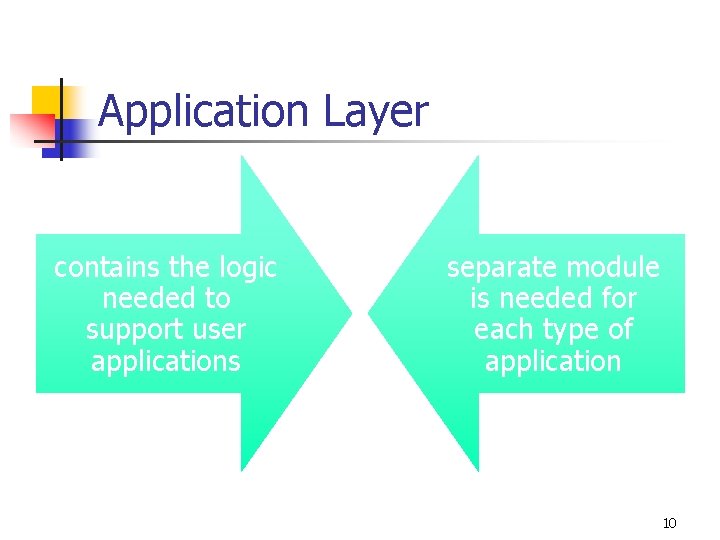
Application Layer contains the logic needed to support user applications separate module is needed for each type of application 10
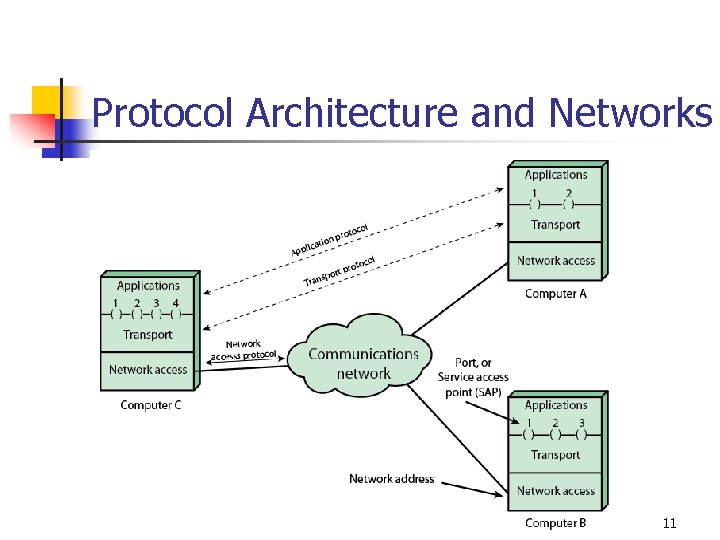
Protocol Architecture and Networks 11
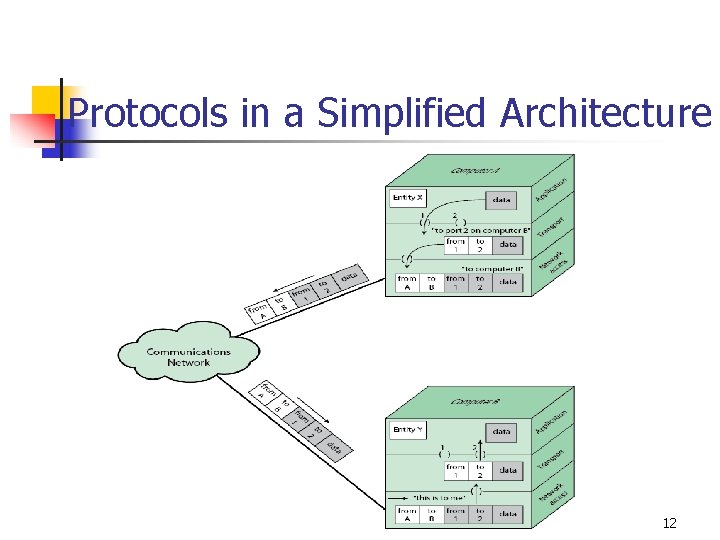
Protocols in a Simplified Architecture 12
13
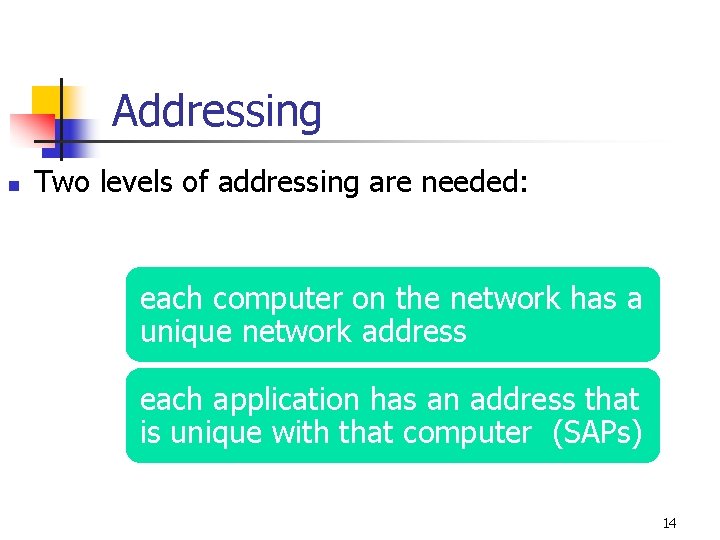
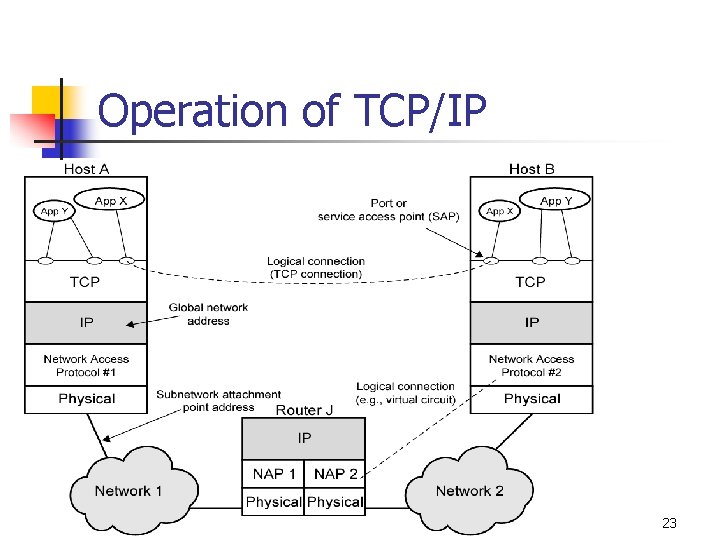
Addressing n Two levels of addressing are needed: each computer on the network has a unique network address each application has an address that is unique with that computer (SAPs) 14
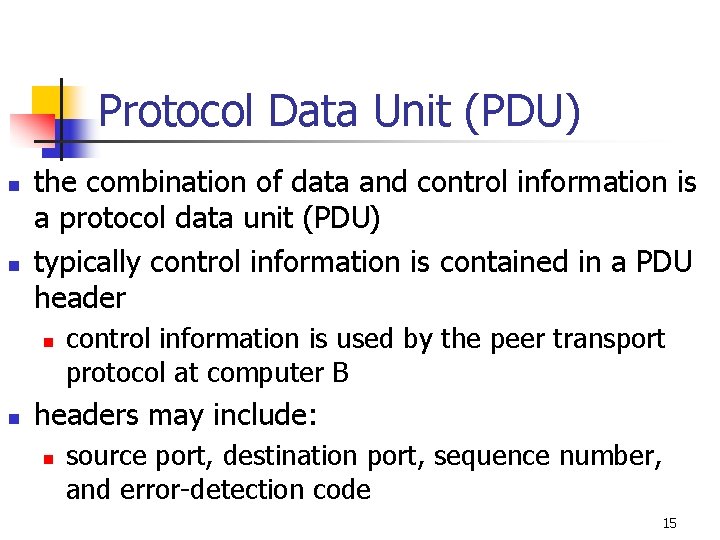
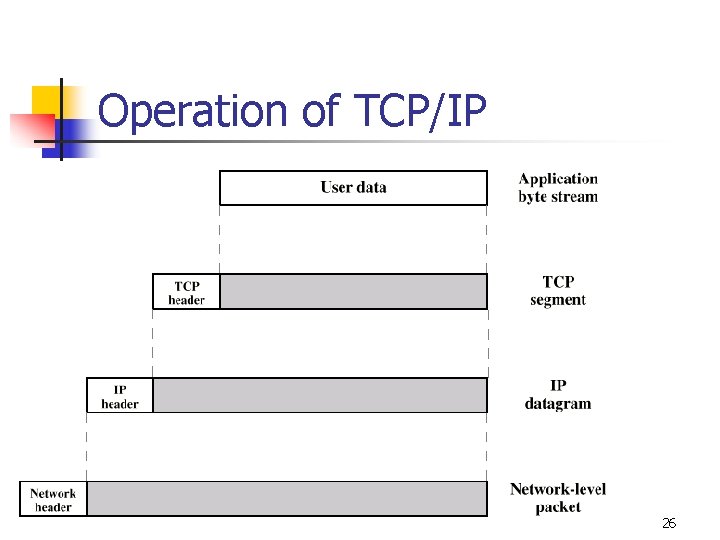
Protocol Data Unit (PDU) n n the combination of data and control information is a protocol data unit (PDU) typically control information is contained in a PDU header n n control information is used by the peer transport protocol at computer B headers may include: n source port, destination port, sequence number, and error-detection code 15
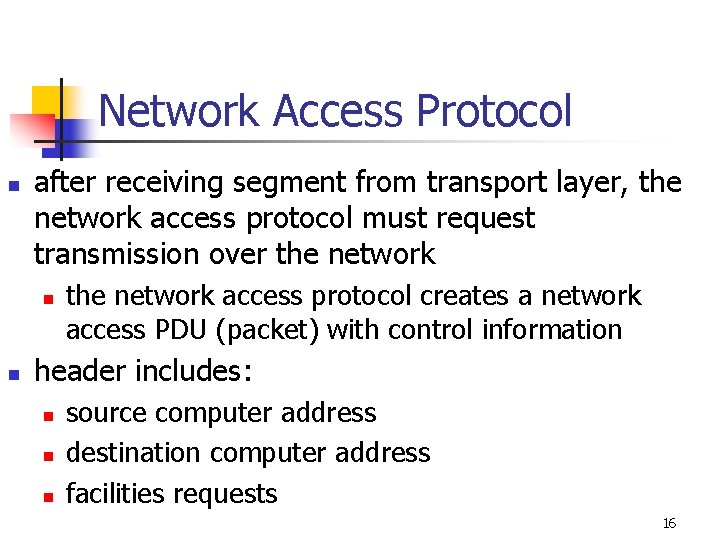
Network Access Protocol n after receiving segment from transport layer, the network access protocol must request transmission over the network n n the network access protocol creates a network access PDU (packet) with control information header includes: n n n source computer address destination computer address facilities requests 16
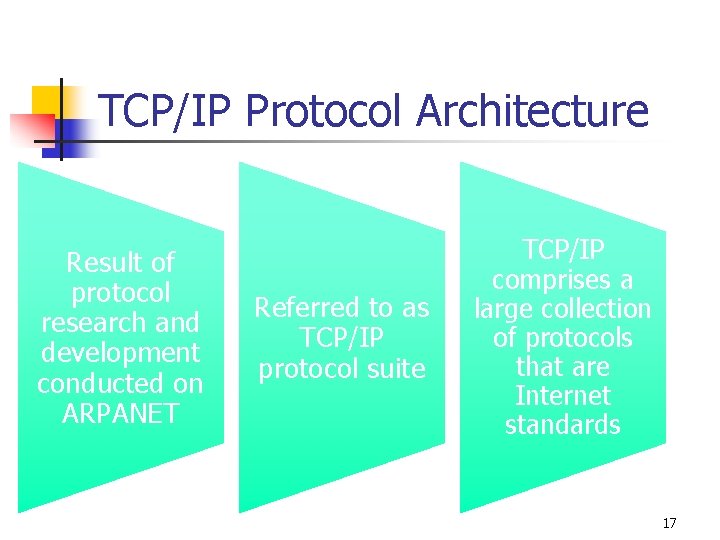
TCP/IP Protocol Architecture Result of protocol research and development conducted on ARPANET Referred to as TCP/IP protocol suite TCP/IP comprises a large collection of protocols that are Internet standards 17
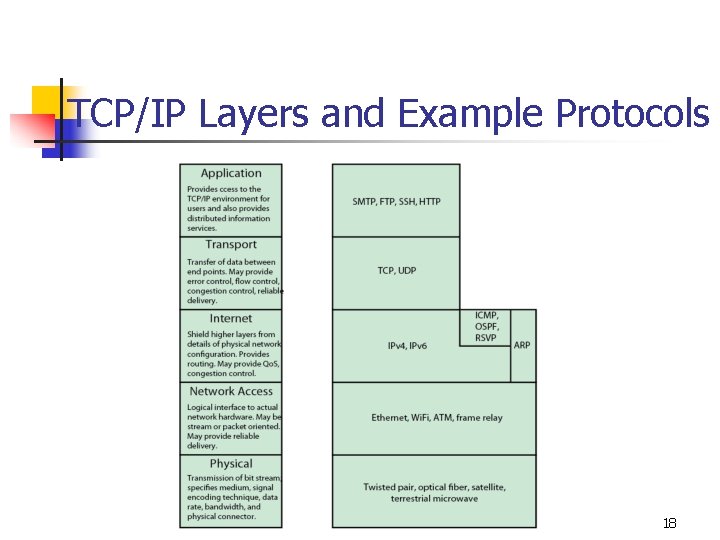
TCP/IP Layers and Example Protocols 18
Physical Layer n n covers the physical interface between computer and network concerned with issues like: n n n characteristics of transmission medium nature of the signals data rates 19
Network Access Layer n n covers the exchange of data between an end system and the network that it is attached to concerned with issues like : n n n destination address provision invoking specific services like priority access to & routing data across a network for two end systems attached to the same network 20
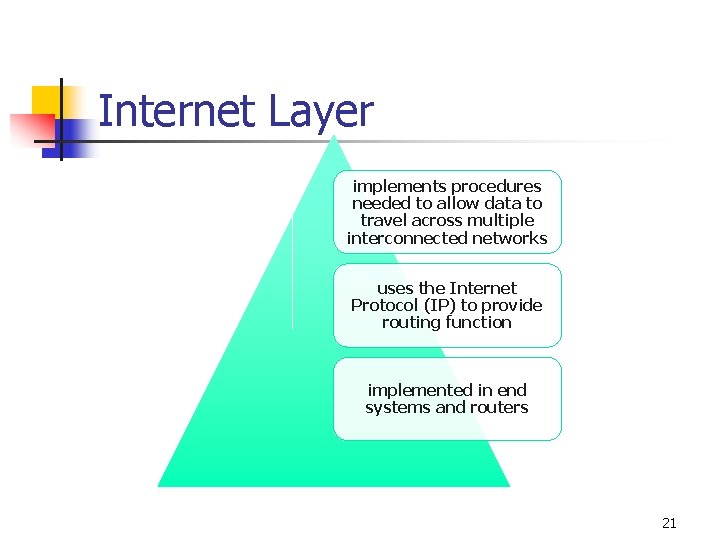
Internet Layer implements procedures needed to allow data to travel across multiple interconnected networks uses the Internet Protocol (IP) to provide routing function implemented in end systems and routers 21
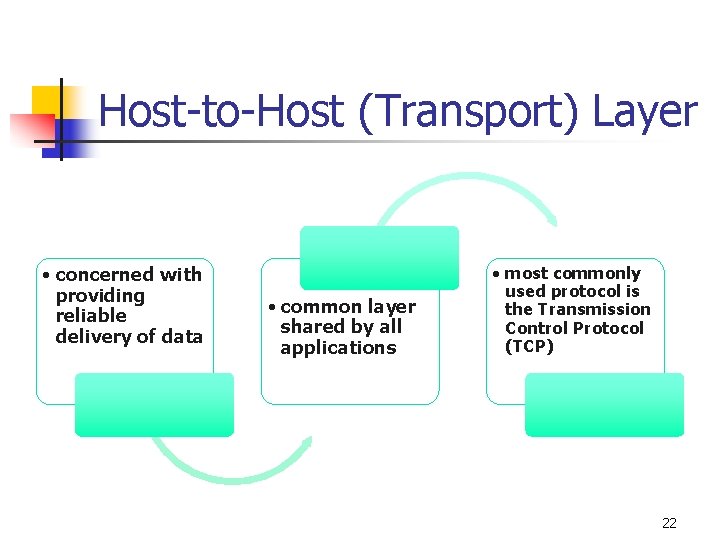
Host-to-Host (Transport) Layer • concerned with providing reliable delivery of data • common layer shared by all applications • most commonly used protocol is the Transmission Control Protocol (TCP) 22
Operation of TCP/IP 23
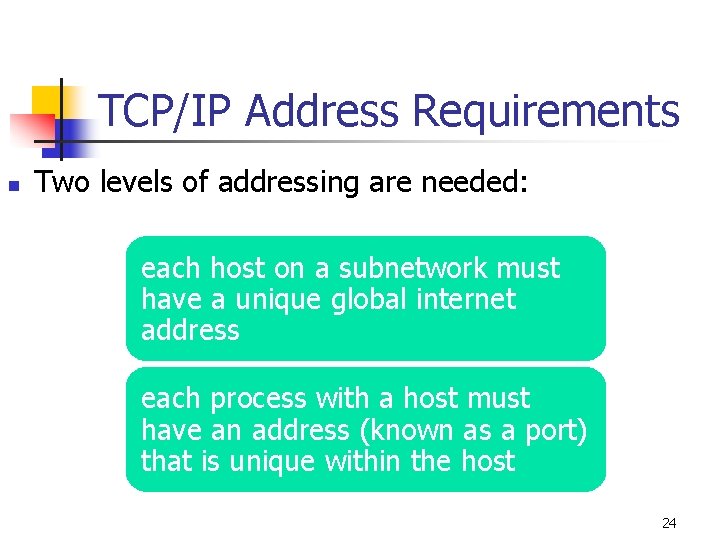
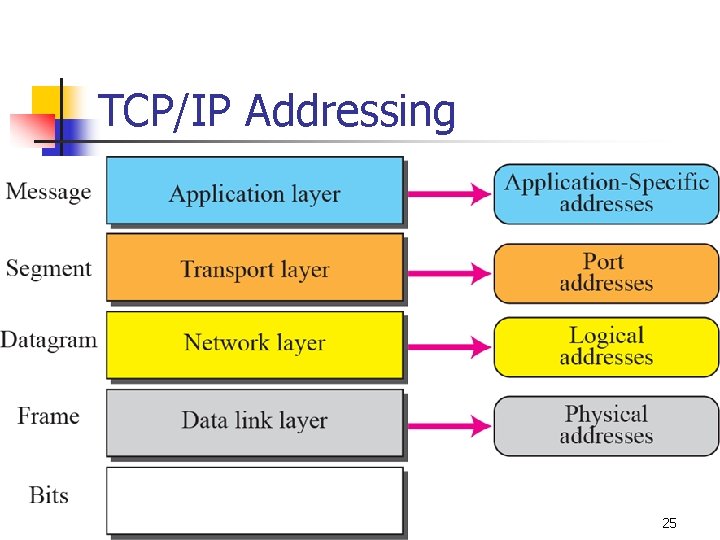
TCP/IP Address Requirements n Two levels of addressing are needed: each host on a subnetwork must have a unique global internet address each process with a host must have an address (known as a port) that is unique within the host 24
TCP/IP Addressing 25
Operation of TCP/IP 26
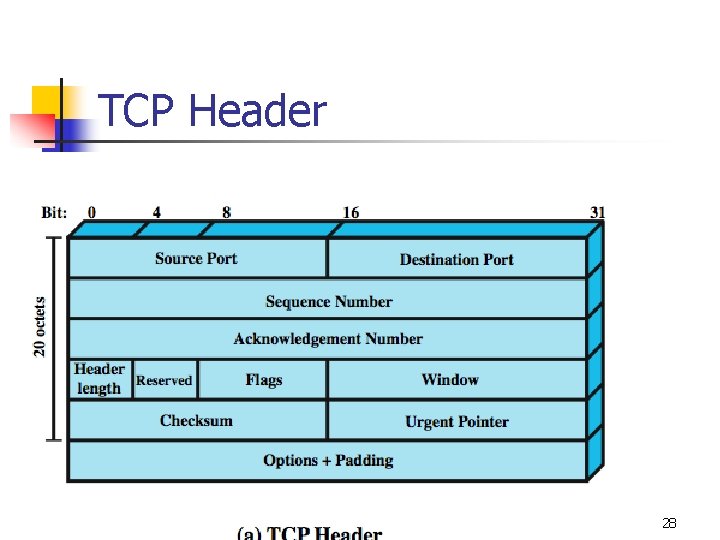
Transmission Control Protocol (TCP) n n TCP is the transport layer protocol for most applications TCP provides a reliable connection for transfer of data between applications A TCP segment is the basic protocol unit TCP tracks segments between entities for duration of 27 each connection
TCP Header 28
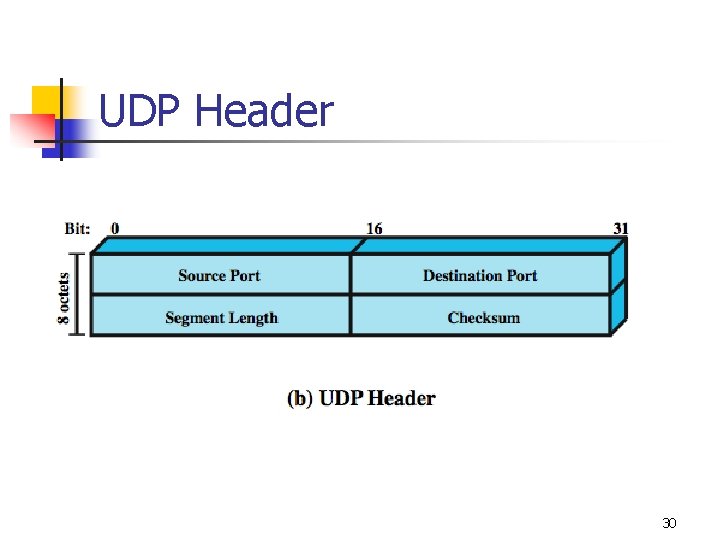
User Datagram Protocol(UDP) n n alternative to TCP does not guarantee delivery, preservation of sequence, or protection against duplication adds port addressing capability to IP used with Simple Network Management Protocol (SNMP) 29
UDP Header 30
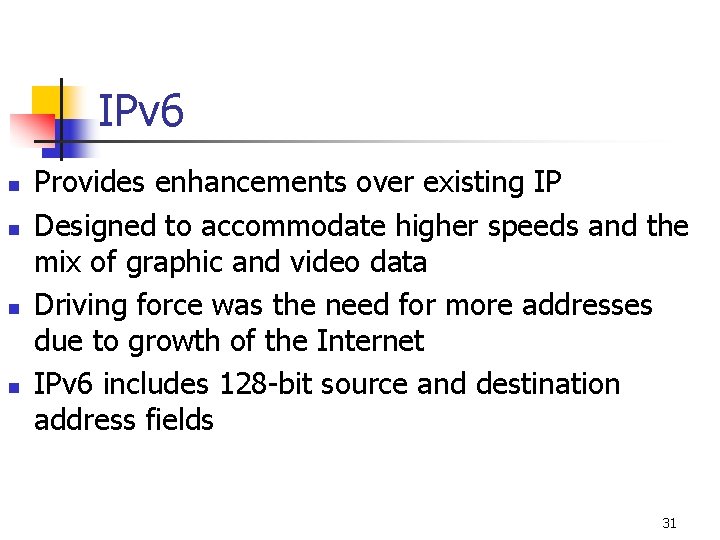
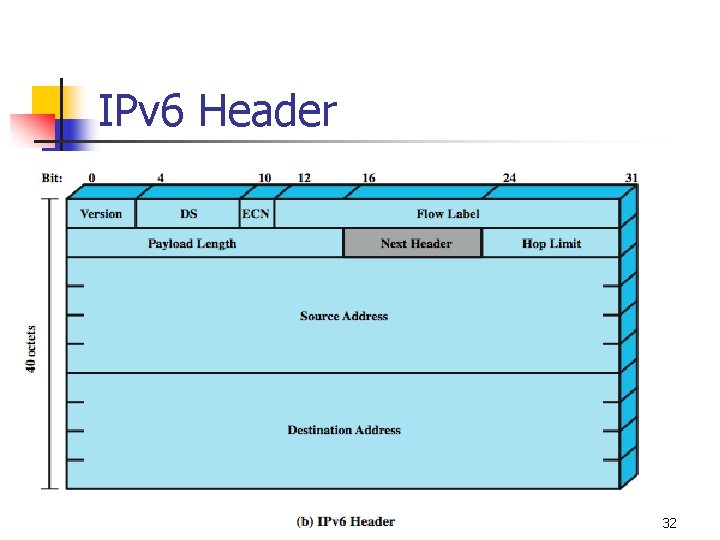
IPv 6 n n Provides enhancements over existing IP Designed to accommodate higher speeds and the mix of graphic and video data Driving force was the need for more addresses due to growth of the Internet IPv 6 includes 128 -bit source and destination address fields 31
IPv 6 Header 32
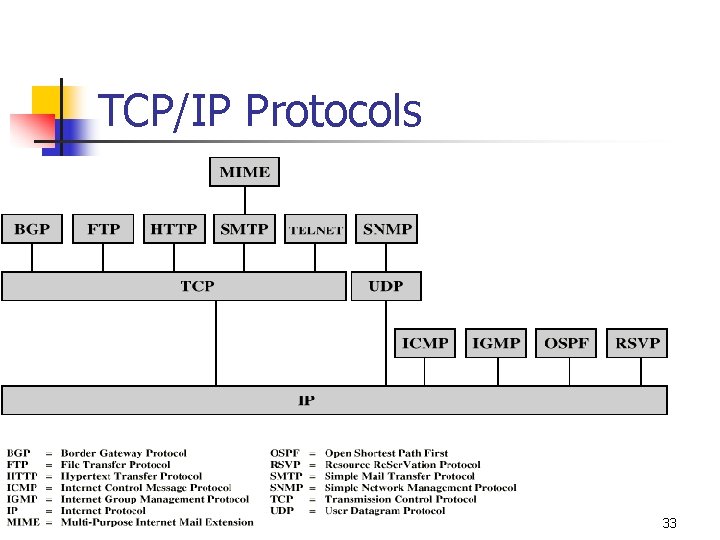
TCP/IP Protocols 33
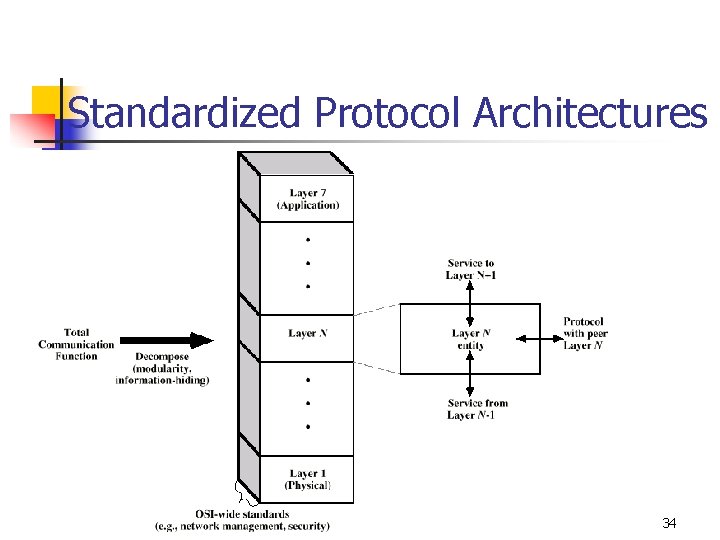
Standardized Protocol Architectures 34
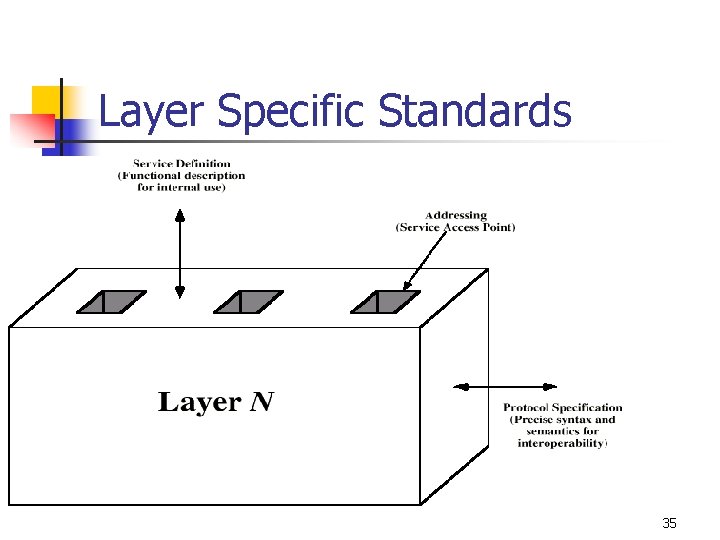
Layer Specific Standards 35
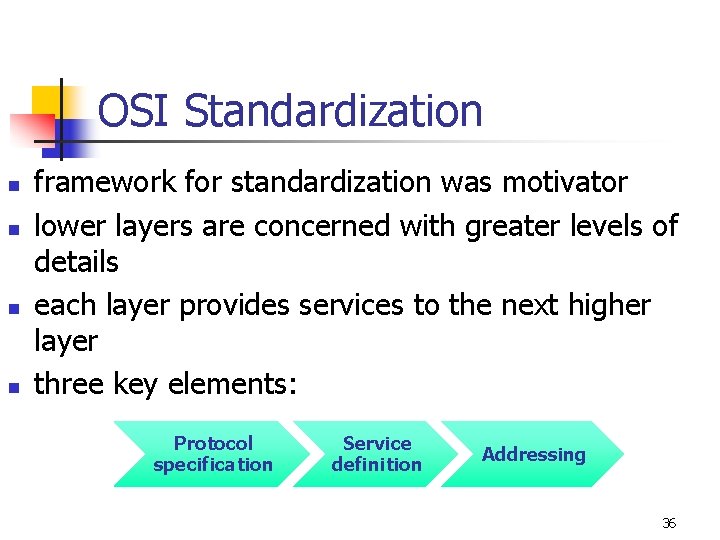
OSI Standardization n n framework for standardization was motivator lower layers are concerned with greater levels of details each layer provides services to the next higher layer three key elements: Protocol specification Service definition Addressing 36
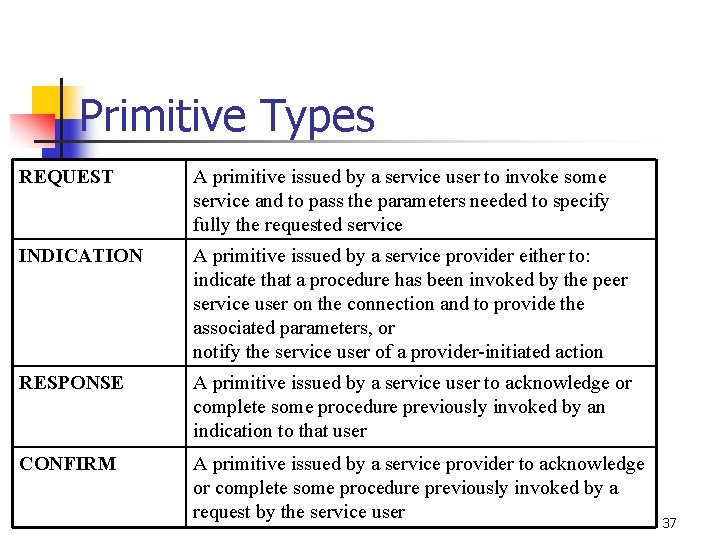
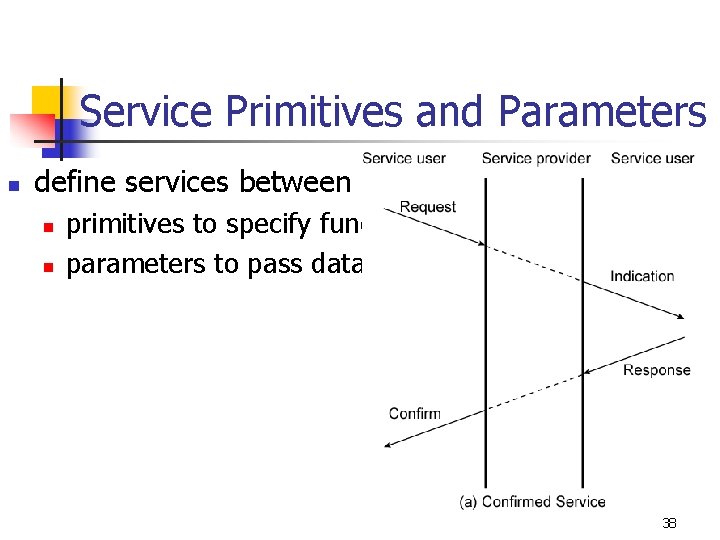
Primitive Types REQUEST A primitive issued by a service user to invoke some service and to pass the parameters needed to specify fully the requested service INDICATION A primitive issued by a service provider either to: indicate that a procedure has been invoked by the peer service user on the connection and to provide the associated parameters, or notify the service user of a provider-initiated action RESPONSE A primitive issued by a service user to acknowledge or complete some procedure previously invoked by an indication to that user CONFIRM A primitive issued by a service provider to acknowledge or complete some procedure previously invoked by a request by the service user 37
Service Primitives and Parameters n define services between adjacent layers using: n n primitives to specify function performed parameters to pass data and control information 38
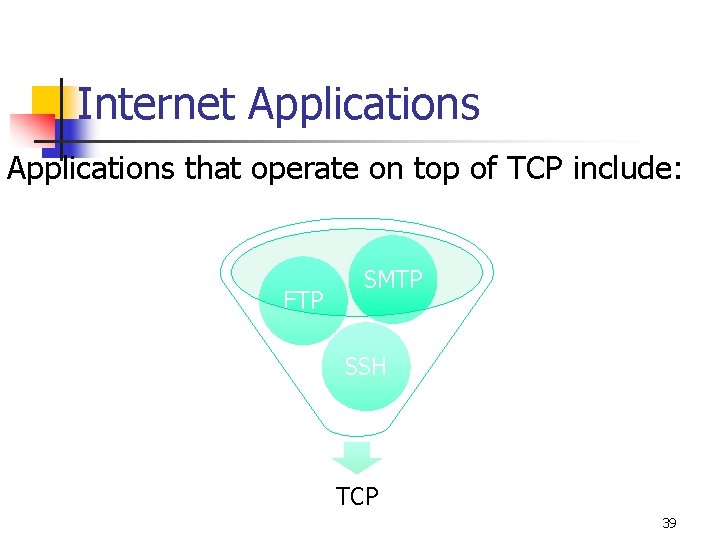
Internet Applications that operate on top of TCP include: FTP SMTP SSH TCP 39
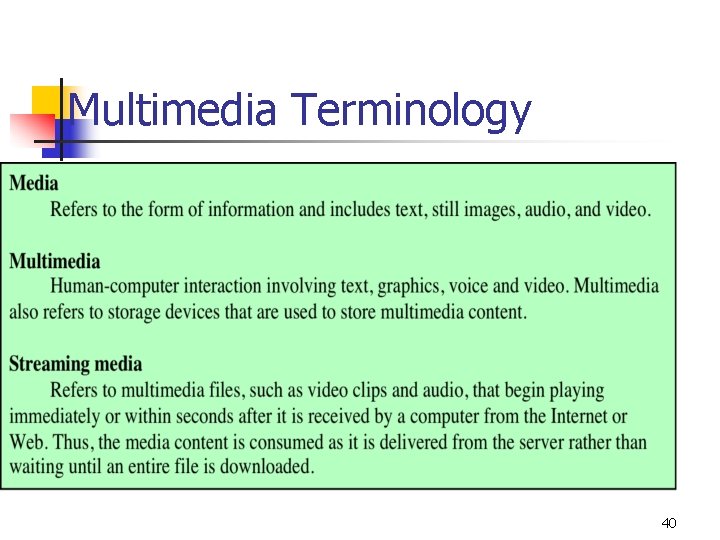
Multimedia Terminology 40
Multimedia Terminology audio generally encompasses sounds that are produced by a human, telephony and related voice communications technology image supports the communication of individual pictures, charts, or drawings video service carries sequences of pictures in time text is information that can be entered via a keyboard and is directly readable and printable 41
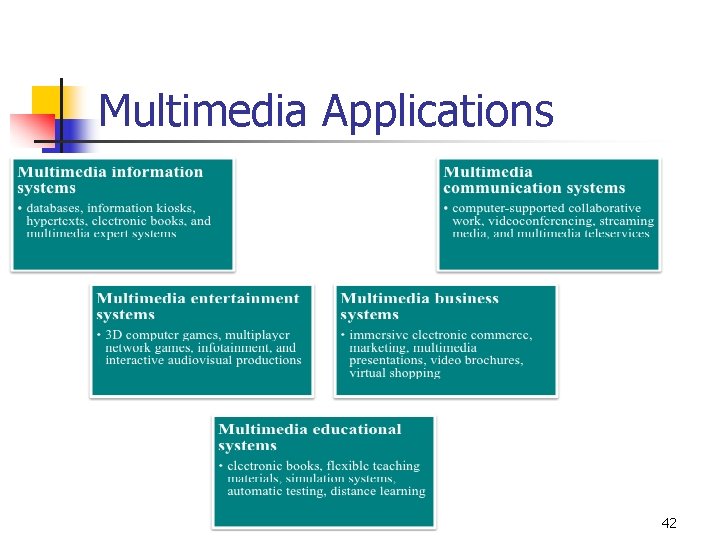
Multimedia Applications 42
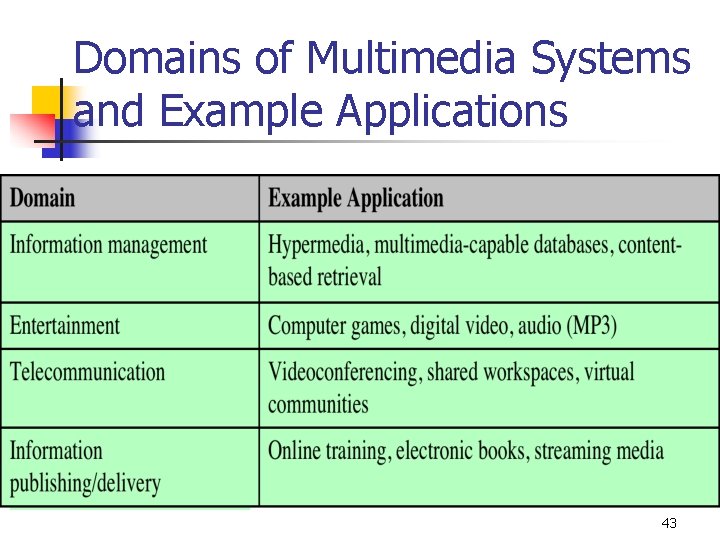
Domains of Multimedia Systems and Example Applications 43
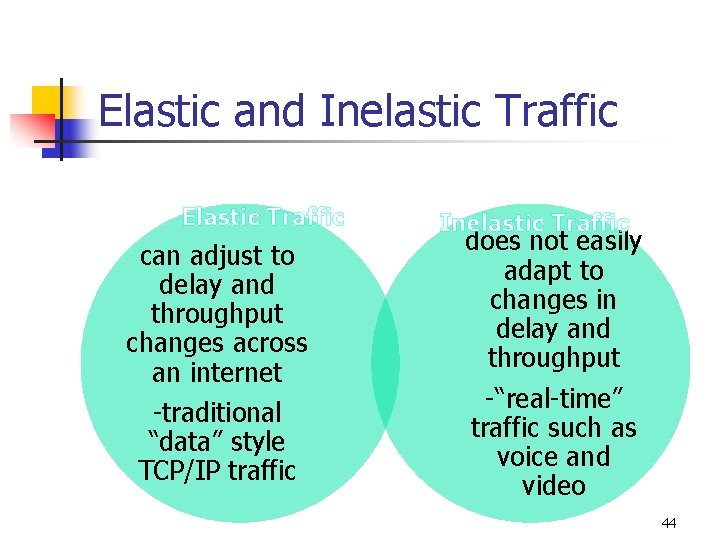
Elastic and Inelastic Traffic Elastic Traffic can adjust to delay and throughput changes across an internet -traditional “data” style TCP/IP traffic Inelastic Traffic does not easily adapt to changes in delay and throughput -“real-time” traffic such as voice and video 44
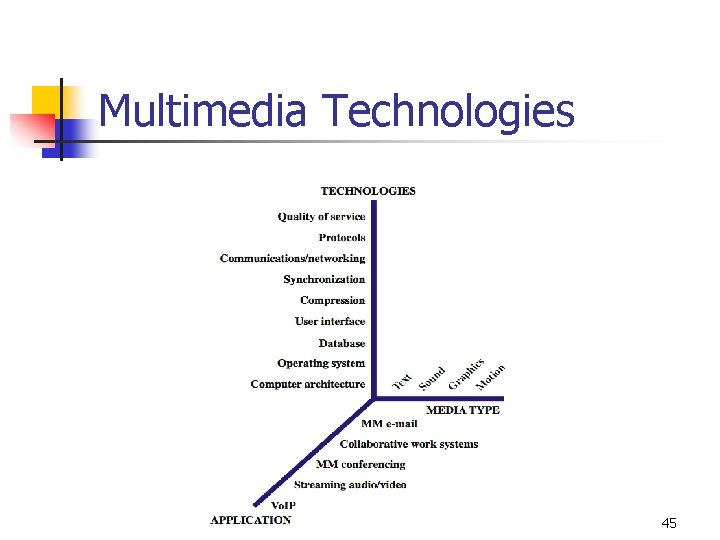
Multimedia Technologies 45
46
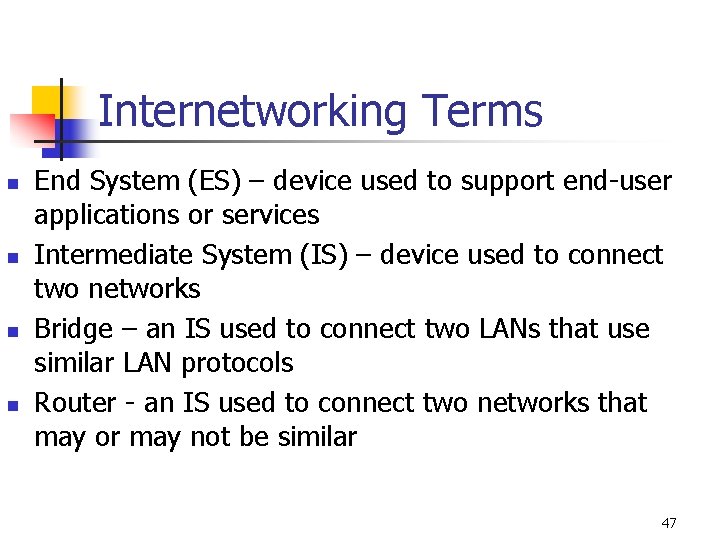
Internetworking Terms n n End System (ES) – device used to support end-user applications or services Intermediate System (IS) – device used to connect two networks Bridge – an IS used to connect two LANs that use similar LAN protocols Router - an IS used to connect two networks that may or may not be similar 47
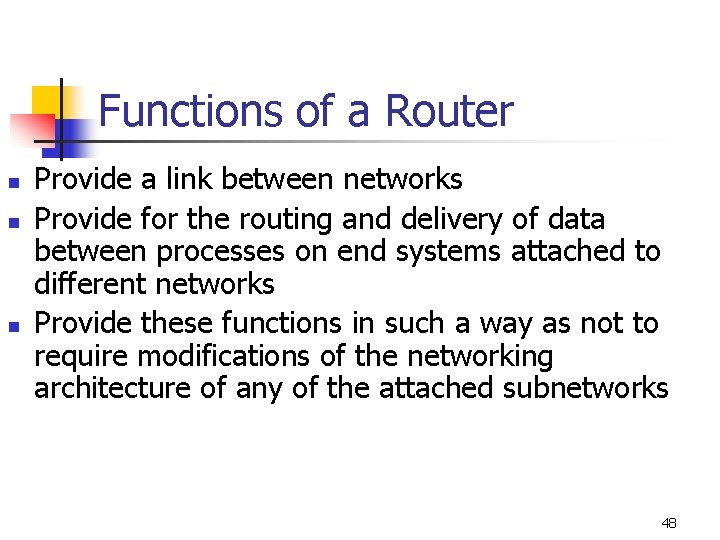
Functions of a Router n n n Provide a link between networks Provide for the routing and delivery of data between processes on end systems attached to different networks Provide these functions in such a way as not to require modifications of the networking architecture of any of the attached subnetworks 48
Network Differences Routers Must Accommodate n Addressing schemes n n Maximum packet sizes n n Different maximum packet sizes requires segmentation Interfaces n n Different schemes for assigning addresses Differing hardware and software interfaces Reliability n Network may provide unreliable service 49
Summary n n n Why we need protocols for communication Benefits of adopting layered approach From simple to featured protocol example Addressing schemes Standards Comparison (TCP/IP Vs. OSI) Functionality of and important device on the basis of studied protocol 50