
PROTOCOLS AND THE TCPIP SUITE Acknowledgement The Slides
- Slides: 32
PROTOCOLS AND THE TCP/IP SUITE Acknowledgement: The Slides Were Provided By Cory Beard, William Stallings For Their Textbook “Wireless Communication Networks And Systems”, Which May Be Updated/Modified By Dr. Honggang Wang TRANSMISSION FUNDAMENTALS 2 -1
KEY FEATURES OF A PROTOCOL • Syntax – Concerns the format of the data blocks • Semantics – Includes control information for coordination and error handling • Timing – Includes speed matching and sequencing Protocols and the TCP/IP Suite 4 -2
AGENTS INVOLVED IN COMMUNICATION • Applications – Exchange data between computers (e. g. , electronic mail) • Computers – Connected to networks • Networks – Transfers data from one computer to another Protocols and the TCP/IP Suite 4 -3
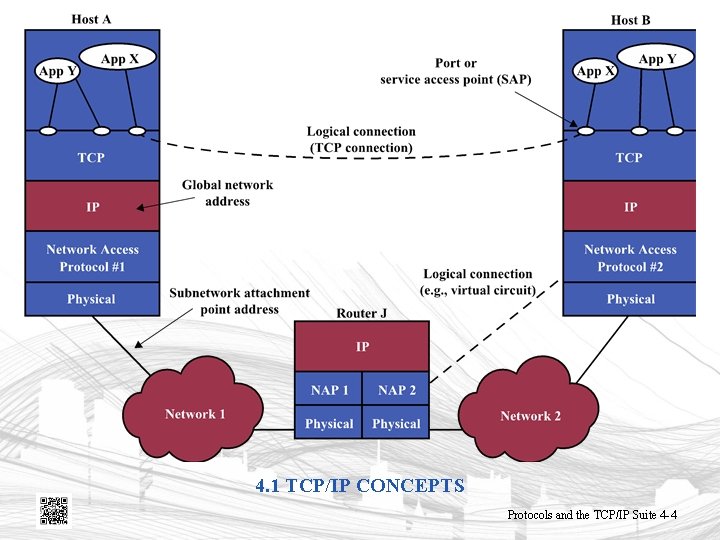
4. 1 TCP/IP CONCEPTS Protocols and the TCP/IP Suite 4 -4
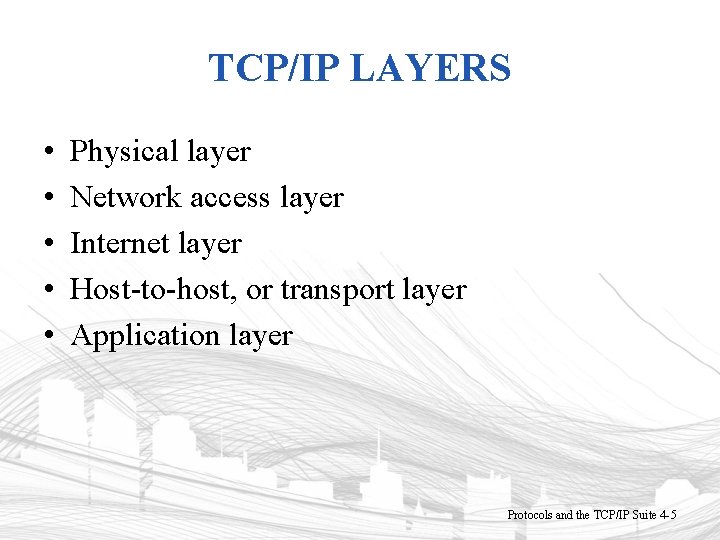
TCP/IP LAYERS • • • Physical layer Network access layer Internet layer Host-to-host, or transport layer Application layer Protocols and the TCP/IP Suite 4 -5
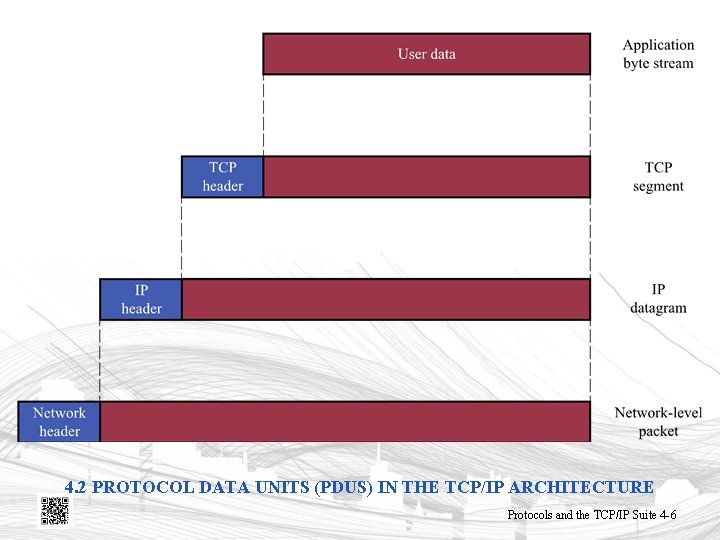
4. 2 PROTOCOL DATA UNITS (PDUS) IN THE TCP/IP ARCHITECTURE Protocols and the TCP/IP Suite 4 -6
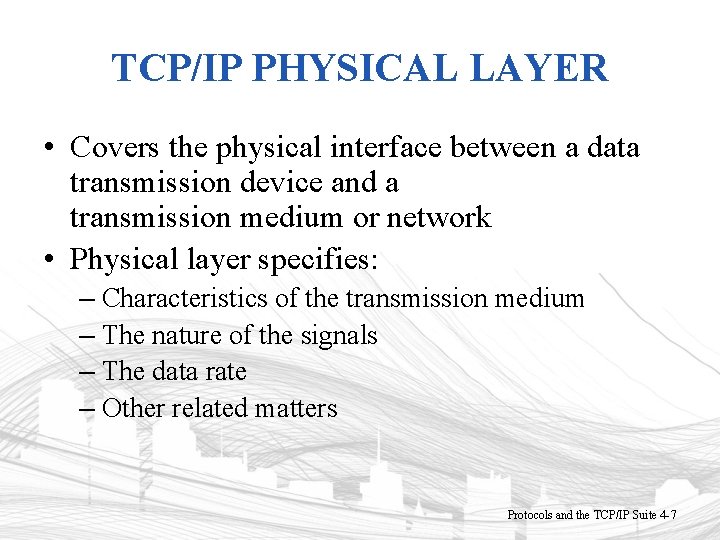
TCP/IP PHYSICAL LAYER • Covers the physical interface between a data transmission device and a transmission medium or network • Physical layer specifies: – Characteristics of the transmission medium – The nature of the signals – The data rate – Other related matters Protocols and the TCP/IP Suite 4 -7
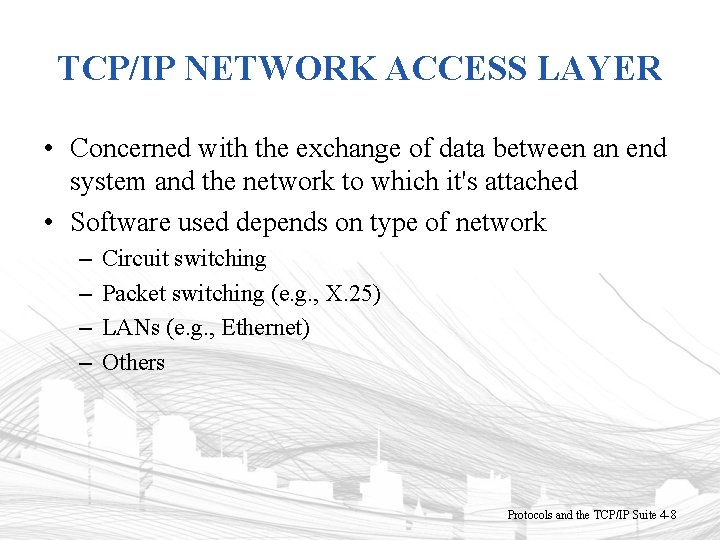
TCP/IP NETWORK ACCESS LAYER • Concerned with the exchange of data between an end system and the network to which it's attached • Software used depends on type of network – – Circuit switching Packet switching (e. g. , X. 25) LANs (e. g. , Ethernet) Others Protocols and the TCP/IP Suite 4 -8
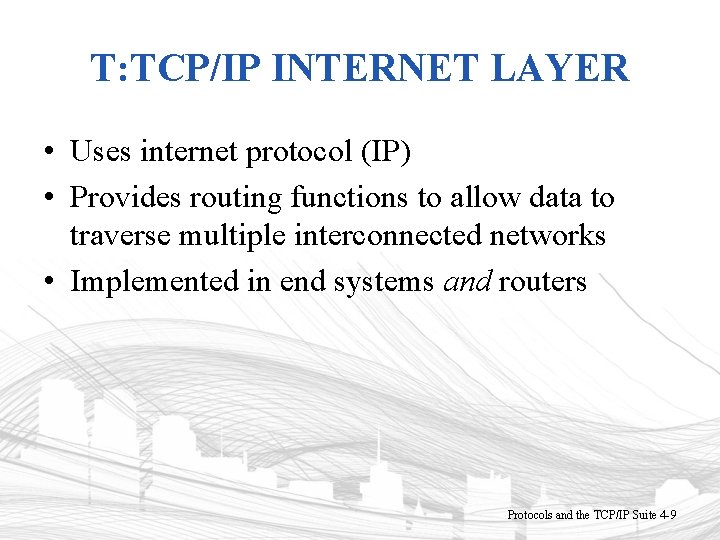
T: TCP/IP INTERNET LAYER • Uses internet protocol (IP) • Provides routing functions to allow data to traverse multiple interconnected networks • Implemented in end systems and routers Protocols and the TCP/IP Suite 4 -9
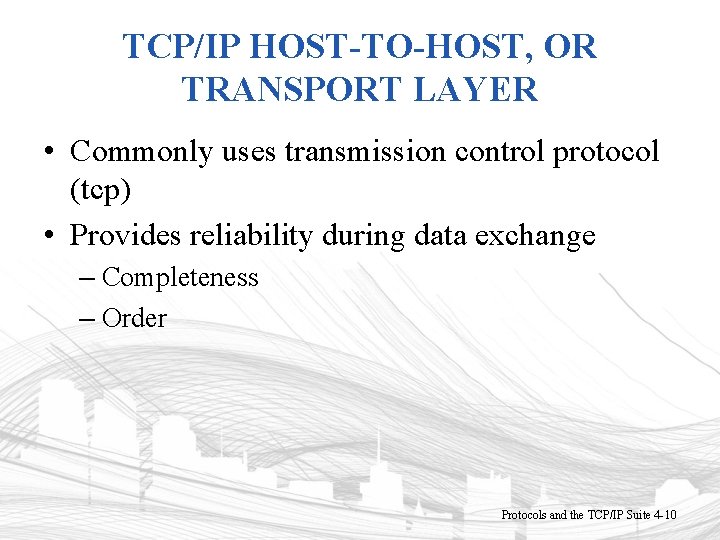
TCP/IP HOST-TO-HOST, OR TRANSPORT LAYER • Commonly uses transmission control protocol (tcp) • Provides reliability during data exchange – Completeness – Order Protocols and the TCP/IP Suite 4 -10
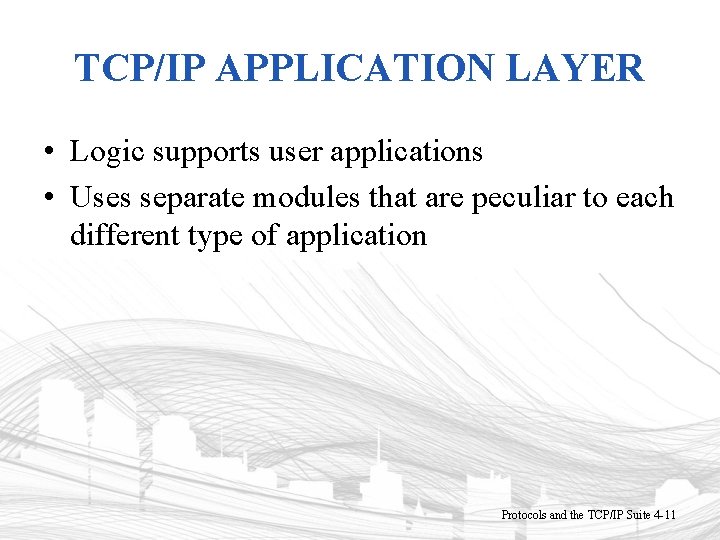
TCP/IP APPLICATION LAYER • Logic supports user applications • Uses separate modules that are peculiar to each different type of application Protocols and the TCP/IP Suite 4 -11
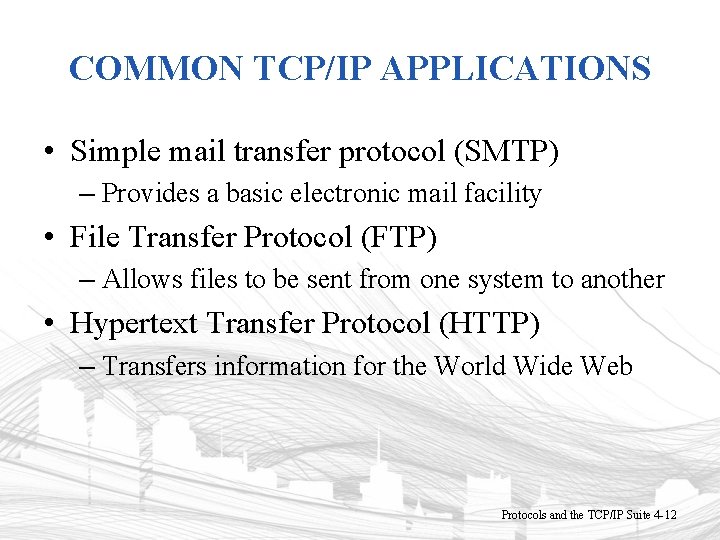
COMMON TCP/IP APPLICATIONS • Simple mail transfer protocol (SMTP) – Provides a basic electronic mail facility • File Transfer Protocol (FTP) – Allows files to be sent from one system to another • Hypertext Transfer Protocol (HTTP) – Transfers information for the World Wide Web Protocols and the TCP/IP Suite 4 -12
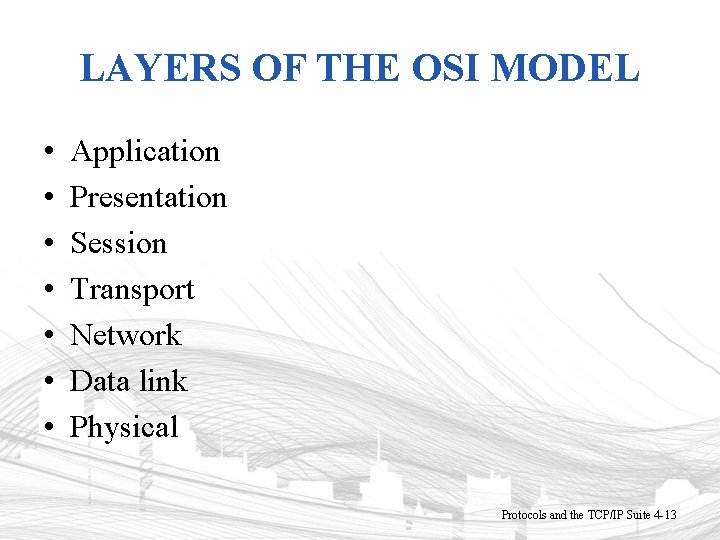
LAYERS OF THE OSI MODEL • • Application Presentation Session Transport Network Data link Physical Protocols and the TCP/IP Suite 4 -13
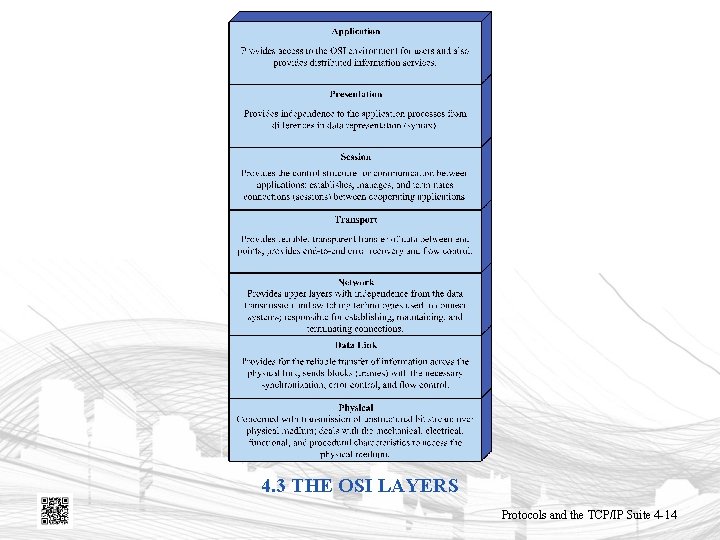
4. 3 THE OSI LAYERS Protocols and the TCP/IP Suite 4 -14
OSI APPLICATION LAYER • Provides access to the OSI environment for users • Provides distributed information services Protocols and the TCP/IP Suite 4 -15
OSI PRESENTATION LAYER • Provides independence to the application processes from differences in data representation (syntax) Protocols and the TCP/IP Suite 4 -16
OSI SESSION LAYER • Provides the control structure for communication between applications • Establishes, manages, and terminates connections (sessions) between cooperating applications Protocols and the TCP/IP Suite 4 -17
OSI TRANSPORT LAYER • Provides reliable, transparent transfer of data between end points • Provides end-to-end error recovery and flow control Protocols and the TCP/IP Suite 4 -18
OSI NETWORK LAYER • Provides upper layers with independence from the data transmission and switching technologies used to connect systems • Responsible for establishing, maintaining, and terminating connections Protocols and the TCP/IP Suite 4 -19
OSI DATA LINK LAYER • Provides for the reliable transfer of information across the physical link • Sends blocks (frames) with the necessary synchronization, error control, and flow control Protocols and the TCP/IP Suite 4 -20
OSI PHYSICAL LAYER • Concerned with transmission of unstructured bit stream over physical medium • Deals with accessing the physical medium – – Mechanical characteristics Electrical characteristics Functional characteristics Procedural characteristics Protocols and the TCP/IP Suite 4 -21
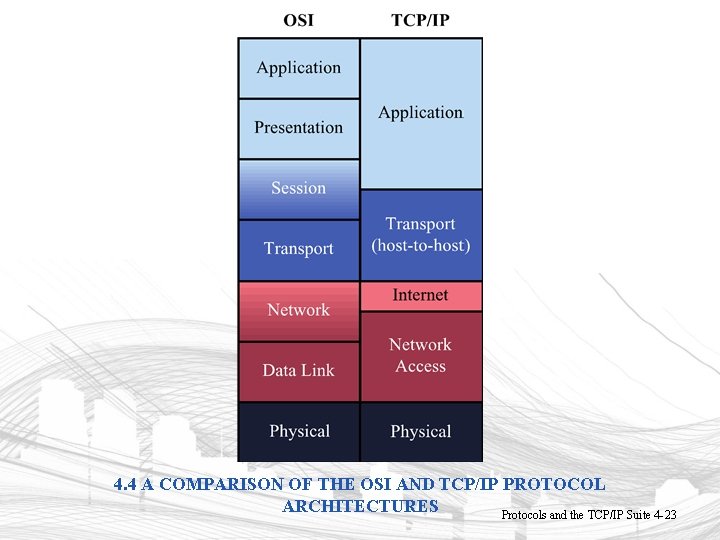
TCP/IP ARCHITECTURE DOMINANCE • TCP/IP protocols matured quicker than similar OSI protocols – When the need for interoperability across networks was recognized, only TCP/IP was available and ready to go • OSI model is unnecessarily complex – Accomplishes in seven layers what TCP/IP does with fewer layers Protocols and the TCP/IP Suite 4 -22
4. 4 A COMPARISON OF THE OSI AND TCP/IP PROTOCOL ARCHITECTURES Protocols and the TCP/IP Suite 4 -23
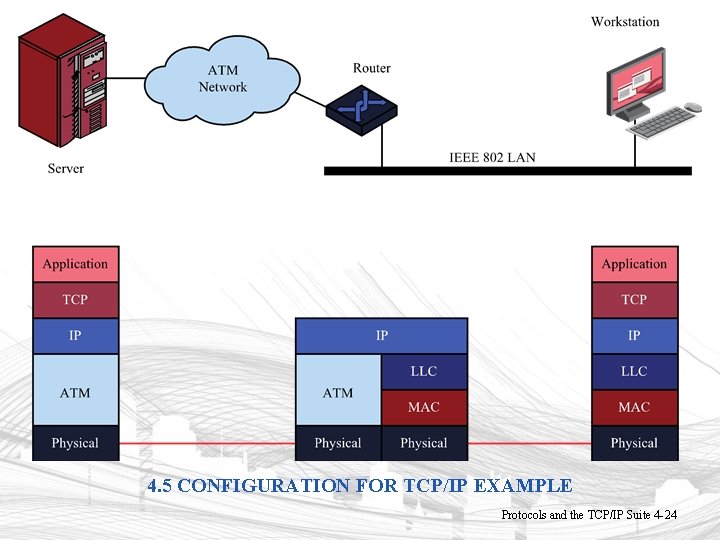
4. 5 CONFIGURATION FOR TCP/IP EXAMPLE Protocols and the TCP/IP Suite 4 -24
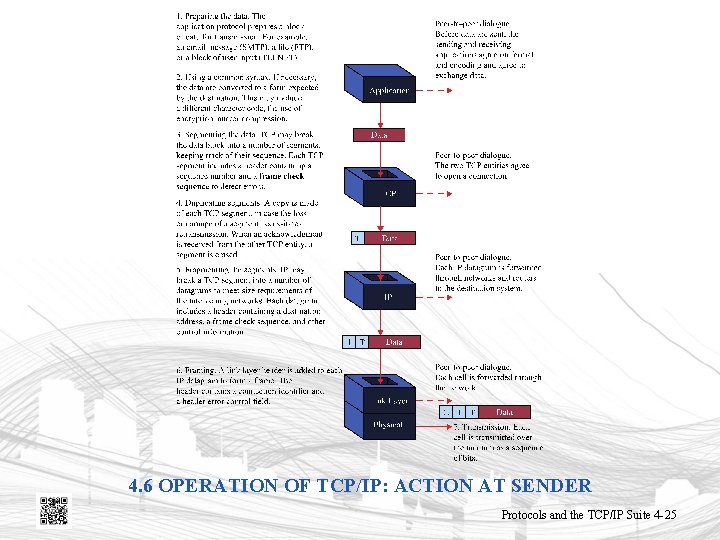
4. 6 OPERATION OF TCP/IP: ACTION AT SENDER Protocols and the TCP/IP Suite 4 -25
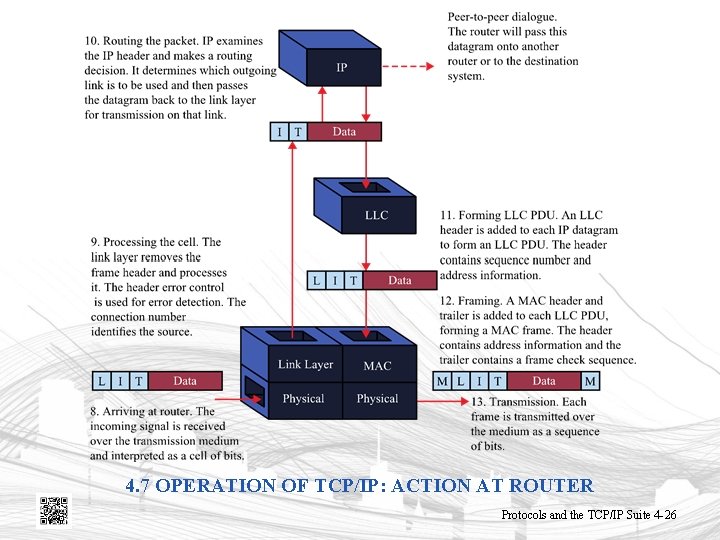
4. 7 OPERATION OF TCP/IP: ACTION AT ROUTER Protocols and the TCP/IP Suite 4 -26
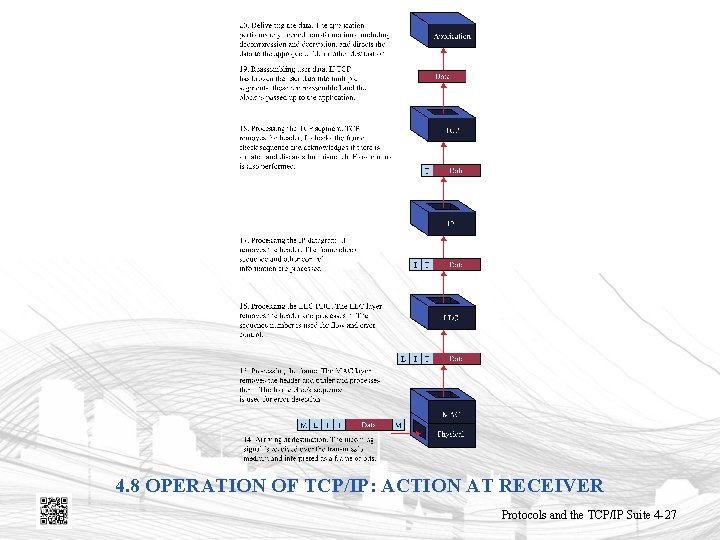
4. 8 OPERATION OF TCP/IP: ACTION AT RECEIVER Protocols and the TCP/IP Suite 4 -27
ELEMENTS OF STANDARDIZATION WITHIN OSI FRAMEWORK • Protocol Specification – Format of protocol data units (PDUs) exchanged – Semantics of all fields – Allowable sequence of PDUs • Service Definition – Functional description that defines what services are provided, but not how the services are to be provided • Addressing – Entities are referenced by means of a service access point (SAP) Protocols and the TCP/IP Suite 4 -28
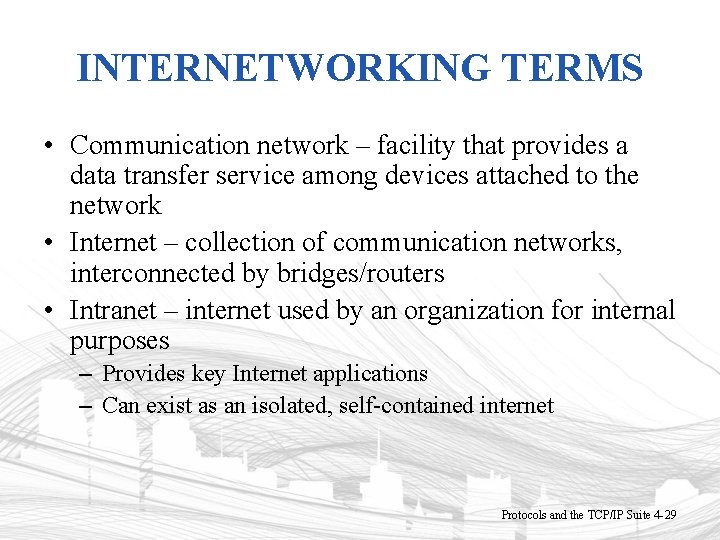
INTERNETWORKING TERMS • Communication network – facility that provides a data transfer service among devices attached to the network • Internet – collection of communication networks, interconnected by bridges/routers • Intranet – internet used by an organization for internal purposes – Provides key Internet applications – Can exist as an isolated, self-contained internet Protocols and the TCP/IP Suite 4 -29
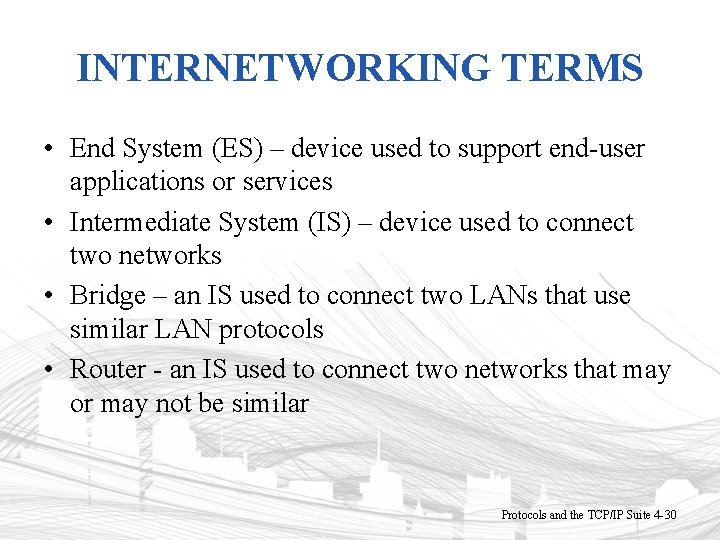
INTERNETWORKING TERMS • End System (ES) – device used to support end-user applications or services • Intermediate System (IS) – device used to connect two networks • Bridge – an IS used to connect two LANs that use similar LAN protocols • Router - an IS used to connect two networks that may or may not be similar Protocols and the TCP/IP Suite 4 -30
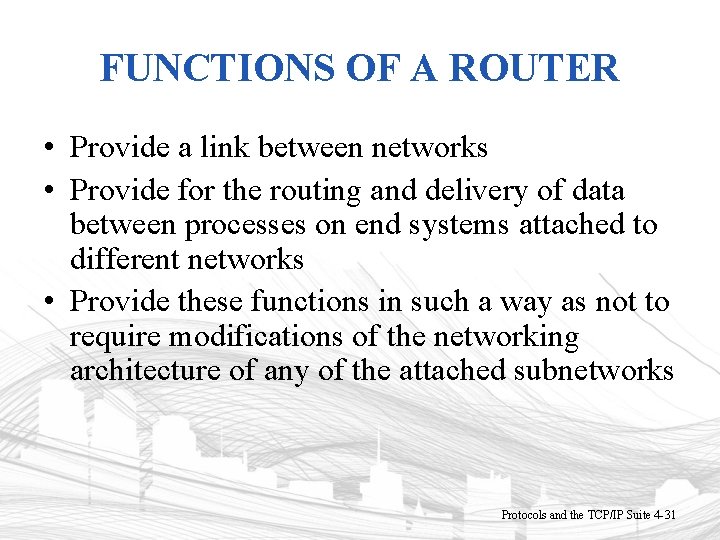
FUNCTIONS OF A ROUTER • Provide a link between networks • Provide for the routing and delivery of data between processes on end systems attached to different networks • Provide these functions in such a way as not to require modifications of the networking architecture of any of the attached subnetworks Protocols and the TCP/IP Suite 4 -31
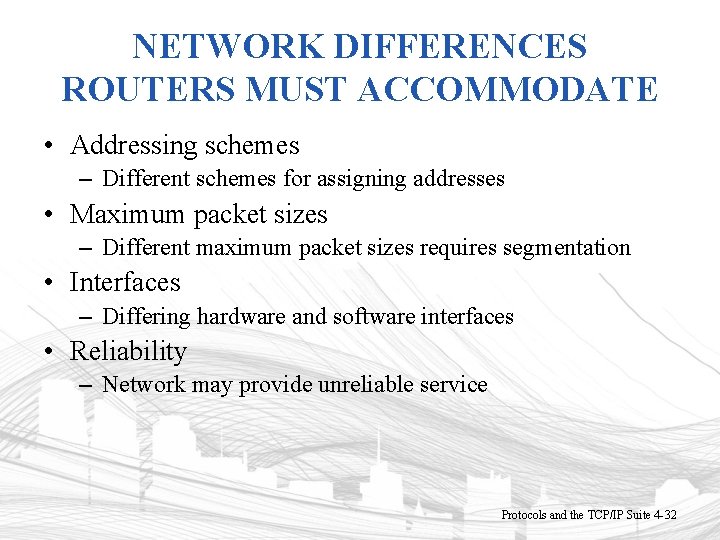
NETWORK DIFFERENCES ROUTERS MUST ACCOMMODATE • Addressing schemes – Different schemes for assigning addresses • Maximum packet sizes – Different maximum packet sizes requires segmentation • Interfaces – Differing hardware and software interfaces • Reliability – Network may provide unreliable service Protocols and the TCP/IP Suite 4 -32