
Protists Some Basics 200 000 species difficult to
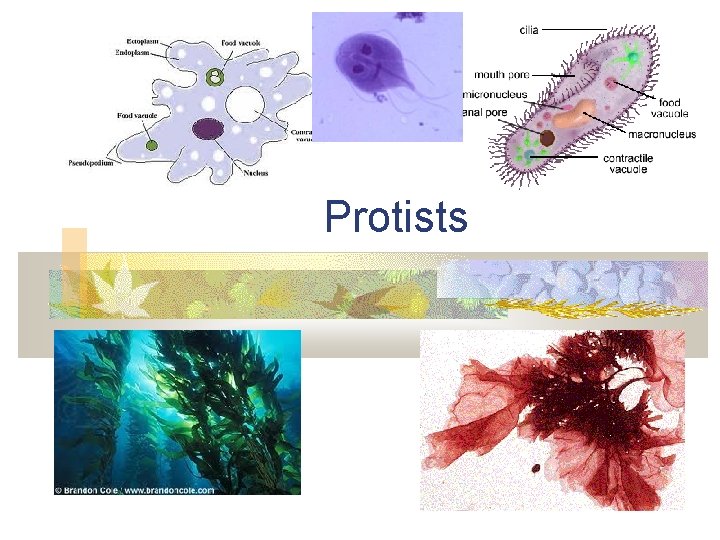
Protists
Some Basics: 200 000 species difficult to classify no “typical” protist most aquatic, some terrestrial only characteristic that all protists share is that they are not animals, plants or fungi most single-celled
Some Characteristics of single -celled protists: 1) eukaryotes – membranes around their organelles (nucleus), > 2 m 2) unicellular – one celled 3) reproduce asexually by binary fission 4) must live in moist surroundings
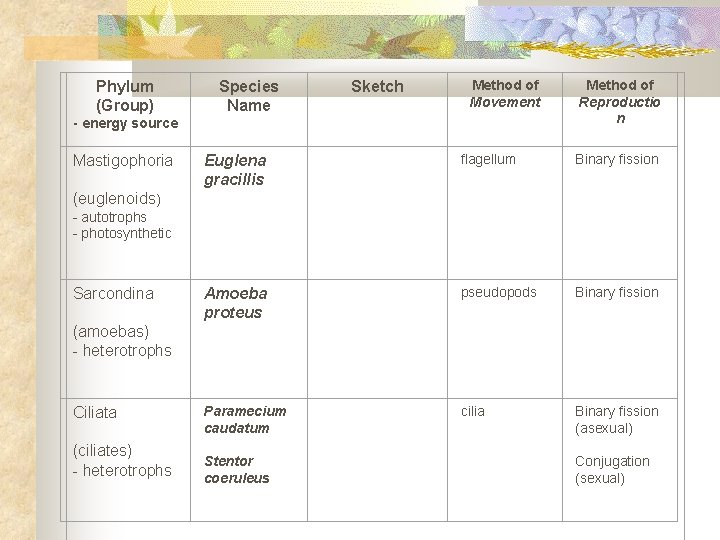
Phylum (Group) Species Name Sketch Method of Movement - energy source Mastigophoria Method of Reproductio n Euglena gracillis flagellum Binary fission Amoeba proteus pseudopods Binary fission Paramecium caudatum cilia Binary fission (asexual) (euglenoids) - autotrophs - photosynthetic Sarcondina (amoebas) - heterotrophs Ciliata (ciliates) - heterotrophs Stentor coeruleus Conjugation (sexual)
Life Cycles Single-celled protists reproduce asexually (binary fission) and sexually (conjugation) Multi-cellular protists more complex may involve the formation of sex cells (haploid sperm and egg), when sex cells fuse, diploid zygote is formed some alternate between a diploid and haploid stage (alternation of generations) Examples: Brown algae (Fig. 13 page 65) Plasmodium – malaria protist (Fig. 14 page 66)
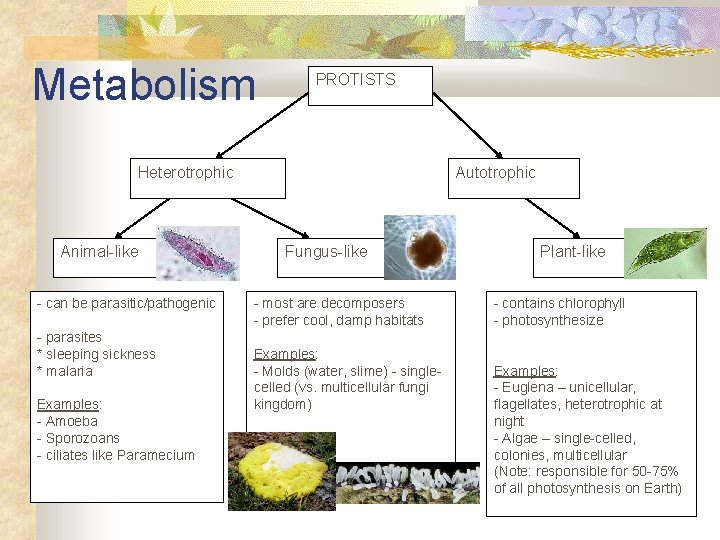
Metabolism PROTISTS Heterotrophic Animal-like - can be parasitic/pathogenic - parasites * sleeping sickness * malaria Examples: - Amoeba - Sporozoans - ciliates like Paramecium Autotrophic Fungus-like - most are decomposers - prefer cool, damp habitats Examples: - Molds (water, slime) - singlecelled (vs. multicellular fungi kingdom) Plant-like - contains chlorophyll - photosynthesize Examples: - Euglena – unicellular, flagellates, heterotrophic at night - Algae – single-celled, colonies, multicellular (Note: responsible for 50 -75% of all photosynthesis on Earth)
- Slides: 6