
PROTISTS Insert something funny below ProtistsGeneral Info Protists

PROTISTS!!!!! Insert something funny below ________
Protists—General Info • Protists are eukaryotes and thus are much more complex than the prokaryotes. • The first eukaryotes were unicellular. – Not only were they the predecessor to the great variety of modern protists, but also to all other eukaryotes - plants, fungi, and animals. • The origin of the eukaryotic cell and the emergence of multicellularity unfolded during the evolution of protists.
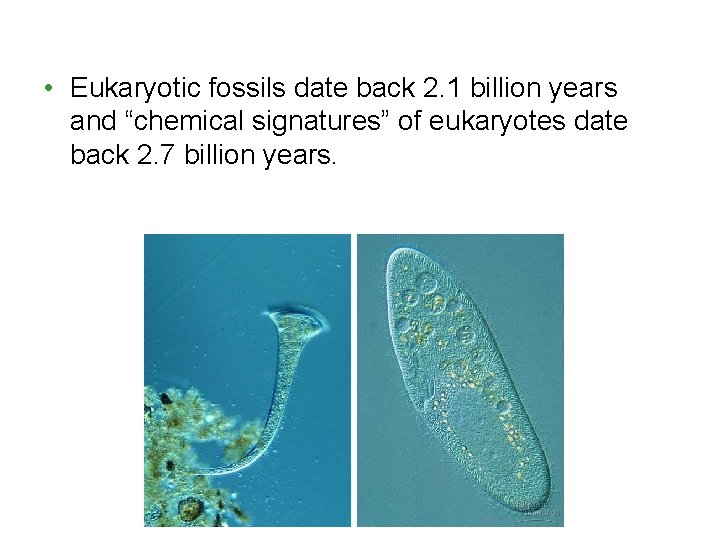
• Eukaryotic fossils date back 2. 1 billion years and “chemical signatures” of eukaryotes date back 2. 7 billion years.
• In the five-kingdom system of classification, the eukaryotes were distributed among four kingdoms: Protista, Plantae, Fungi, and Animalia. • Protista was defined partly by structural level (mostly unicellular eukaryotes) and partly by exclusion from the definitions of plants, fungi, or animals.
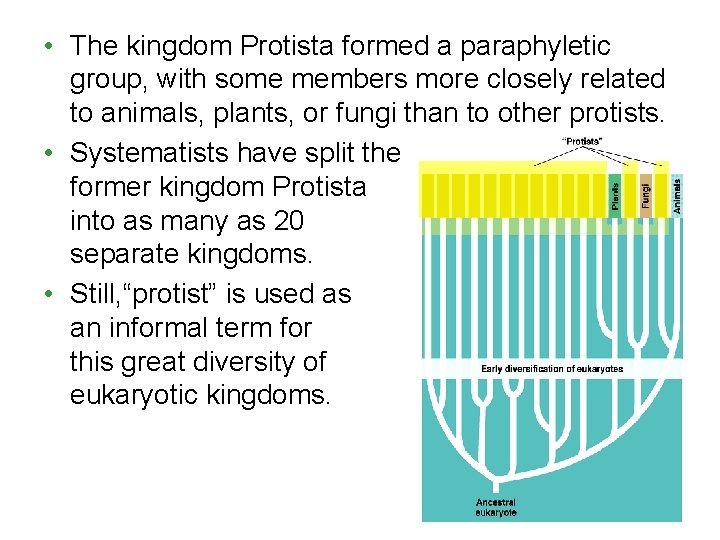
• The kingdom Protista formed a paraphyletic group, with some members more closely related to animals, plants, or fungi than to other protists. • Systematists have split the former kingdom Protista into as many as 20 separate kingdoms. • Still, “protist” is used as an informal term for this great diversity of eukaryotic kingdoms.
Protist Diversity • Protists are so diverse that few general characteristics can be cited without exceptions. • Most of the 60, 000 known protists are unicellular, but some are colonial and others multicellular. • While unicellular protists would seem to be the simplest eukaryotic organisms, at the cellular level they are the most elaborate of all cells. – A single cell must perform all the basic functions performed by the collective of specialized cells in plants and animals.
• Protists are the most nutritionally diverse of all eukaryotes, – Most protists are aerobic, with mitochondria for cellular respiration. – Some protists are photoautotrophs with chloroplasts. – Still others are heterotrophs that absorb organic molecules or ingest larger food particles. – A few are mixotrophs, combining photosynthesis and heterotrophic nutrition.
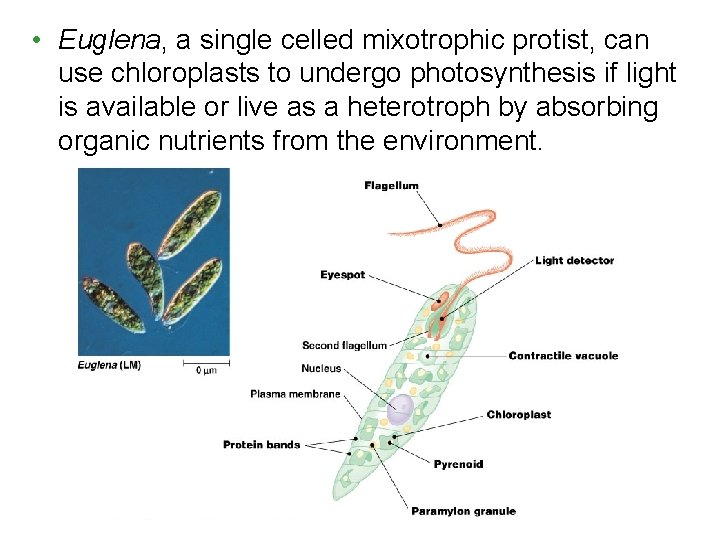
• Euglena, a single celled mixotrophic protist, can use chloroplasts to undergo photosynthesis if light is available or live as a heterotroph by absorbing organic nutrients from the environment.
• While nutrition is not a reliable taxonomic characteristic, it is useful in understanding the adaptations of protists and the roles that they play in biological communities. – Protists can be divided into three ecological categories: • Protozoa-- ingestive, animal-like protists • Absorptive-- fungus-like protists • Algae-- photosynthetic, plant-like protists.
Assignment • Pick a type of protist out of the hat and design a poster describing the characteristics of that protist.
- Slides: 10