
Protists Fungi Where do Protists and Fungi belong
Protists & Fungi
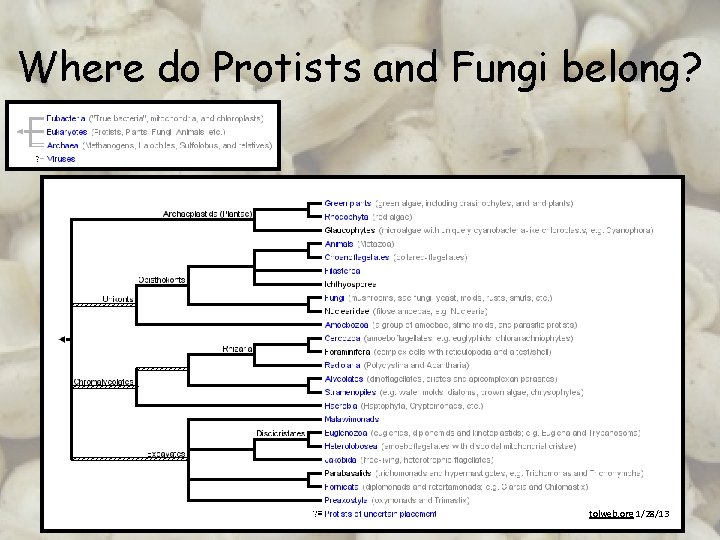
Where do Protists and Fungi belong? tolweb. org 1/28/13
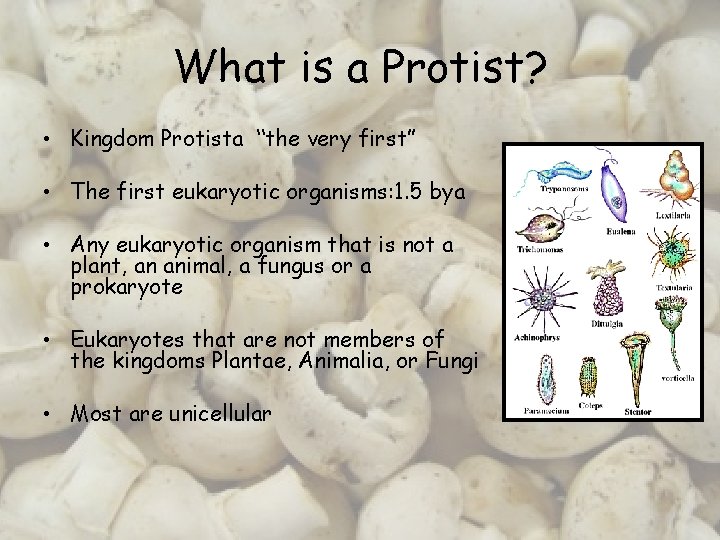
What is a Protist? • Kingdom Protista “the very first” • The first eukaryotic organisms: 1. 5 bya • Any eukaryotic organism that is not a plant, an animal, a fungus or a prokaryote • Eukaryotes that are not members of the kingdoms Plantae, Animalia, or Fungi • Most are unicellular
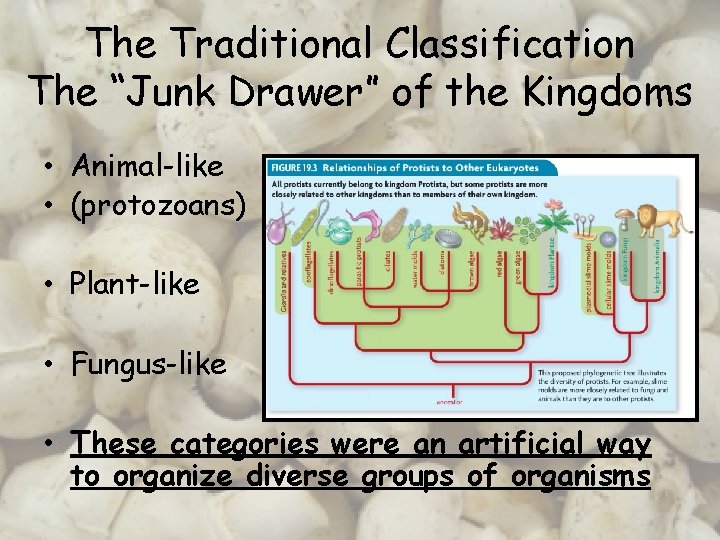
The Traditional Classification The “Junk Drawer” of the Kingdoms • Animal-like • (protozoans) • Plant-like • Fungus-like • These categories were an artificial way to organize diverse groups of organisms
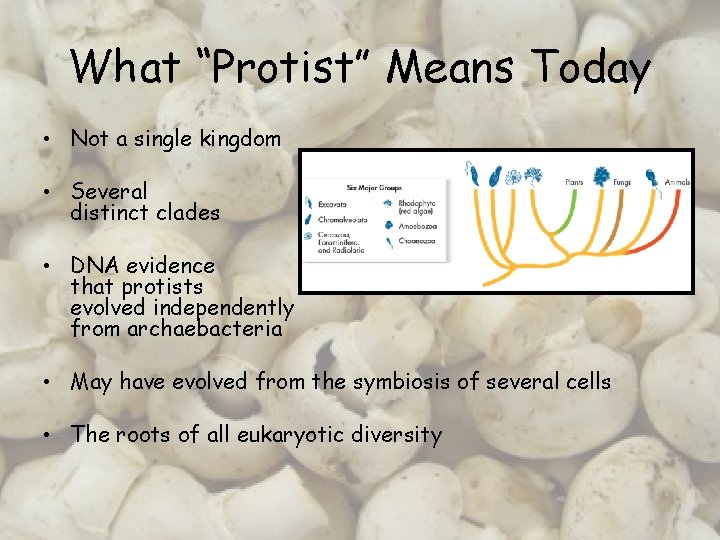
What “Protist” Means Today • Not a single kingdom • Several distinct clades • DNA evidence that protists evolved independently from archaebacteria • May have evolved from the symbiosis of several cells • The roots of all eukaryotic diversity
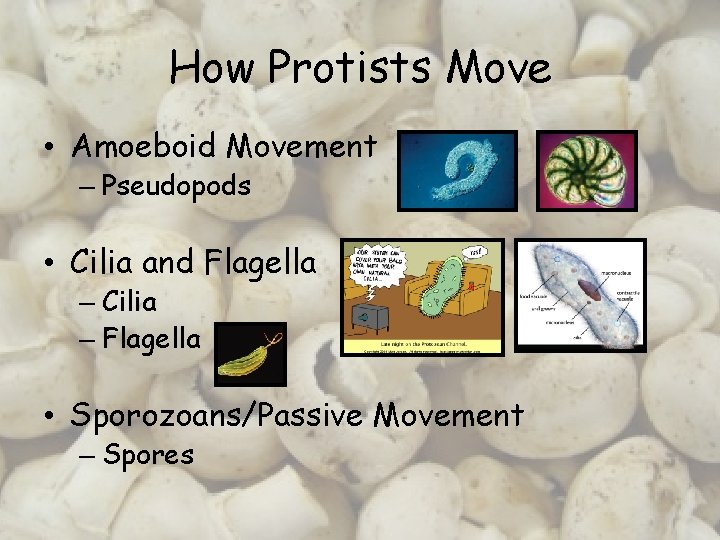
How Protists Move • Amoeboid Movement – Pseudopods • Cilia and Flagella – Cilia – Flagella • Sporozoans/Passive Movement – Spores
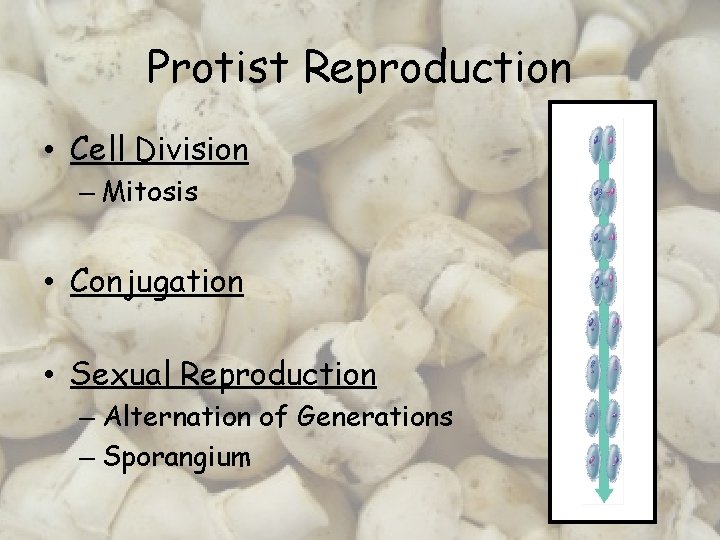
Protist Reproduction • Cell Division – Mitosis • Conjugation • Sexual Reproduction – Alternation of Generations – Sporangium
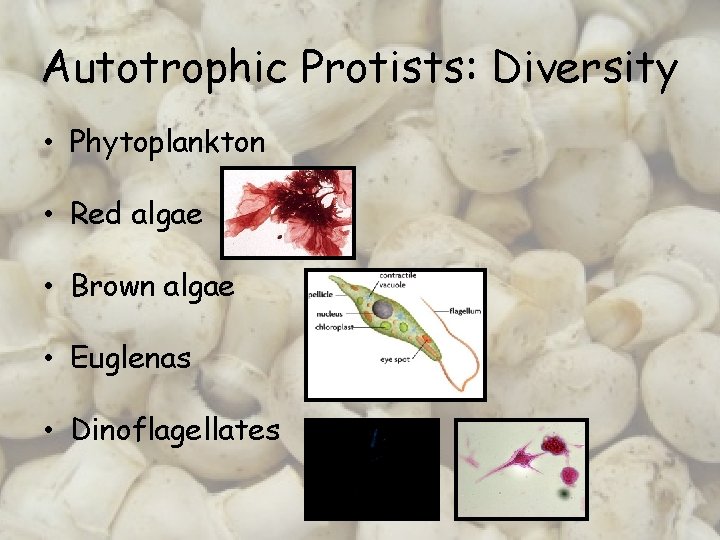
Autotrophic Protists: Diversity • Phytoplankton • Red algae • Brown algae • Euglenas • Dinoflagellates
Autotrophic Protists: Ecological Roles • Feeding Fish and Whales • Supporting Coral Reefs • Providing Shelter • Recycling Wastes
Feeding Fish and Whales What are Plankton? • • Any drifting organisms that inhabit the pelagic zone of oceans, seas, or bodies of fresh water. That is, plankton are defined by their ecological niche rather than phylogenetic or taxonomic classification. They provide a crucial source of food to larger, more familiar aquatic organisms such as fish and cetacea • From the Greek planktos: “to drift or wander” • Phytoplankton – Small, photosynthetic organisms found near the surface of the ocean – Nearly ½ of photosynthesis on Earth is carried out by phytoplankton • • Protists are Plankton…not all Plankton are Protists!!! Zooplankton – Holoplankton – Meroplankton
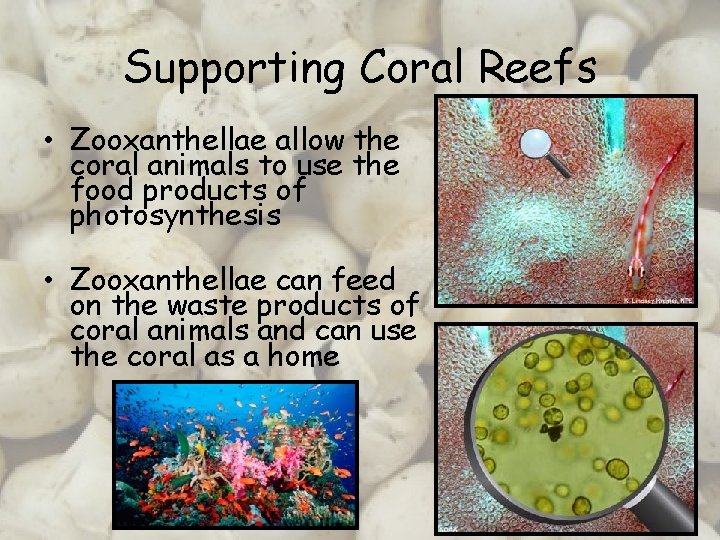
Supporting Coral Reefs • Zooxanthellae allow the coral animals to use the food products of photosynthesis • Zooxanthellae can feed on the waste products of coral animals and can use the coral as a home
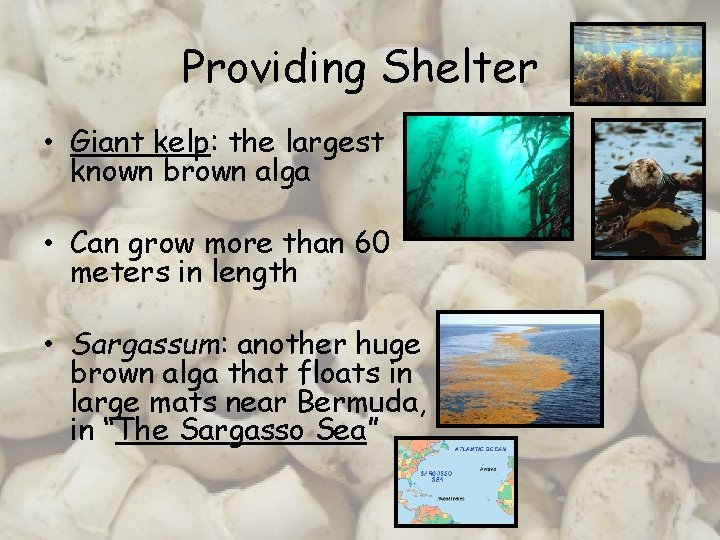
Providing Shelter • Giant kelp: the largest known brown alga • Can grow more than 60 meters in length • Sargassum: another huge brown alga that floats in large mats near Bermuda, in “The Sargasso Sea”
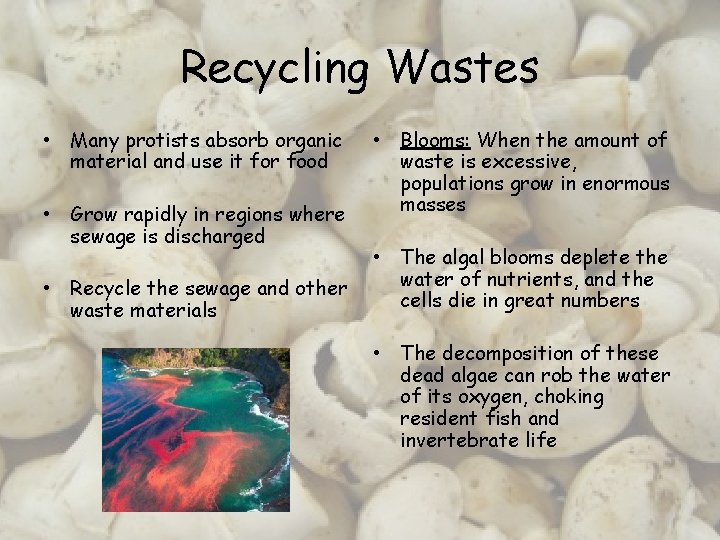
Recycling Wastes • Many protists absorb organic material and use it for food • Grow rapidly in regions where sewage is discharged • Recycle the sewage and other waste materials • Blooms: When the amount of waste is excessive, populations grow in enormous masses • The algal blooms deplete the water of nutrients, and the cells die in great numbers • The decomposition of these dead algae can rob the water of its oxygen, choking resident fish and invertebrate life
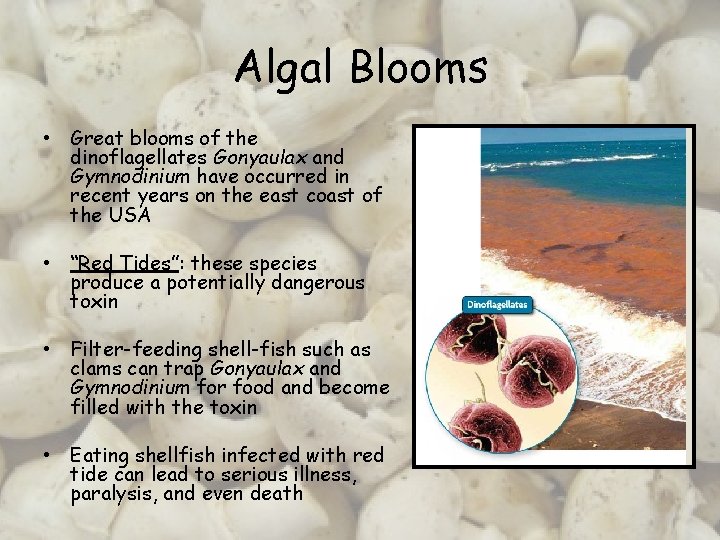
Algal Blooms • Great blooms of the dinoflagellates Gonyaulax and Gymnodinium have occurred in recent years on the east coast of the USA • “Red Tides”: these species produce a potentially dangerous toxin • Filter-feeding shell-fish such as clams can trap Gonyaulax and Gymnodinium for food and become filled with the toxin • Eating shellfish infected with red tide can lead to serious illness, paralysis, and even death

Heterotrophic Protists • Amoebas – Food vacuole • Ciliates (Example: Paramecium) – Gullet • Slime Molds: thrive on dead or decaying organic matter – Play key roles in recycling organic matter (forest or backyard compost pile) – Begin life as amoeba-like cells – Plasmodium: cells fuse to produce structures with many nuclei • Water Molds: absorb molecules that other organisms have released into the environment
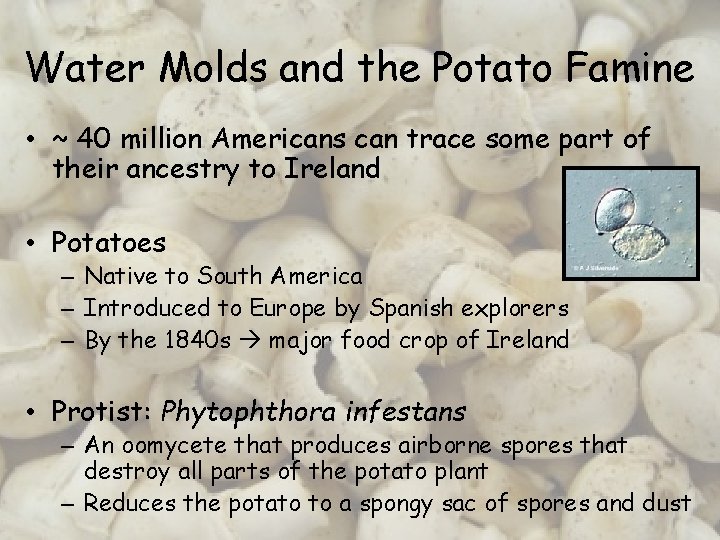
Water Molds and the Potato Famine • ~ 40 million Americans can trace some part of their ancestry to Ireland • Potatoes – Native to South America – Introduced to Europe by Spanish explorers – By the 1840 s major food crop of Ireland • Protist: Phytophthora infestans – An oomycete that produces airborne spores that destroy all parts of the potato plant – Reduces the potato to a spongy sac of spores and dust
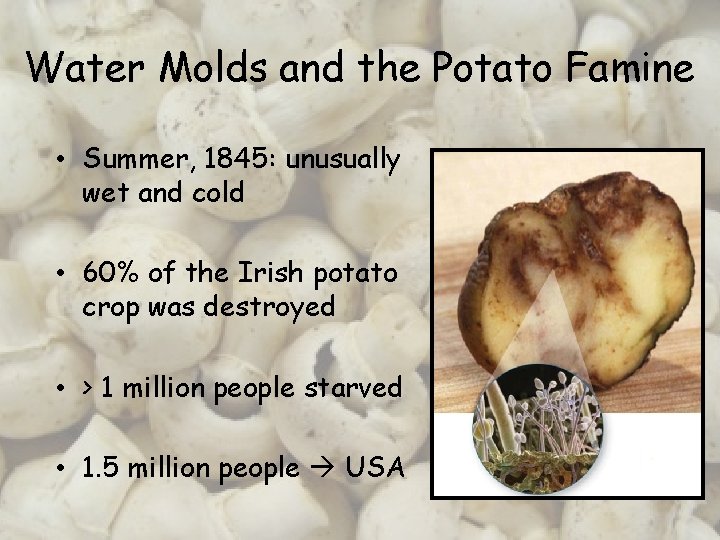
Water Molds and the Potato Famine • Summer, 1845: unusually wet and cold • 60% of the Irish potato crop was destroyed • > 1 million people starved • 1. 5 million people USA
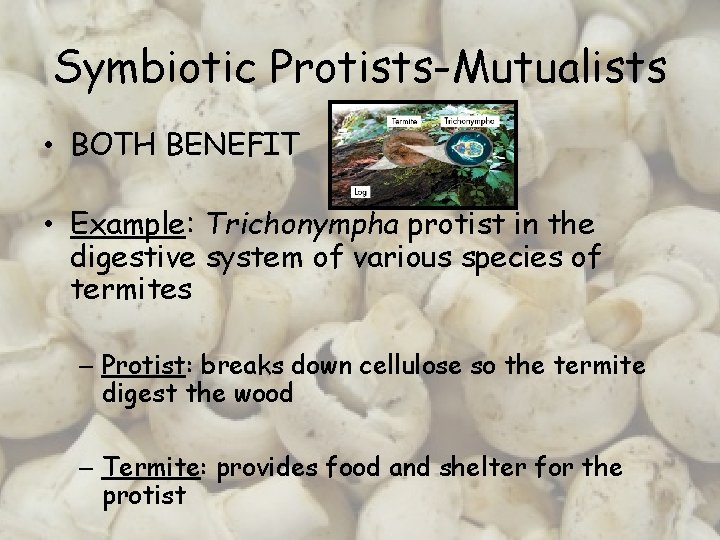
Symbiotic Protists-Mutualists • BOTH BENEFIT • Example: Trichonympha protist in the digestive system of various species of termites – Protist: breaks down cellulose so the termite digest the wood – Termite: provides food and shelter for the protist
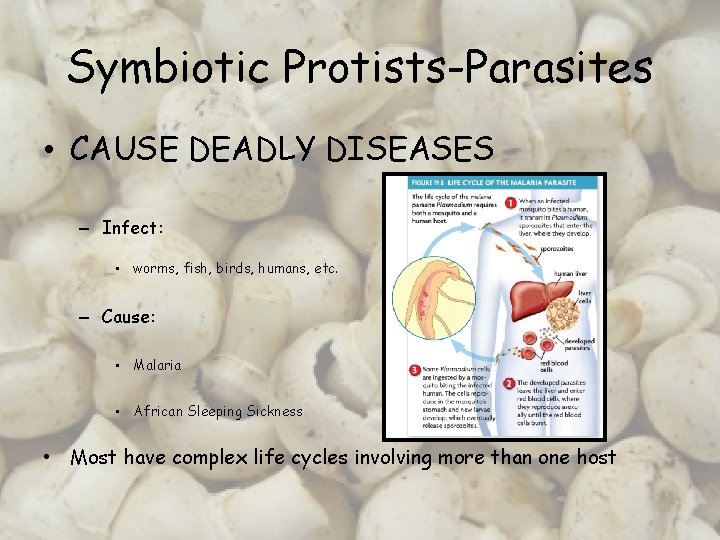
Symbiotic Protists-Parasites • CAUSE DEADLY DISEASES – Infect: • worms, fish, birds, humans, etc. – Cause: • Malaria • African Sleeping Sickness • Most have complex life cycles involving more than one host
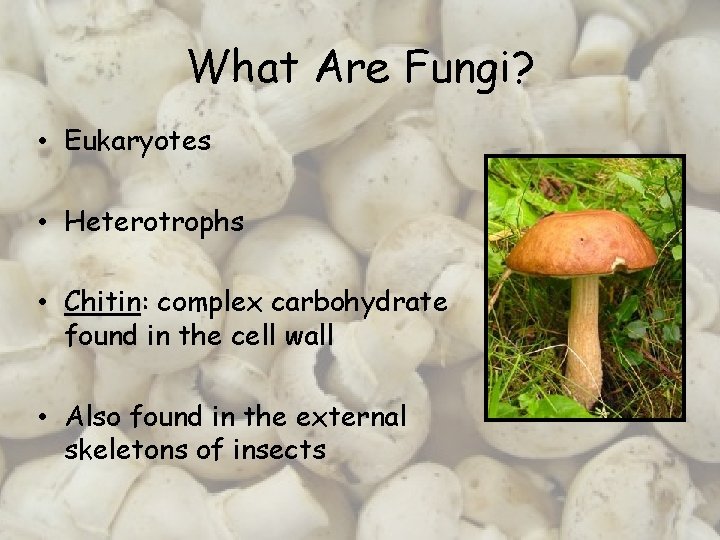
What Are Fungi? • Eukaryotes • Heterotrophs • Chitin: complex carbohydrate found in the cell wall • Also found in the external skeletons of insects
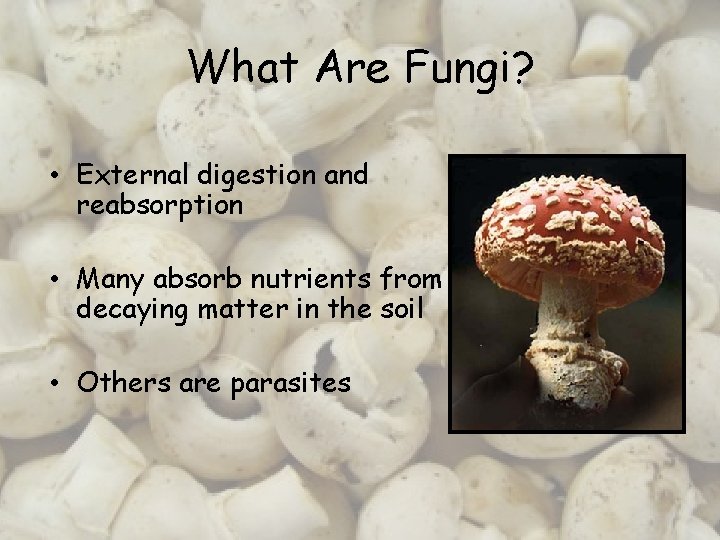
What Are Fungi? • External digestion and reabsorption • Many absorb nutrients from decaying matter in the soil • Others are parasites
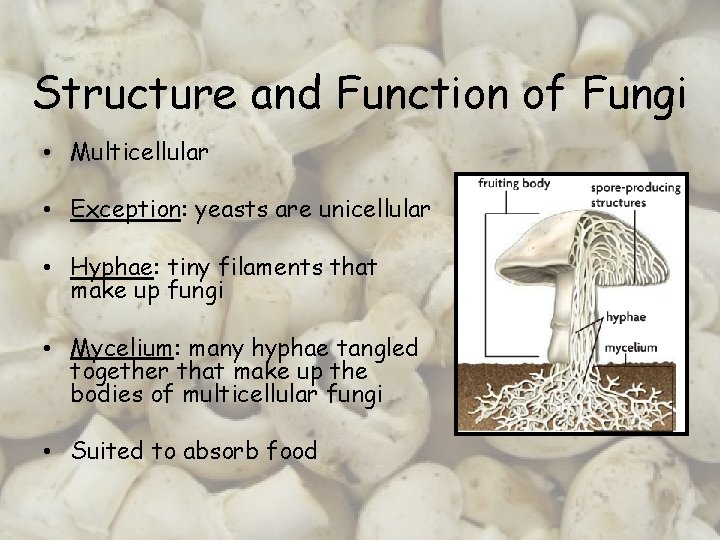
Structure and Function of Fungi • Multicellular • Exception: yeasts are unicellular • Hyphae: tiny filaments that make up fungi • Mycelium: many hyphae tangled together that make up the bodies of multicellular fungi • Suited to absorb food
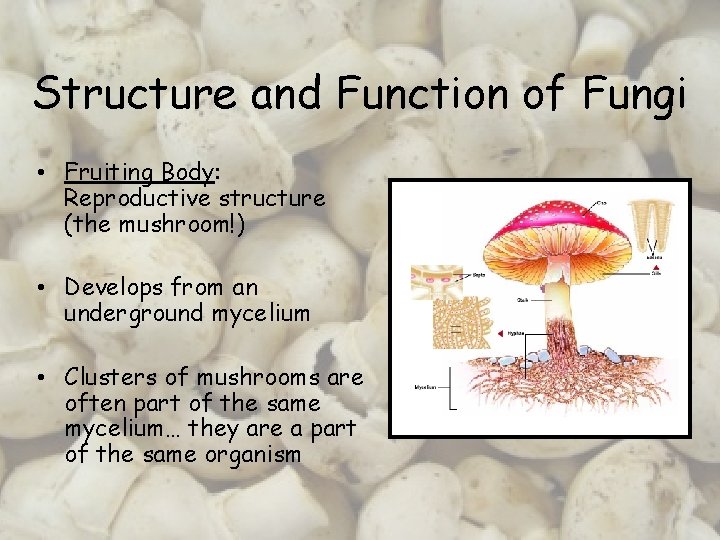
Structure and Function of Fungi • Fruiting Body: Reproductive structure (the mushroom!) • Develops from an underground mycelium • Clusters of mushrooms are often part of the same mycelium… they are a part of the same organism
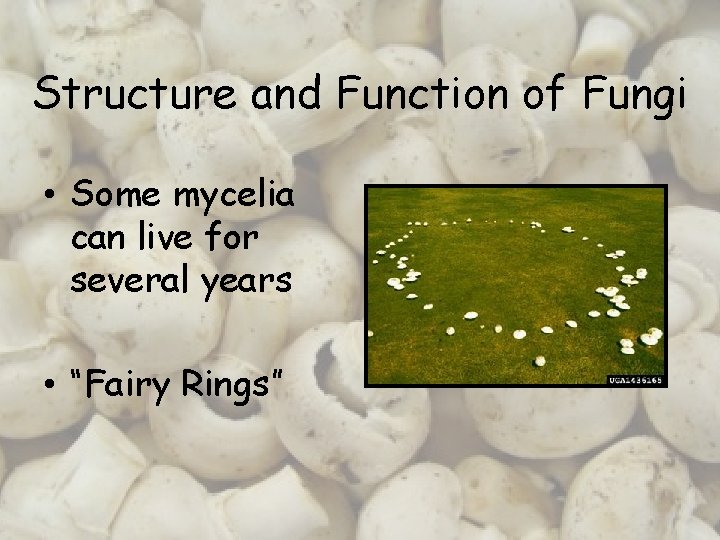
Structure and Function of Fungi • Some mycelia can live for several years • “Fairy Rings”
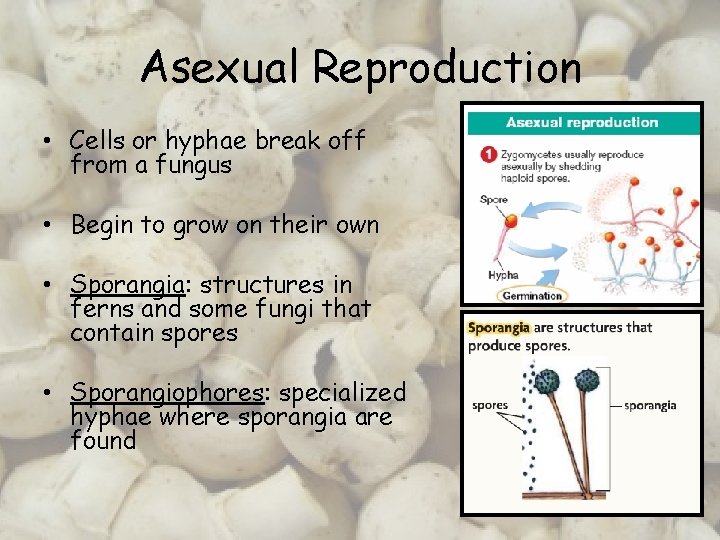
Asexual Reproduction • Cells or hyphae break off from a fungus • Begin to grow on their own • Sporangia: structures in ferns and some fungi that contain spores • Sporangiophores: specialized hyphae where sporangia are found
Sexual Reproduction • Involves two different mating types • + and - • Gametangium: gamete-forming structure • Produced when the hyphae of opposing mating types of fungi meet • A diploid nucleus (zygote), is formed meiosis occurs produces haploid cells
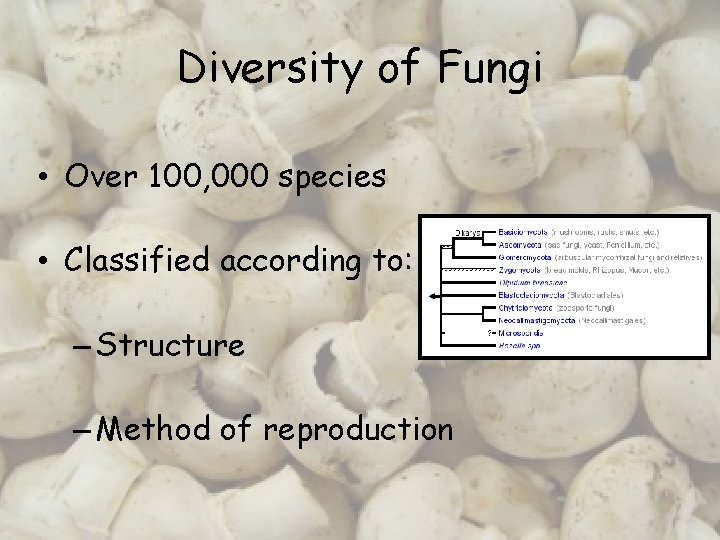
Diversity of Fungi • Over 100, 000 species • Classified according to: – Structure – Method of reproduction
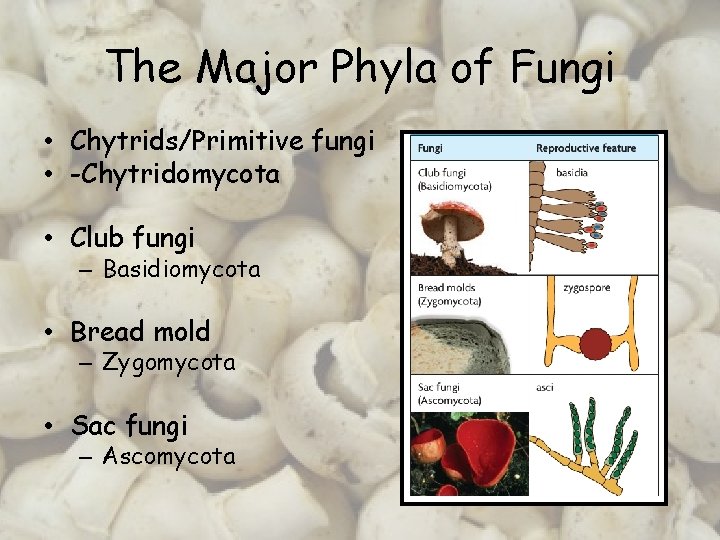
The Major Phyla of Fungi • Chytrids/Primitive fungi • -Chytridomycota • Club fungi – Basidiomycota • Bread mold – Zygomycota • Sac fungi – Ascomycota
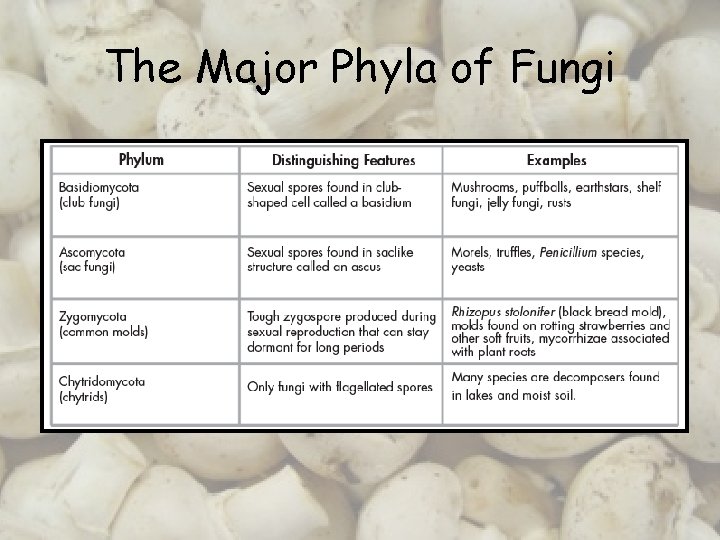
The Major Phyla of Fungi
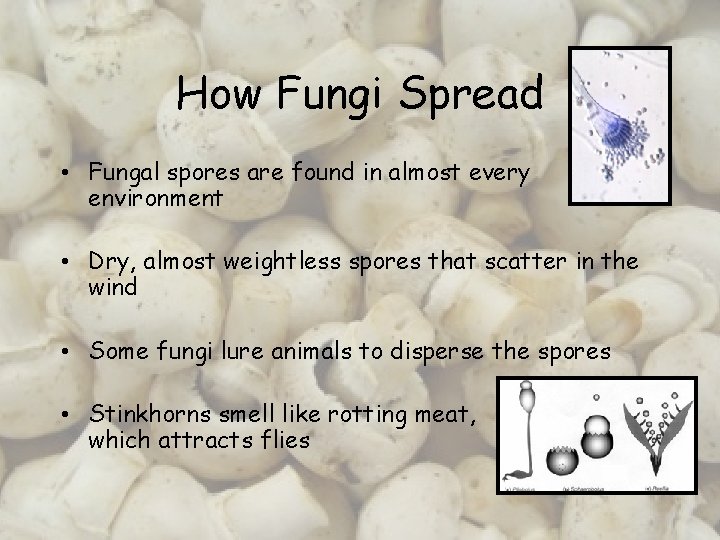
How Fungi Spread • Fungal spores are found in almost every environment • Dry, almost weightless spores that scatter in the wind • Some fungi lure animals to disperse the spores • Stinkhorns smell like rotting meat, which attracts flies
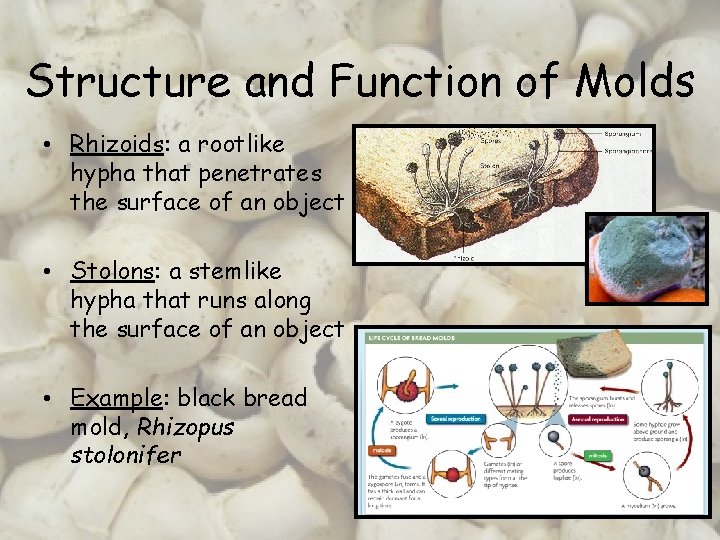
Structure and Function of Molds • Rhizoids: a rootlike hypha that penetrates the surface of an object • Stolons: a stemlike hypha that runs along the surface of an object • Example: black bread mold, Rhizopus stolonifer
Edible and Inedible Mushrooms • Many mushrooms are considered delicacies • When properly cooked and prepared, domestic mushrooms are tasty and nutritious • Wild mushrooms: some are edible, many are poisonous • Don’t eat wild mushrooms!
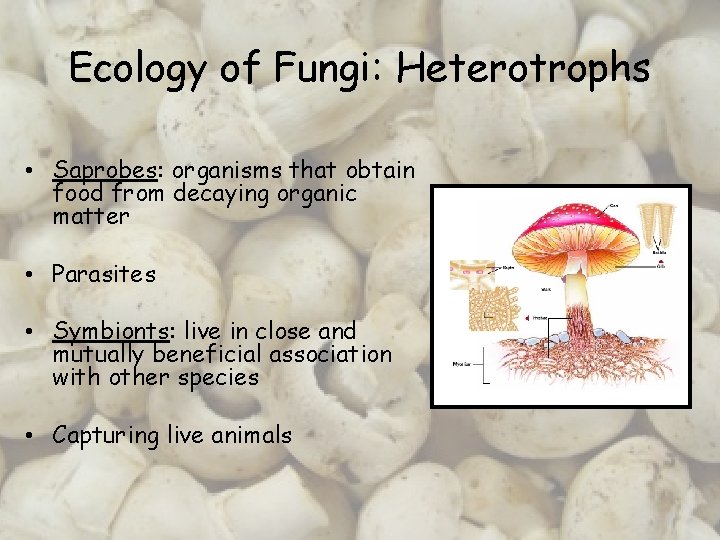
Ecology of Fungi: Heterotrophs • Saprobes: organisms that obtain food from decaying organic matter • Parasites • Symbionts: live in close and mutually beneficial association with other species • Capturing live animals
Fungi as Decomposers • Fungi are found in every ecosystem, where they recycle nutrients by breaking down the bodies and wastes of other nutrients • Release digestive enzymes that break down leaves, fruit and other organic matter
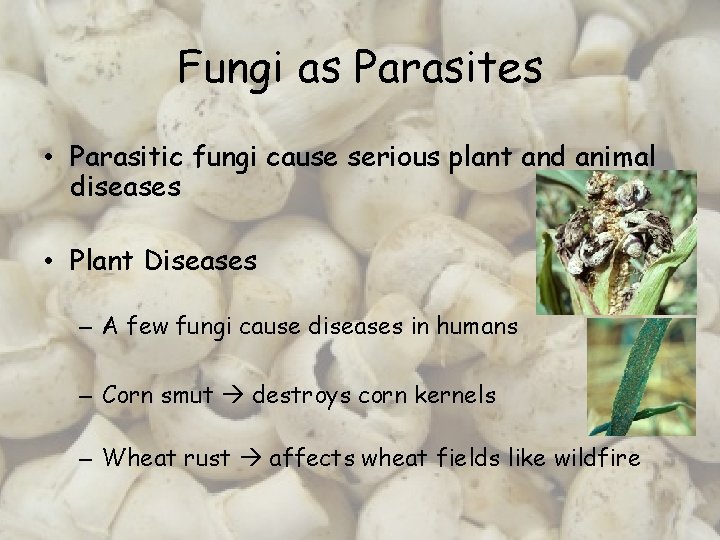
Fungi as Parasites • Parasitic fungi cause serious plant and animal diseases • Plant Diseases – A few fungi cause diseases in humans – Corn smut destroys corn kernels – Wheat rust affects wheat fields like wildfire
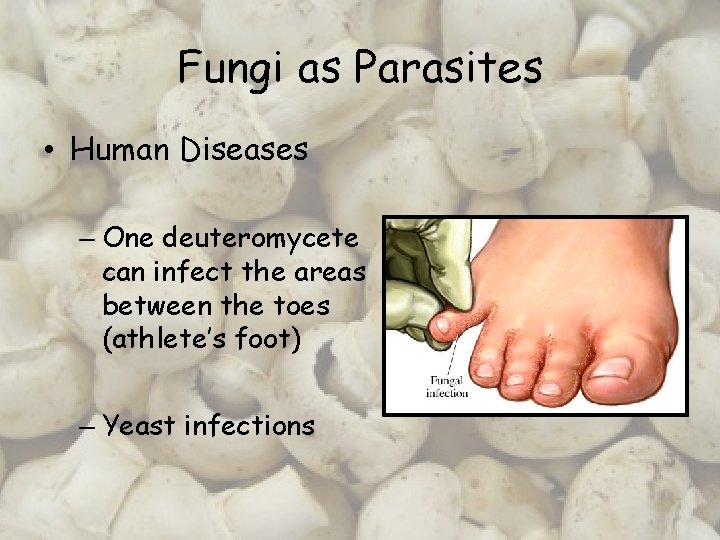
Fungi as Parasites • Human Diseases – One deuteromycete can infect the areas between the toes (athlete’s foot) – Yeast infections
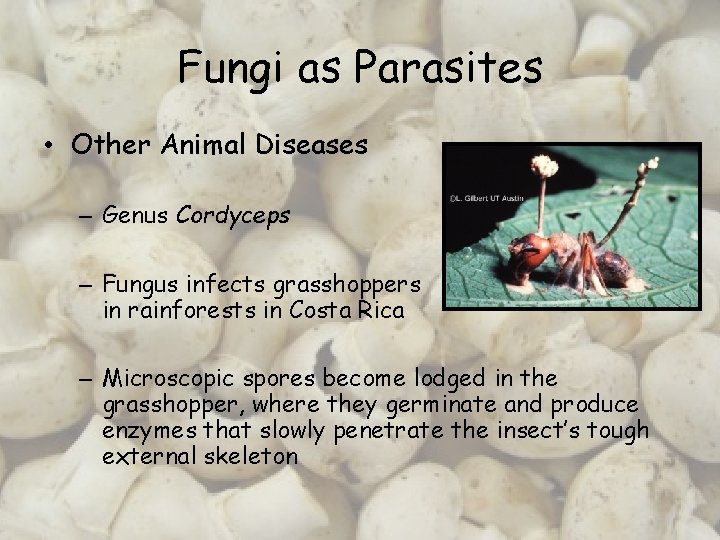
Fungi as Parasites • Other Animal Diseases – Genus Cordyceps – Fungus infects grasshoppers in rainforests in Costa Rica – Microscopic spores become lodged in the grasshopper, where they germinate and produce enzymes that slowly penetrate the insect’s tough external skeleton
Symbiotic Relationships • Some fungi form symbiotic relationships in which both partners benefit • Two such mutualistic associations are essential to many ecosystems – lichens – mycorrhizae
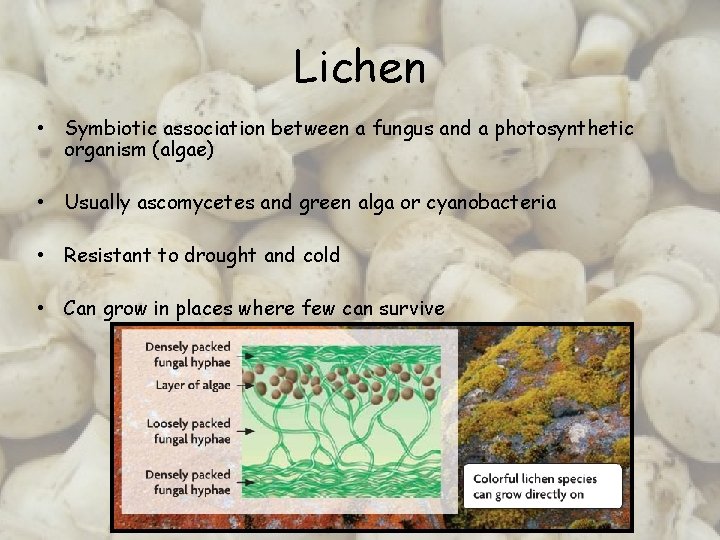
Lichen • Symbiotic association between a fungus and a photosynthetic organism (algae) • Usually ascomycetes and green alga or cyanobacteria • Resistant to drought and cold • Can grow in places where few can survive
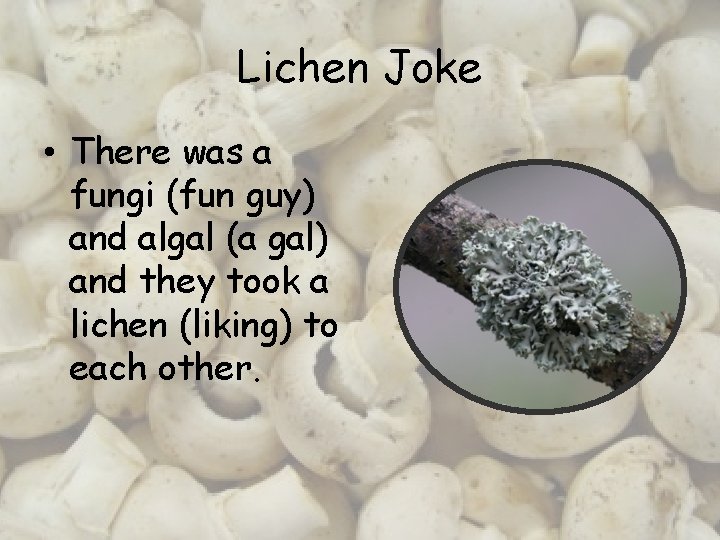
Lichen Joke • There was a fungi (fun guy) and algal (a gal) and they took a lichen (liking) to each other.
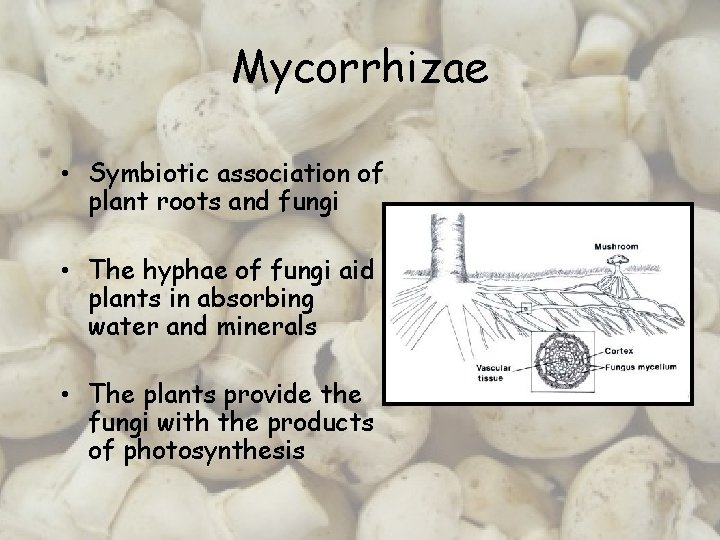
Mycorrhizae • Symbiotic association of plant roots and fungi • The hyphae of fungi aid plants in absorbing water and minerals • The plants provide the fungi with the products of photosynthesis
- Slides: 41