
PROTISTS FUNGI Ch 20 21 Todays Learning Objectives
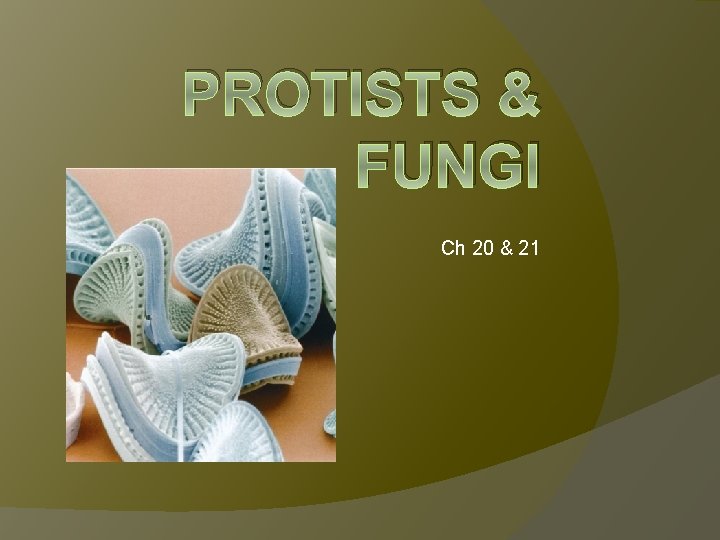
PROTISTS & FUNGI Ch 20 & 21
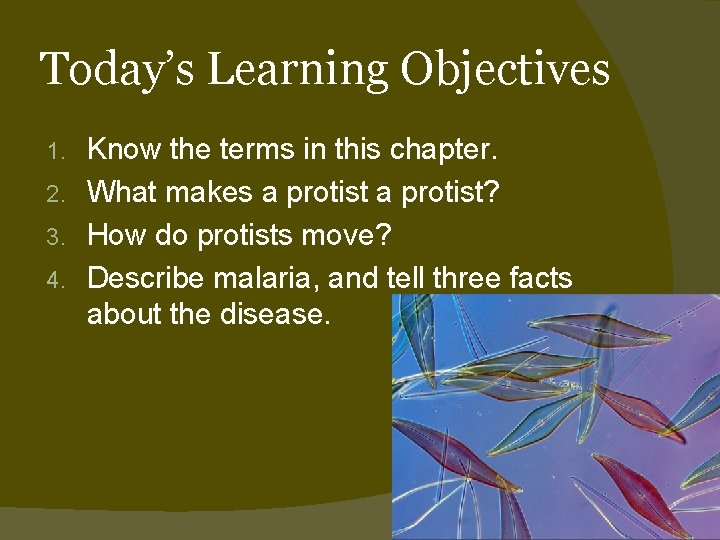
Today’s Learning Objectives Know the terms in this chapter. 2. What makes a protist? 3. How do protists move? 4. Describe malaria, and tell three facts about the disease. 1.
The Kingdom Protista (20 -1) � Protista – � Kingdom; includes any organism that is not a plant, animal, fungus, or bacterium � Eukaryotes with no distinct tissues � “Garbage can” kingdom is unfortunate ○ Organisms within Protista are actually very interesting, and range from very cool to very nasty ○ It’s not their fault we don’t know how to classify them!
Protista � Protists were probably the first eukaryotes � Endosymbiotic theory: Eukaryotes evolved when prokaryotes began living inside other prokaryotes �Endo – inside �Symbiosis – living together
Protista (Ch 17 has pic!) � Where did this crazy idea come from? �Remember mitochondria? ○ Mitochondria have their own DNA that is different than the DNA of the cell. �Remember chloroplasts? ○ Chloroplasts have their own DNA that is different than the DNA of the cell.
Endosymbiotic theory Many other pieces of evidence support the endosymbiotic theory. For example: � Mitochondria and chloroplasts contain DNA that is Mitochondria and chloroplasts are surrounded by their own plasma membranes, which are similar to bacterial membranes. � New mitochondria and chloroplasts are produced through a process similar to binary fission. Bacteria also reproduce through binary fission. � The internal structure and biochemistry of chloroplasts is very similar to that of cyanobacteria. �
Protista �It is thought that mitochondria and chloroplasts were originally free-living organisms that came to live inside of a larger cell, providing it energy �What would the mitochondria get in return? �Protection, food, reproduction

Protista � 3 groups of Protists 1. Animal-like (Protozoa) 2. Plant-like (Algae) 3. Fungi-like (Slime molds, water molds)

Animal-like Protists (20 -2) � Protozoa – �Single-celled microscopic organisms that move and are heterotrophs �Many free living, others parasites �Examples: paramecium, amoeba
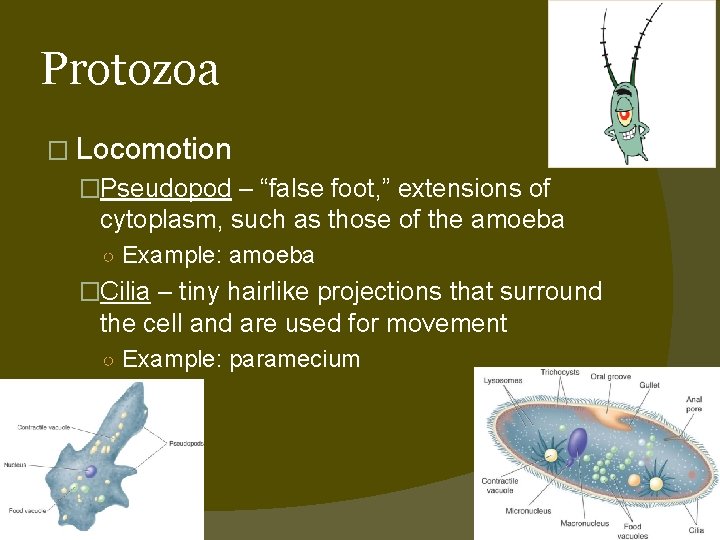
Protozoa � Locomotion �Pseudopod – “false foot, ” extensions of cytoplasm, such as those of the amoeba ○ Example: amoeba �Cilia – tiny hairlike projections that surround the cell and are used for movement ○ Example: paramecium
Protozoan Reproduction � Asexual reproduction (usual method) – �Binary fission – result 2 identical cells �Multiple fission – result >2 identical cells � Gene exchange �Conjugation – opposite mating strains exchange genetic material �Again, not really sexual reproduction because no offspring produced �Not all species of protozoa have this ability � Sexual reproduction – a few of the protozoans produce egg and sperm for sexual reproduction
Protozoa � Four groups of Protozoa 1. Zooflagellates 2. Sarcodines 3. Ciliates 4. Sporozoans

Protozoa � Zooflagellates – animal-like protists that swim with flagella �Flagella – long whip-like appendage �Live in lakes & streams, absorb nutrients from the water �Others live inside larger organisms as parasites
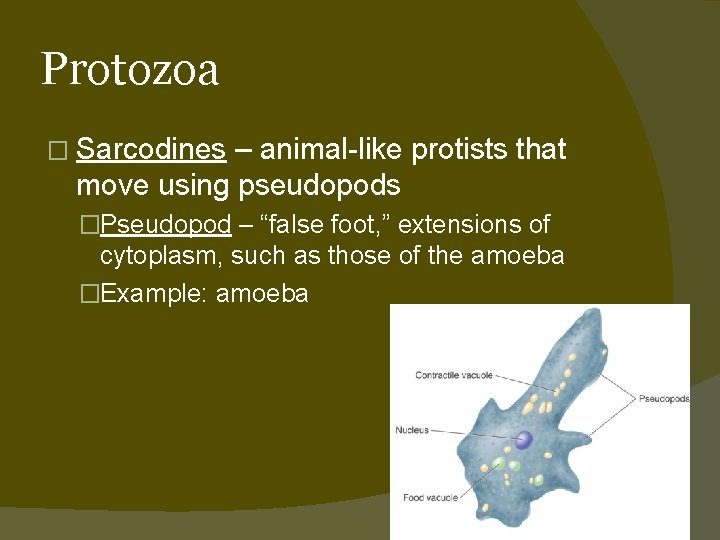
Protozoa � Sarcodines – animal-like protists that move using pseudopods �Pseudopod – “false foot, ” extensions of cytoplasm, such as those of the amoeba �Example: amoeba
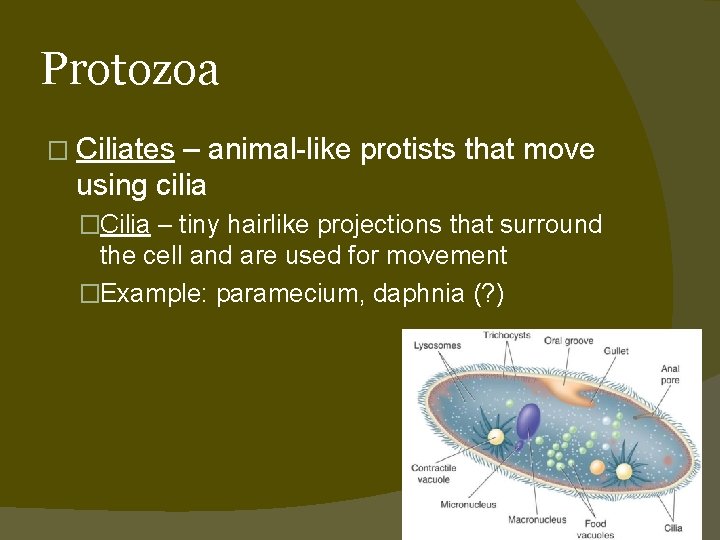
Protozoa � Ciliates – animal-like protists that move using cilia �Cilia – tiny hairlike projections that surround the cell and are used for movement �Example: paramecium, daphnia (? )
Protozoa � Paramecia �Live in fresh water �Use cilia to move, and to direct food into their oral groove �Forms food vacuole where it will be digested
Protozoa � Paramecium Factoids �Has two nuclei – one large and one small – the small one is a backup copy of genes �Contractile vacuole – star-shaped organelle very important in freshwater protists, eliminates excess water ○ Water constantly moves into the cell due to osmosis ○ The paramecium is which (hypertonic or hypotonic) to the pond water?
Protozoa � Sporozoans – animal-like protists that do not move on their own �These are parasites
Protozoa � Zooplankton – �This is a general term for any free-living animal-like protozoa in the sea, a main food source in ocean for fish
Focus on… �Malaria ○ Malaria is one of the world’s most serious infectious diseases, killing as many as 2 million people each year. ○ The protist Plasmodium, which causes malaria, is carried by the female Anopheles mosquito. ○ Symptoms: typically very sick with high fevers, shaking chills, and flu-like illness ○ Although malaria can be a deadly disease, illness and death from malaria can usually be prevented.
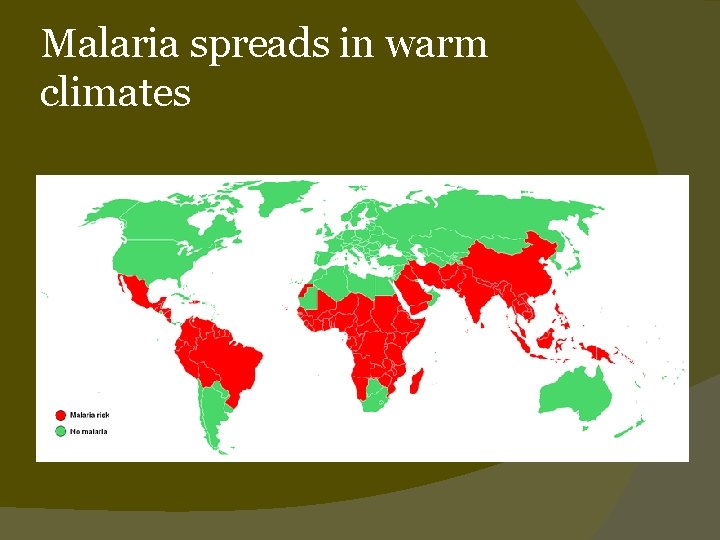
Malaria spreads in warm climates
Malaria � Weird life cycle �Enters human body through mosquito bite (has tiny rod -shaped body form) �Travels to the liver where it produces 40, 000 offspring that are grape-shaped �These pour out of the liver seeking red blood cells to inhabit ○ (they eat your hemoglobin!) �Inside the RBC they produce more of themselves, continually taking over more RBC ○ (sneaky because your immune system can’t “see” them while they are in the RBC) �Eventually produce another, now sexual, form, which must be drunk by a mosquito when it bites you �It then has to meet the opposite sex in the body of the mosquito
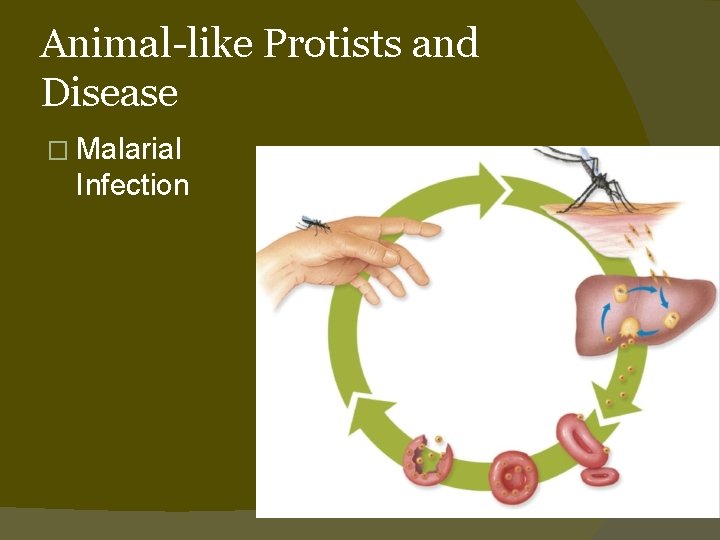
Animal-like Protists and Disease � Malarial Infection
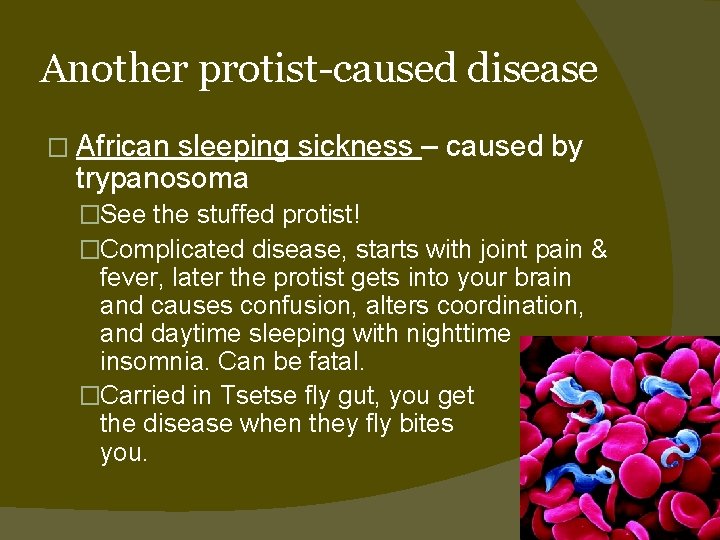
Another protist-caused disease � African sleeping sickness – caused by trypanosoma �See the stuffed protist! �Complicated disease, starts with joint pain & fever, later the protist gets into your brain and causes confusion, alters coordination, and daytime sleeping with nighttime insomnia. Can be fatal. �Carried in Tsetse fly gut, you get the disease when they fly bites you.
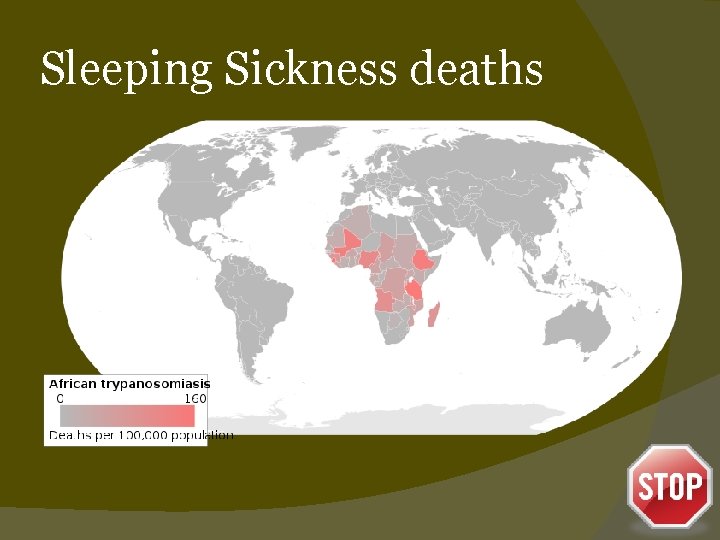
Sleeping Sickness deaths
Today’s Learning Objectives � Know 3 examples of algae and a fact about each. � What are slime molds? � What is Phytophora infestans?
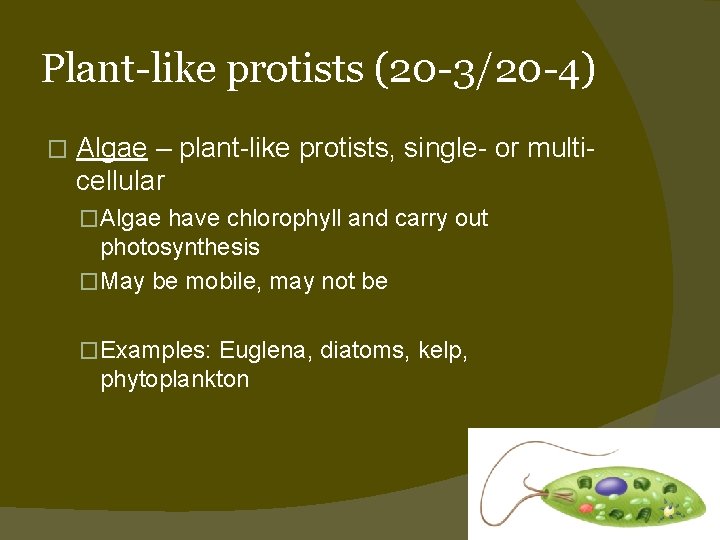
Plant-like protists (20 -3/20 -4) � Algae – plant-like protists, single- or multicellular �Algae have chlorophyll and carry out photosynthesis �May be mobile, may not be �Examples: Euglena, diatoms, kelp, phytoplankton
Algae � 7 Groups of Algae 1. Euglenophytes 2. Chrysophytes – yellow algae 3. Diatoms 4. Dinoflagellates – flagella in grooves; produce light when disturbed 5. Red algae – bush like, grow on coral reefs 6. Brown algae 7. Green algae
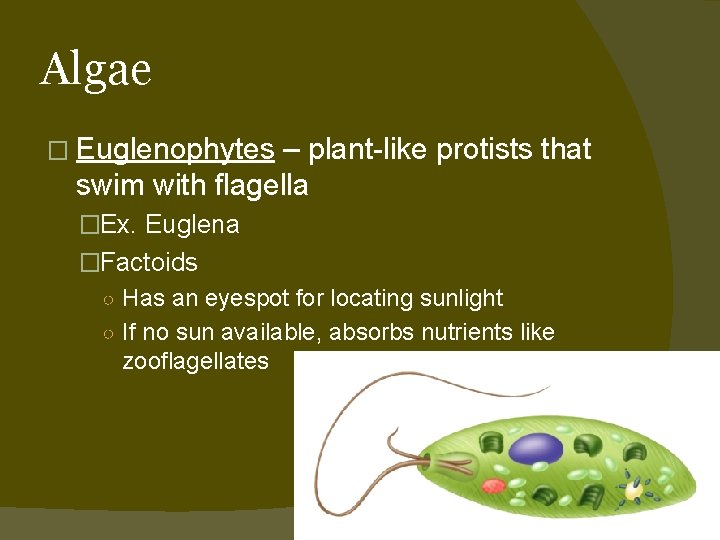
Algae � Euglenophytes – plant-like protists that swim with flagella �Ex. Euglena �Factoids ○ Has an eyespot for locating sunlight ○ If no sun available, absorbs nutrients like zooflagellates
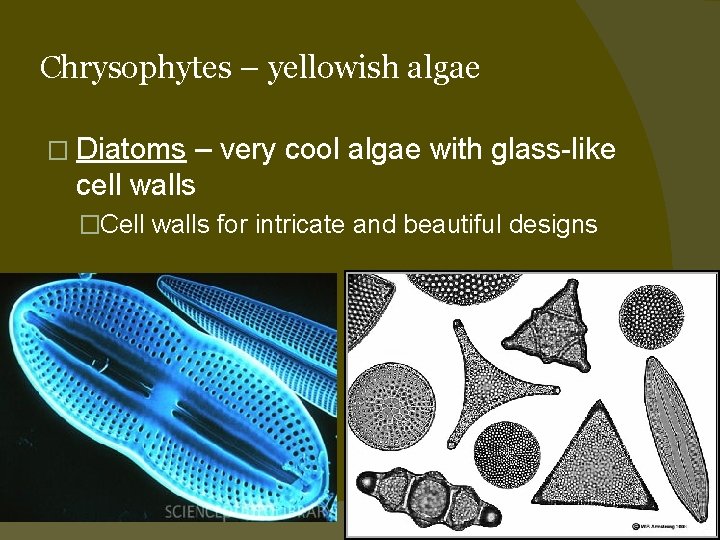
Chrysophytes – yellowish algae � Diatoms – very cool algae with glass-like cell walls �Cell walls for intricate and beautiful designs
Algae � Dinoflagellates – algae with flagella that stay within grooves of their body �Some of these produce light when disturbed � Red algae – large, multicellular algae that use a red pigment to help with photosynthesis �Look kind of bush-like, grow on coral reefs �Not all are red, they just have the red pigment
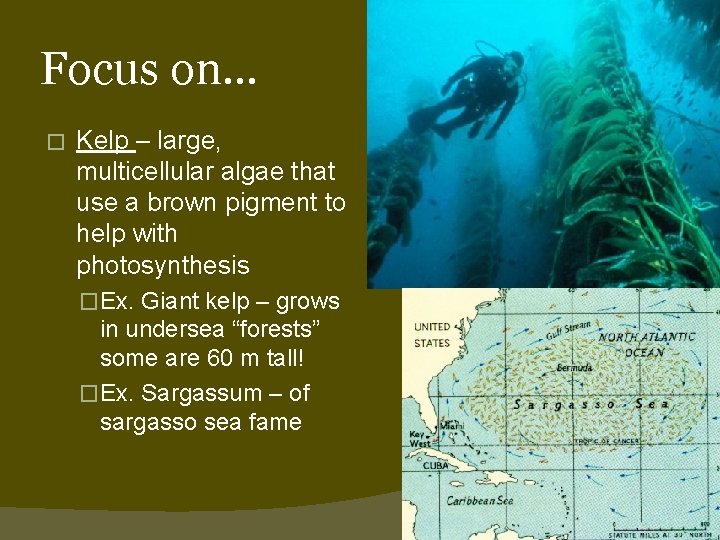
Focus on… � Kelp – large, multicellular algae that use a brown pigment to help with photosynthesis �Ex. Giant kelp – grows in undersea “forests” some are 60 m tall! �Ex. Sargassum – of sargasso sea fame
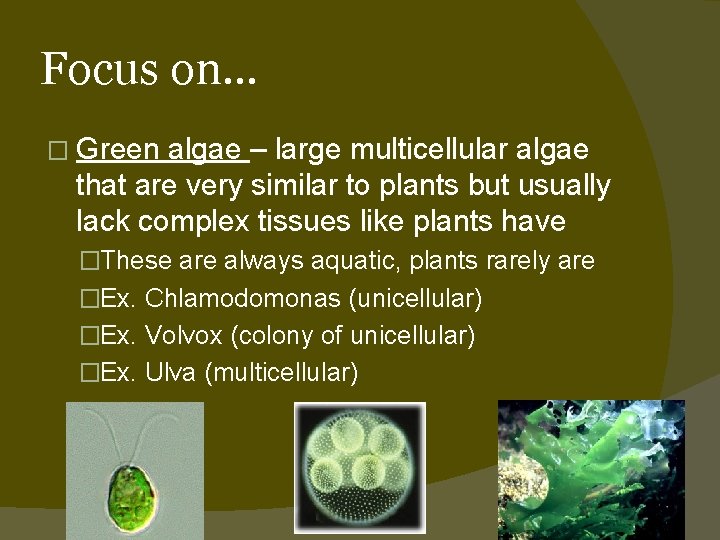
Focus on… � Green algae – large multicellular algae that are very similar to plants but usually lack complex tissues like plants have �These are always aquatic, plants rarely are �Ex. Chlamodomonas (unicellular) �Ex. Volvox (colony of unicellular) �Ex. Ulva (multicellular)
Algae � Algal reproduction… � Alternation of generations – lifestyle that alternates between generations of haploid and diploid individuals �Haploid = 1 copy of each chromosome �Diploid = 2 copies of each chromosome �Clear examples of this originate with green algae
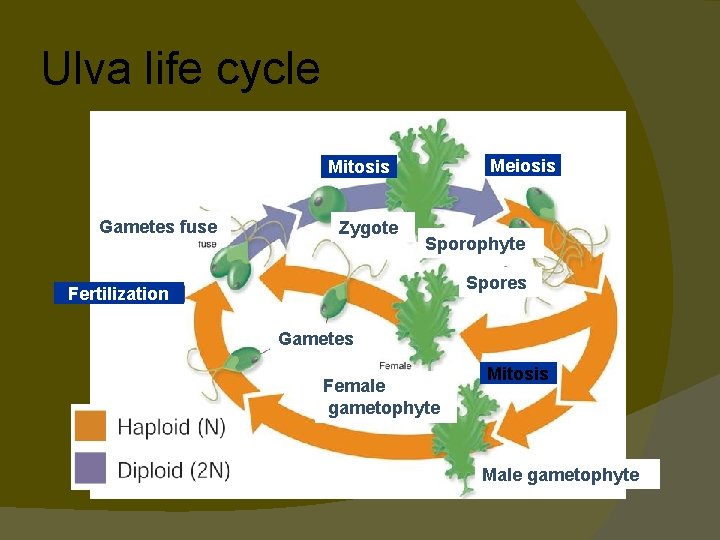
Ulva life cycle Meiosis Mitosis Gametes fuse Zygote Sporophyte Spores Fertilization Gametes Female gametophyte Mitosis Male gametophyte
Algae � Ecology of algae �Phytoplankton are tiny algae that float at top of seas, form basis of ocean food chain ○ What are some things that eat phytoplankton? �Also used in food. Examples? �Used in medicines, lab research, and industry too
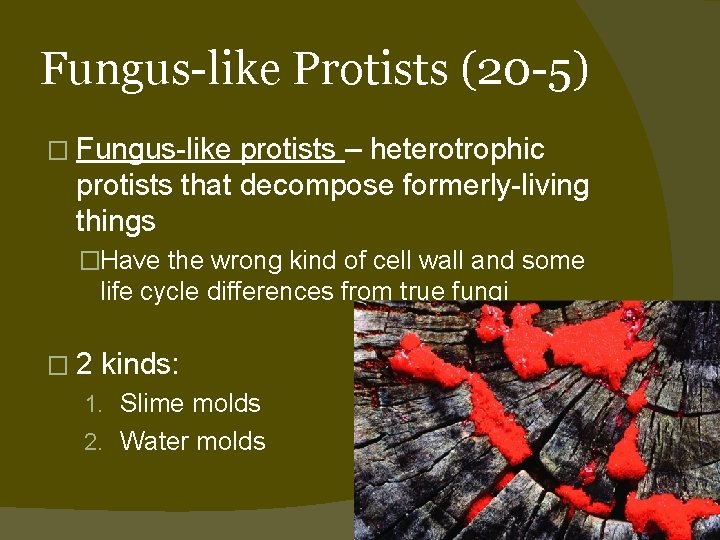
Fungus-like Protists (20 -5) � Fungus-like protists – heterotrophic protists that decompose formerly-living things �Have the wrong kind of cell wall and some life cycle differences from true fungi � 2 kinds: 1. Slime molds 2. Water molds
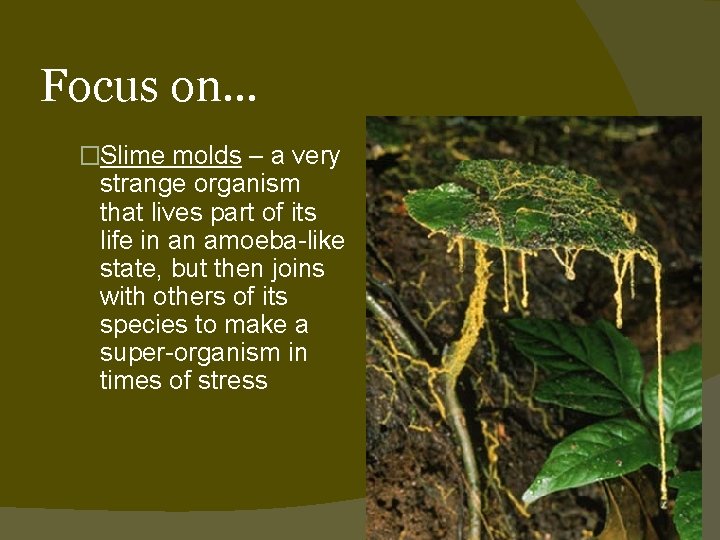
Focus on… �Slime molds – a very strange organism that lives part of its life in an amoeba-like state, but then joins with others of its species to make a super-organism in times of stress
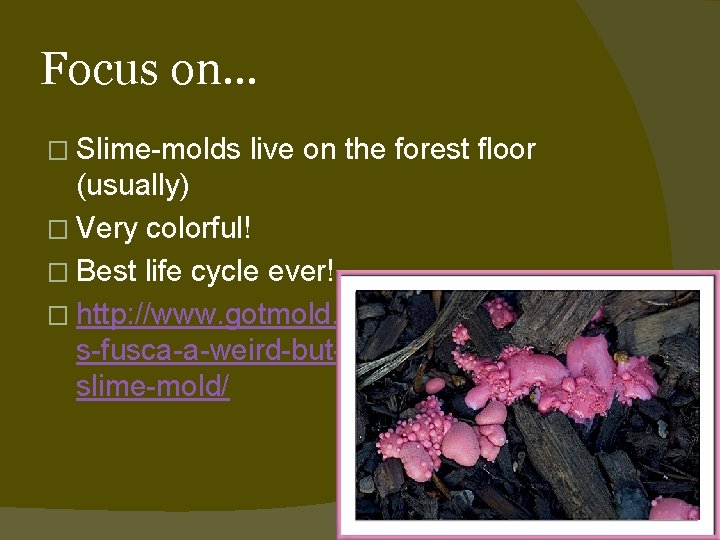
Focus on… � Slime-molds live on the forest floor (usually) � Very colorful! � Best life cycle ever! � http: //www. gotmold. ca/2015/05/stemoniti s-fusca-a-weird-but-amazing-species-ofslime-mold/
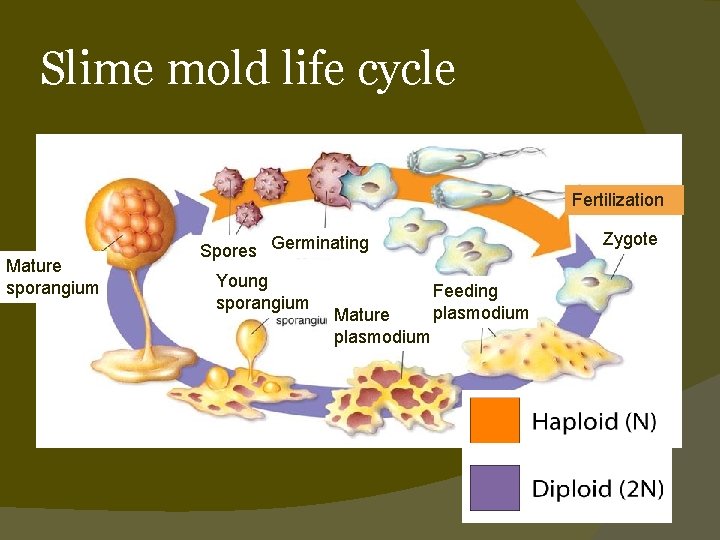
Slime mold life cycle Fertilization Mature sporangium Zygote Spores Germinating Young sporangium Mature plasmodium Feeding plasmodium
Focus on… � Slime molds blur the idea of the individual �When form the superorganism, some even lose their cell membranes, so are just a bunch of nuclei in one giant blob of cytoplasm
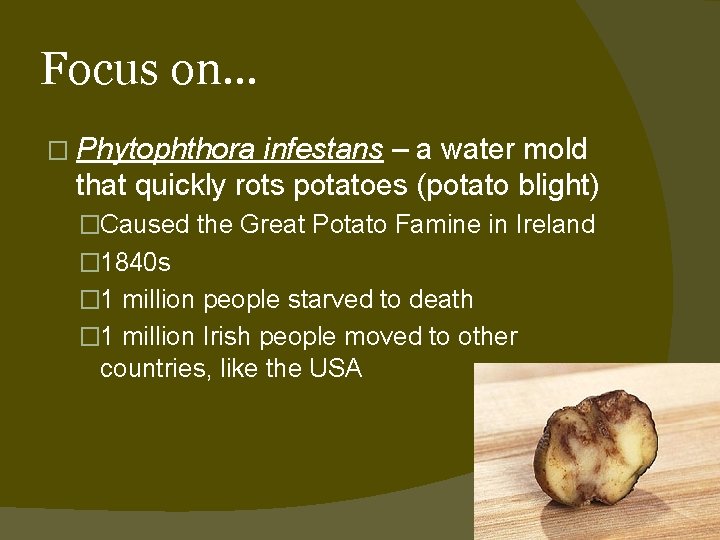
Focus on… � Phytophthora infestans – a water mold that quickly rots potatoes (potato blight) �Caused the Great Potato Famine in Ireland � 1840 s � 1 million people starved to death � 1 million Irish people moved to other countries, like the USA
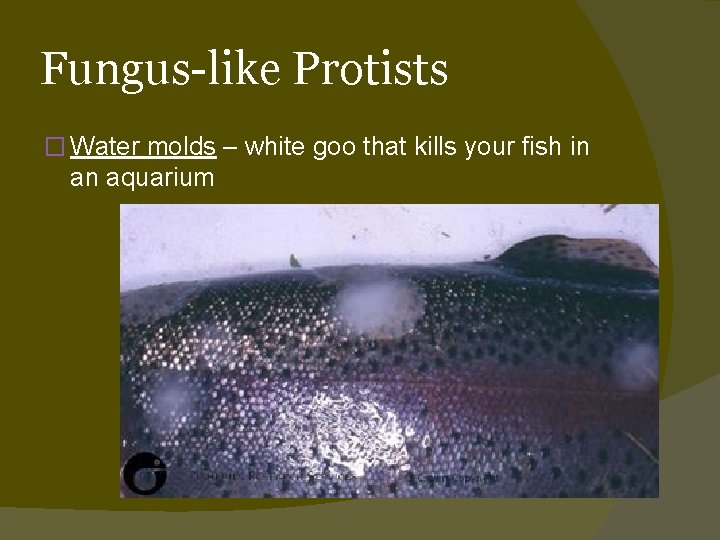
Fungus-like Protists � Water molds – white goo that kills your fish in an aquarium
Fungus-like Protists � Ecology of fungus-like protists �Important decomposers �Diseases of animals and plants ○ Ex. (Some) mildews and blights
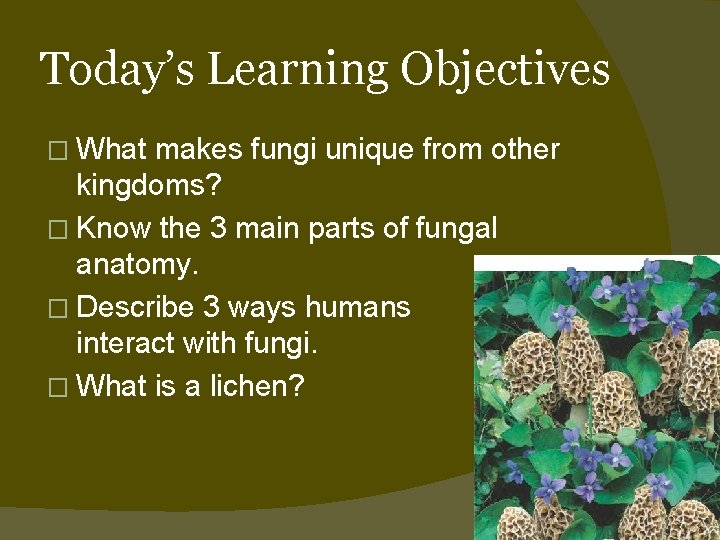
Today’s Learning Objectives � What makes fungi unique from other kingdoms? � Know the 3 main parts of fungal anatomy. � Describe 3 ways humans interact with fungi. � What is a lichen?
Overview of Fungi (21 -1) � Fungi – eukaryotes, mostly multicellular, decomposers, cell walls made of chitin �Chitin – complex carbohydrate that makes up cell walls of fungi & exoskeletons of insects �Ex. Molds, Yeasts, Mushrooms �Pronunciation: Fun-jeye OR Fun-guy ○ Not: Fun-jee �Normal role in ecosystem: decomposers � Mycology – Study of fungi
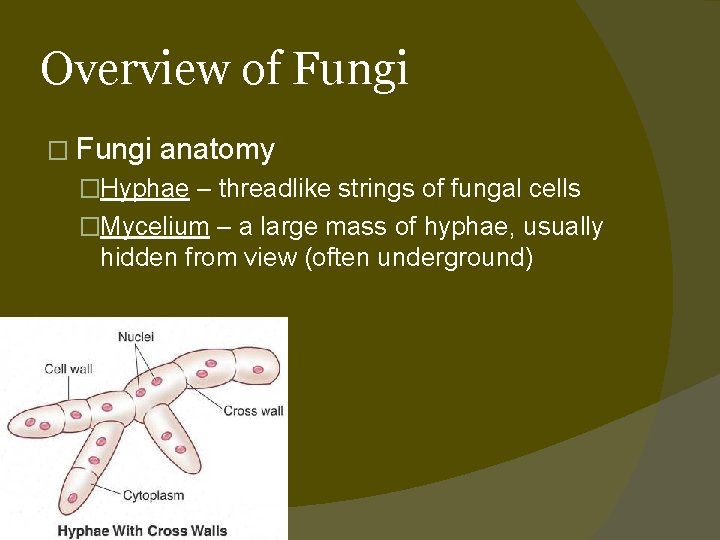
Overview of Fungi � Fungi anatomy �Hyphae – threadlike strings of fungal cells �Mycelium – a large mass of hyphae, usually hidden from view (often underground)
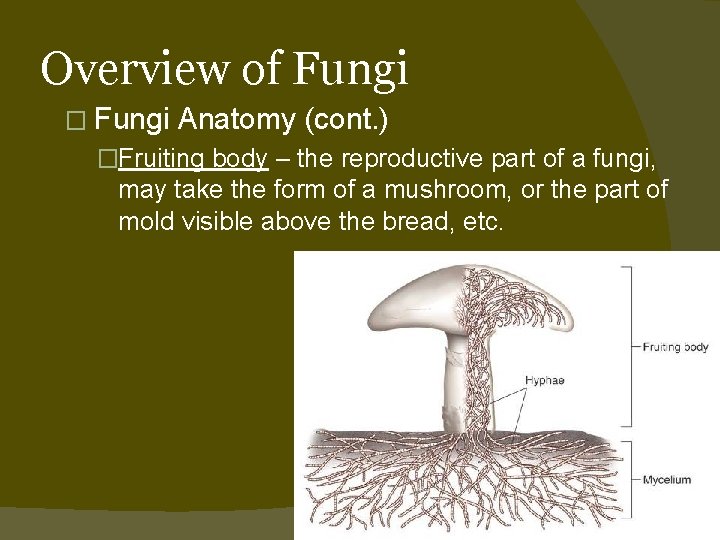
Overview of Fungi � Fungi Anatomy (cont. ) �Fruiting body – the reproductive part of a fungi, may take the form of a mushroom, or the part of mold visible above the bread, etc.
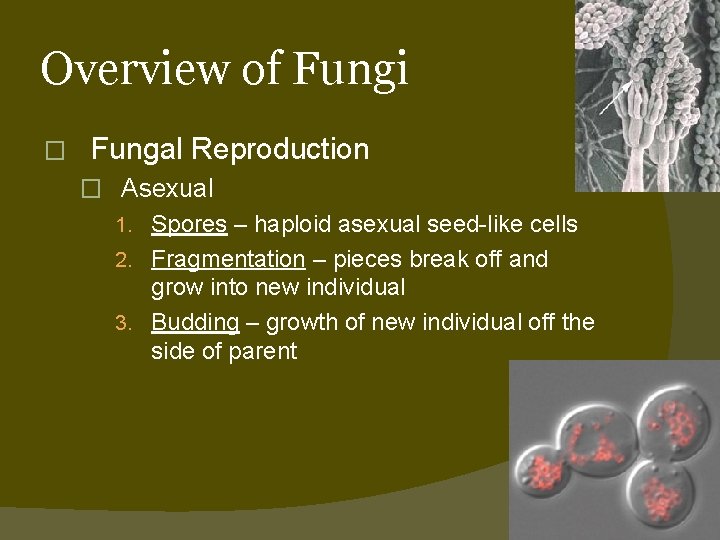
Overview of Fungi � Fungal Reproduction � Asexual 1. Spores – haploid asexual seed-like cells 2. Fragmentation – pieces break off and grow into new individual 3. Budding – growth of new individual off the side of parent
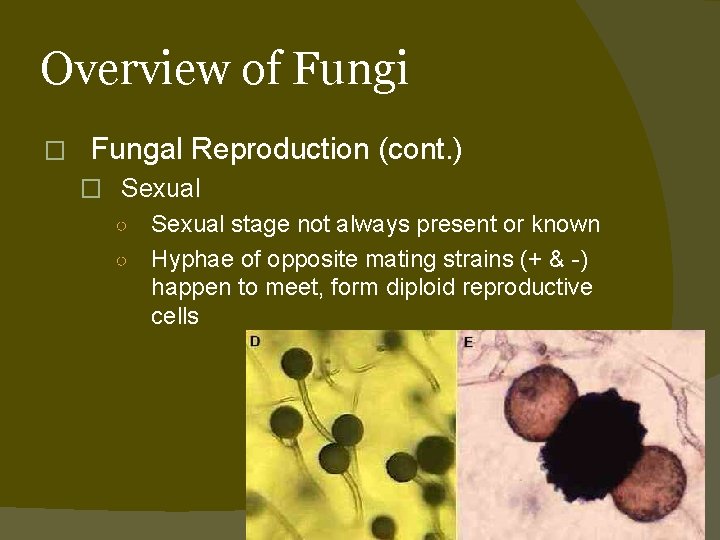
Overview of Fungi � Fungal Reproduction (cont. ) � Sexual ○ Sexual stage not always present or known ○ Hyphae of opposite mating strains (+ & -) happen to meet, form diploid reproductive cells
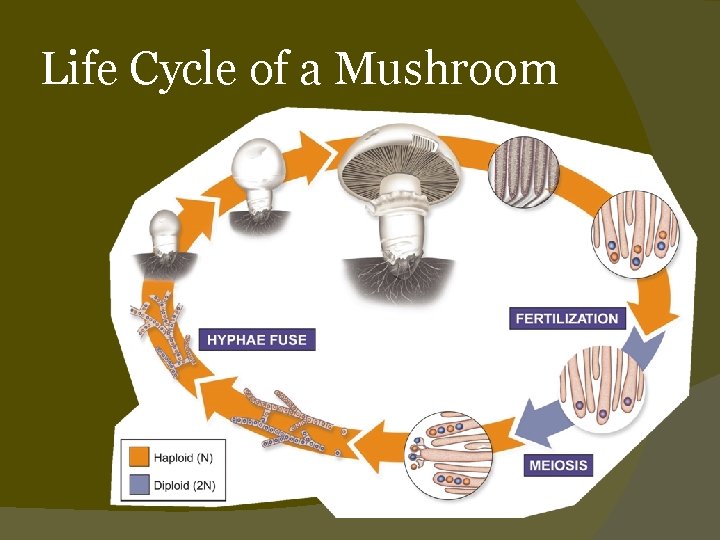
Life Cycle of a Mushroom
Fungi & Humans � Fungi have complicated relations to humans �Food: mushrooms, truffles �Food processing: cheese, bread, alcohol �Food spoiling/crop disease: ○ mold, rusts, smuts �Human diseases: ○ athletes foot, ringworm, yeast infection, poisons, histoplasmosis �Cures: antibiotics
Classification of Fungi (21 -2) � Four main groups of Fungi 1. Common molds 2. Sac fungi 3. Club fungi 4. Imperfect fungi
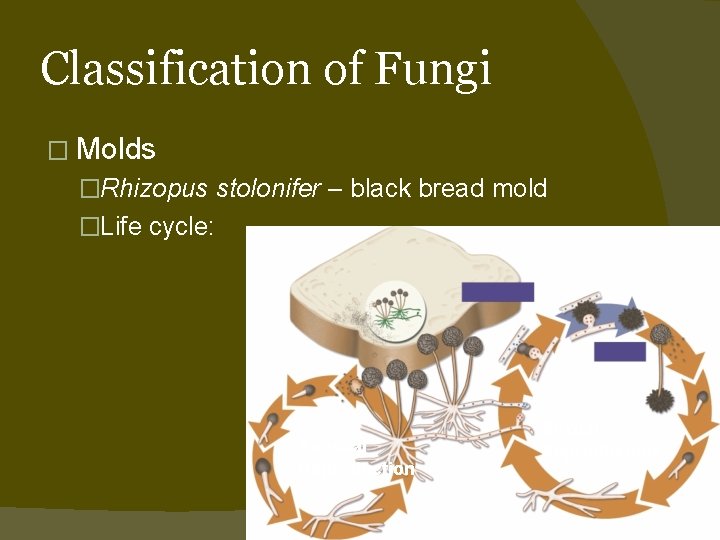
Classification of Fungi � Molds �Rhizopus stolonifer – black bread mold �Life cycle: Asexual Reproduction Sexual Reproduction

Classification of Fungi � Sac fungi �Include yeast � Club fungi �Includes mushrooms & puffballs
Classification of Fungi � Imperfect fungi �Odd group. Sexual stage has never been seen, so these fungi cannot be categorized properly �Includes Penicillium – the mold that we get penicillin from.
Focus on… � Important species: �Penicillium & others – antibiotics �Saccharomyces cerevisiae – ○ AKA: Yeast ○ Traditionally: alcohol, bread ○ New uses: some vaccines, insulin for diabetics
Ecology of Fungi � In nature: �Fungi are essential to recycling nutrients from dead organisms to the environment
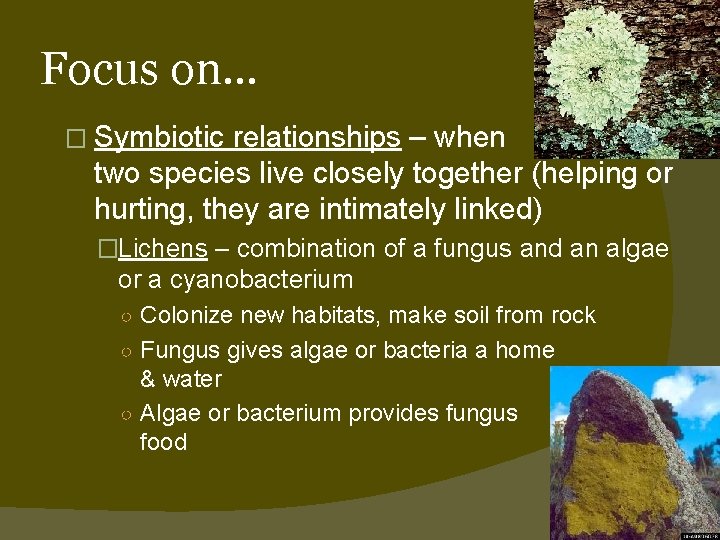
Focus on… � Symbiotic relationships – when two species live closely together (helping or hurting, they are intimately linked) �Lichens – combination of a fungus and an algae or a cyanobacterium ○ Colonize new habitats, make soil from rock ○ Fungus gives algae or bacteria a home & water ○ Algae or bacterium provides fungus food
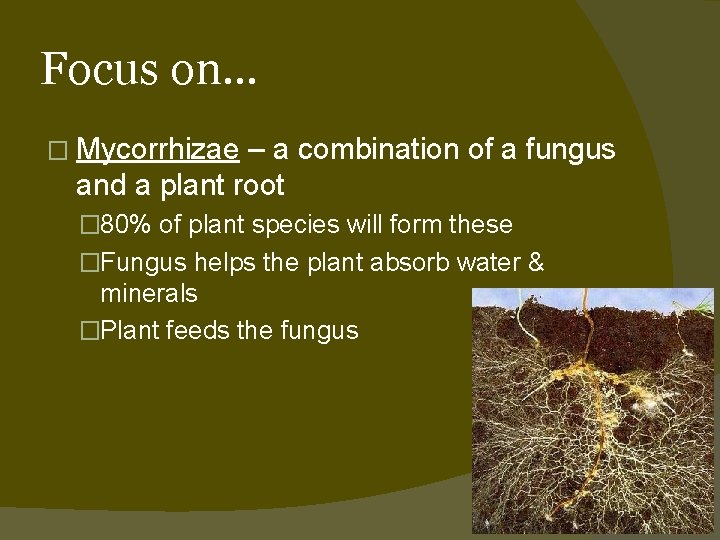
Focus on… � Mycorrhizae – a combination of a fungus and a plant root � 80% of plant species will form these �Fungus helps the plant absorb water & minerals �Plant feeds the fungus
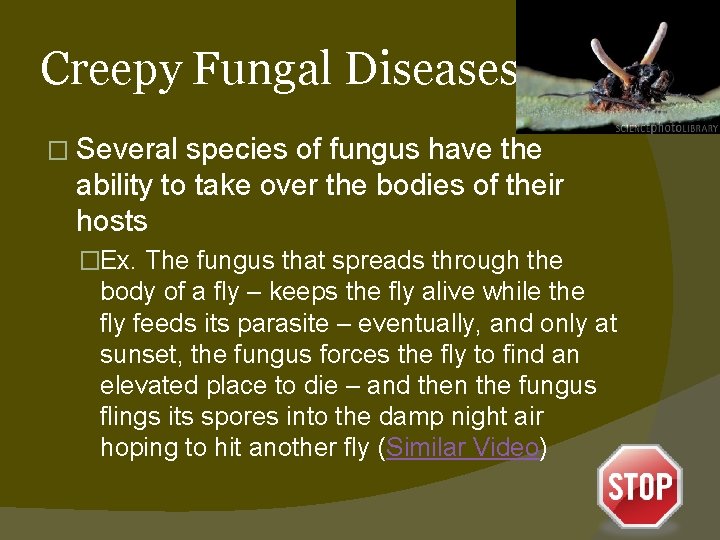
Creepy Fungal Diseases � Several species of fungus have the ability to take over the bodies of their hosts �Ex. The fungus that spreads through the body of a fly – keeps the fly alive while the fly feeds its parasite – eventually, and only at sunset, the fungus forces the fly to find an elevated place to die – and then the fungus flings its spores into the damp night air hoping to hit another fly (Similar Video)
- Slides: 61