
PROTISTANS 18 1 Introduction to Protists I Introduction
- Slides: 29
PROTISTANS
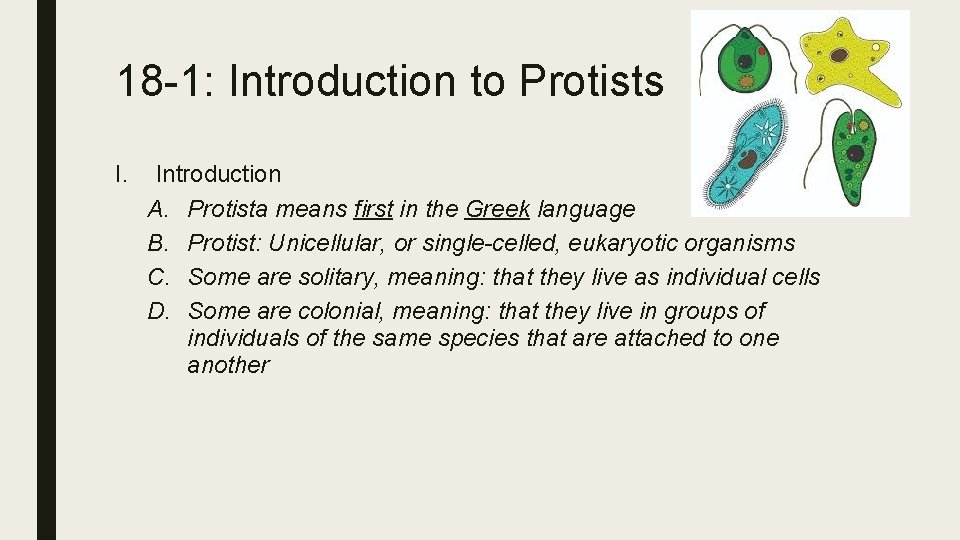
18 -1: Introduction to Protists I. Introduction A. Protista means first in the Greek language B. Protist: Unicellular, or single-celled, eukaryotic organisms C. Some are solitary, meaning: that they live as individual cells D. Some are colonial, meaning: that they live in groups of individuals of the same species that are attached to one another
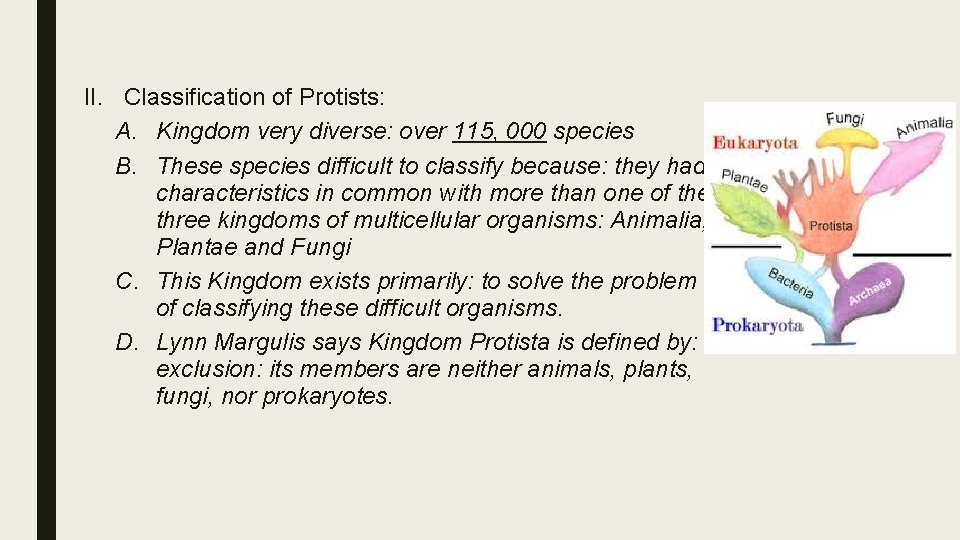
II. Classification of Protists: A. Kingdom very diverse: over 115, 000 species B. These species difficult to classify because: they had characteristics in common with more than one of the three kingdoms of multicellular organisms: Animalia, Plantae and Fungi C. This Kingdom exists primarily: to solve the problem of classifying these difficult organisms. D. Lynn Margulis says Kingdom Protista is defined by: exclusion: its members are neither animals, plants, fungi, nor prokaryotes.
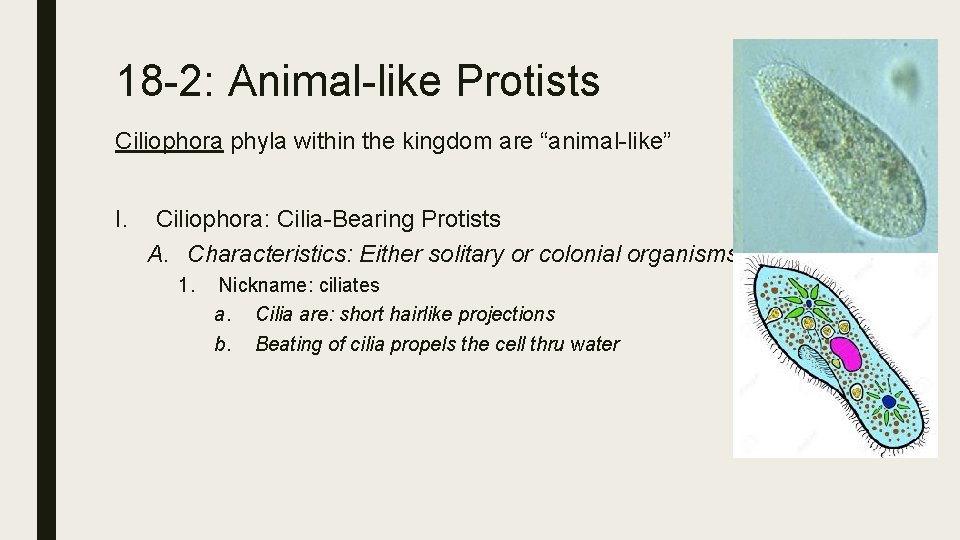
18 -2: Animal-like Protists Ciliophora phyla within the kingdom are “animal-like” I. Ciliophora: Cilia-Bearing Protists A. Characteristics: Either solitary or colonial organisms 1. Nickname: ciliates a. Cilia are: short hairlike projections b. Beating of cilia propels the cell thru water
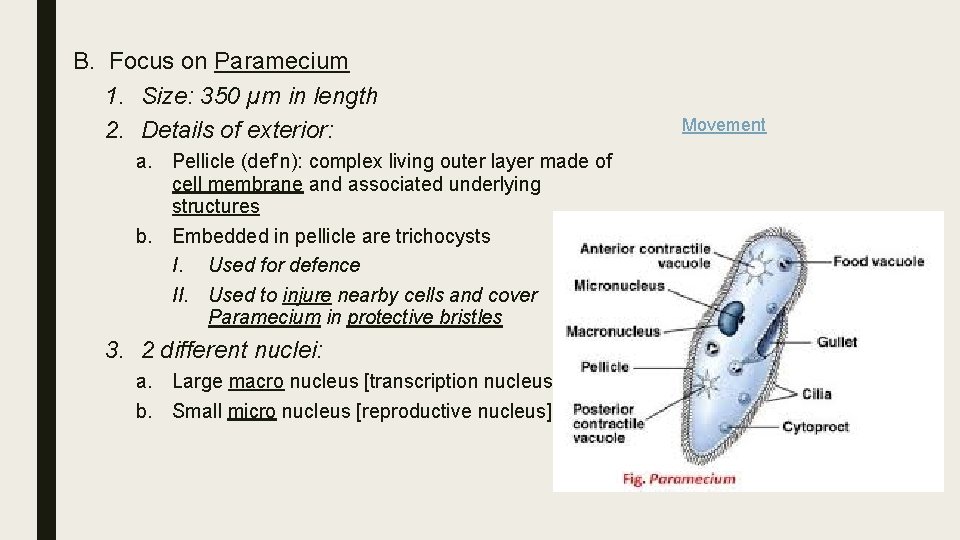
B. Focus on Paramecium 1. Size: 350 µm in length 2. Details of exterior: a. Pellicle (def’n): complex living outer layer made of cell membrane and associated underlying structures b. Embedded in pellicle are trichocysts I. Used for defence II. Used to injure nearby cells and cover Paramecium in protective bristles 3. 2 different nuclei: a. Large macro nucleus [transcription nucleus] b. Small micro nucleus [reproductive nucleus] Movement
4. Feeding: a. Uses cilia to direct water into gullet b. Food (e. g. bacteria) forced into cavities called food vacuoles c. Break off into cytoplasm and circulate, eventually fusing with lysosomes 5. Digestion: a. Lysosome (def’n): organelles that contain digestive enzymes 6. Waste Removal: a. “Used” food vacuoles fuse with region of cell membrane called the anal pore 7. Excretion a. Water flows into Paramecium due to osmosis b. Expelled by process: i. Excess water collects in other vacuoles ii. Vacuoles fuse with canals located around the contractile vacuoles iii. When filled, this organelle contracts quickly and pumps water out
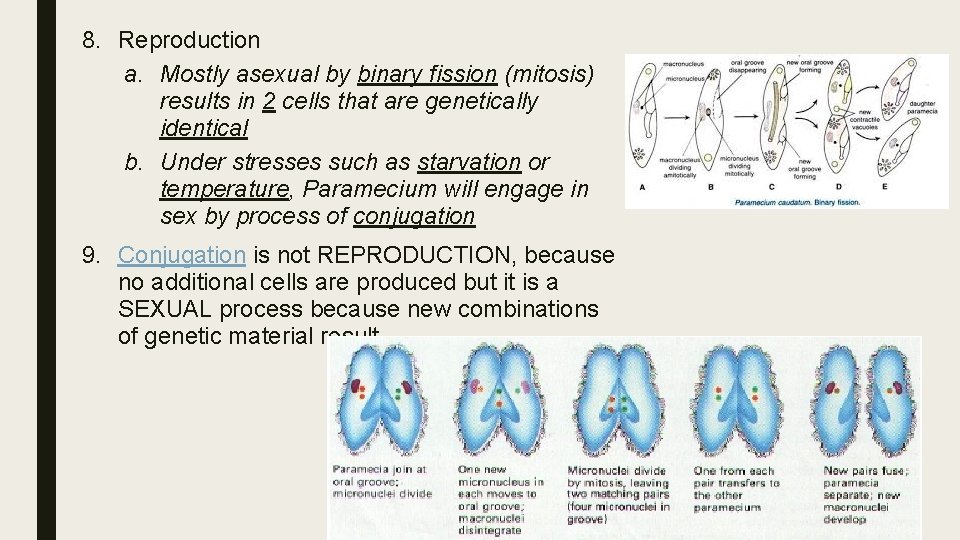
8. Reproduction a. Mostly asexual by binary fission (mitosis) results in 2 cells that are genetically identical b. Under stresses such as starvation or temperature, Paramecium will engage in sex by process of conjugation 9. Conjugation is not REPRODUCTION, because no additional cells are produced but it is a SEXUAL process because new combinations of genetic material result
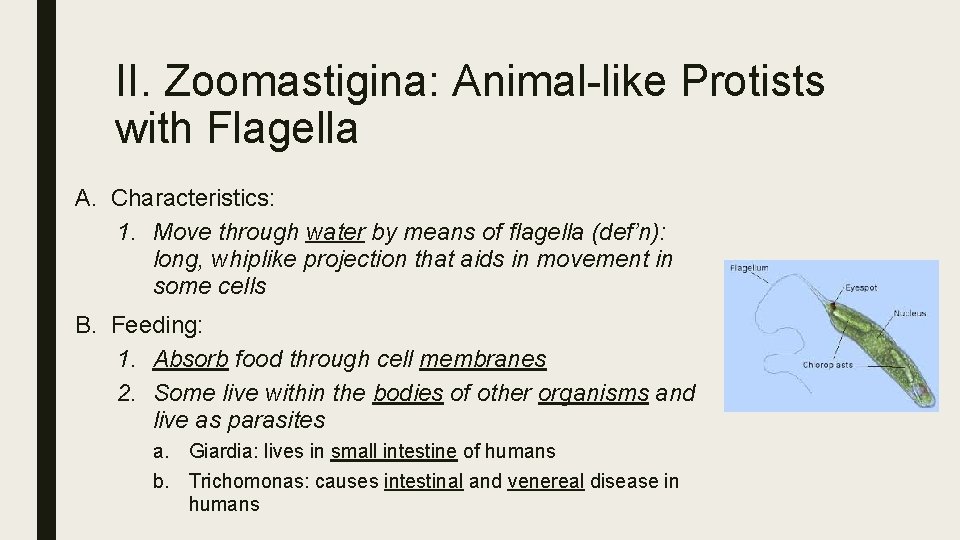
II. Zoomastigina: Animal-like Protists with Flagella A. Characteristics: 1. Move through water by means of flagella (def’n): long, whiplike projection that aids in movement in some cells B. Feeding: 1. Absorb food through cell membranes 2. Some live within the bodies of other organisms and live as parasites a. Giardia: lives in small intestine of humans b. Trichomonas: causes intestinal and venereal disease in humans
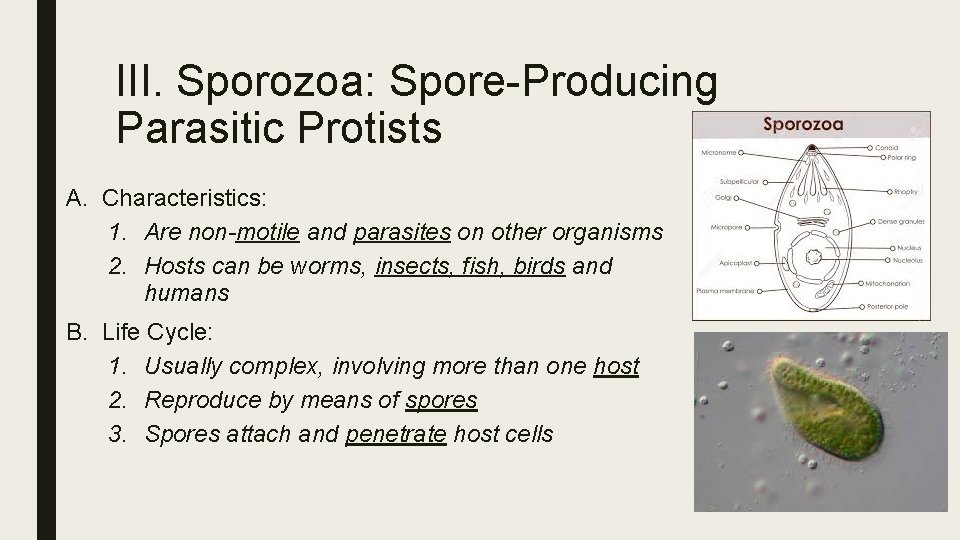
III. Sporozoa: Spore-Producing Parasitic Protists A. Characteristics: 1. Are non-motile and parasites on other organisms 2. Hosts can be worms, insects, fish, birds and humans B. Life Cycle: 1. Usually complex, involving more than one host 2. Reproduce by means of spores 3. Spores attach and penetrate host cells
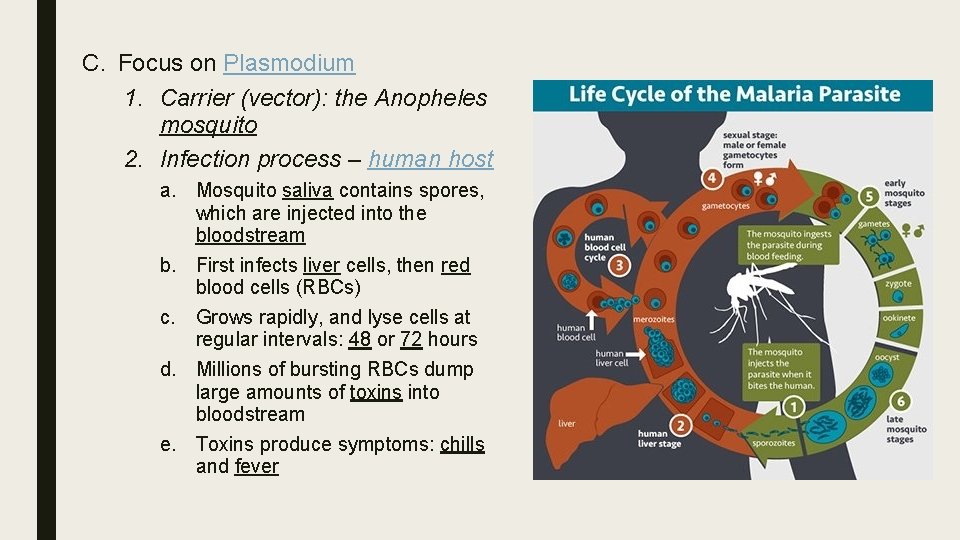
C. Focus on Plasmodium 1. Carrier (vector): the Anopheles mosquito 2. Infection process – human host a. Mosquito saliva contains spores, which are injected into the bloodstream b. First infects liver cells, then red blood cells (RBCs) c. Grows rapidly, and lyse cells at regular intervals: 48 or 72 hours d. Millions of bursting RBCs dump large amounts of toxins into bloodstream e. Toxins produce symptoms: chills and fever
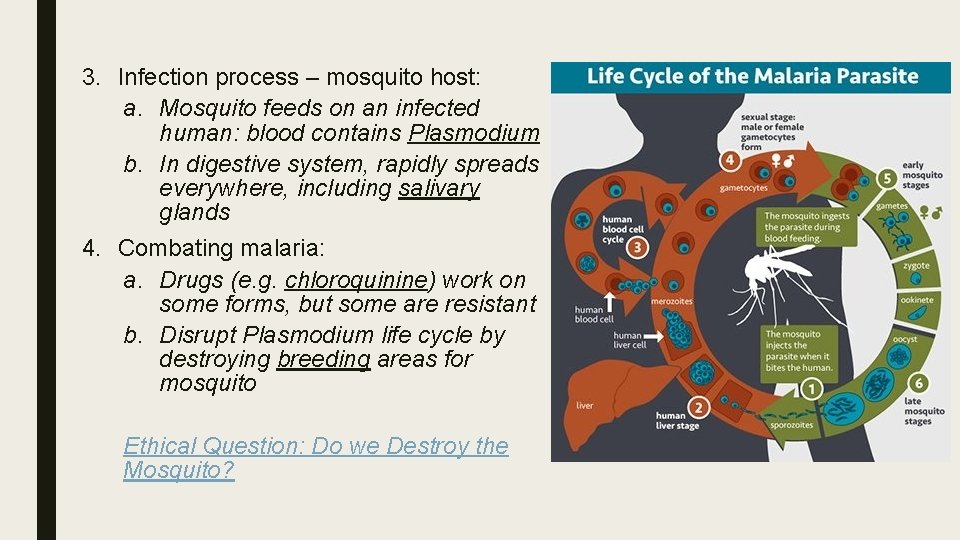
3. Infection process – mosquito host: a. Mosquito feeds on an infected human: blood contains Plasmodium b. In digestive system, rapidly spreads everywhere, including salivary glands 4. Combating malaria: a. Drugs (e. g. chloroquinine) work on some forms, but some are resistant b. Disrupt Plasmodium life cycle by destroying breeding areas for mosquito Ethical Question: Do we Destroy the Mosquito?
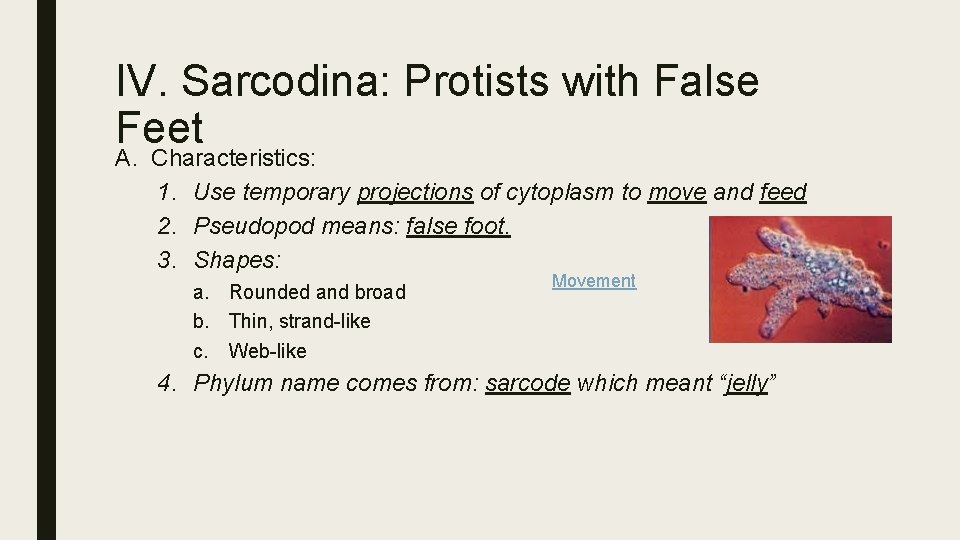
IV. Sarcodina: Protists with False Feet A. Characteristics: 1. Use temporary projections of cytoplasm to move and feed 2. Pseudopod means: false foot. 3. Shapes: a. Rounded and broad b. Thin, strand-like c. Web-like Movement 4. Phylum name comes from: sarcode which meant “jelly”
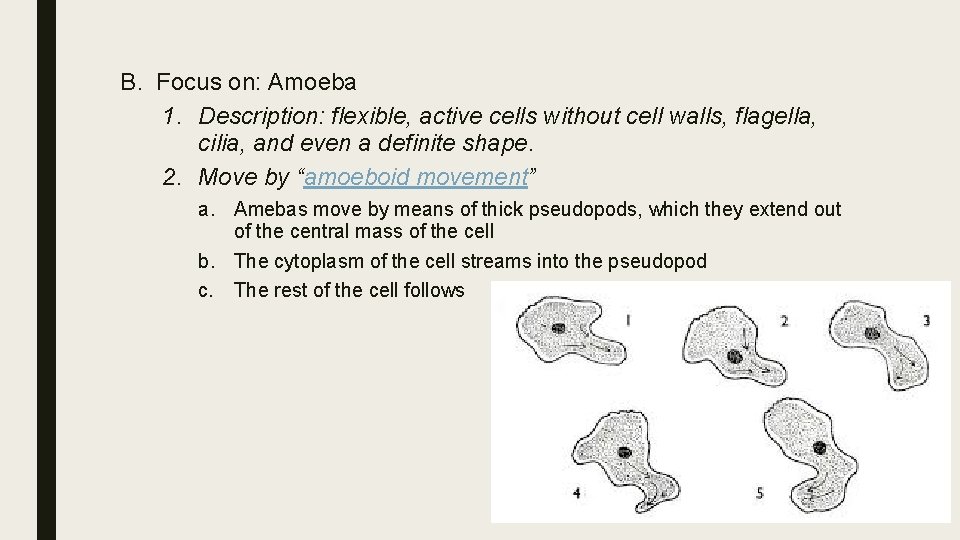
B. Focus on: Amoeba 1. Description: flexible, active cells without cell walls, flagella, cilia, and even a definite shape. 2. Move by “amoeboid movement” a. Amebas move by means of thick pseudopods, which they extend out of the central mass of the cell b. The cytoplasm of the cell streams into the pseudopod c. The rest of the cell follows
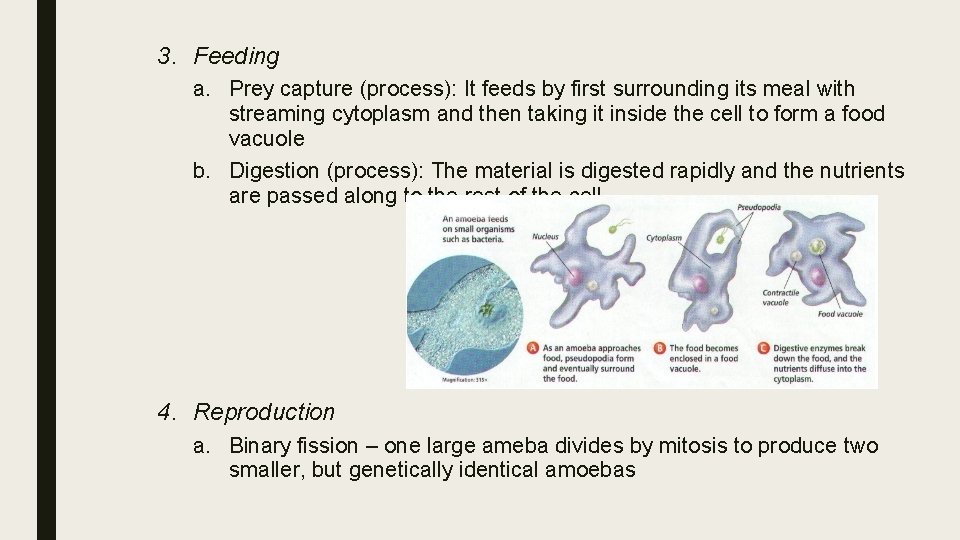
3. Feeding a. Prey capture (process): It feeds by first surrounding its meal with streaming cytoplasm and then taking it inside the cell to form a food vacuole b. Digestion (process): The material is digested rapidly and the nutrients are passed along to the rest of the cell 4. Reproduction a. Binary fission – one large ameba divides by mitosis to produce two smaller, but genetically identical amoebas
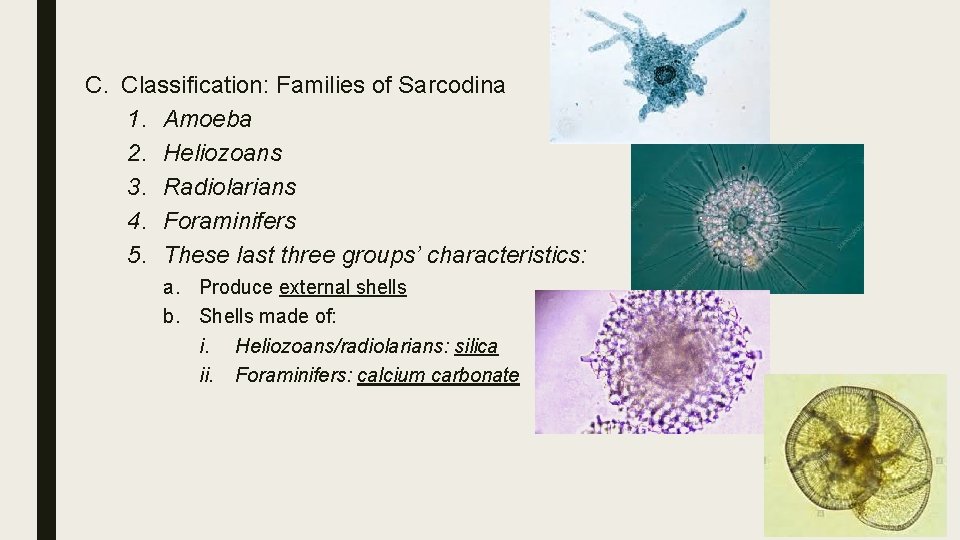
C. Classification: Families of Sarcodina 1. Amoeba 2. Heliozoans 3. Radiolarians 4. Foraminifers 5. These last three groups’ characteristics: a. Produce external shells b. Shells made of: i. Heliozoans/radiolarians: silica ii. Foraminifers: calcium carbonate
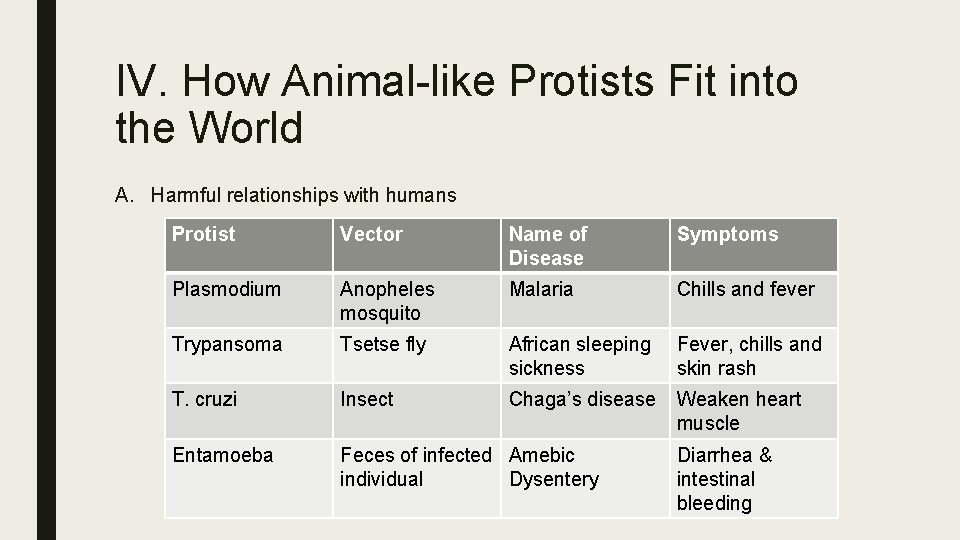
IV. How Animal-like Protists Fit into the World A. Harmful relationships with humans Protist Vector Name of Disease Symptoms Plasmodium Anopheles mosquito Malaria Chills and fever Trypansoma Tsetse fly African sleeping sickness Fever, chills and skin rash T. cruzi Insect Chaga’s disease Weaken heart muscle Entamoeba Feces of infected Amebic individual Dysentery Diarrhea & intestinal bleeding
B. Helpful relationships: 1. Termites eat wood, which contains the carbohydrate cellulose, but don’t have the enzymes to break it down 2. Trichonympha living in termite gut manufacture the enzyme cellulase C. Ecological role: 1. In food chains: are food for tiny multicellular animals, that in turn are food for larger animals
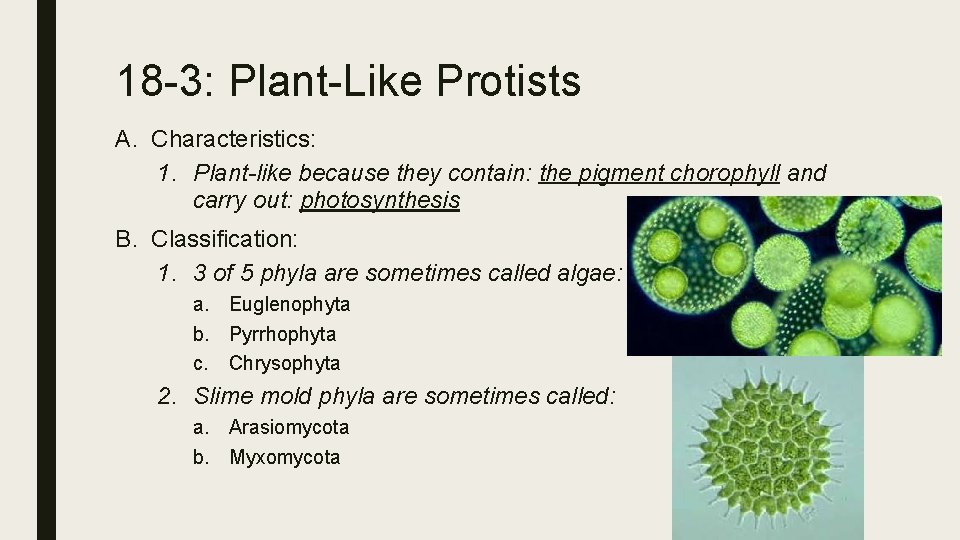
18 -3: Plant-Like Protists A. Characteristics: 1. Plant-like because they contain: the pigment chorophyll and carry out: photosynthesis B. Classification: 1. 3 of 5 phyla are sometimes called algae: a. Euglenophyta b. Pyrrhophyta c. Chrysophyta 2. Slime mold phyla are sometimes called: a. Arasiomycota b. Myxomycota
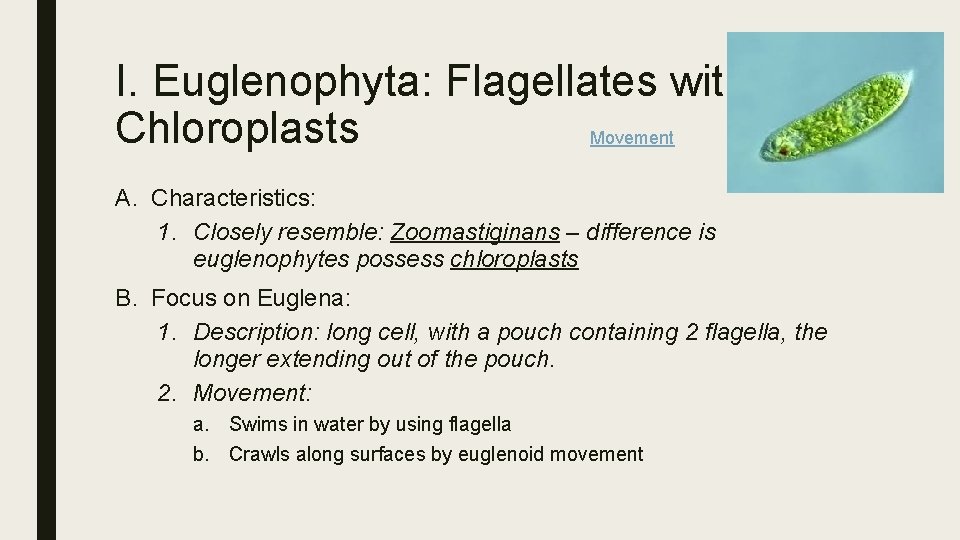
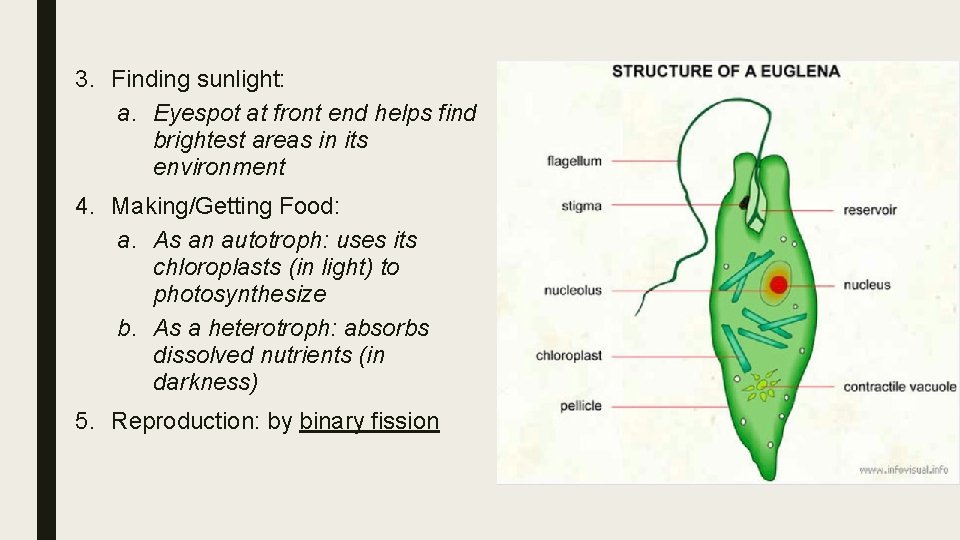
I. Euglenophyta: Flagellates with Chloroplasts Movement A. Characteristics: 1. Closely resemble: Zoomastiginans – difference is euglenophytes possess chloroplasts B. Focus on Euglena: 1. Description: long cell, with a pouch containing 2 flagella, the longer extending out of the pouch. 2. Movement: a. Swims in water by using flagella b. Crawls along surfaces by euglenoid movement
3. Finding sunlight: a. Eyespot at front end helps find brightest areas in its environment 4. Making/Getting Food: a. As an autotroph: uses its chloroplasts (in light) to photosynthesize b. As a heterotroph: absorbs dissolved nutrients (in darkness) 5. Reproduction: by binary fission
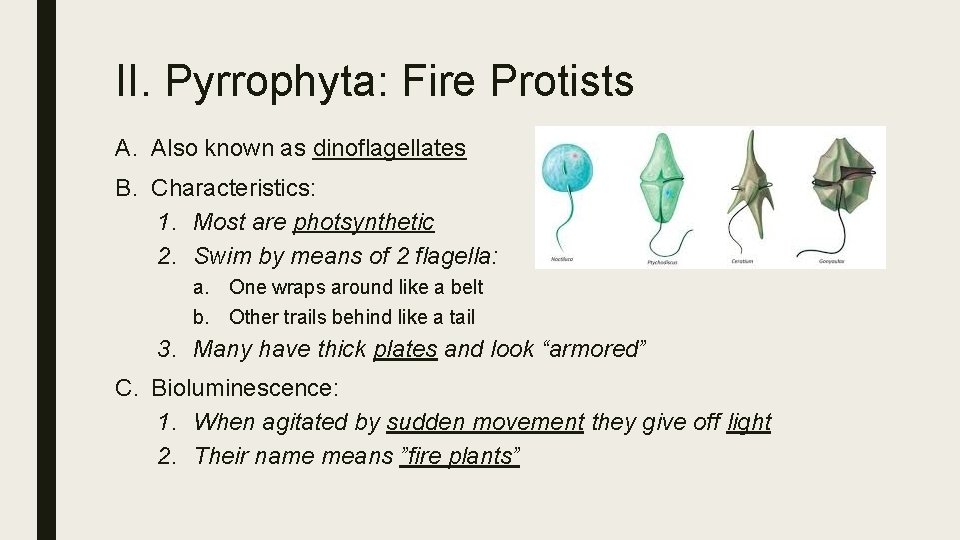
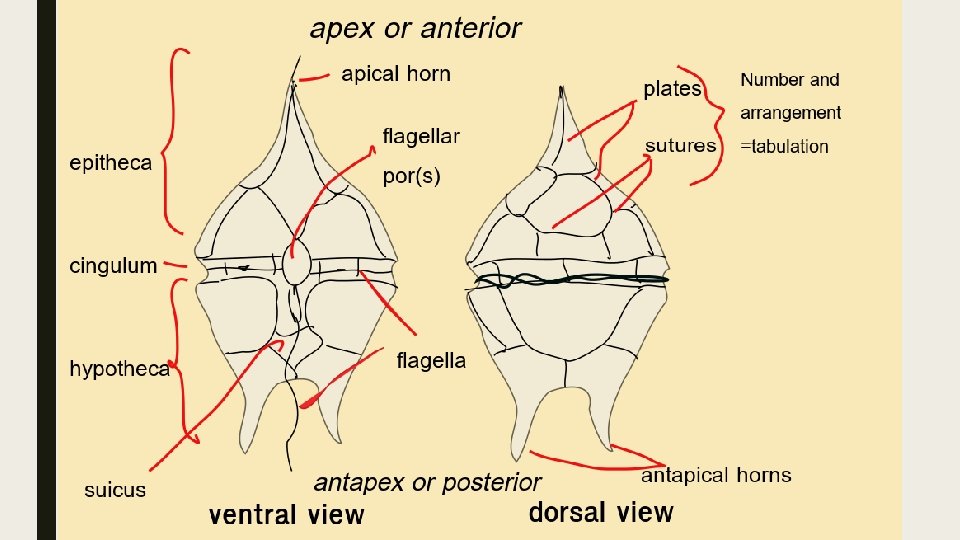
II. Pyrrophyta: Fire Protists A. Also known as dinoflagellates B. Characteristics: 1. Most are photsynthetic 2. Swim by means of 2 flagella: a. One wraps around like a belt b. Other trails behind like a tail 3. Many have thick plates and look “armored” C. Bioluminescence: 1. When agitated by sudden movement they give off light 2. Their name means ”fire plants”
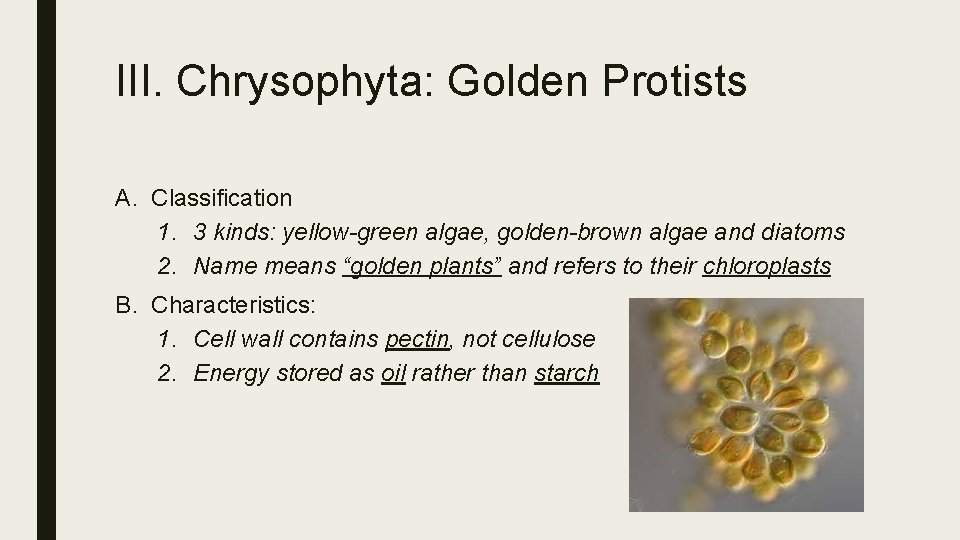
III. Chrysophyta: Golden Protists A. Classification 1. 3 kinds: yellow-green algae, golden-brown algae and diatoms 2. Name means “golden plants” and refers to their chloroplasts B. Characteristics: 1. Cell wall contains pectin, not cellulose 2. Energy stored as oil rather than starch
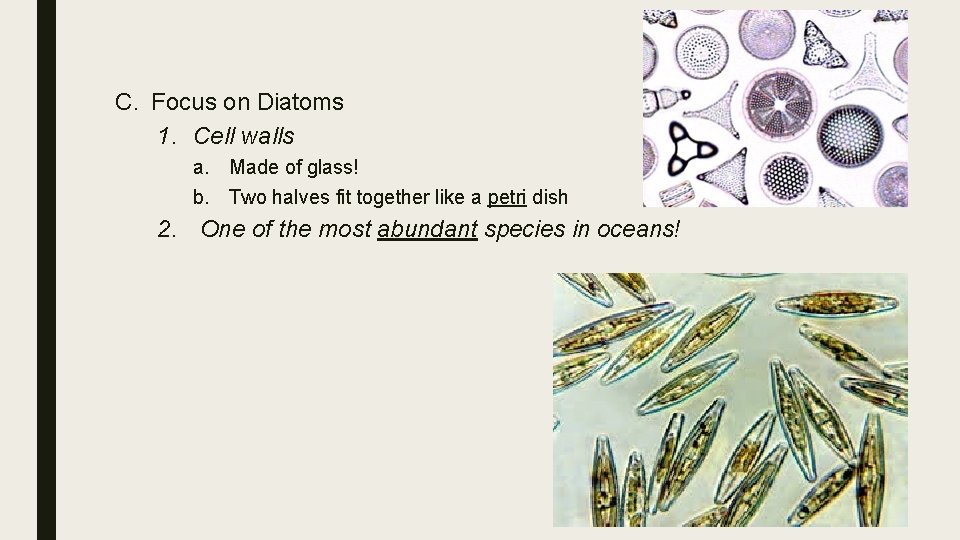
C. Focus on Diatoms 1. Cell walls a. Made of glass! b. Two halves fit together like a petri dish 2. One of the most abundant species in oceans!
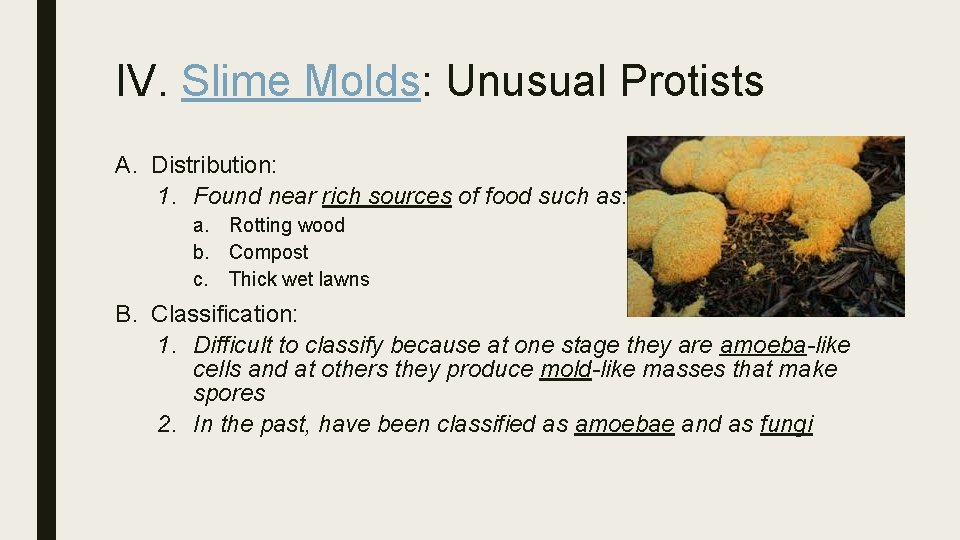
IV. Slime Molds: Unusual Protists A. Distribution: 1. Found near rich sources of food such as: a. Rotting wood b. Compost c. Thick wet lawns B. Classification: 1. Difficult to classify because at one stage they are amoeba-like cells and at others they produce mold-like masses that make spores 2. In the past, have been classified as amoebae and as fungi
C. Focus on Acrasiomycota 1. Life cycle stages: a. Begin as individual cells (amoeba-like); mostly in this form b. When food runs out, groups of cells gather to produce: a large mass of cells c. This mass starts to function as a single organism 2. Migration: up to several centimeters 3. Reproduction: a. Form a structure called a fruiting body b. This makes spores by mitosis c. These become amoeboid cells that repeat the cycle
V. How the Plant-Like Protists Fit Into the World A. Distribution: 1. Found in: Fresh water, oceans and land B. Harmful Relationships: 1. Euglenophyte blooms (cycle) a. Excess waste dumped into water b. Grow into enormous masses called “blooms” c. Run out of nutrients & die, compounding the pollution clean-up problem
2. Dinoflagellate blooms (cycle) a. Some species contain toxins that can paralyze or kill b. People aren’t affected by swimming c. Shellfish like clams and oysters trap them for food and concentrate the toxin d. Eating shellfish from “red tide” areas can cause serious illness
C. Helpful Relationships: 1. Coral, sea anemones, and clams may have dinoflagellates as photosynthetic symbionts D. Ecology 1. Phytoplankton (def’n): small photosynthetic organisms found floating at ocean’s surface 2. Importance: a. More than 70%. . . of photosynthesis on Earth is done here! b. Provide organisms on our planet with oxygen and food c. Example food chain: Phytoplankton tiny animals small fish large fish humans (zooplankton) (tuna)