
PROTEOMICBASED INTEGRATED SUBJECTSPECIFIC NETWORKS IN CANCER Min Jin
PROTEOMIC-BASED INTEGRATED SUBJECTSPECIFIC NETWORKS IN CANCER Min Jin Ha Department of Biostatistics University of Texas MD Anderson Cancer Center
TEAM Key Personnel • Min Jin Ha (PI) – Department of Biostatistics, UT MD Anderson Cancer Center • Veerabhadran Baladandayuthapani (Co-PI) – Department of Biostatistics, UT MD Anderson Cancer Center • Rehan Akbani (Co-I) – Department of Bioinformatics and Computational Biology, UT MD Anderson Cancer Center • Abishek Saha (post-doctoral fellow)– Department of Biostatistics, UT MD Anderson Cancer Center
BROAD OBJECTIVES • The cancer functional genome and proteome provides a rich source of information to identify patient-specific variations in signaling pathways and activities within and across tumor • Patient-specific approaches have recently emerged, within a precision medicine paradigm, that acknowledges the fact that pathway structures and activity might be considerably different within and across tumor • The overall objective is to develop general analytic frameworks to characterize patient-specific pathway signatures by sequential estimations of cancer-specific (global) and patient-specific (local) networks
ANALYTICAL SCHEMA & SPECIFIC AIMS
DATA RESOURCES • Reverse-phase protein array (RPPA)-based proteomic data from The Cancer Genome Atlas (TCGA) across 33 cancer types and MD Anderson Cell Lines Project (MCLP) across 19 tumor lineages • Dr. Akbani (Co-I) have led the generation and curation of these comprehensive databases • The MDACC TCGA RPPA platform includes extensively validated 181 high-quality antibodies that target proteins covering major signaling pathways, including apoptosis, cell cycle, DNA damage, PI 3 K, MAPK and m. TOR pathways
Breast cancer subtypes • Of the patients with HER 2 -positive breast cancer in cluster C 1, 75% showed activation of the RTK pathway that includes HER 2 (ERBB 2) protein • All patients in C 3 had HER 2 -negative breast cancer • 66%, 82%, and 72% of the patients in C 3 showed activation of the apoptosis, breast reactive, and RAS/MAPK pathways, respectively

Higher prognostic power of PRECISE scores as compared to naïve/existing approaches
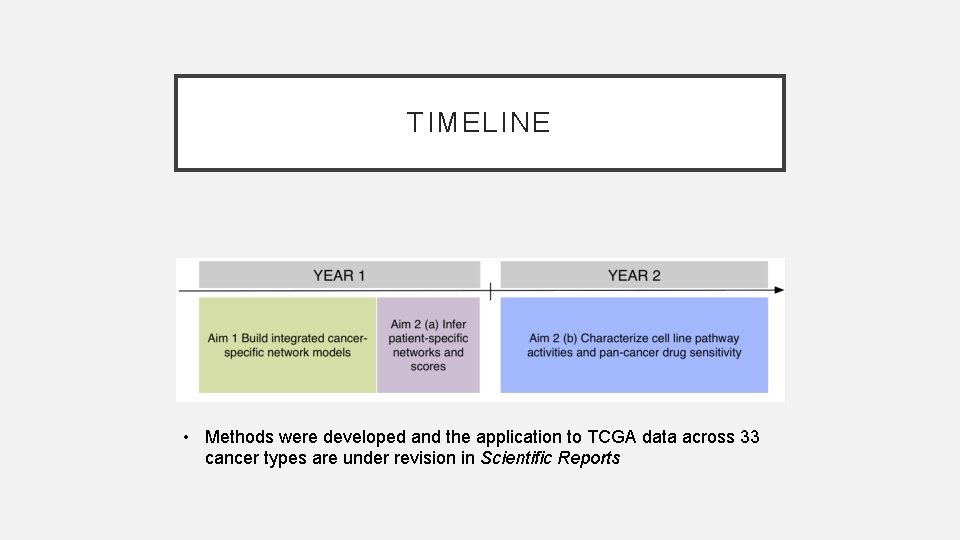
TIMELINE • Methods were developed and the application to TCGA data across 33 cancer types are under revision in Scientific Reports
- Slides: 8