
PROTEINS Keratin Hair Skin Nails Myoglobin Muscle Listen
PROTEINS
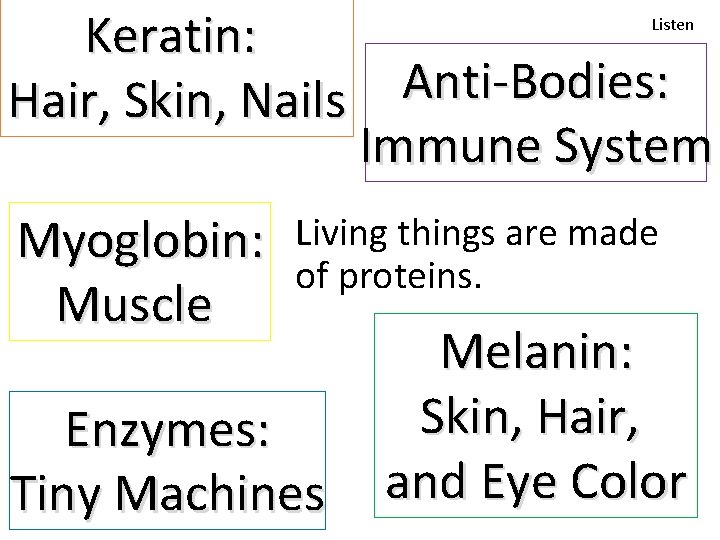
Keratin: Hair, Skin, Nails Myoglobin: Muscle Listen Anti-Bodies: Immune System Living things are made of proteins. Enzymes: Tiny Machines Melanin: Skin, Hair, and Eye Color
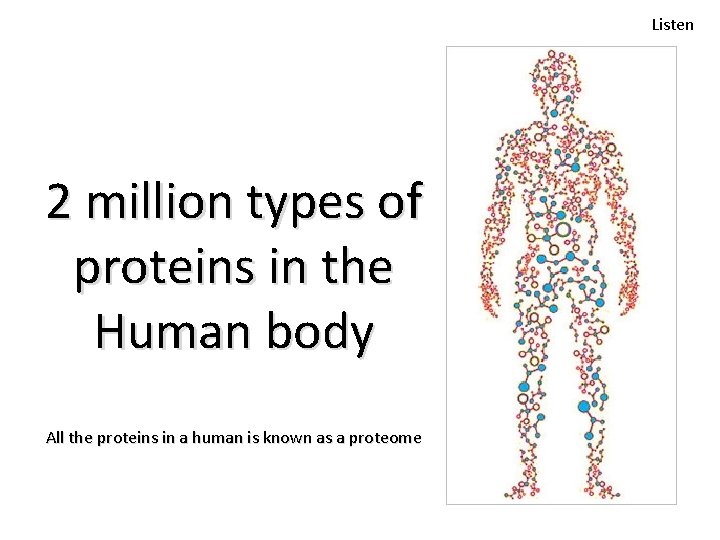
Listen 2 million types of proteins in the Human body All the proteins in a human is known as a proteome
Listen 10 million types of proteins In the world that we know of so far
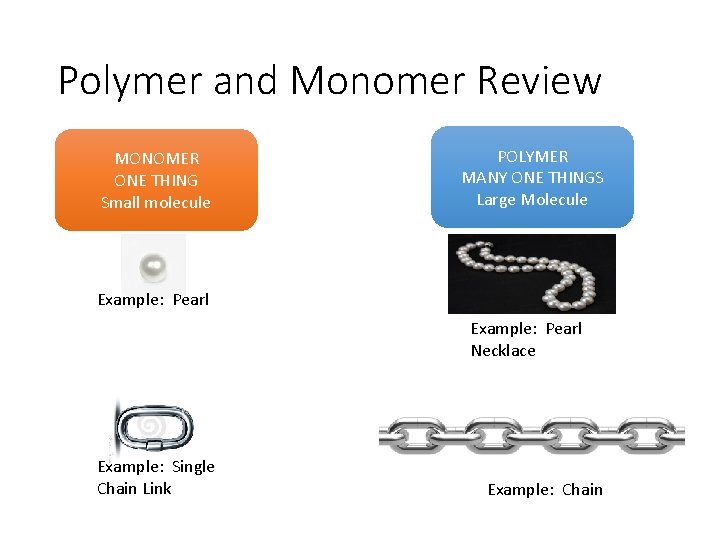
Polymer and Monomer Review MONOMER ONE THING Small molecule POLYMER MANY ONE THINGS Large Molecule Example: Pearl Necklace Example: Single Chain Link Example: Chain
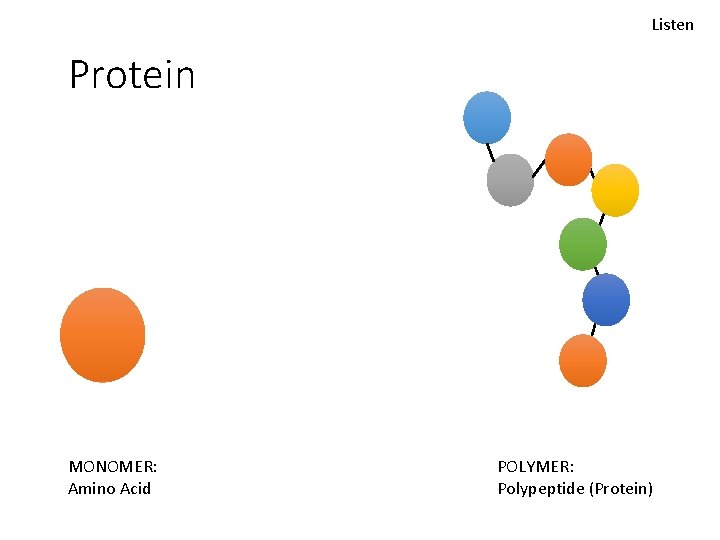
Listen Protein MONOMER: Amino Acid POLYMER: Polypeptide (Protein)
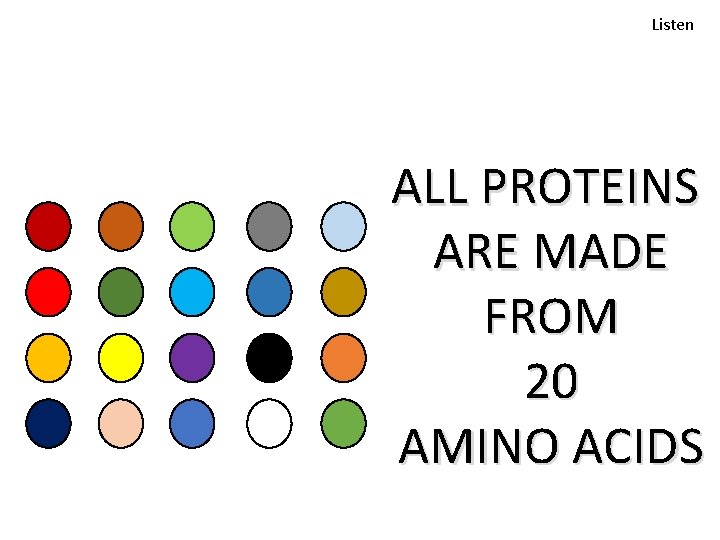
Listen ALL PROTEINS ARE MADE FROM 20 AMINO ACIDS
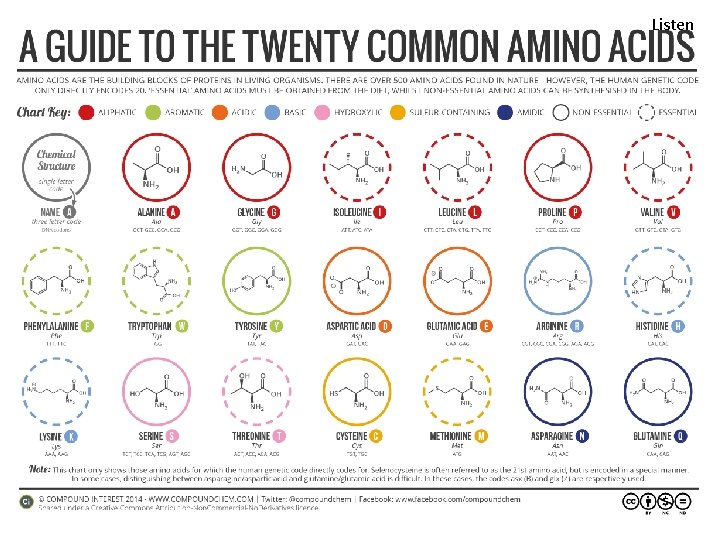
Listen
Listen
Listen
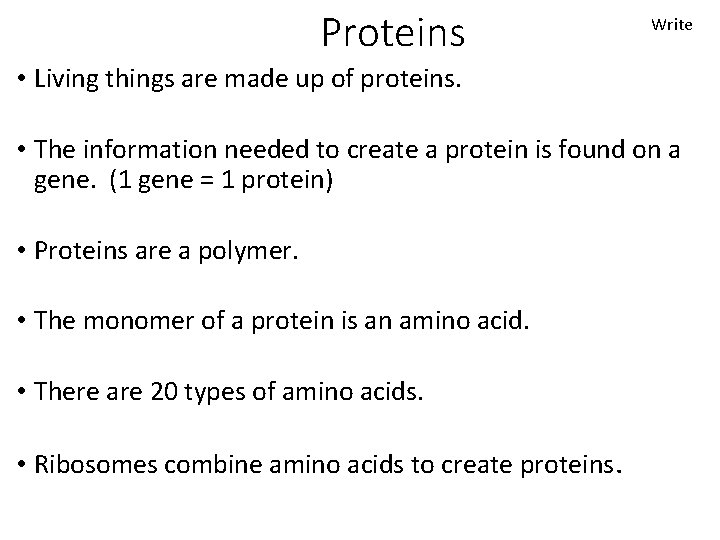
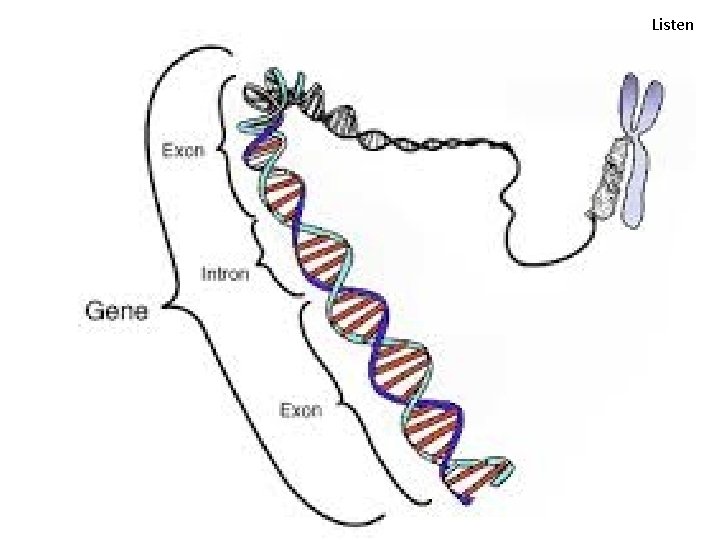
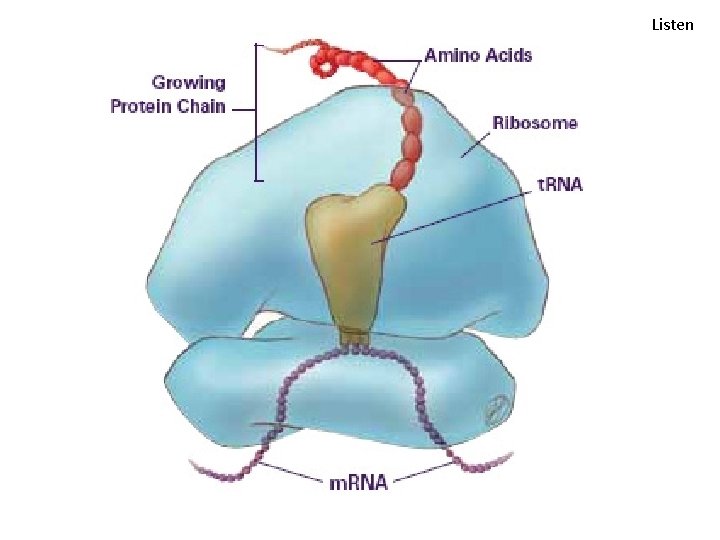
Proteins Write • Living things are made up of proteins. • The information needed to create a protein is found on a gene. (1 gene = 1 protein) • Proteins are a polymer. • The monomer of a protein is an amino acid. • There are 20 types of amino acids. • Ribosomes combine amino acids to create proteins.
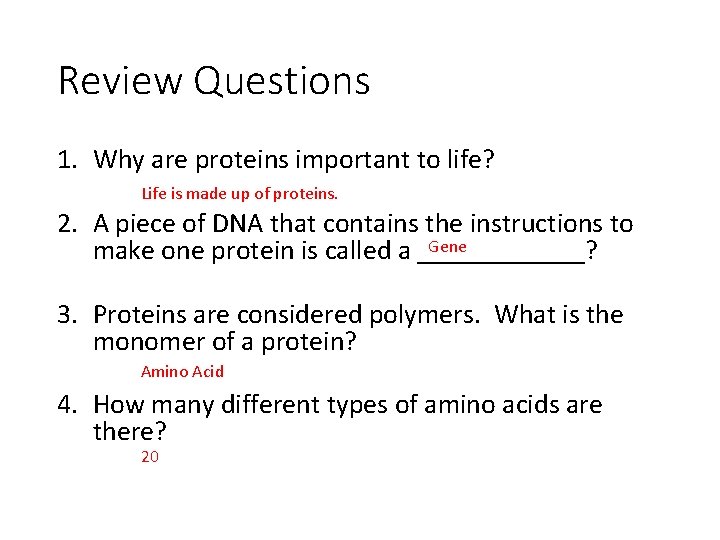
Review Questions 1. Why are proteins important to life? Life is made up of proteins. 2. A piece of DNA that contains the instructions to Gene make one protein is called a ______? 3. Proteins are considered polymers. What is the monomer of a protein? Amino Acid 4. How many different types of amino acids are there? 20
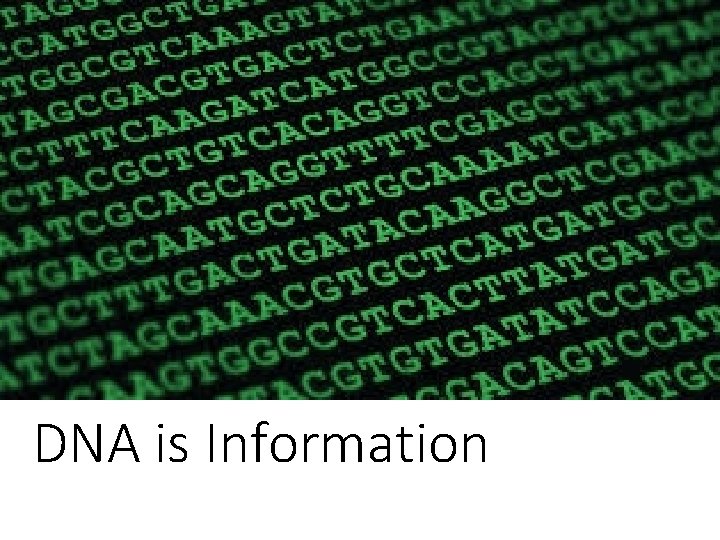
DNA is Information
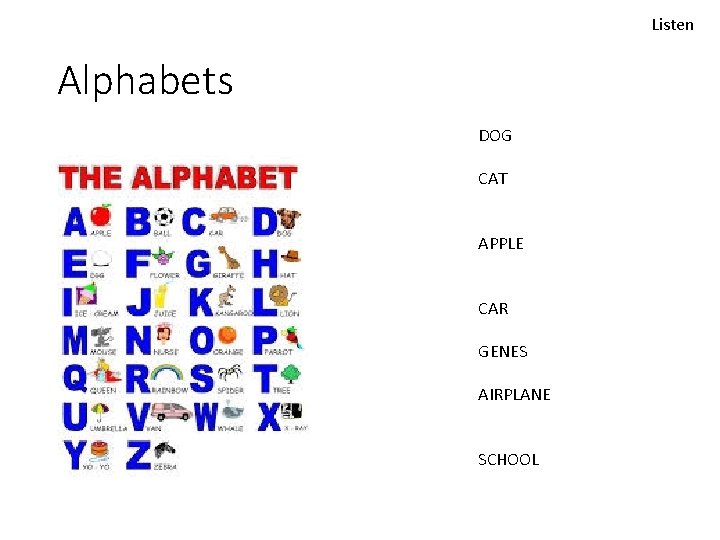
Listen Alphabets DOG CAT APPLE CAR GENES AIRPLANE SCHOOL
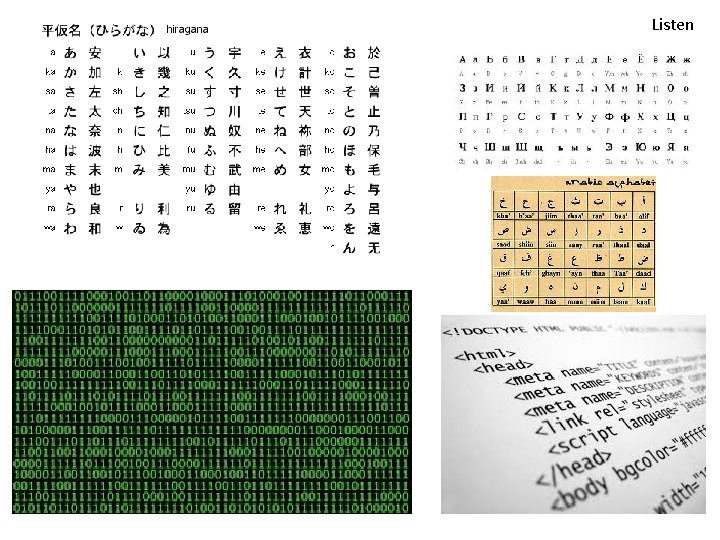
Listen
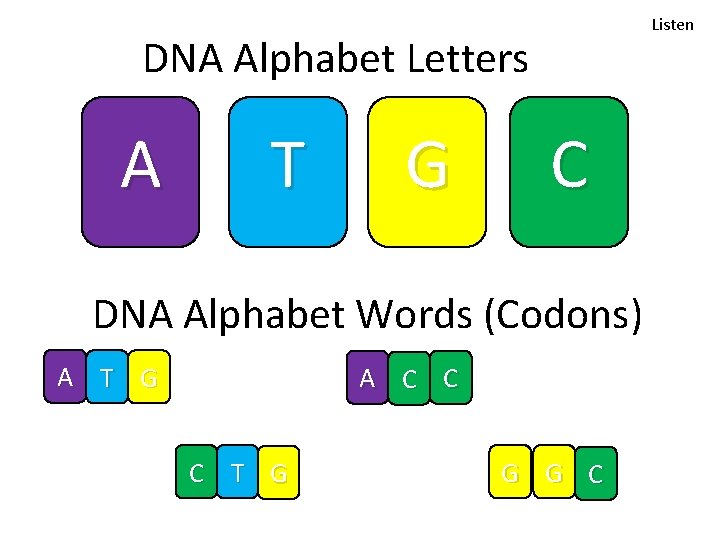
Listen DNA Alphabet Letters A T G C DNA Alphabet Words (Codons) A T G A C C C T G G G C

Listen 64 Codons 20 Amino Acids
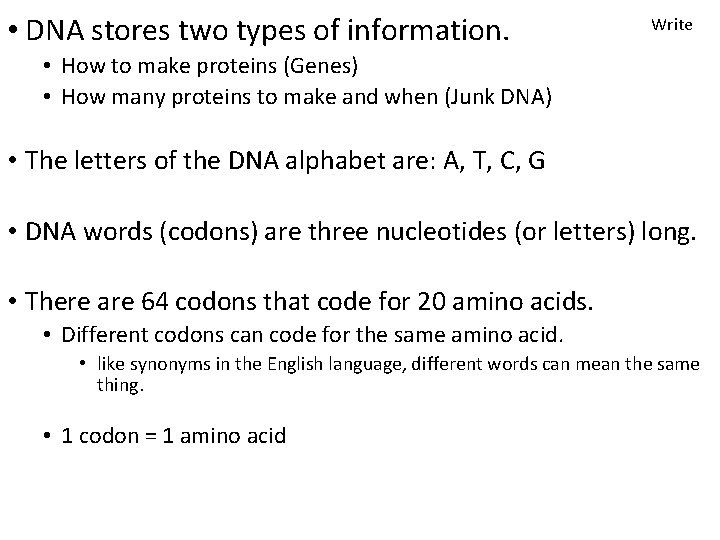
• DNA stores two types of information. Write • How to make proteins (Genes) • How many proteins to make and when (Junk DNA) • The letters of the DNA alphabet are: A, T, C, G • DNA words (codons) are three nucleotides (or letters) long. • There are 64 codons that code for 20 amino acids. • Different codons can code for the same amino acid. • like synonyms in the English language, different words can mean the same thing. • 1 codon = 1 amino acid
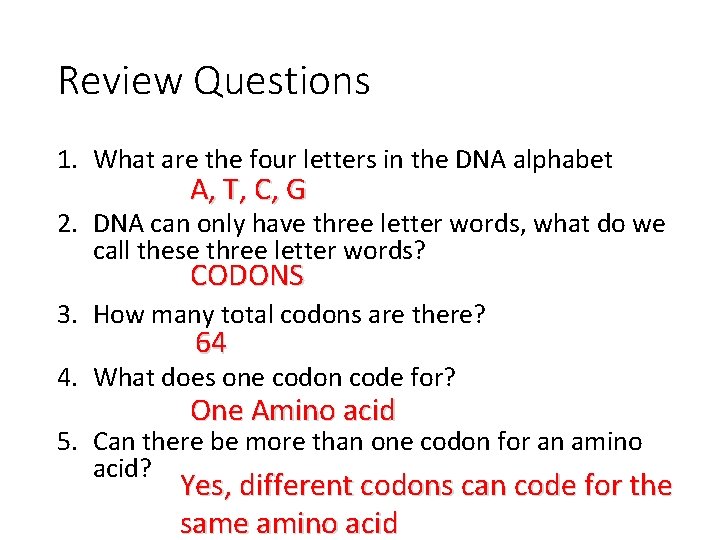
Review Questions 1. What are the four letters in the DNA alphabet A, T, C, G 2. DNA can only have three letter words, what do we call these three letter words? CODONS 3. How many total codons are there? 64 4. What does one codon code for? One Amino acid 5. Can there be more than one codon for an amino acid? Yes, different codons can code for the same amino acid
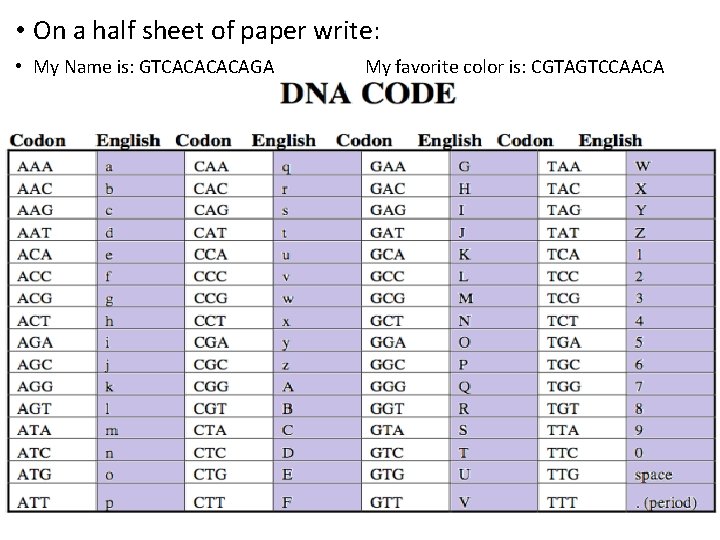
• On a half sheet of paper write: • My Name is: GTCACAGA My favorite color is: CGTAGTCCAACA
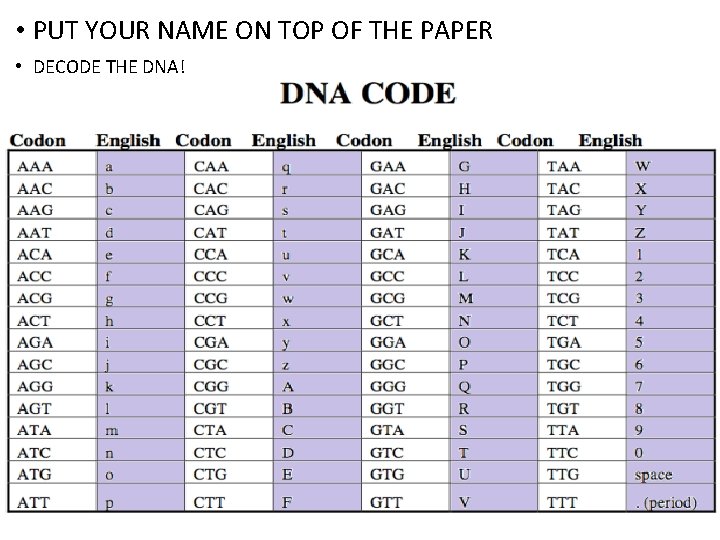
• PUT YOUR NAME ON TOP OF THE PAPER • DECODE THE DNA!
CENTRAL DOGMA
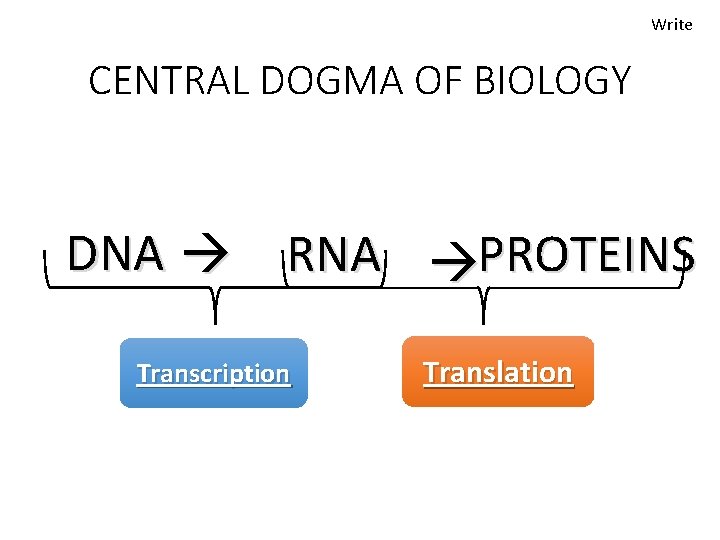
Write CENTRAL DOGMA OF BIOLOGY DNA RNA PROTEINS Transcription Translation
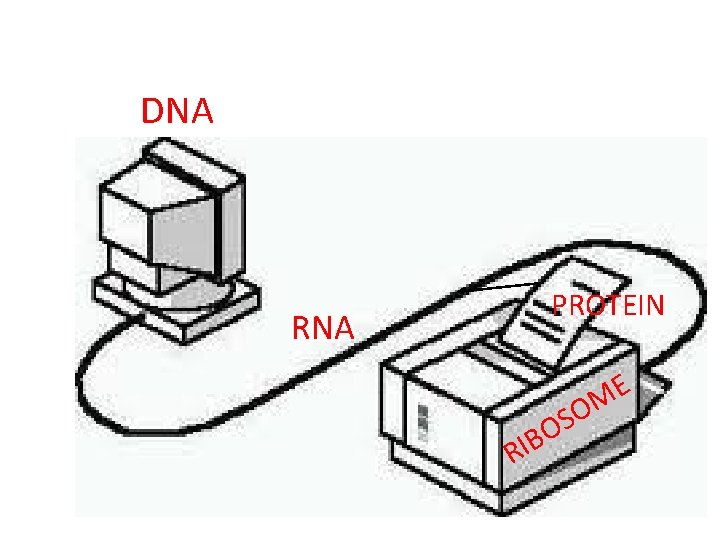
DNA RNA PROTEIN O B I R E M O S
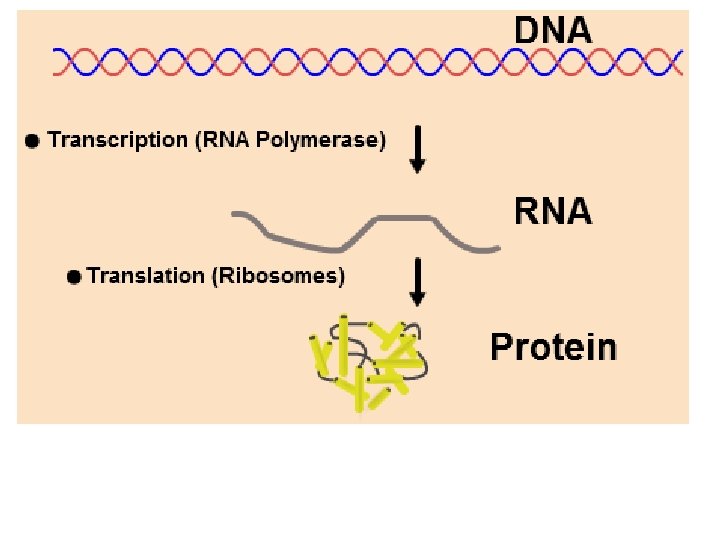
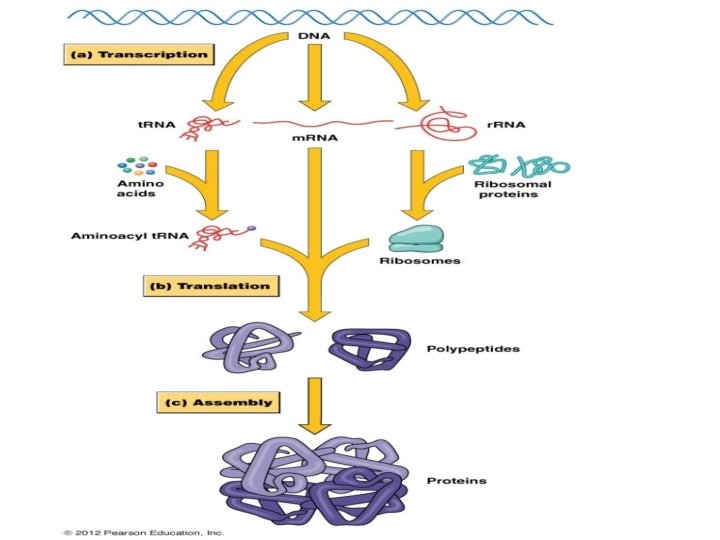
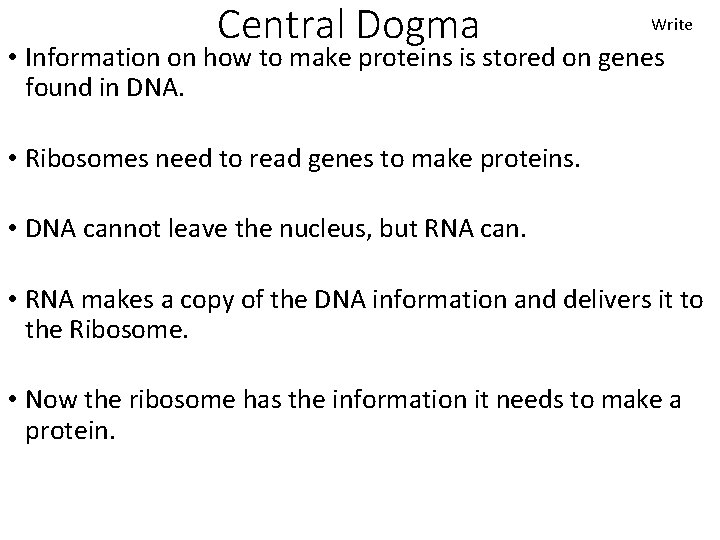
Central Dogma Write • Information on how to make proteins is stored on genes found in DNA. • Ribosomes need to read genes to make proteins. • DNA cannot leave the nucleus, but RNA can. • RNA makes a copy of the DNA information and delivers it to the Ribosome. • Now the ribosome has the information it needs to make a protein.
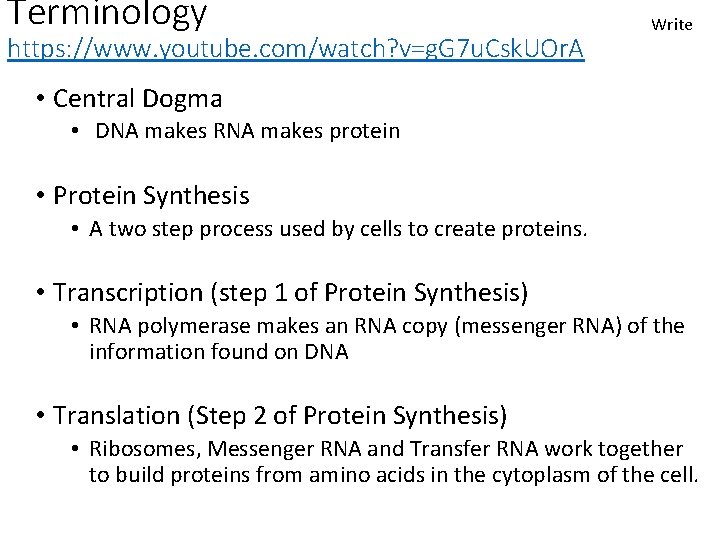
Terminology https: //www. youtube. com/watch? v=g. G 7 u. Csk. UOr. A Write • Central Dogma • DNA makes RNA makes protein • Protein Synthesis • A two step process used by cells to create proteins. • Transcription (step 1 of Protein Synthesis) • RNA polymerase makes an RNA copy (messenger RNA) of the information found on DNA • Translation (Step 2 of Protein Synthesis) • Ribosomes, Messenger RNA and Transfer RNA work together to build proteins from amino acids in the cytoplasm of the cell.
Protein Synthesis
Video Questions 0 -45 s Answer • Which structure contains the genome (genes) • DNA is packaged around histones and coiled up into 23 pairs of ________. • Sections of DNA that contain the instructions for making proteins are called. ________.
Video Questions 0: 45 – 1: 40 Answer • When a gene is switched on, this enzyme attaches to DNA and creates a messenger RNA using free RNA nucleotides in the nucleus. • When RNA polymerase creates a messenger RNA strand using information from the gene on the DNA we call this process ________.
Write Transcription • Purpose: Create a Messenger RNA by copying information found on DNA • Where: Nucleus • RNA Polymerase: Enzyme that creates the messenger RNA strand.
Video Questions 1: 40 - Answer • The organelle that acts as a protein factory is called a ________? • Where does m. RNA go after it leaves the nucleus? • What RNA molecule carries amino acids? • How does the t. RNA and m. RNA work together? • The growing chain of amino acids is called a ______?
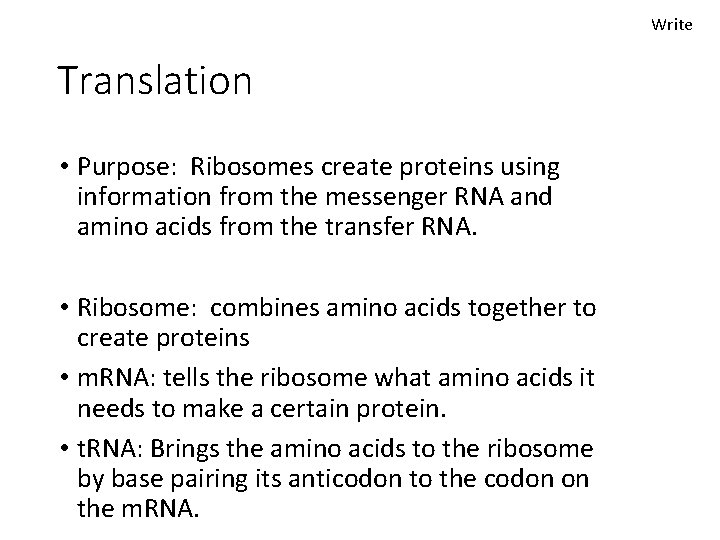
Write Translation • Purpose: Ribosomes create proteins using information from the messenger RNA and amino acids from the transfer RNA. • Ribosome: combines amino acids together to create proteins • m. RNA: tells the ribosome what amino acids it needs to make a certain protein. • t. RNA: Brings the amino acids to the ribosome by base pairing its anticodon to the codon on the m. RNA.
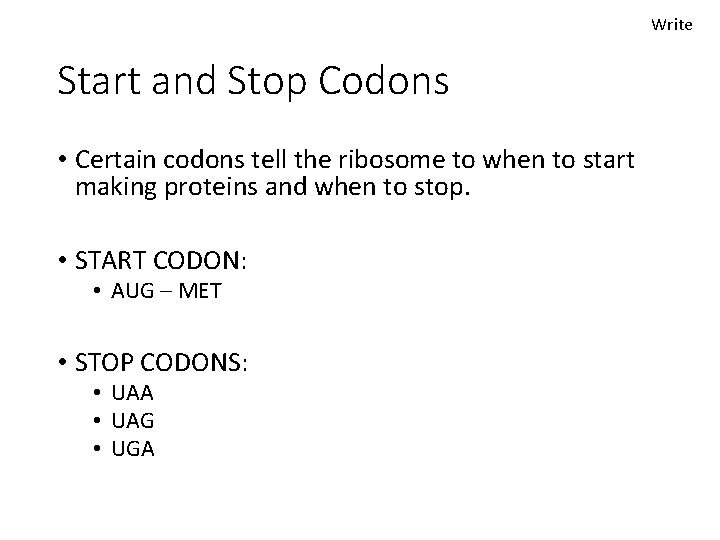
Write Start and Stop Codons • Certain codons tell the ribosome to when to start making proteins and when to stop. • START CODON: • AUG – MET • STOP CODONS: • UAA • UAG • UGA
Transcription and Translation • Now that we’ve learned how the cell undergoes transcription and translation, we can now do transcription and translation ourselves.
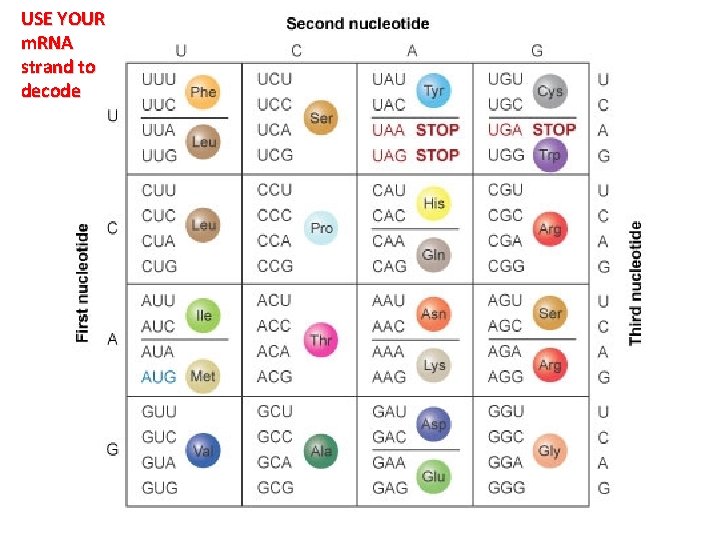
USE YOUR m. RNA strand to decode
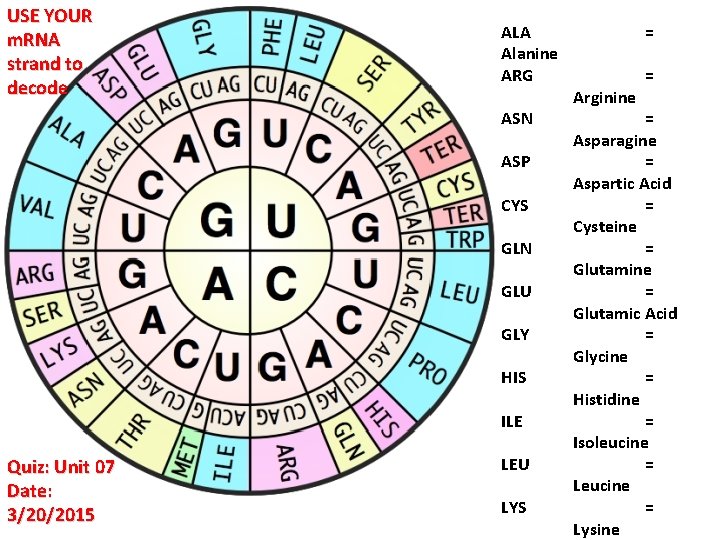
USE YOUR m. RNA strand to decode ALA Alanine ARG ASN ASP CYS GLN GLU GLY HIS ILE Quiz: Unit 07 Date: 3/20/2015 LEU LYS = Arginine = = Asparagine = Aspartic Acid = Cysteine = Glutamic Acid = Glycine = Histidine = Isoleucine = Lysine
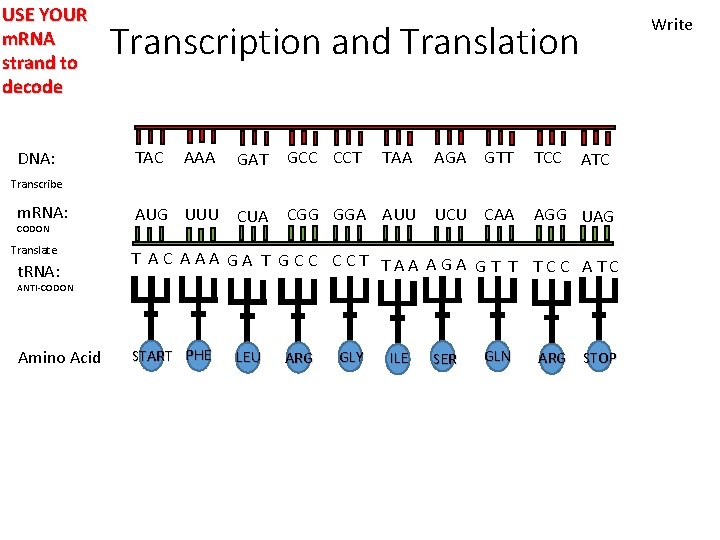
USE YOUR m. RNA strand to decode DNA: Write Transcription and Translation AAA GAT GCC CCT TAA AGA GTT TCC AUG UUU CUA CGG GGA AUU UCU CAA AGG UAG TAC ATC Transcribe m. RNA: CODON Translate t. RNA: T AC AAA GA T GCC CCT TAA AGA GT T TCC ATC Amino Acid START PHE ANTI-CODON LEU ARG GLY ILE SER GLN ARG STOP
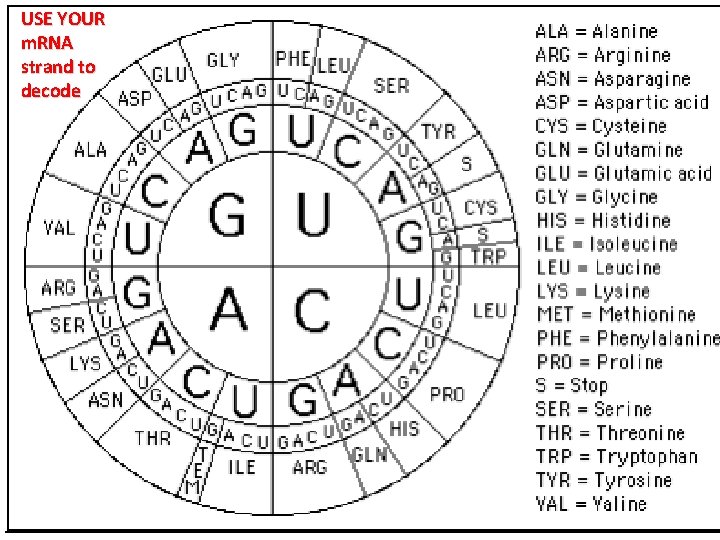
USE YOUR m. RNA strand to decode
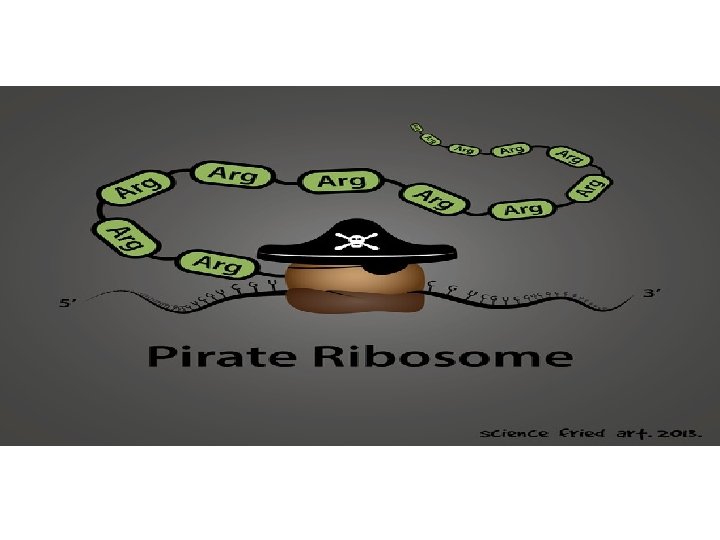
Translation

• TURN IN YOUR REVIEW • CLEAR YOUR DESKS • SPREAD OUT – 1 person per table
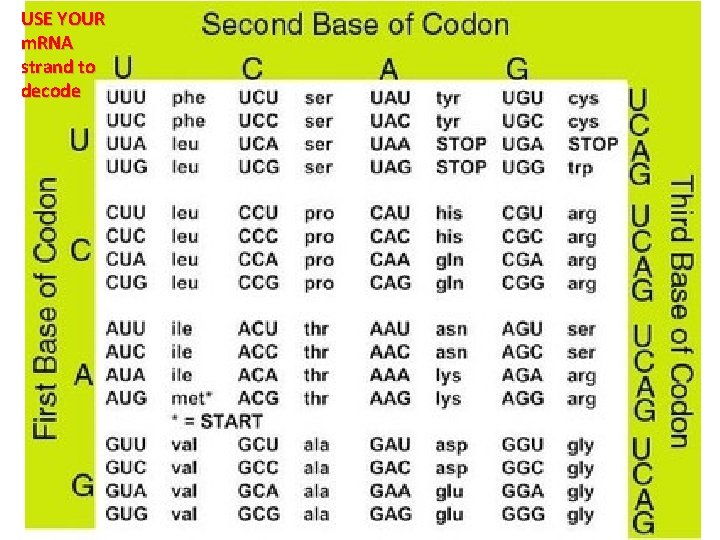
USE YOUR m. RNA strand to decode
- Slides: 43