
Proteins Hannah Barreca Daria Lukasz Ian Reucroft Roshelle
Proteins Hannah Barreca Daria Lukasz Ian Reucroft Roshelle Belfer Stephanie Puthumana
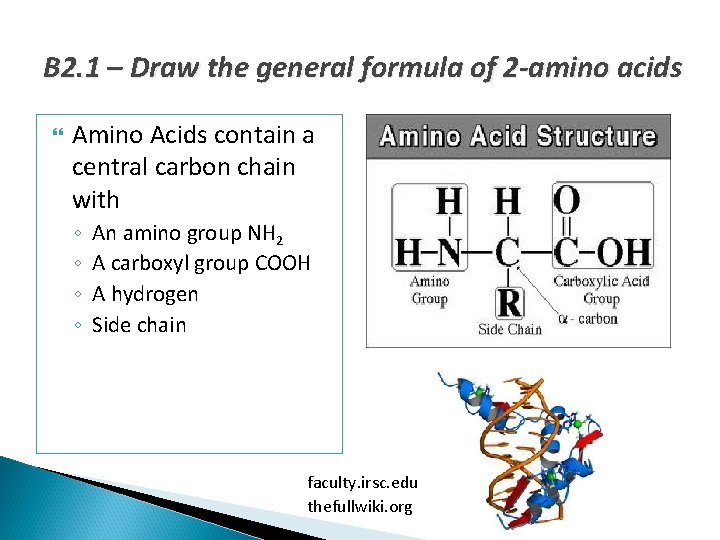
B 2. 1 – Draw the general formula of 2 -amino acids Amino Acids contain a central carbon chain with ◦ ◦ An amino group NH 2 A carboxyl group COOH A hydrogen Side chain faculty. irsc. edu thefullwiki. org
B 2. 2 – Describe the characteristic properties of 2 -amino acids Crystalline solids Very high melting point in excess of 200°C Very soluble in water, not soluble in organic solutions Exist as ionic species
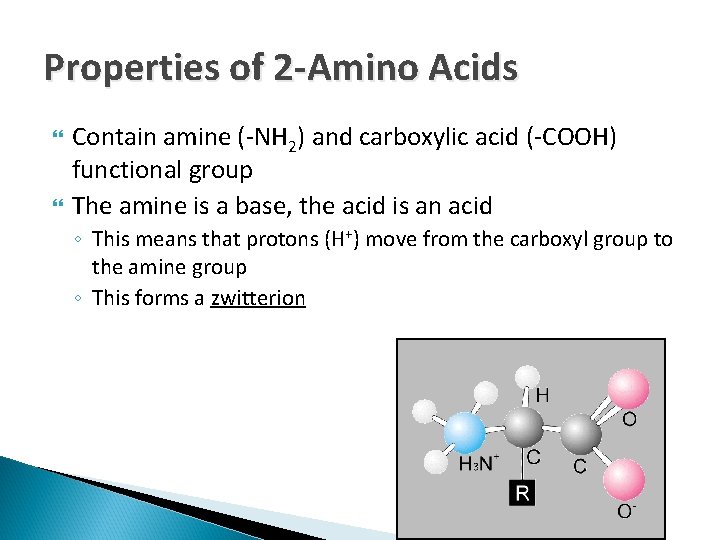
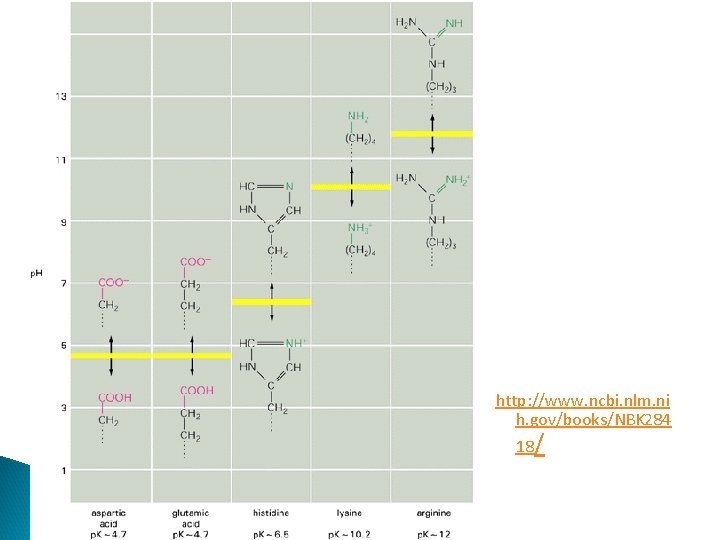
Properties of 2 -Amino Acids Contain amine (-NH 2) and carboxylic acid (-COOH) functional group The amine is a base, the acid is an acid ◦ This means that protons (H+) move from the carboxyl group to the amine group ◦ This forms a zwitterion
Properties of 2 -Amino Acids Zwitterions have net charge of zero ◦ Are both positively and negatively charged ◦ This is the form of amino acids even when solid ◦ When dissolved, zwitterion ions are formed If OH¯ ions added, p. H rises ◦ NH 3+ loses H+ ◦ Amino acid is negative
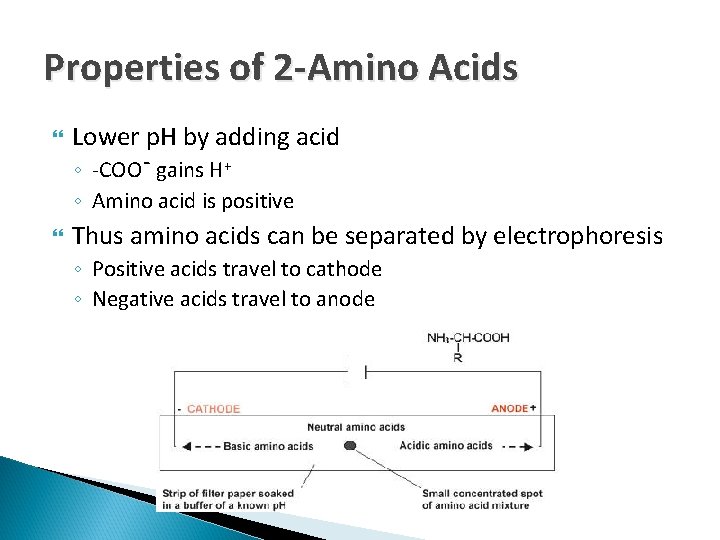
Properties of 2 -Amino Acids Lower p. H by adding acid ◦ -COO¯ gains H+ ◦ Amino acid is positive Thus amino acids can be separated by electrophoresis ◦ Positive acids travel to cathode ◦ Negative acids travel to anode
Properties of 2 -Amino Acids If positive amino acid has alkali added to it ◦ ◦ ◦ Ion has two acidic hydrogens -COOH hydrogen is more acidic and is removed to make water We have zwitterion again! Net charge of zero is restored Acid wouldn’t go anywhere in electrophoresis
Properties of 2 -Amino Acids p. H which results in lack of movement is isoelectric point ◦ Varies from amino acid to amino acid ◦ Not necessarily at p. H 7, more often p. H 6 ◦ p. HI Buffer action ◦ - COO¯ is proton acceptor: acts as base ◦ NH 3+ is proton donor: acts as acid ◦ Amino acids thus are amphiprotic and act as buffers, depending on environment
http: //www. ncbi. nlm. ni h. gov/books/NBK 284 18/
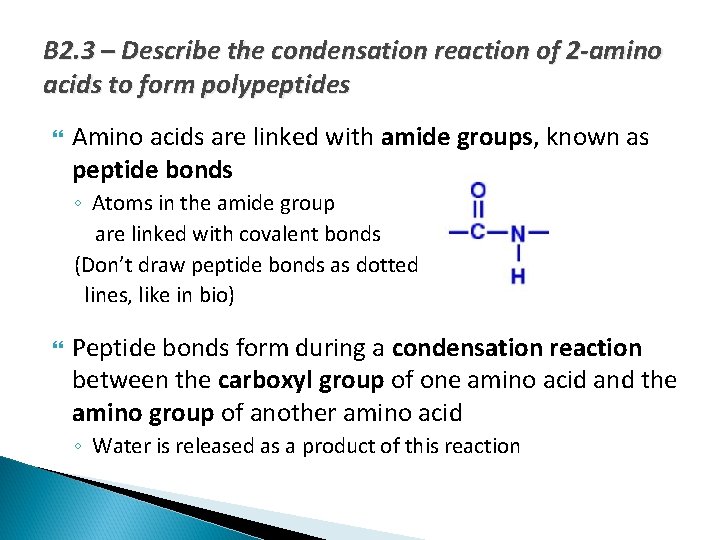
B 2. 3 – Describe the condensation reaction of 2 -amino acids to form polypeptides Amino acids are linked with amide groups, known as peptide bonds ◦ Atoms in the amide group are linked with covalent bonds (Don’t draw peptide bonds as dotted lines, like in bio) Peptide bonds form during a condensation reaction between the carboxyl group of one amino acid and the amino group of another amino acid ◦ Water is released as a product of this reaction
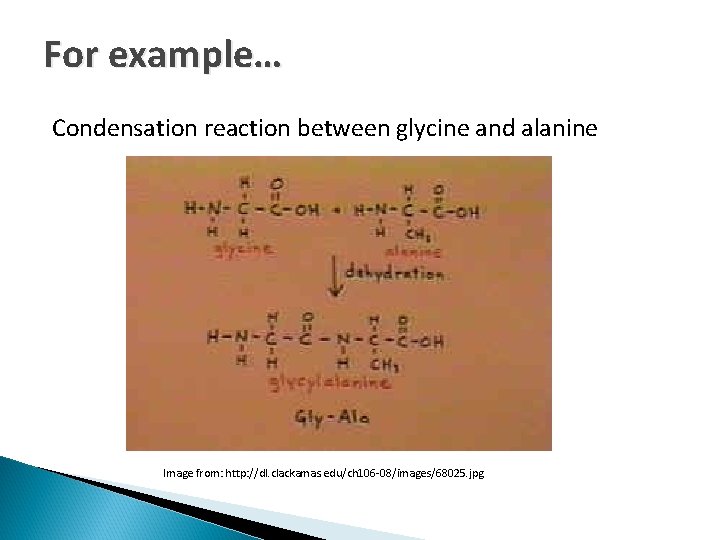
For example… Condensation reaction between glycine and alanine Image from: http: //dl. clackamas. edu/ch 106 -08/images/68025. jpg
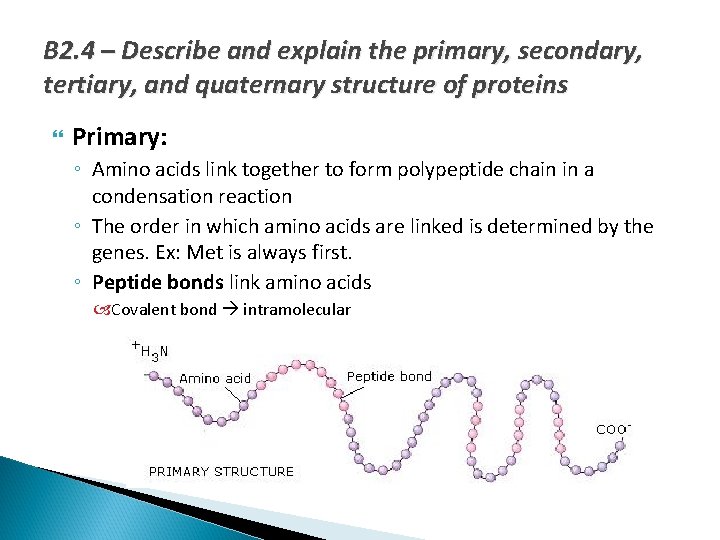
B 2. 4 – Describe and explain the primary, secondary, tertiary, and quaternary structure of proteins Primary: ◦ Amino acids link together to form polypeptide chain in a condensation reaction ◦ The order in which amino acids are linked is determined by the genes. Ex: Met is always first. ◦ Peptide bonds link amino acids Covalent bond intramolecular
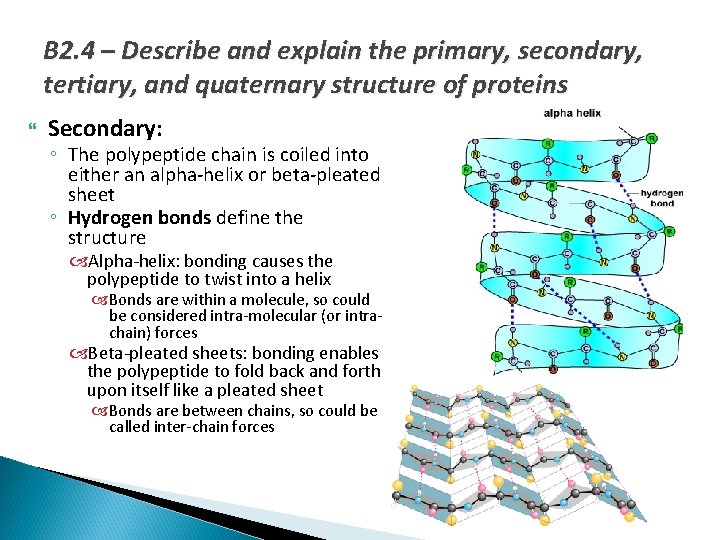
B 2. 4 – Describe and explain the primary, secondary, tertiary, and quaternary structure of proteins Secondary: ◦ The polypeptide chain is coiled into either an alpha-helix or beta-pleated sheet ◦ Hydrogen bonds define the structure Alpha-helix: bonding causes the polypeptide to twist into a helix Bonds are within a molecule, so could be considered intra-molecular (or intrachain) forces Beta-pleated sheets: bonding enables the polypeptide to fold back and forth upon itself like a pleated sheet Bonds are between chains, so could be called inter-chain forces
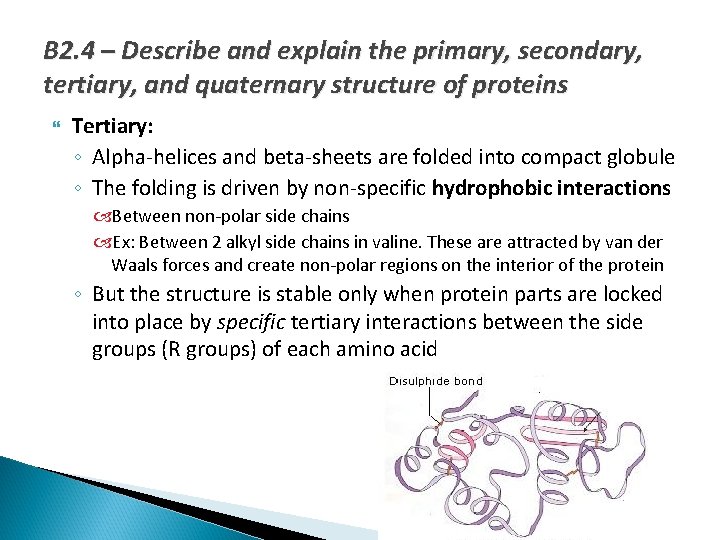
B 2. 4 – Describe and explain the primary, secondary, tertiary, and quaternary structure of proteins Tertiary: ◦ Alpha-helices and beta-sheets are folded into compact globule ◦ The folding is driven by non-specific hydrophobic interactions Between non-polar side chains Ex: Between 2 alkyl side chains in valine. These are attracted by van der Waals forces and create non-polar regions on the interior of the protein ◦ But the structure is stable only when protein parts are locked into place by specific tertiary interactions between the side groups (R groups) of each amino acid
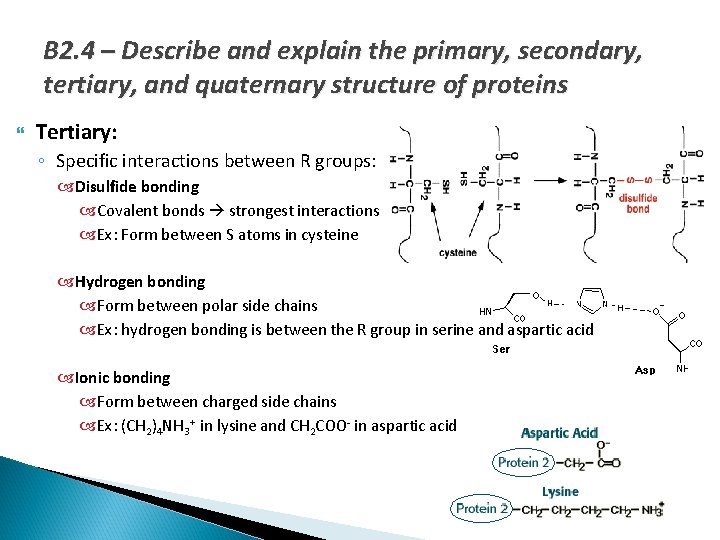
B 2. 4 – Describe and explain the primary, secondary, tertiary, and quaternary structure of proteins Tertiary: ◦ Specific interactions between R groups: Disulfide bonding Covalent bonds strongest interactions Ex: Form between S atoms in cysteine Hydrogen bonding Form between polar side chains Ex: hydrogen bonding is between the R group in serine and aspartic acid Ionic bonding Form between charged side chains Ex: (CH 2)4 NH 3+ in lysine and CH 2 COO- in aspartic acid
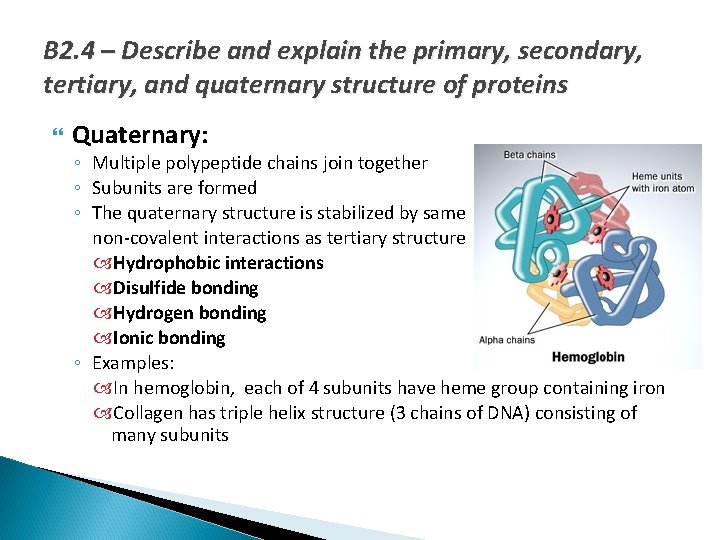
B 2. 4 – Describe and explain the primary, secondary, tertiary, and quaternary structure of proteins Quaternary: ◦ Multiple polypeptide chains join together ◦ Subunits are formed ◦ The quaternary structure is stabilized by same non-covalent interactions as tertiary structure Hydrophobic interactions Disulfide bonding Hydrogen bonding Ionic bonding ◦ Examples: In hemoglobin, each of 4 subunits have heme group containing iron Collagen has triple helix structure (3 chains of DNA) consisting of many subunits
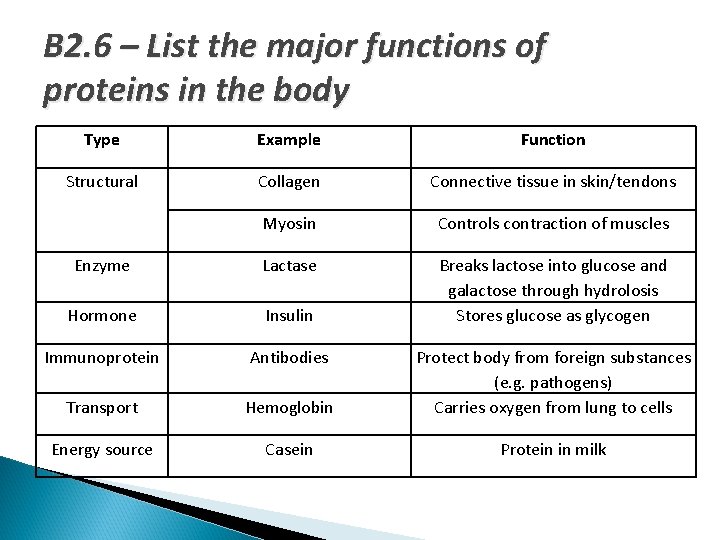
B 2. 6 – List the major functions of proteins in the body Type Example Function Structural Collagen Connective tissue in skin/tendons Myosin Controls contraction of muscles Enzyme Lactase Hormone Insulin Breaks lactose into glucose and galactose through hydrolosis Stores glucose as glycogen Immunoprotein Antibodies Transport Hemoglobin Protect body from foreign substances (e. g. pathogens) Carries oxygen from lung to cells Energy source Casein Protein in milk
References http: //themedicalbiochemistrypage. org/proteinstructure. html http: //www. chemguide. co. uk/organicprops/aminoacid s/proteinstruct. html Amino Acids. (n. d. ). Lecture 27. Retrieved August 24, 2011, from http: //butane. chem. uiuc. edu/cyerkes/ the acid base behaviour of amino acids. (n. d. ). chemguide: helping you to understand Chemistry. Retrieved August 24, 2011, from http: //www. chemguide. co. uk/org
- Slides: 18