
Proteins Chemical composition of the proteins Properties of

- Slides: 24
Proteins. Chemical composition of the proteins. Properties of α- amino carboxylic acids.
Proteins. General overview: Ø Major food macronutrients. Provide energy and building blocks for the development of body’s specific proteins. Ø Polymers with a high molecular weight. Ø Protein content in animal cells and microorganisms up to 40 -50%, in plant cells – up to 35% dry weight. Ø Main protein sources: animals, plants, microorganisms. Quantitative and qualitative differences.
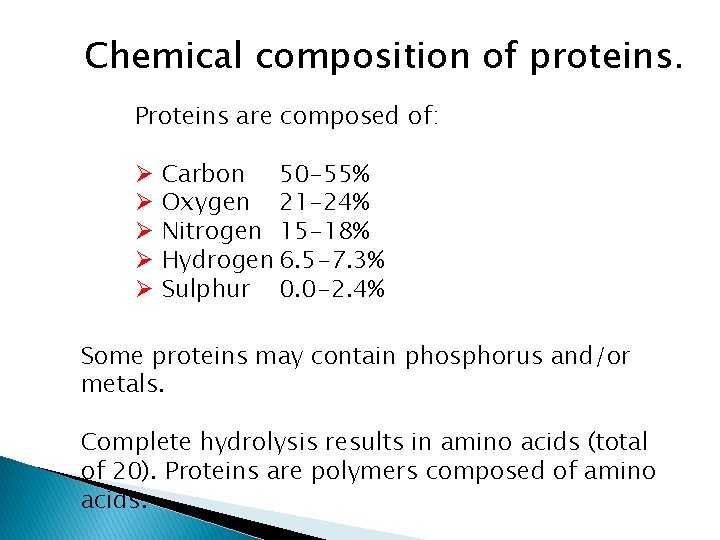
Chemical composition of proteins. Proteins are composed of: Ø Ø Ø Carbon 50 -55% Oxygen 21 -24% Nitrogen 15 -18% Hydrogen 6. 5 -7. 3% Sulphur 0. 0 -2. 4% Some proteins may contain phosphorus and/or metals. Complete hydrolysis results in amino acids (total of 20). Proteins are polymers composed of amino acids.
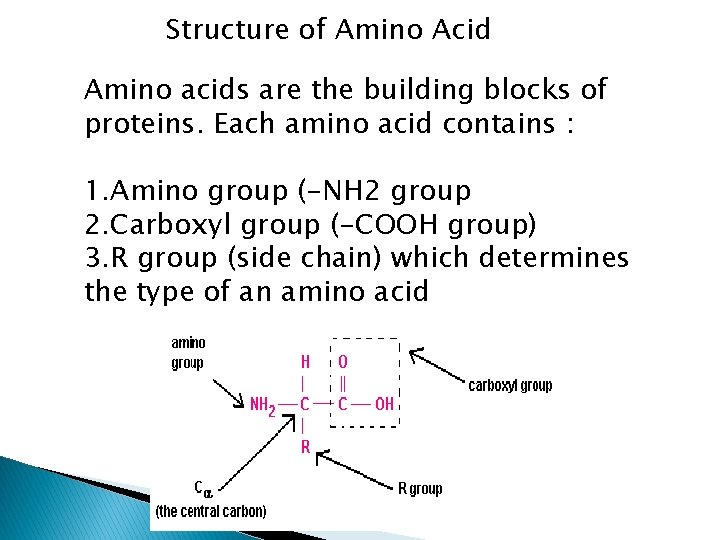
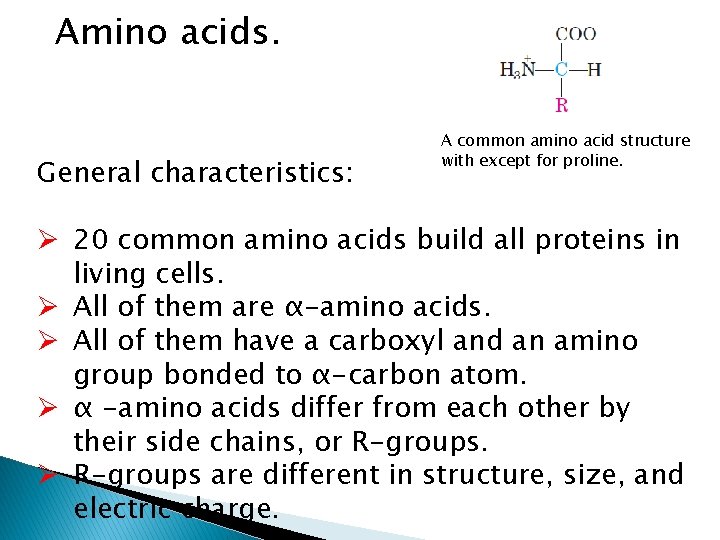
Structure of Amino Acid Amino acids are the building blocks of proteins. Each amino acid contains : 1. Amino group (-NH 2 group 2. Carboxyl group (-COOH group) 3. R group (side chain) which determines the type of an amino acid
Amino acids. General characteristics: A common amino acid structure with except for proline. Ø 20 common amino acids build all proteins in living cells. Ø All of them are α-amino acids. Ø All of them have a carboxyl and an amino group bonded to α-carbon atom. Ø α -amino acids differ from each other by their side chains, or R-groups. Ø R-groups are different in structure, size, and electric charge.
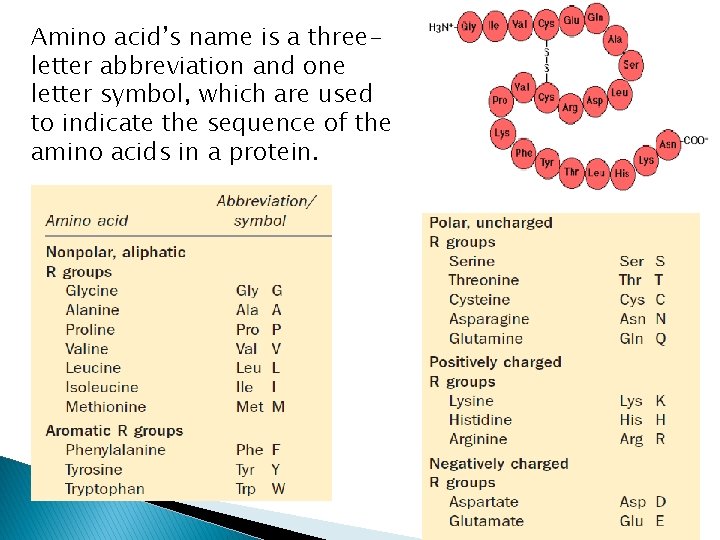
Amino acid’s name is a threeletter abbreviation and one letter symbol, which are used to indicate the sequence of the amino acids in a protein.
Classification of amino acids is based on the polarity of R-groups, or their tendency to interact with water at biological p. H (near p. H 7).
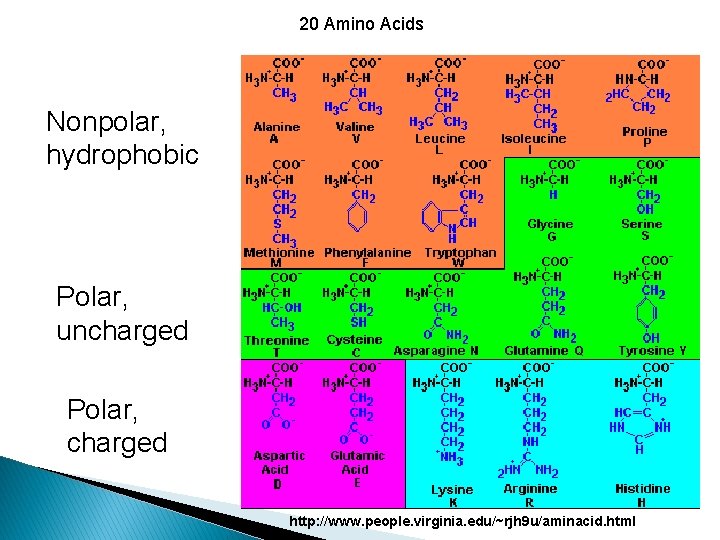
20 Amino Acids Nonpolar, hydrophobic Polar, uncharged Polar, charged http: //www. people. virginia. edu/~rjh 9 u/aminacid. html
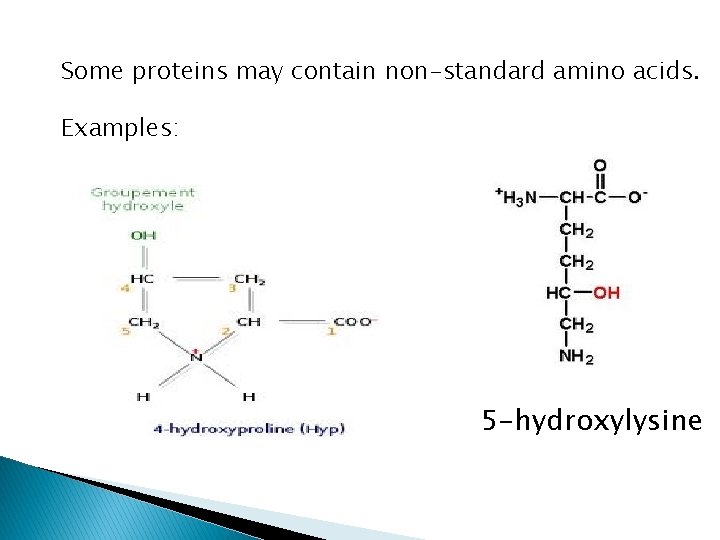
Some proteins may contain non-standard amino acids. Examples: 5 -hydroxylysine
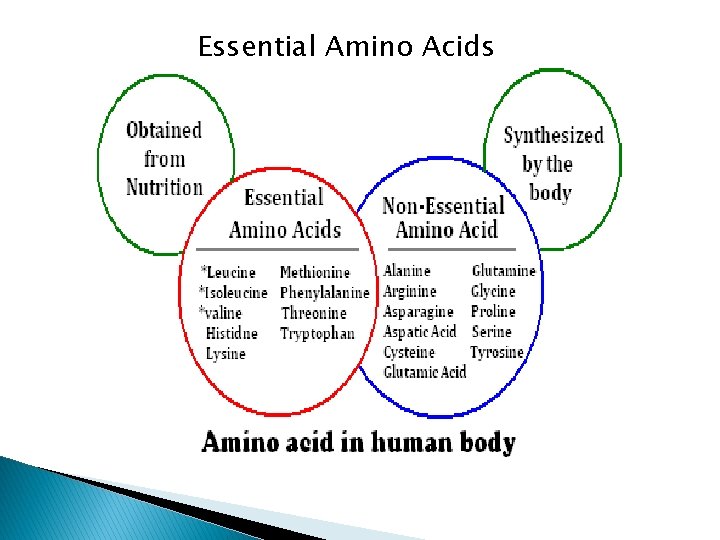
Essential Amino Acids
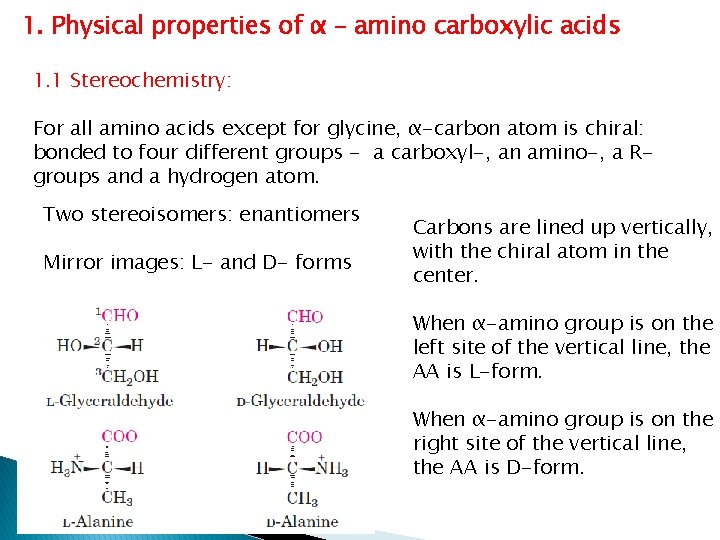
1. Physical properties of α – amino carboxylic acids 1. 1 Stereochemistry: For all amino acids except for glycine, α-carbon atom is chiral: bonded to four different groups - a carboxyl-, an amino-, a Rgroups and a hydrogen atom. Two stereoisomers: enantiomers Mirror images: L- and D- forms Carbons are lined up vertically, with the chiral atom in the center. When α-amino group is on the left site of the vertical line, the AA is L-form. When α-amino group is on the right site of the vertical line, the AA is D-form.
D- and L- forms of the AA have optical properties: rotate plane-polarized light. The equal amounts of left- and right-handed enantiomers of AA is called racemate or racemic mixture. It does not have any optical properties. All protein molecules are composed of the L -forms of AA. D-forms of the AA have been found in small peptides in some microorganisms.
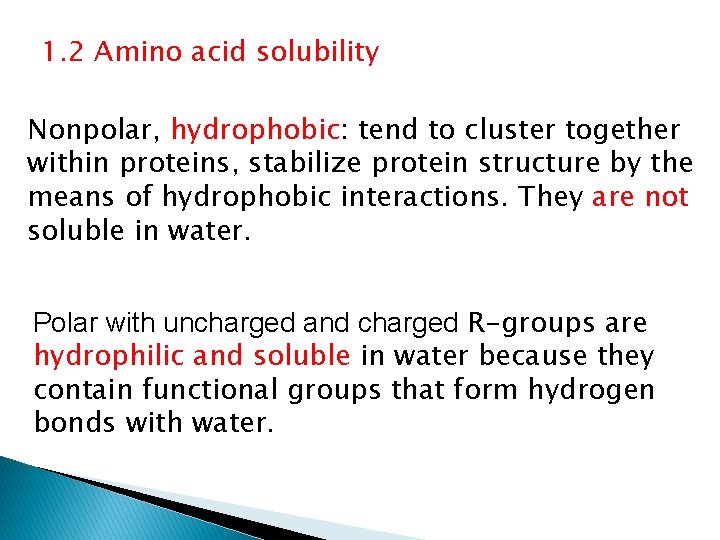
1. 2 Amino acid solubility Nonpolar, hydrophobic: tend to cluster together within proteins, stabilize protein structure by the means of hydrophobic interactions. They are not soluble in water. Polar with uncharged and charged R-groups are hydrophilic and soluble in water because they contain functional groups that form hydrogen bonds with water.
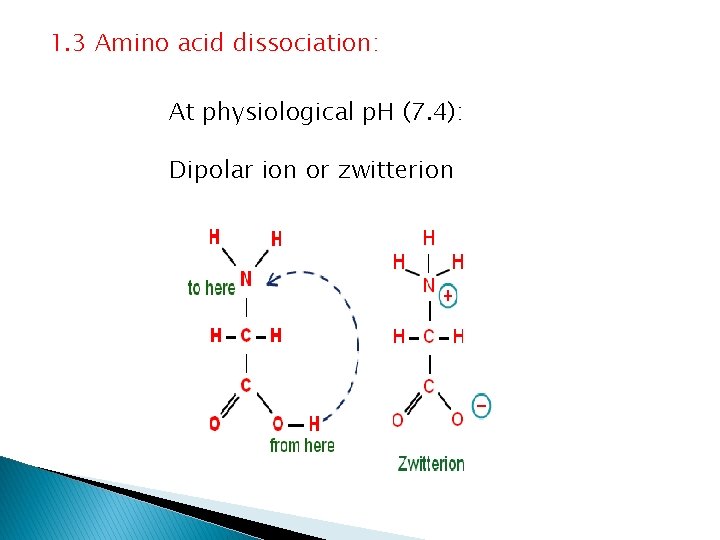
1. 3 Amino acid dissociation: At physiological p. H (7. 4): Dipolar ion or zwitterion
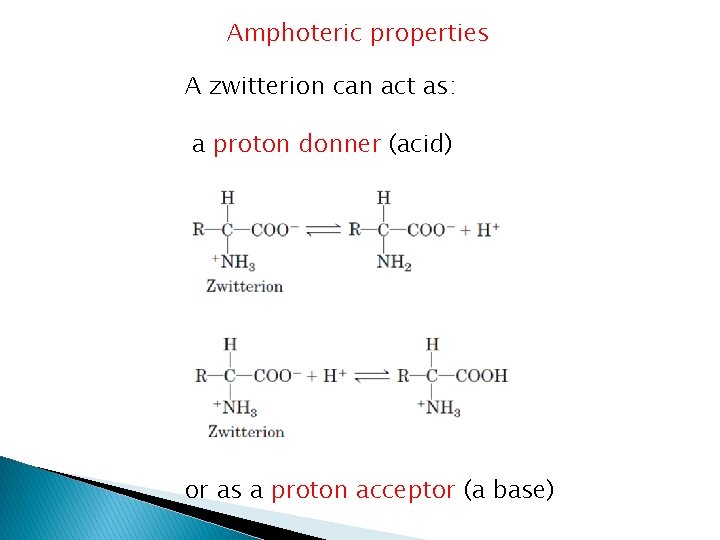
Amphoteric properties A zwitterion can act as: a proton donner (acid) or as a proton acceptor (a base)
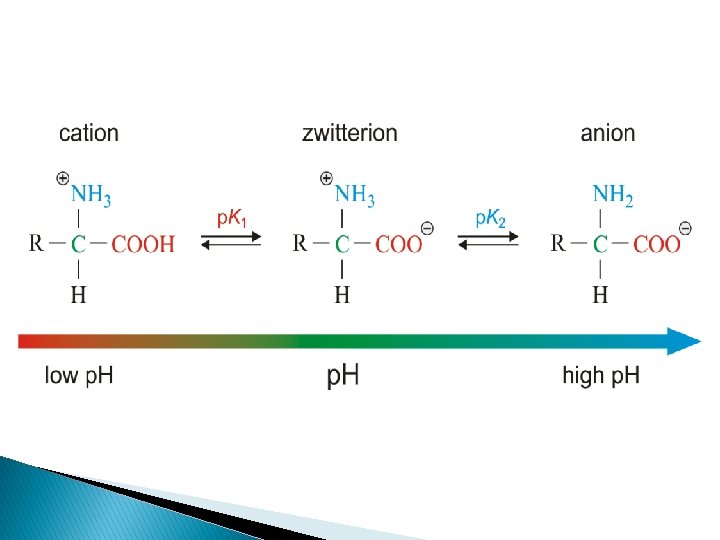
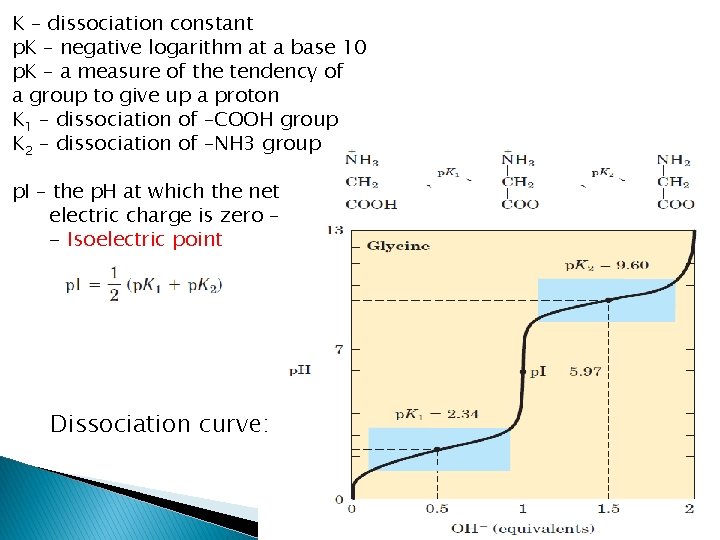
K – dissociation constant p. K – negative logarithm at a base 10 p. K – a measure of the tendency of a group to give up a proton K 1 – dissociation of –COOH group K 2 – dissociation of –NH 3 group p. I – the p. H at which the net electric charge is zero – - Isoelectric point Dissociation curve:
Buffering capacity of amino acids ØBuffers are aqueous systems that tend to resist changes in p. H when small amounts of acid (H+) or base (OH-) are added. ØBuffering region: extending from 1 p. H unit on either side of the p. Ka.
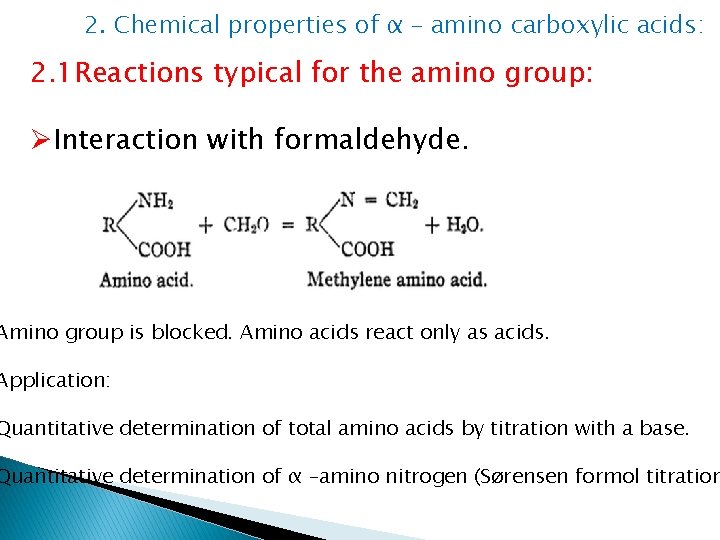
2. Chemical properties of α – amino carboxylic acids: 2. 1 Reactions typical for the amino group: ØInteraction with formaldehyde. Amino group is blocked. Amino acids react only as acids. Application: Quantitative determination of total amino acids by titration with a base. Quantitative determination of α –amino nitrogen (Sørensen formol titration
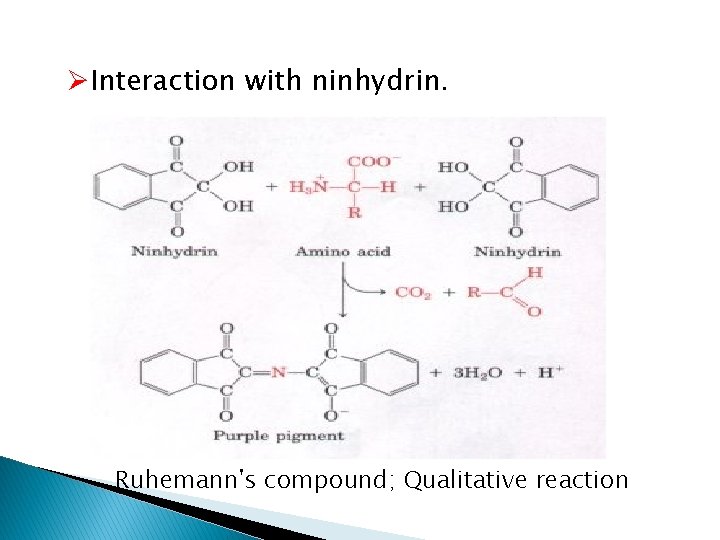
ØInteraction with ninhydrin. Ruhemann's compound; Qualitative reaction
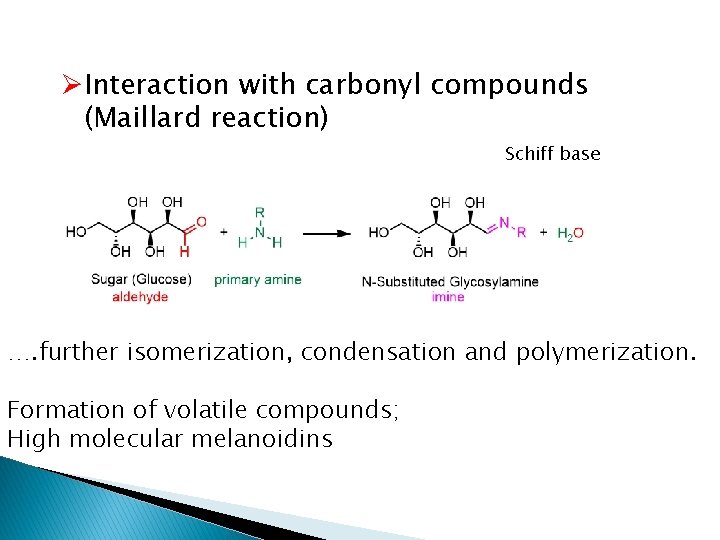
ØInteraction with carbonyl compounds (Maillard reaction) Schiff base …. further isomerization, condensation and polymerization. Formation of volatile compounds; High molecular melanoidins
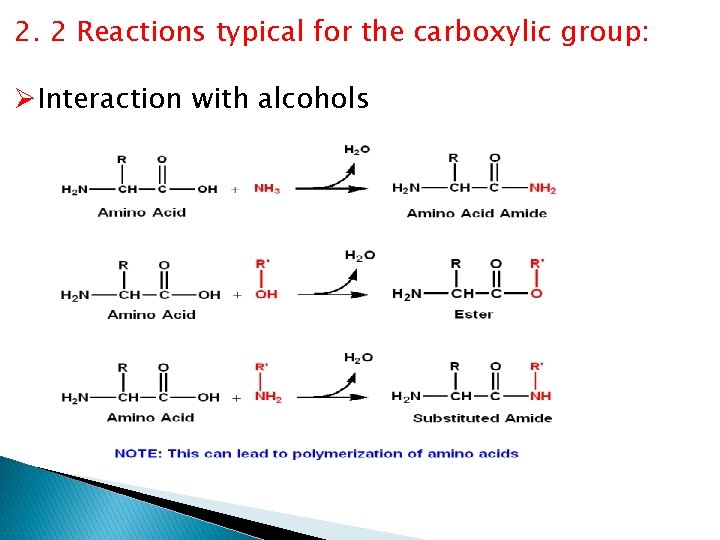
2. 2 Reactions typical for the carboxylic group: ØInteraction with alcohols
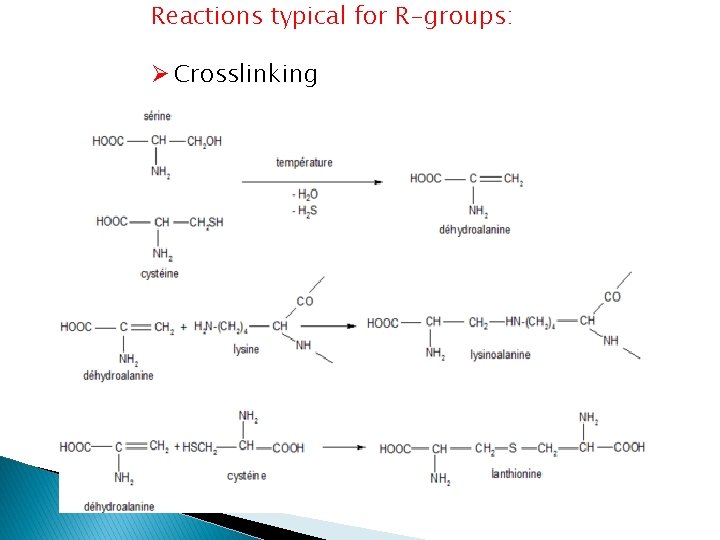
Reactions typical for R-groups: Ø Crosslinking