
Proteins Biopolymers of amino acids Amino acids are
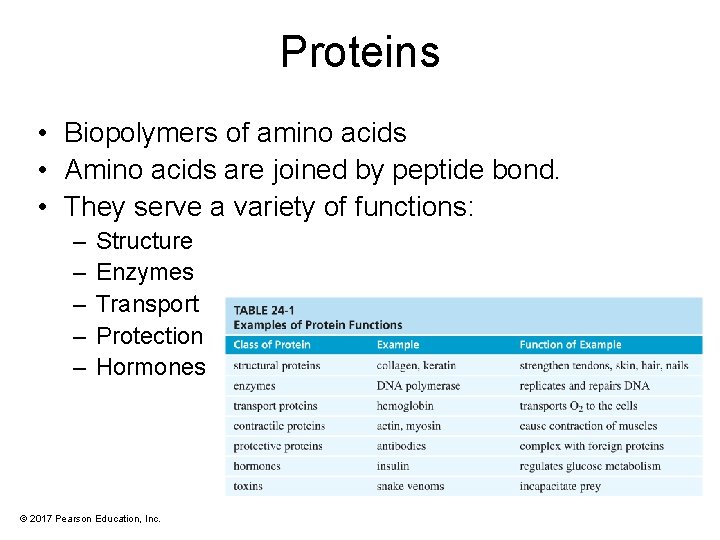
Proteins • Biopolymers of amino acids • Amino acids are joined by peptide bond. • They serve a variety of functions: – – – Structure Enzymes Transport Protection Hormones © 2017 Pearson Education, Inc.
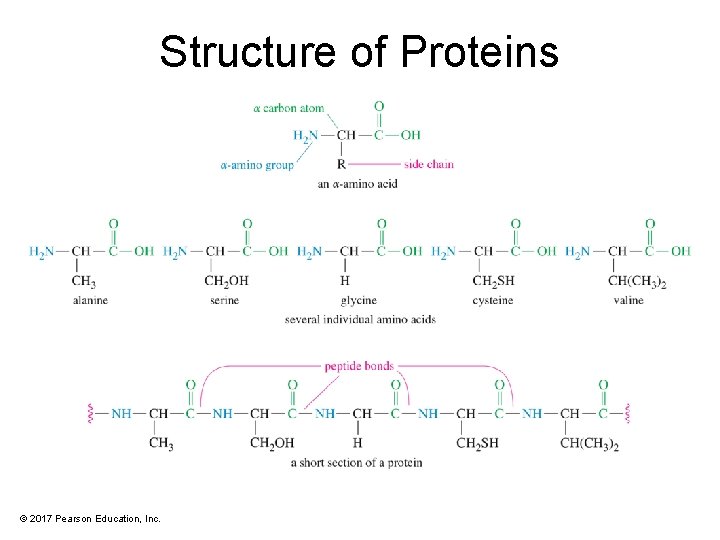
Structure of Proteins © 2017 Pearson Education, Inc.
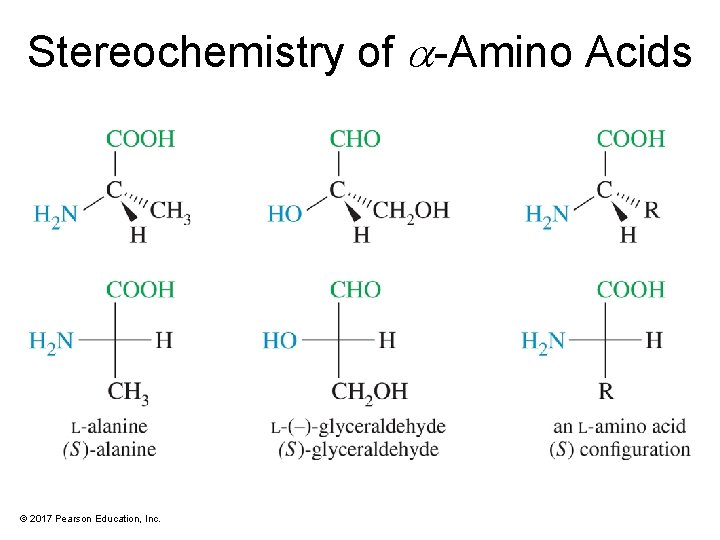
Stereochemistry of -Amino Acids © 2017 Pearson Education, Inc.
Standard Amino Acids • Twenty standard alpha-amino acids • Differ in side-chain characteristics: – – – —H or alkyl Contains an —OH Contains sulfur Contains a nonbasic nitrogen Has —COOH Has a basic nitrogen © 2017 Pearson Education, Inc.
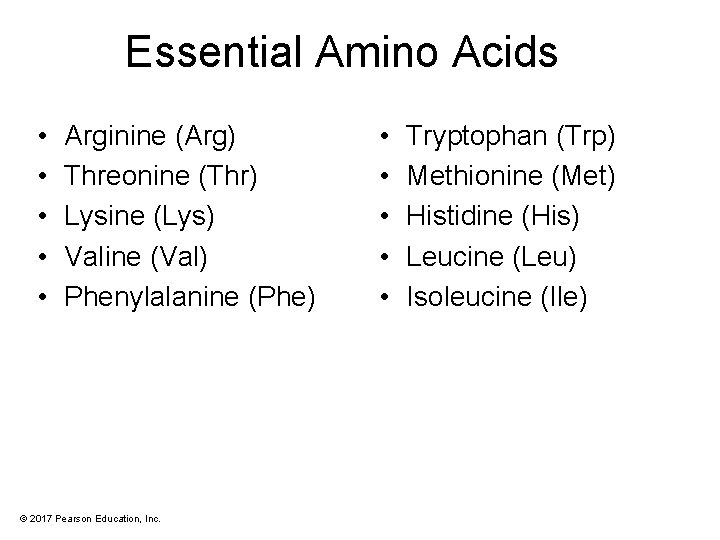
Essential Amino Acids • • • Arginine (Arg) Threonine (Thr) Lysine (Lys) Valine (Val) Phenylalanine (Phe) © 2017 Pearson Education, Inc. • • • Tryptophan (Trp) Methionine (Met) Histidine (His) Leucine (Leu) Isoleucine (Ile)

Complete Proteins • Provide all the essential amino acids • Examples: Those found in meat, fish, milk, and eggs • Proteins that are severely deficient in one or more of the essential amino acids are called incomplete proteins. Plant proteins are generally incomplete. • Vegetarians should eat many different kinds of plants or supplement their diets with milk and/or eggs. © 2017 Pearson Education, Inc.
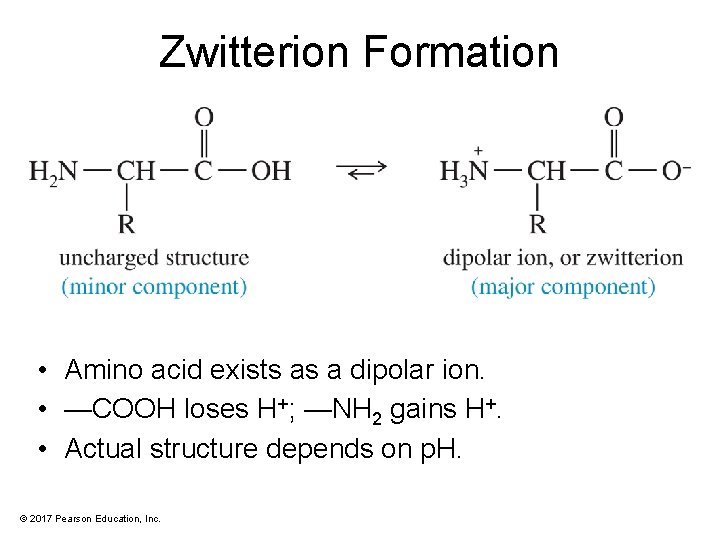
Zwitterion Formation • Amino acid exists as a dipolar ion. • —COOH loses H+; —NH 2 gains H+. • Actual structure depends on p. H. © 2017 Pearson Education, Inc.
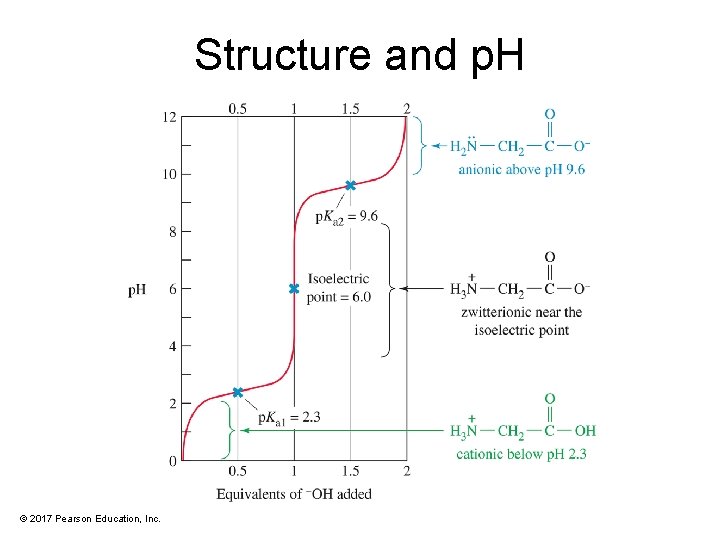
Structure and p. H © 2017 Pearson Education, Inc.
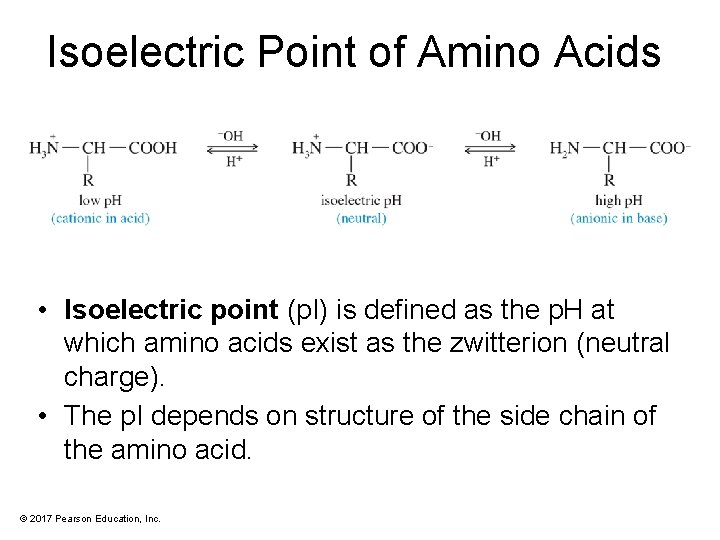
Isoelectric Point of Amino Acids • Isoelectric point (p. I) is defined as the p. H at which amino acids exist as the zwitterion (neutral charge). • The p. I depends on structure of the side chain of the amino acid. © 2017 Pearson Education, Inc.
Isoelectric Points • Acidic amino acids: Isoelectric p. H ~3. • Basic amino acids: Isoelectric p. H ~9. • Neutral amino acids: Isoelectric p. H is slightly acidic, 5– 6. © 2017 Pearson Education, Inc.
Electrophoresis Separation • Electrophoresis uses differences in isoelectric points to separate mixtures of amino acids. • Positively charged (cationic) amino acids are attracted to the negative electrode (the cathode). • Negatively charged (anionic) amino acids are attracted to the positive electrode (the anode). • An amino acid at its isoelectric point has no net charge, so it does not move. © 2017 Pearson Education, Inc.
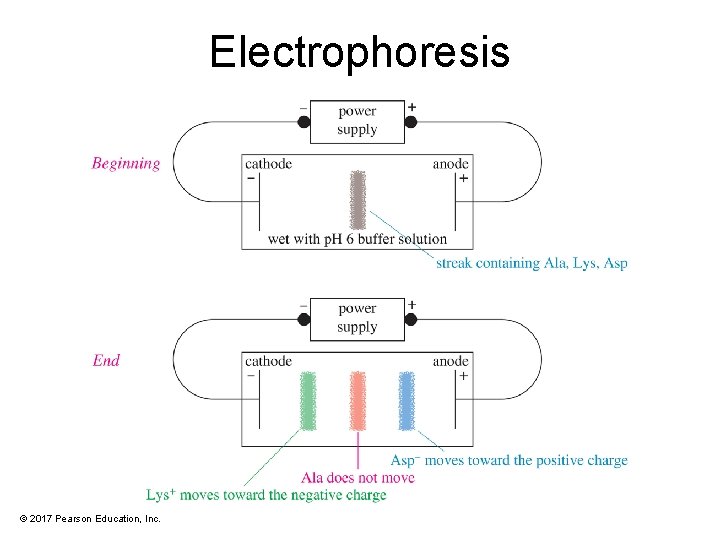
Electrophoresis © 2017 Pearson Education, Inc.
Resolution of Amino Acids • Usually, only the L-enantiomer is biologically active. • Convert the amino acid to a salt, using a chiral acid or base. The result is a mixture of diastereomeric salts that can be separated by chromatography. • Use an enzyme, such as acylase, that will react with only one enantiomer. © 2017 Pearson Education, Inc.
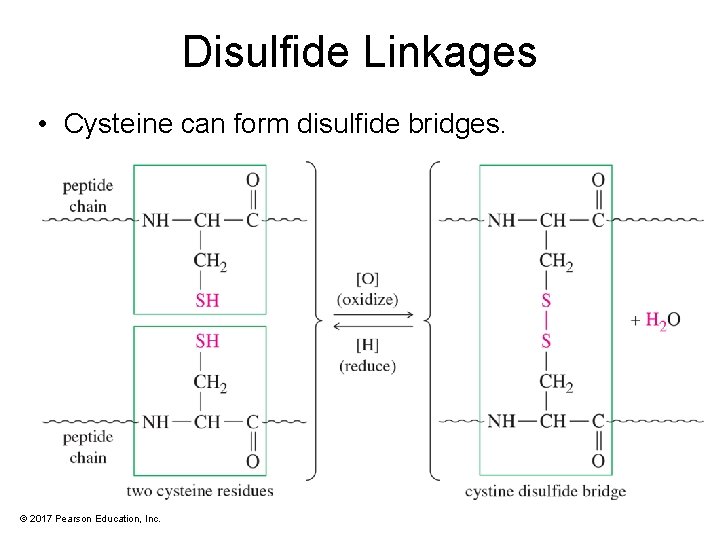
Disulfide Linkages • Cysteine can form disulfide bridges. © 2017 Pearson Education, Inc.
Classification of Proteins • Simple: Hydrolyzed to amino acids only • Conjugated: Bonded to a nonprotein group, such as sugar, nucleic acid, or lipid • Fibrous: Long, stringy filaments, insoluble in water; function as structure • Globular: Folded into spherical shape; function as enzymes, hormones, or transport proteins © 2017 Pearson Education, Inc.
Levels of Protein Structure • Primary: The sequence of the amino acids in the chain and the disulfide links • Secondary: Structure formed by hydrogen bonding. Examples are helix and pleated sheet. • Tertiary: Complete 3 -D conformation • Quaternary: Association of two or more peptide chains to form protein © 2017 Pearson Education, Inc.
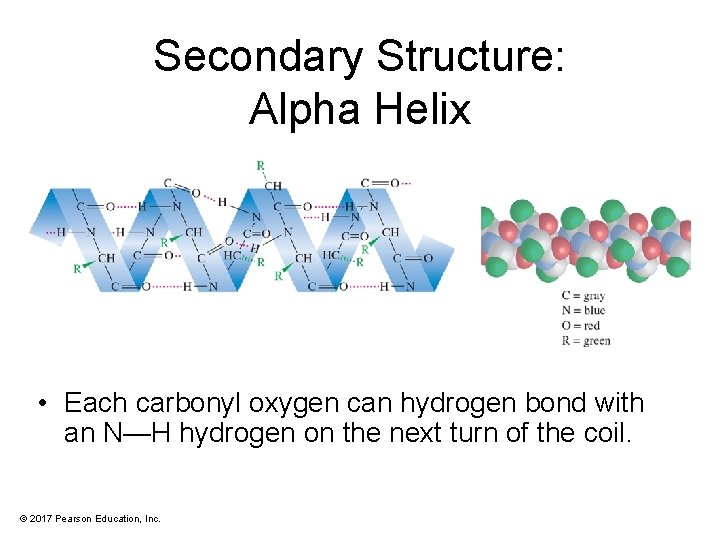
Secondary Structure: Alpha Helix • Each carbonyl oxygen can hydrogen bond with an N—H hydrogen on the next turn of the coil. © 2017 Pearson Education, Inc.
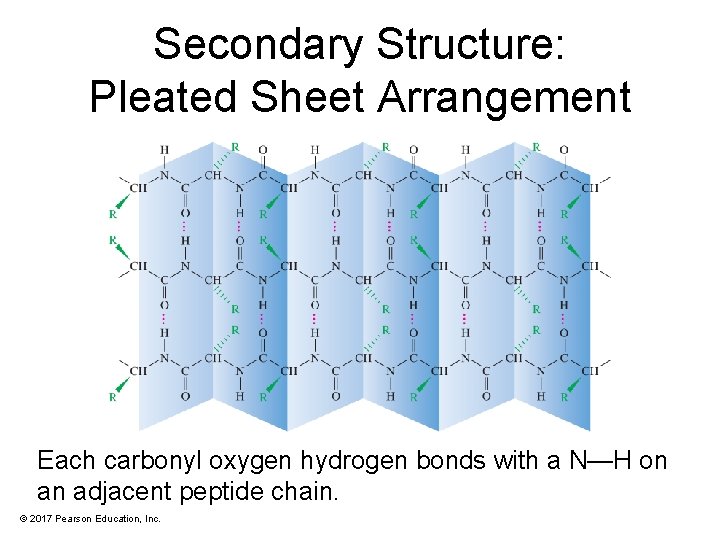
Secondary Structure: Pleated Sheet Arrangement Each carbonyl oxygen hydrogen bonds with a N—H on an adjacent peptide chain. © 2017 Pearson Education, Inc.
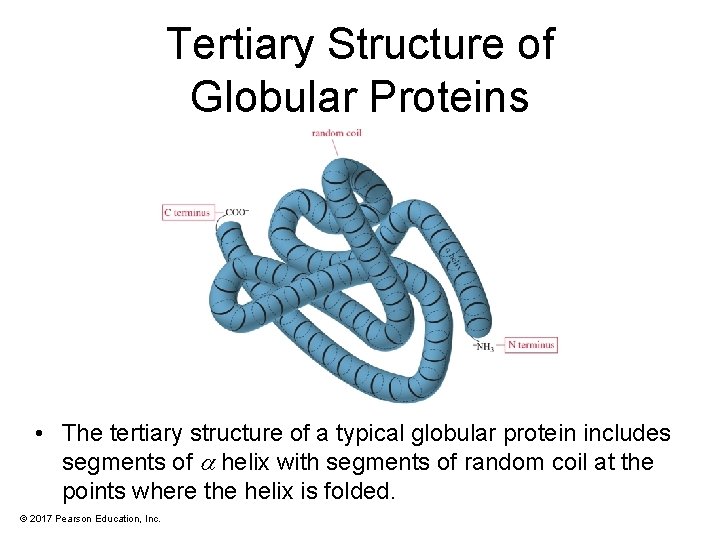
Tertiary Structure of Globular Proteins • The tertiary structure of a typical globular protein includes segments of helix with segments of random coil at the points where the helix is folded. © 2017 Pearson Education, Inc.
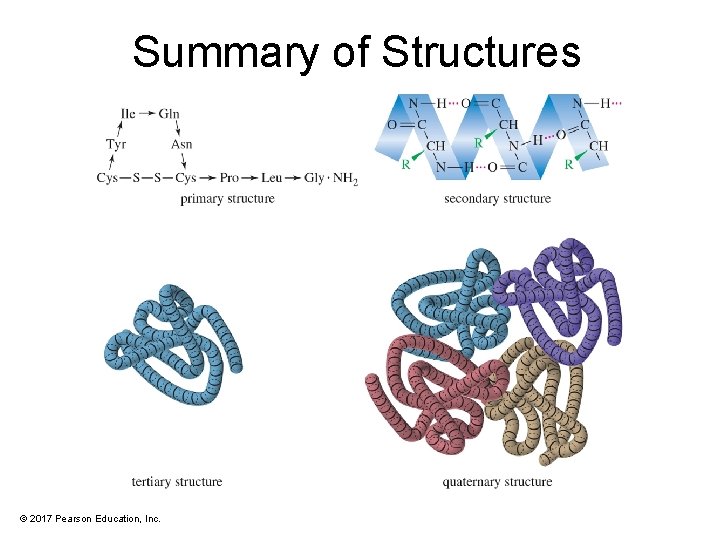
Summary of Structures © 2017 Pearson Education, Inc.
- Slides: 20