
PROTEIN SYNTHESIS WHAT IS IT HOW DOES IT
- Slides: 27
PROTEIN SYNTHESIS WHAT IS IT? HOW DOES IT WORK?
Learning Outcomes All: Will be able to describe simple steps in protein synthesis: Transcription and Translation and be able to distinguish between them. Describe the roles of DNA, m. RNA, t. RNA, and Ribosomes in the process Able to ‘read’ string of m. RNA codons and construct a string of corresponding amino acids using a table Most: Describe the differences between DNA and RNA Able to describe the roles of RNA polymerase in the process of protein synthesis and recall where it occurs Some: Able to fit the concept of m. RNA splicing into the model.
DNA Some starter questions. . . What does DNA stand for? What is it made up from? Where is it found? What does it do?
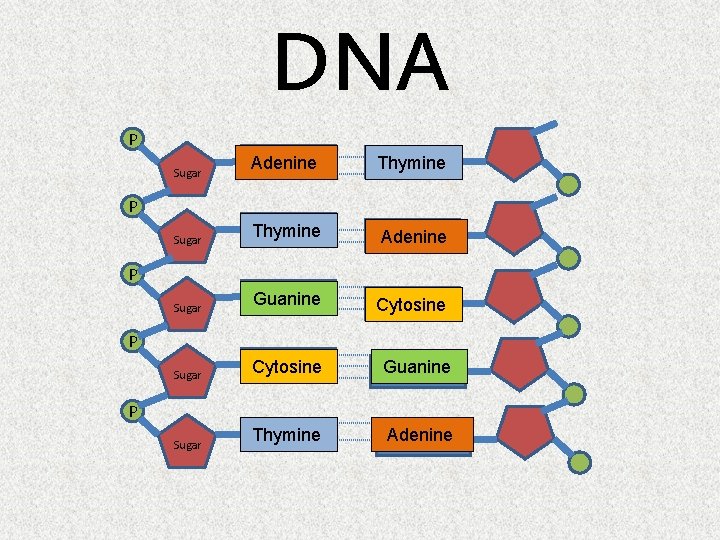
DNA • Deoxyribo. Nucleic acid • Contain instructions on how to build proteins used in the body. • Found in cell nucleus. • Codes for individual Proteins. • Made up from chain of sugar-phosphates and one of four bases.
DNA P BASE Adenine Thymine BASE Thymine Adenine BASE Guanine Cytosine BASE Cytosine Guanine BASE Thymine Adenine BASE Sugar P BASE Sugar
PROTEIN Some simple starter questions. . . What is a Protein? What is it made from? Where are they made? What can they do?
PROTEIN • • Polymer of units linked by peptide bonds: Built up from 20 amino acids Created in Ribosomes Perform nearly all biological functions: – Enzymes – Antibodies – Structural bodies – Hormones – etc!
BUT. . . If DNA is used to build proteins Q: HOW IS THIS ACTUALLY ACHIEVED? DNA cannot escape the nucleus – the molecules are too large, and proteins are manufactured in ribosomes outside the nuclear envelope A: DNA uses an intermediary form: messenger RNA (m. RNA)
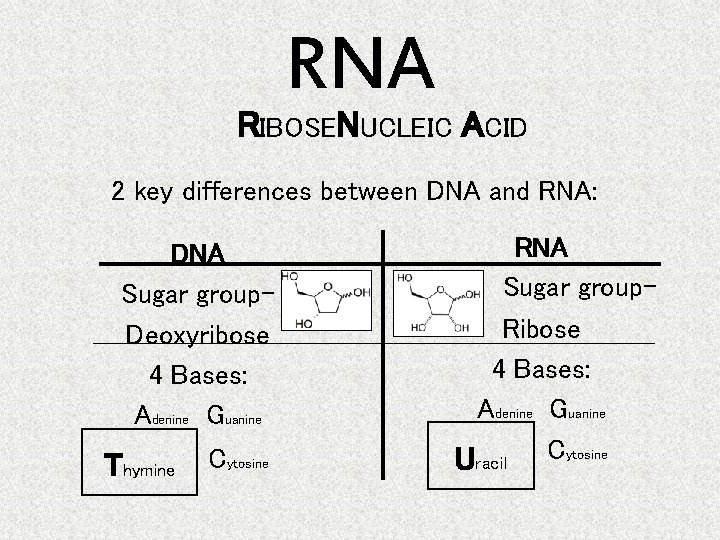
RNA RIBOSENUCLEIC ACID 2 key differences between DNA and RNA: DNA Sugar group. Deoxyribose 4 Bases: Adenine Guanine Thymine Cytosine RNA Sugar group. Ribose 4 Bases: Adenine Guanine Uracil Cytosine
From DNA to PROTEIN 2 phases to the process: TRANSCRIPTION and TRANSLATION
TASK 1 Model a length of DNA by listing at least 21 nucleotide bases And then build a complementary list of bases to complete the molecule
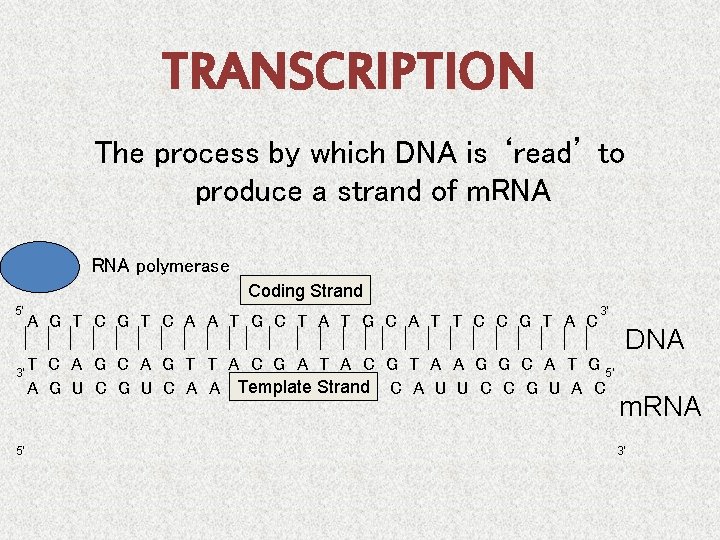
TRANSCRIPTION The process by which DNA is ‘read’ to produce a strand of m. RNA polymerase Coding Strand 5’ 3’ 5’ A G T C A A T G C T A T G C A T T C C G T A C 3’ T C A G T T A C G A T A C G T A A G G C A T G 5’ A G U C A A UTemplate G C U Strand A U G C A U U C C G U A C DNA m. RNA 3’
TASK 2 Using your model from task 1 build a list of base pairs to from a strand of m. RNA
TRANSCRIPTION Here is a video that shows the process in detail It is created using simulations of the molecules involved DNA to PROTIEN
TRANSCRIPTION The steps in this part of the process are: 1. RNA polymerase binds to DNA strand unwinds a short section (about 12 base pairs long) 2. This then travels along the DNA strand building an RNA molecule from the TEMPLATE STRAND 3. Non coding strands of m. RNA (Introns) are cut out leaving just coding strands (Exons) in a process called SPLICING
TRANSCRIPTION This stage is now complete and the m. RNA is free to pass through the nuclear envelope and into the cell cytoplasm. . . where it is met by a ribosome and is ready to undergo. . TRANSLATION
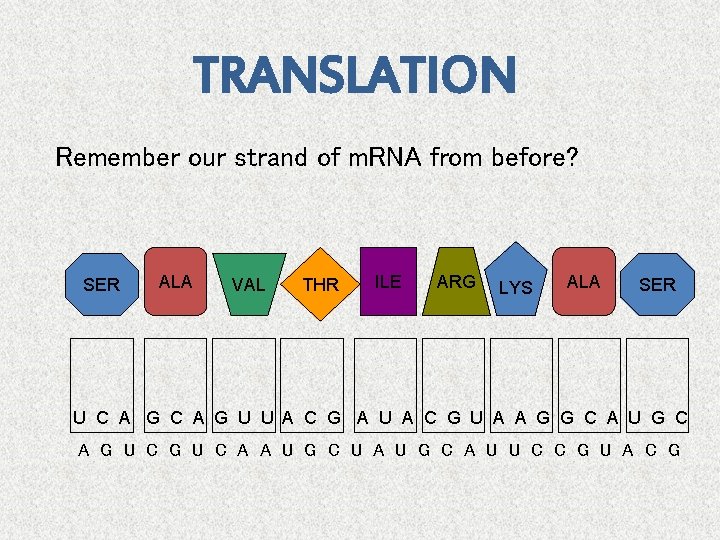
TRANSLATION This is: the process by which m. RNA is ‘read’ to produce a strand protein chain Another type of RNA is involved in this stage; Transfer RNA (t. RNA) These units carry specific, individual, amino acids Process is carried out in the RIBOSOME
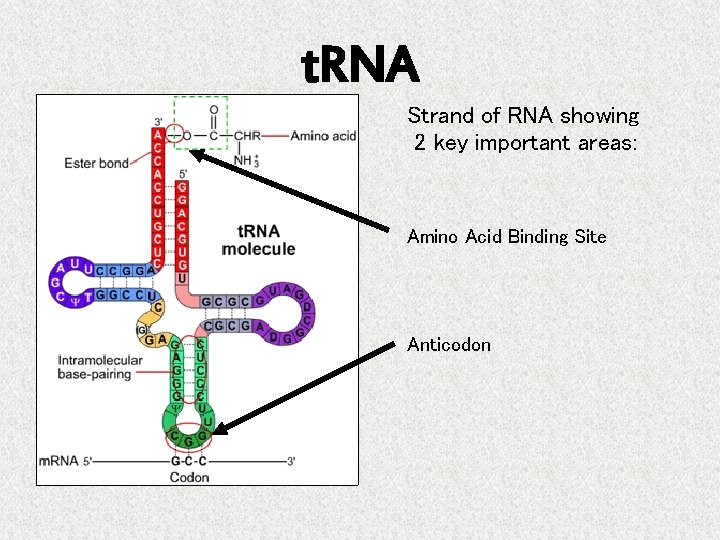
TRANSLATION and t. RNA is a short strand of RNA with 2 important features: 1: t. RNA caries an ANTI CODON Each t. RNA molecule has an area with 3 bare bases: these match up to corresponding bases on the m. RNA (called codons) There are 64 different t. RNA molecules for each possible combination of bases
TRANSLATION and t. RNA is a short strand of RNA with 2 important features: 2: t. RNA is SPECIFIC Each type of t. RNA carries a SPECIFIC amino acid Some amino acids are coded for by just a single codon others by several
t. RNA Strand of RNA showing 2 key important areas: Amino Acid Binding Site Anticodon
TRANSLATION Remember our strand of m. RNA from before? SER ALA VAL THR ILE ARG LYS ALA SER U C A G U U A C G A U A C G U A A G G C A U G C A G U C A A U G C U A U G C A U U C C G U A C G
TRANSLATION Now we return to the video… If that wasn’t very clear then here is a slightly more stylised video TRANSCRIPTION
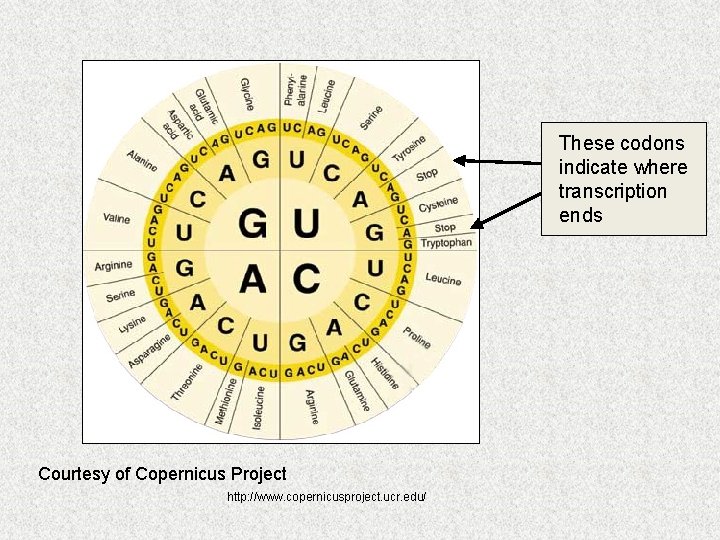
TASK 3 Using your model strand of m. RNA from Task 2 Now create a chain of amino acids to from your very own protein. Either use the table in the book, or the “amino acid wheel” on next slide.
These codons indicate where transcription ends Courtesy of Copernicus Project http: //www. copernicusproject. ucr. edu/
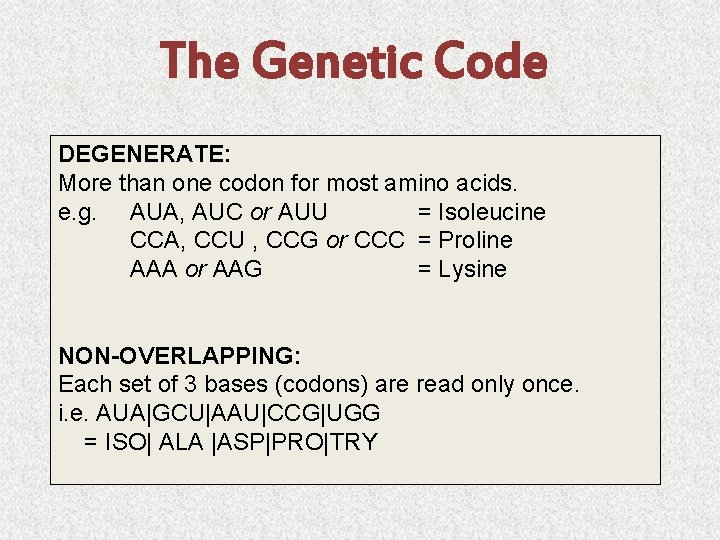
The Genetic Code DEGENERATE: More than one codon for most amino acids. e. g. AUA, AUC or AUU = Isoleucine CCA, CCU , CCG or CCC = Proline AAA or AAG = Lysine NON-OVERLAPPING: Each set of 3 bases (codons) are read only once. i. e. AUA|GCU|AAU|CCG|UGG = ISO| ALA |ASP|PRO|TRY
TASK 4 Using PCs log onto www. wolframalpha. com Enter sequence of bases from your DNA coding strand Try several different strands with same software. Who can get the most matches to the human genome?
TASK 5 Create a model of either TRANSLATION or TRANSCRIPTION Can be any format e. g. : Power. Point, Poster, 3 D Model