
Protein Synthesis Transcription The Central Dogma l What
- Slides: 13
Protein Synthesis: Transcription
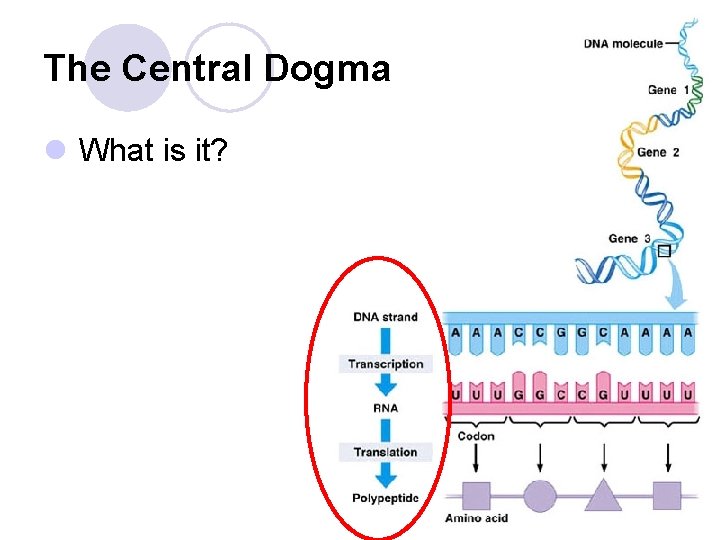
The Central Dogma l What is it?
Transcription l The process by which DNA is used as a template for the production of complementary messenger RNA molecules (m. RNA) l Where does transcription occur? ¡In the nucleus of a eukaryotic cell l What are three stages of transcription? ¡Initiation ¡Elongation ¡Termination
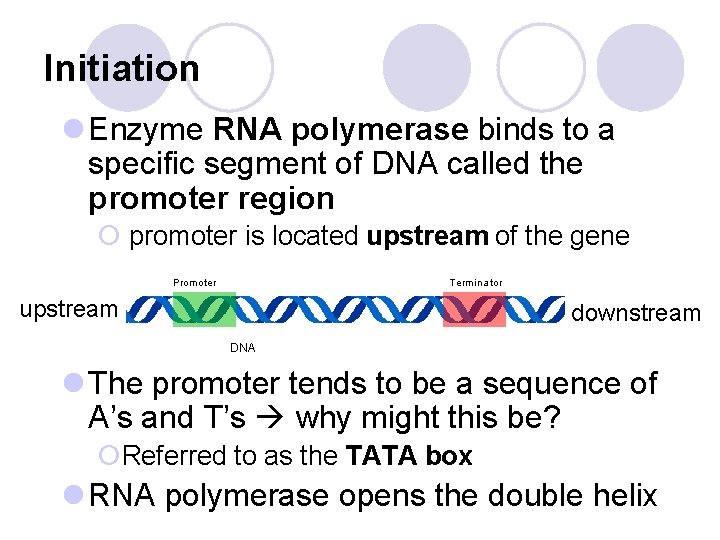
Initiation l Enzyme RNA polymerase binds to a specific segment of DNA called the promoter region ¡ promoter is located upstream of the gene upstream downstream l The promoter tends to be a sequence of A’s and T’s why might this be? ¡Referred to as the TATA box l RNA polymerase opens the double helix
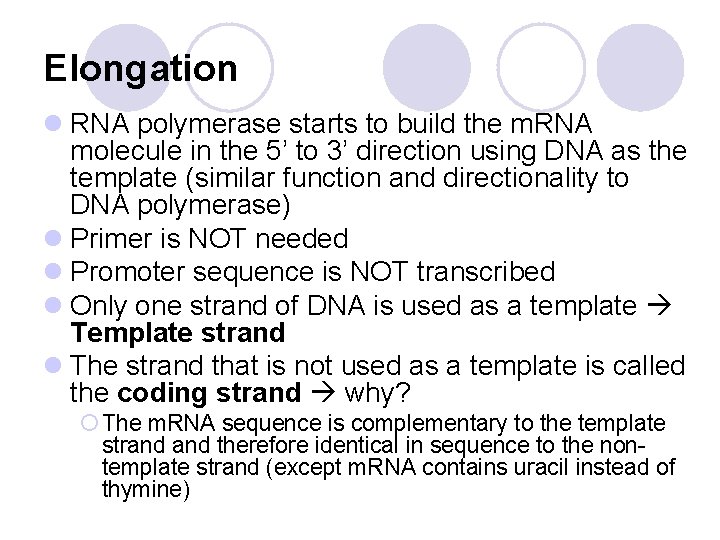
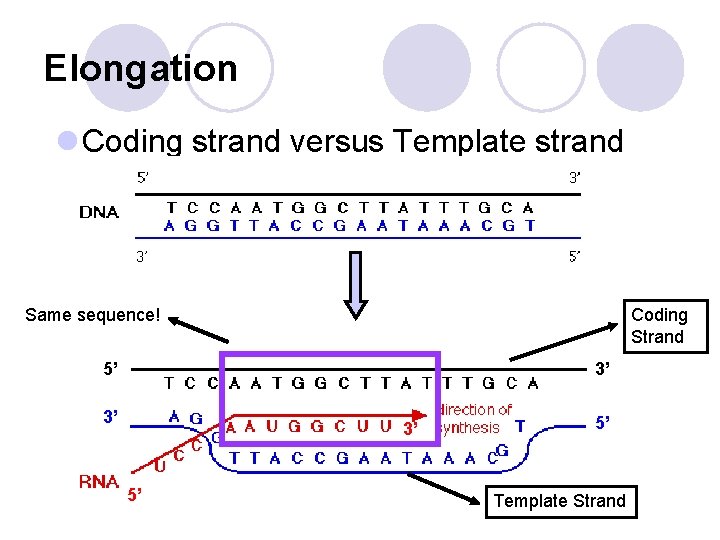
Elongation l RNA polymerase starts to build the m. RNA molecule in the 5’ to 3’ direction using DNA as the template (similar function and directionality to DNA polymerase) l Primer is NOT needed l Promoter sequence is NOT transcribed l Only one strand of DNA is used as a template Template strand l The strand that is not used as a template is called the coding strand why? ¡ The m. RNA sequence is complementary to the template strand therefore identical in sequence to the nontemplate strand (except m. RNA contains uracil instead of thymine)
Elongation l Coding strand versus Template strand Same sequence! Coding Strand 5’ 3’ 3’ 3’ 5’ 5’ Template Strand
Termination l RNA polymerase reaches the termination sequence which signals it to stop adding nucleotides to the growing m. RNA strand l The newly formed m. RNA detaches from the DNA template strand l RNA synthesis stops and RNA polymerase is released
Post-Transcriptional Modifications l Although m. RNA has been made, it is not ready to leave the nucleus yet l The primary transcript (m. RNA before modification) must be processed l Three modifications: ¡ 5’ cap ¡ poly-A-tail ¡ Splicing
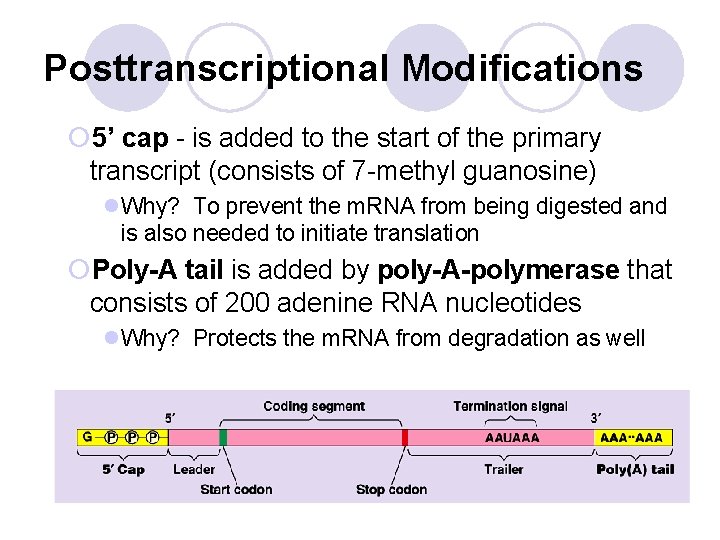
Posttranscriptional Modifications ¡ 5’ cap - is added to the start of the primary transcript (consists of 7 -methyl guanosine) l. Why? To prevent the m. RNA from being digested and is also needed to initiate translation ¡Poly-A tail is added by poly-A-polymerase that consists of 200 adenine RNA nucleotides l. Why? Protects the m. RNA from degradation as well
Splicing l In eukaryotes, there are sections of DNA that are coding (called exons) or noncoding (called introns) ‘ex’ for expressed l The noncoding regions (introns) must be removed before the m. RNA exits the nucleus l Spliceosomes are responsible for cutting those introns out of the m. RNA l Why do you think it is important to remove the introns? ¡ If the introns are translated, the protein the gene codes for will not fold properly and therefore will not perform its function properly
Posttranscriptional Modifications l Now that m. RNA has been capped, tailed, and spliced (you can think of the RNA being a model that needs clothes and make-up before going on for a show) it is called the m. RNA transcript l It is ready to move to the cytoplasm
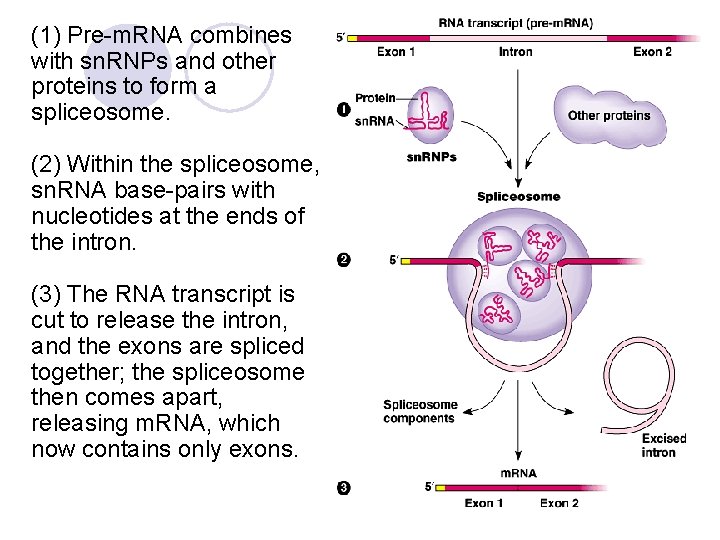
(1) Pre-m. RNA combines with sn. RNPs and other proteins to form a spliceosome. (2) Within the spliceosome, sn. RNA base-pairs with nucleotides at the ends of the intron. (3) The RNA transcript is cut to release the intron, and the exons are spliced together; the spliceosome then comes apart, releasing m. RNA, which now contains only exons.
Homework l Read p 242 to 244 l Answer questions #1 -6, 8, and 10 -11 on p 249 (skip the HIV Case Study)