
Protein Synthesis Transcription and Translation The How to
- Slides: 20
Protein Synthesis Transcription and Translation The How to…
Why Proteins are Important l l The goal of any cell at any given moment is to produce chains of proteins. These proteins are used to dictate directions and functions of the cell.
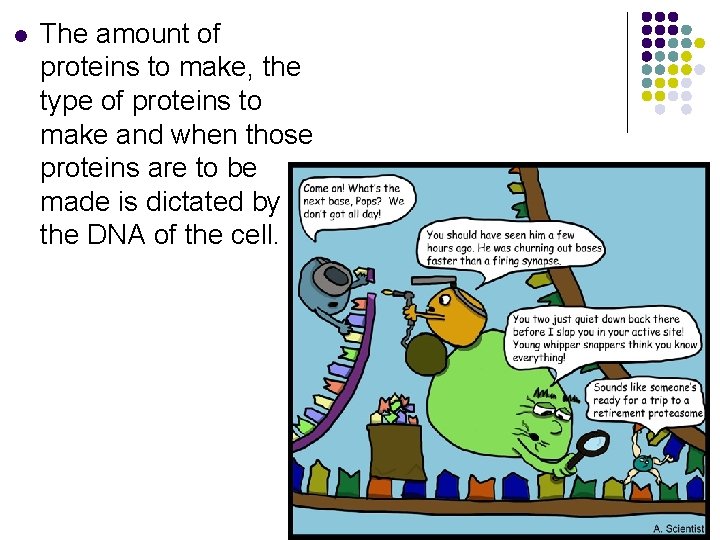
l The amount of proteins to make, the type of proteins to make and when those proteins are to be made is dictated by the DNA of the cell.
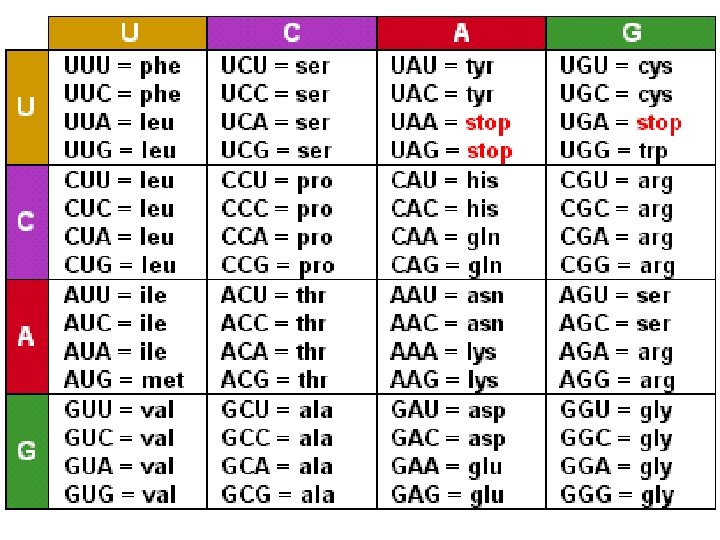
Amino acids: the building blocks of proteins l l Proteins are made from many amino acids. The sequence of nitrogenous bases in DNA is the “code” that tells cells what amino acids to produce There are 20 different amino acids that are commonly found in proteins Every 3 nitrogenous bases code for an amino acid
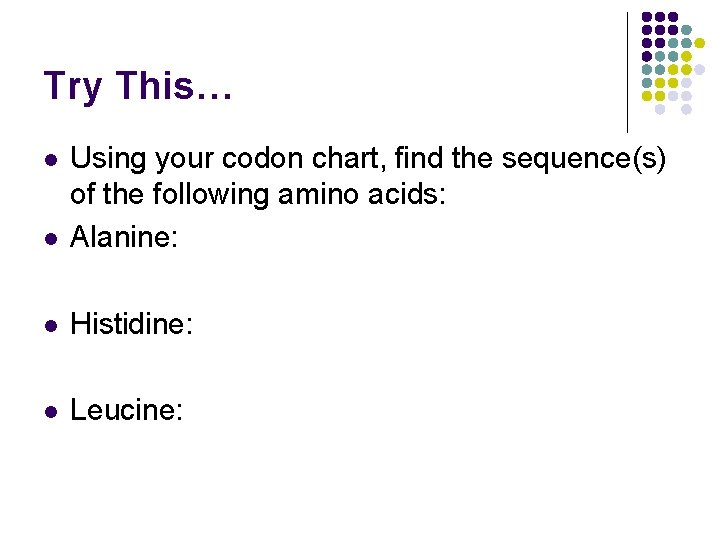
Try This… l Using your codon chart, find the sequence(s) of the following amino acids: Alanine: l Histidine: l Leucine: l
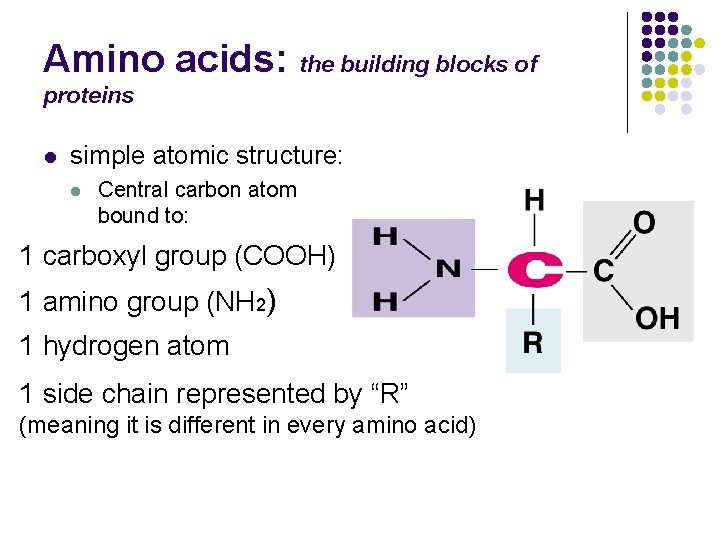
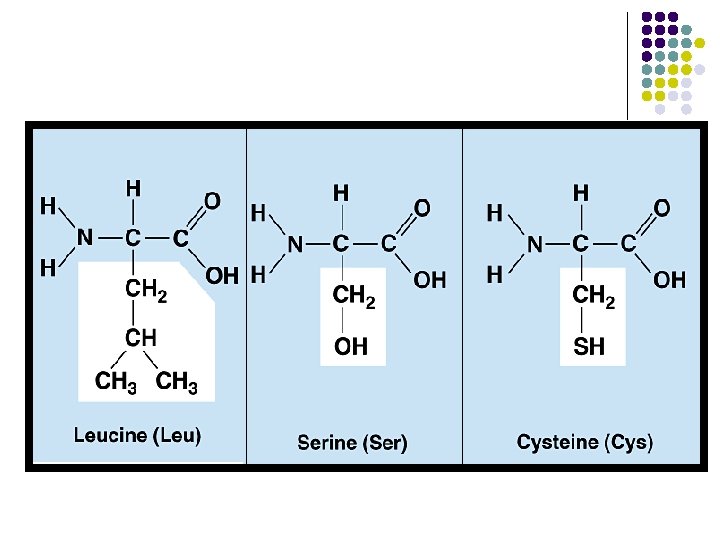
Amino acids: the building blocks of proteins l simple atomic structure: l Central carbon atom bound to: 1 carboxyl group (COOH) 1 amino group (NH 2) 1 hydrogen atom 1 side chain represented by “R” (meaning it is different in every amino acid)
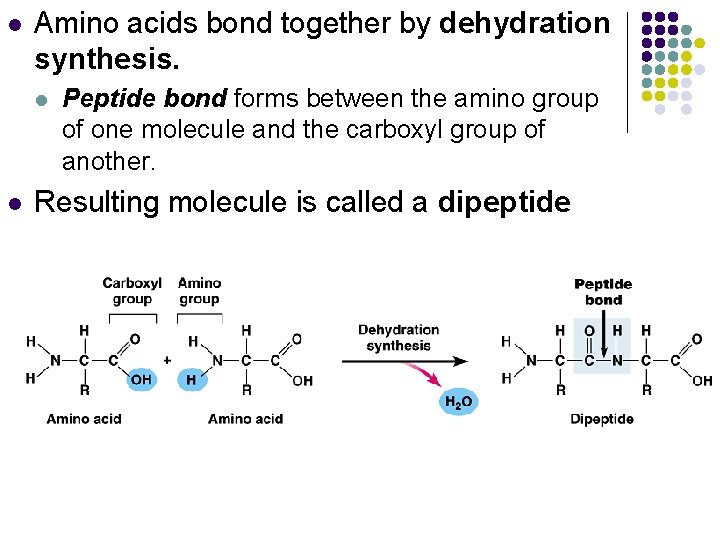
l Amino acids bond together by dehydration synthesis. l l Peptide bond forms between the amino group of one molecule and the carboxyl group of another. Resulting molecule is called a dipeptide
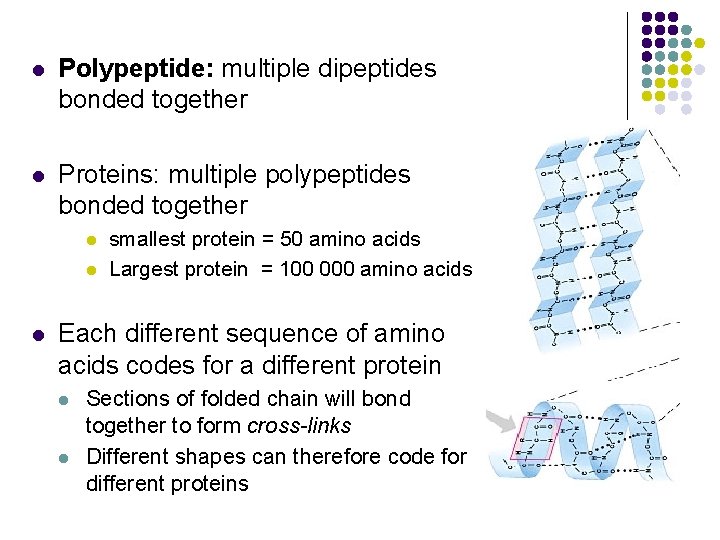
l Polypeptide: multiple dipeptides bonded together l Proteins: multiple polypeptides bonded together l l l smallest protein = 50 amino acids Largest protein = 100 000 amino acids Each different sequence of amino acids codes for a different protein l l Sections of folded chain will bond together to form cross-links Different shapes can therefore code for different proteins
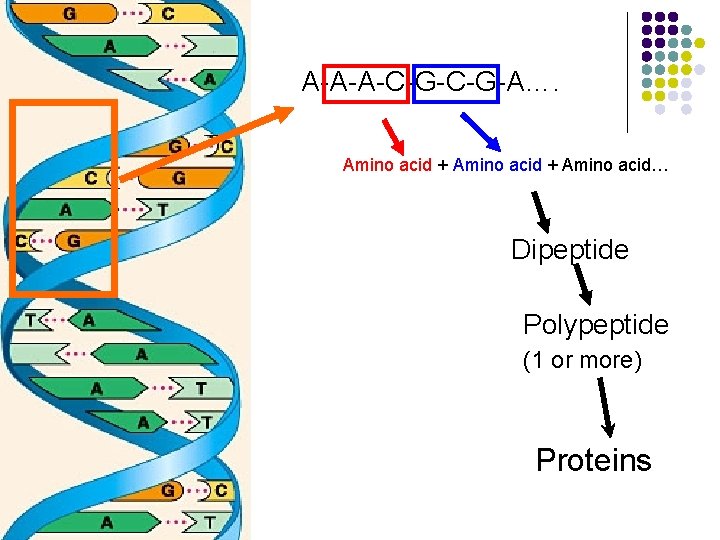
A-A-A-C-G-A…. Amino acid + Amino acid… Dipeptide Polypeptide (1 or more) Proteins
l l l Today scientists know that genes are made of many nucleotides. The order of the bases codes for the amino acids that will be added to the polypeptide chain. The order will vary among different species but will be similar among members of the same species.
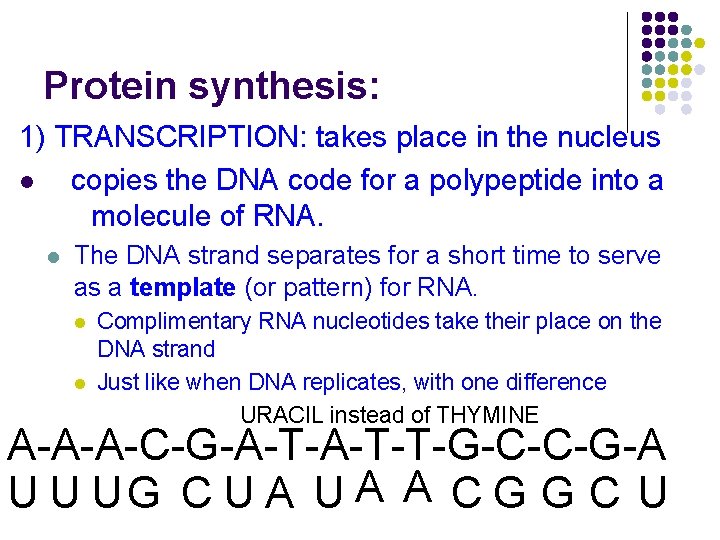
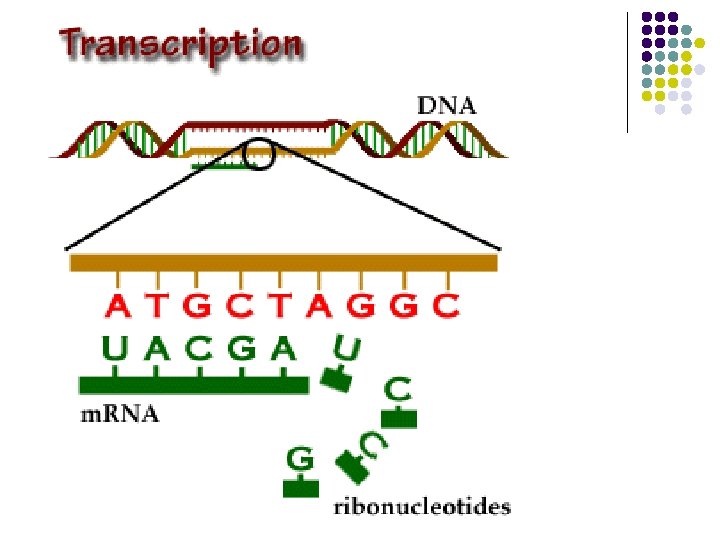
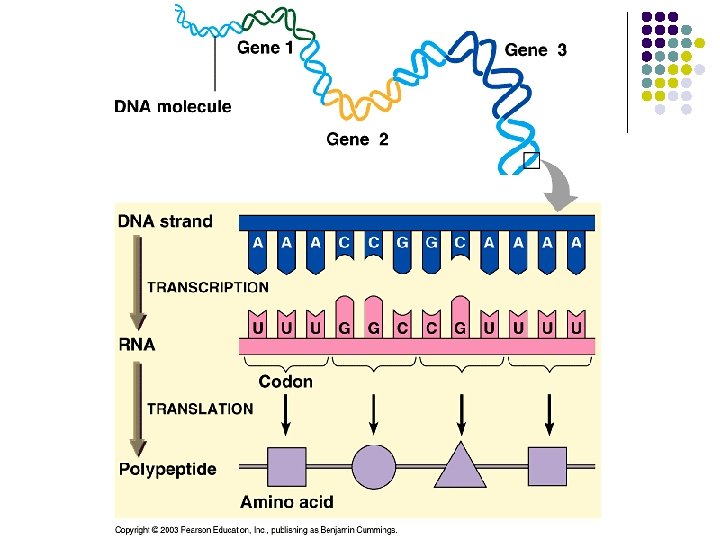
Protein synthesis: 1) TRANSCRIPTION: takes place in the nucleus l copies the DNA code for a polypeptide into a molecule of RNA. l The DNA strand separates for a short time to serve as a template (or pattern) for RNA. l l Complimentary RNA nucleotides take their place on the DNA strand Just like when DNA replicates, with one difference URACIL instead of THYMINE A-A-A-C-G-A-T-T-G-C-C-G-A U U UG C U A A C G G C U
l When the RNA reaches a specific “STOP” code (a code of Nucleic acids e. g. UAC) it leaves the DNA strand. l The RNA strand is now a separate molecule that carries the complete code for one Polypeptide l The involved RNA in this step is known as messenger RNA or m. RNA
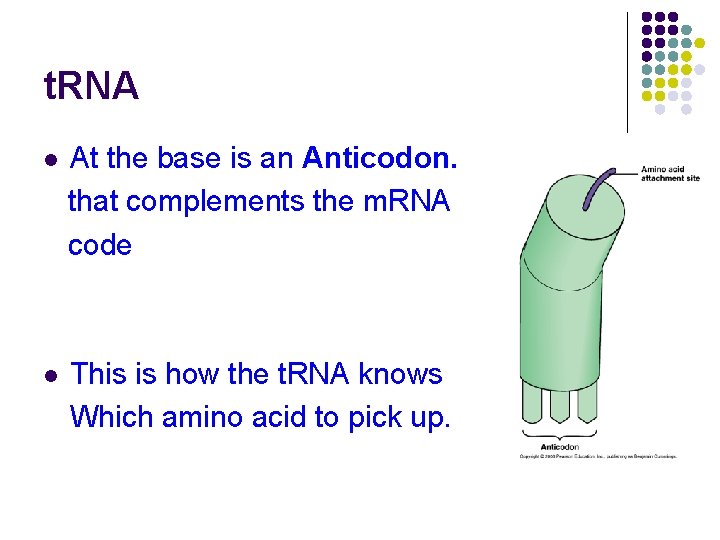
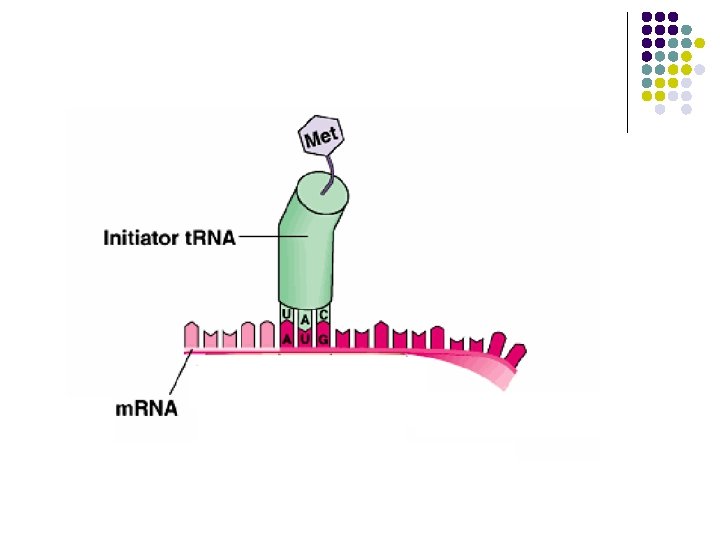
2) TRANSLATION: code amino acids Once m. RNA has copied the code, the next step is to actually create the polypeptides. Transfer RNA ---- t. RNA l There are 20 different kinds of t. RNA, one for each amino acid l The have a short tail on one end that can “pick up an amino acid” l Each t. RNA can carry only one specific amino acid
t. RNA l At the base is an Anticodon. that complements the m. RNA code l This is how the t. RNA knows Which amino acid to pick up.
l l Once the amino acids are lined up, they will go through dehydration synthesis to become a complete protein. Once the protein is made, it will either: l l Stay in the cell and be used to instruct organelles on their function. Be transferred to another cell to communicate information between 2 cells.