
Protein Synthesis The genetic code the sequence of
- Slides: 23
Protein Synthesis • • The genetic code – the sequence of nucleotides in DNA – is ultimately translated into the sequence of amino acids in proteins – gene expression in general, one gene encodes information for one protein (can be structural or enzymatic) – one-gene, one-protein hypothesis DNA does not directly synthesize proteins RNA acts as an intermediary between DNA and protein – polymer of nucleotides but has several important differences: sugar bases strands RNA DNA ribose A, U, C, G single deoxyribose A, T, C, G double
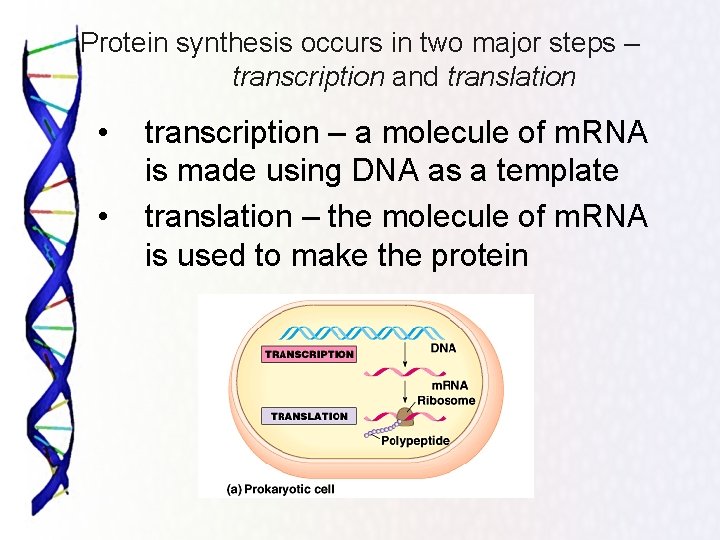
Protein synthesis occurs in two major steps – transcription and translation • • transcription – a molecule of m. RNA is made using DNA as a template translation – the molecule of m. RNA is used to make the protein
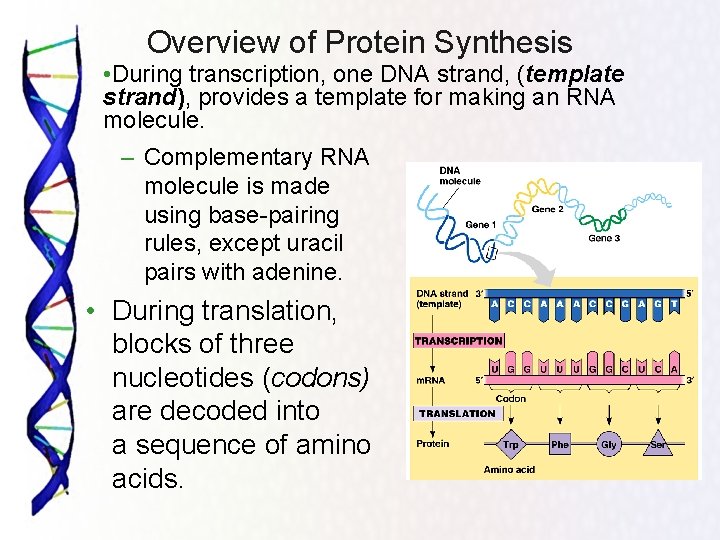
Overview of Protein Synthesis • During transcription, one DNA strand, (template strand), provides a template for making an RNA molecule. – Complementary RNA molecule is made using base-pairing rules, except uracil pairs with adenine. • During translation, blocks of three nucleotides (codons) are decoded into a sequence of amino acids.
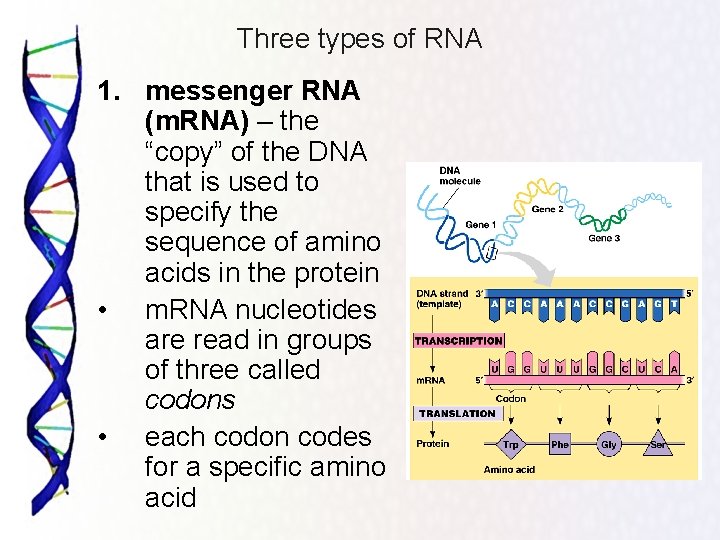
Three types of RNA 1. messenger RNA (m. RNA) – the “copy” of the DNA that is used to specify the sequence of amino acids in the protein • m. RNA nucleotides are read in groups of three called codons • each codon codes for a specific amino acid
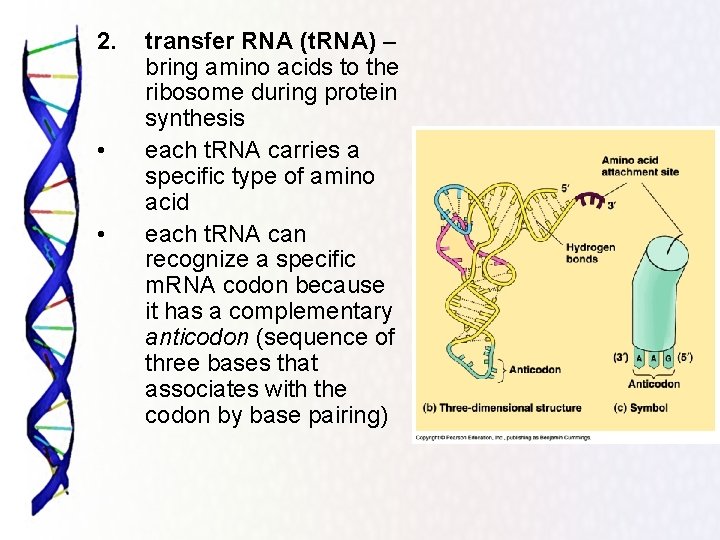
2. • • transfer RNA (t. RNA) – bring amino acids to the ribosome during protein synthesis each t. RNA carries a specific type of amino acid each t. RNA can recognize a specific m. RNA codon because it has a complementary anticodon (sequence of three bases that associates with the codon by base pairing)
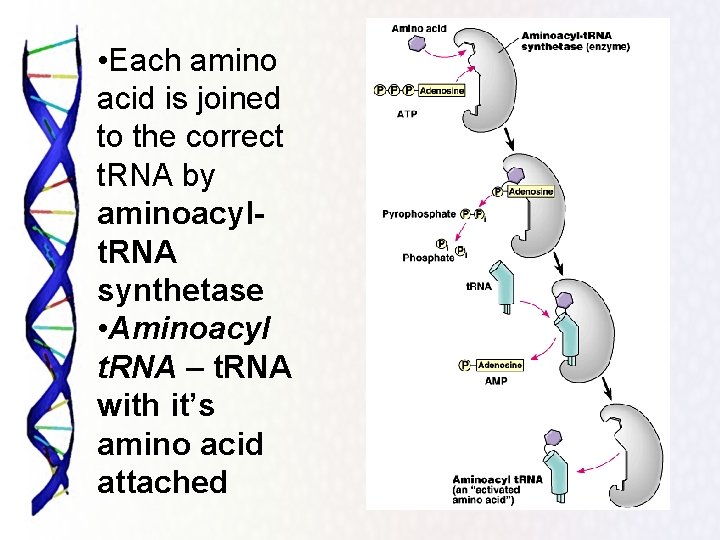
• Each amino acid is joined to the correct t. RNA by aminoacylt. RNA synthetase • Aminoacyl t. RNA – t. RNA with it’s amino acid attached
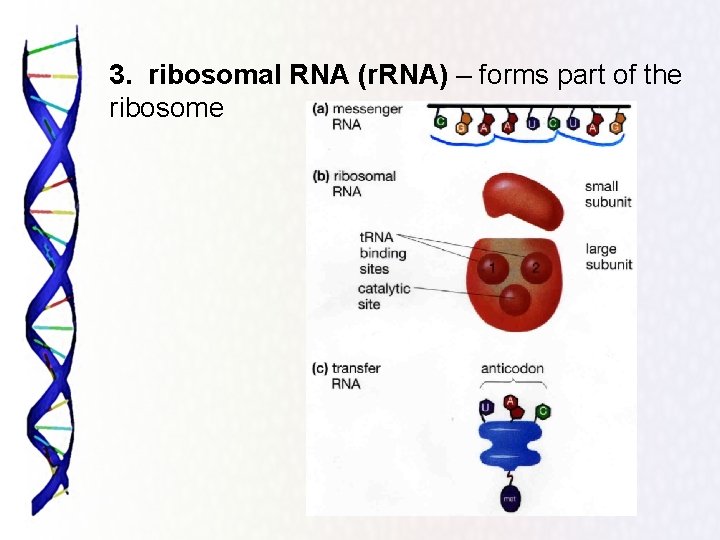
3. ribosomal RNA (r. RNA) – forms part of the ribosome
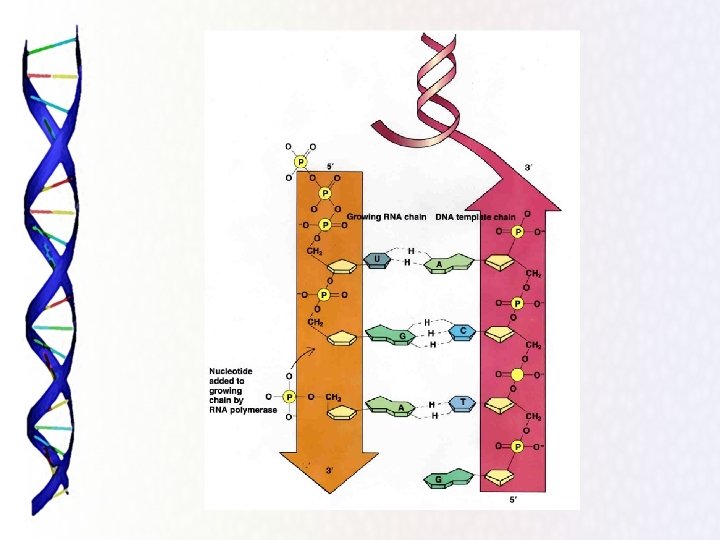
• • Transcription synthesis of RNA using DNA as a template most RNA is synthesized by DNAdependent RNA polymerases enzymes that require DNA as a template similar to DNA polymerases synthesize RNA in a 5’ to 3’ direction use nucleotides with three phosphate groups as substrates (nucleoside triphosphates), removing two of the phosphates as the subunits are linked together (just like DNA synthesis) the transcibed strand of DNA and the complementary RNA strand are antiparallel
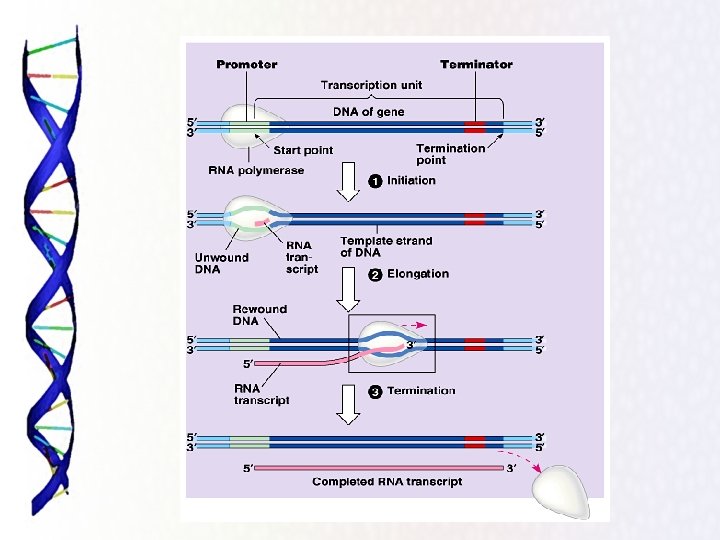
• • • Transcription begins with an RNA polymerase attaching to a DNA sequence called the promoter (promoter is not transcribed) – marks the beginning of the gene RNA polymerase unwinds the DNA strand only one of the strands of DNA is transcribed – called the transcribed strand, template strand, or antisense strand The strand that is NOT transcribed is the sense strand RNA polymerase continues down the gene synthesizing a single strand of m. RNA through base-pairing (A matches with U) until it reaches a termination signal
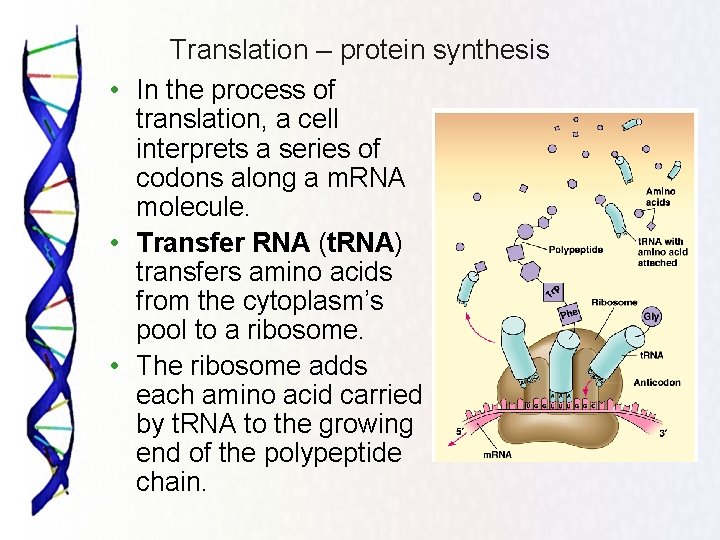
Translation – protein synthesis • In the process of translation, a cell interprets a series of codons along a m. RNA molecule. • Transfer RNA (t. RNA) transfers amino acids from the cytoplasm’s pool to a ribosome. • The ribosome adds each amino acid carried by t. RNA to the growing end of the polypeptide chain.
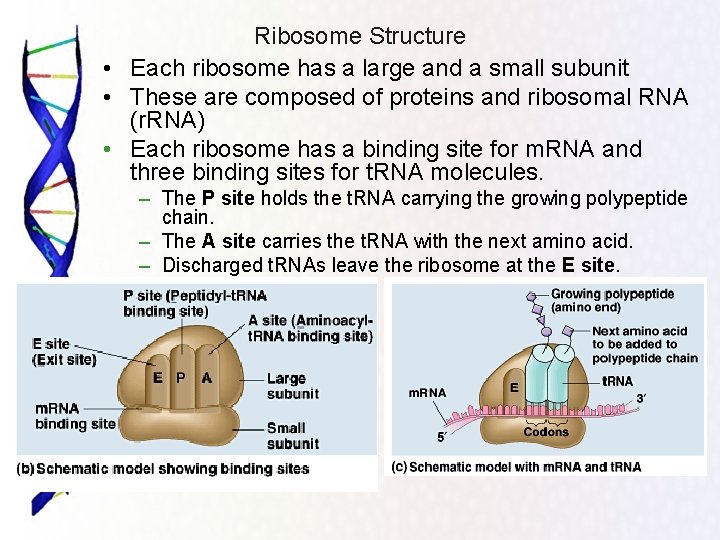
Ribosome Structure • Each ribosome has a large and a small subunit • These are composed of proteins and ribosomal RNA (r. RNA) • Each ribosome has a binding site for m. RNA and three binding sites for t. RNA molecules. – The P site holds the t. RNA carrying the growing polypeptide chain. – The A site carries the t. RNA with the next amino acid. – Discharged t. RNAs leave the ribosome at the E site.
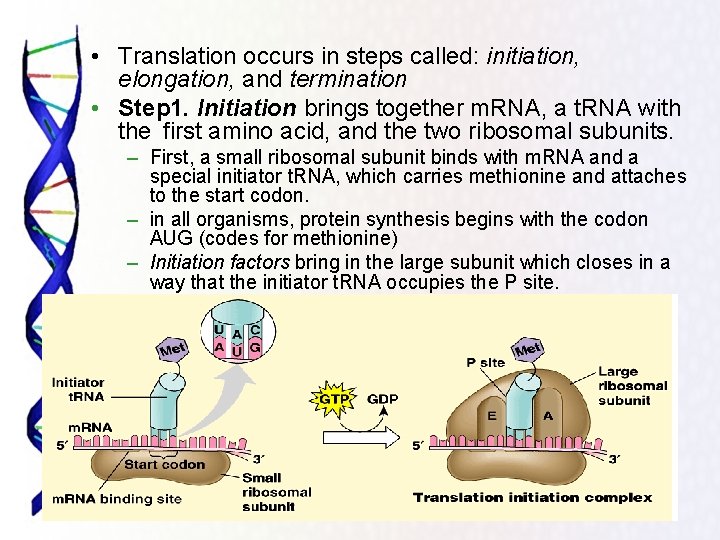
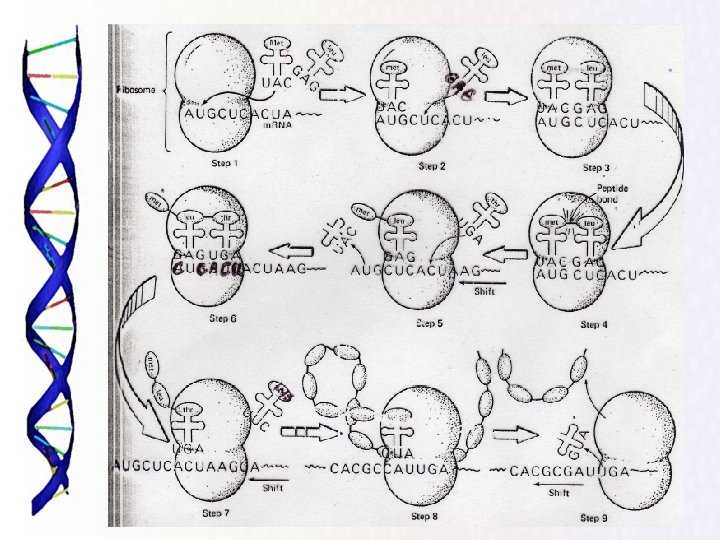
• Translation occurs in steps called: initiation, elongation, and termination • Step 1. Initiation brings together m. RNA, a t. RNA with the first amino acid, and the two ribosomal subunits. – First, a small ribosomal subunit binds with m. RNA and a special initiator t. RNA, which carries methionine and attaches to the start codon. – in all organisms, protein synthesis begins with the codon AUG (codes for methionine) – Initiation factors bring in the large subunit which closes in a way that the initiator t. RNA occupies the P site.
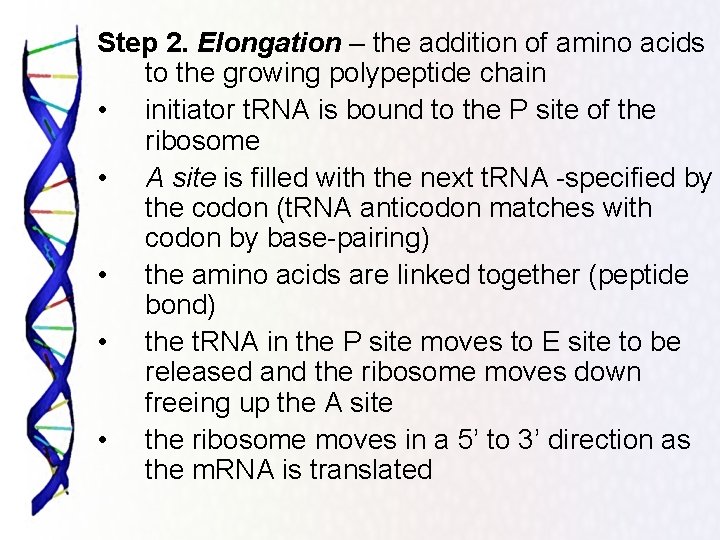
Step 2. Elongation – the addition of amino acids to the growing polypeptide chain • initiator t. RNA is bound to the P site of the ribosome • A site is filled with the next t. RNA -specified by the codon (t. RNA anticodon matches with codon by base-pairing) • the amino acids are linked together (peptide bond) • the t. RNA in the P site moves to E site to be released and the ribosome moves down freeing up the A site • the ribosome moves in a 5’ to 3’ direction as the m. RNA is translated
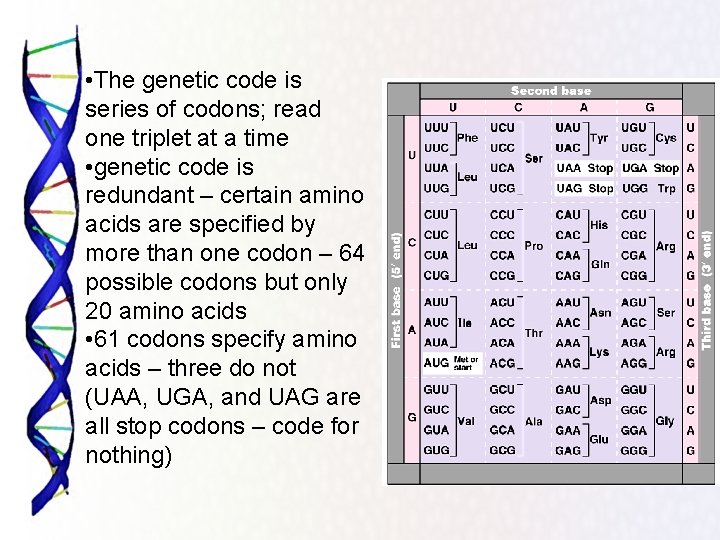
• The genetic code is series of codons; read one triplet at a time • genetic code is redundant – certain amino acids are specified by more than one codon – 64 possible codons but only 20 amino acids • 61 codons specify amino acids – three do not (UAA, UGA, and UAG are all stop codons – code for nothing)
Step 3. Termination – ribosome reaches the termination codon (stop codon) at the end of the sequence – stop codon does not code for an amino acid
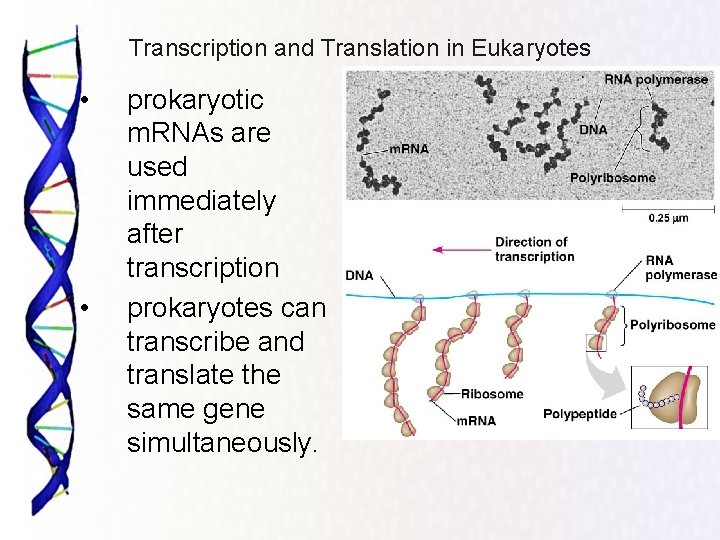
Transcription and Translation in Eukaryotes • • prokaryotic m. RNAs are used immediately after transcription prokaryotes can transcribe and translate the same gene simultaneously.
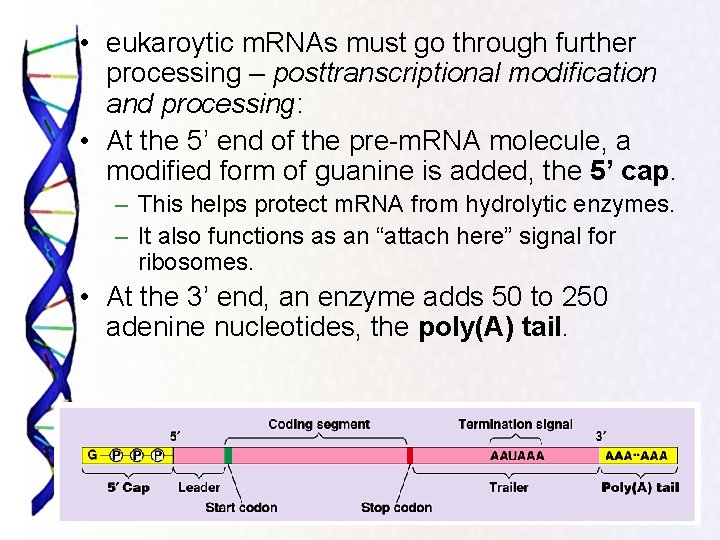
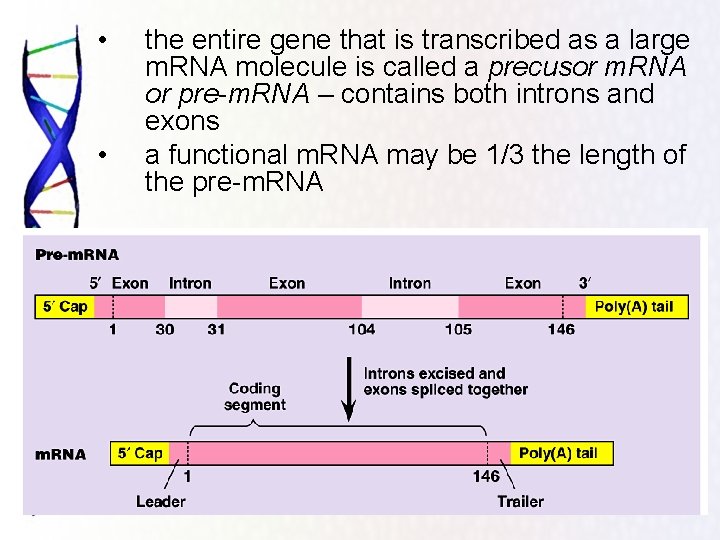
• eukaroytic m. RNAs must go through further processing – posttranscriptional modification and processing: • At the 5’ end of the pre-m. RNA molecule, a modified form of guanine is added, the 5’ cap. – This helps protect m. RNA from hydrolytic enzymes. – It also functions as an “attach here” signal for ribosomes. • At the 3’ end, an enzyme adds 50 to 250 adenine nucleotides, the poly(A) tail.
• • eukaryotic genes have interrupted coding sequences – they contain long sequences of bases within the proteincoding sequences that do not code for amino acids in the final protein noncoding regions within the genes are called introns (intervening sequences) protein-coding sequences are called exons (expressed sequences) a eukaryotic gene may have multiple introns and exons
• • the entire gene that is transcribed as a large m. RNA molecule is called a precusor m. RNA or pre-m. RNA – contains both introns and exons a functional m. RNA may be 1/3 the length of the pre-m. RNA
• • In order for a pre-m. RNA to become a function message, it must be capped, have a poly-A tail added, have the introns removed, and have the exons spliced together excision of introns and splicing of exons catalyzed by sn. RNPs (small nuclear ribonucleoprotein complexes)