
Protein Synthesis Review l What are some functions
- Slides: 12
Protein Synthesis
Review! l What are some functions of proteins? l Enzymes, which speed up chemical reactions l Build and repair cell structures l Determine the structure & function of living organisms
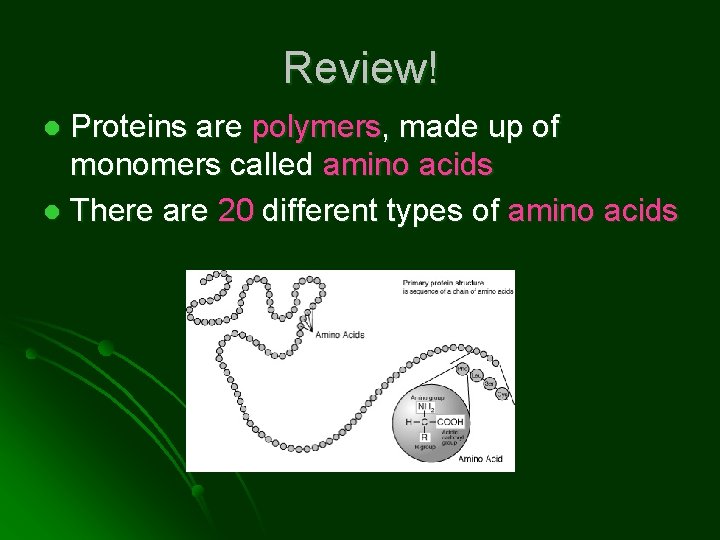
Review! Proteins are polymers, made up of monomers called amino acids l There are 20 different types of amino acids l
Review! What codes for these proteins? l DNA contains the sequence of nucleotides that codes for the synthesis of proteins. l Problem: l l DNA is found in the nucleus. l Proteins are made at the ribosomes, which are found in the cytoplasm
l HOW CAN THE INFORMATION FROM THE NUCLEUS GET TO THE RIBOSOME? l RNA! – m. RNA is used to move information from the DNA to ribosomes l This process is called TRANSCRIPTION.
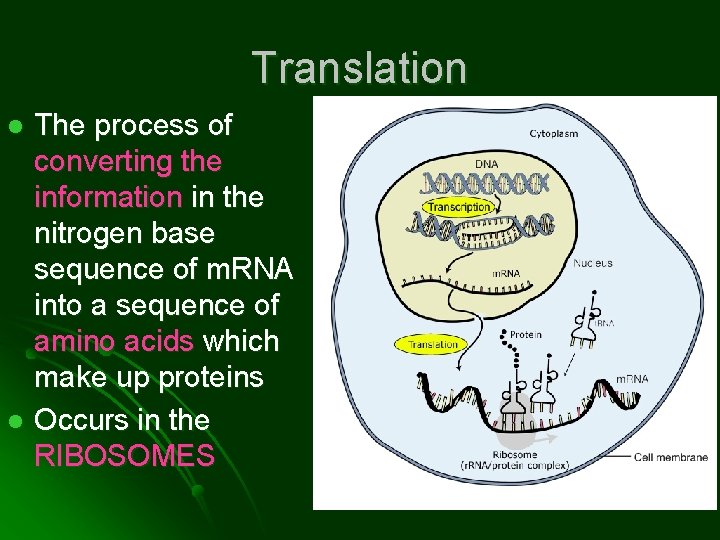
Translation The process of converting the information in the nitrogen base sequence of m. RNA into a sequence of amino acids which make up proteins l Occurs in the RIBOSOMES l
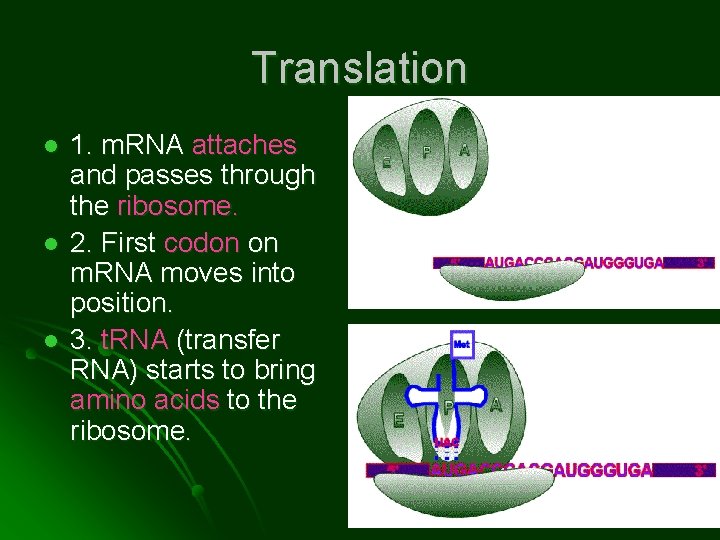
Translation l l l 1. m. RNA attaches and passes through the ribosome. 2. First codon on m. RNA moves into position. 3. t. RNA (transfer RNA) starts to bring amino acids to the ribosome.
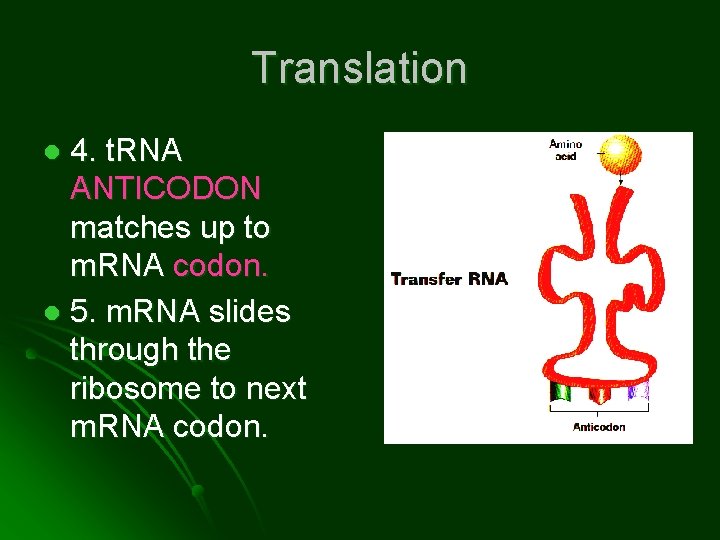
Translation 4. t. RNA ANTICODON matches up to m. RNA codon. l 5. m. RNA slides through the ribosome to next m. RNA codon. l
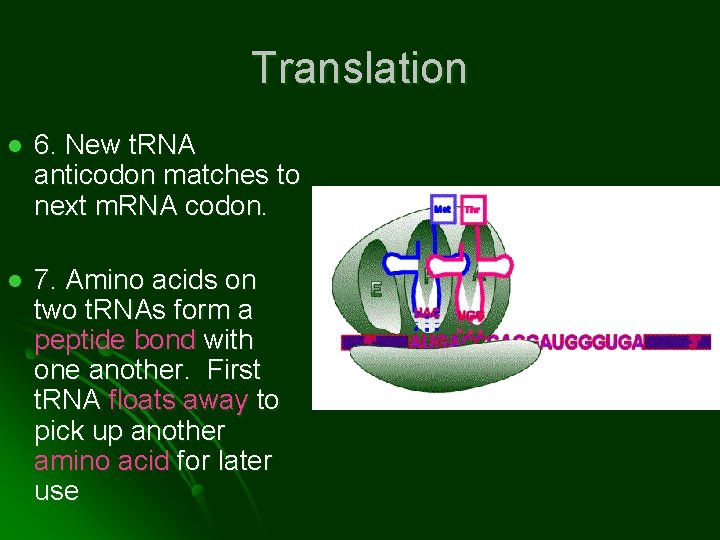
Translation l 6. New t. RNA anticodon matches to next m. RNA codon. l 7. Amino acids on two t. RNAs form a peptide bond with one another. First t. RNA floats away to pick up another amino acid for later use
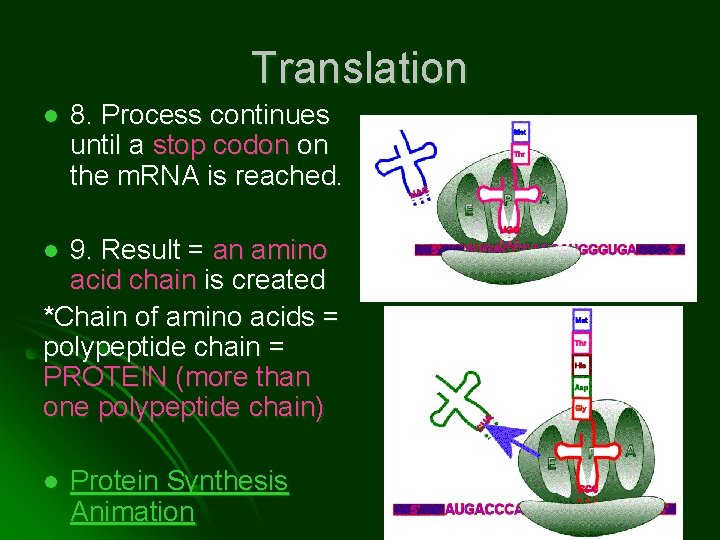
Translation l 8. Process continues until a stop codon on the m. RNA is reached. 9. Result = an amino acid chain is created *Chain of amino acids = polypeptide chain = PROTEIN (more than one polypeptide chain) l l Protein Synthesis Animation
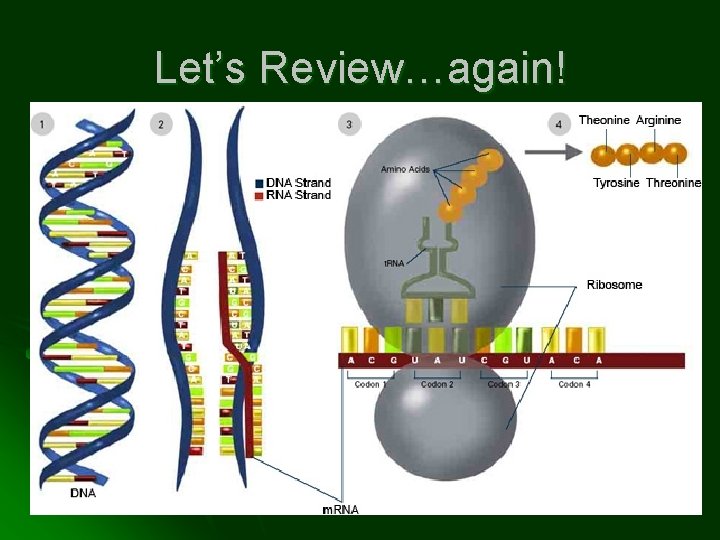
Let’s Review…again!
Decode the following If the coding DNA strand contained the following sequence: TAC CGA TTG ACT l What would the m. RNA strand be? AUG GCU AAC UGA l What would the t. RNA sequence be? UAC CGA UUG ACU l What would the amino acid sequence be? (base it on the m. RNA strand!) methionine, alanine, asparagine, “stop” l