
Protein Synthesis Part 1 Transcription n DNA is





- Slides: 28
Protein Synthesis Part 1: Transcription
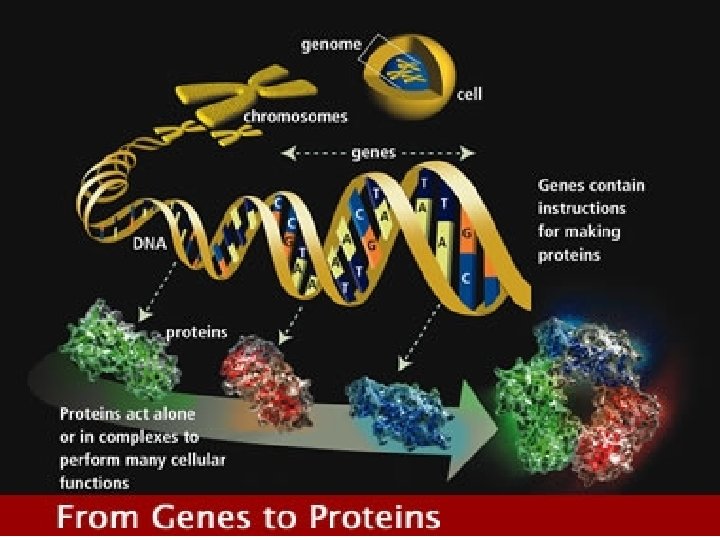
n DNA is like a book of instructions written with the alphabet A, T, G, and C. n Genes are specific sequences of bases that encode instructions on how to make proteins.
Genome n The entire set of genetic information in an organism n Human DNA is 3. 2 billion base pairs long spread among 46 chromosomes
Genomes have DNA sequences that occur with different frequencies n Some DNA sequences only occur ONCE in the entire genome q q Most genes are UNIQUE, single copy DNA sequences Remember, a gene is a section of DNA that codes for a protein Only about 2% of the human genome is genes Human DNA contains about 20, 000 – 25, 000 protein -coding genes
Genomes have DNA sequences that occur with different frequencies n Other DNA sequence are repeated over and over in the genome n These are called HIGHLY REPETATIVE sequences
n 98% of the DNA consists of non-protein coding regions, which may: q q Provide chromosomal structural integrity Regulate where, when, and in what quantity proteins are made. q Provide the code for making RNA q Be left over DNA from viral infections q Be “junk” DNA (DNA that is there, but doing nothing that we know of)
• Although genes get a lot of attention, it’s the proteins that perform most life functions and even make up the majority of cellular structures. • Proteins are large, complex molecules made up of smaller subunits called amino acids.
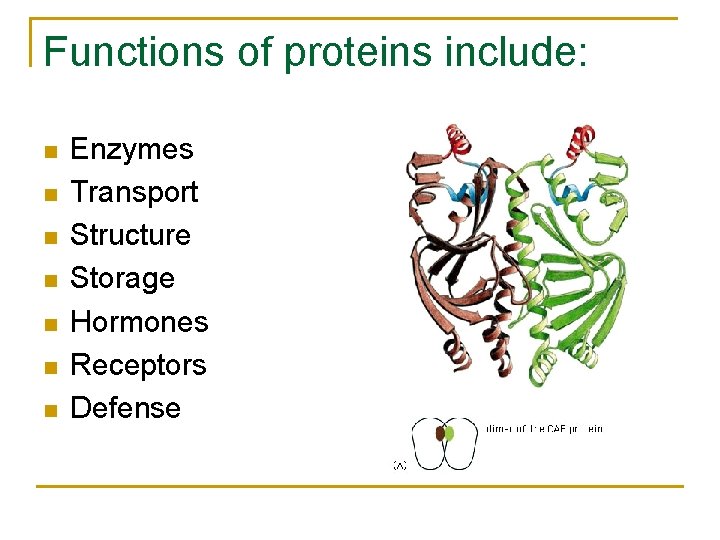
Functions of proteins include: n n n n Enzymes Transport Structure Storage Hormones Receptors Defense
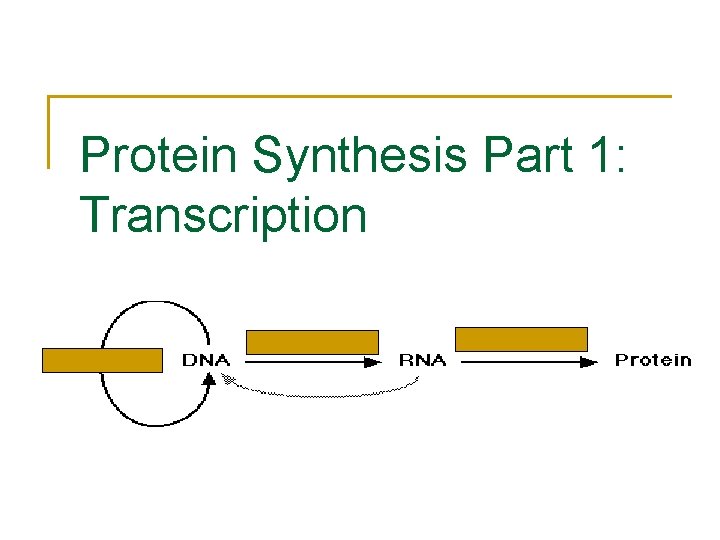
The path from gene to protein has three steps: n In transcription, molecules of RNA are produced from the DNA in the nucleus.
The path from gene to protein has three steps: n During RNA processing, the RNA is modified before leaving the nucleus and non-protein coding regions of the RNA strand are removed
The path from gene to protein has three steps: n In translation, RNA molecules are used as a code for protein assembly at the ribosome.
TODAY WE WILL FOCUS ON TRANSCRIPTION
n n n Overview animation Detailed animation Another animation
Steps in Transcription n Initiation n Elongation n Termination
Initiation n RNA polymerase attaches to the DNA at a sequence called the PROMOTER
Elongation n RNA polymerase synthesizes a new RNA in a 5’ to 3’ direction, anti-parallel to the template DNA strand.
Elongation n Only one region of one DNA strand is used as a template q q The transcribed strand is called the “anti-sense” strand. The non-transcribed strand in the “sense” strand because it has the same sequence (except T) as the new RNA strand.
Elongation n RNA polymerase adds nucleoside triphosphates (ATP, CTP, GTP and UTP) that pair with the exposed bases on one strand of the open DNA segment. O
Elongation n The energy necessary for the synthesis is provided by the breaking of the bond between the first and second phosphate in the triphosphates O
Termination n Transcription of the DNA continues until the RNA polymerase reaches a transcription terminator signal on the DNA, which dislodges the growing RNA strand releases the polymerase.
Termination n Once the RNA for a particular region has been made, the double helix quickly reforms, displacing the growing single strand of RNA. n Many RNA molecules can be transcribed from the same gene simultaneously.
RNA differs from DNA in some ways: n RNA is single stranded, DNA is double stranded q Although, RNA can base pair with itself
RNA differs from DNA in some ways: n RNA has ribose sugar, not deoxyribose sugar
RNA differs from DNA in some ways: n RNA bases are A, G, C and U (uracil), no T q Uracil is a pyrimidine and forms two hydrogen bonds with adenine
Classes of RNA n Ribosomal RNA (r. RNA) q q The configuration is unknown but they are very large and contain thousands of nucleotides. Inside the nucleolus, combines with special proteins to make ribosomes
Classes of RNA n Messenger RNA (m. RNA) q q q Moves into cytoplasm where is becomes associated with ribosomes and starts protein synthesis. Usually 75 -300 nucleotides in length Not folded
Classes of RNA n Transfer RNA (t. RNA) q q 75 -90 nucleotides in length All cells have at least 20 different kinds (for carrying the 20 different amino acids). The single strand folds back and base pairs with itself creating an “L” shaped double helix type of 3 D structure (Flattened out it looks like a ‘t’). They bring amino acids to the ribosome.