
Protein Synthesis Notes The Big Picture All cells
Protein Synthesis
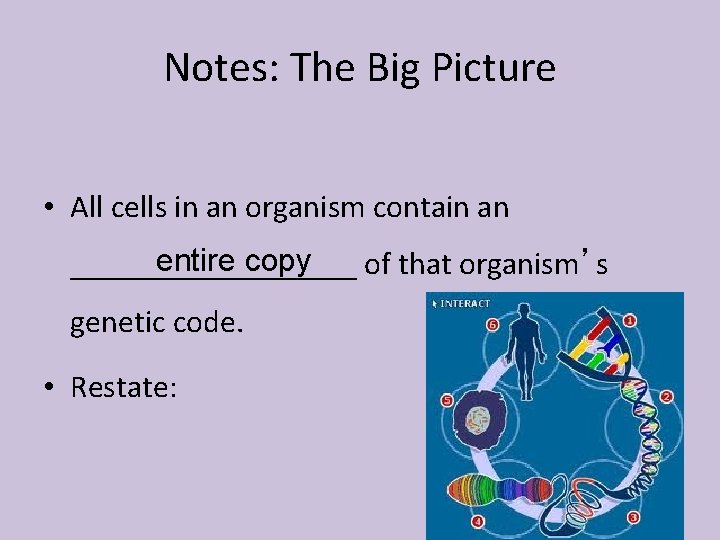
Notes: The Big Picture • All cells in an organism contain an entire copy _________ of that organism’s genetic code. • Restate:
• How do all the cells of an organisms contain the same DNA? (Hint: What process? ) Mitosis
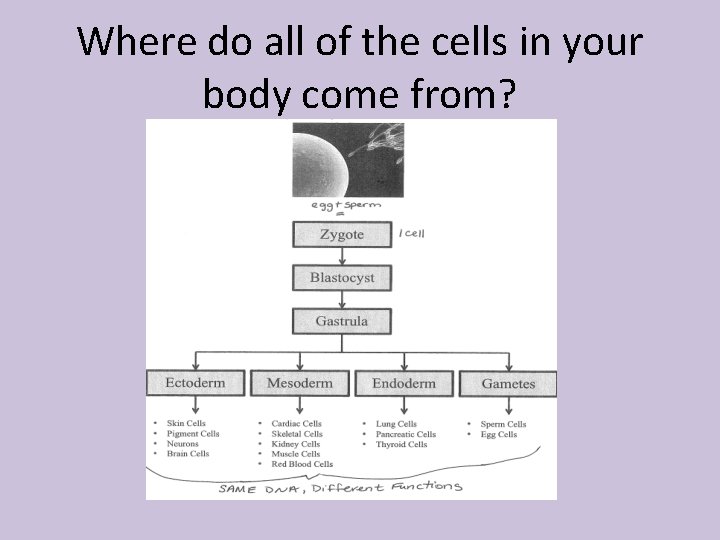
Where do all of the cells in your body come from?
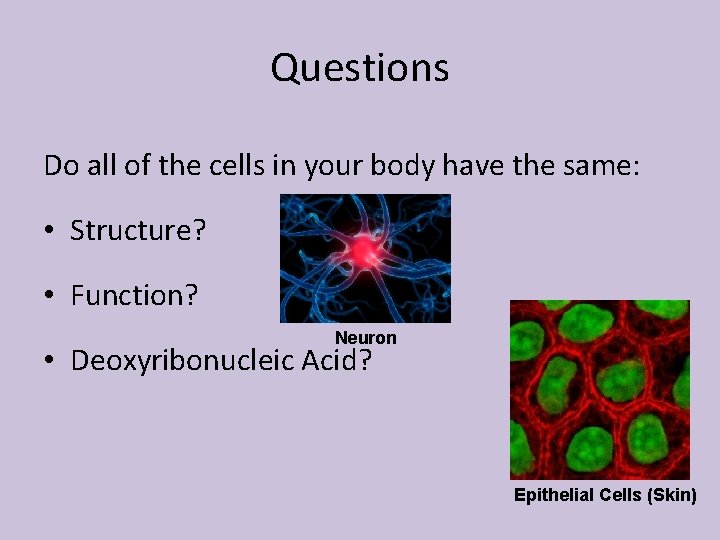
Questions Do all of the cells in your body have the same: • Structure? • Function? Neuron • Deoxyribonucleic Acid? Epithelial Cells (Skin)
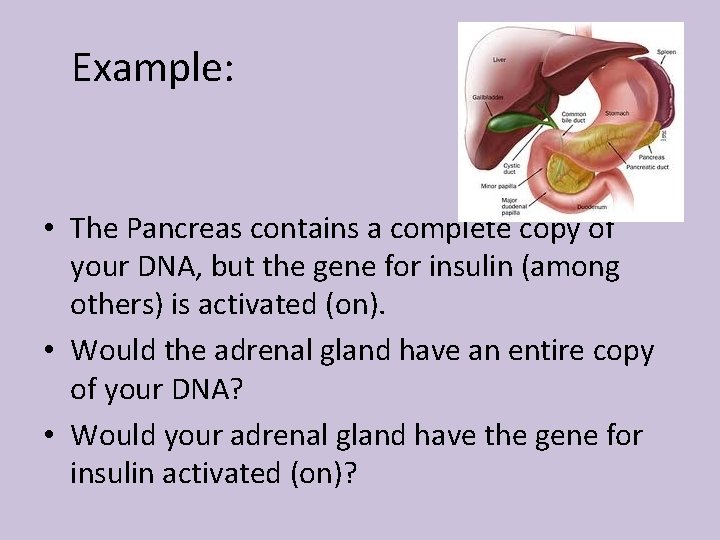
Example: • The Pancreas contains a complete copy of your DNA, but the gene for insulin (among others) is activated (on). • Would the adrenal gland have an entire copy of your DNA? • Would your adrenal gland have the gene for insulin activated (on)?
Notes: The Big Picture • How do specialized cells know which part of the genetic code they are responsible for? • Specialized cells have different genes expressed (turned on). Those genes allow specific proteins to be synthesized, which aides their function. • This process is CALLED: Cell Differentiation
HOW do genes become activated? Any ideas?
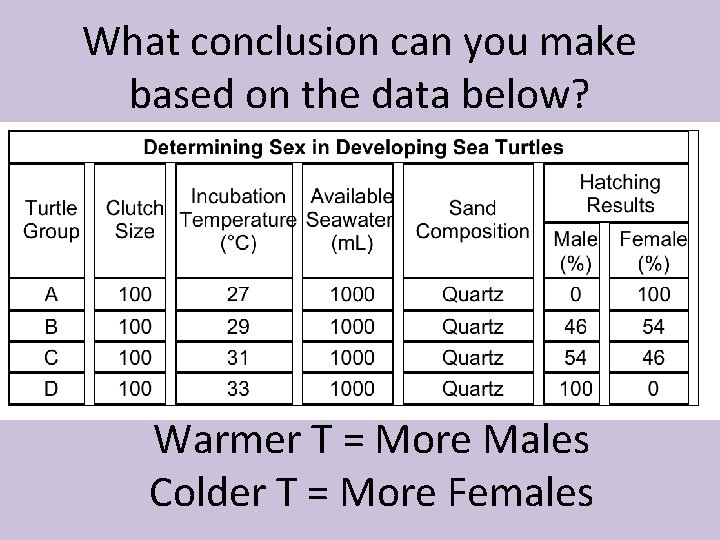
What conclusion can you make based on the data below? Warmer T = More Males Colder T = More Females
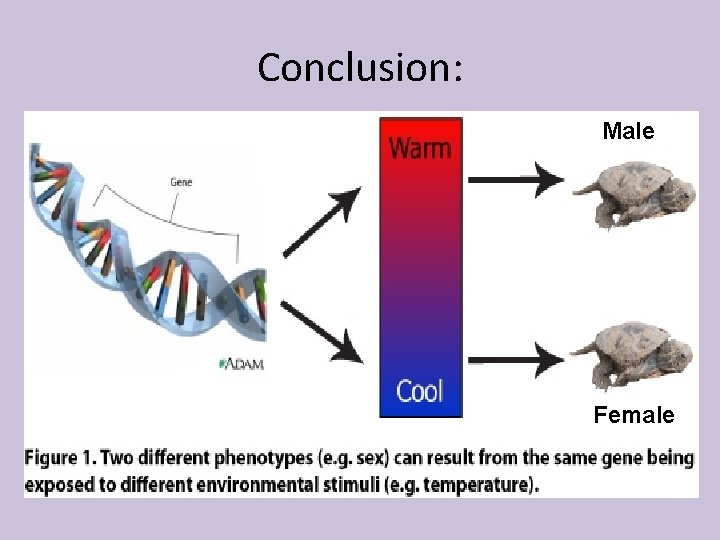
Conclusion: Male Female
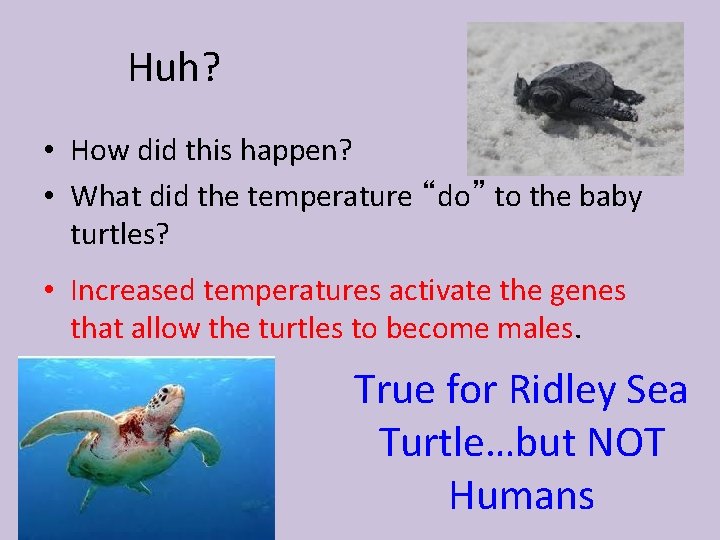
Huh? • How did this happen? • What did the temperature “do” to the baby turtles? • Increased temperatures activate the genes that allow the turtles to become males. True for Ridley Sea Turtle…but NOT Humans
Notes: The Big Picture • How can genes be activated? • Environmental Factors – Temperature – Smoking/pollutants – Light • Chemicals – Oxygen – Drugs
Summary • Use the terms cell differentiation, genetic code, and expressed to summarize today’s lesson. • Cell differentiation allows the genetic code to have certain parts expressed.
Protein Synthesis Unit Learning Targets • The point is to understand how cells use DNA to create traits. • By the end of this unit you will describe how DNA codes for traits, the steps of protein synthesis, & how environmental and chemical factors affect gene expression in organisms.
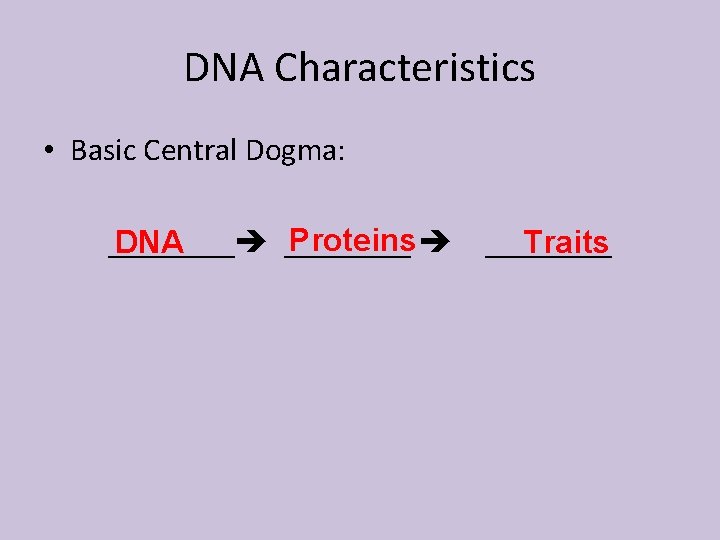
DNA Characteristics • Basic Central Dogma: Proteins ________ DNA ____ Traits
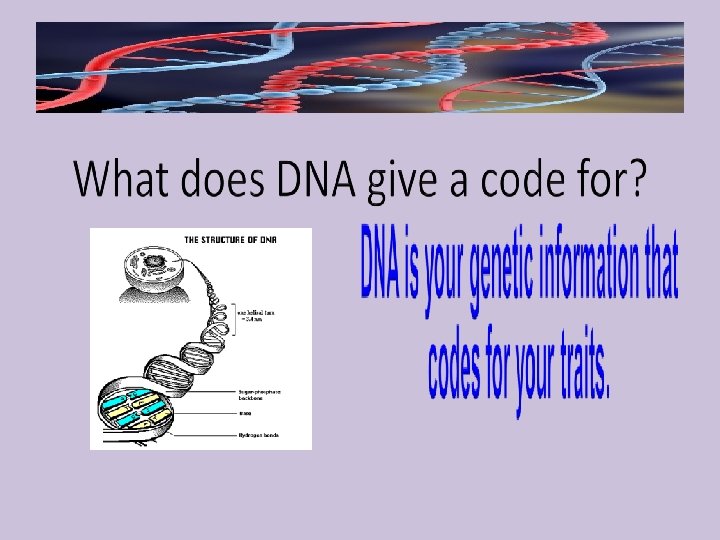
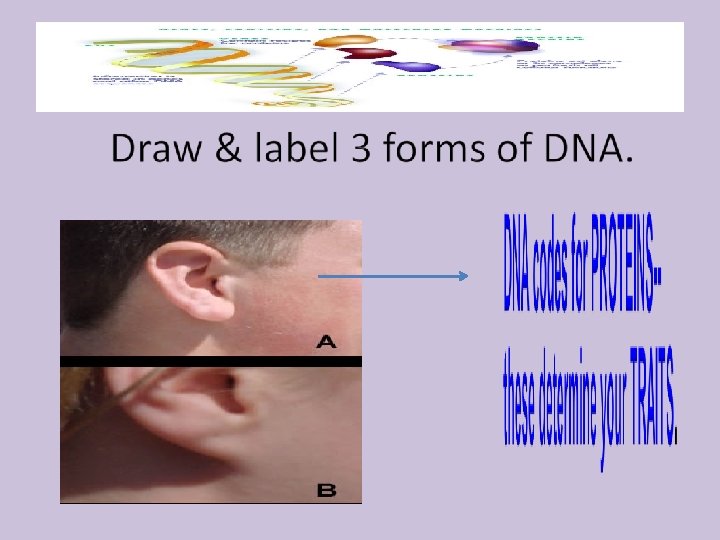
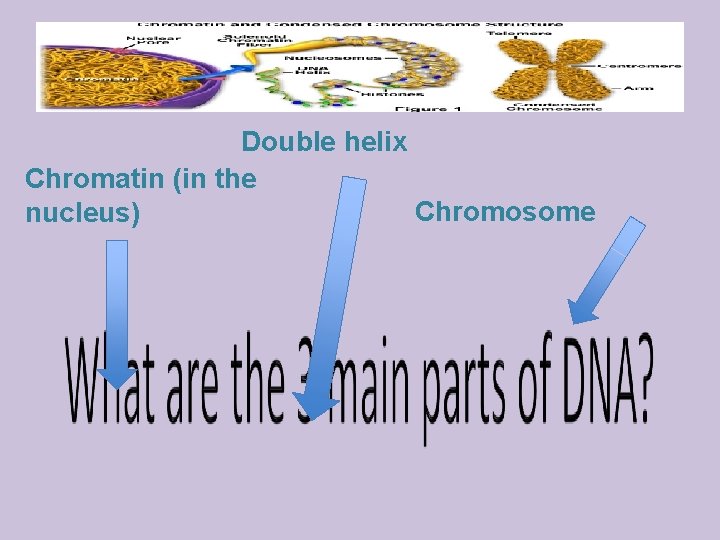
Double helix Chromatin (in the Chromosome nucleus)
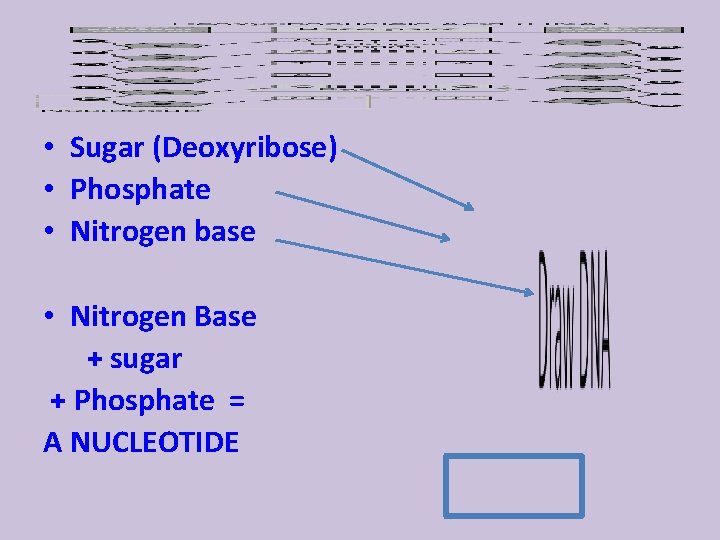
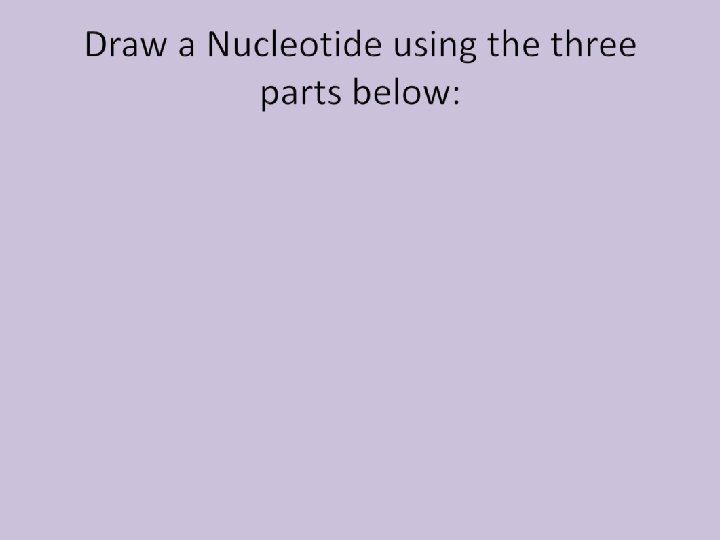
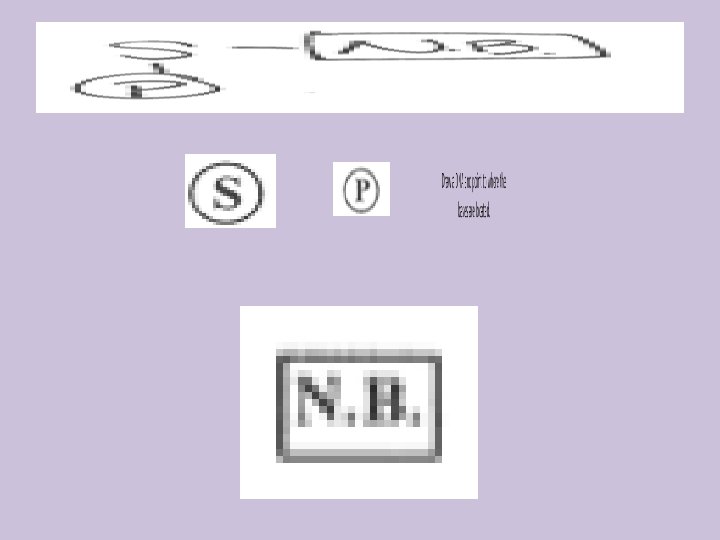
• Sugar (Deoxyribose) • Phosphate • Nitrogen base • Nitrogen Base + sugar + Phosphate = A NUCLEOTIDE
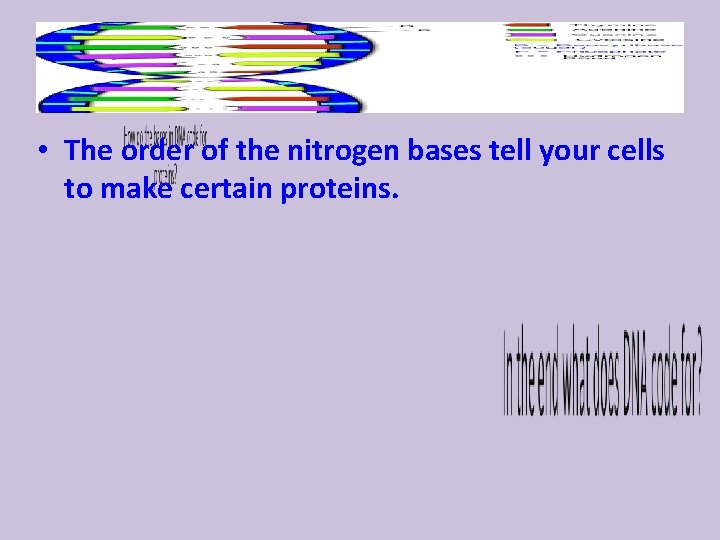
• The order of the nitrogen bases tell your cells to make certain proteins.
• DNA codes for PROTEINS. • DNA Proteins
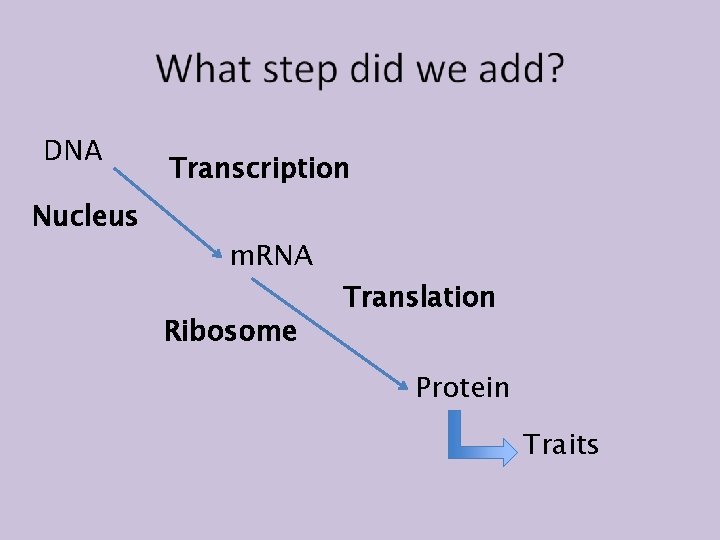
DNA Nucleus Transcription m. RNA Ribosome Translation Protein Traits
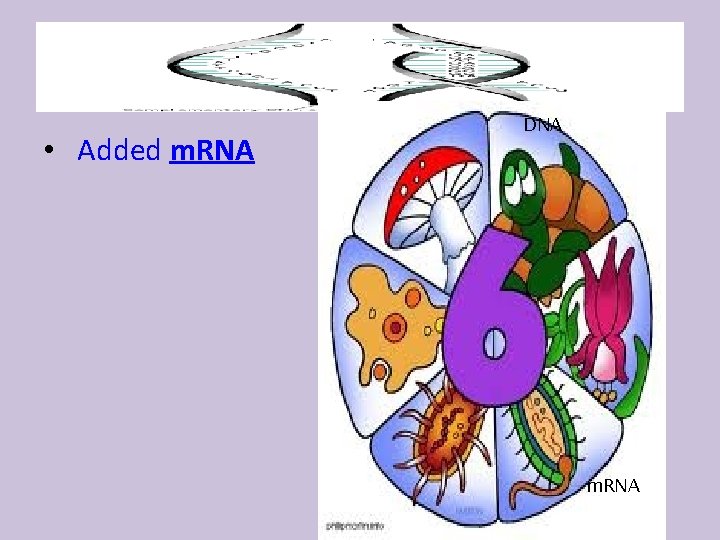
• Added m. RNA DNA m. RNA
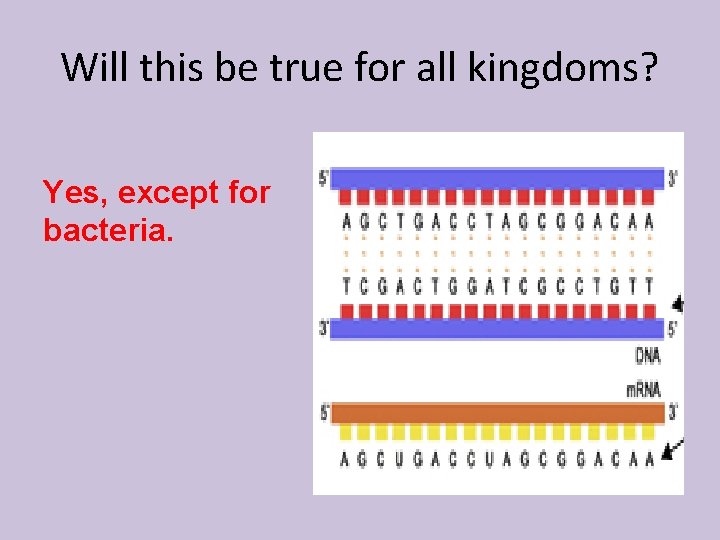
Will this be true for all kingdoms? Yes, except for bacteria.
Protein Synthesis
Compare/ Contrast DNA & m. RNA.
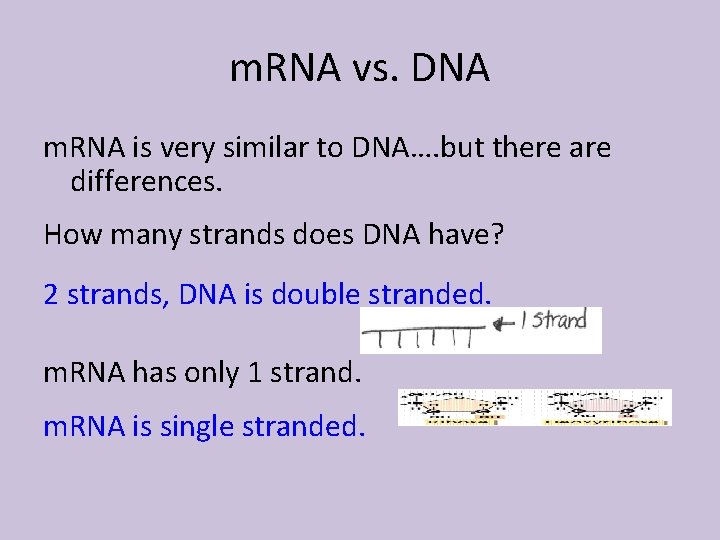
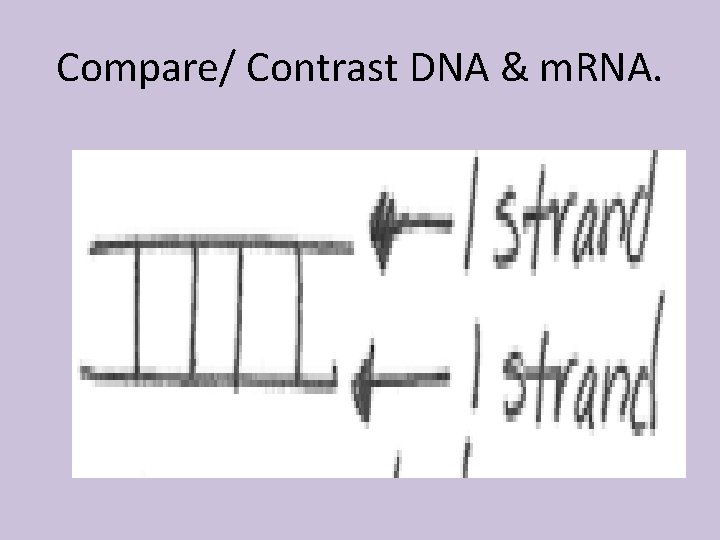
m. RNA vs. DNA m. RNA is very similar to DNA…. but there are differences. How many strands does DNA have? 2 strands, DNA is double stranded. m. RNA has only 1 strand. m. RNA is single stranded.
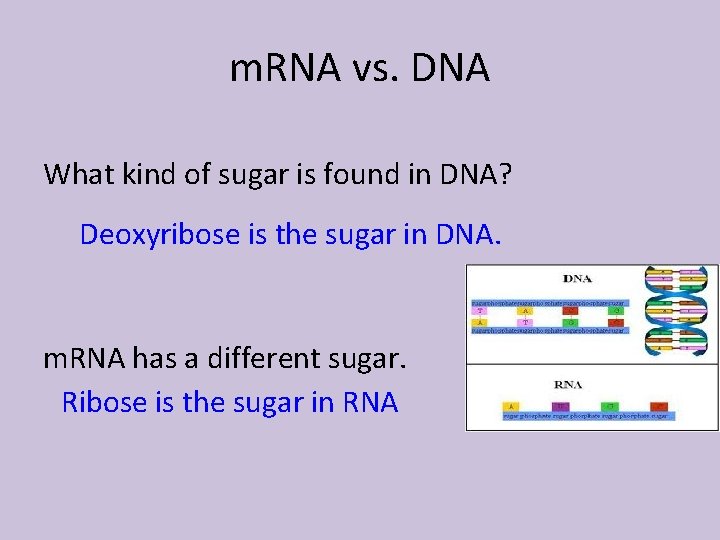
m. RNA vs. DNA What kind of sugar is found in DNA? Deoxyribose is the sugar in DNA. m. RNA has a different sugar. Ribose is the sugar in RNA
m. RNA vs. DNA What are the 4 nitorgen bases in DNA? A- Adenine G- Guanine C- Cytosine T- Thymine What do each pair up with? A—T G—C
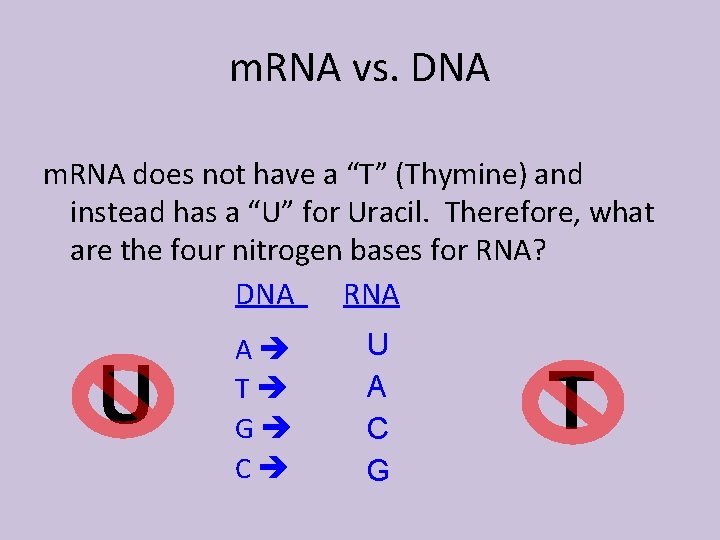
m. RNA vs. DNA m. RNA does not have a “T” (Thymine) and instead has a “U” for Uracil. Therefore, what are the four nitrogen bases for RNA? DNA RNA U A T G C U A C G T
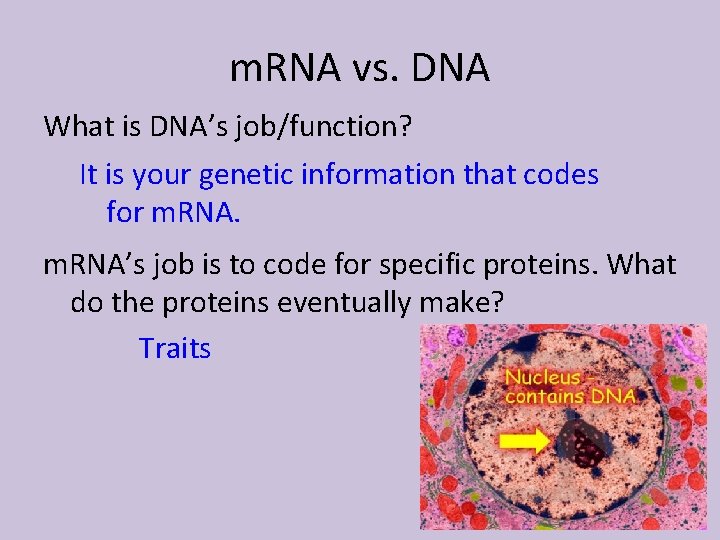
m. RNA vs. DNA What is DNA’s job/function? It is your genetic information that codes for m. RNA’s job is to code for specific proteins. What do the proteins eventually make? Traits
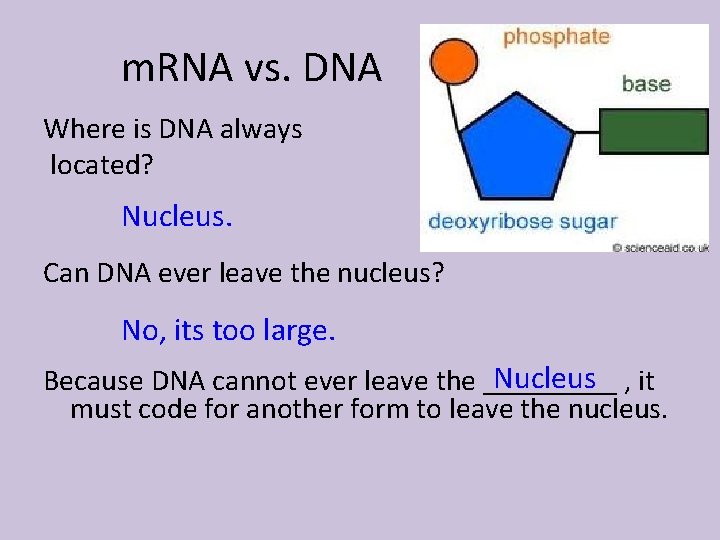
m. RNA vs. DNA Where is DNA always located? Nucleus. Can DNA ever leave the nucleus? No, its too large. Nucleus , it Because DNA cannot ever leave the _____ must code for another form to leave the nucleus.
Compare DNA & RNA • Similarities: They both have nucleotides.
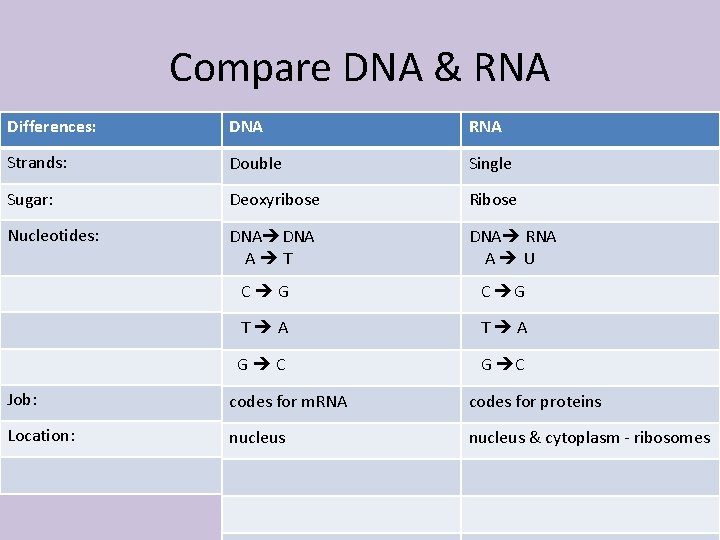
Compare DNA & RNA Differences: DNA RNA Strands: Double Single Sugar: Deoxyribose Ribose Nucleotides: DNA A T DNA RNA A U C G T A G C Job: codes for m. RNA codes for proteins Location: nucleus & cytoplasm - ribosomes
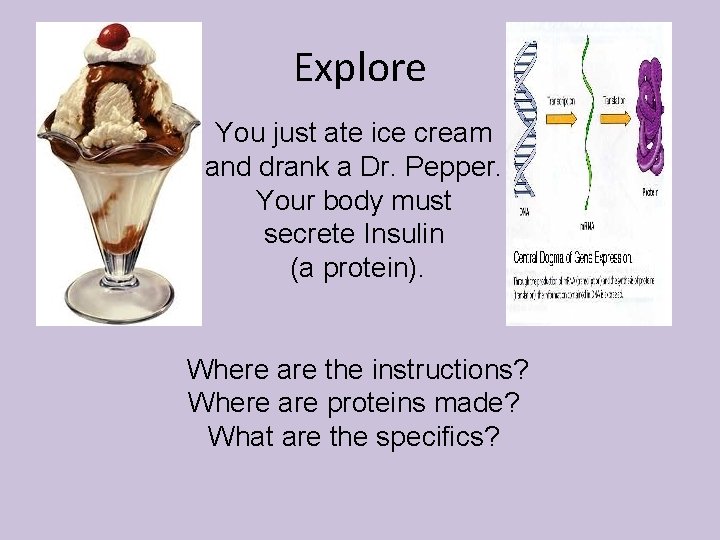
Explore You just ate ice cream and drank a Dr. Pepper. Your body must secrete Insulin (a protein). Where are the instructions? Where are proteins made? What are the specifics?
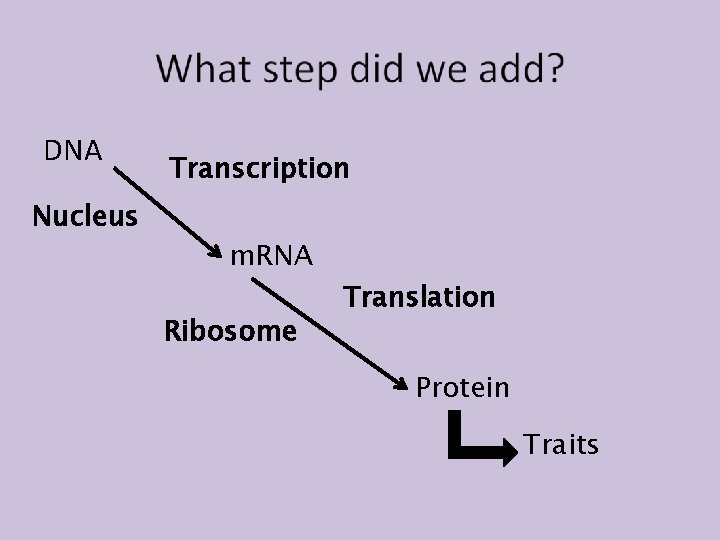
DNA Nucleus Transcription m. RNA Ribosome Translation Protein Traits
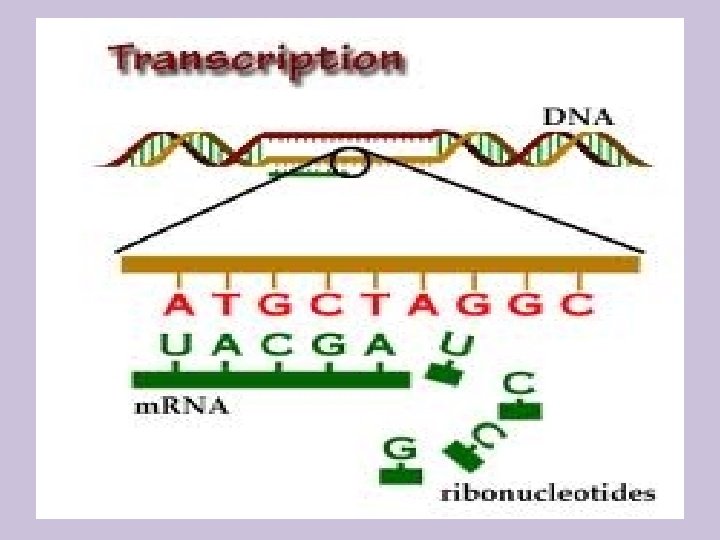
Transcription= The process of making m. RNA from DNA. Is transcription happening in every gene every second? Yes If DNA cannot leave the nucleus, then where must transcription occur? In the nucleus. ***m. RNA is the blueprint for converting the message of DNA into proteins.
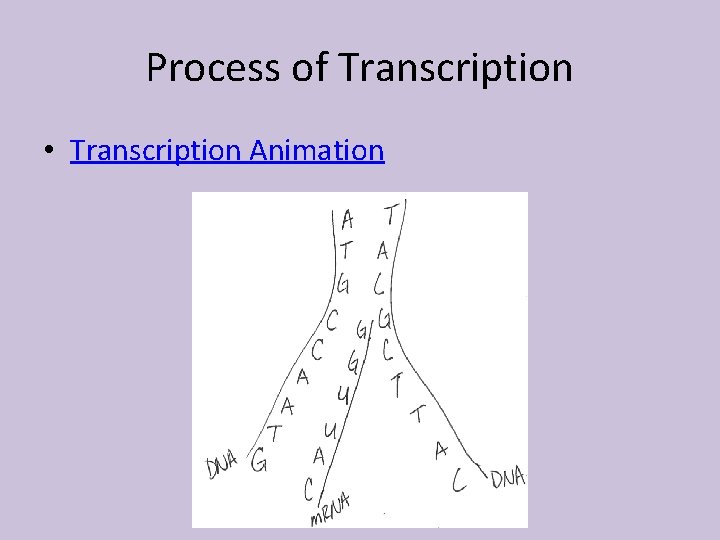
Process of Transcription • Transcription Animation
Draw Transcription
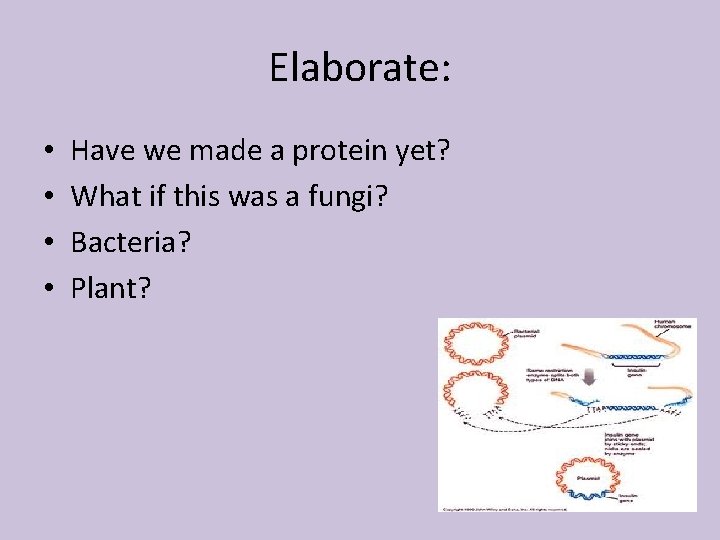
Elaborate: • • Have we made a protein yet? What if this was a fungi? Bacteria? Plant?
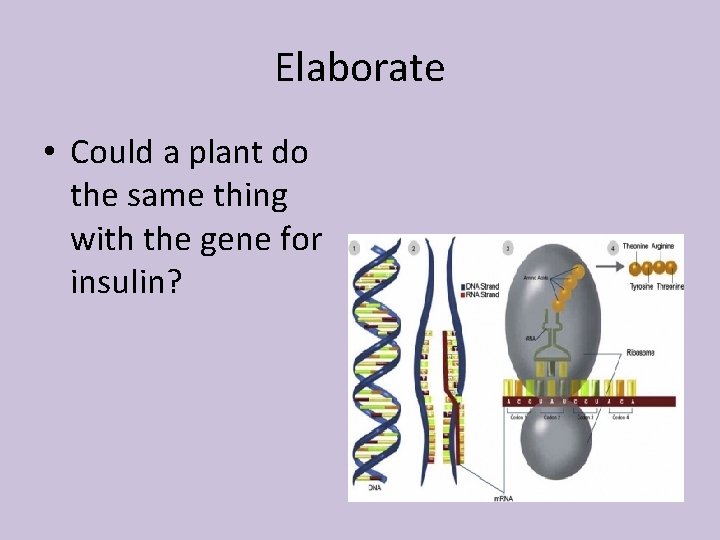
Elaborate • Predict what would happen if the gene for insulin was added to a bacterial cell.

Skip Page 10 • We will come back to this page tomorrow

Complete Venn Diagram DNA vs. RNA • Double strand • Thymine • Adenine • Nucleus • Guanine • Strores genetic • Cytosine info • Double helix shape • Comprised of • Goes through Nucleotides Replication • Deoxyribose sugar • Single strand • Uracil • Cytoplasm • Made of 3 base units = codons • Ribose sugar
Translation Each codon codes for a specific amino acid. A codon chart is used to easily determine the amino acid that each codon codes for. Practice: Which amino acid do each of these codons code for? UUA CCC AGA GAC
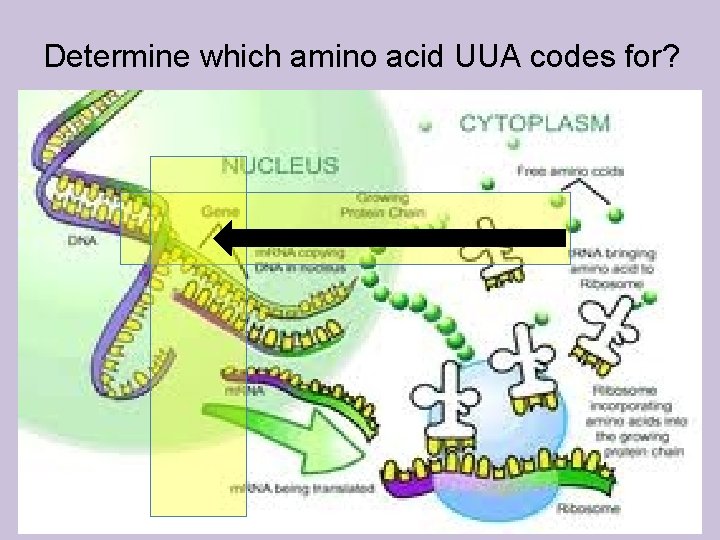
Determine which amino acid UUA codes for?
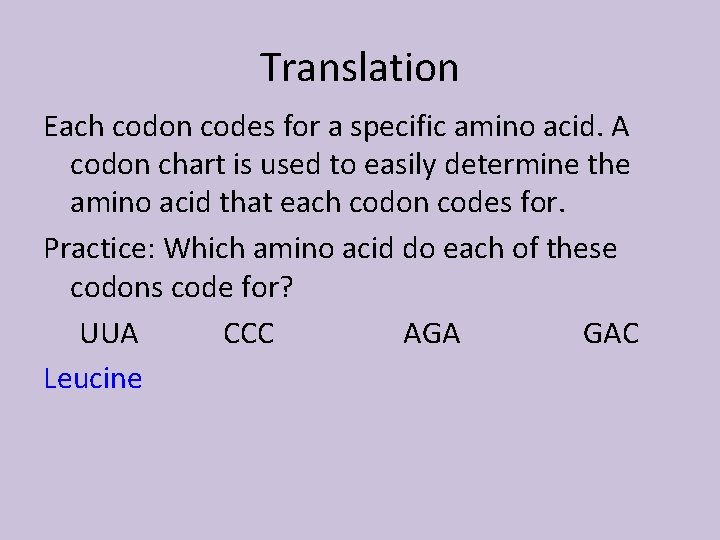
Translation Each codon codes for a specific amino acid. A codon chart is used to easily determine the amino acid that each codon codes for. Practice: Which amino acid do each of these codons code for? UUA CCC AGA GAC Leucine
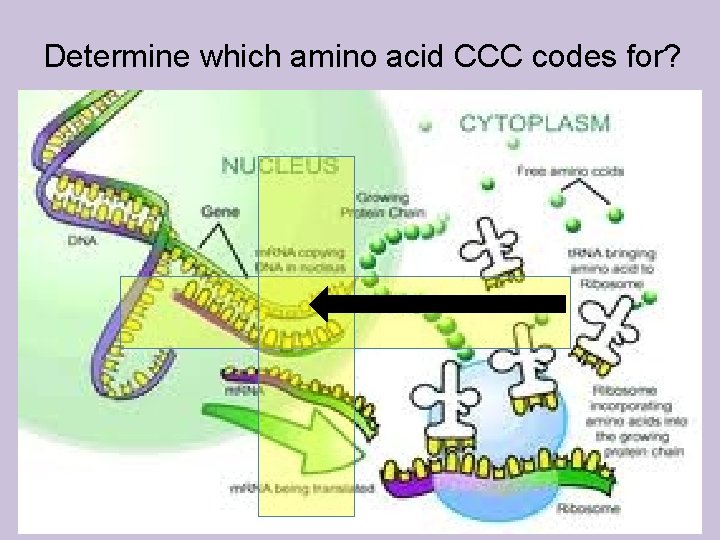
Determine which amino acid CCC codes for?
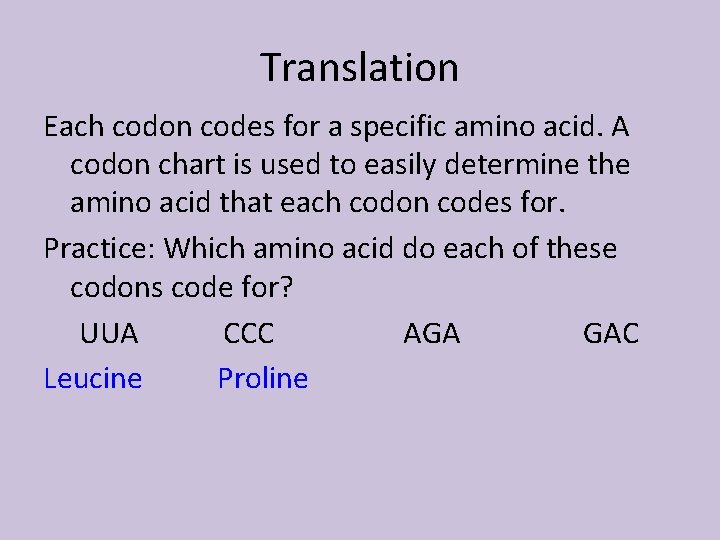
Translation Each codon codes for a specific amino acid. A codon chart is used to easily determine the amino acid that each codon codes for. Practice: Which amino acid do each of these codons code for? UUA CCC AGA GAC Leucine Proline
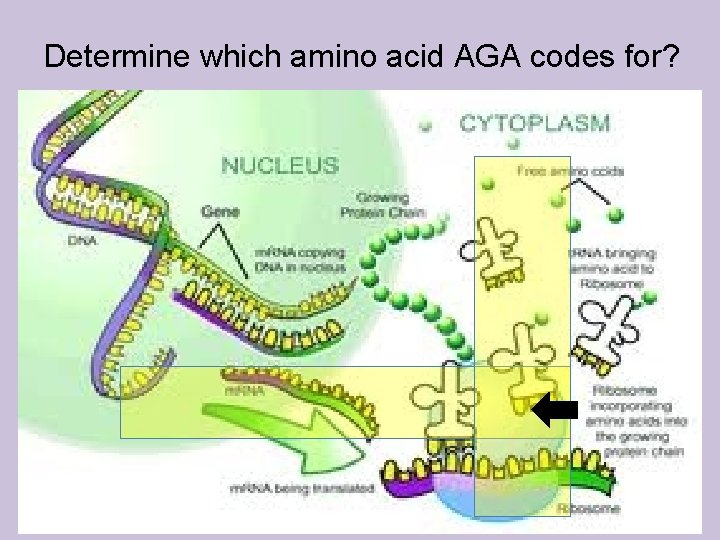
Determine which amino acid AGA codes for?
Translation Each codon codes for a specific amino acid. A codon chart is used to easily determine the amino acid that each codon codes for. Practice: Which amino acid do each of these codons code for? UUA CCC AGA GAC Leucine Proline Arginine
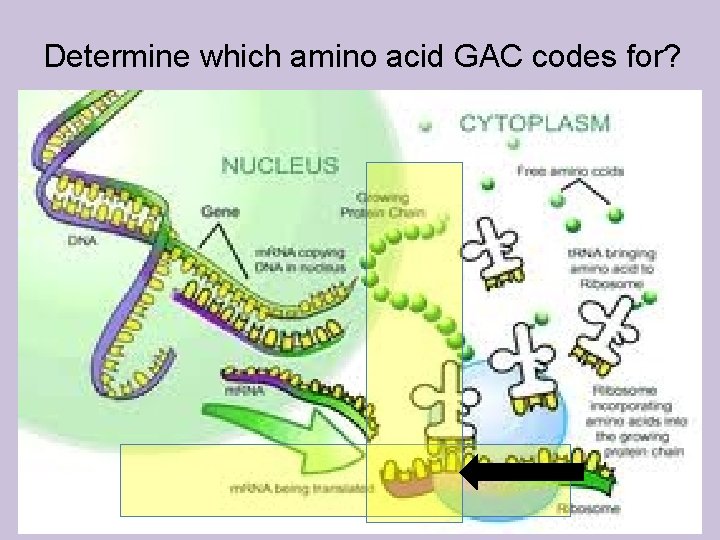
Determine which amino acid GAC codes for?
Translation Each codon codes for a specific amino acid. A codon chart is used to easily determine the amino acid that each codon codes for. Practice: Which amino acid do each of these codons code for? UUA CCC AGA GAC Leucine Proline Arginine Aspartic Acid
Translation Notice: multiple codons code for the same amino acid. Practice: Which two codons code for histidine? CAU & CAC
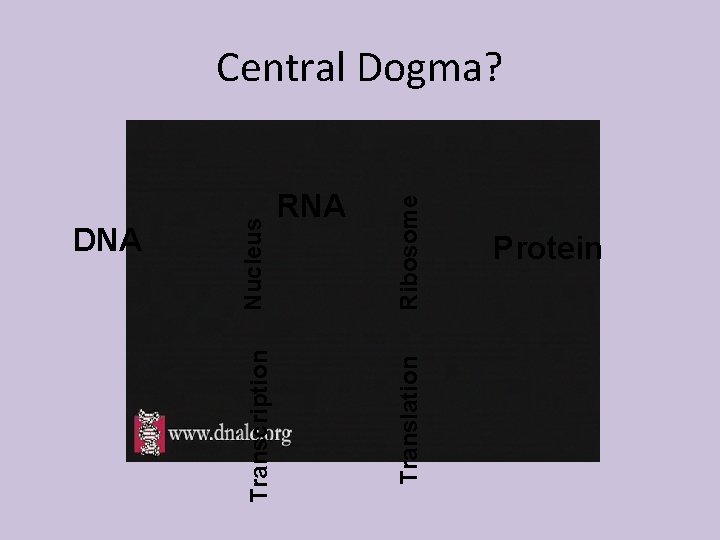
Ribosome RNA Translation Nucleus DNA Transcription Central Dogma? Protein
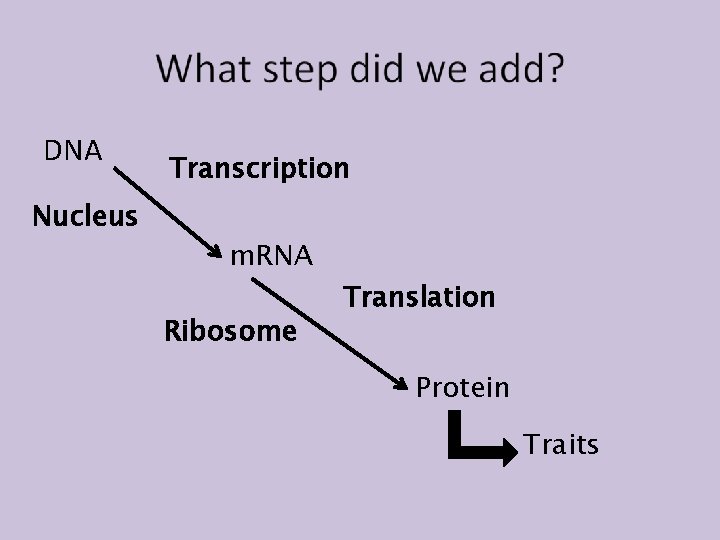
DNA Nucleus Transcription m. RNA Ribosome Translation Protein Traits
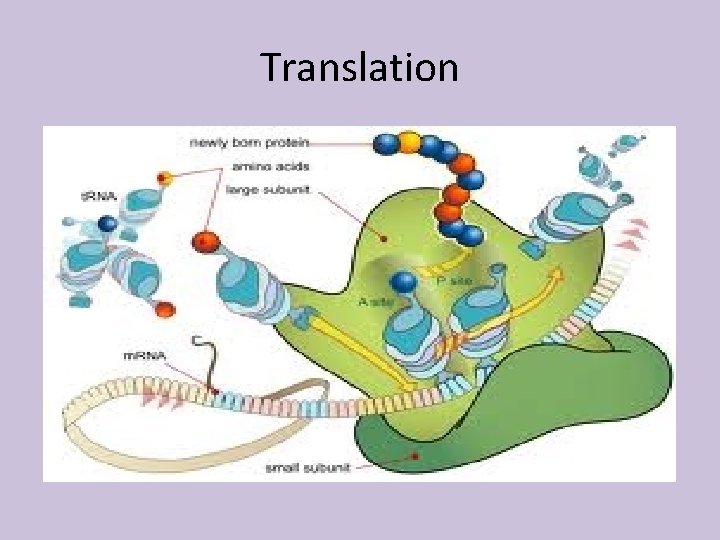
Translation
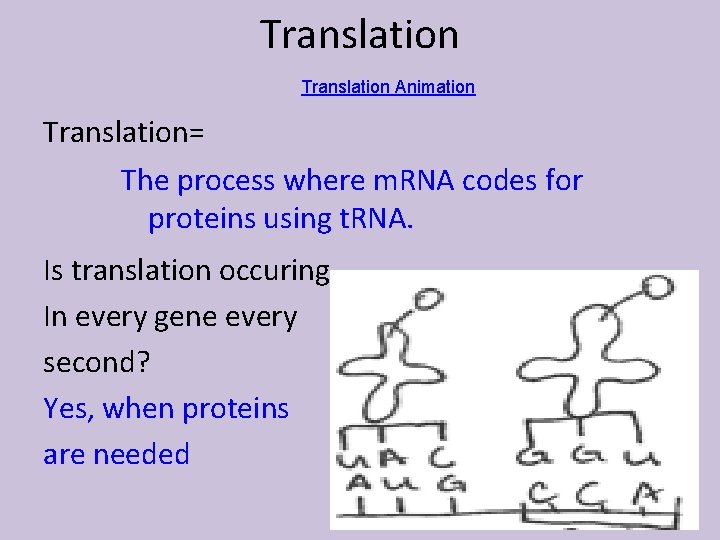
Translation Animation Translation= The process where m. RNA codes for proteins using t. RNA. Is translation occuring In every gene every second? Yes, when proteins are needed
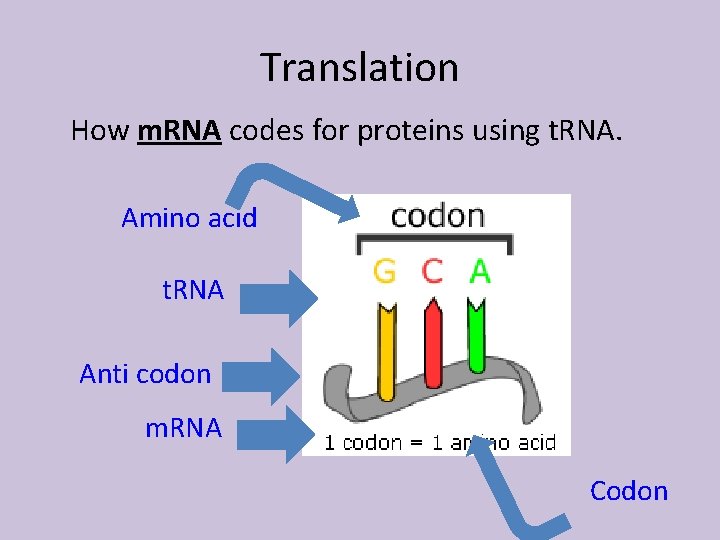
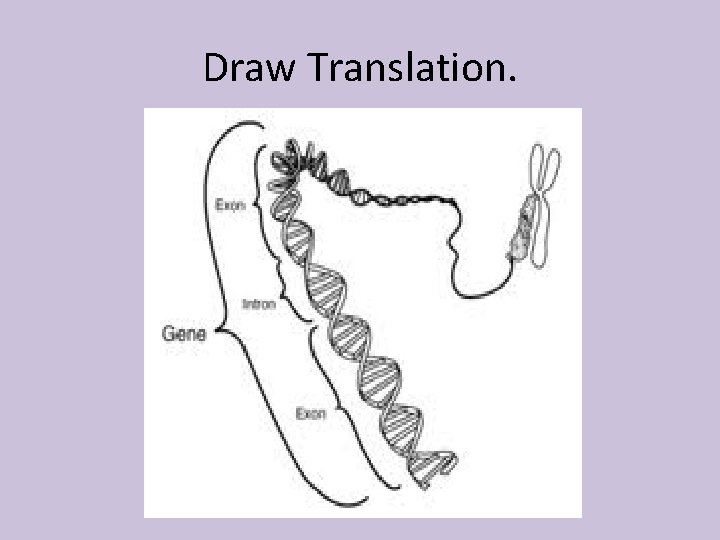
Translation How m. RNA codes for proteins using t. RNA. Amino acid t. RNA Anti codon m. RNA Codon
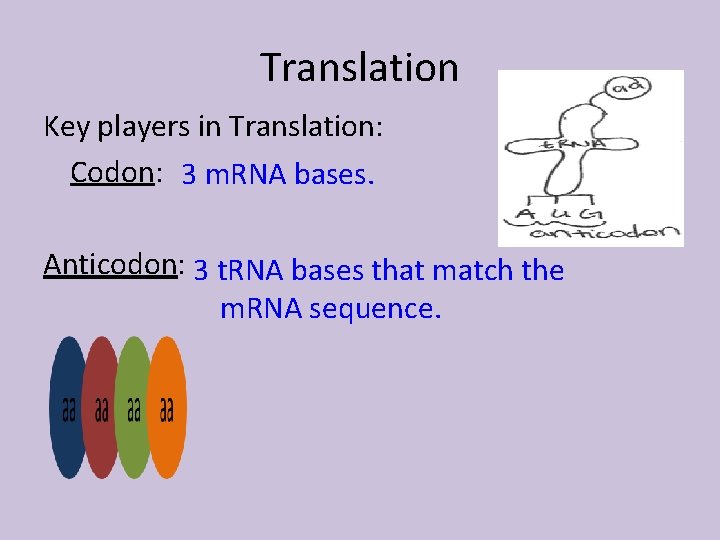
Translation Key players in Translation: Codon: 3 m. RNA bases. Anticodon: 3 t. RNA bases that match the m. RNA sequence.
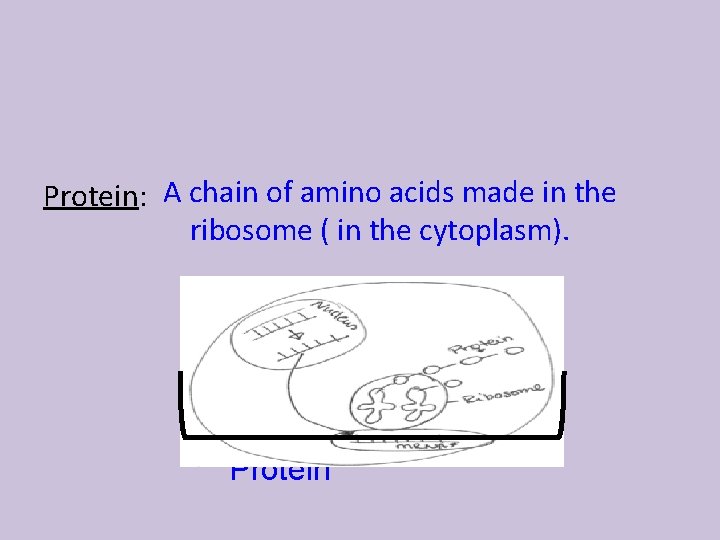
Protein: A chain of amino acids made in the ribosome ( in the cytoplasm). Protein
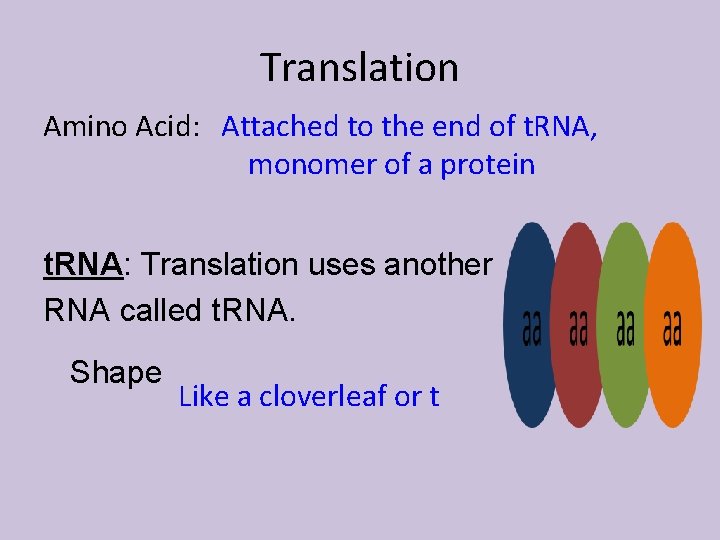
Translation Amino Acid: Attached to the end of t. RNA, monomer of a protein t. RNA: Translation uses another RNA called t. RNA. Shape Like a cloverleaf or t
Draw Translation.
Elaborate: • • Have we made a protein yet? What if this was a fungi? Bacteria? Plant?
Elaborate • Could a plant do the same thing with the gene for insulin?
Protein Synthesis
Central Dogma?
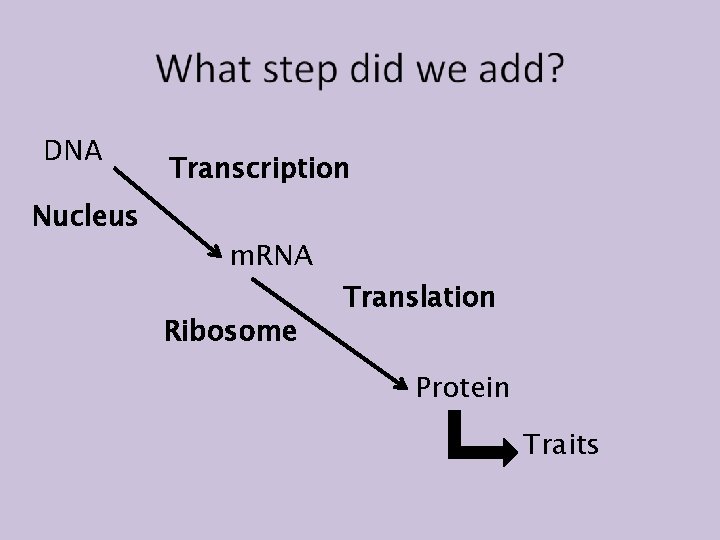
DNA Nucleus Transcription m. RNA Ribosome Translation Protein Traits
Can any step in the process of protein synthesis be regulated? Yes What is the result if any step in the process does not occur correctly? The protein might be incorrect which will affect the trait.
Mutation What is a mutation? A change in DNA. NOVA Video: ONE WRONG LETTER, Watch part 3. Mutation during replication: What happens during replication? DNA copies itself. Sometimes DNA copies itself incorrectly; then m. RNA is made & it is incorrect.
Mutations There are 3 types of mutations: 1. Substitution: Question: If a codon ACA changes to AUA will the codon change? Yes. Question: If a codon ACA changes to Yes. AUA will the amino acid change?
Mutations 1. Substitution: (Continued) Question: If a codon ACA changes to NO. ACU will the amino acid change? Question: If a codon ACA changes to ACU what will happen to the proteins? Nothing will happen to the protein because the codons code for the same amino acid.
Mutations 1. Substitution: (Continued) Will a change in m. RNA change the Yes. codon? Will a change in m. RNA always change the amino acid? NO, not always. Will a change in amino acid change the protein? Yes.
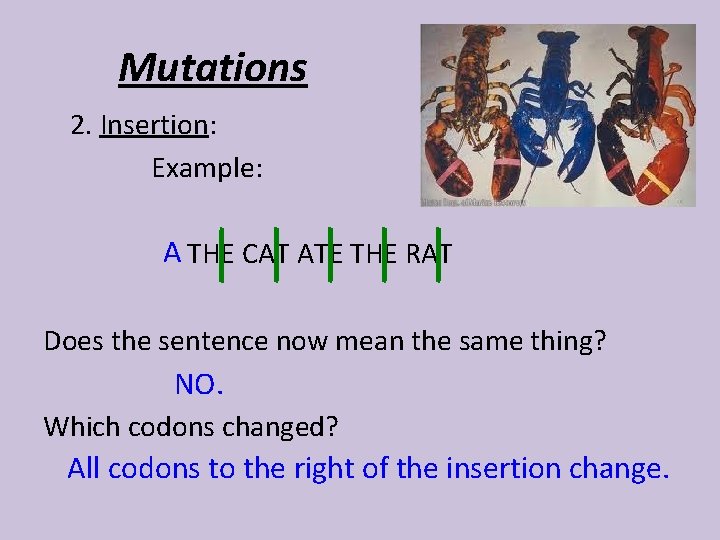
Mutations 2. Insertion: Example: A THE CAT ATE THE RAT Does the sentence now mean the same thing? NO. Which codons changed? All codons to the right of the insertion change.
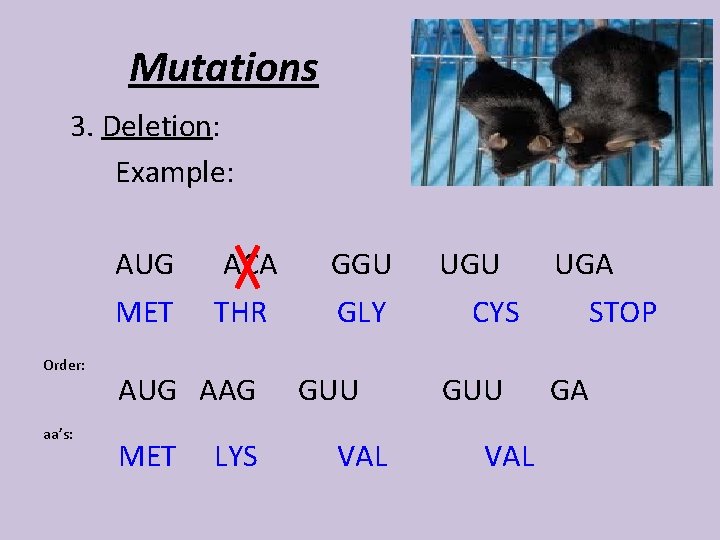
Mutations 3. Deletion: Example: AUG MET Order: aa’s: ACA THR AUG AAG MET LYS GGU GLY GUU VAL UGU CYS UGA STOP GUU GA VAL
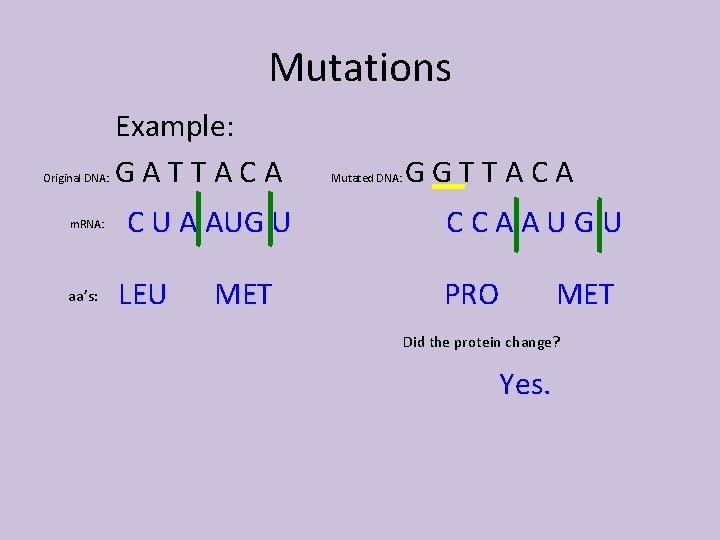
Mutations Original DNA: m. RNA: aa’s: Example: GATTACA Mutated DNA: GGTTACA C U A AUG U CCAAUGU LEU PRO MET Did the protein change? Yes.
- Slides: 80