
Protein Synthesis Important Terms Genesegment of DNA DNAblueprint
Protein Synthesis
Important Terms: �Gene-segment of DNA �DNA-blueprint for protein synthesis; information is “encoded”; 3 letters = 1 amino acid �Protein-manufactures in the ribosome and major building material for cells
3 Types of RNA: �Transfer RNA (t. RNA)-small, cloverleaf-shaped; recognizes m RNA codon in translation �Ribosomal RNA (r. RNA)-helps form ribosomes �Messenger RNA (m. RNA)-long, single nucleotide that resembles half of DNA molecule, carry message containing intructions for

2 Major Phases in Protein Synthesis: �Transcription – complementary RNA is made at DNA gene �Translation – information carried in m. RNA is “decoded” to make proteins; occurs in the cytoplasm �Example: DNA gene: AAT-CGT-TCG-ATT-GCG Transcription: UUA-GCA-AGC-UAACGC Translation : Leu-Ala-Ser-STOP

Events in Translation: �m. RNA attaches to ribosomes �t. RNA transfers amino acids to ribosomes (there are 20 common types of t. RNA), t. RNA have a special threebase sequence called anticodon on their “head” that can bind to complementary codons. �When t. RNA is in position, ribosome moves the m. RNA strand along bringing the next codon in position; joined
Events in Translation: �Amino acid is bonded and the t. RNA is released and moves away from ribosome to pick another amino acid. �When the last codon is read “STOP”, the protein is then released.
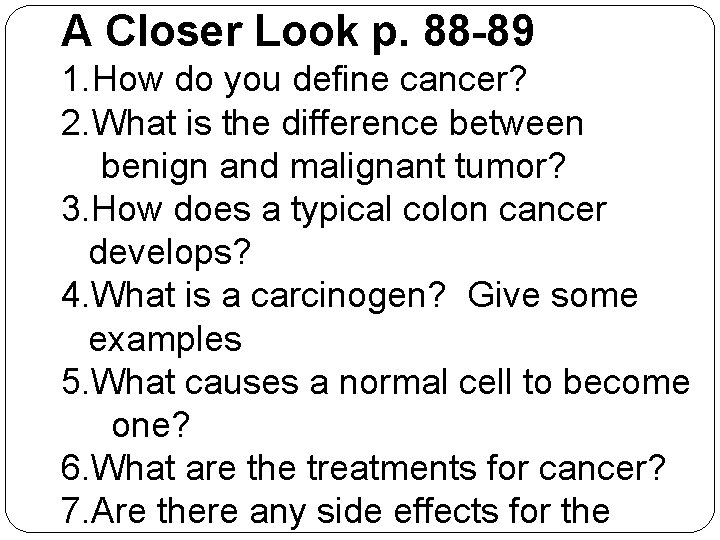
A Closer Look p. 88 -89 1. How do you define cancer? 2. What is the difference between benign and malignant tumor? 3. How does a typical colon cancer develops? 4. What is a carcinogen? Give some examples 5. What causes a normal cell to become one? 6. What are the treatments for cancer? 7. Are there any side effects for the
- Slides: 7