
Protein Synthesis From Gene to Protein DNA acts
- Slides: 20
Protein Synthesis
From Gene to Protein • DNA acts as a template to organise and produce proteins. • Proteins form the structure of the body and the enzymes that run it. • A gene is a strip of DNA, which codes for the formation of a protein. • The gap between the DNA template in the nucleus and the actual formation of the protein is bridged by RNA.
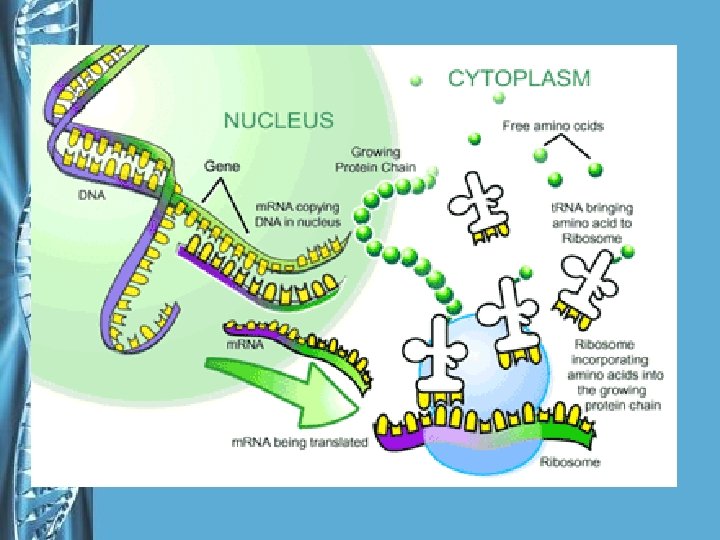
From Gene to Protein • First, a copy of the DNA template is made and carried out to the cytoplasm – tis is done via messenger RNA (m. RNA). • Then amino acids are collected from the cytoplasm and carried to the assembly point (ribosome) – this is done by transfer RNA (t. RNA). • The amino acids are clicked together in the right order using ribosomal RNA (r. RNA) in the ribosomes.
RNA – Ribose Nucleic Acid • RNA contains the sugar Ribose. • The base Thymine is replaced with Uracil. • The strands are much shorter than DNA. • RNA is single stranded. • There are 3 types: – m. RNA – t. RNA – r. RNA
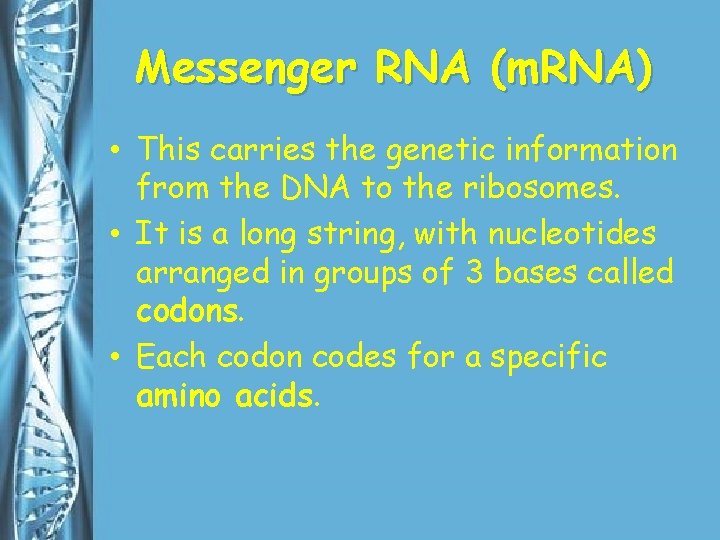
Messenger RNA (m. RNA) • This carries the genetic information from the DNA to the ribosomes. • It is a long string, with nucleotides arranged in groups of 3 bases called codons. • Each codon codes for a specific amino acids.
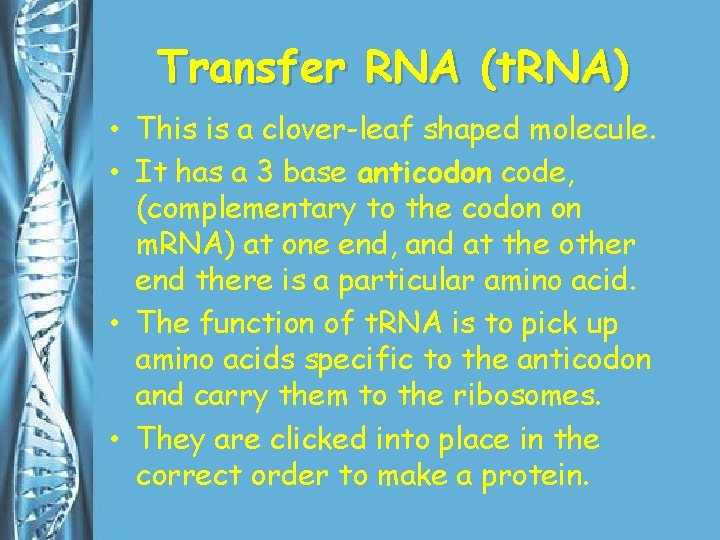
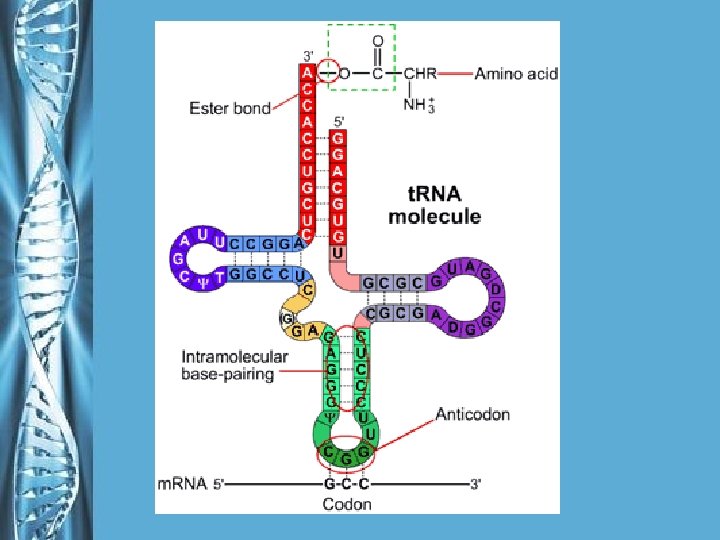
Transfer RNA (t. RNA) • This is a clover-leaf shaped molecule. • It has a 3 base anticodon code, (complementary to the codon on m. RNA) at one end, and at the other end there is a particular amino acid. • The function of t. RNA is to pick up amino acids specific to the anticodon and carry them to the ribosomes. • They are clicked into place in the correct order to make a protein.
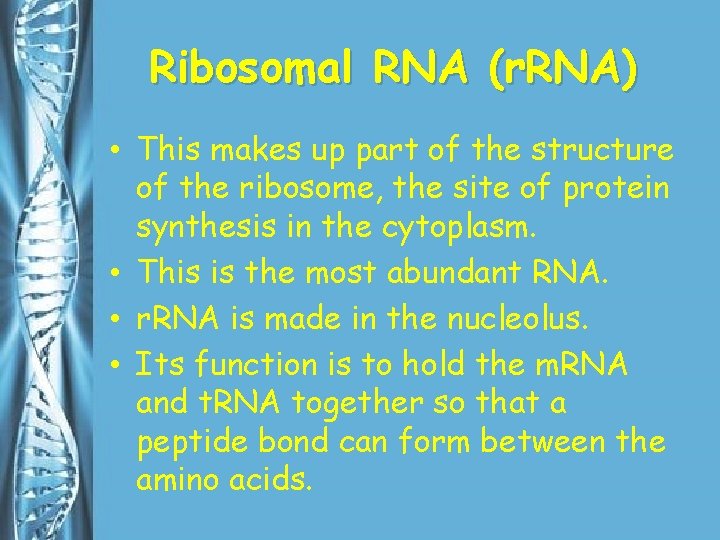
Ribosomal RNA (r. RNA) • This makes up part of the structure of the ribosome, the site of protein synthesis in the cytoplasm. • This is the most abundant RNA. • r. RNA is made in the nucleolus. • Its function is to hold the m. RNA and t. RNA together so that a peptide bond can form between the amino acids.
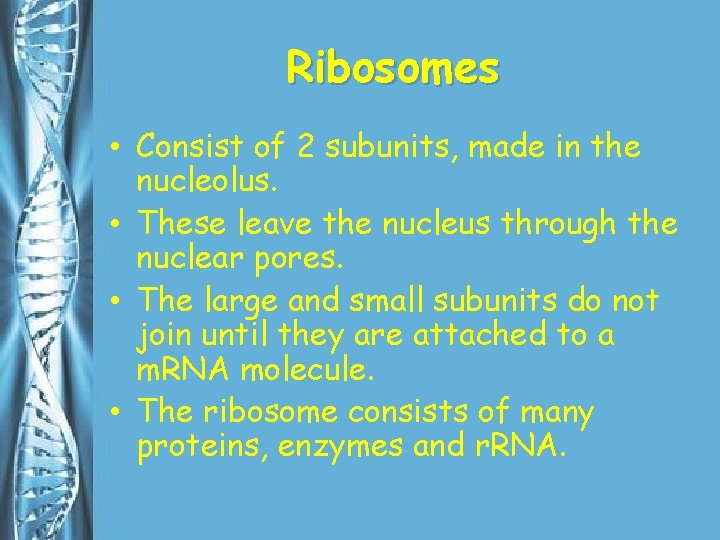
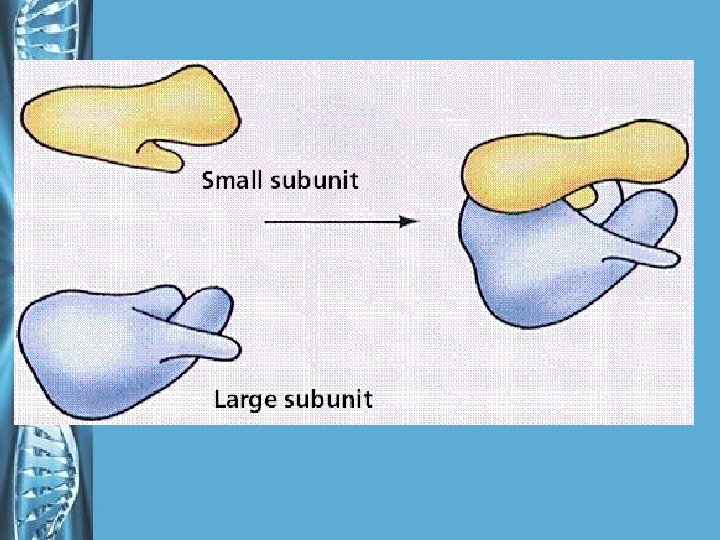
Ribosomes • Consist of 2 subunits, made in the nucleolus. • These leave the nucleus through the nuclear pores. • The large and small subunits do not join until they are attached to a m. RNA molecule. • The ribosome consists of many proteins, enzymes and r. RNA.
Protein Synthesis • In the cell there are 2 codes: – The base codes on the DNA – The amino acid codes of a protein. ØThis involves 2 processes: ØTranscription ØTranslation
Transcription • A section of DNA unwinds and one side acts as a template. • Using this a mirror image molecule known as m. RNA is formed. • It follows the strict base pairing rule. – C with G – A with T/U • The process is controlled by enzymes. • Codes on the DNA act as punctuation marking the start and end of the protein.
Transcription • The m. RNA moves out of the nucleus through the nuclear pore, and attaches itself to the large and small subunits of a ribosome.
Transcription • http: //www. youtube. com/watch? v=z t. Pkv 7 wc 3 y. U&feature=related • http: //www. youtube. com/watch? v=a y 6 bd_r 2 JSw&feature=related
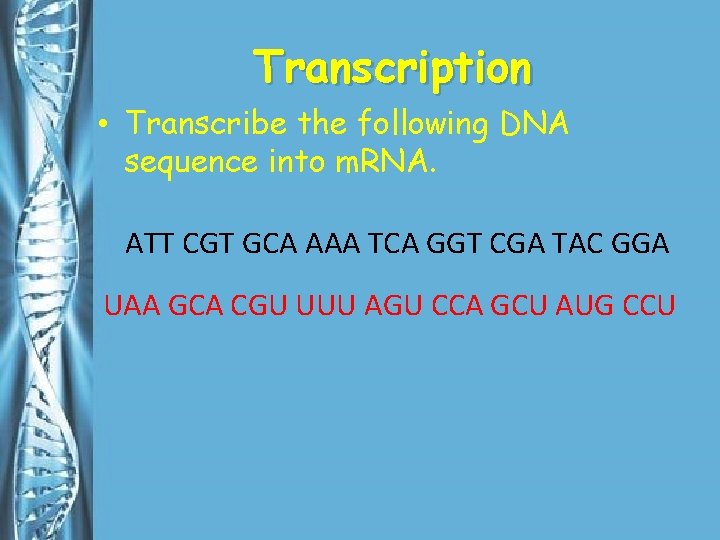
Transcription • Transcribe the following DNA sequence into m. RNA. ATT CGT GCA AAA TCA GGT CGA TAC GGA UAA GCA CGU UUU AGU CCA GCU AUG CCU
Translation • The m. RNA molecule passes through a slot between the large and small subunits of the ribosome. • Here the m. RNA is translated into protein. • The t. RNA carries the appropriate amino acids to the ribosome. • The anticodon on the t. RNA matches the m. RNA, so the r. RNA clicks the amino acid onto the growing polypeptide chain that will form a protein.
Translation • As each new amino acid joins, the ribosome nudges the m. RNA strand along 3 notches and the next t. RNA falls into place. • A strand of m. RNA is read many times to produce many molecules of the same protein.
• http: //www. youtube. com/watch? v=5 b. LEDd-PSTQ&feature=related
Summary • http: //www. youtube. com/watch? v=9 83 lhh 20 r. GY&feature=related