
Protein Synthesis Chapter 12 Whats the Point How
![What’s the Point? ] How do we go from a code in our DNA](https://slidetodoc.com/presentation_image_h2/b74ccb743acd270312beb64a56676552/image-2.jpg "What’s the Point? ] How do we go from a code in our DNA")

![1. Initiation ] RNA polymerase attaches to a promoter on DNA strand. Helicase unzips](https://slidetodoc.com/presentation_image_h2/b74ccb743acd270312beb64a56676552/image-5.jpg "1. Initiation ] RNA polymerase attaches to a promoter on DNA strand. Helicase unzips")
![Three types of RNA are transcribed. ] m. RNA (messenger RNA) - encodes genetic](https://slidetodoc.com/presentation_image_h2/b74ccb743acd270312beb64a56676552/image-8.jpg "Three types of RNA are transcribed. ] m. RNA (messenger RNA) - encodes genetic")
![] r. RNA (ribosomal RNA) - associates with proteins to form ribosomes. large subunit](https://slidetodoc.com/presentation_image_h2/b74ccb743acd270312beb64a56676552/image-9.jpg "] r. RNA (ribosomal RNA) - associates with proteins to form ribosomes. large subunit")
![] t. RNA (transfer RNA) - transports specific amino acids to ribosome during protein](https://slidetodoc.com/presentation_image_h2/b74ccb743acd270312beb64a56676552/image-10.jpg "] t. RNA (transfer RNA) - transports specific amino acids to ribosome during protein")
![Eukaryotic m. RNA must be processed before it exits nucleus & enters cytoplasm. ]](https://slidetodoc.com/presentation_image_h2/b74ccb743acd270312beb64a56676552/image-11.jpg "Eukaryotic m. RNA must be processed before it exits nucleus & enters cytoplasm. ]")
![1. Initiation ] Small ribosomal subunit binds to “start codon” [AUG] on m. RNA](https://slidetodoc.com/presentation_image_h2/b74ccb743acd270312beb64a56676552/image-13.jpg "1. Initiation ] Small ribosomal subunit binds to “start codon” [AUG] on m. RNA")
![2. Elongation ] Large ribosomal subunit binds to small subunit. ] A second t.](https://slidetodoc.com/presentation_image_h2/b74ccb743acd270312beb64a56676552/image-14.jpg "2. Elongation ] Large ribosomal subunit binds to small subunit. ] A second t.")
![] Initiator t. RNA is released. ] Ribosome moves down m. RNA by 1](https://slidetodoc.com/presentation_image_h2/b74ccb743acd270312beb64a56676552/image-15.jpg "] Initiator t. RNA is released. ] Ribosome moves down m. RNA by 1")
![] t. RNAs continue to add amino acids; polypeptide lengthens.](https://slidetodoc.com/presentation_image_h2/b74ccb743acd270312beb64a56676552/image-16.jpg "] t. RNAs continue to add amino acids; polypeptide lengthens.")
![3. Termination ] Occurs when ribosome reaches an m. RNA stop codon (UGA, UAG](https://slidetodoc.com/presentation_image_h2/b74ccb743acd270312beb64a56676552/image-17.jpg "3. Termination ] Occurs when ribosome reaches an m. RNA stop codon (UGA, UAG")
- Slides: 24
Protein Synthesis Chapter 12
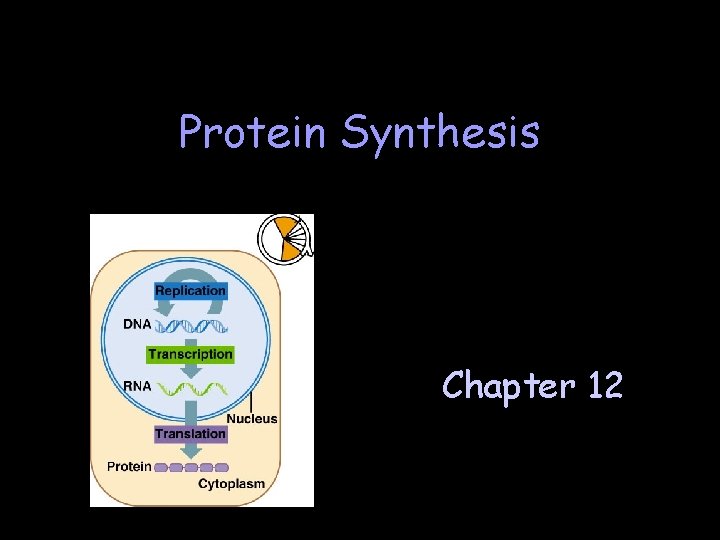
What’s the Point? ] How do we go from a code in our DNA (a gene sequence, like GAATTC) to how we look? ] “Read” the DNA code, and transcribe it into a different format so it can be translated into a protein.
A. Comparison of DNA & RNA
B. Transcription Process by which a DNA sequence (gene) is converted to an RNA sequence. F Occurs in the nucleus of eukaryotic cells & cytoplasm of prokaryotic cells. F Is regulated by operons (bacterial cells) or transcription factors (multicellular organisms). F Involves 3 processes: initiation, elongation & termination
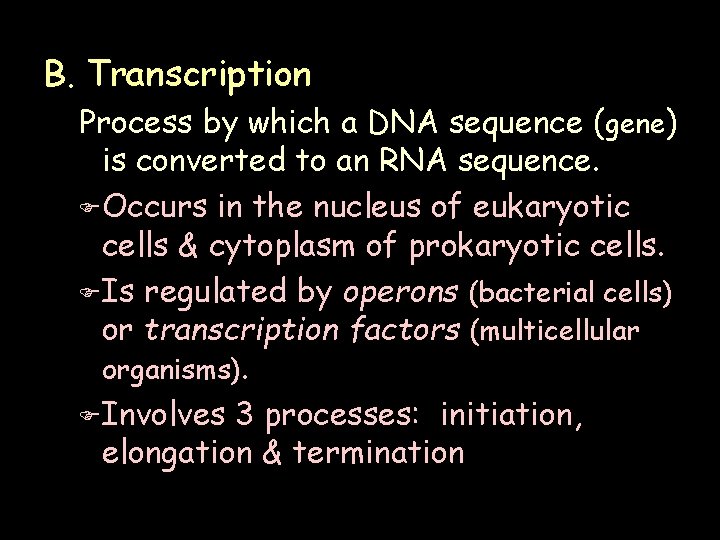
1. Initiation ] RNA polymerase attaches to a promoter on DNA strand. Helicase unzips a short section of DNA. ] Free RNA nucleotides move in & H-bond to complementary bases on DNA template strand. ]
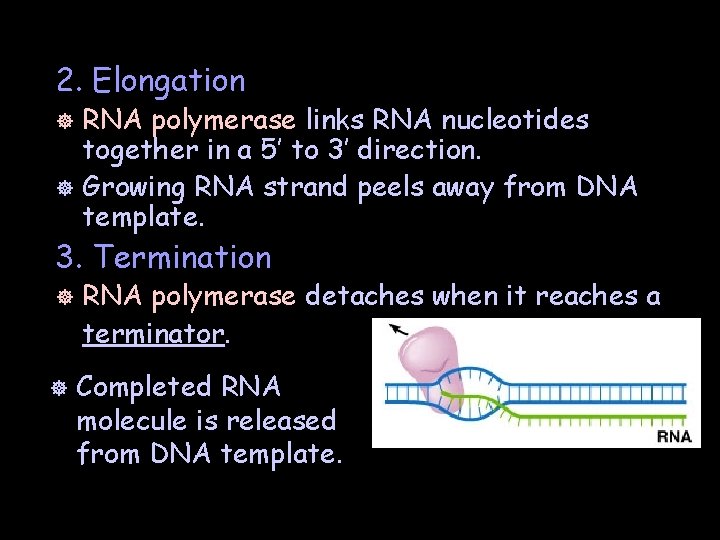
2. Elongation RNA polymerase links RNA nucleotides together in a 5’ to 3’ direction. ] Growing RNA strand peels away from DNA template. ] 3. Termination ] ] RNA polymerase detaches when it reaches a terminator. Completed RNA molecule is released from DNA template.
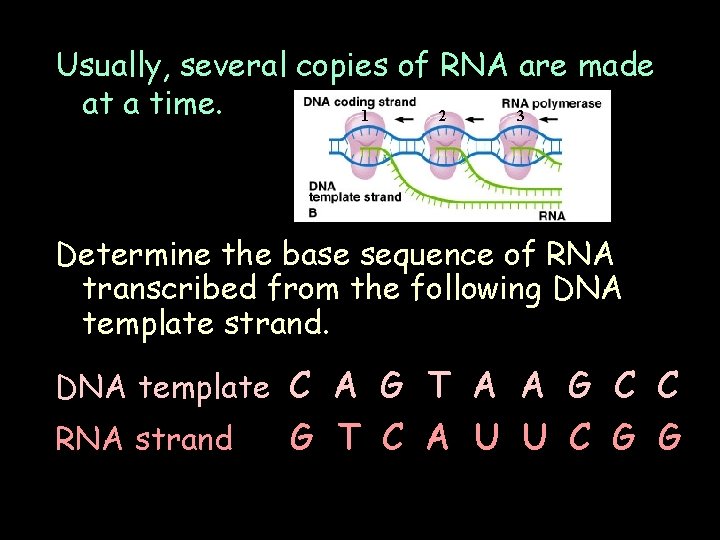
Usually, several copies of RNA are made at a time. 1 2 3 Determine the base sequence of RNA transcribed from the following DNA template strand. DNA template C A G T A A G C C RNA strand G T C A U U C G G
Three types of RNA are transcribed. ] m. RNA (messenger RNA) - encodes genetic information from DNA & carries it into the cytoplasm. 5’ 3’ codon Each three consecutive m. RNA bases forms a genetic code word (codon) that codes for a particular amino acid.
] r. RNA (ribosomal RNA) - associates with proteins to form ribosomes. large subunit small subunit Subunits are separate in the cytoplasm, but join during protein synthesis (translation).
] t. RNA (transfer RNA) - transports specific amino acids to ribosome during protein synthesis (translation). Anticodon - specific sequence of 3 nucleotides; complementary to an m. RNA codon. Amino acid accepting end Anticodon sequence determines the specific amino acid that binds to t. RNA.
Eukaryotic m. RNA must be processed before it exits nucleus & enters cytoplasm. ] nucleotide cap is added ] “poly A tail” is added ] introns are removed
C. Translation Process by which an m. RNA sequence is translated into an amino acid sequence (polypeptide/protein). F Occurs in the cytoplasm of eukaryotic & prokaryotic cells. F Requires: m. RNA, t. RNAs, amino acids & ribosomes. F Involves 3 processes: initiation, elongation & termination
1. Initiation ] Small ribosomal subunit binds to “start codon” [AUG] on m. RNA molecule. ] AUG codon attracts initiator t. RNA.
2. Elongation ] Large ribosomal subunit binds to small subunit. ] A second t. RNA anticodon binds to the next m. RNA codon. ]A peptide bond forms between the two amino acids.
] Initiator t. RNA is released. ] Ribosome moves down m. RNA by 1 codon. ] A third t. RNA anticodon binds to the next m. RNA codon. ]A peptide bond forms between 2 nd & 3 rd amino acids.
] t. RNAs continue to add amino acids; polypeptide lengthens.
3. Termination ] Occurs when ribosome reaches an m. RNA stop codon (UGA, UAG or UAA). Stop codons do NOT specify an amino acid. ] Last t. RNA is released, ribosomal subunits separate & new polypeptide/protein is released.
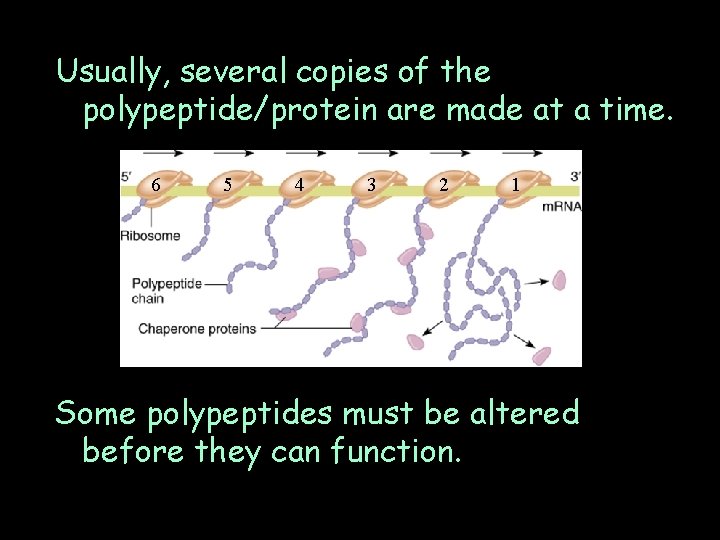
Usually, several copies of the polypeptide/protein are made at a time. 6 5 4 3 2 1 Some polypeptides must be altered before they can function.
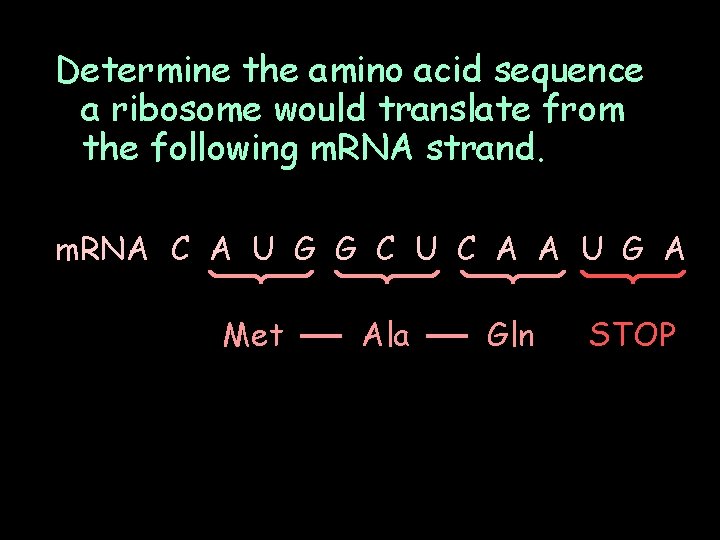
Determine the amino acid sequence a ribosome would translate from the following m. RNA strand. m. RNA C A U G G C U C A A U G A Met Ala Gln STOP
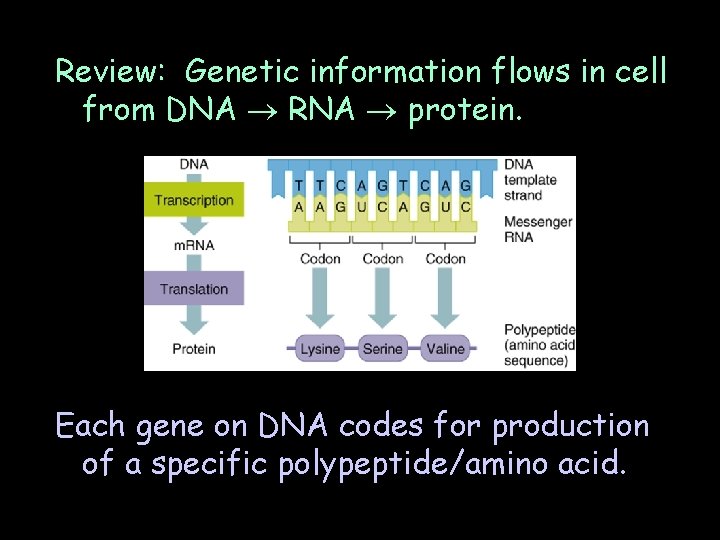
Review: Genetic information flows in cell from DNA RNA protein. Each gene on DNA codes for production of a specific polypeptide/amino acid.
Play this as a review: https: //www. youtube. com/watch? v =9 k. OGOY 7 vthk&feature=youtube _gdata_player
D. Mutation A physical change in the nucleotide sequence of DNA. F May not affect phenotype (silent mutation). F Can affect somatic cells (somatic mutation) or sex cells (germinal mutation). F Can form spontaneously or be induced by a mutagen.
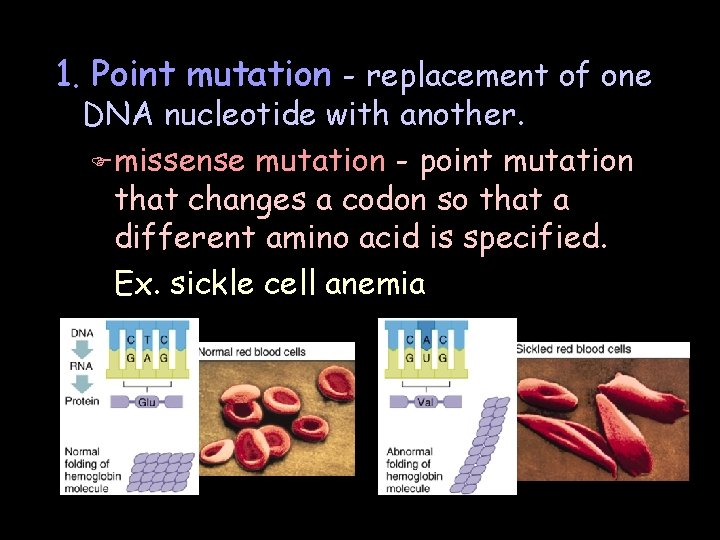
1. Point mutation - replacement of one DNA nucleotide with another. F missense mutation - point mutation that changes a codon so that a different amino acid is specified. Ex. sickle cell anemia
F nonsense mutation - point mutation that changes an amino acid-specifying codon into a stop codon. 2. Frameshift mutation - the insertion or deletion of DNA nucleotides; results in disruption of the reading frame. Ex. cystic fibrosis 3. Expanding repeat - the # of copies of a 3 nucleotide sequence increases over several generations. Ex. myotonic dystrophy