
PROTEIN SYNTHESIS Central Dogma of Biology RNA ribonucleic
PROTEIN SYNTHESIS
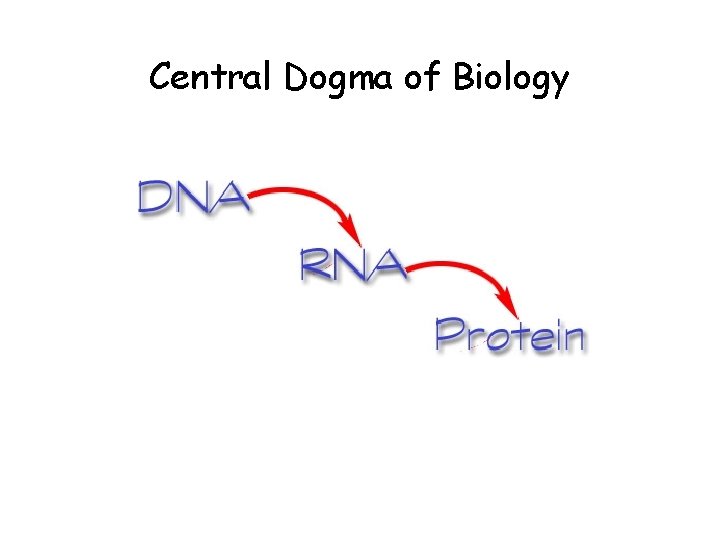
Central Dogma of Biology
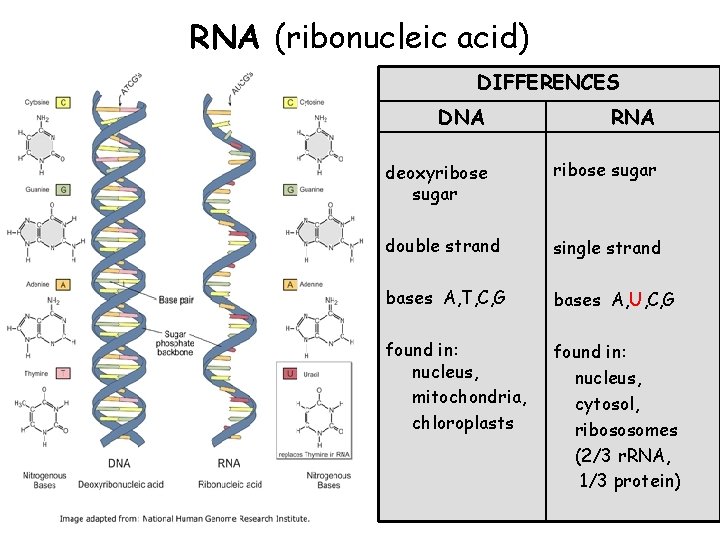
RNA (ribonucleic acid) DIFFERENCES DNA RNA deoxyribose sugar double strand single strand bases A, T, C, G bases A, U, C, G found in: nucleus, mitochondria, chloroplasts found in: nucleus, cytosol, ribososomes (2/3 r. RNA, 1/3 protein)
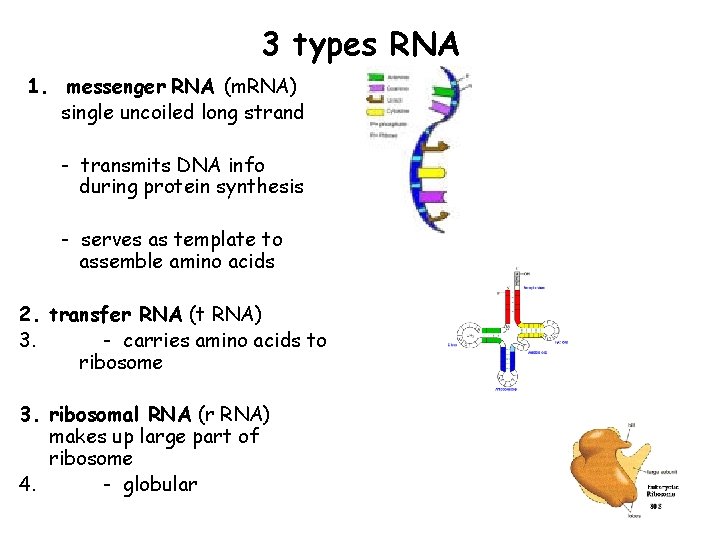
3 types RNA 1. messenger RNA (m. RNA) single uncoiled long strand - transmits DNA info during protein synthesis - serves as template to assemble amino acids 2. transfer RNA (t RNA) 3. - carries amino acids to ribosome 3. ribosomal RNA (r RNA) makes up large part of ribosome 4. - globular
PROTEIN SYNTHESIS/GENE EXPRESSION Formation of proteins using information coded on DNA and carried out by RNA. DNA: the president RNA: the vice president PROTEINS: the workers that carry out the jobs - Functions of Proteins cell structure, repair , and growth cell movement control biochemical pathways (enzymes) direct synthesis of lipids and carbohydrates **most important biomolecule for life**
How is information necessary for creating proteins encoded in the RNA? The genetic code from DNA is transcribed onto m. RNA by Codons.
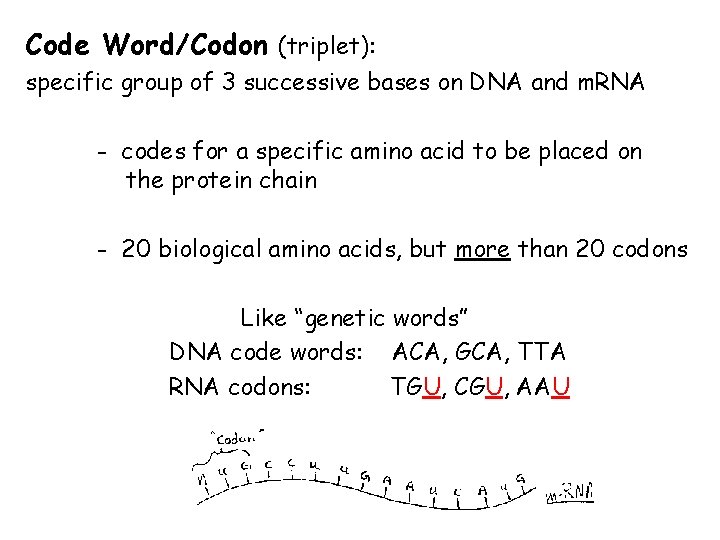
Code Word/Codon (triplet): specific group of 3 successive bases on DNA and m. RNA - codes for a specific amino acid to be placed on the protein chain - 20 biological amino acids, but more than 20 codons Like “genetic words” DNA code words: ACA, GCA, TTA RNA codons: TGU, CGU, AAU
How many combinations of code words/codons can we make from 4 bases? 64 combinations ( 43 = 64) ** each code word always codes for same amino acid**
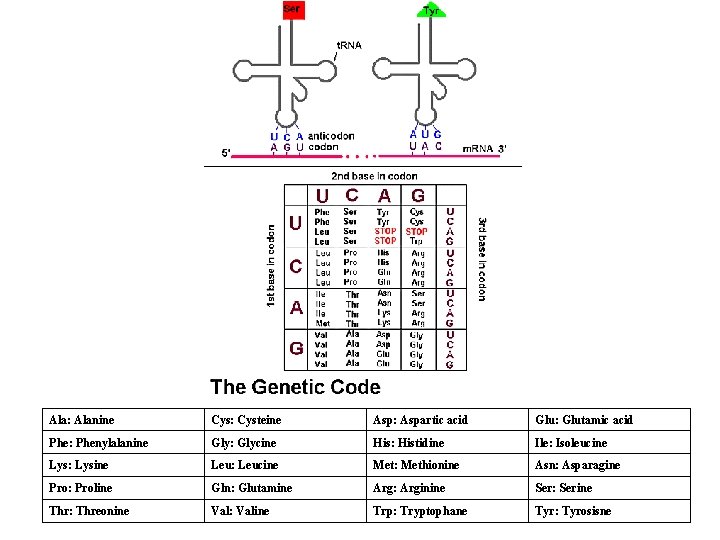
Ala: Alanine Cys: Cysteine Asp: Aspartic acid Glu: Glutamic acid Phe: Phenylalanine Gly: Glycine His: Histidine Ile: Isoleucine Lys: Lysine Leu: Leucine Met: Methionine Asn: Asparagine Pro: Proline Gln: Glutamine Arg: Arginine Ser: Serine Thr: Threonine Val: Valine Trp: Tryptophane Tyr: Tyrosisne
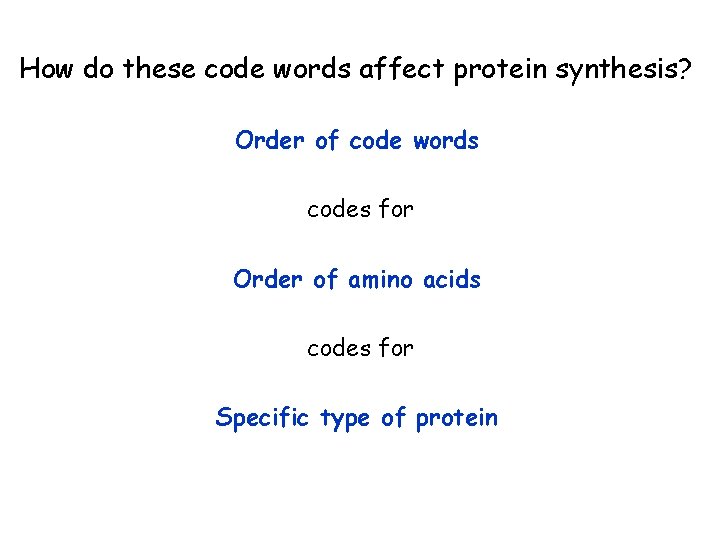
How do these code words affect protein synthesis? Order of code words codes for Order of amino acids codes for Specific type of protein
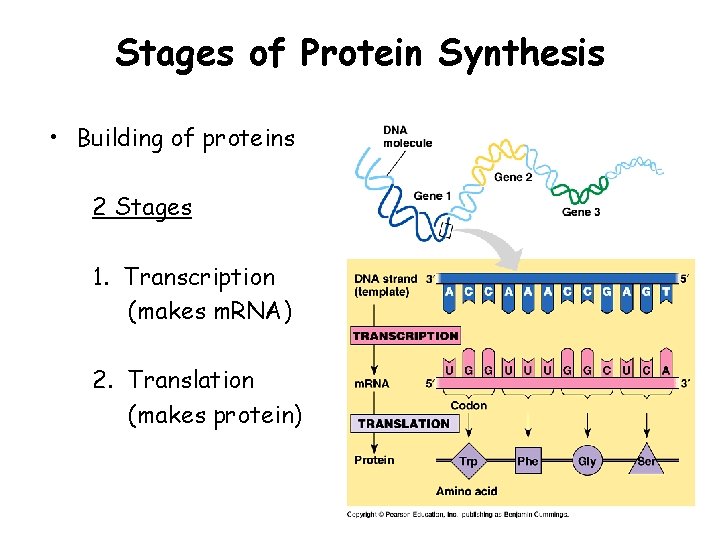
Stages of Protein Synthesis • Building of proteins 2 Stages 1. Transcription (makes m. RNA) 2. Translation (makes protein)
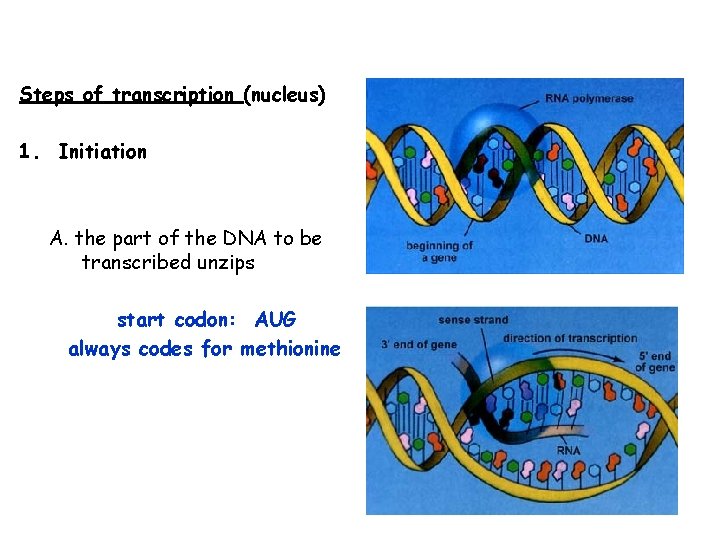
Steps of transcription (nucleus) 1. Initiation A. the part of the DNA to be transcribed unzips start codon: AUG always codes for methionine
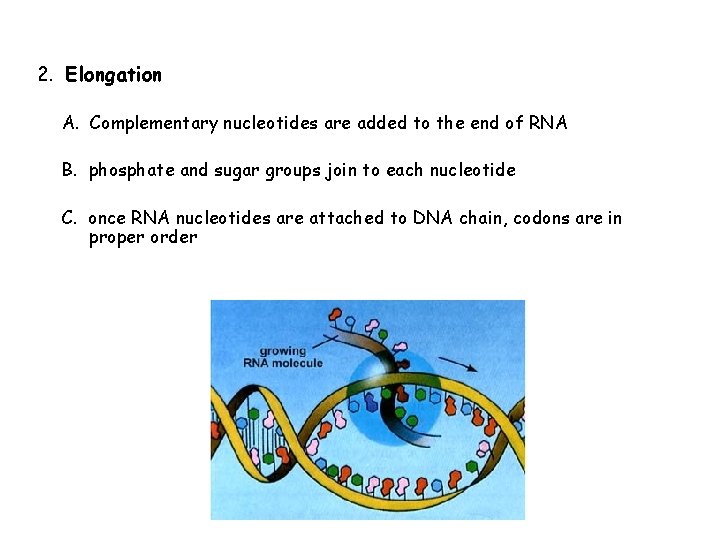
2. Elongation A. Complementary nucleotides are added to the end of RNA B. phosphate and sugar groups join to each nucleotide C. once RNA nucleotides are attached to DNA chain, codons are in proper order
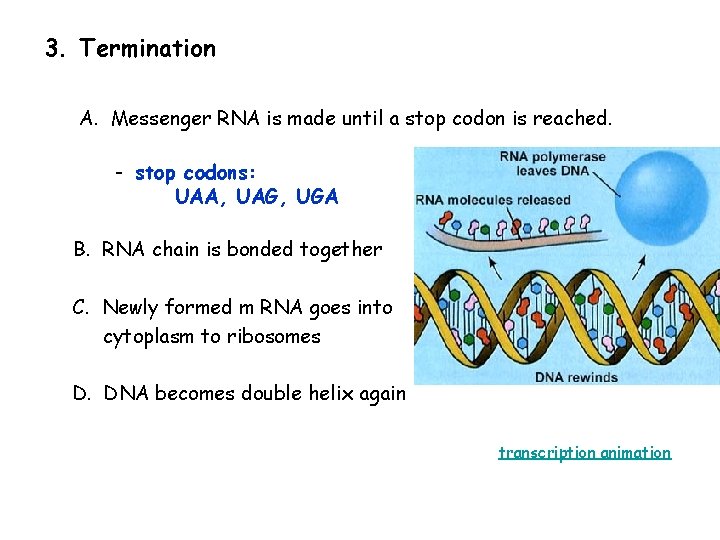
3. Termination A. Messenger RNA is made until a stop codon is reached. - stop codons: UAA, UAG, UGA B. RNA chain is bonded together C. Newly formed m RNA goes into cytoplasm to ribosomes D. DNA becomes double helix again transcription animation
II. Translation (in cytoplasm at ribosome) - process whereby protein is synthesized (created) from m. RNA - newly synthesized m. RNA moves from nucleus to ribosome in cytoplasm - gene has 100 x more nucleotides than the protein it makes Ex: 100 a. a. = 300 nucleotides
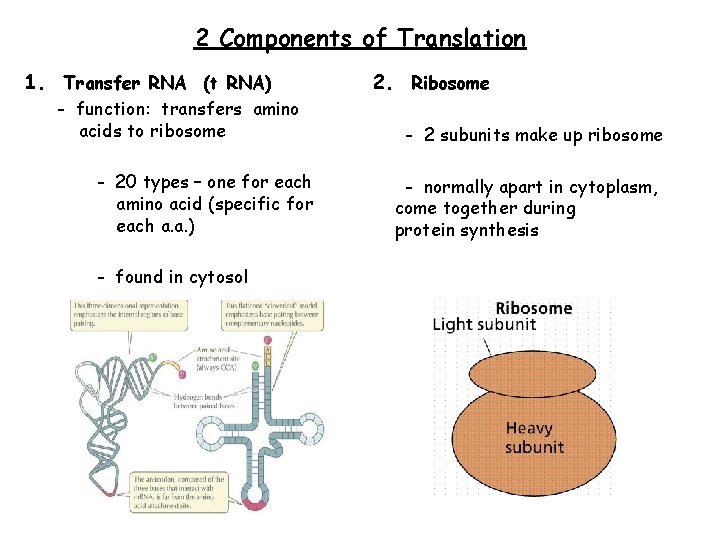
2 Components of Translation 1. Transfer RNA (t RNA) - function: transfers amino acids to ribosome - 20 types – one for each amino acid (specific for each a. a. ) - found in cytosol 2. Ribosome - 2 subunits make up ribosome - normally apart in cytoplasm, come together during protein synthesis
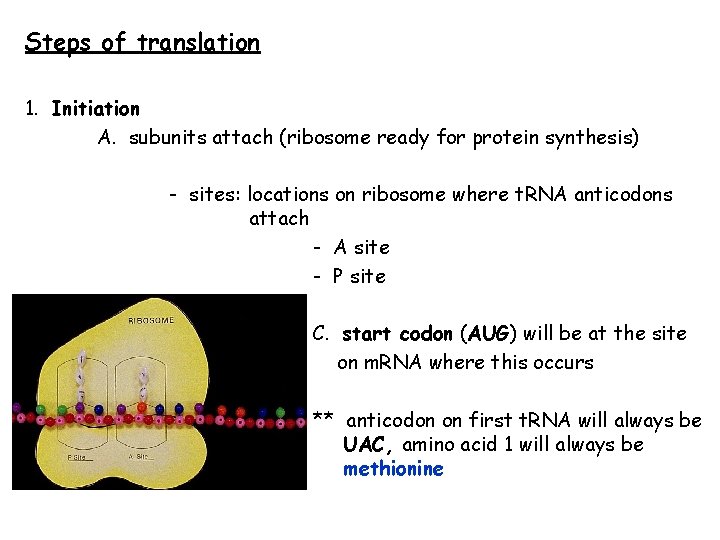
Steps of translation 1. Initiation A. subunits attach (ribosome ready for protein synthesis) - sites: locations on ribosome where t. RNA anticodons attach - A site - P site C. start codon (AUG) will be at the site on m. RNA where this occurs ** anticodon on first t. RNA will always be UAC, amino acid 1 will always be methionine
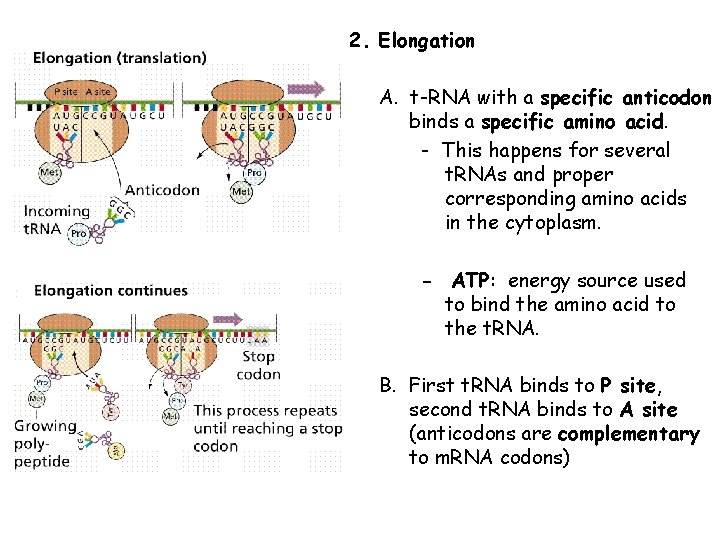
2. Elongation A. t-RNA with a specific anticodon binds a specific amino acid. - This happens for several t. RNAs and proper corresponding amino acids in the cytoplasm. - ATP: energy source used to bind the amino acid to the t. RNA. B. First t. RNA binds to P site, second t. RNA binds to A site (anticodons are complementary to m. RNA codons)
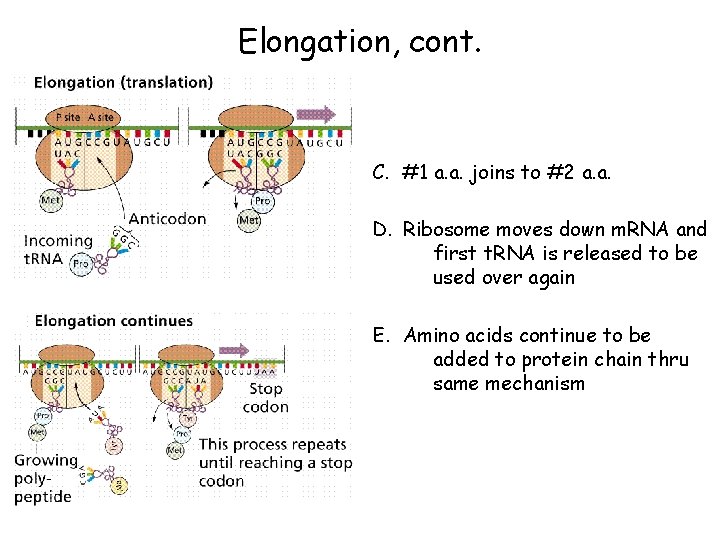
Elongation, cont. C. #1 a. a. joins to #2 a. a. D. Ribosome moves down m. RNA and first t. RNA is released to be used over again E. Amino acids continue to be added to protein chain thru same mechanism
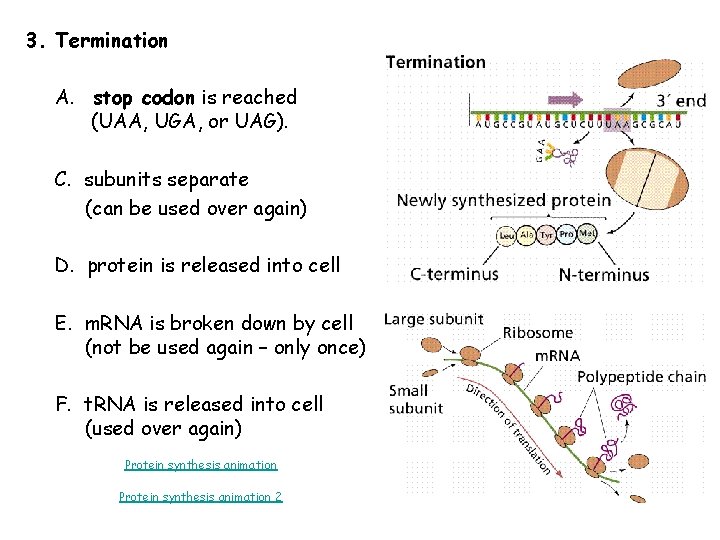
3. Termination A. stop codon is reached (UAA, UGA, or UAG). C. subunits separate (can be used over again) D. protein is released into cell E. m. RNA is broken down by cell (not be used again – only once) F. t. RNA is released into cell (used over again) Protein synthesis animation 2
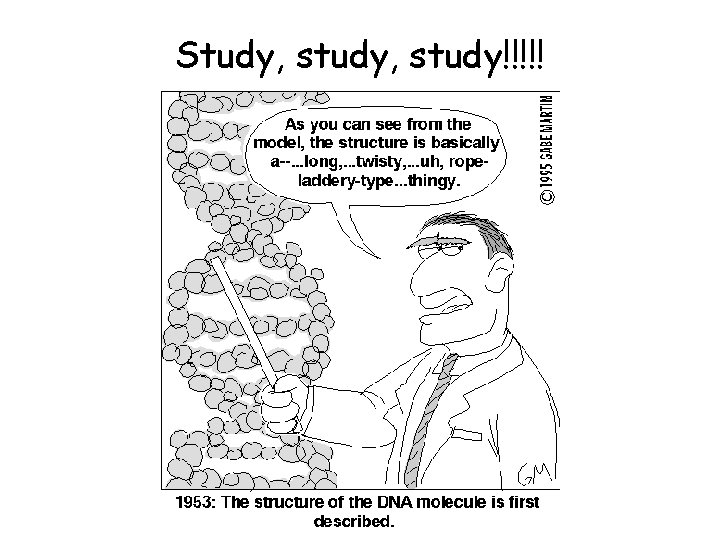
Study, study!!!!!
- Slides: 21