
Protein Synthesis Activity Read through the procedures What
- Slides: 21
Protein Synthesis Activity Read through the procedures. What is occurring at each step? 1. Nucleus (back table) • Copy the DNA template A onto your lab sheet THEN Transcribe the DNA template onto your lab sheet 2. Ribosome (original table) • Other team members copy the DNA and m. RNA (check for accuracy) 3. m. RNA/Codon • Send one person to locate the correct codon and write the WORD on the back of the card onto your lab sheet. • Return to your group and report your findings 4. Protein Sentence • Get your sentence checked- it should start with ‘start’ and end with ‘stop’ 5. Genetic Code • Use the genetic code to translate your m. RNA to the appropriate amino acid
Protein Synthesis Activity • What are you doing in the nucleus? • How many people from each group? • Where are the ribosomes? What do you do there? • How will you know you are doing it right? • How do you find your Amino Acid chain? • How long will you have?
Protein Synthesis Lab • C- level 2 voice • H- ask three before me • A- In groups of 3, complete the process of protein synthesis moving from nucleus to ribosome. • M- remain at your ribosome (table) unless you are the m. RNA transcribing the DNA • P- complete 3 complete protein synthesis sentences on your lab sheet • Success
Protein Synthesis Lab Honors • C- level 2 voice • H- ask three before me • A- In groups of three, complete the process of protein synthesis moving from nucleus to ribosome (m. RNA to t. RNA to Protein) • M- remain at your ribosome (table) unless you are the m. RNA transcribing the DNA or the t. RNA anticodon • P- complete 3 complete protein synthesis sentences on your lab sheet • Success
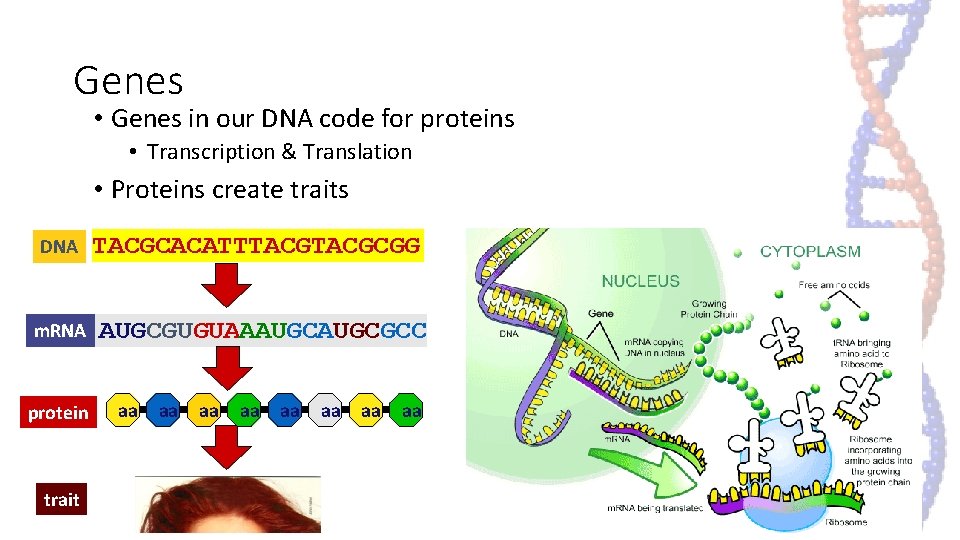
Genes • Genes in our DNA code for proteins • Transcription & Translation • Proteins create traits DNA m. RNA protein trait TACGCACATTTACGCGG AUGCGUGUAAAUGCGCC aa aa
What if something goes wrong? ?
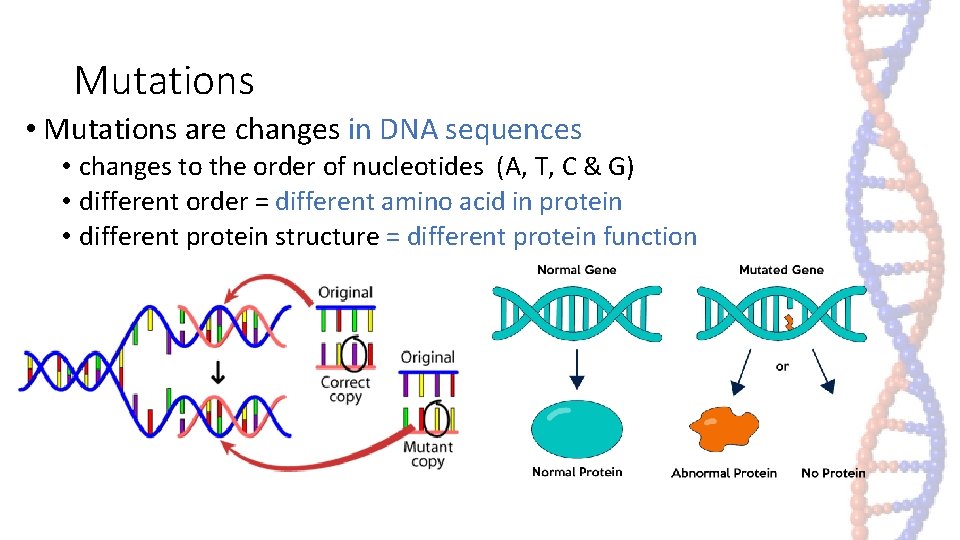
Mutations • Mutations are changes in DNA sequences • changes to the order of nucleotides (A, T, C & G) • different order = different amino acid in protein • different protein structure = different protein function
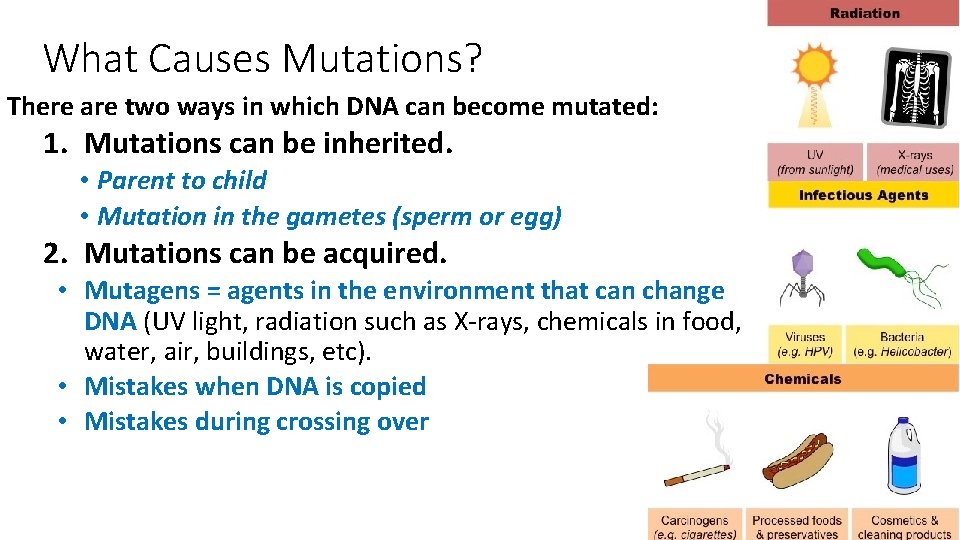
What Causes Mutations? There are two ways in which DNA can become mutated: 1. Mutations can be inherited. • Parent to child • Mutation in the gametes (sperm or egg) 2. Mutations can be acquired. • Mutagens = agents in the environment that can change DNA (UV light, radiation such as X-rays, chemicals in food, water, air, buildings, etc). • Mistakes when DNA is copied • Mistakes during crossing over
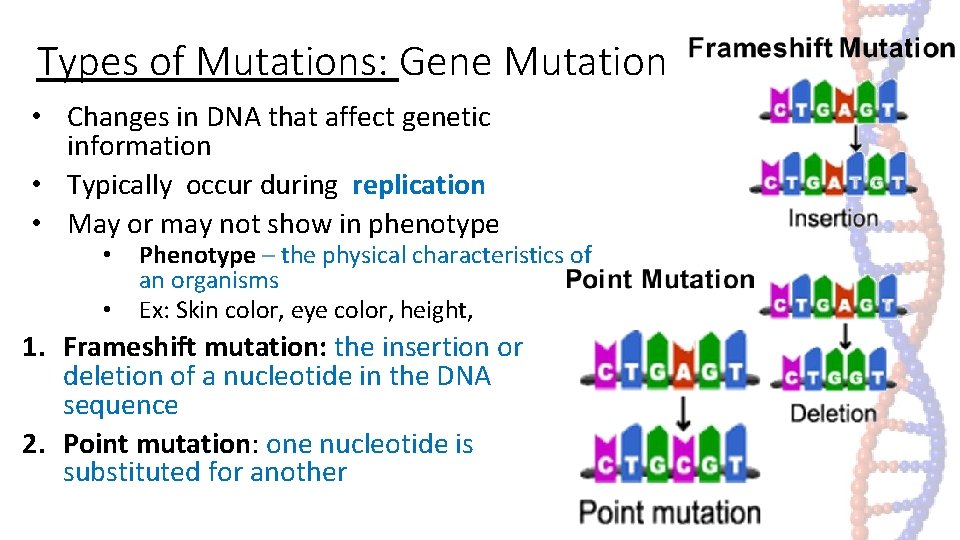
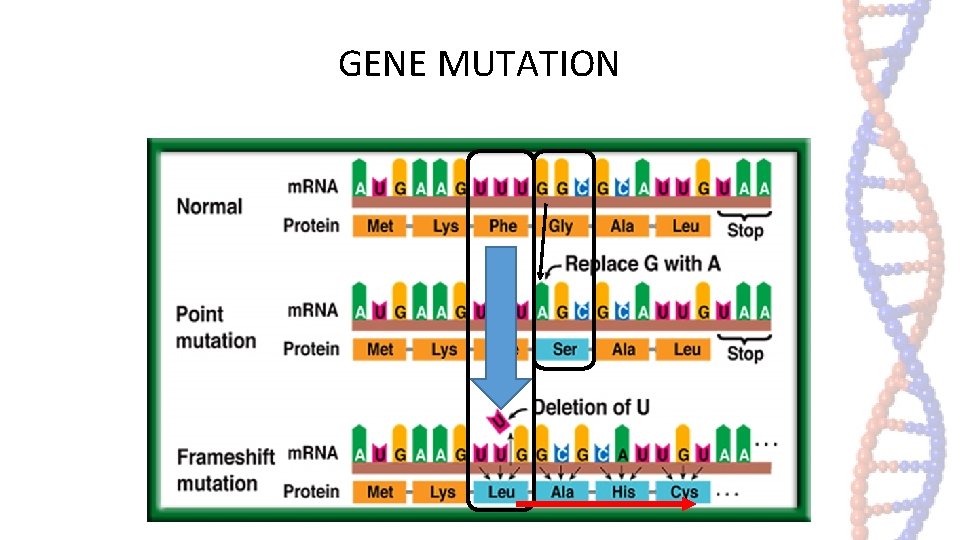
Types of Mutations: Gene Mutation • Changes in DNA that affect genetic information • Typically occur during replication • May or may not show in phenotype • • Phenotype – the physical characteristics of an organisms Ex: Skin color, eye color, height, 1. Frameshift mutation: the insertion or deletion of a nucleotide in the DNA sequence 2. Point mutation: one nucleotide is substituted for another
GENE MUTATION
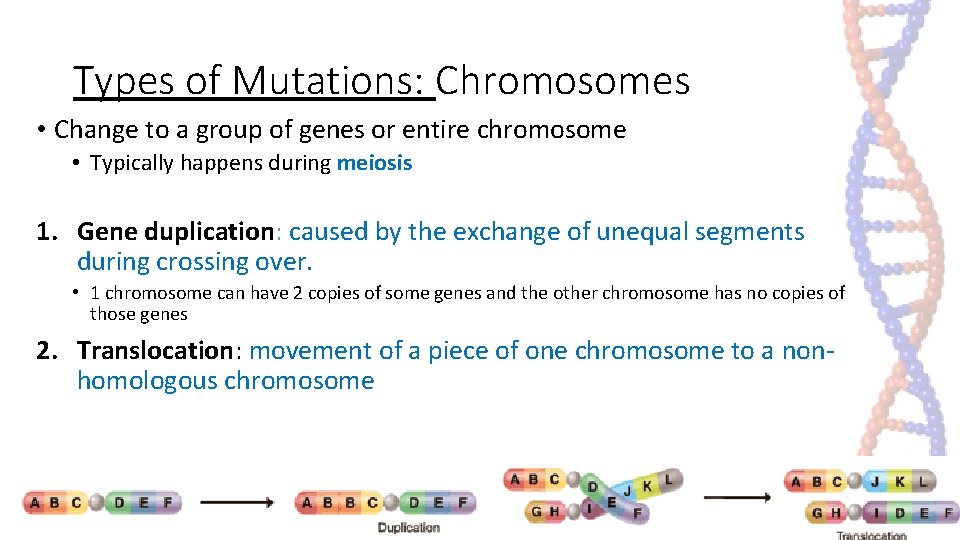
Types of Mutations: Chromosomes • Change to a group of genes or entire chromosome • Typically happens during meiosis 1. Gene duplication: caused by the exchange of unequal segments during crossing over. • 1 chromosome can have 2 copies of some genes and the other chromosome has no copies of those genes 2. Translocation: movement of a piece of one chromosome to a nonhomologous chromosome
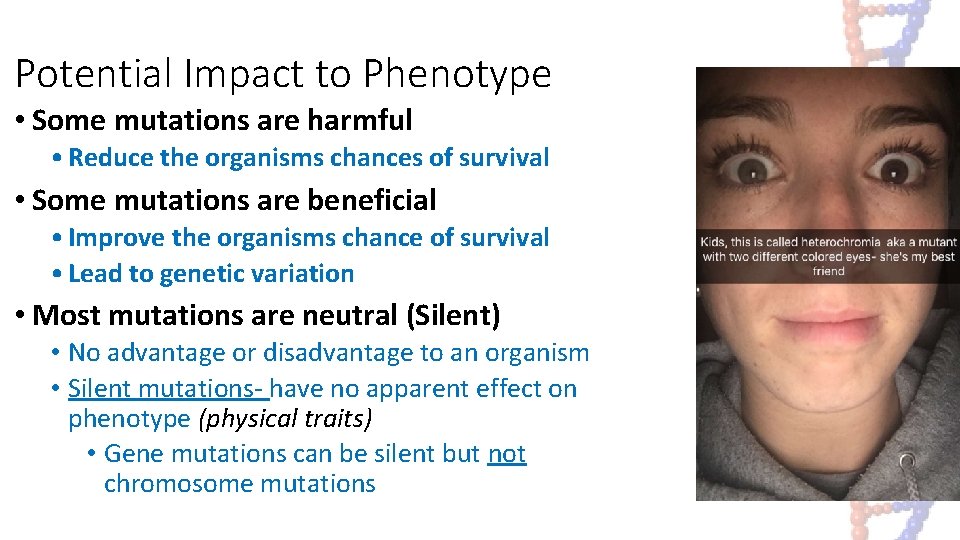
Potential Impact to Phenotype • Some mutations are harmful • Reduce the organisms chances of survival • Some mutations are beneficial • Improve the organisms chance of survival • Lead to genetic variation • Most mutations are neutral (Silent) • No advantage or disadvantage to an organism • Silent mutations- have no apparent effect on phenotype (physical traits) • Gene mutations can be silent but not chromosome mutations
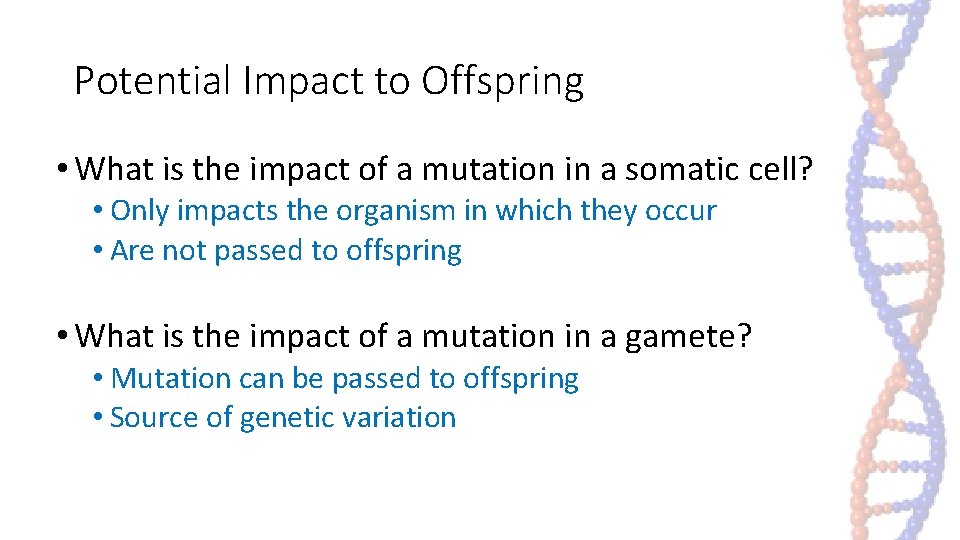
Potential Impact to Offspring • What is the impact of a mutation in a somatic cell? • Only impacts the organism in which they occur • Are not passed to offspring • What is the impact of a mutation in a gamete? • Mutation can be passed to offspring • Source of genetic variation
How are mutations related to protein synthesis? Changes in the DNA can cause a change in the protein
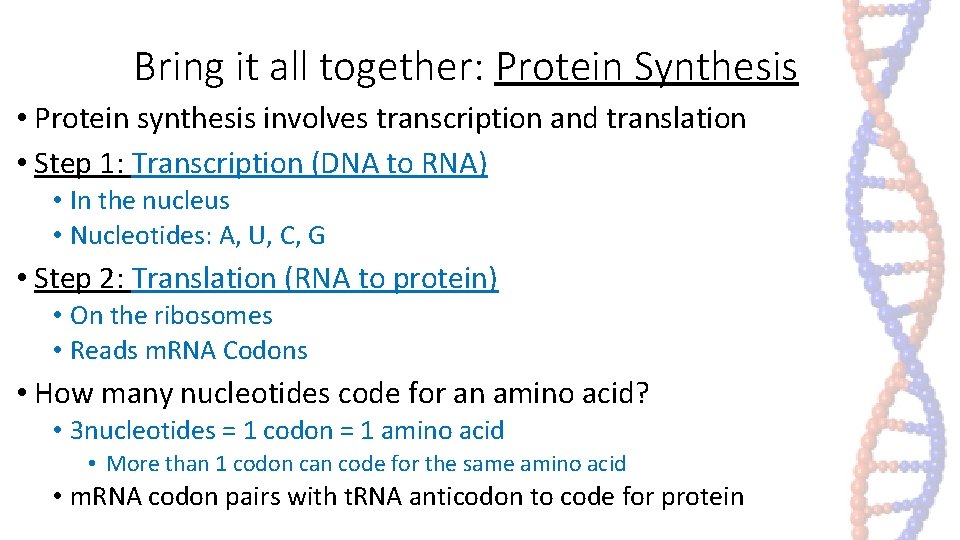
Bring it all together: Protein Synthesis • Protein synthesis involves transcription and translation • Step 1: Transcription (DNA to RNA) • In the nucleus • Nucleotides: A, U, C, G • Step 2: Translation (RNA to protein) • On the ribosomes • Reads m. RNA Codons • How many nucleotides code for an amino acid? • 3 nucleotides = 1 codon = 1 amino acid • More than 1 codon can code for the same amino acid • m. RNA codon pairs with t. RNA anticodon to code for protein
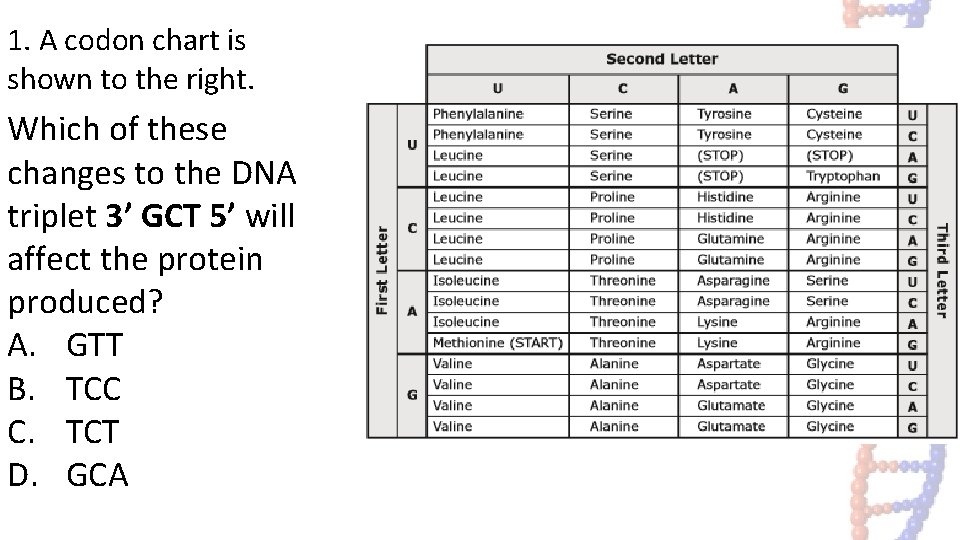
1. A codon chart is shown to the right. Which of these changes to the DNA triplet 3’ GCT 5’ will affect the protein produced? A. GTT B. TCC C. TCT D. GCA
Exit ticket!! Quiz next class on PS- study guide on the website!
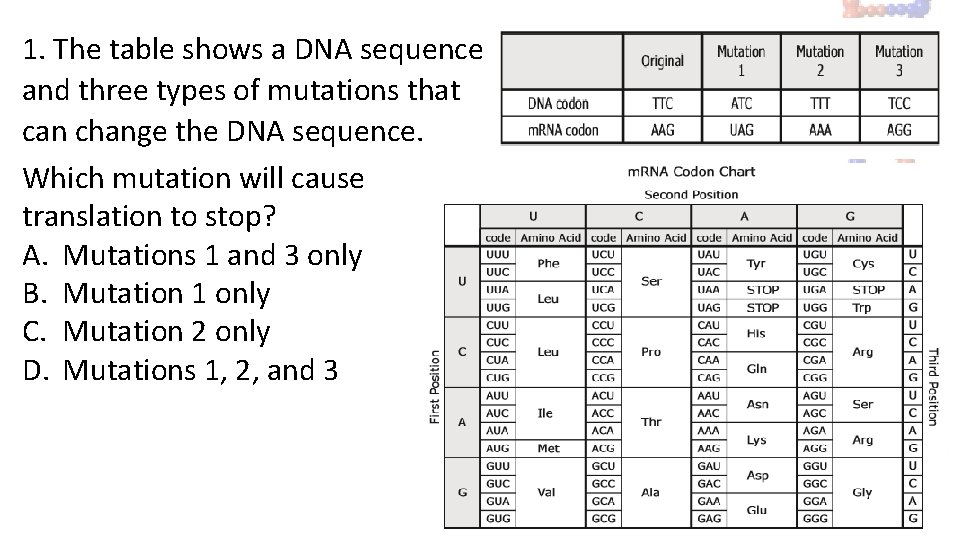
1. The table shows a DNA sequence and three types of mutations that can change the DNA sequence. Which mutation will cause translation to stop? A. Mutations 1 and 3 only B. Mutation 1 only C. Mutation 2 only D. Mutations 1, 2, and 3
2. The sequence of DNA below is part of a gene. How many amino acids are coded for by this segment? 5' ATCAGCGCTGGC 3' A. 4 B. 8 C. 12 D. 24
3. A DNA strand with the sequence AACGTAACG is transcribed. What is the sequence of the m. RNA molecule synthesized? • A) • B) • C) • D) AACGTAACG UUGCAUUGC AACGUAACG TTGCATTGC
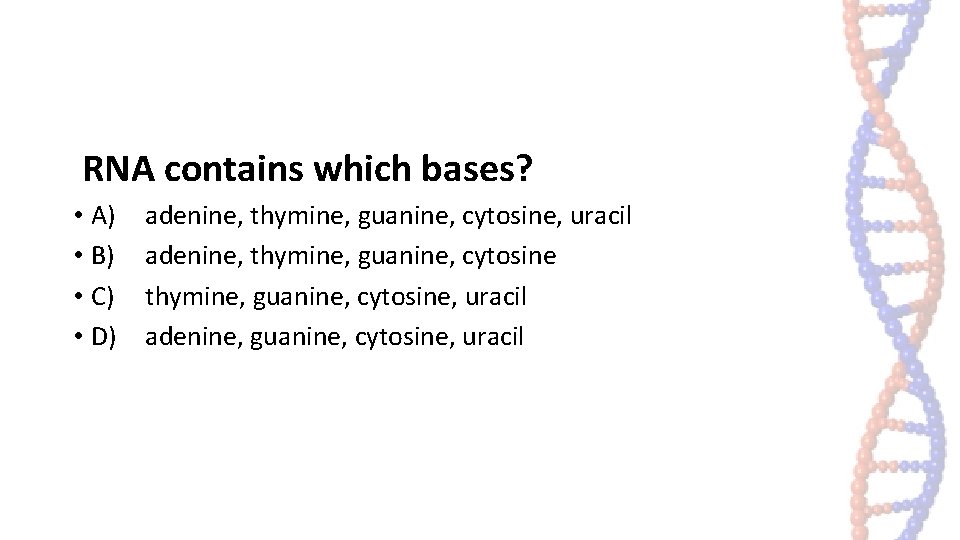
RNA contains which bases? • A) • B) • C) • D) adenine, thymine, guanine, cytosine, uracil adenine, guanine, cytosine, uracil