
PROTEIN SYNTHESIS 1 2 The Central Dogma of
- Slides: 43
PROTEIN SYNTHESIS 1
2
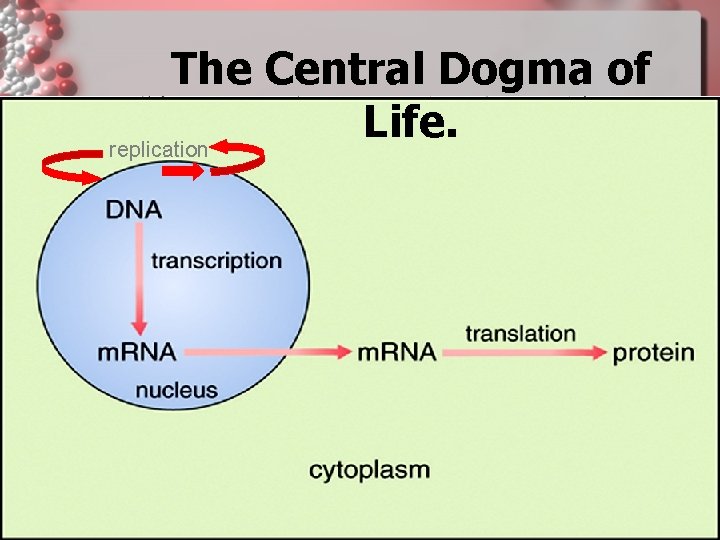
The Central Dogma of Life. replication
DNA • DNA contains genes, sequences of nucleotide bases • These Genes code for polypeptides (proteins) • Proteins are used to build cells and do much of the work inside cells 4
Genes & Proteins § Proteins are made of amino acids linked together by peptide bonds § 20 different amino acids exist 5
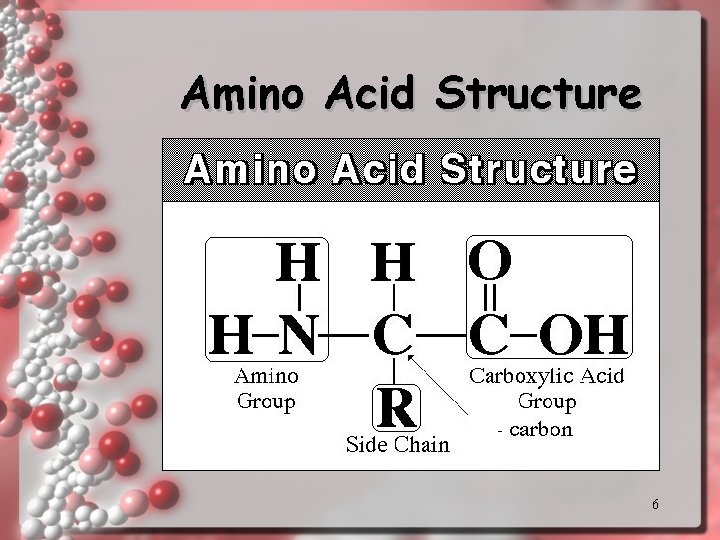
Amino Acid Structure 6
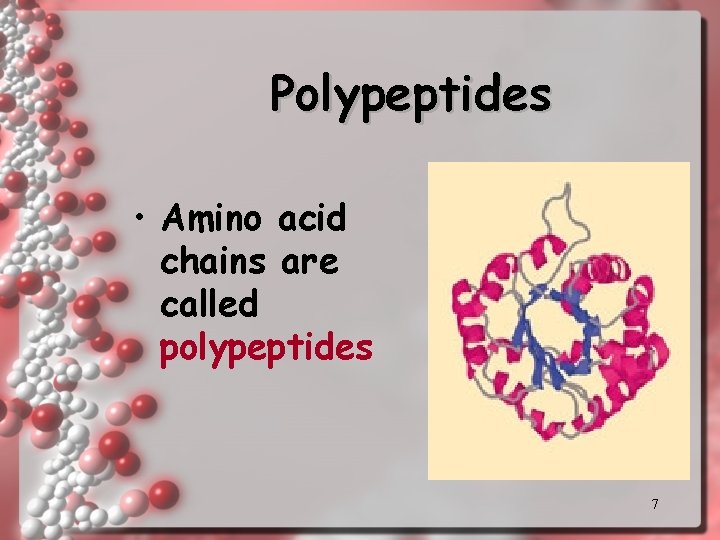
Polypeptides • Amino acid chains are called polypeptides 7
DNA Begins the Process • DNA is found inside the nucleus • Proteins, however, are made in the cytoplasm of cells by organelles called ribosomes • Ribosomes may be free in the cytosol or attached to the surface of rough ER 8
Starting with DNA • DNA ‘s code must be copied and taken to the cytosol • In the cytoplasm, this code must be read so amino acids can be assembled to make polypeptides (proteins) • This process is called PROTEIN SYNTHESIS 9
RNA 10
Roles of RNA and DNA • DNA is the MASTER PLAN • RNA is the BLUEPRINT of the Master Plan 11
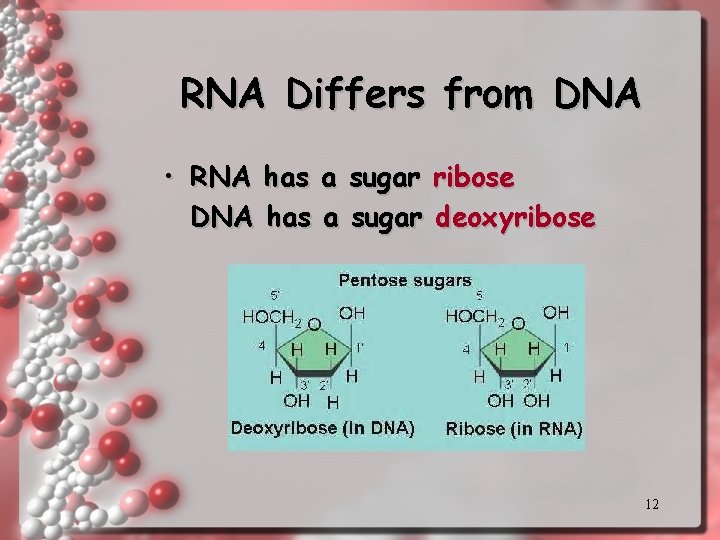
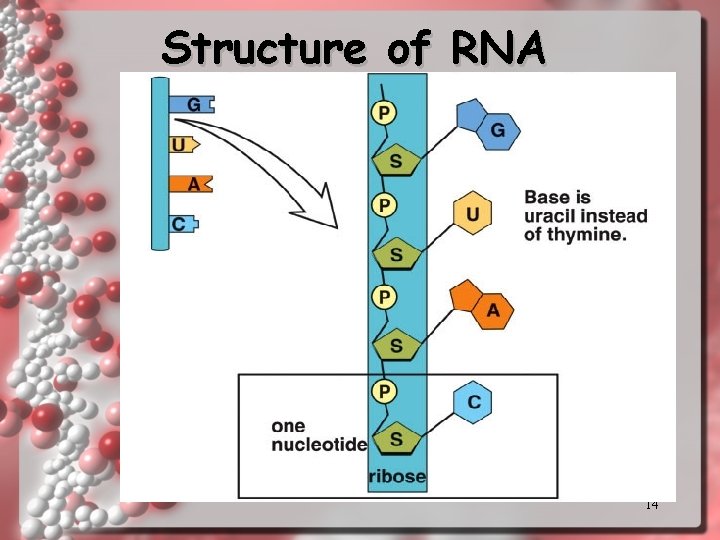
RNA Differs from DNA • RNA has a sugar ribose DNA has a sugar deoxyribose 12
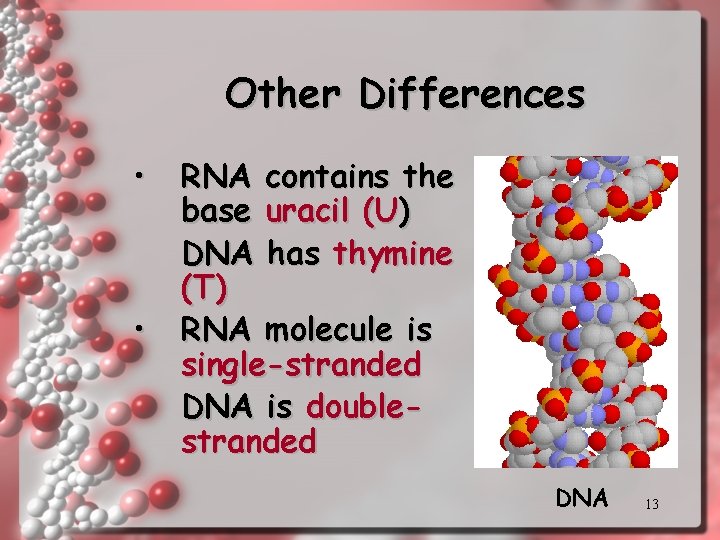
Other Differences • • RNA contains the base uracil (U) DNA has thymine (T) RNA molecule is single-stranded DNA is doublestranded DNA 13
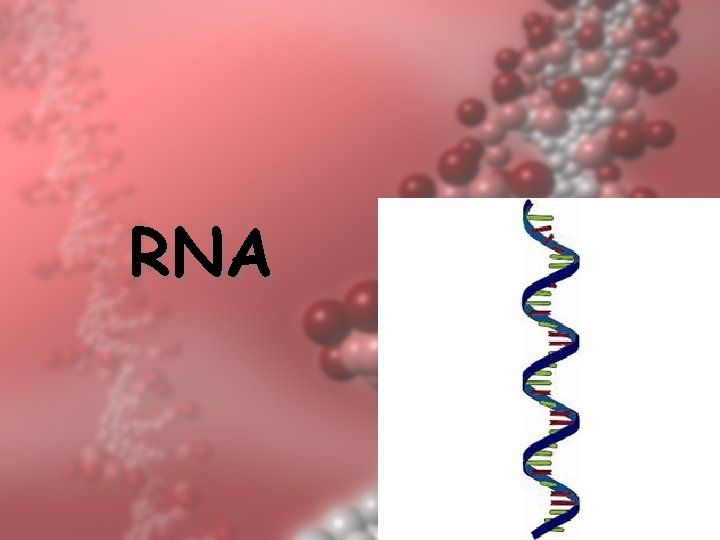
Structure of RNA 14
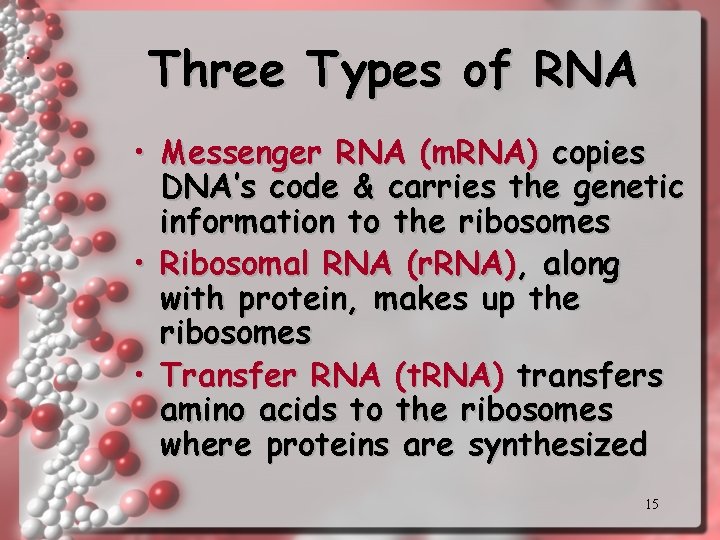
. Three Types of RNA • Messenger RNA (m. RNA) copies DNA’s code & carries the genetic information to the ribosomes • Ribosomal RNA (r. RNA), along with protein, makes up the ribosomes • Transfer RNA (t. RNA) transfers amino acids to the ribosomes where proteins are synthesized 15
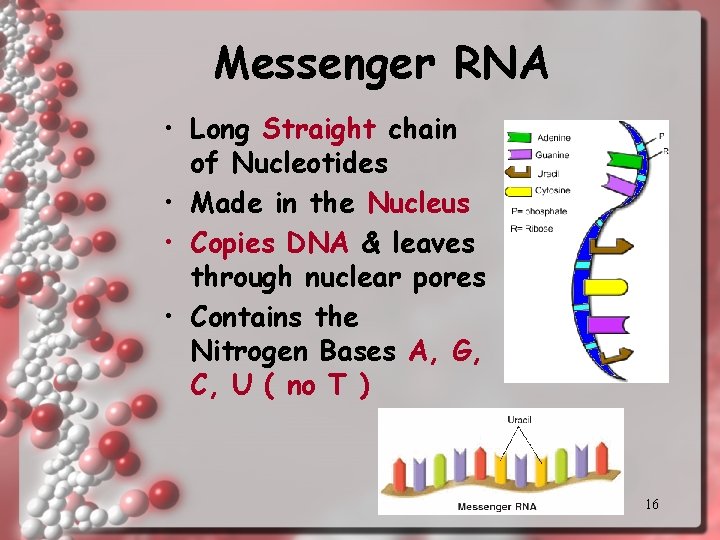
Messenger RNA • Long Straight chain of Nucleotides • Made in the Nucleus • Copies DNA & leaves through nuclear pores • Contains the Nitrogen Bases A, G, C, U ( no T ) 16
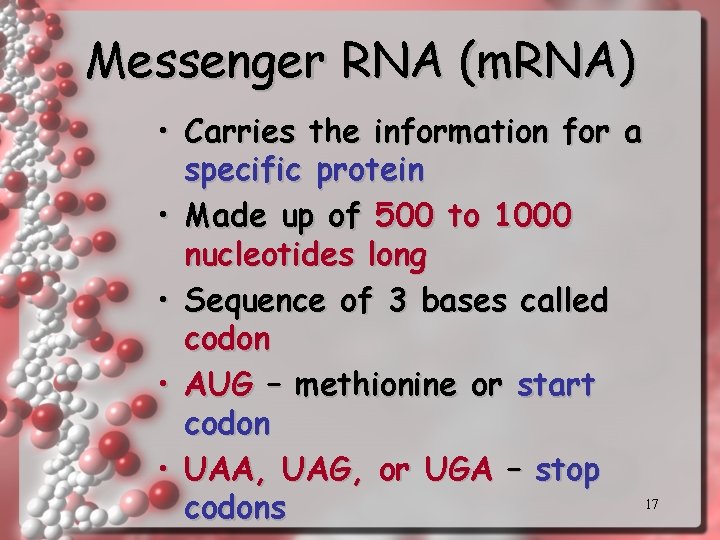
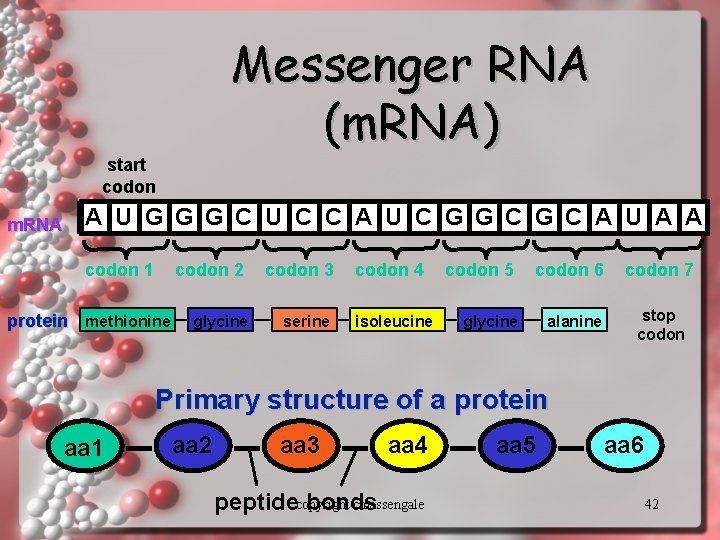
Messenger RNA (m. RNA) • Carries the information for a specific protein • Made up of 500 to 1000 nucleotides long • Sequence of 3 bases called codon • AUG – methionine or start codon • UAA, UAG, or UGA – stop 17 codons
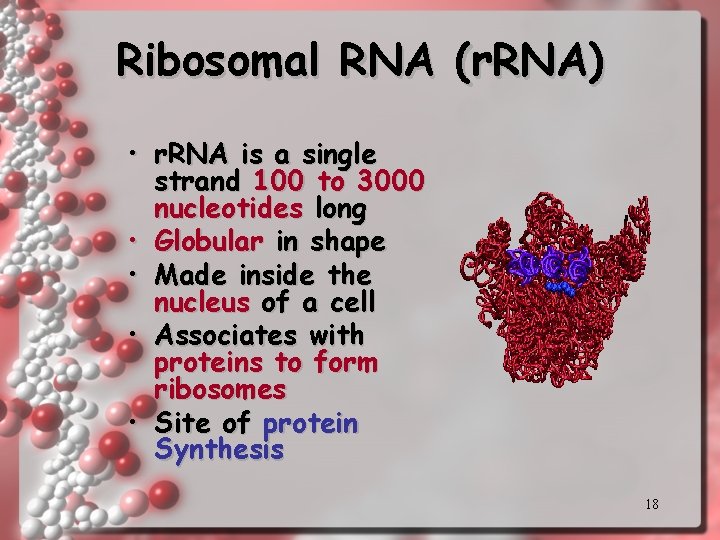
Ribosomal RNA (r. RNA) • r. RNA is a single strand 100 to 3000 nucleotides long • Globular in shape • Made inside the nucleus of a cell • Associates with proteins to form ribosomes • Site of protein Synthesis 18
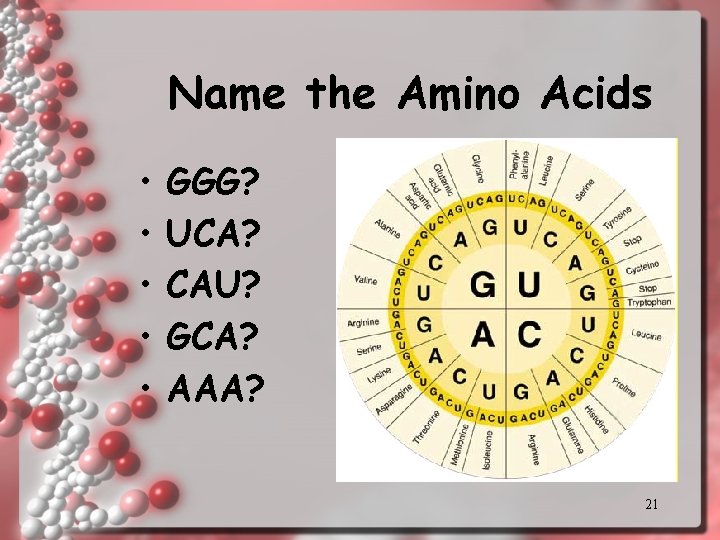
The Genetic Code • A codon designates an amino acid • An amino acid may have more than one codon • There are 20 amino acids, but 64 possible codons • Some codons tell the ribosome to stop translating 19
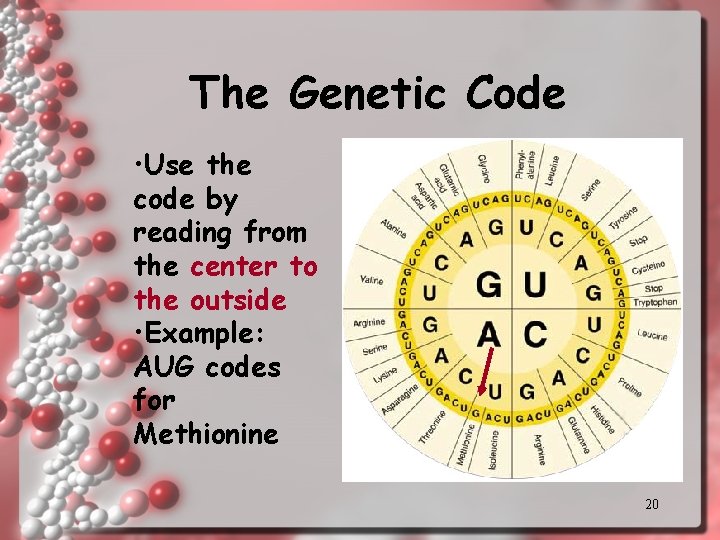
The Genetic Code • Use the code by reading from the center to the outside • Example: AUG codes for Methionine 20
Name the Amino Acids • • • GGG? UCA? CAU? GCA? AAA? 21
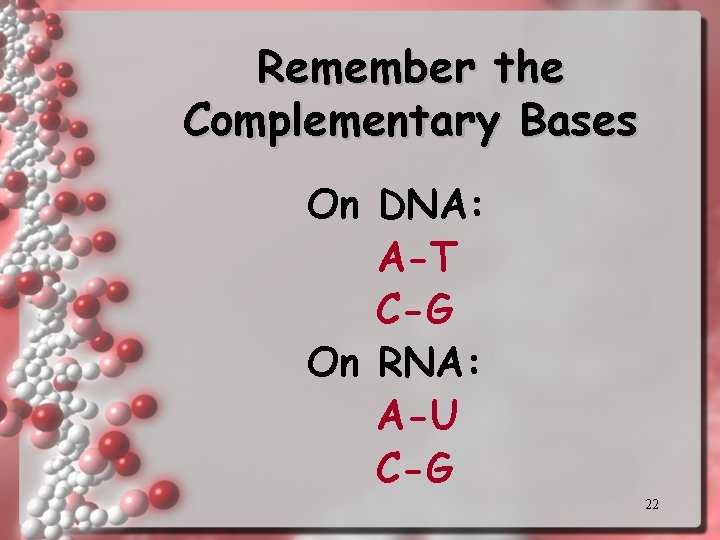
Remember the Complementary Bases On DNA: A-T C-G On RNA: A-U C-G 22
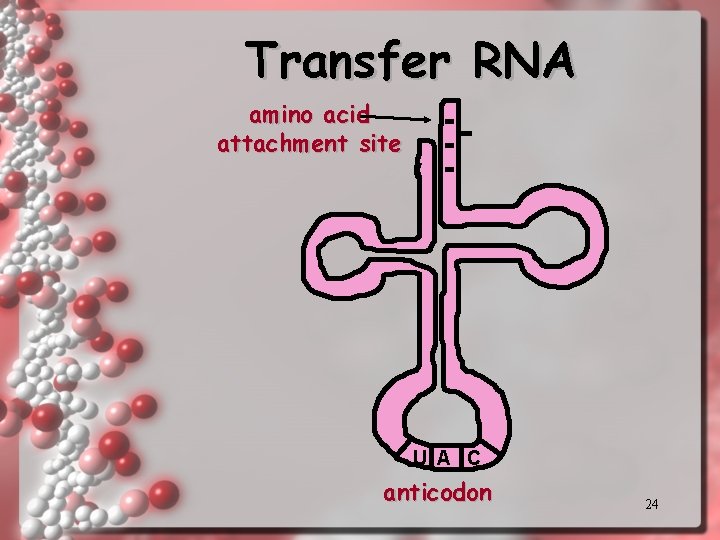
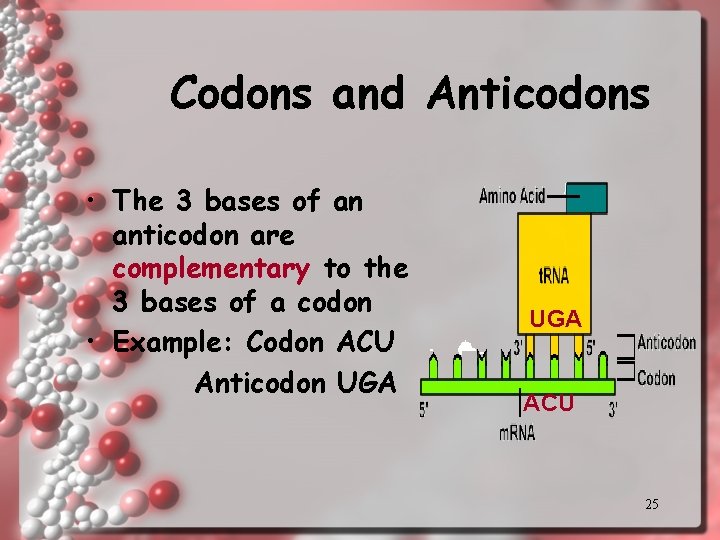
Transfer RNA (t. RNA) • Clover-leaf shape • Single stranded molecule with attachment site at one end for an amino acid • Opposite end has three nucleotide bases called the anticodon 23
Transfer RNA amino acid attachment site U A C anticodon 24
Codons and Anticodons • The 3 bases of an anticodon are complementary to the 3 bases of a codon • Example: Codon ACU Anticodon UGA ACU 25
Transcription and Translation 26
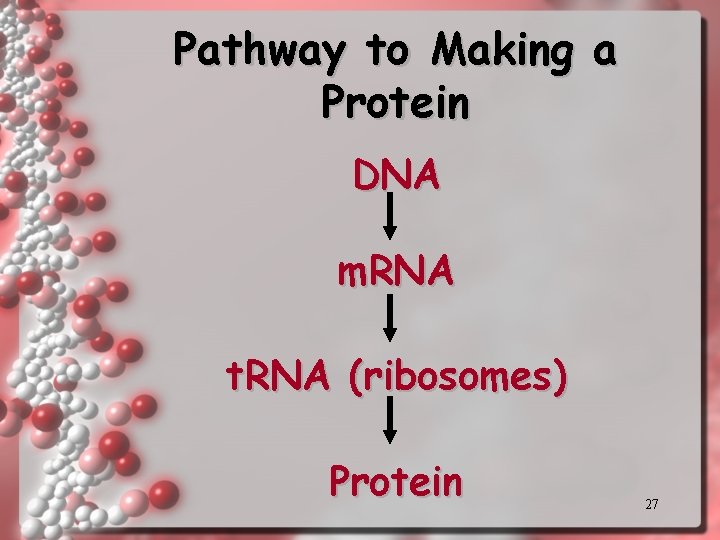
Pathway to Making a Protein DNA m. RNA t. RNA (ribosomes) Protein 27
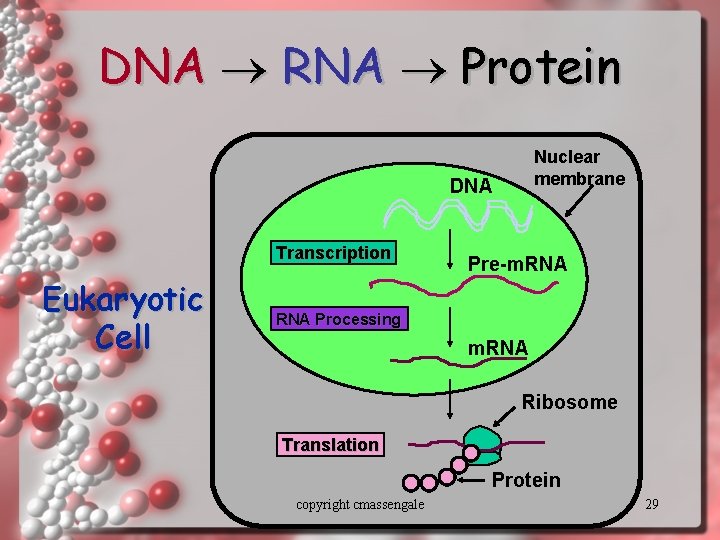
Protein Synthesis § The production or synthesis of polypeptide chains (proteins) § Two phases: Transcription & Translation § m. RNA must be processed before it leaves the nucleus of eukaryotic cells 28
DNA RNA Protein Nuclear membrane DNA Transcription Eukaryotic Cell Pre-m. RNA Processing m. RNA Ribosome Translation Protein copyright cmassengale 29
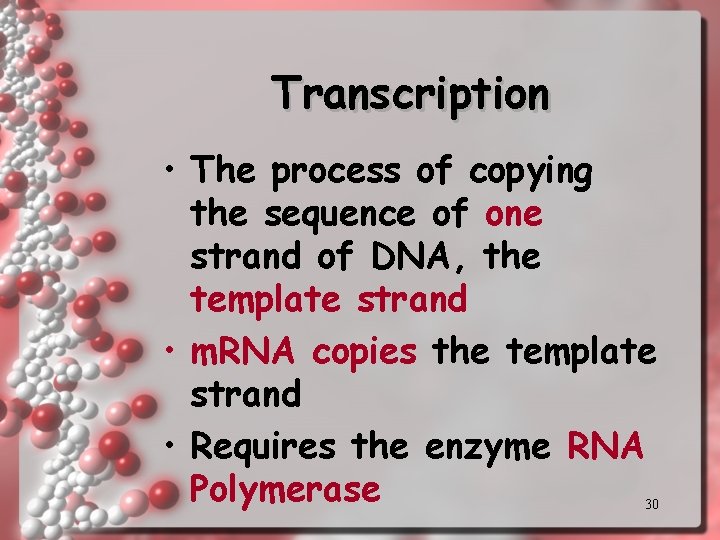
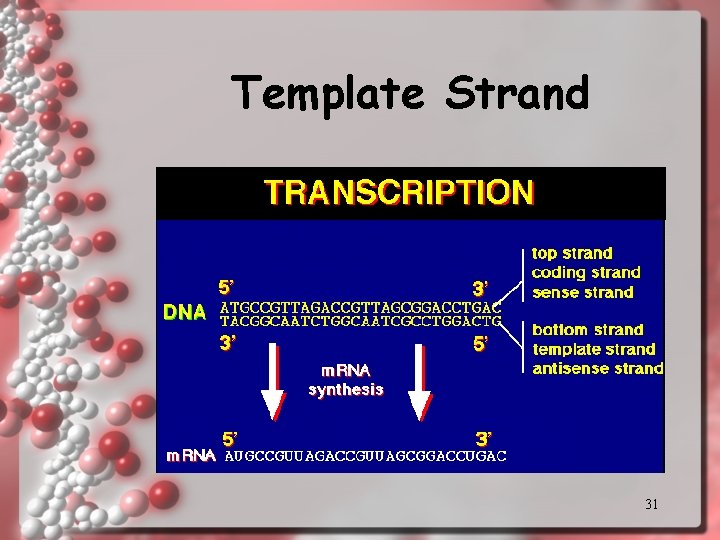
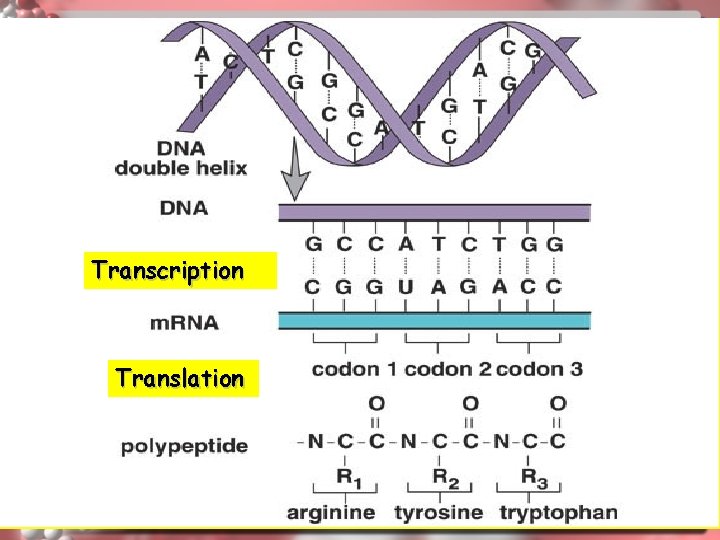
Transcription • The process of copying the sequence of one strand of DNA, the template strand • m. RNA copies the template strand • Requires the enzyme RNA Polymerase 30
Template Strand 31
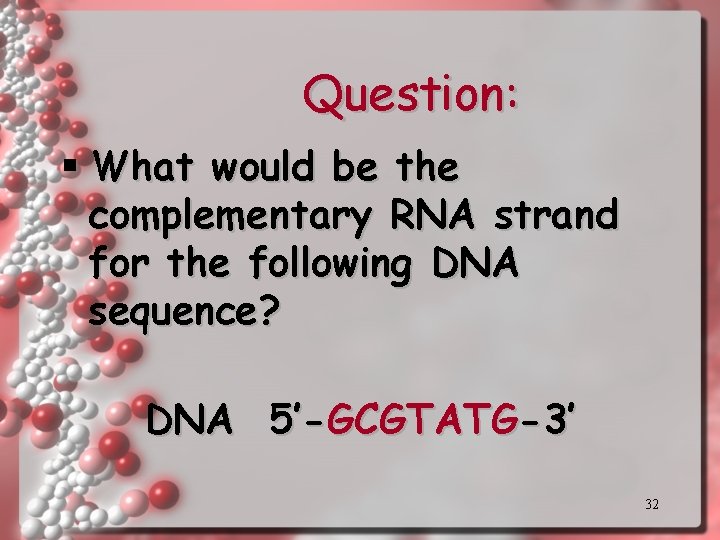
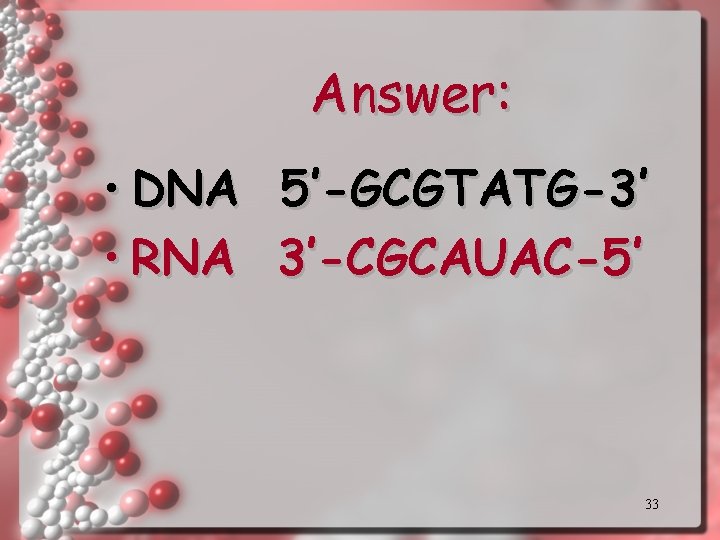
Question: § What would be the complementary RNA strand for the following DNA sequence? DNA 5’-GCGTATG-3’ 32
Answer: • DNA 5’-GCGTATG-3’ • RNA 3’-CGCAUAC-5’ 33
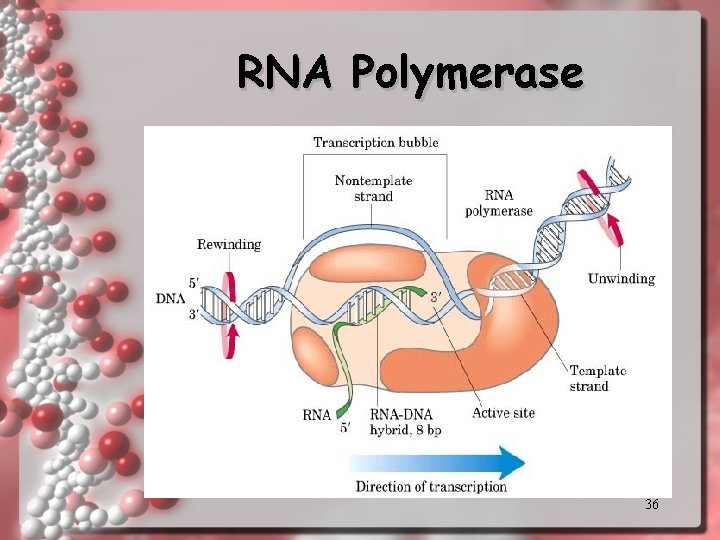
Transcription • During transcription, RNA polymerase binds to DNA and separates the DNA strands • RNA Polymerase then uses one strand of DNA as a template to assemble nucleotides into RNA 34
Transcription • Promoters are regions on DNA that show where RNA Polymerase must bind to begin the Transcription of RNA • Called the TATA box • Specific base sequences act as signals to stop • Called the termination signal 35
RNA Polymerase 36
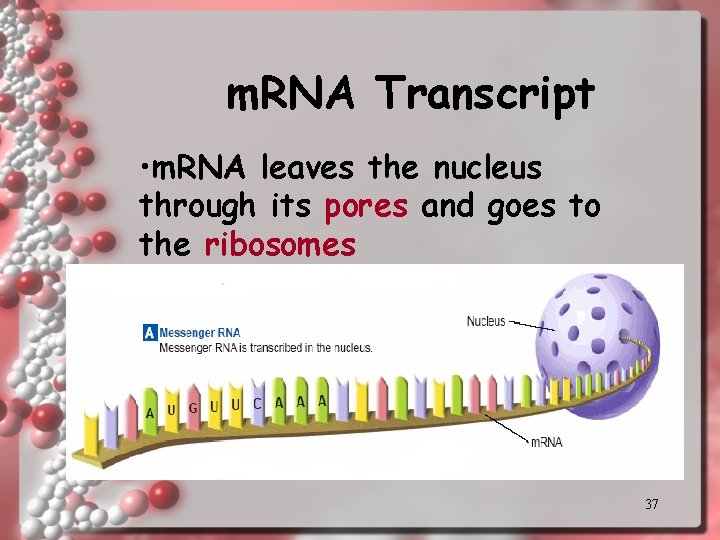
m. RNA Transcript • m. RNA leaves the nucleus through its pores and goes to the ribosomes 37
Translation • Translation is the process of decoding the m. RNA into a polypeptide chain • Ribosomes read m. RNA three bases or 1 codon at a time and construct the proteins 38
Transcription Translation 39
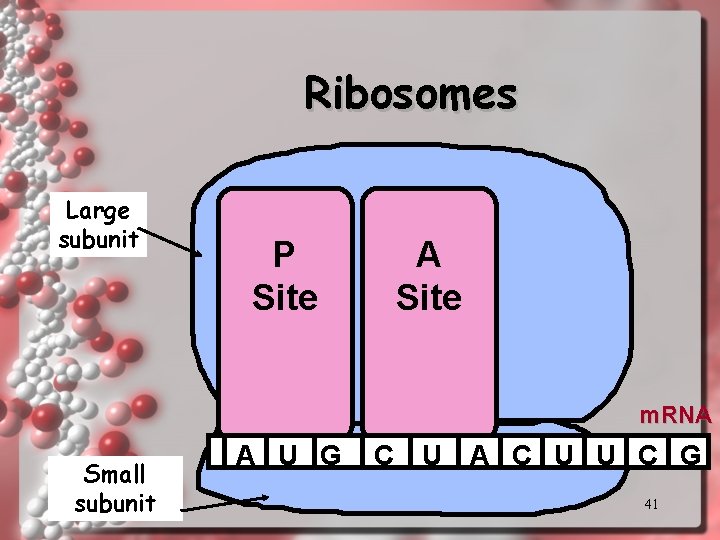
Ribosomes • Made of a large and small subunit • Composed of r. RNA (40%) and proteins (60%) • Have two sites for t. RNA attachment --- P and A 40
Ribosomes Large subunit P Site A Site m. RNA Small subunit A U G C U A C U U C G 41
Messenger RNA (m. RNA) start codon m. RNA A U G G G C U C C A U C G G C A U A A codon 1 protein methionine codon 2 codon 3 glycine serine codon 4 isoleucine codon 5 codon 6 glycine alanine codon 7 stop codon Primary structure of a protein aa 1 aa 2 aa 3 aa 4 cmassengale peptidecopyright bonds aa 5 aa 6 42
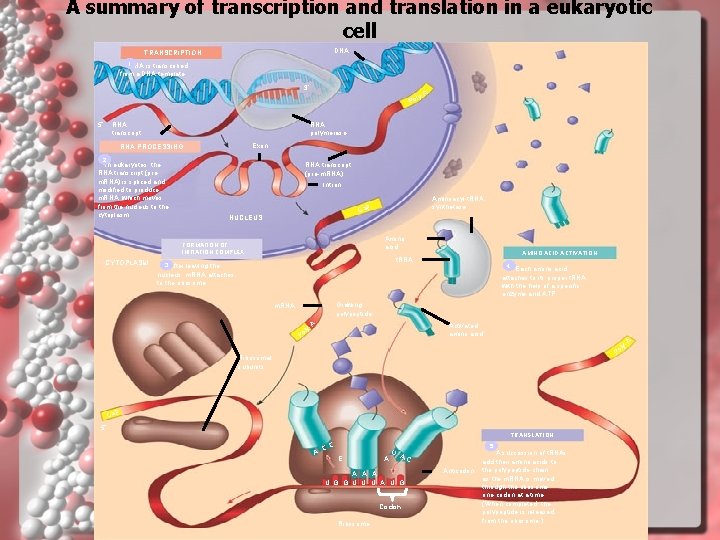
A summary of transcription and translation in a eukaryotic cell DNA TRANSCRIPTION 1 RNA is transcribed from a DNA template. 3 RNA transcript 5 RNA polymerase Exon RNA PROCESSING 2 In eukaryotes, the RNA transcript (prem. RNA) is spliced and modified to produce m. RNA, which moves from the nucleus to the cytoplasm. RNA transcript (pre-m. RNA) Intron Aminoacyl-t. RNA synthetase p Ca NUCLEUS Amino acid FORMATION OF INITIATION COMPLEX CYTOPLASM A ly- Po AMINO ACID ACTIVATION t. RNA 3 After leaving the 4 Each amino acid attaches to its proper t. RNA with the help of a specific enzyme and ATP. nucleus, m. RNA attaches to the ribosome. Growing polypeptide m. RNA A Activated amino acid ly- Po A ly- Po Ribosomal subunits p Ca 5 TRANSLATION A CC E A U 5 AC A A A U G G U U U A U G Figure 17. 26 Codon Ribosome Anticodon A succession of t. RNAs add their amino acids to the polypeptide chain as the m. RNA is moved through the ribosome one codon at a time. (When completed, the polypeptide is released from the ribosome. )