
Protein Structure Determination Lecture 4 Braggs Law and
Protein Structure Determination Lecture 4 -- Bragg’s Law and the Fourier Transform
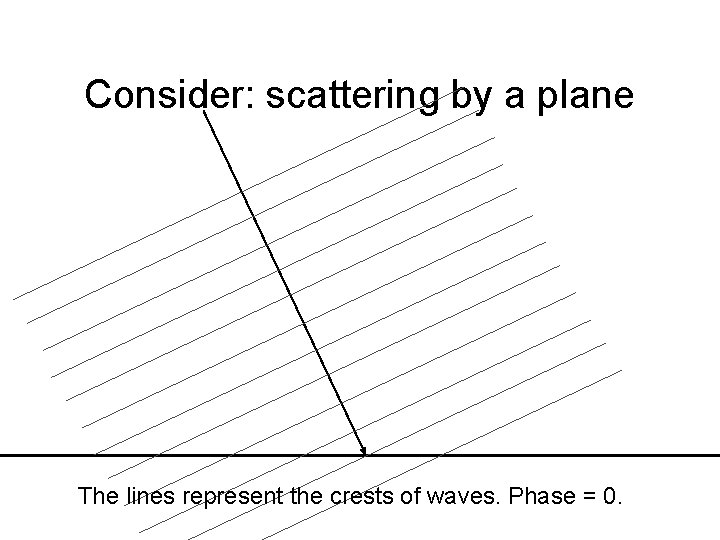
Consider: scattering by a plane The lines represent the crests of waves. Phase = 0.
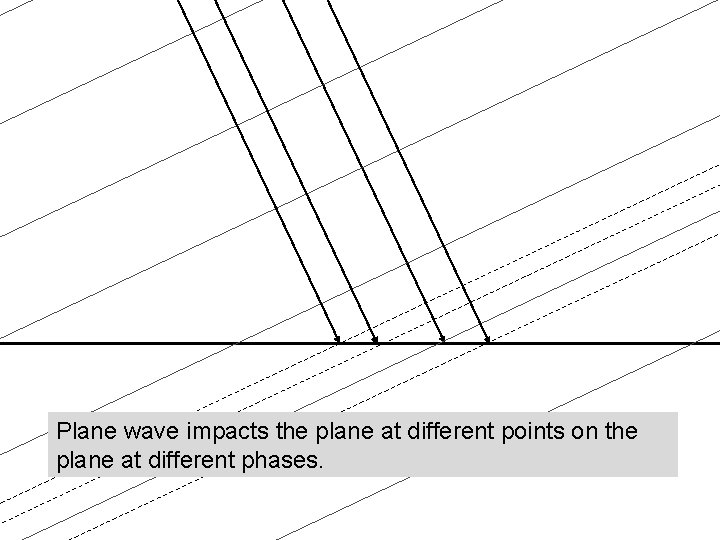
Plane wave impacts the plane at different points on the plane at different phases.
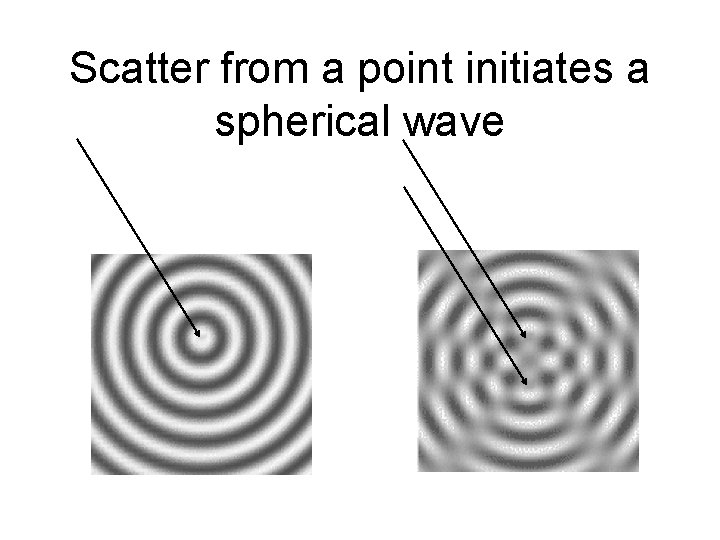
Scatter from a point initiates a spherical wave

Waves scatter from points in all directions, creating interfering sphere waves. The phase of the sphere wave equals the phase of the incident wave at that point.
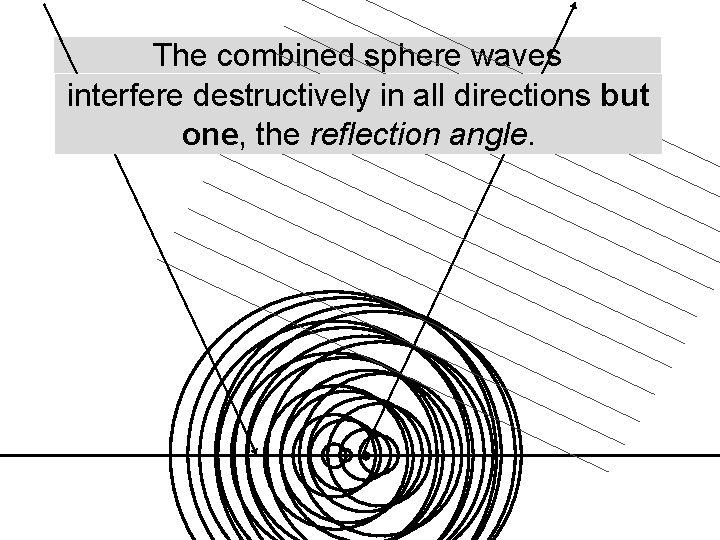
The combined sphere waves interfere destructively in all directions but one, the reflection angle.
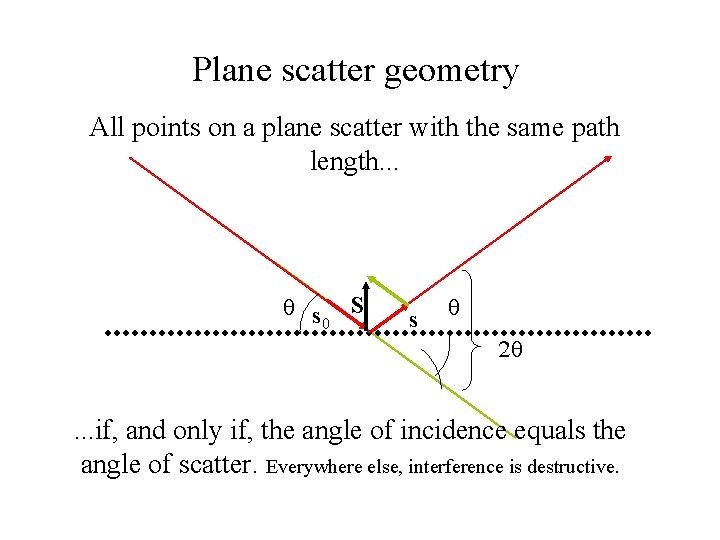
Plane scatter geometry All points on a plane scatter with the same path length. . . s S 0 s . . . if, and only if, the angle of incidence equals the angle of scatter. Everywhere else, interference is destructive.
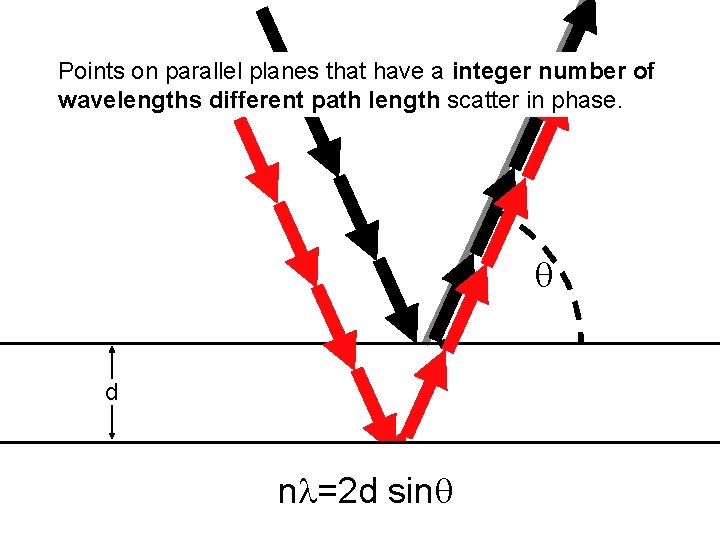
Points on parallel planes that have a integer number of wavelengths different path length scatter in phase. d n =2 d sin
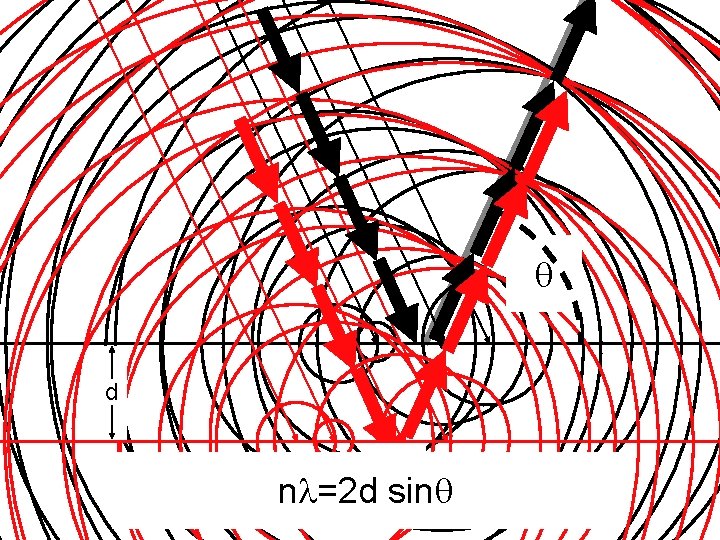
d n =2 d sin
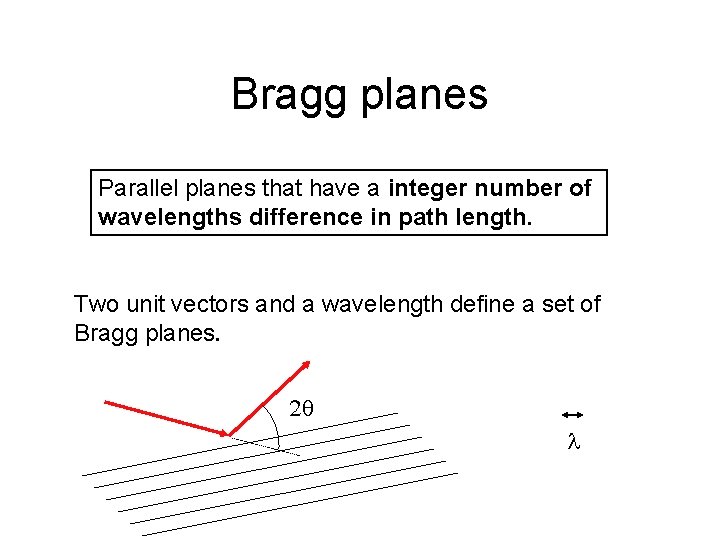
Bragg planes Parallel planes that have a integer number of wavelengths difference in path length. Two unit vectors and a wavelength define a set of Bragg planes.

Sir Lawrence Bragg, winner of 1914 Nobel Prize in Physics Bragg’s law n =2 d sin d path length for this plane is shorter by Planes separated by d scatter in phase. If is larger, d is smaller. d= /2 sin . . . than for this plane.

Path length differences if waves add, then path difference = n d path difference=2 d sin Therefore, n =2 dsin
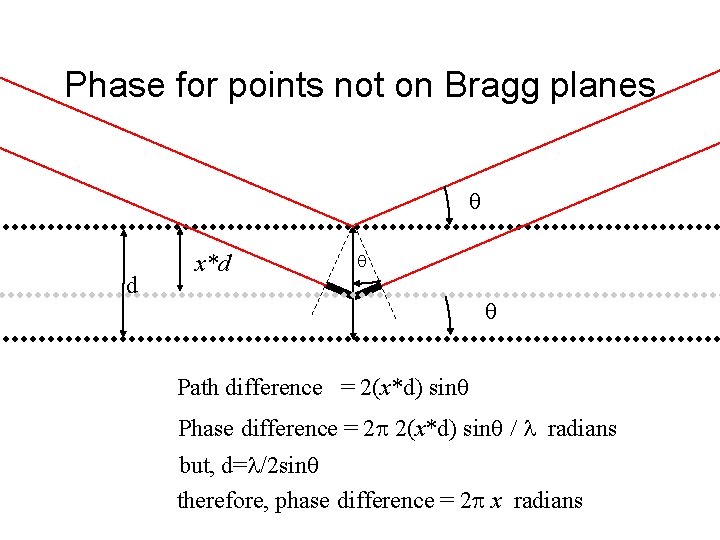
Phase for points not on Bragg planes d x*d Path difference = 2(x*d) sin Phase difference = 2 2(x*d) sin radians but, d= /2 sin therefore, phase difference = 2 x radians
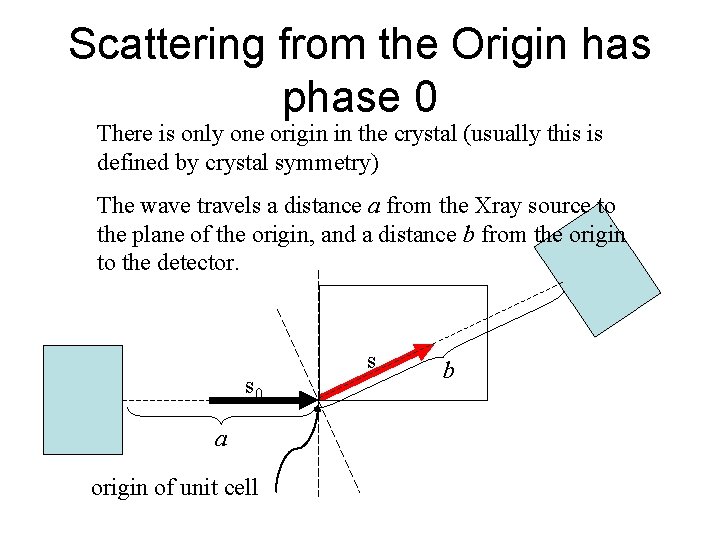
Scattering from the Origin has phase 0 There is only one origin in the crystal (usually this is defined by crystal symmetry) The wave travels a distance a from the Xray source to the plane of the origin, and a distance b from the origin to the detector. s 0 a origin of unit cell s b
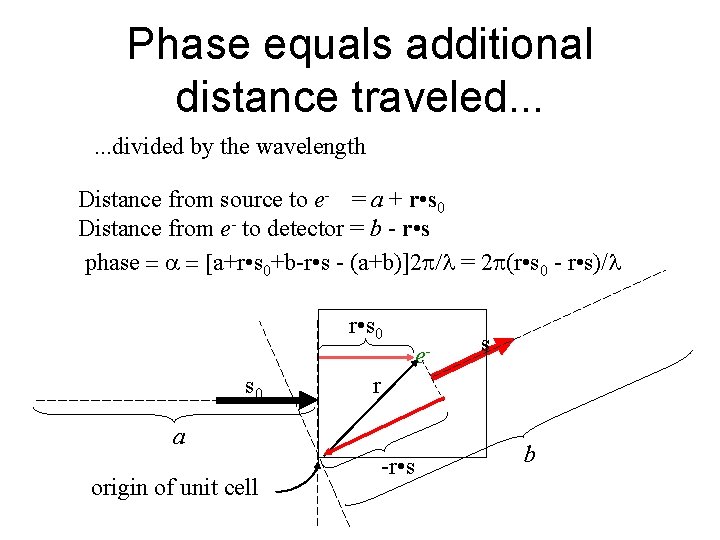
Phase equals additional distance traveled. . . divided by the wavelength Distance from source to e- = a + r • s 0 Distance from e- to detector = b - r • s phase = = [a+r • s 0+b-r • s - (a+b)]2 = 2 (r • s 0 - r • s)/ r • s 0 s r a origin of unit cell e- -r • s b
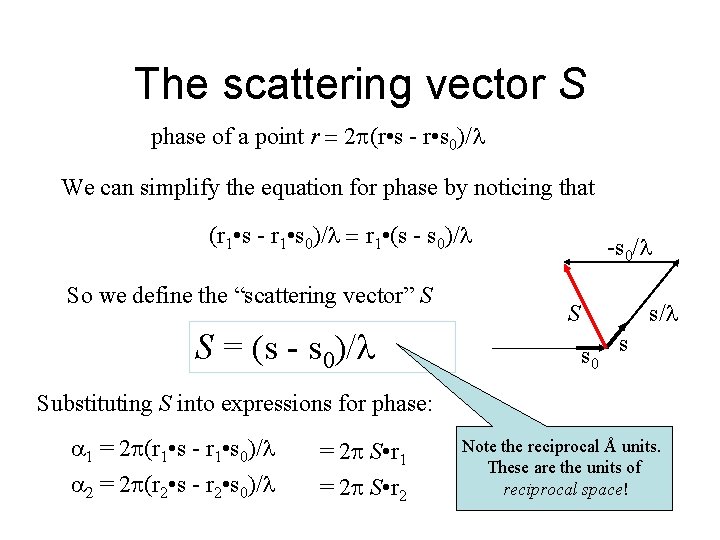
Simplifying slightly The scattering vector S phase of a point r = 2 (r • s - r • s 0)/ We can simplify the equation for phase by noticing that (r 1 • s - r 1 • s 0)/ = r 1 • (s - s 0)/ So we define the “scattering vector” S S = (s - s 0)/ -s 0/ S s/ s 0 s Substituting S into expressions for phase: 1 = 2 (r 1 • s - r 1 • s 0)/ = 2 (r 2 • s - r 2 • s 0)/ = 2 S • r 1 = 2 S • r 2 Note the reciprocal Å units. These are the units of reciprocal space!
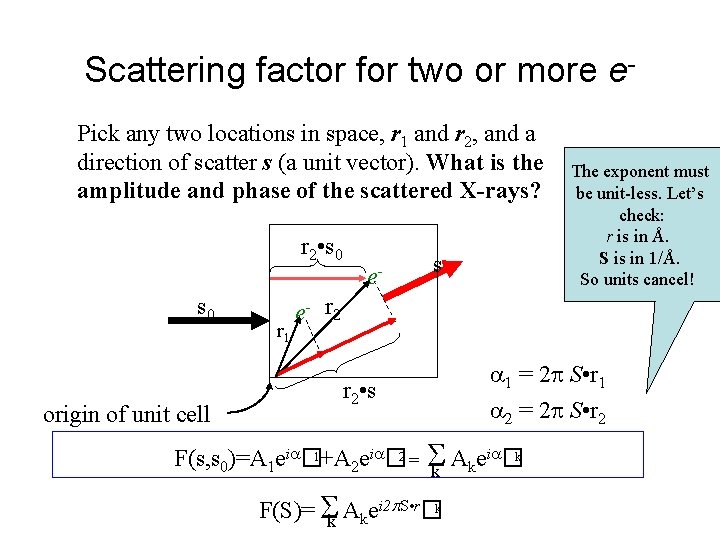
Scattering factor for two or more e. Pick any two locations in space, r 1 and r 2, and a direction of scatter s (a unit vector). What is the amplitude and phase of the scattered X-rays? r 2 • s 0 origin of unit cell r 1 e- s The exponent must be unit-less. Let’s check: r is in Å. S is in 1/Å. So units cancel! e - r 2 • s 1 = 2 S • r 1 = 2 S • r 2 i � k F(s, s 0)=A 1 ei � 1+A 2 ei � 2 = A e k k F(S)= k Akei 2 p. S • r�k
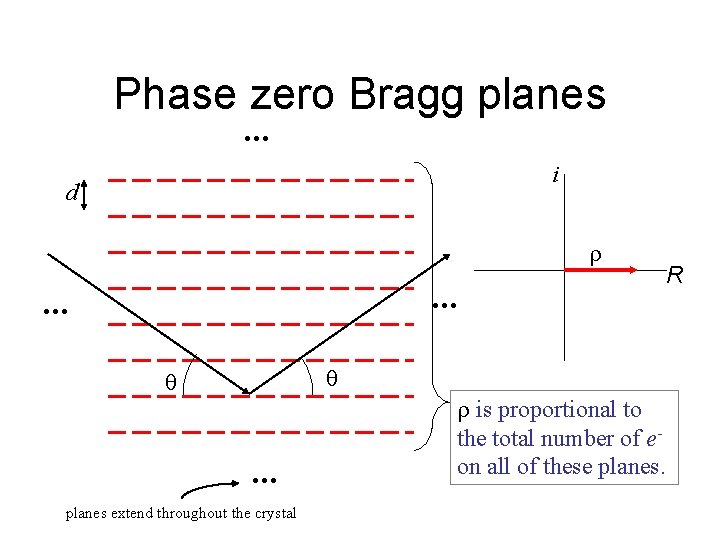
Phase zero Bragg planes. . . i d . . . planes extend throughout the crystal is proportional to the total number of eon all of these planes. R
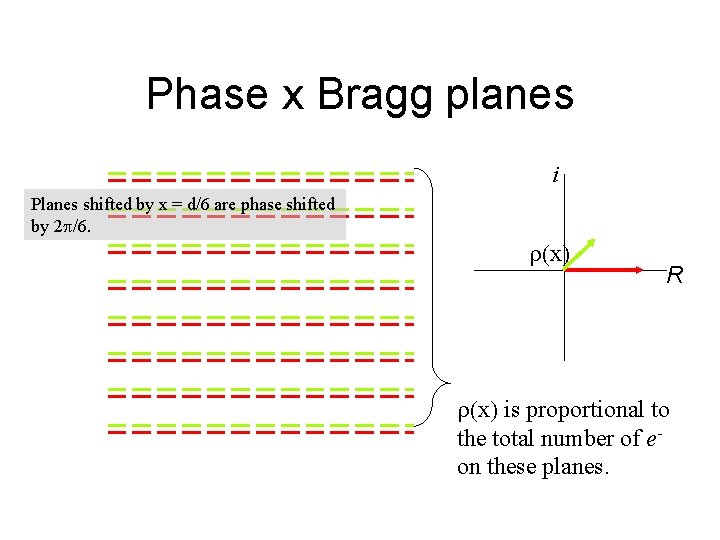
Phase x Bragg planes i Planes shifted by x = d/6 are phase shifted by 2 /6. x R x is proportional to the total number of eon these planes.

Integrating Bragg planes from x=0 to 1 i R i The total F is the wave sum over all Bragg planes. F F= (x)e 2 ix R

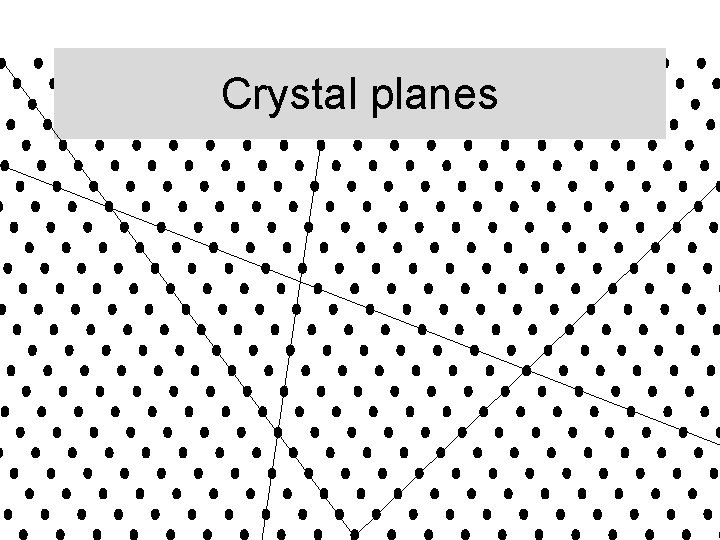
Bragg planes versus crystal planes
Crystal planes
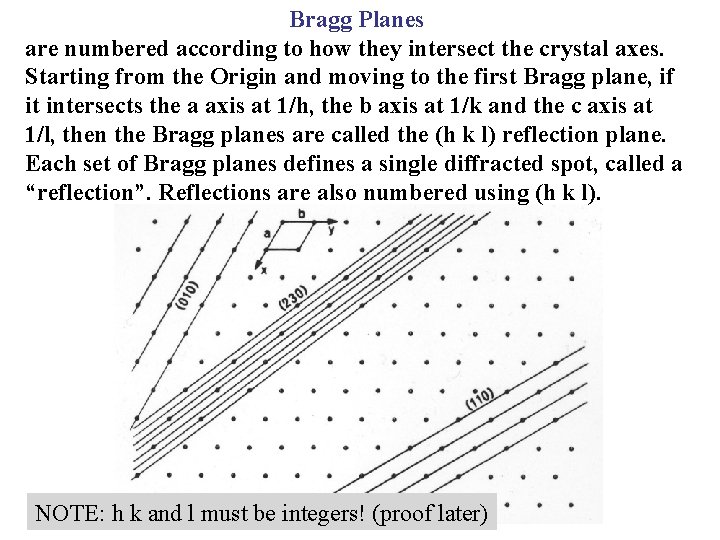
Bragg Planes are numbered according to how they intersect the crystal axes. Starting from the Origin and moving to the first Bragg plane, if it intersects the a axis at 1/h, the b axis at 1/k and the c axis at 1/l, then the Bragg planes are called the (h k l) reflection plane. Each set of Bragg planes defines a single diffracted spot, called a “reflection”. Reflections are also numbered using (h k l). NOTE: h k and l must be integers! (proof later)
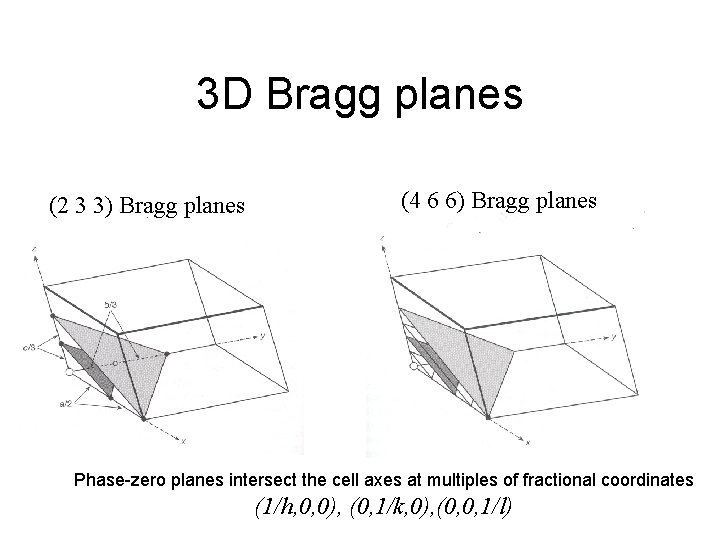
3 D Bragg planes (2 3 3) Bragg planes (4 6 6) Bragg planes Phase-zero planes intersect the cell axes at multiples of fractional coordinates (1/h, 0, 0), (0, 1/k, 0), (0, 0, 1/l)

Proof: The only Bragg planes that diffract X-rays are those that match crystal planes In other words, if we have seen a reflection on the film, that reflection corresponds to a set of crystal planes. Since all crystal planes pass through the unit cell origins, and since the phase of the Origin can be set to zero, all (observable) Bragg planes of phase zero pass through the Origins
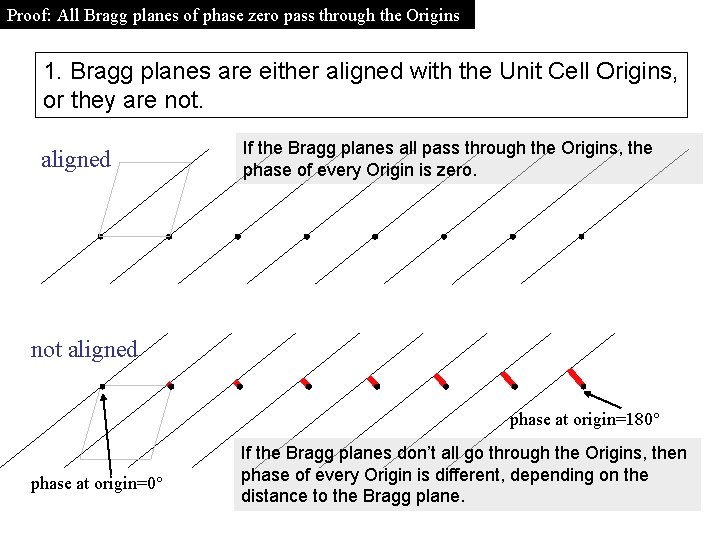
Proof: All Bragg planes of phase zero pass through the Origins 1. Bragg planes are either aligned with the Unit Cell Origins, or they are not. aligned If the Bragg planes all pass through the Origins, the phase of every Origin is zero. not aligned phase at origin=180° phase at origin=0° If the Bragg planes don’t all go through the Origins, then phase of every Origin is different, depending on the distance to the Bragg plane.

Proof: All Bragg planes of phase zero pass through the Origins 2. All planes that pass through the Origins have the same number of electrons The angle and intercept with the Unit Cell determine with atoms are on the plane. 3. All planes that pass through the Origins contribute the same amplitude. . because amplitude is proportional to number of electrons, and (statement 2).
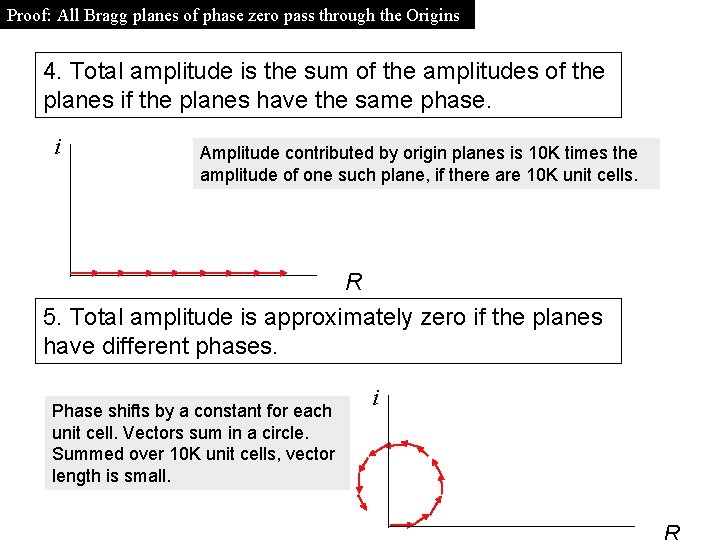
Proof: All Bragg planes of phase zero pass through the Origins 4. Total amplitude is the sum of the amplitudes of the planes if the planes have the same phase. i Amplitude contributed by origin planes is 10 K times the amplitude of one such plane, if there are 10 K unit cells. R 5. Total amplitude is approximately zero if the planes have different phases. Phase shifts by a constant for each unit cell. Vectors sum in a circle. Summed over 10 K unit cells, vector length is small. i
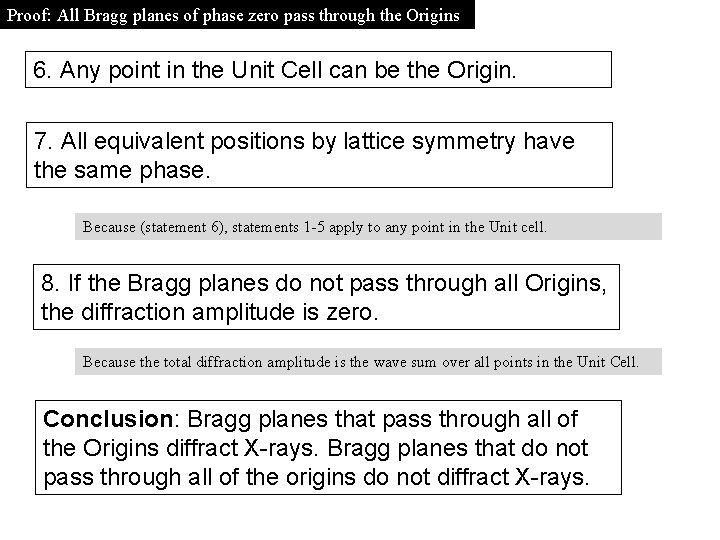
Proof: All Bragg planes of phase zero pass through the Origins 6. Any point in the Unit Cell can be the Origin. 7. All equivalent positions by lattice symmetry have the same phase. Because (statement 6), statements 1 -5 apply to any point in the Unit cell. 8. If the Bragg planes do not pass through all Origins, the diffraction amplitude is zero. Because the total diffraction amplitude is the wave sum over all points in the Unit Cell. Conclusion: Bragg planes that pass through all of the Origins diffract X-rays. Bragg planes that do not pass through all of the origins do not diffract X-rays.
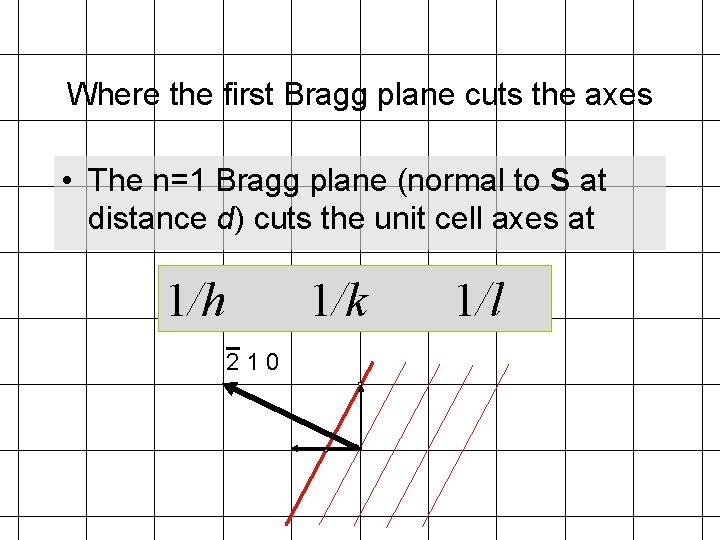
Where the first Bragg plane cuts the axes • The n=1 Bragg plane (normal to S at distance d) cuts the unit cell axes at 1/h 210 1/k 1/l
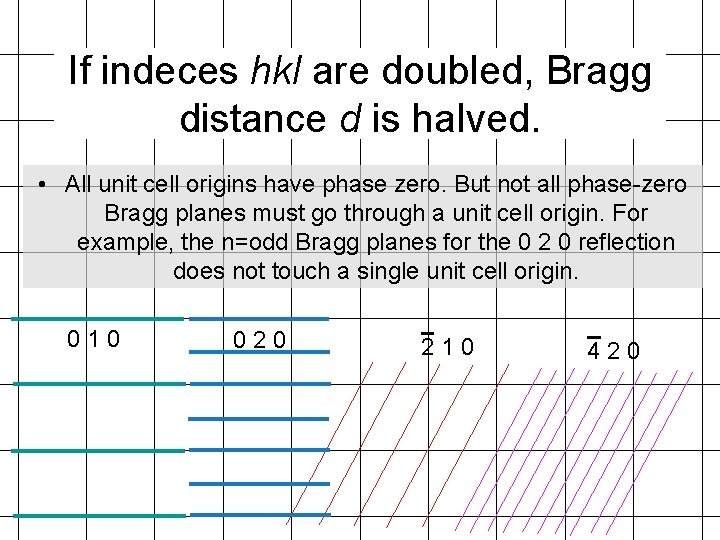
If indeces hkl are doubled, Bragg distance d is halved. • All unit cell origins have phase zero. But not all phase-zero Bragg planes must go through a unit cell origin. For example, the n=odd Bragg planes for the 0 2 0 reflection does not touch a single unit cell origin. 010 020 210 420
Calculating the structure factors • Draw a plane that intersects the unit cell axes at 1/h, 1/k, and 1/l (careful to consider the sign of h, k, l) • Measure the phase of each atom as its distance from the nearest Bragg plane, divided by d and multiplied by 360°. • Draw the scattering factor for that atom, and sum the scattering factors to get the structure factor.
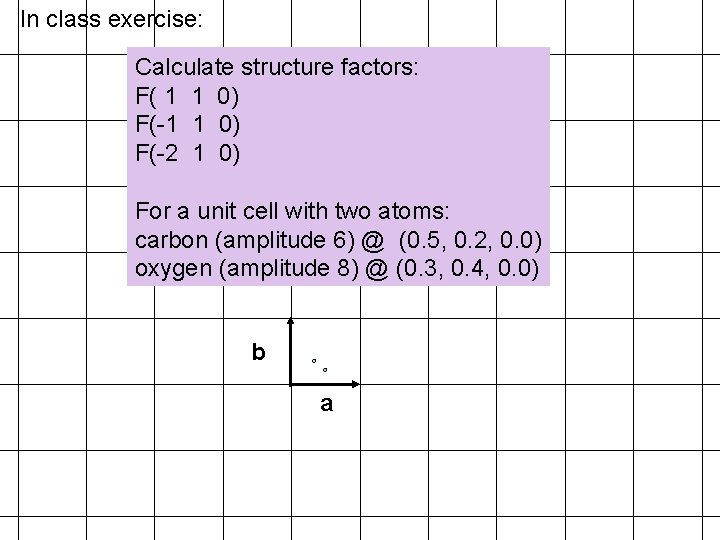
In class exercise: Calculate structure factors: F( 1 1 0) F(-2 1 0) For a unit cell with two atoms: carbon (amplitude 6) @ (0. 5, 0. 2, 0. 0) oxygen (amplitude 8) @ (0. 3, 0. 4, 0. 0) b a
Calculating the density • Given the structure factors F(hkl), find the point(s) of maximum e-density. F(hkl) = |F(hkl)|ei • Draw Bragg planes with phase = (Measure phase in the direction (h, k, l)) • Erase Bragg planes with phase = +180° • After drawing and erasing all F’s, the darkest areas are the locations of the atoms.
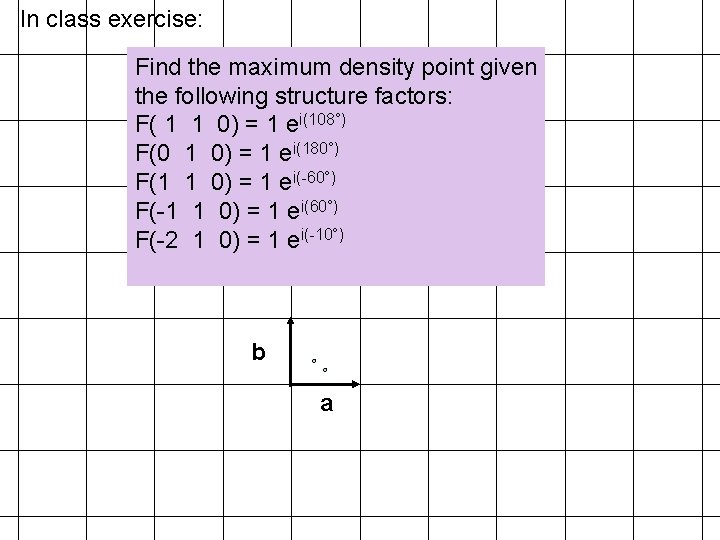
In class exercise: Find the maximum density point given the following structure factors: F( 1 1 0) = 1 ei(108°) F(0 1 0) = 1 ei(180°) F(1 1 0) = 1 ei(-60°) F(-1 1 0) = 1 ei(60°) F(-2 1 0) = 1 ei(-10°) b a
- Slides: 36