
Protein Structure Cells and Proteins Unit 1 Advanced
- Slides: 8
Protein Structure Cells and Proteins Unit 1 Advanced Higher Miss Aitken Textbook P 18 -19
Protein Structure • After a polypeptide has gone through posttranslational modification, it must be folded to make the final protein shape. • Polypeptides go through up to 4 levels of folding to become a protein.
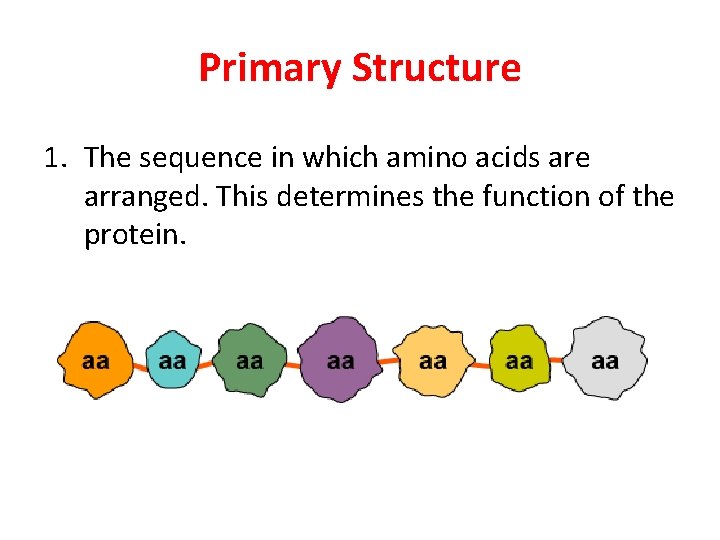
Primary Structure 1. The sequence in which amino acids are arranged. This determines the function of the protein.
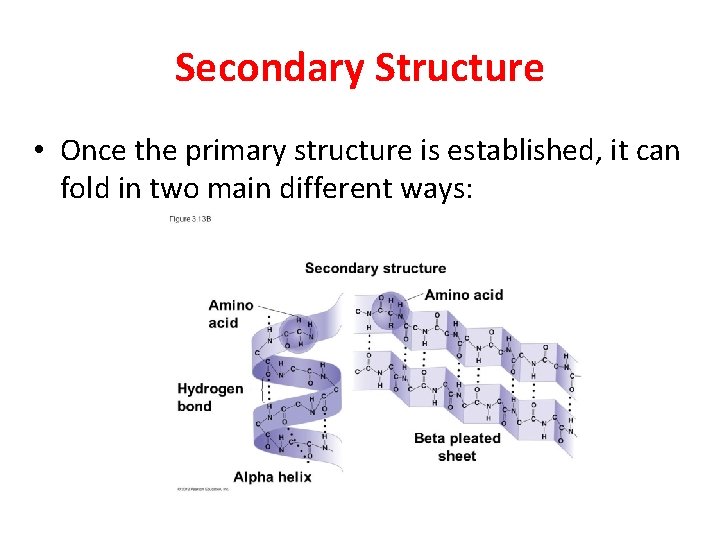
Secondary Structure • Once the primary structure is established, it can fold in two main different ways:
Tertiary Structure • For many proteins, the final folded shape is the tertiary structure. This is 3 dimensional and is caused by interactions between R groups of amino acids. • There are 4 types of interactions which will affect the tertiary structure: – Hydrophobic interactions – Ionic bonds – Van der Waals interactions – Disulphide bridges
Tertiary Structure • Tertiary structure is affected by changes in temperature and p. H. • A higher temperature will cause the structure to become destablised as the chain “shakes” which breaks weak bonds. • A change in p. H will affect the ionisation of the acidic and basic R groups and changes the charge they carry so they no longer bond correctly.
Quaternary Structure • This is where the polypeptide unit may join with other units. • Examples: – Collagen – made of 3 subunits – Haemoglobin – made of 4 subunits
Prosthetic Groups • A non-protein strongly bound to one or more poly peptide units within the protein. • Example: – Haemoglobin – made of 4 subunits of protein and one “haem” group – made of Iron.