
Protein Structural Prediction Performance of Structure Prediction Methods

![Related Work • NP-hard [Akutsu, 1997; Pierce et al. , 2002] and NP-complete to](https://slidetodoc.com/presentation_image_h2/2e5760871d71ae3dd6f148d9325041a0/image-17.jpg "Related Work • NP-hard [Akutsu, 1997; Pierce et al. , 2002] and NP-complete to")
![Tree Decomposition [Robertson & Seymour, 1986] • Definition. A tree decomposition (T, X) of](https://slidetodoc.com/presentation_image_h2/2e5760871d71ae3dd6f148d9325041a0/image-21.jpg "Tree Decomposition [Robertson & Seymour, 1986] • Definition. A tree decomposition (T, X) of")
![Tree Decomposition [Robertson & Seymour, 1986] Greedy: minimum degree heuristic b f d c](https://slidetodoc.com/presentation_image_h2/2e5760871d71ae3dd6f148d9325041a0/image-22.jpg "Tree Decomposition [Robertson & Seymour, 1986] Greedy: minimum degree heuristic b f d c")
- Slides: 27
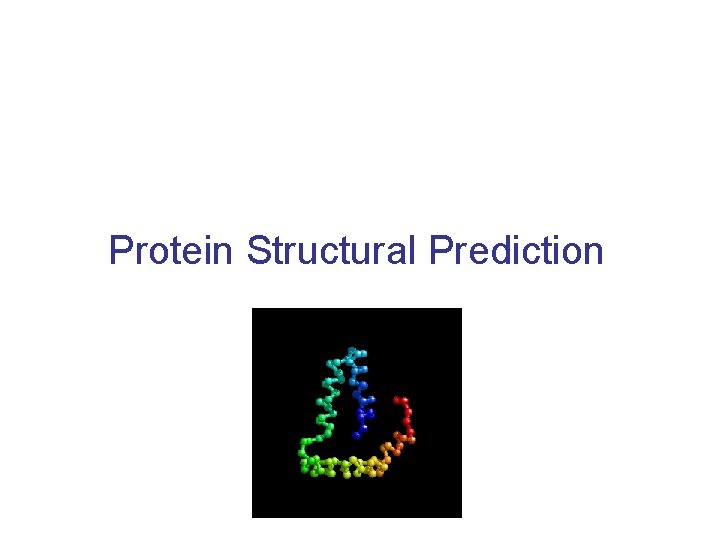
Protein Structural Prediction
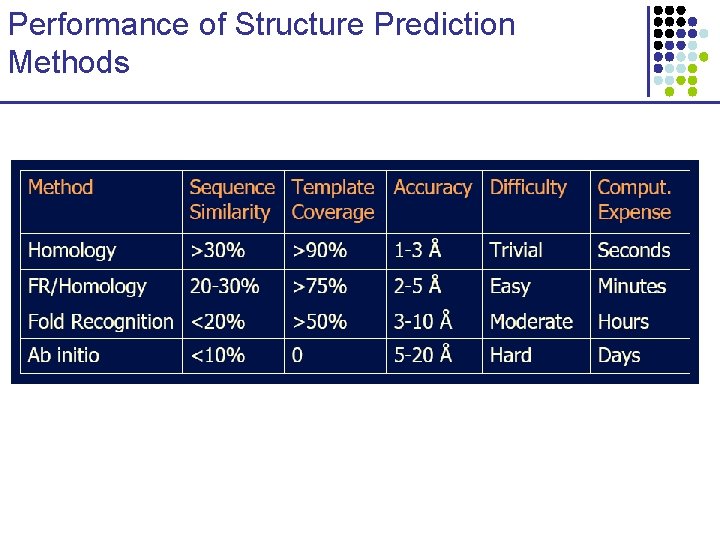
Performance of Structure Prediction Methods
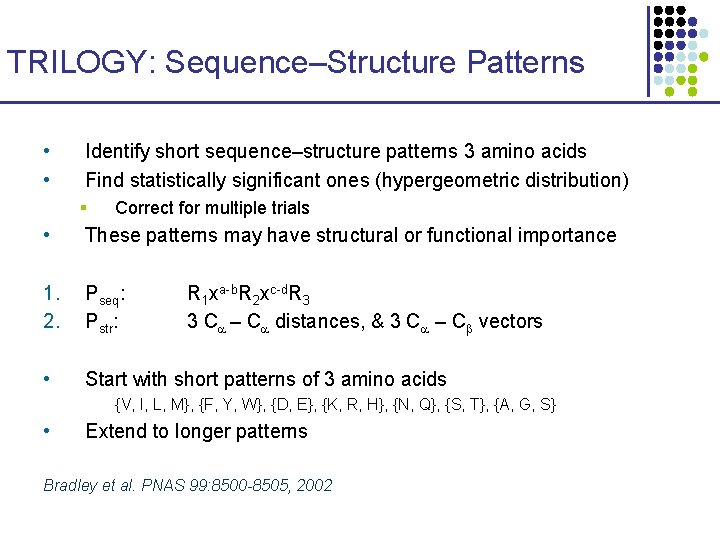
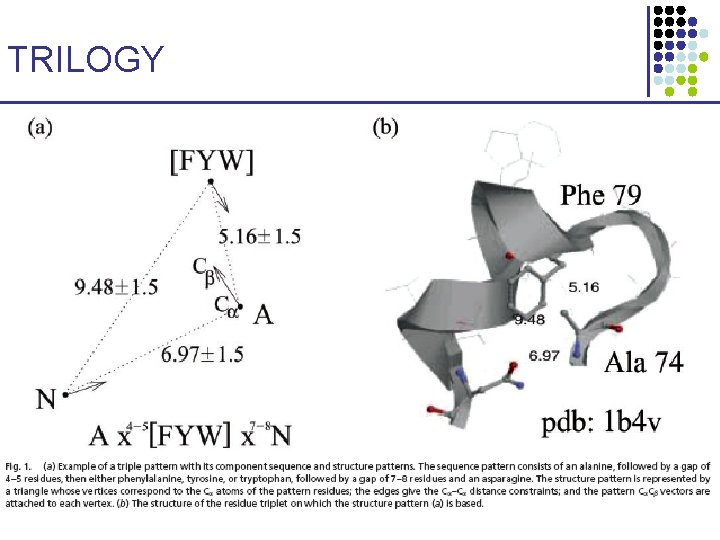
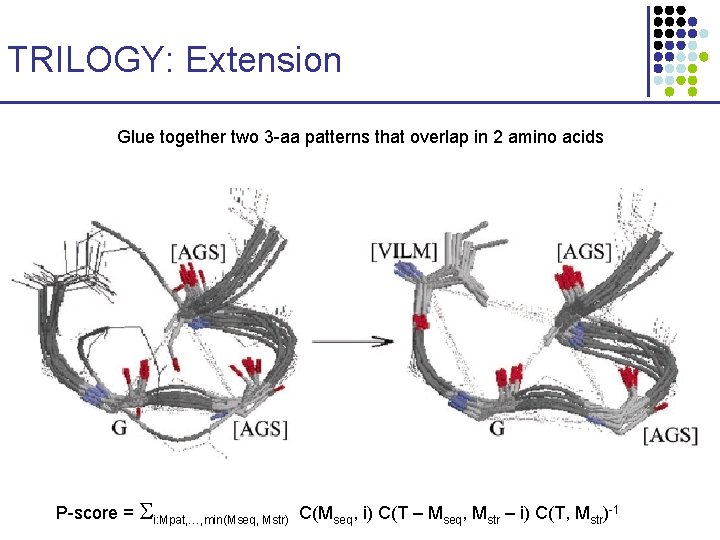
TRILOGY: Sequence–Structure Patterns • • Identify short sequence–structure patterns 3 amino acids Find statistically significant ones (hypergeometric distribution) § Correct for multiple trials • These patterns may have structural or functional importance 1. 2. Pseq: Pstr: • Start with short patterns of 3 amino acids R 1 xa-b. R 2 xc-d. R 3 3 C – C distances, & 3 C – C vectors {V, I, L, M}, {F, Y, W}, {D, E}, {K, R, H}, {N, Q}, {S, T}, {A, G, S} • Extend to longer patterns Bradley et al. PNAS 99: 8500 -8505, 2002
TRILOGY
TRILOGY: Extension Glue together two 3 -aa patterns that overlap in 2 amino acids P-score = i: Mpat, …, min(Mseq, Mstr) C(Mseq, i) C(T – Mseq, Mstr – i) C(T, Mstr)-1
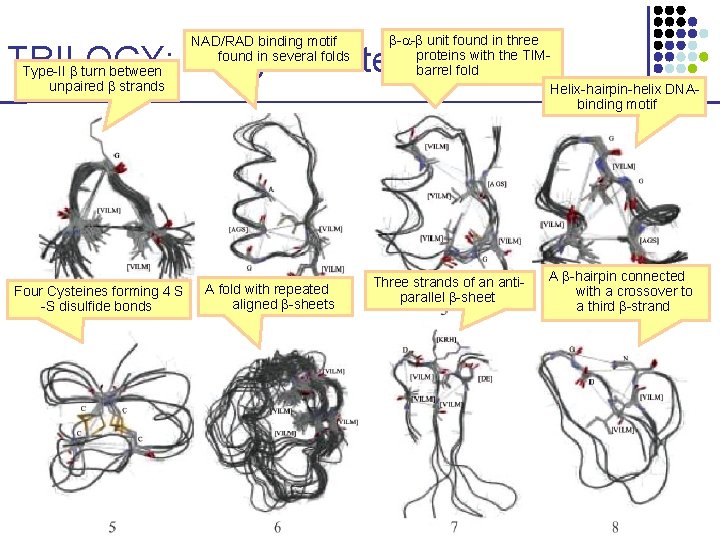
NAD/RAD binding motif found in several folds - - unit found in three proteins with the TIMbarrel fold Helix-hairpin-helix DNAbinding motif TRILOGY: Longer Patterns Type-II turn between unpaired strands Four Cysteines forming 4 S -S disulfide bonds A fold with repeated aligned -sheets Three strands of an antiparallel -sheet A -hairpin connected with a crossover to a third -strand
Small Libraries of Structural Fragments for Representing Protein Structures
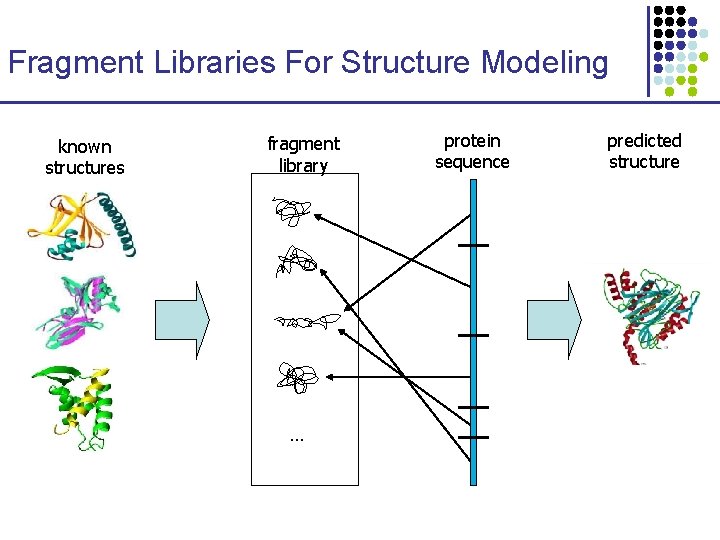
Fragment Libraries For Structure Modeling known structures fragment library … protein sequence predicted structure
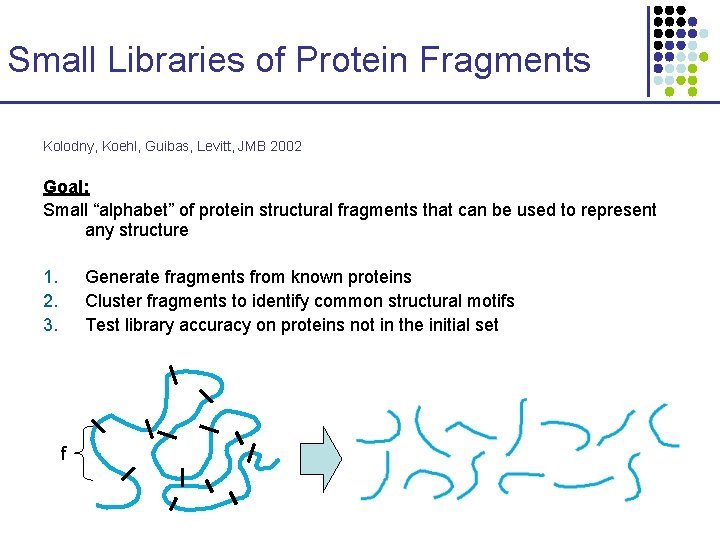
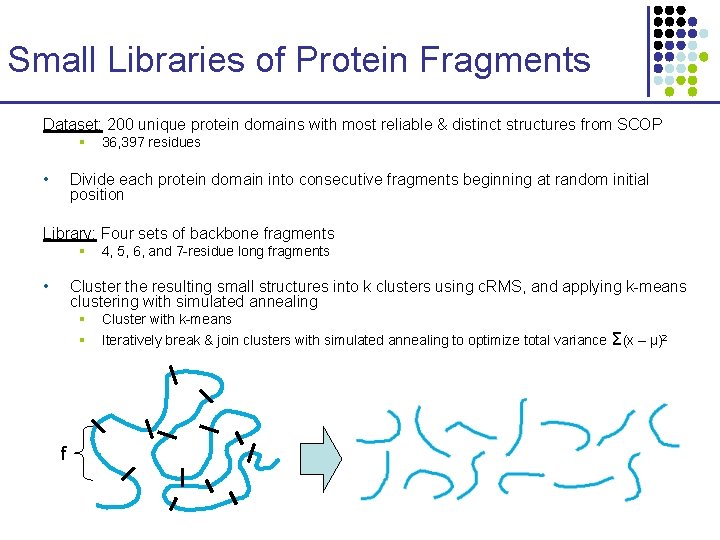
Small Libraries of Protein Fragments Kolodny, Koehl, Guibas, Levitt, JMB 2002 Goal: Small “alphabet” of protein structural fragments that can be used to represent any structure 1. 2. 3. Generate fragments from known proteins Cluster fragments to identify common structural motifs Test library accuracy on proteins not in the initial set f
Small Libraries of Protein Fragments Dataset: 200 unique protein domains with most reliable & distinct structures from SCOP § • 36, 397 residues Divide each protein domain into consecutive fragments beginning at random initial position Library: Four sets of backbone fragments § • 4, 5, 6, and 7 -residue long fragments Cluster the resulting small structures into k clusters using c. RMS, and applying k-means clustering with simulated annealing § § f Cluster with k-means Iteratively break & join clusters with simulated annealing to optimize total variance Σ(x – μ)2
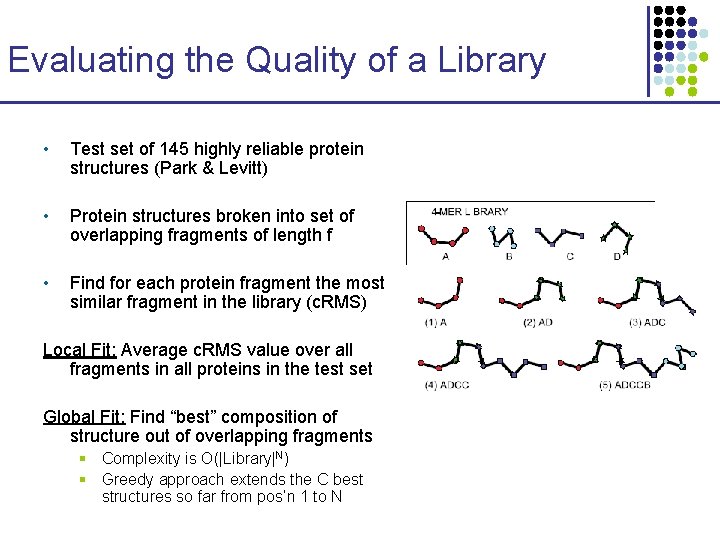
Evaluating the Quality of a Library • Test set of 145 highly reliable protein structures (Park & Levitt) • Protein structures broken into set of overlapping fragments of length f • Find for each protein fragment the most similar fragment in the library (c. RMS) Local Fit: Average c. RMS value over all fragments in all proteins in the test set Global Fit: Find “best” composition of structure out of overlapping fragments § Complexity is O(|Library|N) § Greedy approach extends the C best structures so far from pos’n 1 to N
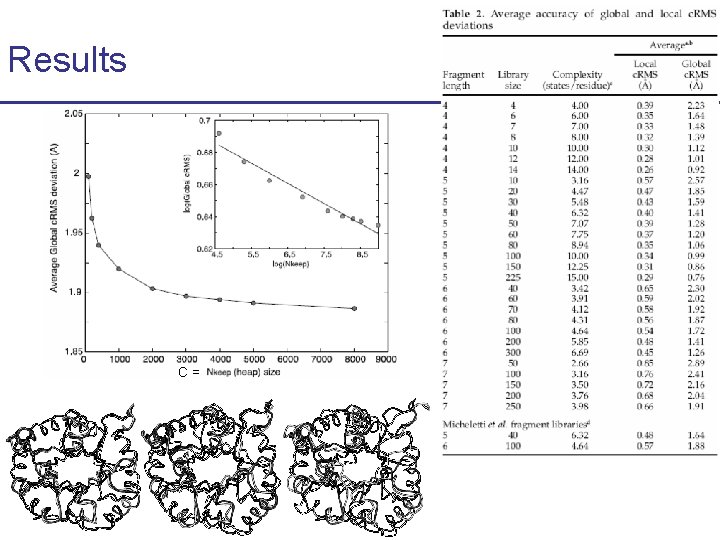
Results C=
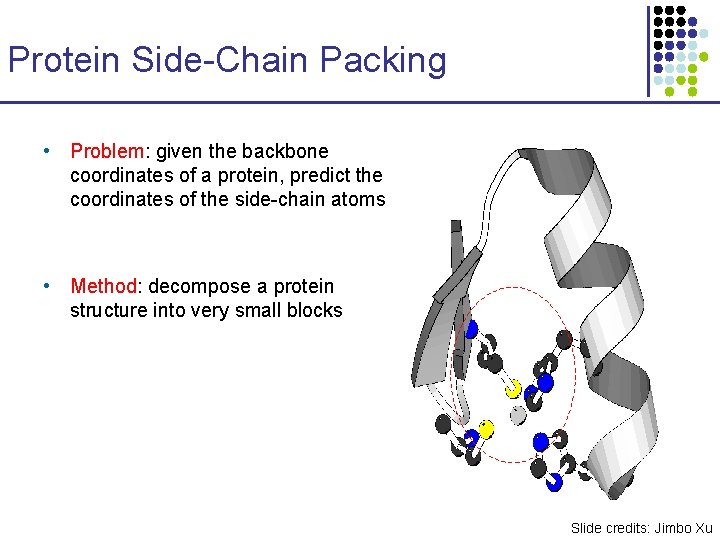
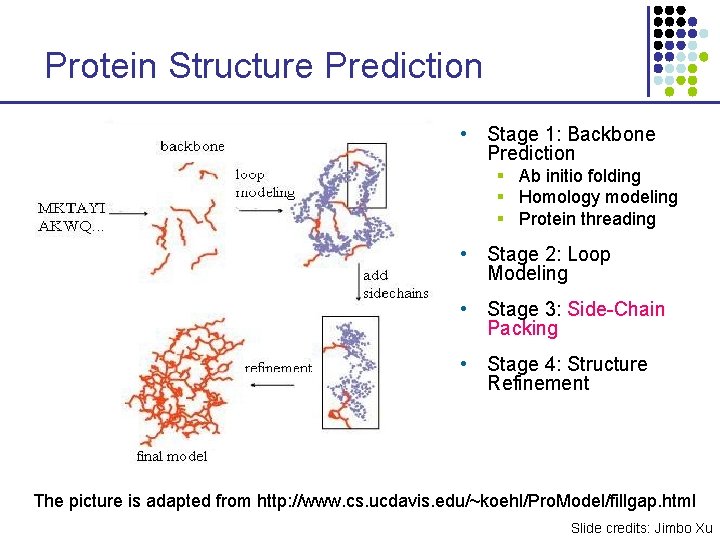
Protein Side-Chain Packing • Problem: given the backbone coordinates of a protein, predict the coordinates of the side-chain atoms • Method: decompose a protein structure into very small blocks Slide credits: Jimbo Xu
Protein Structure Prediction • Stage 1: Backbone Prediction § Ab initio folding § Homology modeling § Protein threading • Stage 2: Loop Modeling • Stage 3: Side-Chain Packing • Stage 4: Structure Refinement The picture is adapted from http: //www. cs. ucdavis. edu/~koehl/Pro. Model/fillgap. html Slide credits: Jimbo Xu
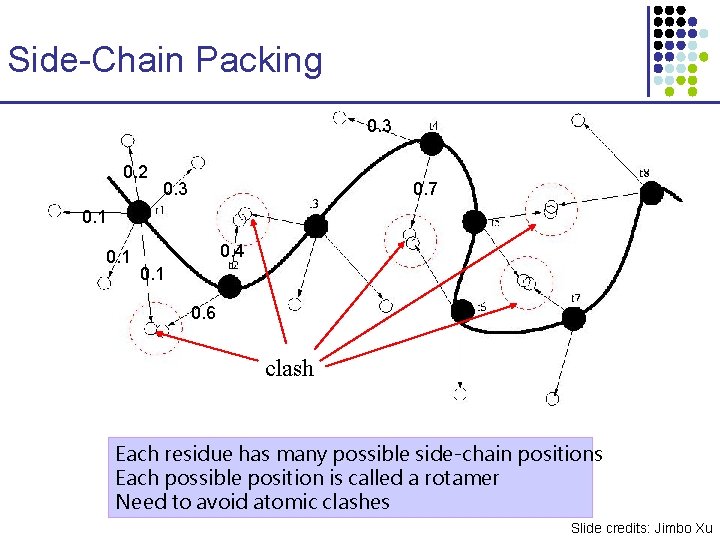
Side-Chain Packing 0. 3 0. 2 0. 3 0. 7 0. 1 0. 4 0. 1 0. 6 clash Each residue has many possible side-chain positions Each possible position is called a rotamer Need to avoid atomic clashes Slide credits: Jimbo Xu
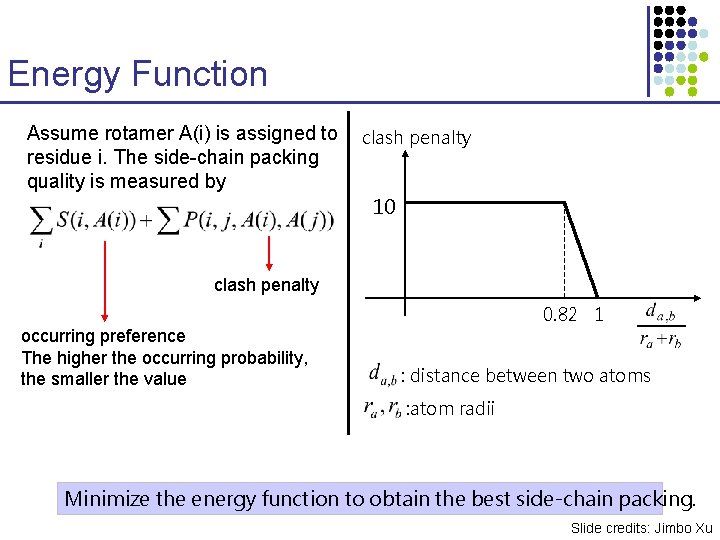
Energy Function Assume rotamer A(i) is assigned to residue i. The side-chain packing quality is measured by clash penalty 10 clash penalty occurring preference The higher the occurring probability, the smaller the value 0. 82 1 : distance between two atoms : atom radii Minimize the energy function to obtain the best side-chain packing. Slide credits: Jimbo Xu
Related Work • NP-hard [Akutsu, 1997; Pierce et al. , 2002] and NP-complete to achieve an approximation ratio O(N) [Chazelle et al, 2004] • Dead-End Elimination: eliminate rotamers one-by-one • SCWRL: biconnected decomposition of a protein structure [Dunbrack et al. , 2003] § One of the most popular side-chain packing programs • Linear integer programming [Althaus et al, 2000; Eriksson et al, 2001; Kingsford et al, 2004] • Semidefinite programming [Chazelle et al, 2004] Slide credits: Jimbo Xu
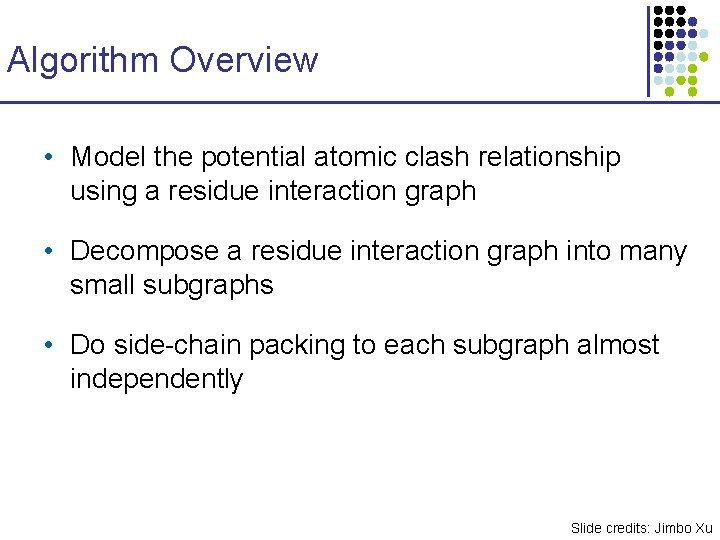
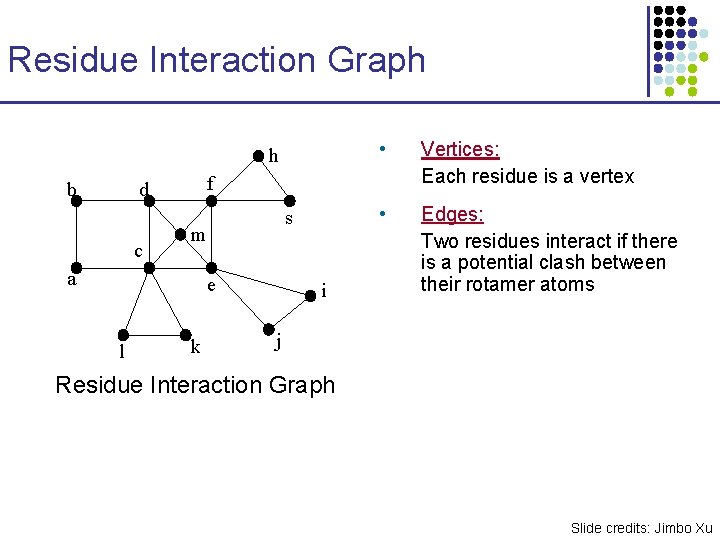
Algorithm Overview • Model the potential atomic clash relationship using a residue interaction graph • Decompose a residue interaction graph into many small subgraphs • Do side-chain packing to each subgraph almost independently Slide credits: Jimbo Xu
Residue Interaction Graph h b s m a e l Vertices: Each residue is a vertex • Edges: Two residues interact if there is a potential clash between their rotamer atoms f d c • k i j Residue Interaction Graph Slide credits: Jimbo Xu
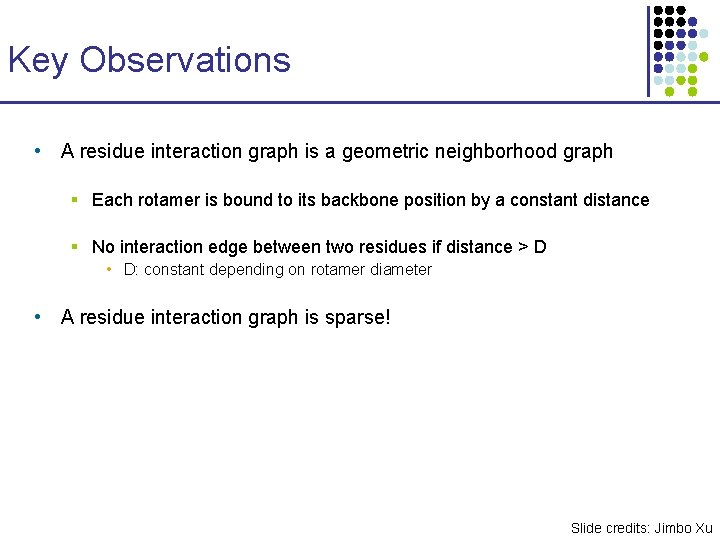
Key Observations • A residue interaction graph is a geometric neighborhood graph § Each rotamer is bound to its backbone position by a constant distance § No interaction edge between two residues if distance > D • D: constant depending on rotamer diameter • A residue interaction graph is sparse! Slide credits: Jimbo Xu
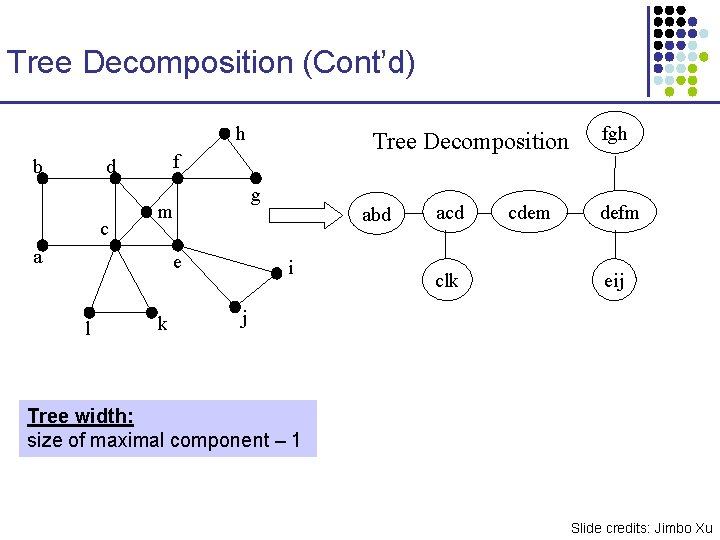
Tree Decomposition [Robertson & Seymour, 1986] • Definition. A tree decomposition (T, X) of a graph G = (V, E): § T=(I, F) is a tree with node set I and edge set F § X is a set of subsets of V, the components; Union of elts. in X = V § 1 -to-1 mapping between I and X § For any edge (v, w) in E, there is at least one X(i) in X s. t. v, w are in X(i) § In tree T, if node j is on the path from i to k, then X(i) ∩ X(k) X(j) • Tree width is defined to be the maximal component size minus 1 Slide credits: Jimbo Xu
Tree Decomposition [Robertson & Seymour, 1986] Greedy: minimum degree heuristic b f d c h m a c e l 1. 2. 3. 4. 5. k i j f d abd g h g m a e l i j k Choose the vertex with minimal degree The chosen vertex and its neighbors form a component Add one edge to any two neighbors of the chosen vertex Remove the chosen vertex Repeat the above steps until the graph is empty Slide credits: Jimbo Xu
Tree Decomposition (Cont’d) h b f d c g m a e l Tree Decomposition k abd i acd clk cdem fgh defm eij j Tree width: size of maximal component – 1 Slide credits: Jimbo Xu
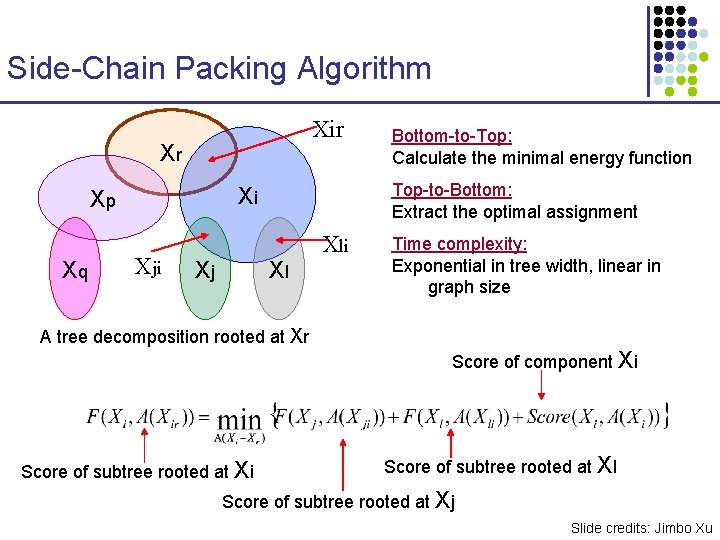
Side-Chain Packing Algorithm Xir Xr Xq Top-to-Bottom: Extract the optimal assignment Xi Xp Xji Xj Xl A tree decomposition rooted at Xr Score of subtree rooted at Xi Bottom-to-Top: Calculate the minimal energy function Xli Time complexity: Exponential in tree width, linear in graph size Score of component Xi Score of subtree rooted at Xl Score of subtree rooted at Xj Slide credits: Jimbo Xu
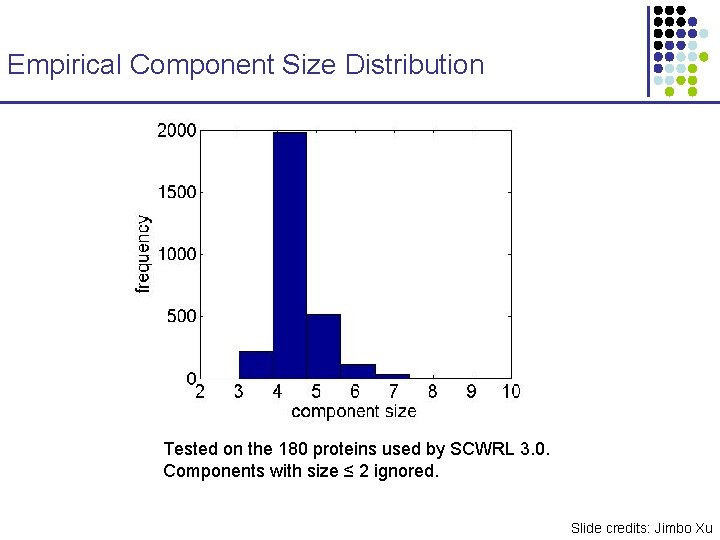
Empirical Component Size Distribution Tested on the 180 proteins used by SCWRL 3. 0. Components with size ≤ 2 ignored. Slide credits: Jimbo Xu
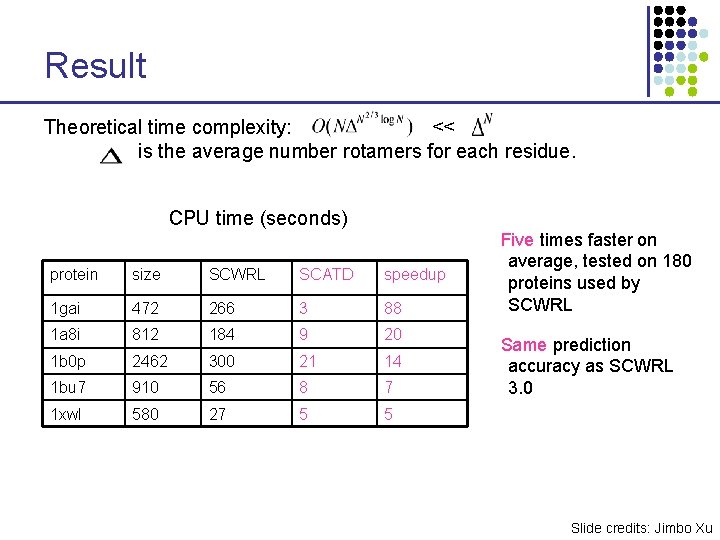
Result Theoretical time complexity: << is the average number rotamers for each residue. CPU time (seconds) protein size SCWRL SCATD speedup 1 gai 472 266 3 88 1 a 8 i 812 184 9 20 1 b 0 p 2462 300 21 14 1 bu 7 910 56 8 7 1 xwl 580 27 5 5 Five times faster on average, tested on 180 proteins used by SCWRL Same prediction accuracy as SCWRL 3. 0 Slide credits: Jimbo Xu
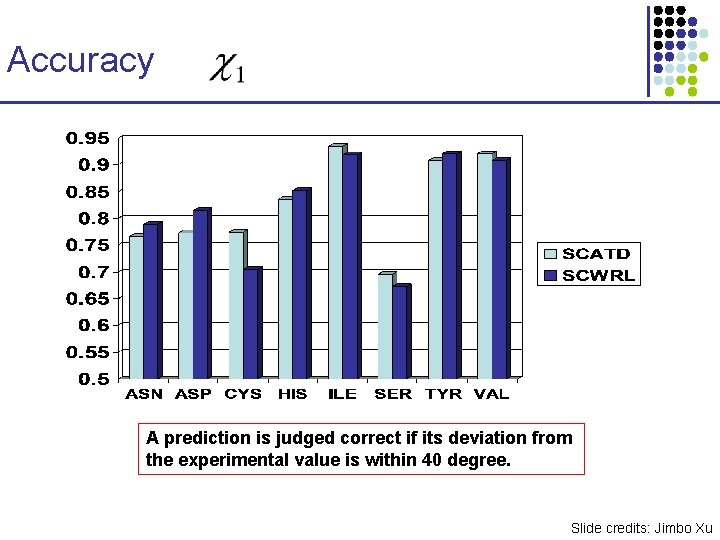
Accuracy A prediction is judged correct if its deviation from the experimental value is within 40 degree. Slide credits: Jimbo Xu