
Protein Structural Domain Prediction Based on Dihedral and
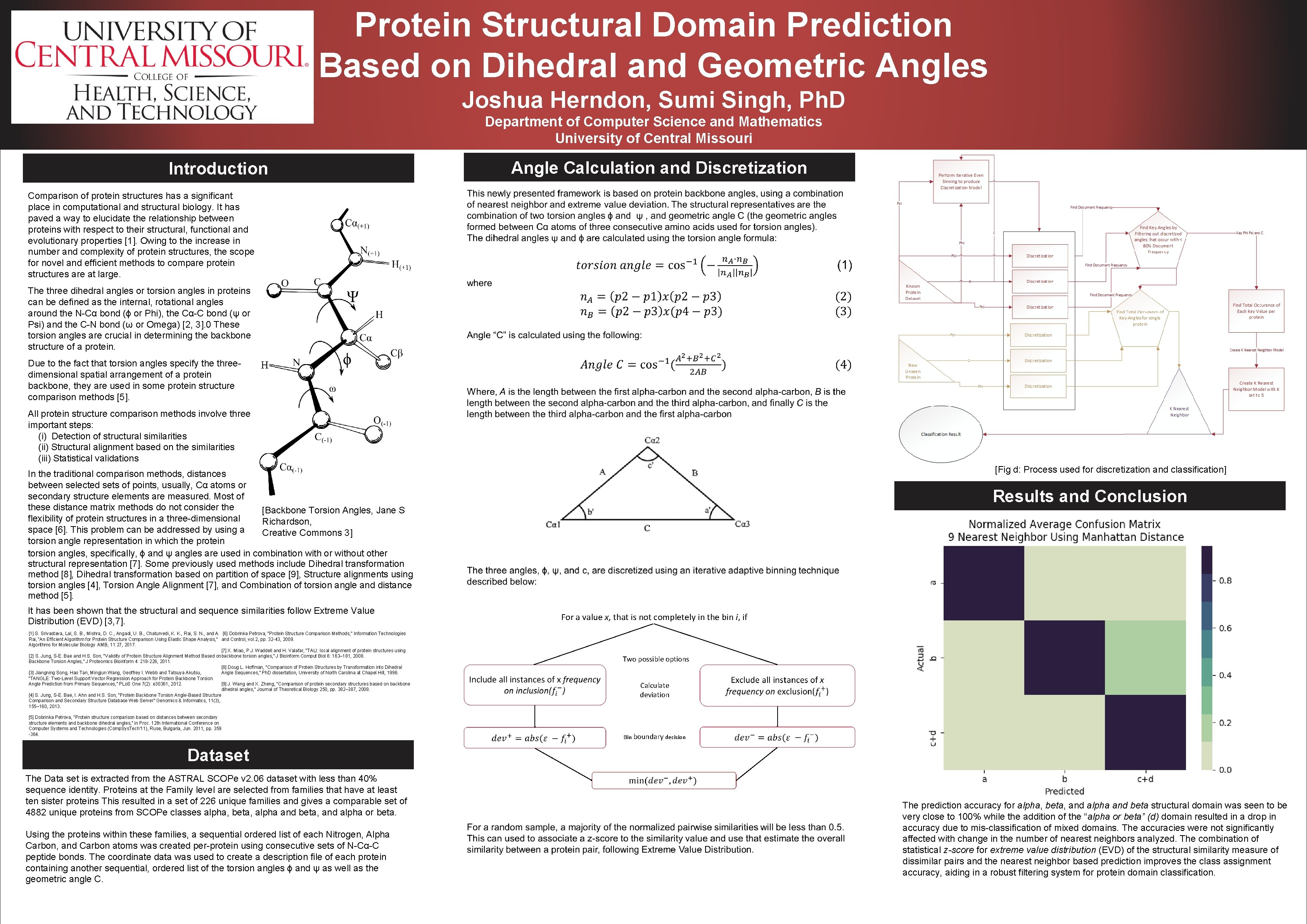
Protein Structural Domain Prediction Based on Dihedral and Geometric Angles Joshua Herndon, Sumi Singh, Ph. D Department of Computer Science and Mathematics University of Central Missouri Introduction Angle Calculation and Discretization Comparison of protein structures has a significant place in computational and structural biology. It has paved a way to elucidate the relationship between proteins with respect to their structural, functional and evolutionary properties [1]. Owing to the increase in number and complexity of protein structures, the scope for novel and efficient methods to compare protein structures are at large. The three dihedral angles or torsion angles in proteins can be defined as the internal, rotational angles around the N-Cα bond (ϕ or Phi), the Cα-C bond (ψ or Psi) and the C-N bond (ω or Omega) [2, 3]. 0 These torsion angles are crucial in determining the backbone structure of a protein. Due to the fact that torsion angles specify the threedimensional spatial arrangement of a protein backbone, they are used in some protein structure comparison methods [5]. All protein structure comparison methods involve three important steps: (i) Detection of structural similarities (ii) Structural alignment based on the similarities (iii) Statistical validations [Fig d: Process used for discretization and classification] In the traditional comparison methods, distances between selected sets of points, usually, Cα atoms or secondary structure elements are measured. Most of these distance matrix methods do not consider the [Backbone Torsion Angles, Jane S flexibility of protein structures in a three-dimensional Richardson, space [6]. This problem can be addressed by using a Creative Commons 3] torsion angle representation in which the protein torsion angles, specifically, ϕ and ψ angles are used in combination with or without other structural representation [7]. Some previously used methods include Dihedral transformation method [8], Dihedral transformation based on partition of space [9], Structure alignments using torsion angles [4], Torsion Angle Alignment [7], and Combination of torsion angle and distance method [5]. It has been shown that the structural and sequence similarities follow Extreme Value Distribution (EVD) [3, 7]. [1] S. Srivastava, Lal, S. B. , Mishra, D. C. , Angadi, U. B. , Chaturvedi, K. K. , Rai, S. N. , and A. [6] Dobrinka Petrova, “Protein Structure Comparison Methods, ” Information Technologies Rai, “An Efficient Algorithm for Protein Structure Comparison Using Elastic Shape Analysis, ” and Control, vol. 2, pp. 32 -43, 2009. Algorithms for Molecular Biology AMB, 11: 27, 2017. [7] X. Miao, P. J. Waddell and H. Valafar, “TALI: local alignment of protein structures using [2] S. Jung, S-E. Bae and H. S. Son, “Validity of Protein Structure Alignment Method Based onbackbone torsion angles, ” J Bioinform Comput Biol 6: 163– 181, 2008. Backbone Torsion Angles, ” J Proteomics Bioinform 4: 218 -226, 2011. [8] Doug L. Hoffman, “Comparison of Protein Structures by Transformation into Dihedral Angle Sequences, ” Ph. D dissertation, University of North Carolina at Chapel Hill, 1996. [3] Jiangning Song, Hao Tan, Mingjun Wang, Geoffrey I. Webb and Tatsuya Akutsu, “TANGLE: Two-Level Support Vector Regression Approach for Protein Backbone Torsion [9] J. Wang and X. Zheng, “Comparison of protein secondary structures based on backbone Angle Prediction from Primary Sequences, ” PLo. S One 7(2): e 30361, 2012. dihedral angles, ” Journal of Theoretical Biology 250, pp. 382– 387, 2008. [4] S. Jung, S-E. Bae, I. Ahn and H. S. Son, “Protein Backbone Torsion Angle-Based Structure Comparison and Secondary Structure Database Web Server” Genomics & Informatics, 11(3), 155– 160, 2013. [5] Dobrinka Petrova, “Protein structure comparison based on distances between secondary structure elements and backbone dihedral angles, ” in Proc. 12 th International Conference on Computer Systems and Technologies (Comp. Sys. Tech’ 11), Ruse, Bulgaria, Jun. 2011, pp. 359 -364. Results and Conclusion For a value x, that is not completely in the bin i, if Two possible options Calculate deviation Bin boundary decision Dataset The Data set is extracted from the ASTRAL SCOPe v 2. 06 dataset with less than 40% sequence identity. Proteins at the Family level are selected from families that have at least ten sister proteins This resulted in a set of 226 unique families and gives a comparable set of 4882 unique proteins from SCOPe classes alpha, beta, alpha and beta, and alpha or beta. Using the proteins within these families, a sequential ordered list of each Nitrogen, Alpha Carbon, and Carbon atoms was created per-protein using consecutive sets of N-Cα-C peptide bonds. The coordinate data was used to create a description file of each protein containing another sequential, ordered list of the torsion angles ϕ and ψ as well as the geometric angle C. The prediction accuracy for alpha, beta, and alpha and beta structural domain was seen to be very close to 100% while the addition of the “alpha or beta” (d) domain resulted in a drop in accuracy due to mis-classification of mixed domains. The accuracies were not significantly affected with change in the number of nearest neighbors analyzed. The combination of statistical z-score for extreme value distribution (EVD) of the structural similarity measure of dissimilar pairs and the nearest neighbor based prediction improves the class assignment accuracy, aiding in a robust filtering system for protein domain classification.
- Slides: 1