
Protein Sorting Transport Paths of Protein Trafficking Nuclear
- Slides: 17
Protein Sorting & Transport Paths of Protein Trafficking Nuclear Protein Transport Mitochondrial & Chloroplast Transport Experimental Systems Overview of the Cytomembrane System The Endoplasmic Reticulum The Golgi Apparatus Vesicular Transport between Compartments Exocytosis Endocytosis and Lysosomes
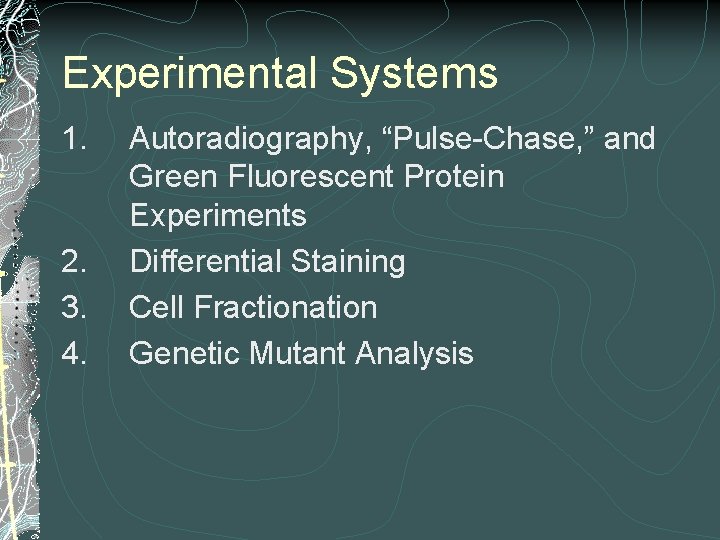
Experimental Systems 1. 2. 3. 4. Autoradiography, “Pulse-Chase, ” and Green Fluorescent Protein Experiments Differential Staining Cell Fractionation Genetic Mutant Analysis
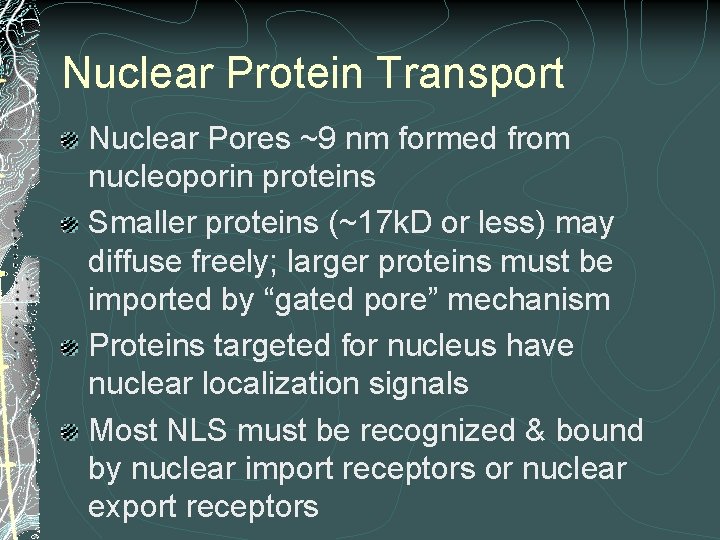
Nuclear Protein Transport Nuclear Pores ~9 nm formed from nucleoporin proteins Smaller proteins (~17 k. D or less) may diffuse freely; larger proteins must be imported by “gated pore” mechanism Proteins targeted for nucleus have nuclear localization signals Most NLS must be recognized & bound by nuclear import receptors or nuclear export receptors
Nuclear Protein Transport During nuclear protein transport, much of the tertiary structure of the transported protein remains intact, due to large size of nuclear pores Energy is provided by GTP hydrolysis via Ran, a GTPase found both in cytoplasm & nucleus In the cytoplasm a GTPase activating factor (GAP) triggers hydrolysis of GTP by Ran; in the nucleus a GDP-GTP exchange factor (GEF) The gradient of Ran-GDP and Ran-GTP
Mitochondrial/Chloroplast Protein. Transport Mitochondrial proteins that are encoded by nuclear genes possess mitochondrial import sequences Transport is mediated by a TOM complex and two TIM complexes; another complex (OXA) mediates insertion of mitochondrial-encoded proteins into inner membrane & also contributes to insertion of some nuclearencoded proteins
Mitochondrial/Chloroplast Protein. Transport ATP hydrolysis & a H+ gradient drive protein transport into mitochondria via a ratcheting mechanism Integral proteins possess stop transport sequences that interrupt the transport process to create the transmembrane domains; formation of the transmembrane domain may be either mediated by TIM 23, TIM 22 (specialized for multipass proteins), or OXA
Mitochondrial/Chloroplast Protein. Transport of chloroplast proteins is similar to mitochondrial proteins Thylakoid proteins require an extra thylakoid transport sequence & import proteins
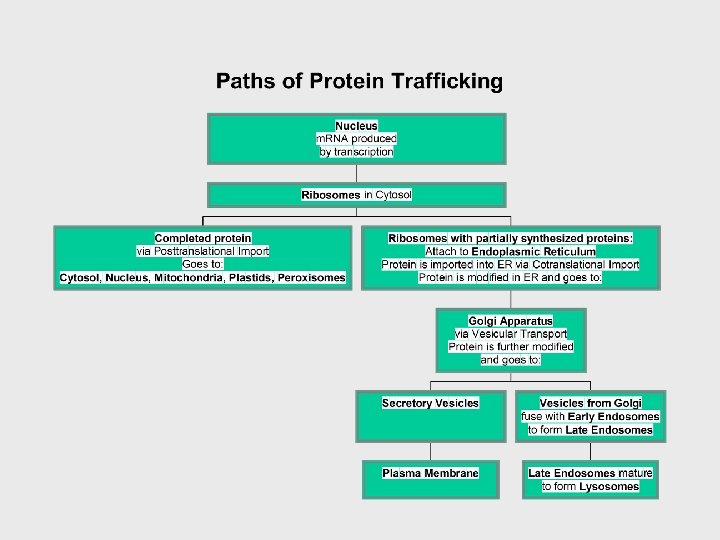
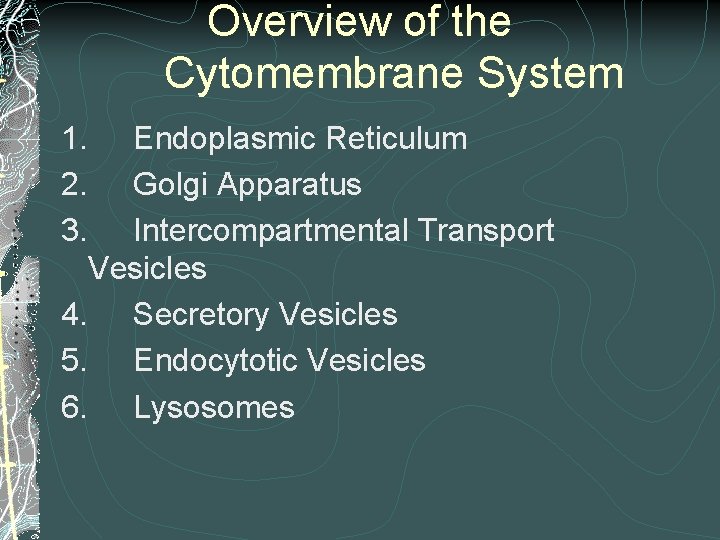
Overview of the Cytomembrane System 1. 2. 3. Endoplasmic Reticulum Golgi Apparatus Intercompartmental Transport Vesicles 4. Secretory Vesicles 5. Endocytotic Vesicles 6. Lysosomes
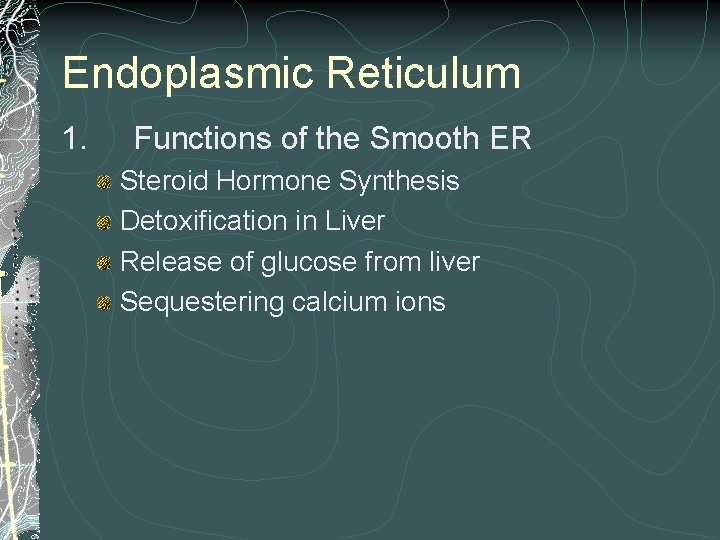
Endoplasmic Reticulum 1. Functions of the Smooth ER Steroid Hormone Synthesis Detoxification in Liver Release of glucose from liver Sequestering calcium ions
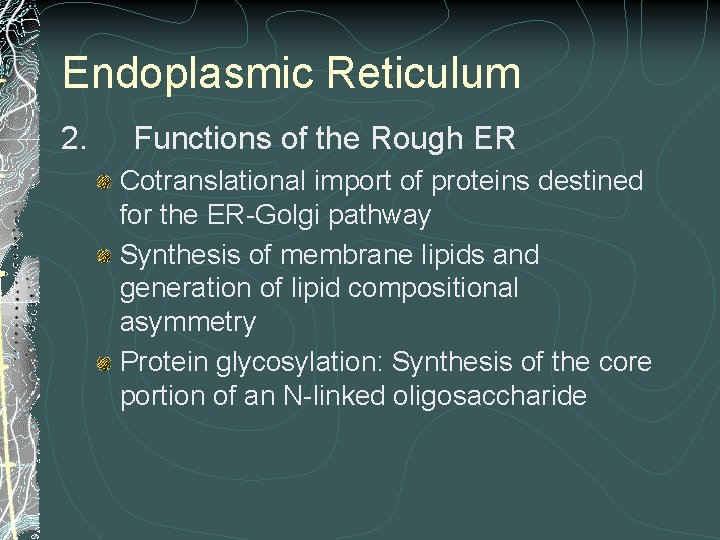
Endoplasmic Reticulum 2. Functions of the Rough ER Cotranslational import of proteins destined for the ER-Golgi pathway Synthesis of membrane lipids and generation of lipid compositional asymmetry Protein glycosylation: Synthesis of the core portion of an N-linked oligosaccharide
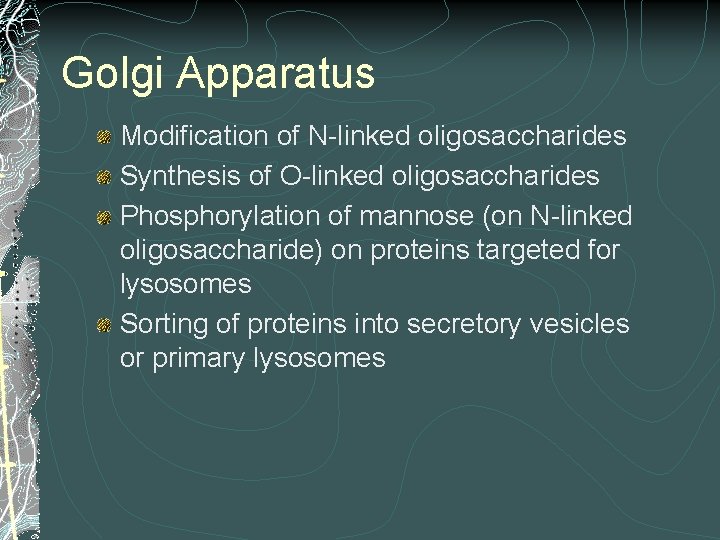
Golgi Apparatus Modification of N-linked oligosaccharides Synthesis of O-linked oligosaccharides Phosphorylation of mannose (on N-linked oligosaccharide) on proteins targeted for lysosomes Sorting of proteins into secretory vesicles or primary lysosomes
Vesicular Transport between Compartments 1. Transport vesicles are generally covered with coat proteins: COPII-coated vesicles: move proteins from ER to cis-Golgi COPI-coated vesicles: move proteins from cis-Golgi to ER; also possibly from ER to Golgi and between Golgi cisternae Clathrin-coated vesicles: move proteins from the trans-Golgi to the plasma membrane or lysosomes
Vesicular Transport between Compartments 2. Receptor protein systems (SNAREs) are believed to target and dock specific vesicles to the correct compartment 3. At each step in the cytomembrane pathway, proteins that should stay in the previous compartment are retrieved by membranebound receptors and sent back to the correct compartment.
Exocytosis Secretory vesicles (from the trans-Golgi) are targeted to the plasma membrane, with which they fuse. The soluble contents of the vesicles are released to the outside, and the vesicle membrane becomes part of the PM.
Endocytosis and Lysosomes Endocytotic vesicles form from clathrincoated pits in the plasma membrane. This process is often mediated by receptor proteins that bind to specific ligands that the cell need to transport. Generally, the endocytotic vesicles fuse with primary lysosomes (from the trans. Golgi) to form secondary lysosomes.
Endocytosis and Lysosomes contain many different hydrolytic enzymes that process the contents of the endosome. Lysosome proteins are recognized and sorted by the trans-Golgi due to the mannose 6 -phosphate residues on Nlinked oligosaccharide