
Protein sintesis Translasi MRQ 2009 Review Replication The
- Slides: 33
Protein sintesis & Translasi MRQ 2009
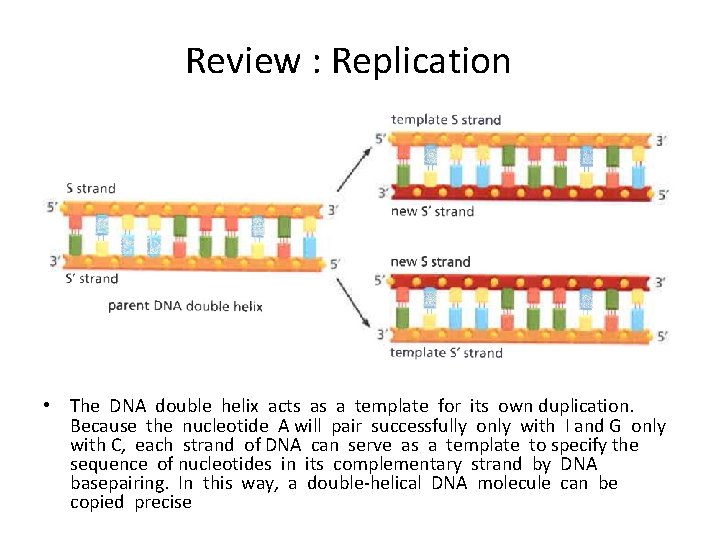
Review : Replication • The DNA double helix acts as a template for its own duplication. Because the nucleotide A will pair successfully only with I and G only with C, each strand of DNA can serve as a template to specify the sequence of nucleotides in its complementary strand by DNA basepairing. In this way, a double-helical DNA molecule can be copied precise
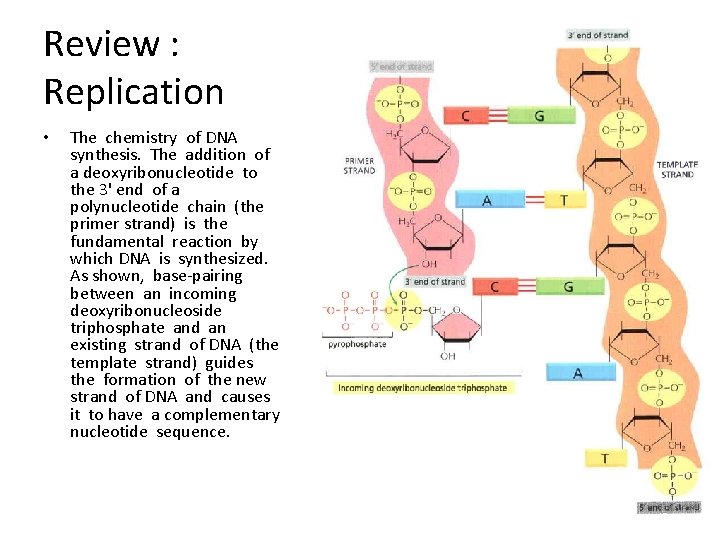
Review : Replication • The chemistry of DNA synthesis. The addition of a deoxyribonucleotide to the 3' end of a polynucleotide chain (the primer strand) is the fundamental reaction by which DNA is synthesized. As shown, base-pairing between an incoming deoxyribonucleoside triphosphate and an existing strand of DNA (the template strand) guides the formation of the new strand of DNA and causes it to have a complementary nucleotide sequence.
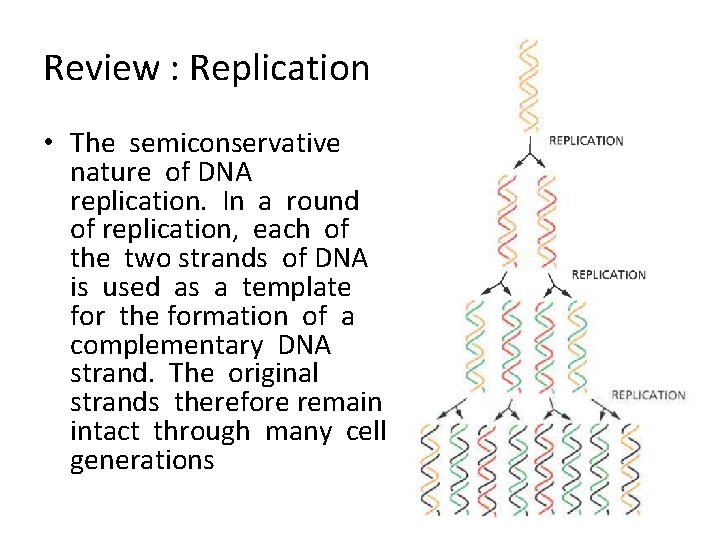
Review : Replication • The semiconservative nature of DNA replication. In a round of replication, each of the two strands of DNA is used as a template for the formation of a complementary DNA strand. The original strands therefore remain intact through many cell generations
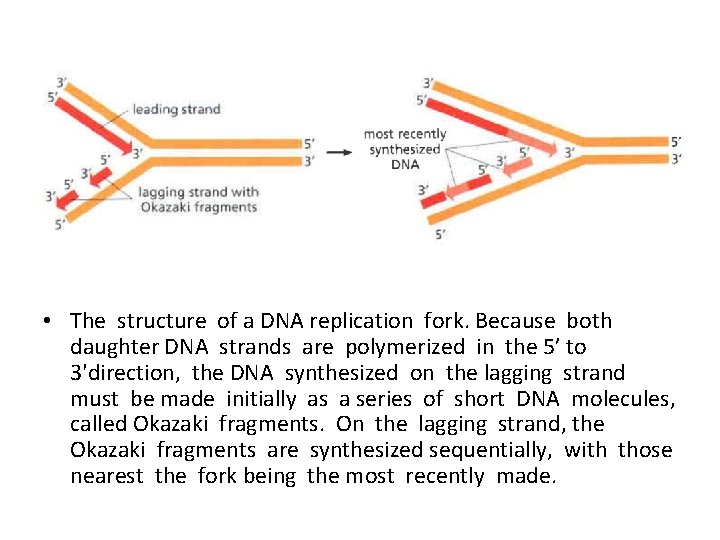
• The structure of a DNA replication fork. Because both daughter DNA strands are polymerized in the 5’ to 3'direction, the DNA synthesized on the lagging strand must be made initially as a series of short DNA molecules, called Okazaki fragments. On the lagging strand, the Okazaki fragments are synthesized sequentially, with those nearest the fork being the most recently made.
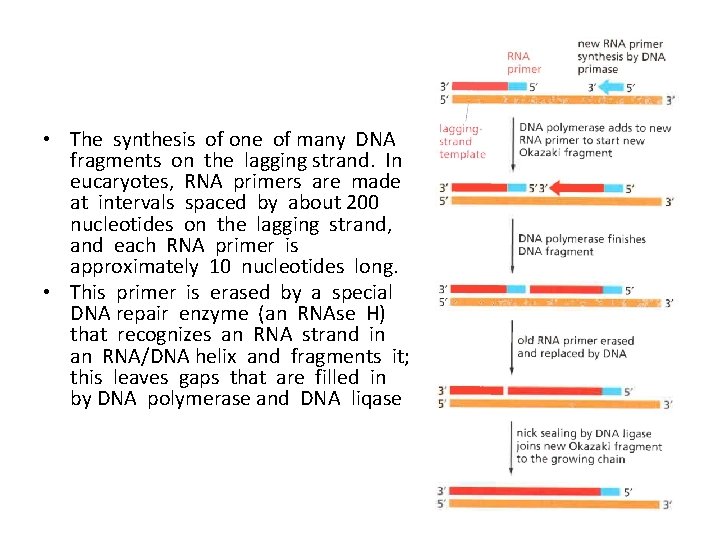
• The synthesis of one of many DNA fragments on the lagging strand. In eucaryotes, RNA primers are made at intervals spaced by about 200 nucleotides on the lagging strand, and each RNA primer is approximately 10 nucleotides long. • This primer is erased by a special DNA repair enzyme (an RNAse H) that recognizes an RNA strand in an RNA/DNA helix and fragments it; this leaves gaps that are filled in by DNA polymerase and DNA liqase
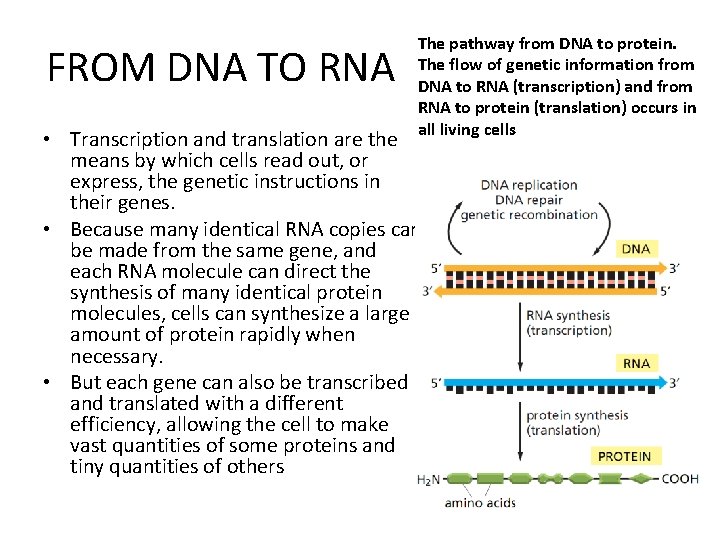
FROM DNA TO RNA The pathway from DNA to protein. The flow of genetic information from DNA to RNA (transcription) and from RNA to protein (translation) occurs in all living cells • Transcription and translation are the means by which cells read out, or express, the genetic instructions in their genes. • Because many identical RNA copies can be made from the same gene, and each RNA molecule can direct the synthesis of many identical protein molecules, cells can synthesize a large amount of protein rapidly when necessary. • But each gene can also be transcribed and translated with a different efficiency, allowing the cell to make vast quantities of some proteins and tiny quantities of others
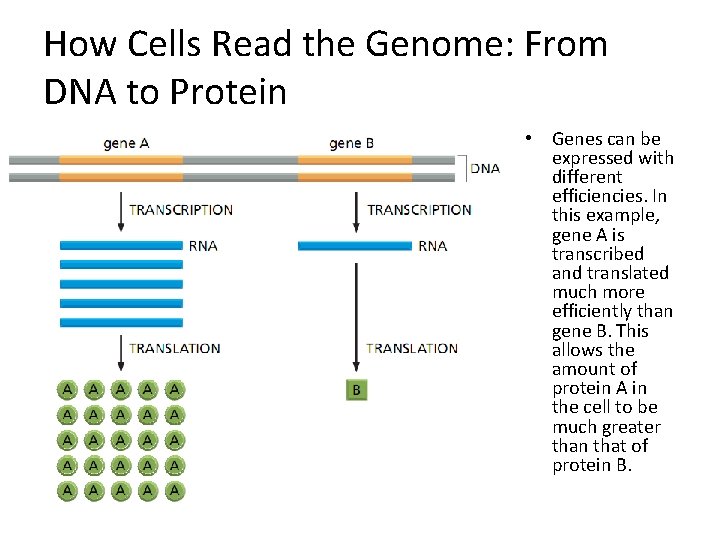
How Cells Read the Genome: From DNA to Protein • Genes can be expressed with different efficiencies. In this example, gene A is transcribed and translated much more efficiently than gene B. This allows the amount of protein A in the cell to be much greater than that of protein B.
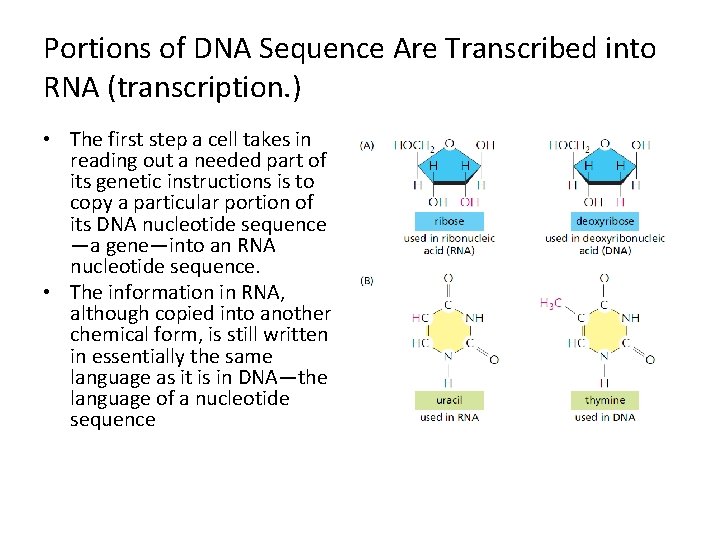
Portions of DNA Sequence Are Transcribed into RNA (transcription. ) • The first step a cell takes in reading out a needed part of its genetic instructions is to copy a particular portion of its DNA nucleotide sequence —a gene—into an RNA nucleotide sequence. • The information in RNA, although copied into another chemical form, is still written in essentially the same language as it is in DNA—the language of a nucleotide sequence
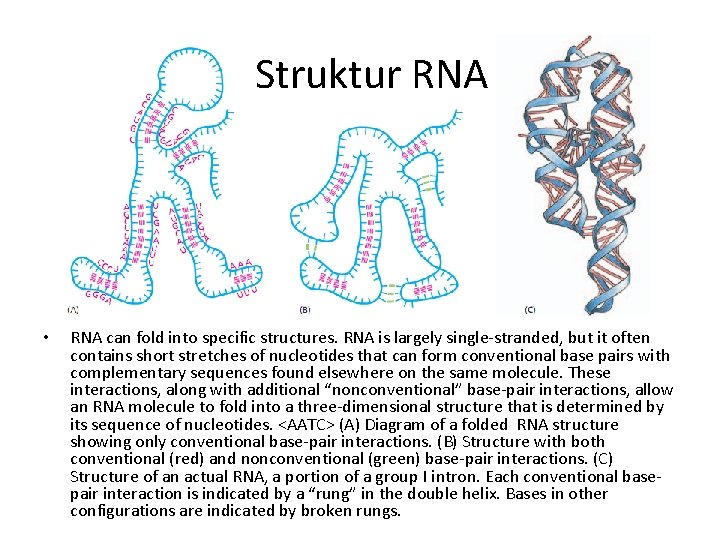
Struktur RNA • RNA can fold into specific structures. RNA is largely single-stranded, but it often contains short stretches of nucleotides that can form conventional base pairs with complementary sequences found elsewhere on the same molecule. These interactions, along with additional “nonconventional” base-pair interactions, allow an RNA molecule to fold into a three-dimensional structure that is determined by its sequence of nucleotides. <AATC> (A) Diagram of a folded RNA structure showing only conventional base-pair interactions. (B) Structure with both conventional (red) and nonconventional (green) base-pair interactions. (C) Structure of an actual RNA, a portion of a group I intron. Each conventional basepair interaction is indicated by a “rung” in the double helix. Bases in other configurations are indicated by broken rungs.
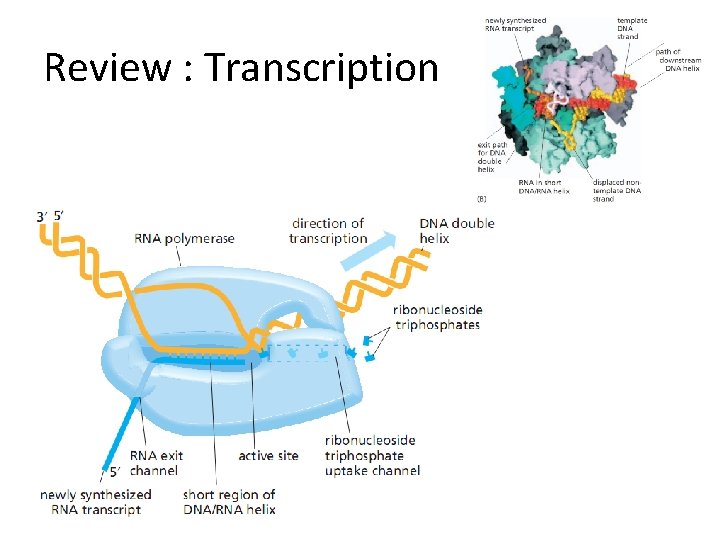
Review : Transcription
• Before the synthesis of a particular protein can begin, the corresponding m. RNA molecule must be produced by transcription. Bacteria contain a single type of RNA polymerase (the enzyme that carries out the transcription of DNA into RNA). • An m. RNA molecule is produced when this enzyme initiates transcription at a promoter, synthesizes the RNA by chain elongation, stops transcription at a terminator, and releases both the DNA template and the completed m. RNA molecule. • In eucaryotic cells, the process of transcription is much more complex, and there are three RNA polymerases polymerase I, II, and III—that are related evolutionarily to one another and to the bacterial polymerase.
FROM RNA TO PROTEIN • An m. RNA Sequence Is Decoded in Sets of Three Nucleotides • Once an m. RNA has been produced by transcription and processing, the information present in its nucleotide sequence is used to synthesize a protein. • Transcription is simple to understand as a means of information transfer: since DNA and RNA are chemically and structurally similar, the DNA can act as a direct template for the synthesis of RNA by complementary base-pairing.
Genetic code • In contrast, the conversion of the information in RNA into protein represents a translation of the information into another language that uses quite different symbols. • Moreover, since there are only 4 different nucleotides in m. RNA and 20 different types of amino acids in a protein, this translation cannot be accounted for by a direct one-toone correspondence between a nucleotide in RNA and an amino acid in protein. • The nucleotide sequence of a gene, through the intermediary of m. RNA, is translated into the amino acid sequence of a protein by rules that are known as the genetic code
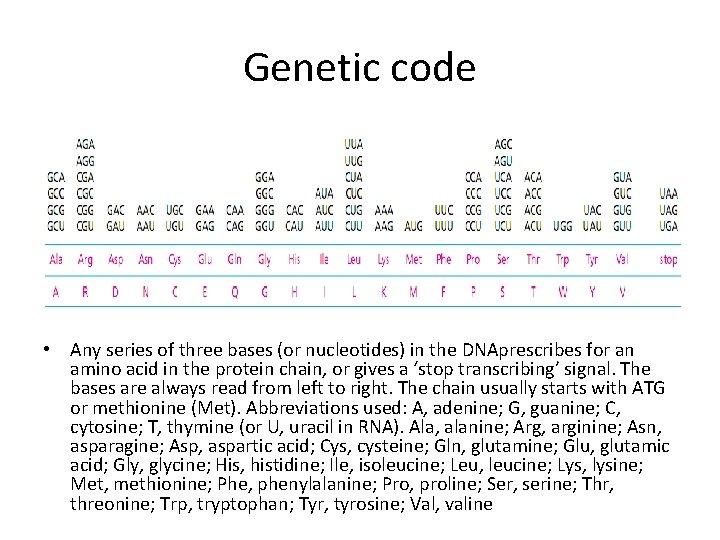
Genetic code • Any series of three bases (or nucleotides) in the DNAprescribes for an amino acid in the protein chain, or gives a ‘stop transcribing’ signal. The bases are always read from left to right. The chain usually starts with ATG or methionine (Met). Abbreviations used: A, adenine; G, guanine; C, cytosine; T, thymine (or U, uracil in RNA). Ala, alanine; Arg, arginine; Asn, asparagine; Asp, aspartic acid; Cys, cysteine; Gln, glutamine; Glu, glutamic acid; Gly, glycine; His, histidine; Ile, isoleucine; Leu, leucine; Lys, lysine; Met, methionine; Phe, phenylalanine; Pro, proline; Ser, serine; Thr, threonine; Trp, tryptophan; Tyr, tyrosine; Val, valine
Kode genetik • Di alam ada 20 macam asam amino yang umum terdapat di dalam struktur polipeptida jasad hidup. • Masing-masing asam amino mempunyai kodon yang spesifik sedangkan nukleotida hanya ada 4 macam yaitu A, U, G, dan C (Tabel 1 2. 2). • Jika suatu kodon hanya terdiri atas dua nukleotida maka hanya akan ada 42 = 16 asam amino, tetapi apabila kodon disusun oleh 3 nukleotida maka akan diperoleh 43 (= 64) asam amino. S • Sedangkan jumlah asam amino yang umum diketahui ada pada jasad hidup hanya 20 macam. • Beberapa kodon diketahui mengkode asam amino yang sama. Fenomena ini dikenal sebagai genetic code redundancy (degeneracy)
Tranlasi • Translasi adalah proses penerjemah urutan nucleotida yang ada pada molekul m. RNA menjadi rangkaian asam -asam amino yang menyusun suatu polipeptida atau protein. • Hanya molekul m. RNA yang ditranslasi, sedangkan r. RNA dan t. RNA tidak ditranslasi. • Molekul m. RNA merupakan transkrip (salinan) urutan DNA yang menyusun suatu gen dalam bentuk ORF (open reading frame, kerangka baca terbuka) • Molekul r. RNA adalah satu molekul penyusun ribosom, yakni organel tempat berlangsungnya sintesis protein, • t. RNA adalah pembawa asam-asam amino yang akan disambungkan menjadi rantai polipeptida
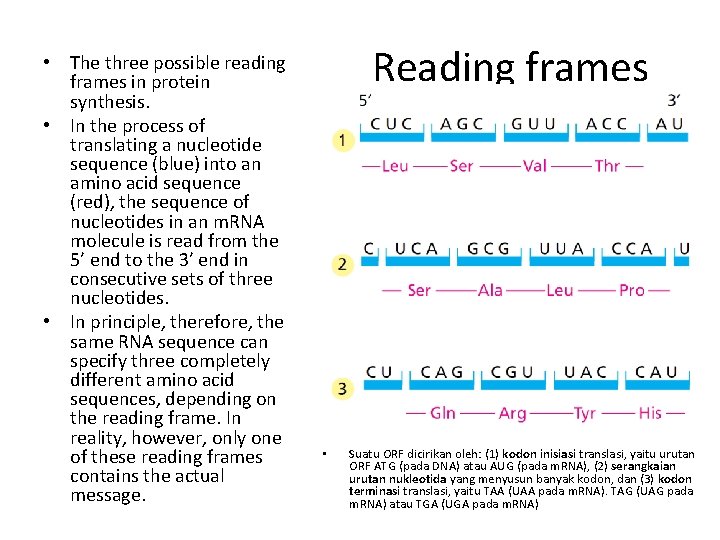
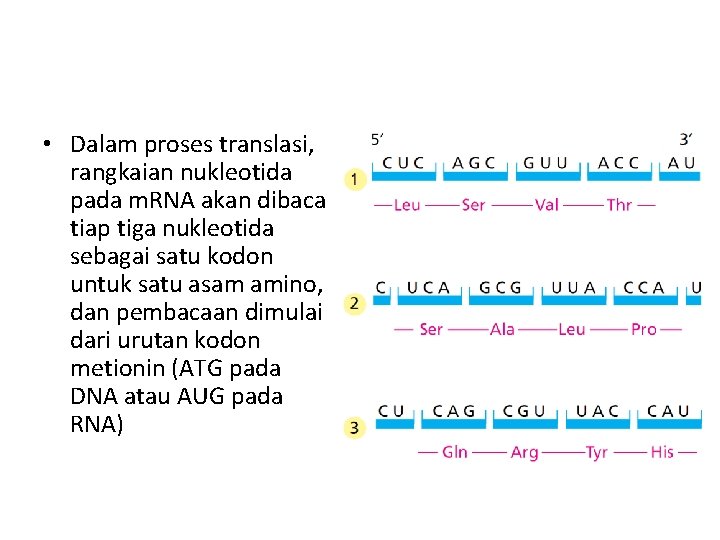
• The three possible reading frames in protein synthesis. • In the process of translating a nucleotide sequence (blue) into an amino acid sequence (red), the sequence of nucleotides in an m. RNA molecule is read from the 5’ end to the 3’ end in consecutive sets of three nucleotides. • In principle, therefore, the same RNA sequence can specify three completely different amino acid sequences, depending on the reading frame. In reality, however, only one of these reading frames contains the actual message. Reading frames • Suatu ORF dicirikan oleh: (1) kodon inisiasi translasi, yaitu urutan ORF ATG (pada DNA) atau AUG (pada m. RNA), (2) serangkaian urutan nukleotida yang menyusun banyak kodon, dan (3) kodon terminasi translasi, yaitu TAA (UAA pada m. RNA). TAG (UAG pada m. RNA) atau TGA (UGA pada m. RNA)
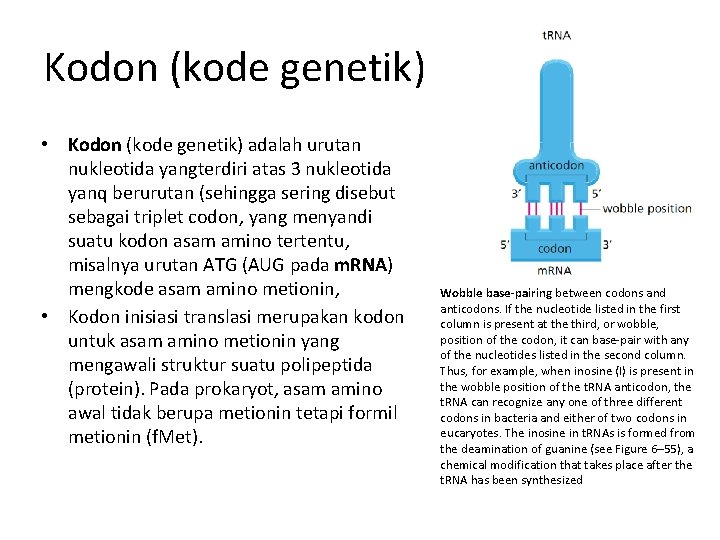
Kodon (kode genetik) • Kodon (kode genetik) adalah urutan nukleotida yangterdiri atas 3 nukleotida yanq berurutan (sehingga sering disebut sebagai triplet codon, yang menyandi suatu kodon asam amino tertentu, misalnya urutan ATG (AUG pada m. RNA) mengkode asam amino metionin, • Kodon inisiasi translasi merupakan kodon untuk asam amino metionin yang mengawali struktur suatu polipeptida (protein). Pada prokaryot, asam amino awal tidak berupa metionin tetapi formil metionin (f. Met). Wobble base-pairing between codons and anticodons. If the nucleotide listed in the first column is present at the third, or wobble, position of the codon, it can base-pair with any of the nucleotides listed in the second column. Thus, for example, when inosine (I) is present in the wobble position of the t. RNA anticodon, the t. RNA can recognize any one of three different codons in bacteria and either of two codons in eucaryotes. The inosine in t. RNAs is formed from the deamination of guanine (see Figure 6– 55), a chemical modification that takes place after the t. RNA has been synthesized
• Dalam proses translasi, rangkaian nukleotida pada m. RNA akan dibaca tiap tiga nukleotida sebagai satu kodon untuk satu asam amino, dan pembacaan dimulai dari urutan kodon metionin (ATG pada DNA atau AUG pada RNA)
• Ada beberapa aspek yang perlu diketahui mengenai kode genetik, yaitu: • Kode genetik bersifat tidak saling tumpang-tindih (nonoverlappind kecuali pada kasus tertentu, misalnya pada bakteriofag • Tidak ada sela (gap) di antara kodon satu dengan kodon yang lain. • Tidak ada koma di antara kodon. • Kodon bersifat degenerotea, buktinya ada beberapa asam amino yang mempunyai lebih dari satu kodon. • Secara umum, kodon bersifat hampir universal karena pada beberapa organel jasad tinggi ada beberapa kodon yang berbeda dari kodon yang digunakan pada sitoplasm
• Dalam proses translasi, setiap kodon berpasangan dengan antikodon yang sesuai yang terdapat pada molekul t. RNA. • Sebagai contoh, kodon metionin (AUG) mempunyai komplemennya dalam bentuk antikodon UAC yang terdapat pada t. RNAMet • Pada waktu t. RNA yang membawa asam amino diikat ke dalam sisi A pada ribosom, maka bagian antikodonnya berpasangan dengan kodon yang sesuai yang ada pada sisi A tersebut. • Oleh karena itu, suatu kodon akan menentukan asam amino yang disambungkan ke dalam polipeptida yang sedang disintesis di dalam ribosom
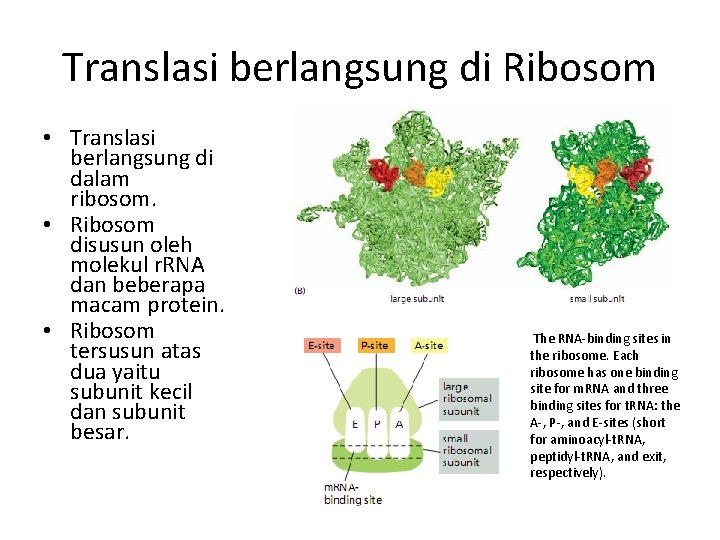
Translasi berlangsung di Ribosom • Translasi berlangsung di dalam ribosom. • Ribosom disusun oleh molekul r. RNA dan beberapa macam protein. • Ribosom tersusun atas dua yaitu subunit kecil dan subunit besar. The RNA-binding sites in the ribosome. Each ribosome has one binding site for m. RNA and three binding sites for t. RNA: the A-, P-, and E-sites (short for aminoacyl-t. RNA, peptidyl-t. RNA, and exit, respectively).
Transkripsi - Tranlasi • Pada jasad prokaryot, translasi sudah dimulai sebelum proses transkripsi (sintesis m. RNA) selesai dilakukan. • Dengan demikian, proses transkripsi dan translasi pada prokaryot berlangsung secara hampir serentak. • Sebaliknya pada eukoryot, proses translasi baru dapat berlangsung jika proses transkripsi (sintesis m. RNA yang matang) sudah selesai dilakukan. • Hal ini disebabkan oleh perbedaan dalam hal struktur sel antara prokaryot dengan eukaryot
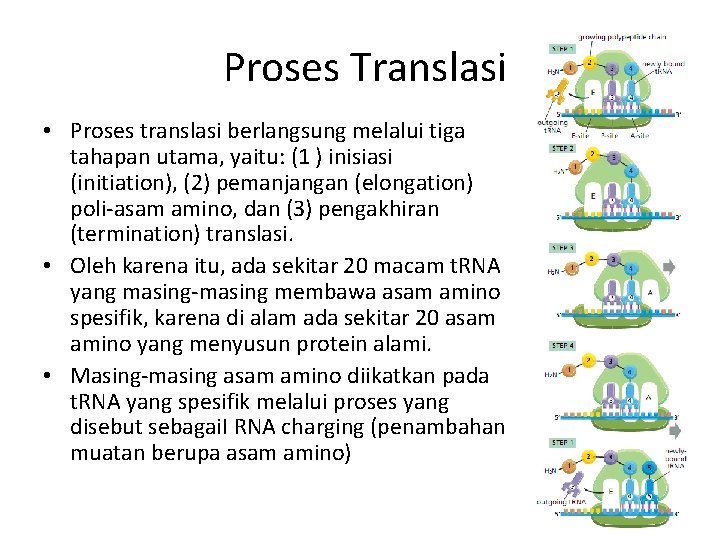
Proses Translasi • Proses translasi berlangsung melalui tiga tahapan utama, yaitu: (1 ) inisiasi (initiation), (2) pemanjangan (elongation) poli-asam amino, dan (3) pengakhiran (termination) translasi. • Oleh karena itu, ada sekitar 20 macam t. RNA yang masing-masing membawa asam amino spesifik, karena di alam ada sekitar 20 asam amino yang menyusun protein alami. • Masing-masing asam amino diikatkan pada t. RNA yang spesifik melalui proses yang disebut sebagai. I RNA charging (penambahan muatan berupa asam amino)
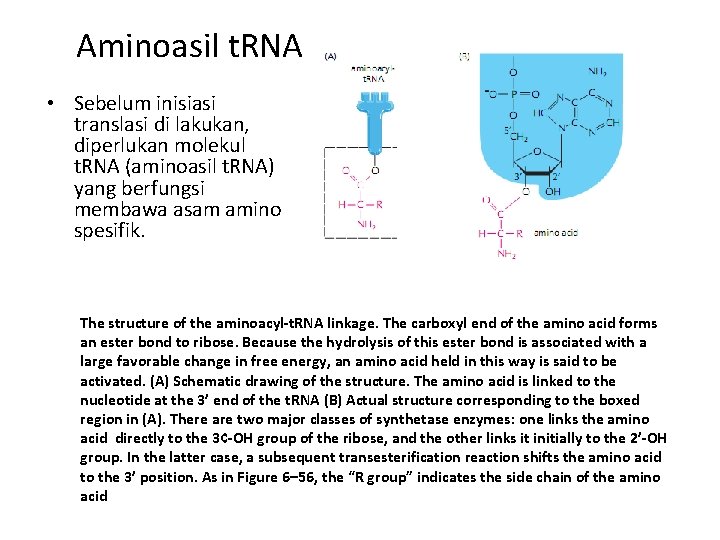
Aminoasil t. RNA • Sebelum inisiasi translasi di lakukan, diperlukan molekul t. RNA (aminoasil t. RNA) yang berfungsi membawa asam amino spesifik. The structure of the aminoacyl-t. RNA linkage. The carboxyl end of the amino acid forms an ester bond to ribose. Because the hydrolysis of this ester bond is associated with a large favorable change in free energy, an amino acid held in this way is said to be activated. (A) Schematic drawing of the structure. The amino acid is linked to the nucleotide at the 3’ end of the t. RNA (B) Actual structure corresponding to the boxed region in (A). There are two major classes of synthetase enzymes: one links the amino acid directly to the 3¢-OH group of the ribose, and the other links it initially to the 2’-OH group. In the latter case, a subsequent transesterification reaction shifts the amino acid to the 3’ position. As in Figure 6– 56, the “R group” indicates the side chain of the amino acid
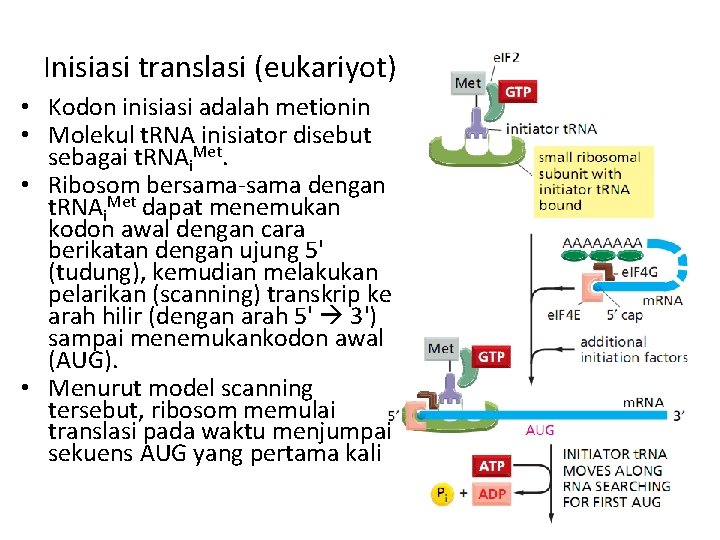
Inisiasi translasi (eukariyot) • Kodon inisiasi adalah metionin • Molekul t. RNA inisiator disebut sebagai t. RNAi. Met. • Ribosom bersama-sama dengan t. RNAi. Met dapat menemukan kodon awal dengan cara berikatan dengan ujung 5' (tudung), kemudian melakukan pelarikan (scanning) transkrip ke arah hilir (dengan arah 5' 3') sampai menemukankodon awal (AUG). • Menurut model scanning tersebut, ribosom memulai translasi pada waktu menjumpai sekuens AUG yang pertama kali
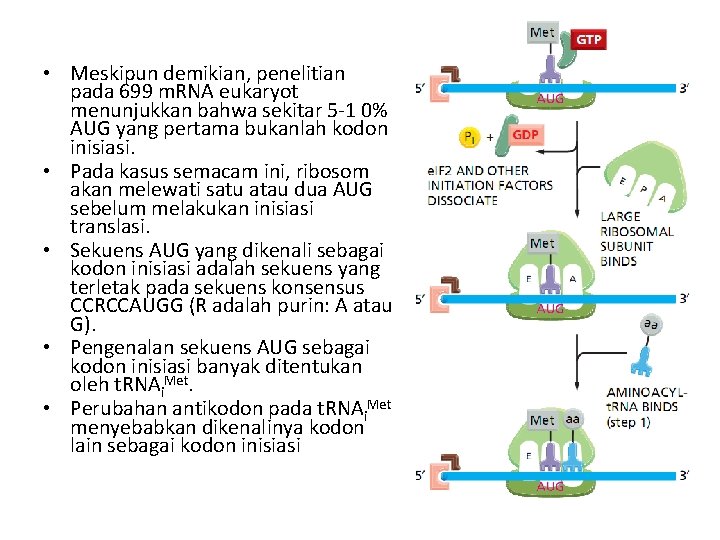
• Meskipun demikian, penelitian pada 699 m. RNA eukaryot menunjukkan bahwa sekitar 5 -1 0% AUG yang pertama bukanlah kodon inisiasi. • Pada kasus semacam ini, ribosom akan melewati satu atau dua AUG sebelum melakukan inisiasi translasi. • Sekuens AUG yang dikenali sebagai kodon inisiasi adalah sekuens yang terletak pada sekuens konsensus CCRCCAUGG (R adalah purin: A atau G). • Pengenalan sekuens AUG sebagai kodon inisiasi banyak ditentukan oleh t. RNAi. Met. • Perubahan antikodon pada t. RNAi. Met menyebabkan dikenalinya kodon lain sebagai kodon inisiasi
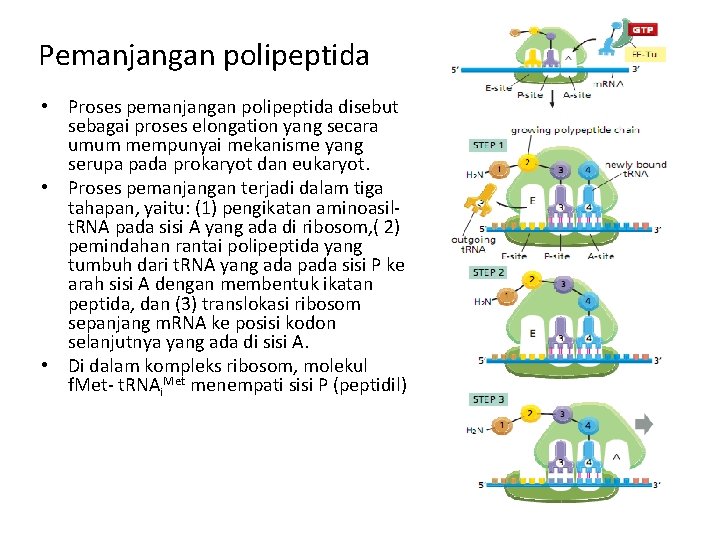
Pemanjangan polipeptida • Proses pemanjangan polipeptida disebut sebagai proses elongation yang secara umum mempunyai mekanisme yang serupa pada prokaryot dan eukaryot. • Proses pemanjangan terjadi dalam tiga tahapan, yaitu: (1) pengikatan aminoasilt. RNA pada sisi A yang ada di ribosom, ( 2) pemindahan rantai polipeptida yang tumbuh dari t. RNA yang ada pada sisi P ke arah sisi A dengan membentuk ikatan peptida, dan (3) translokasi ribosom sepanjang m. RNA ke posisi kodon selanjutnya yang ada di sisi A. • Di dalam kompleks ribosom, molekul f. Met- t. RNAi. Met menempati sisi P (peptidil)
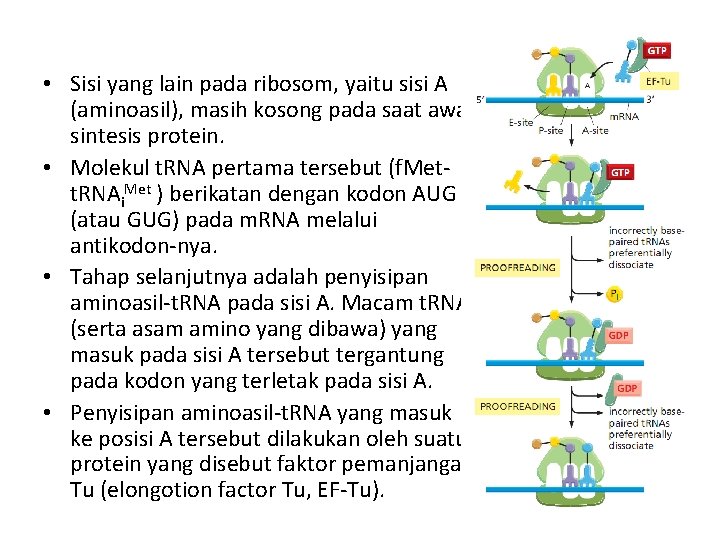
• Sisi yang lain pada ribosom, yaitu sisi A (aminoasil), masih kosong pada saat awal sintesis protein. • Molekul t. RNA pertama tersebut (f. Mett. RNAi. Met ) berikatan dengan kodon AUG (atau GUG) pada m. RNA melalui antikodon-nya. • Tahap selanjutnya adalah penyisipan aminoasil-t. RNA pada sisi A. Macam t. RNA (serta asam amino yang dibawa) yang masuk pada sisi A tersebut tergantung pada kodon yang terletak pada sisi A. • Penyisipan aminoasil-t. RNA yang masuk ke posisi A tersebut dilakukan oleh suatu protein yang disebut faktor pemanjangan Tu (elongotion factor Tu, EF-Tu).
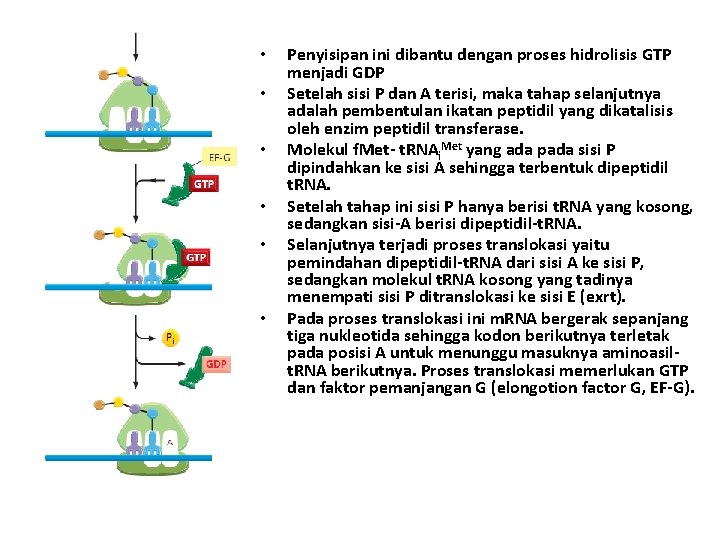
• • • Penyisipan ini dibantu dengan proses hidrolisis GTP menjadi GDP Setelah sisi P dan A terisi, maka tahap selanjutnya adalah pembentulan ikatan peptidil yang dikatalisis oleh enzim peptidil transferase. Molekul f. Met- t. RNAi. Met yang ada pada sisi P dipindahkan ke sisi A sehingga terbentuk dipeptidil t. RNA. Setelah tahap ini sisi P hanya berisi t. RNA yang kosong, sedangkan sisi-A berisi dipeptidil-t. RNA. Selanjutnya terjadi proses translokasi yaitu pemindahan dipeptidil-t. RNA dari sisi A ke sisi P, sedangkan molekul t. RNA kosong yang tadinya menempati sisi P ditranslokasi ke sisi E (exrt). Pada proses translokasi ini m. RNA bergerak sepanjang tiga nukleotida sehingga kodon berikutnya terletak pada posisi A untuk menunggu masuknya aminoasilt. RNA berikutnya. Proses translokasi memerlukan GTP dan faktor pemanjangan G (elongotion factor G, EF-G).
Skema proses pemanjangan po lipeptida • Proses pemanjangan polipeptida berlangsung sangat cepat • Ribosom membaca kodon-kodon pada m. RNA dari ujung 5‘ 3'. Hasil proses translasi adalah molekul polipeptida yang mempunyai ujung amino dan ujung karboksil. • Ujung amino adalahu jungy angp ertamak ali disintesisd an merupakan hasil penerjemahan kodon yang terletak pada ujung 5‘ pada m. RNA, sedangkan ujung yang terakhir disintesis adalah gugus karboksil. • Ujung karboksil merupakan hasil penerjemahan kodon yang terletak pada ujung 3' pada m. RNA. • Oleh karena itu, sintesis protein berlangsung dari ujung amino ke ujung karboksil
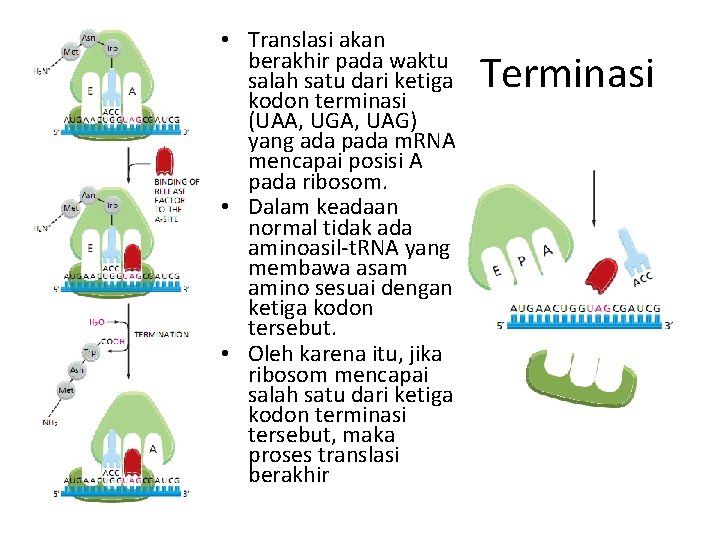
• Translasi akan berakhir pada waktu salah satu dari ketiga kodon terminasi (UAA, UGA, UAG) yang ada pada m. RNA mencapai posisi A pada ribosom. • Dalam keadaan normal tidak ada aminoasil-t. RNA yang membawa asam amino sesuai dengan ketiga kodon tersebut. • Oleh karena itu, jika ribosom mencapai salah satu dari ketiga kodon terminasi tersebut, maka proses translasi berakhir Terminasi