
Protein Purification with fluorescent proteins Laboratory Introduction What
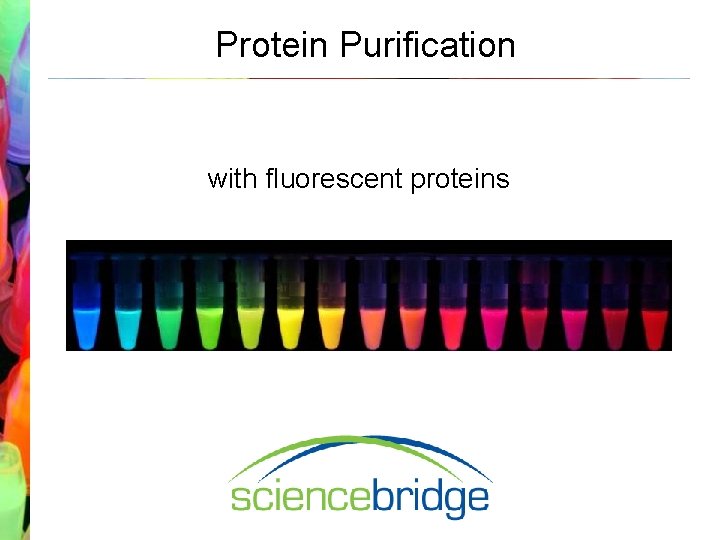
Protein Purification with fluorescent proteins
Laboratory Introduction What is a protocol? What is a protein? Why do scientists use protocols? Why would we need to purify proteins? Now let’s practice pipetting!
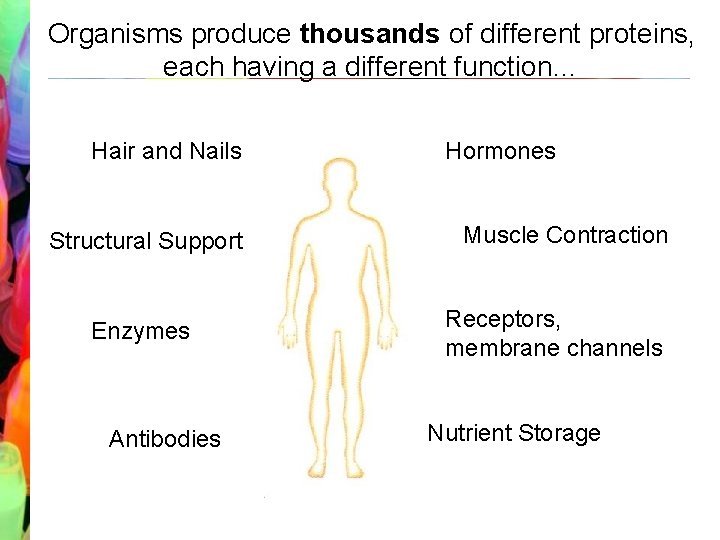
Organisms produce thousands of different proteins, each having a different function… Hair and Nails Structural Support Enzymes Antibodies Hormones Muscle Contraction Receptors, membrane channels Nutrient Storage
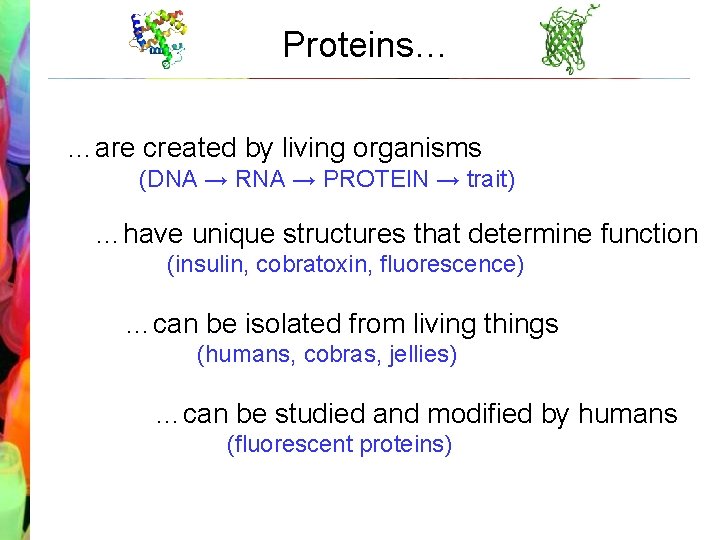
Proteins… …are created by living organisms (DNA → RNA → PROTEIN → trait) …have unique structures that determine function (insulin, cobratoxin, fluorescence) …can be isolated from living things (humans, cobras, jellies) …can be studied and modified by humans (fluorescent proteins)
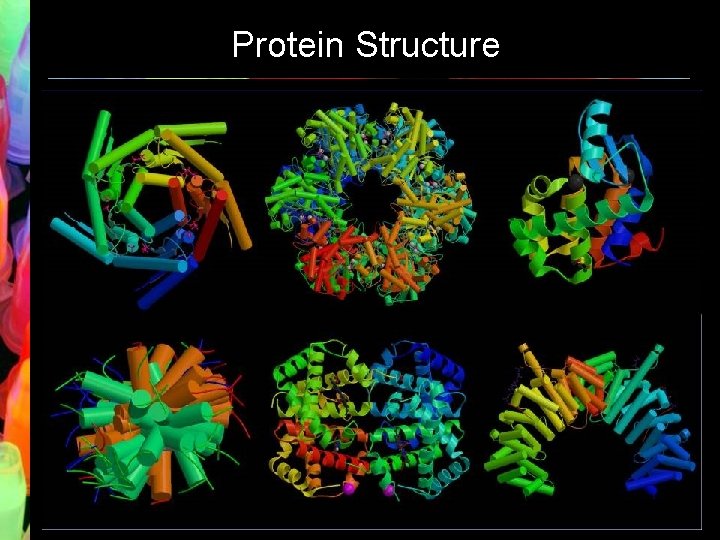
Protein Structure
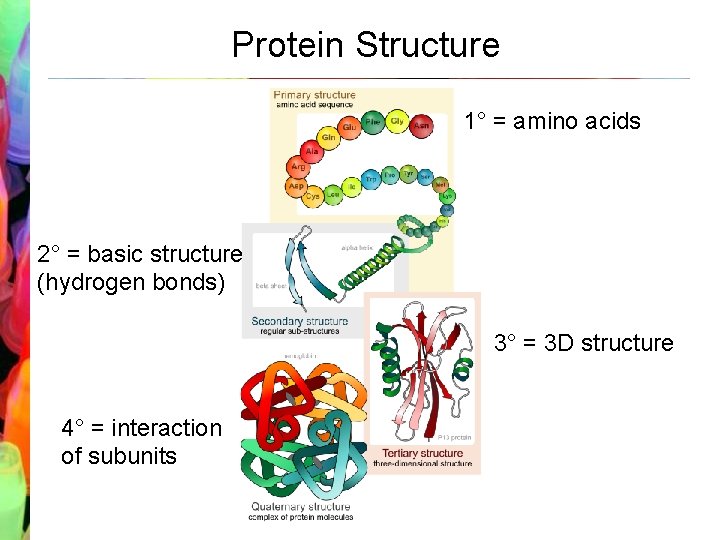
Protein Structure 1° = amino acids 2° = basic structure (hydrogen bonds) 3° = 3 D structure 4° = interaction of subunits
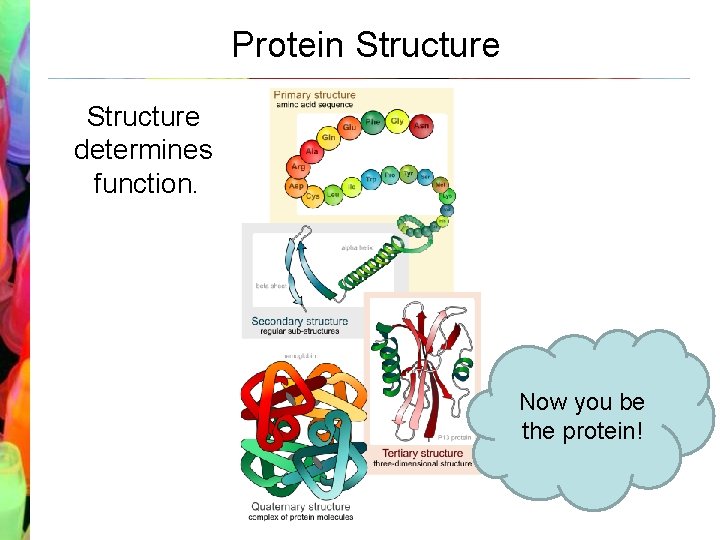
Protein Structure determines function. Now you be the protein!
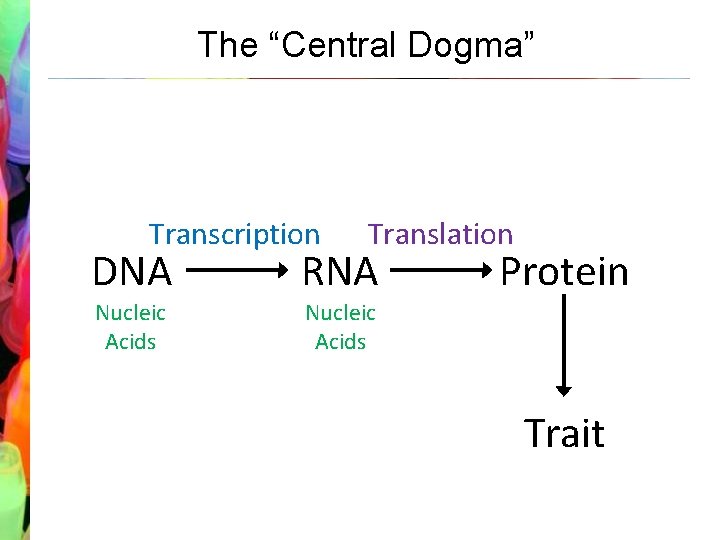
The “Central Dogma” Transcription Translation DNA RNA Protein Nucleic Acids Amino Acids Trait
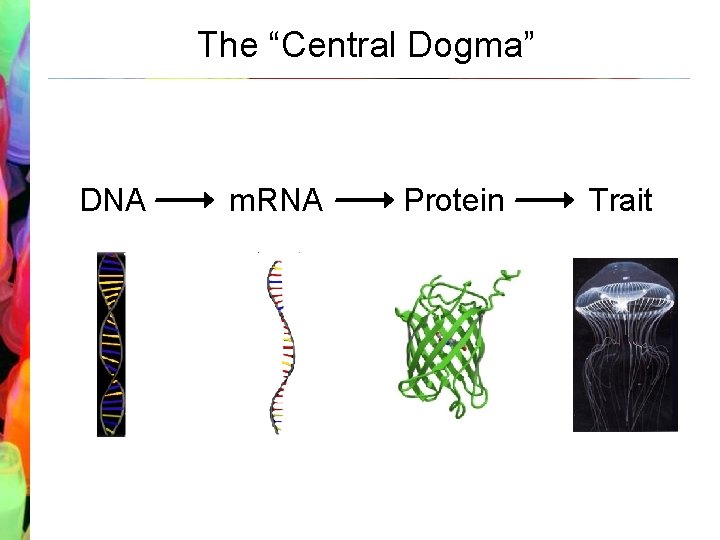
The “Central Dogma” DNA m. RNA Protein Trait
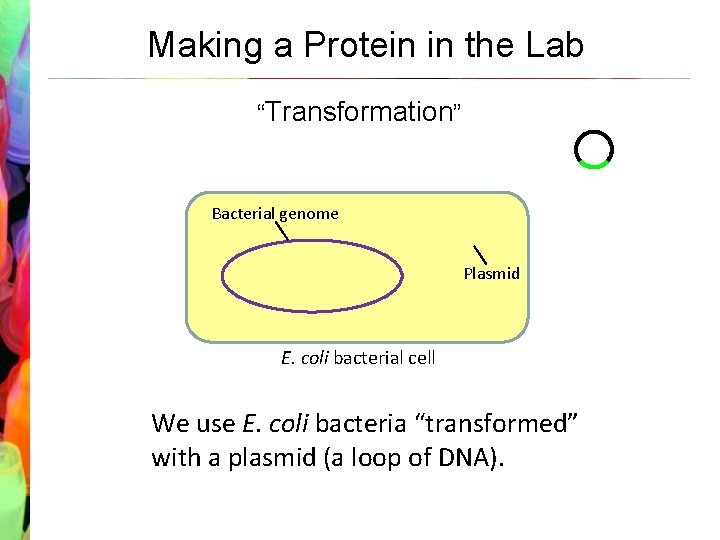
Making a Protein in the Lab “Transformation” Bacterial genome Plasmid E. coli bacterial cell We use E. coli bacteria “transformed” with a plasmid (a loop of DNA).
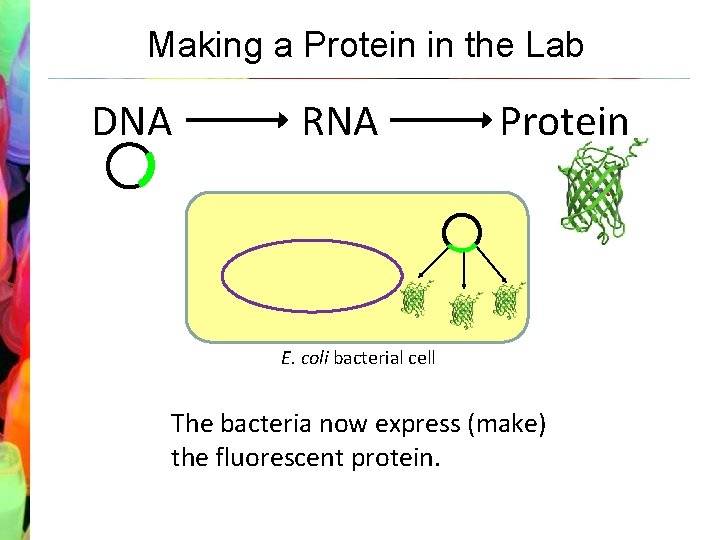
Making a Protein in the Lab DNA RNA Protein E. coli bacterial cell The bacteria now express (make) the fluorescent protein.
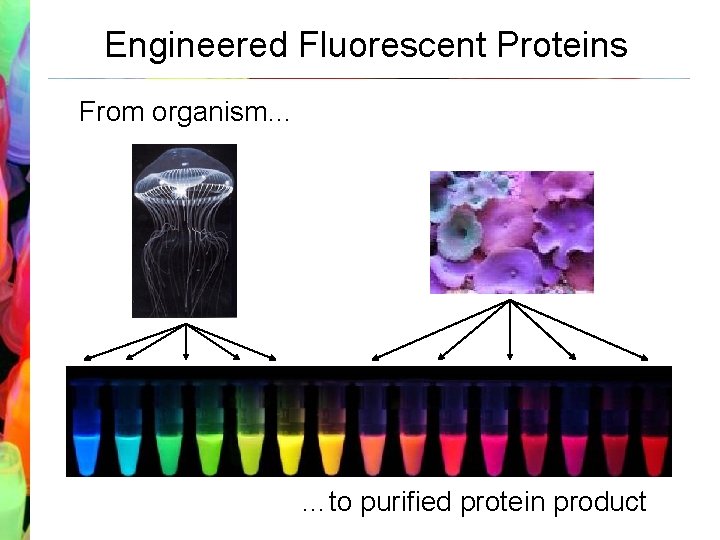
Engineered Fluorescent Proteins From organism… …to purified protein product
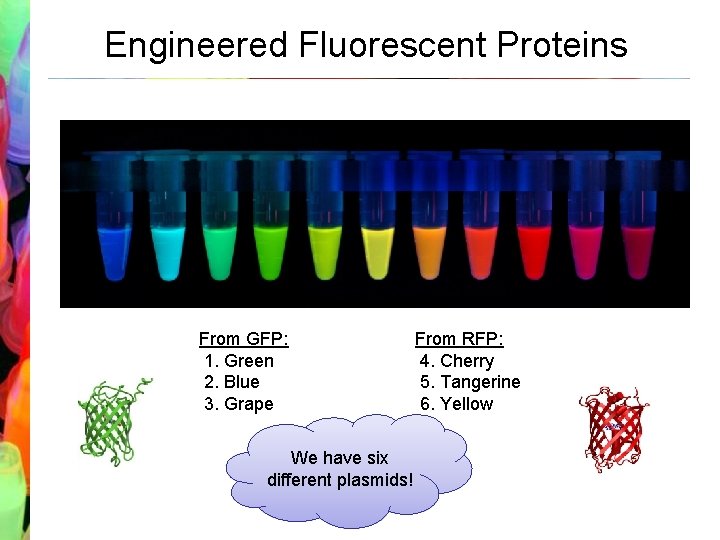
Engineered Fluorescent Proteins From GFP: 1. Green 2. Blue 3. Grape We have six different plasmids! From RFP: 4. Cherry 5. Tangerine 6. Yellow
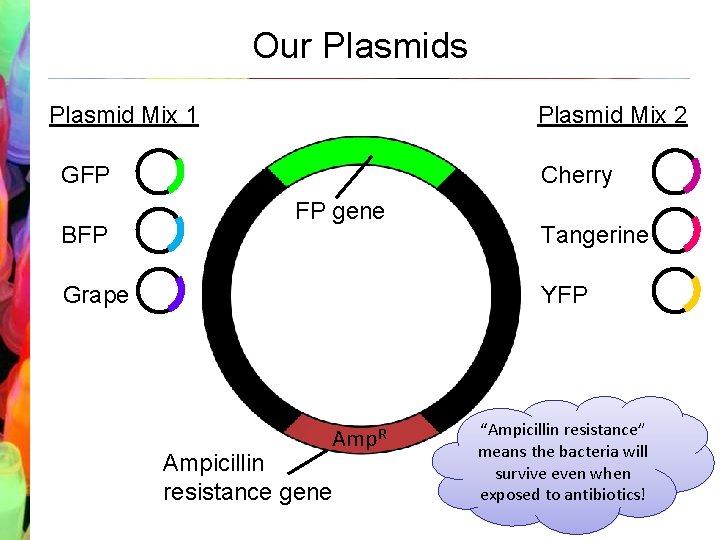
Our Plasmids Plasmid Mix 1 Plasmid Mix 2 GFP BFP Cherry FP gene Grape Tangerine YFP Amp. R Ampicillin resistance gene “Ampicillin resistance” means the bacteria will survive even when exposed to antibiotics!
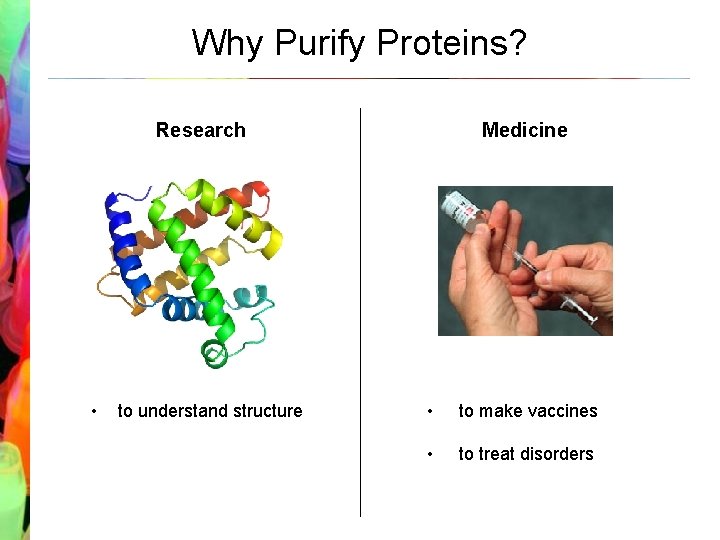
Why Purify Proteins? Research • to understand structure Medicine • to make vaccines • to treat disorders
Why Purify Proteins? Pancreas → Identify Cells → Insert Plasmid into Cell → Isolate Gene → Cell Creates Insulin → Human Use → Insert Gene → Isolate/Purify Protein Insulin for diabetics
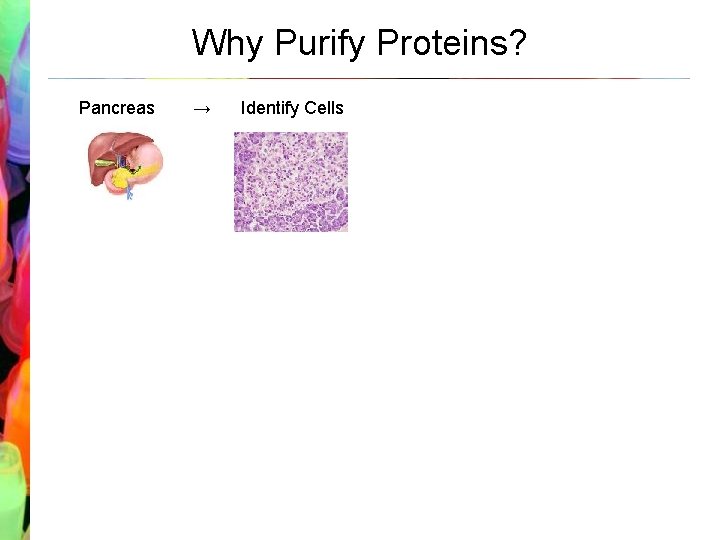
Why Purify Proteins? Pancreas → Identify Cells → Insert Plasmid into Cell → Isolate Gene → Cell Creates Insulin → Human Use → Insert Gene → Isolate/Purify Protein Insulin for diabetics
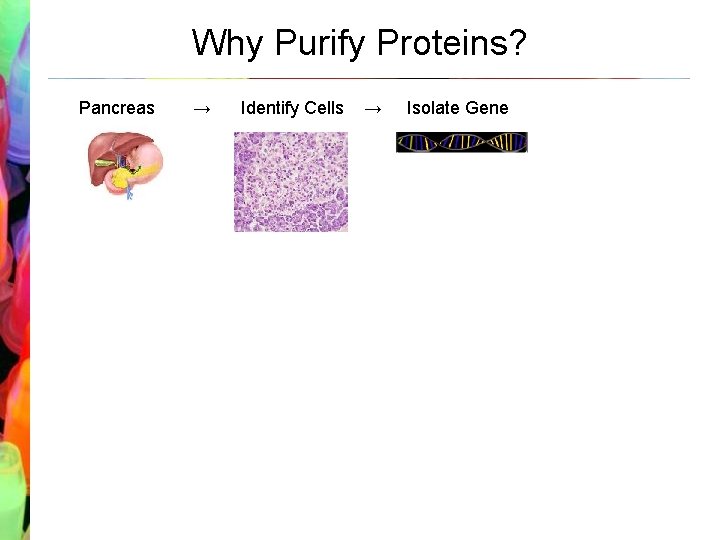
Why Purify Proteins? Pancreas → Identify Cells → Insert Plasmid into Cell → Isolate Gene → Cell Creates Insulin → Human Use → Insert Gene → Isolate/Purify Protein Insulin for diabetics
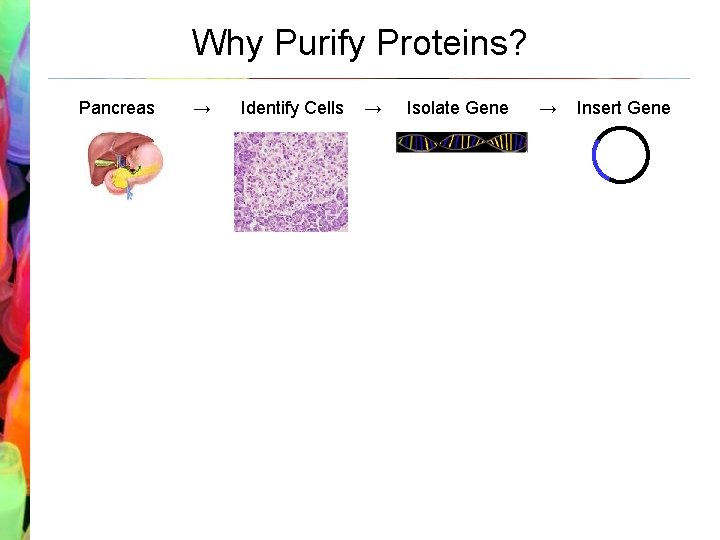
Why Purify Proteins? Pancreas → Identify Cells → Insert Plasmid into Cell → Isolate Gene → Cell Creates Insulin → Human Use → Insert Gene → Isolate/Purify Protein Insulin for diabetics

Why Purify Proteins? Pancreas → Identify Cells → Insert Plasmid into Cell → Isolate Gene → Cell Creates Insulin → Human Use → Insert Gene → Isolate/Purify Protein Insulin for diabetics
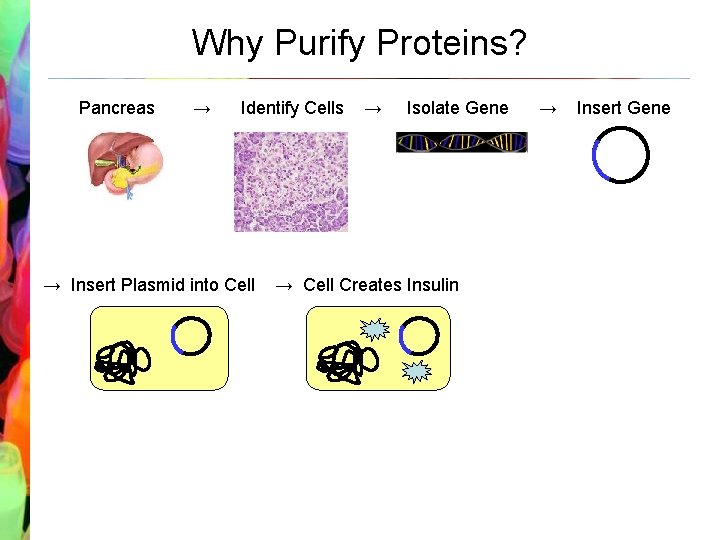
Why Purify Proteins? Pancreas → Identify Cells → Insert Plasmid into Cell → Isolate Gene → Cell Creates Insulin → Human Use → Insert Gene → Isolate/Purify Protein Insulin for diabetics
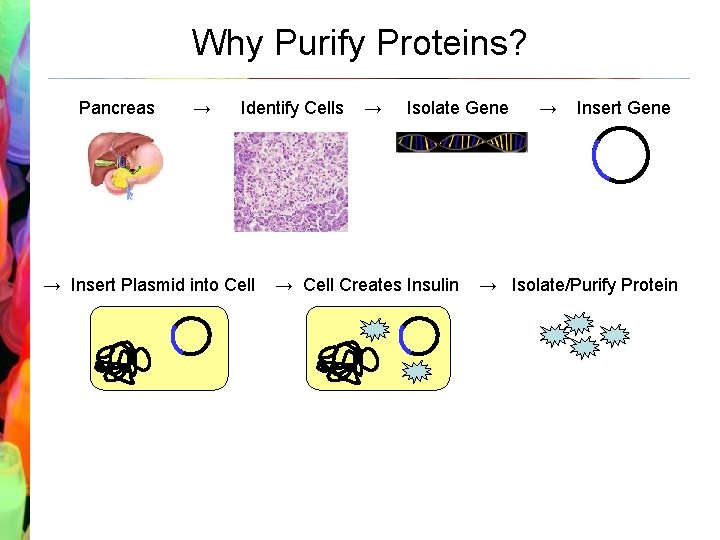
Why Purify Proteins? Pancreas → Identify Cells → Insert Plasmid into Cell → Isolate Gene → Cell Creates Insulin → Human Use → Insert Gene → Isolate/Purify Protein Insulin for diabetics
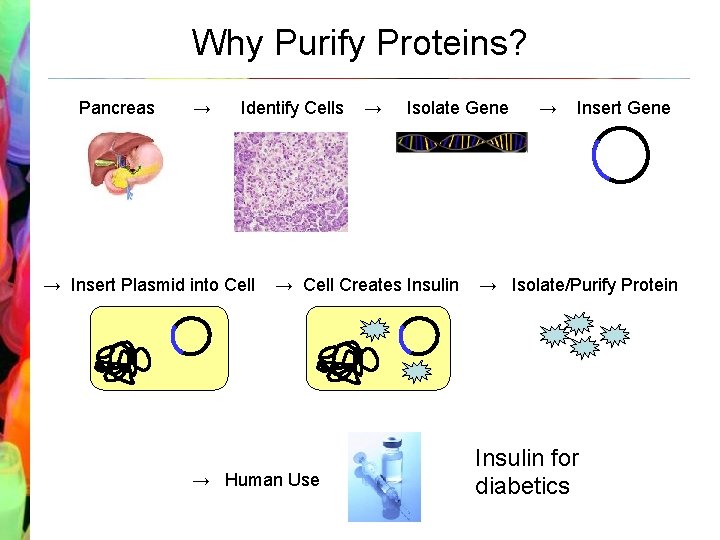
Why Purify Proteins? Pancreas → Identify Cells → Insert Plasmid into Cell → Isolate Gene → Cell Creates Insulin → Human Use → Insert Gene → Isolate/Purify Protein Insulin for diabetics
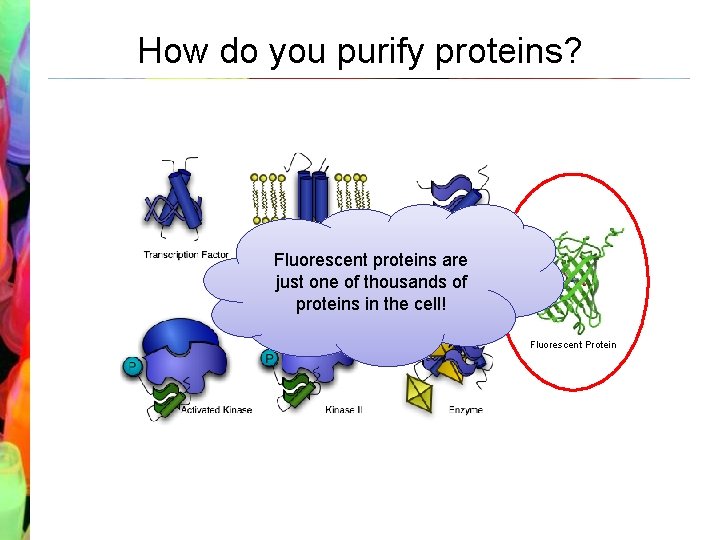
How do you purify proteins? Fluorescent proteins are just one of thousands of proteins in the cell! Fluorescent Protein
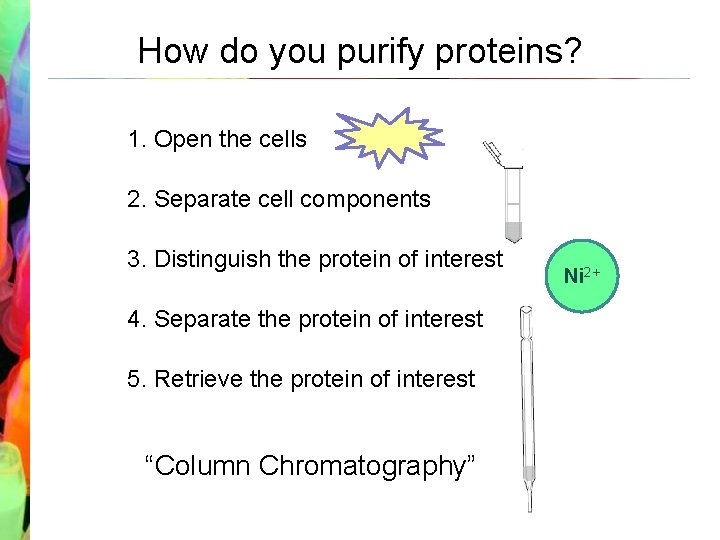
How do you purify proteins? 1. Open the cells 2. Separate cell components 3. Distinguish the protein of interest 4. Separate the protein of interest 5. Retrieve the protein of interest “Column Chromatography” Ni 2+
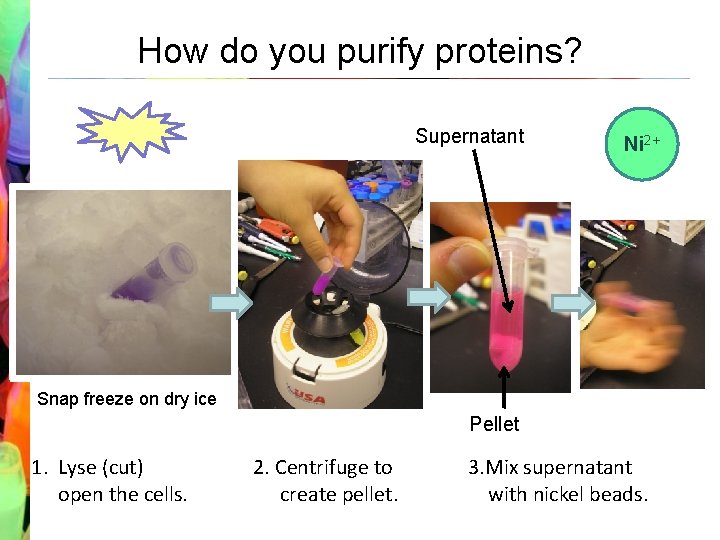
How do you purify proteins? Supernatant Ni 2+ Snap freeze on dry ice Pellet 1. Lyse (cut) open the cells. 2. Centrifuge to create pellet. 3. Mix supernatant with nickel beads.
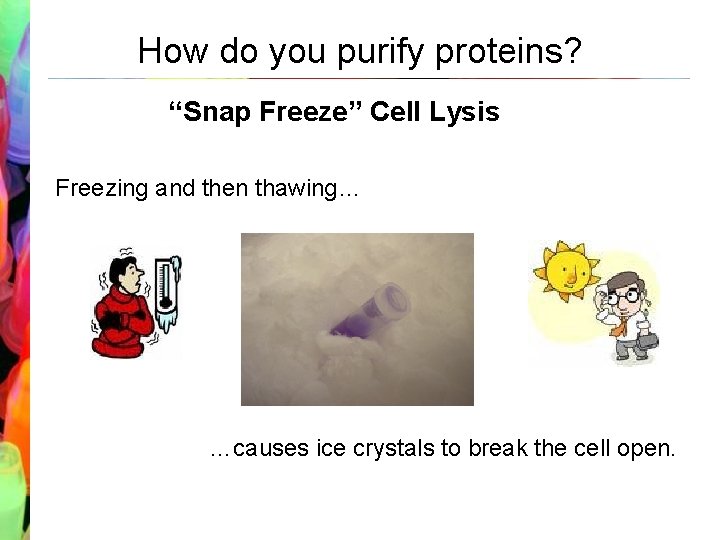
How do you purify proteins? “Snap Freeze” Cell Lysis Freezing and then thawing… …causes ice crystals to break the cell open.
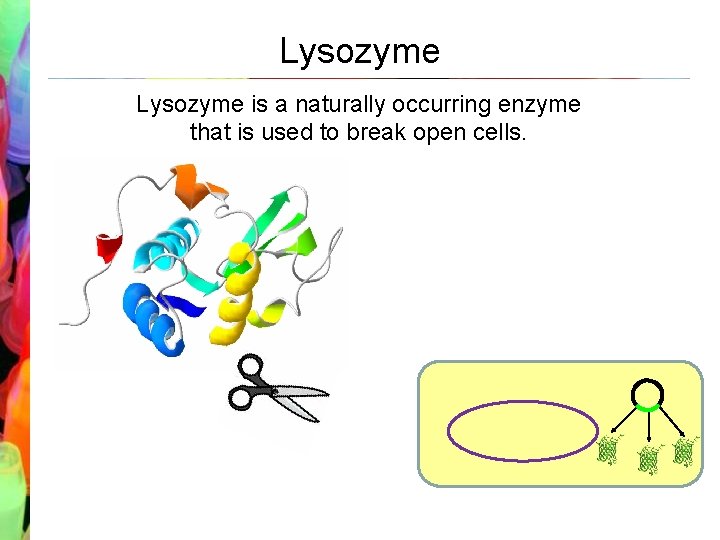
Lysozyme is a naturally occurring enzyme that is used to break open cells.
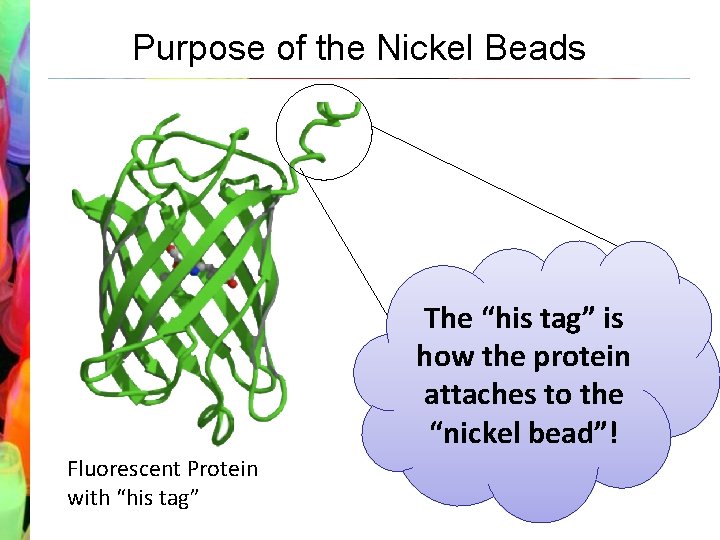
Purpose of the Nickel Beads is h The “his tag” iis s h s i how the protein h is h - to the s attaches i h s hi bead”! “nickel Fluorescent Protein with “his tag” The “his tag”
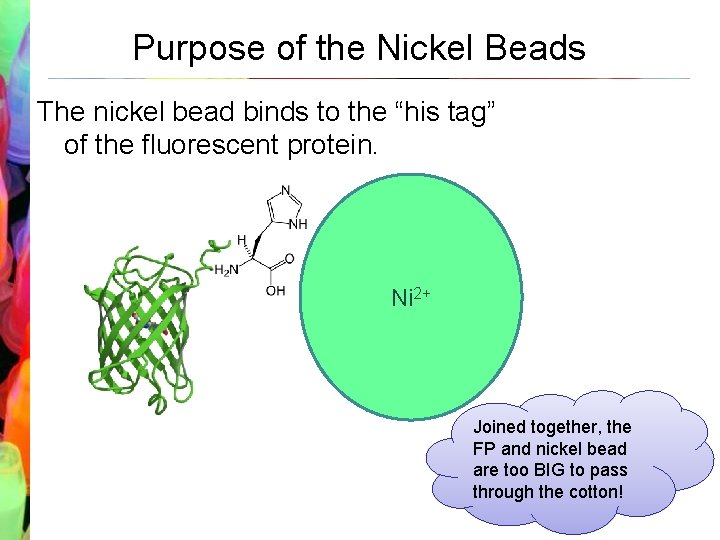
Purpose of the Nickel Beads The nickel bead binds to the “his tag” of the fluorescent protein. Ni 2+ Joined together, the FP and nickel bead are too BIG to pass through the cotton!
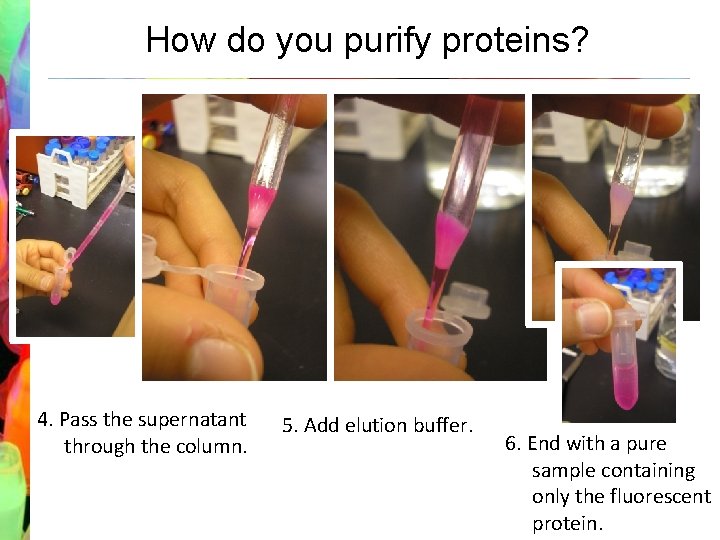
How do you purify proteins? 4. Pass the supernatant through the column. 5. Add elution buffer. 6. End with a pure sample containing only the fluorescent protein.
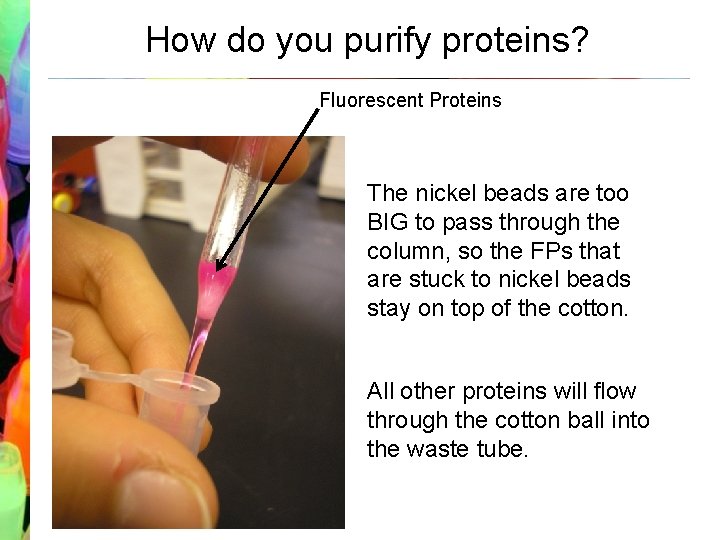
How do you purify proteins? Fluorescent Proteins The nickel beads are too BIG to pass through the column, so the FPs that are stuck to nickel beads stay on top of the cotton. All other proteins will flow through the cotton ball into the waste tube.
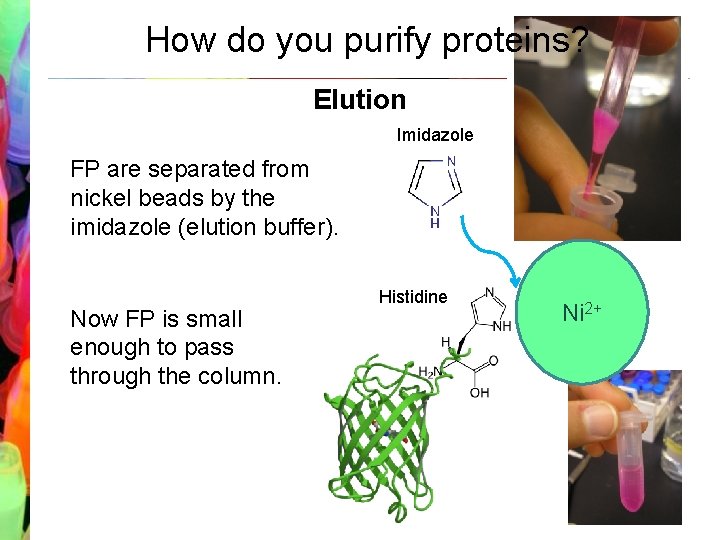
How do you purify proteins? Elution Imidazole FP are separated from nickel beads by the imidazole (elution buffer). Now FP is small enough to pass through the column. Histidine Ni 2+
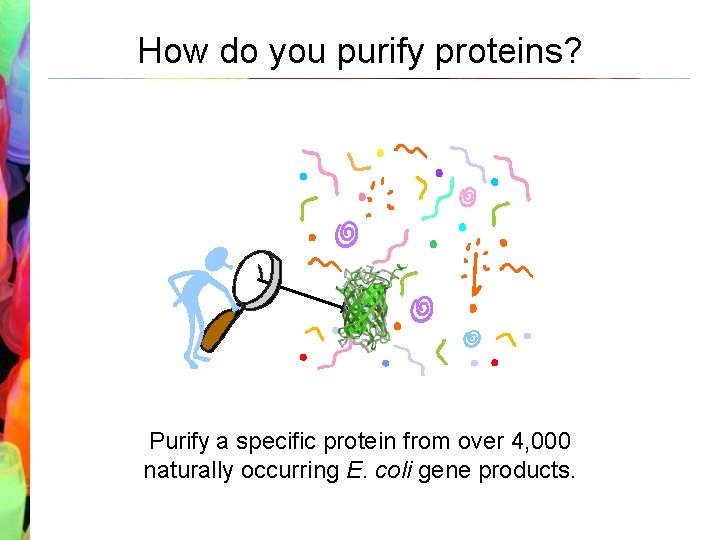
How do you purify proteins? Purify a specific protein from over 4, 000 naturally occurring E. coli gene products.
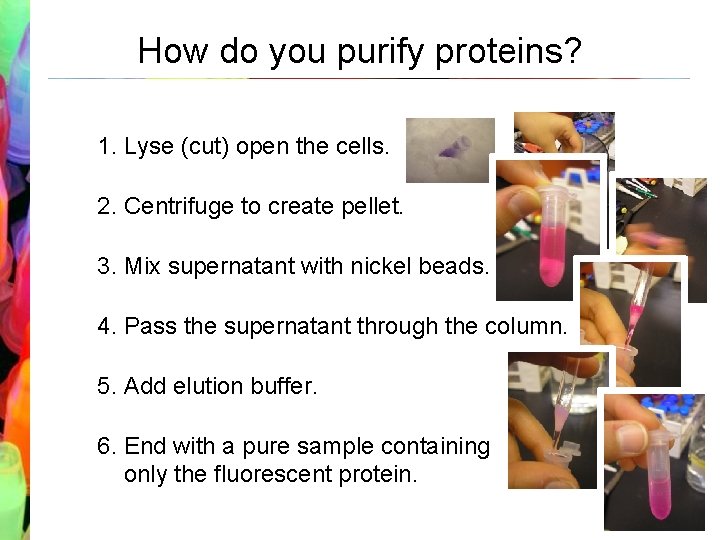
How do you purify proteins? 1. Lyse (cut) open the cells. 2. Centrifuge to create pellet. 3. Mix supernatant with nickel beads. 4. Pass the supernatant through the column. 5. Add elution buffer. 6. End with a pure sample containing only the fluorescent protein.
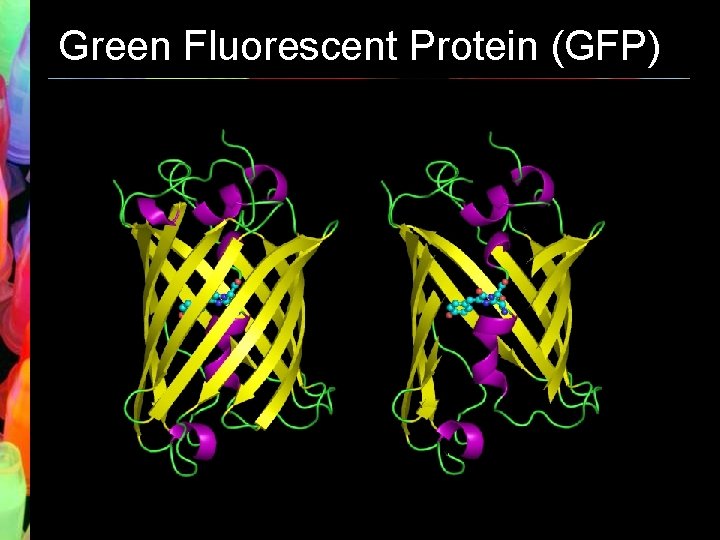
Green Fluorescent Protein (GFP)
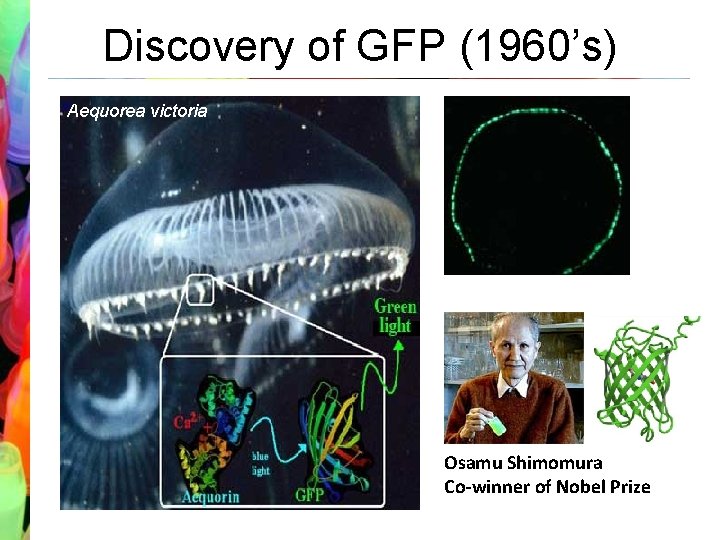
Discovery of GFP (1960’s) Aequorea victoria Osamu Shimomura Co-winner of Nobel Prize
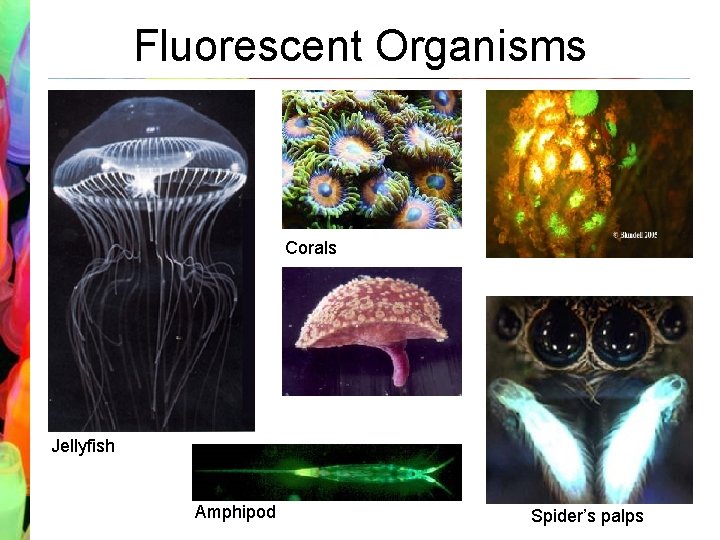
Fluorescent Organisms Corals Jellyfish Amphipod Spider’s palps
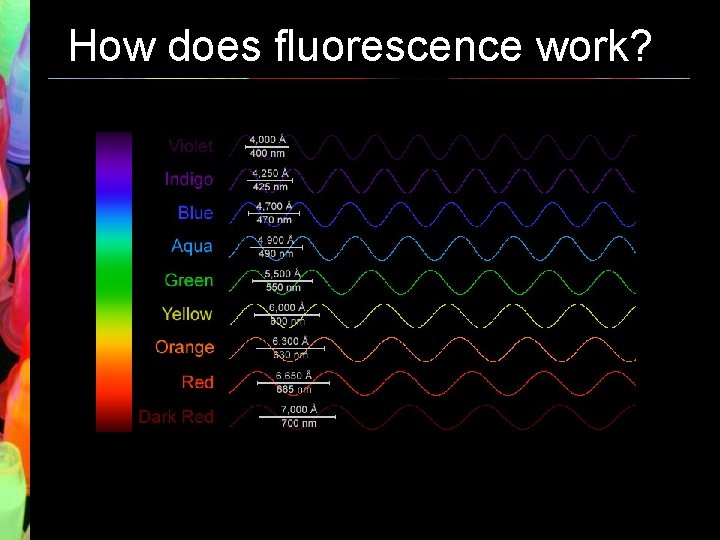
How does fluorescence work?
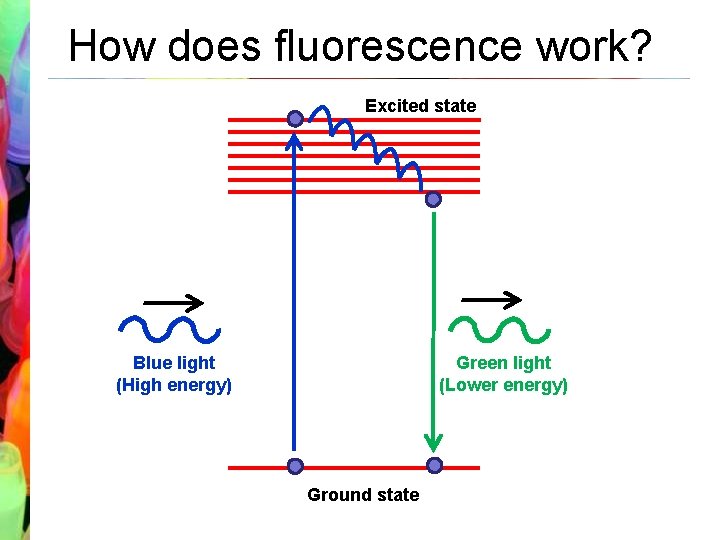
How does fluorescence work? Excited state Blue light (High energy) Green light (Lower energy) Ground state
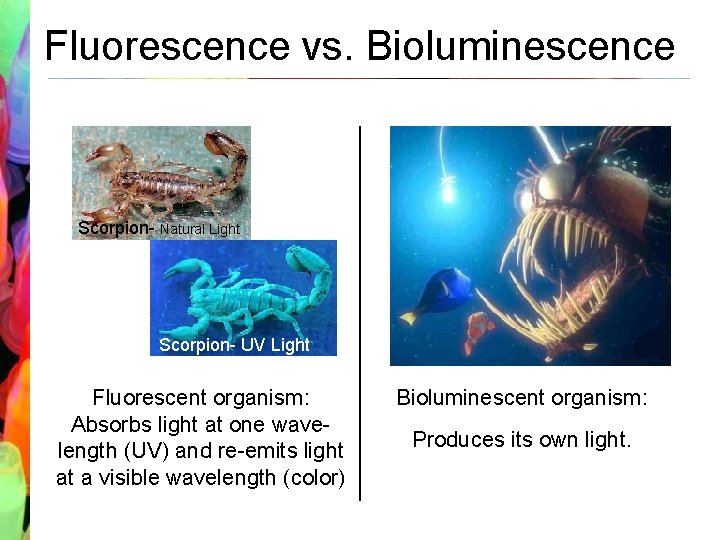
Fluorescence vs. Bioluminescence Natural Light Scorpion- Natural Light In the Dark Scorpion- UV Light Fluorescent organism: Absorbs light at one wavelength (UV) and re-emits light at a visible wavelength (color) Bioluminescent organism: Produces its own light.
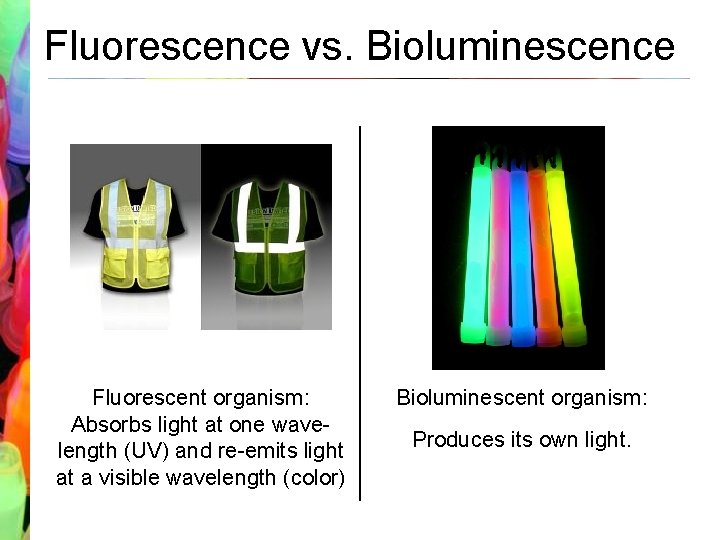
Fluorescence vs. Bioluminescence Fluorescent organism: Absorbs light at one wavelength (UV) and re-emits light at a visible wavelength (color) Bioluminescent organism: Produces its own light.
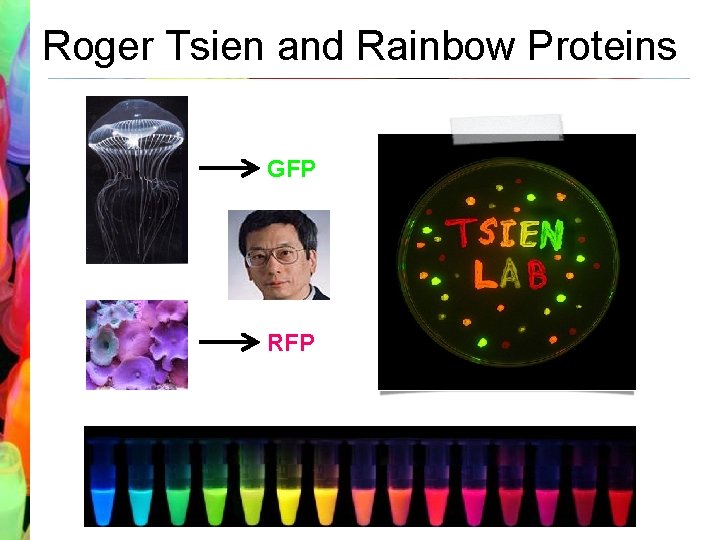
Roger Tsien and Rainbow Proteins GFP RFP
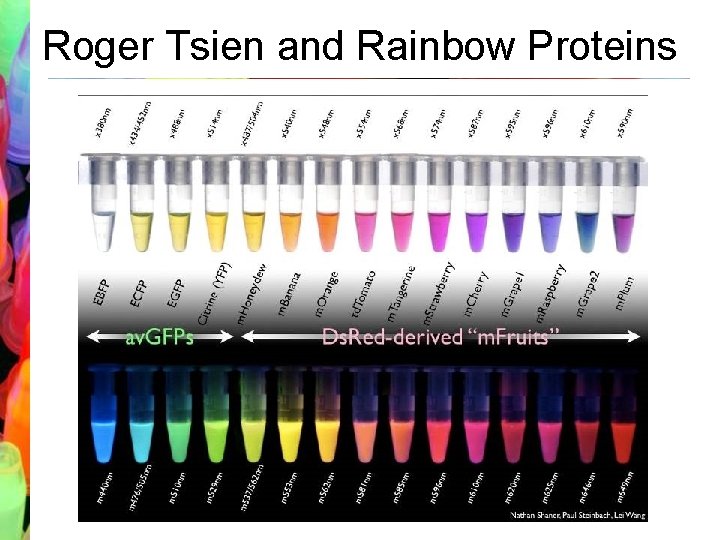
Roger Tsien and Rainbow Proteins
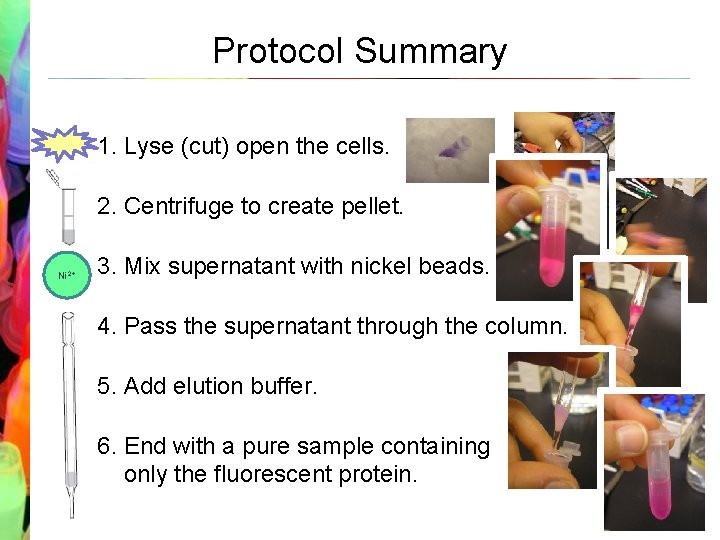
Protocol Summary 1. Lyse (cut) open the cells. 2. Centrifuge to create pellet. Ni 2+ 3. Mix supernatant with nickel beads. 4. Pass the supernatant through the column. 5. Add elution buffer. 6. End with a pure sample containing only the fluorescent protein.
- Slides: 45