
Protein Modeling Challenge Science Olympiad Trial Event Gary
- Slides: 42
Protein Modeling Challenge Science Olympiad Trial Event Gary Graper, Event Supervisor Shannon Colton, Ph. D. , Event Technical Advisor Jennifer Morris, Ph. D. , Event Technical Advisor
Protein Modeling Challenge ¡ To compete successfully in the Protein Modeling Challenge, you will: l Identify basic features of protein structure l Explore protein structure with the computer visualization program Ras. Mol l Create physical models using the flexible modeling media, Mini-Toobers 2
Web-Based Resources ¡ This powerpoint presentation will serve as an interactive resource for your team to gain the knowledge they need to be successful in the Protein Modeling Challenge ¡ You will find links distributed throughout this presentation, indicated by the blue underlined text ¡ Follow these links to the appropriate sources ¡ Good luck and have fun! 3
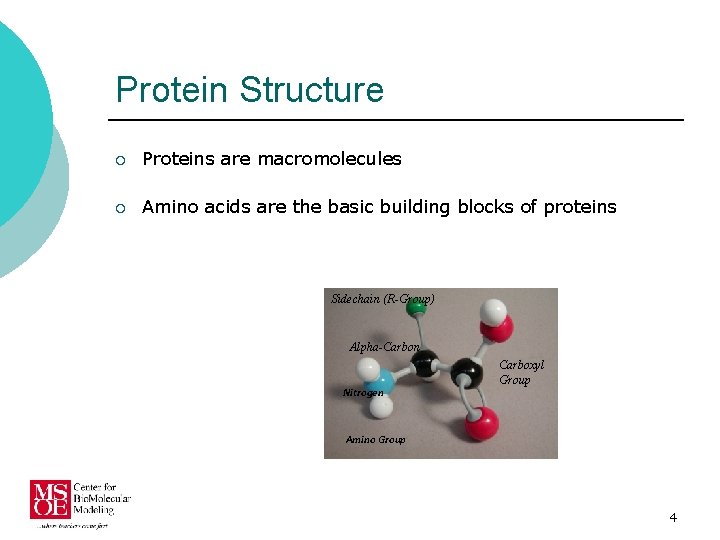
Protein Structure ¡ Proteins are macromolecules ¡ Amino acids are the basic building blocks of proteins Sidechain (R-Group) Alpha-Carbon Nitrogen Carboxyl Group Amino Group 4
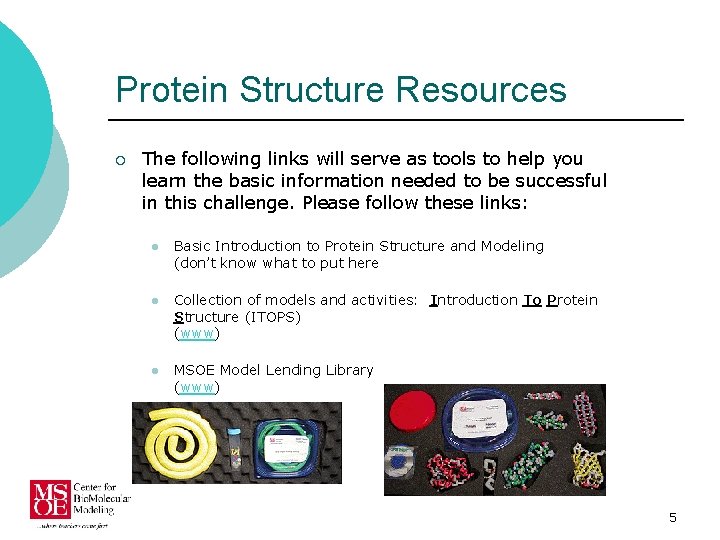
Protein Structure Resources ¡ The following links will serve as tools to help you learn the basic information needed to be successful in this challenge. Please follow these links: l Basic Introduction to Protein Structure and Modeling (don’t know what to put here l Collection of models and activities: Introduction To Protein Structure (ITOPS) (www) l MSOE Model Lending Library (www) 5
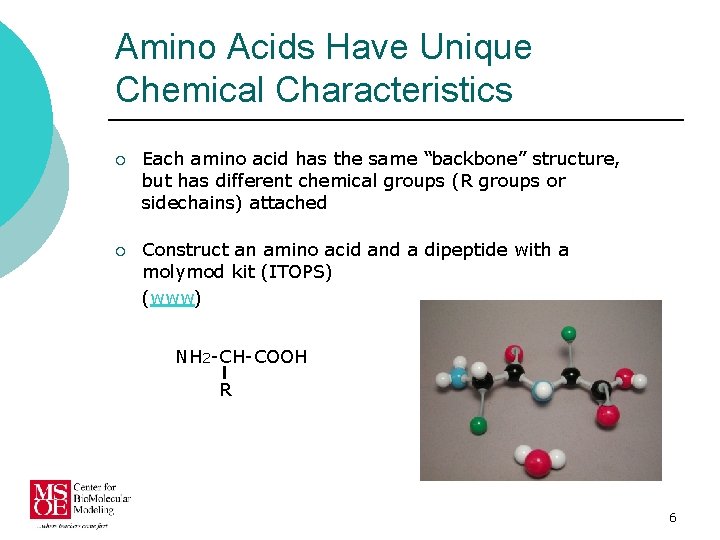
Amino Acids Have Unique Chemical Characteristics ¡ Each amino acid has the same “backbone” structure, but has different chemical groups (R groups or sidechains) attached ¡ Construct an amino acid and a dipeptide with a molymod kit (ITOPS) (www) NH 2 -CH-COOH R 6
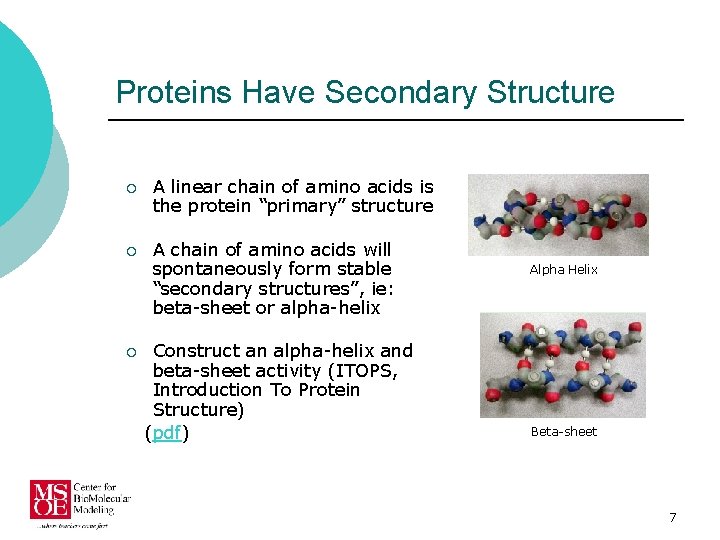
Proteins Have Secondary Structure ¡ A linear chain of amino acids is the protein “primary” structure ¡ A chain of amino acids will spontaneously form stable “secondary structures”, ie: beta-sheet or alpha-helix ¡ Construct an alpha-helix and beta-sheet activity (ITOPS, Introduction To Protein Structure) (pdf) Alpha Helix Beta-sheet 7
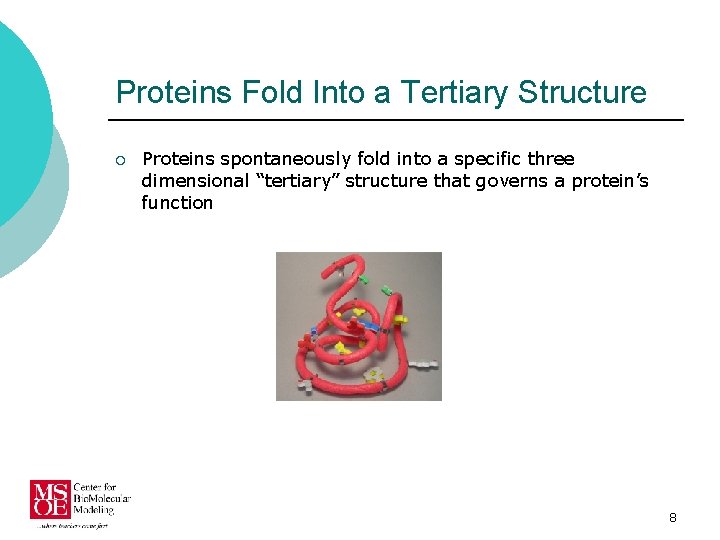
Proteins Fold Into a Tertiary Structure ¡ Proteins spontaneously fold into a specific three dimensional “tertiary” structure that governs a protein’s function 8
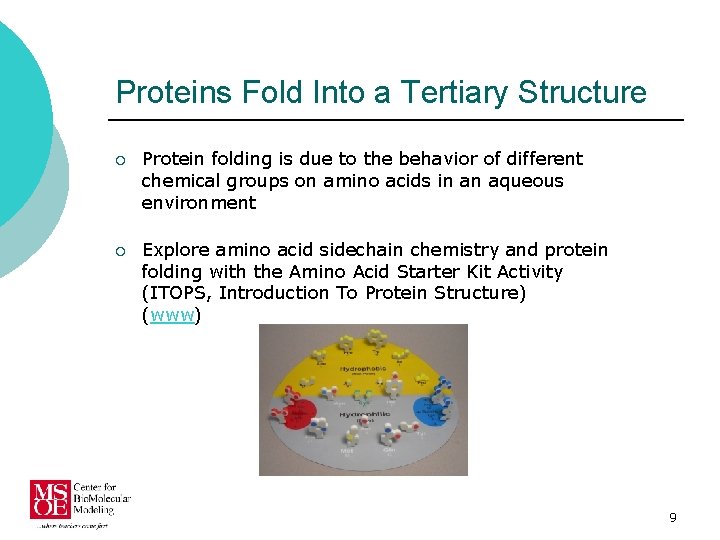
Proteins Fold Into a Tertiary Structure ¡ Protein folding is due to the behavior of different chemical groups on amino acids in an aqueous environment ¡ Explore amino acid sidechain chemistry and protein folding with the Amino Acid Starter Kit Activity (ITOPS, Introduction To Protein Structure) (www) 9
Defining Protein Structure ¡ The 3 -dimensional structure of proteins is often determined by x-ray diffraction or NMR analysis ¡ Each atom in a protein is assigned a specific set of X, Y, Z coordinates in 3 D space to create a PDB data file 10
Protein Data Bank ¡ PDB file lists the X, Y, Z coordinates for each atom in a protein ¡ Protein Data Bank website is the location to download PDB files (www) ¡ PDB Molecule of the Month features the structure and function of a different protein each month (www) 11
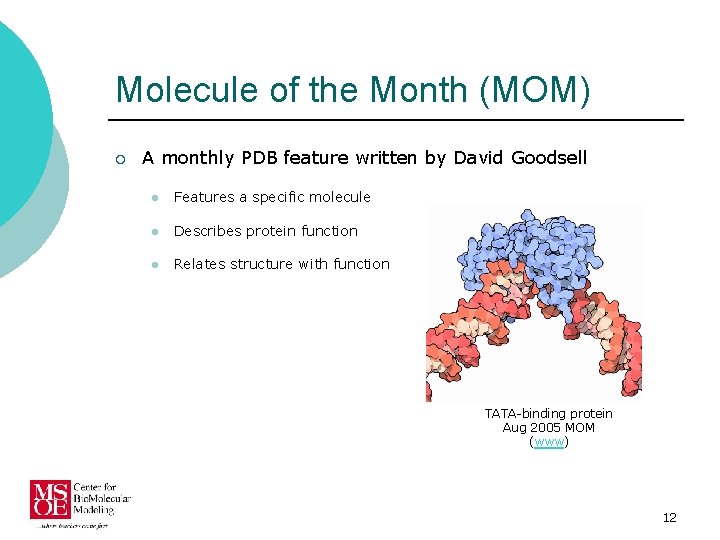
Molecule of the Month (MOM) ¡ A monthly PDB feature written by David Goodsell l Features a specific molecule l Describes protein function l Relates structure with function TATA-binding protein Aug 2005 MOM (www) 12
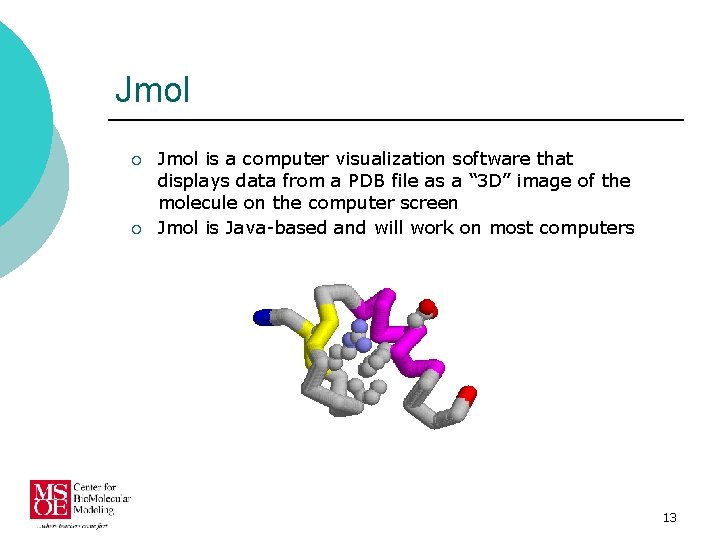
Jmol ¡ ¡ Jmol is a computer visualization software that displays data from a PDB file as a “ 3 D” image of the molecule on the computer screen Jmol is Java-based and will work on most computers 13
Ras. Mol versus Jmol ¡ ¡ Many of you may be familiar with Ras. Mol is a great program and may be continued to be used by Science Olympiad Teams. However, since there have not been updates to Ras. Mol to allow for it to operate easily on Macs, Jmol will be the computer visualization program to be used in the future. The commands that you have used in Ras. Mol are almost the same in Jmol. 14
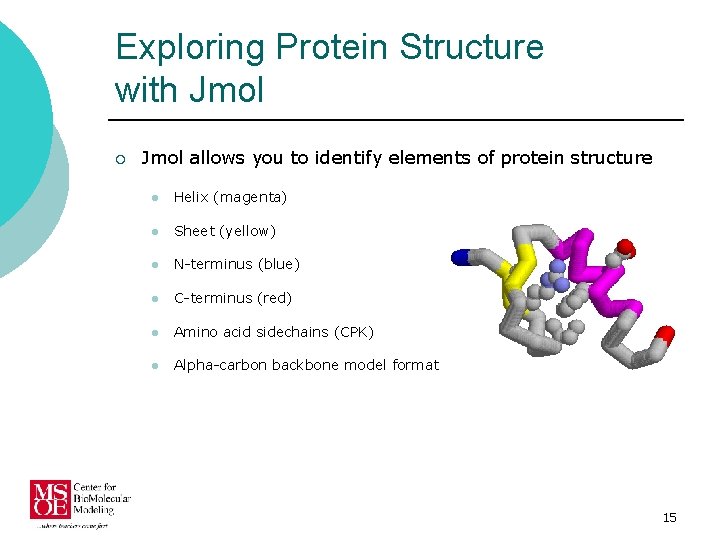
Exploring Protein Structure with Jmol ¡ Jmol allows you to identify elements of protein structure l Helix (magenta) l Sheet (yellow) l N-terminus (blue) l C-terminus (red) l Amino acid sidechains (CPK) l Alpha-carbon backbone model format 15
Jmol Resources ¡ Use the following resources as tools in learning Jmol: l l Jmol free download (www) Assistance on downloading and installing Jmol on your computer (pdf) (need to add link here) l Science Olympiad Guide to Using Jmol to explore protein structure (www) l Reference Card of Jmol commands, condensed (www) 16
Jmol Exercises ¡ Explore the structure of a zinc finger domain and betaglobin proteins and practice Ras. Mol l Zinc Finger Exercise (www) Answers (www) l Beta Globin Exercise (www) Answers (www) 17
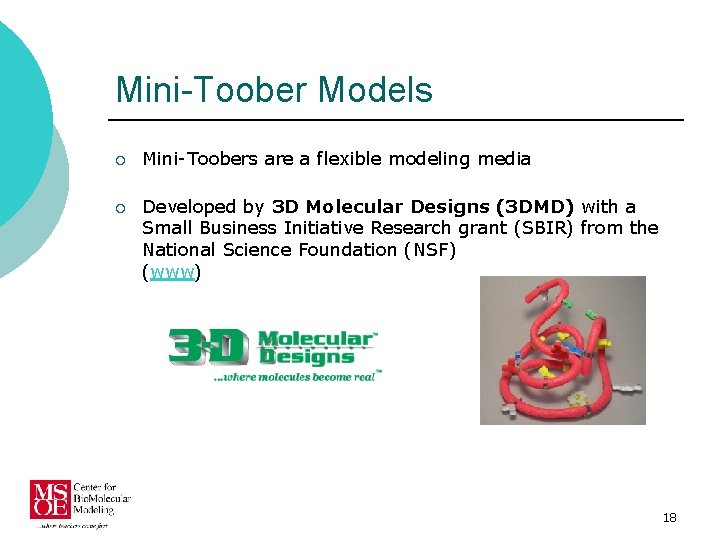
Mini-Toober Models ¡ Mini-Toobers are a flexible modeling media ¡ Developed by 3 D Molecular Designs (3 DMD) with a Small Business Initiative Research grant (SBIR) from the National Science Foundation (NSF) (www) 18
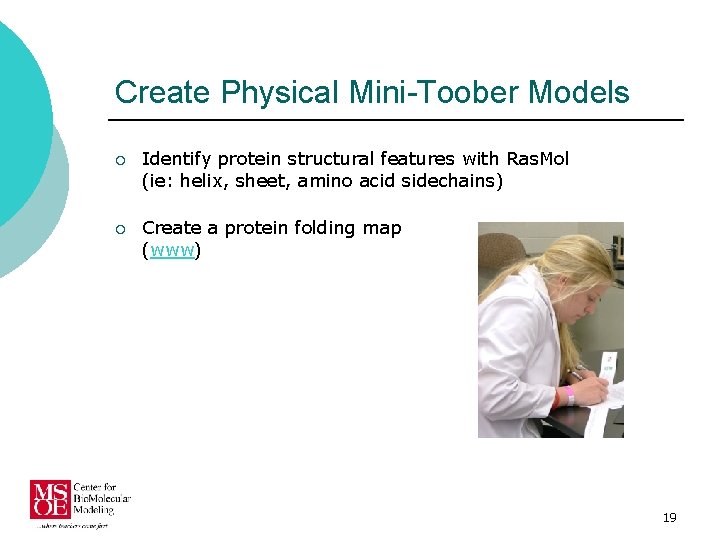
Create Physical Mini-Toober Models ¡ Identify protein structural features with Ras. Mol (ie: helix, sheet, amino acid sidechains) ¡ Create a protein folding map (www) 19
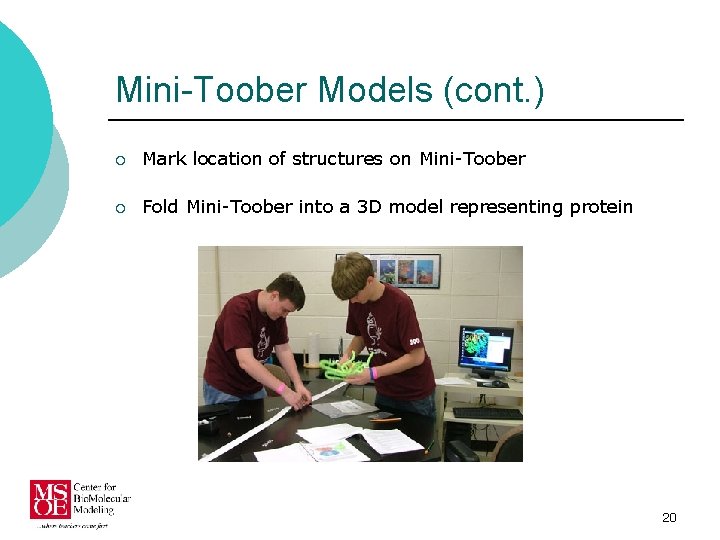
Mini-Toober Models (cont. ) ¡ Mark location of structures on Mini-Toober ¡ Fold Mini-Toober into a 3 D model representing protein 20
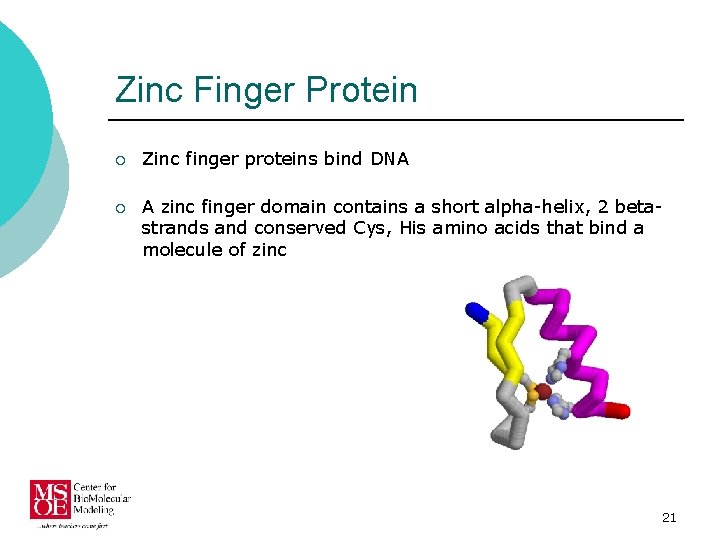
Zinc Finger Protein ¡ Zinc finger proteins bind DNA ¡ A zinc finger domain contains a short alpha-helix, 2 betastrands and conserved Cys, His amino acids that bind a molecule of zinc 21
Zinc Finger Folding Exercise ¡ Zinc Finger Folding Kit is available from MSOE Lending Library - Introduction to Protein Structure. ITOPS (www) ¡ Challenge: Download the 1 ZAA pdb file, create an image in Ras. Mol, identify key structural features, and fold a Mini-Toober model (change to new zinc finger folding kit activities) 22
Protein Modeling Challenge Science Olympiad Trial Event ¡ 2008 Event Rules (www) ¡ Pre-build model (40%) ¡ On-site build (30%) ¡ Written exam (30%) 23
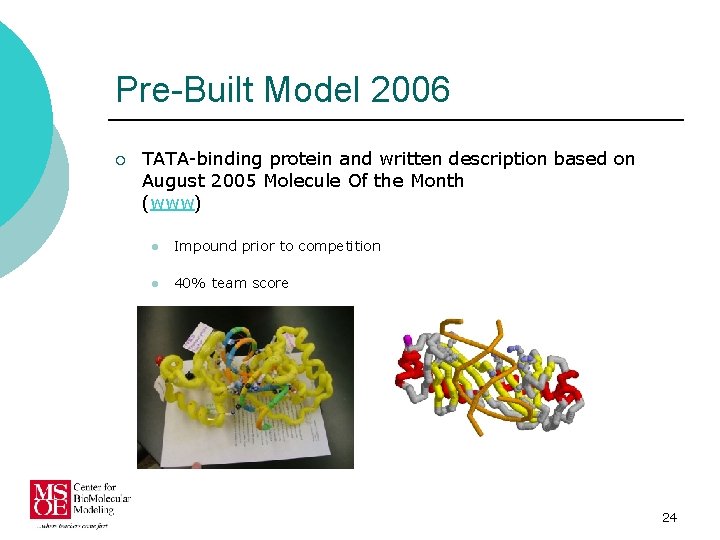
Pre-Built Model 2006 ¡ TATA-binding protein and written description based on August 2005 Molecule Of the Month (www) l Impound prior to competition l 40% team score 24
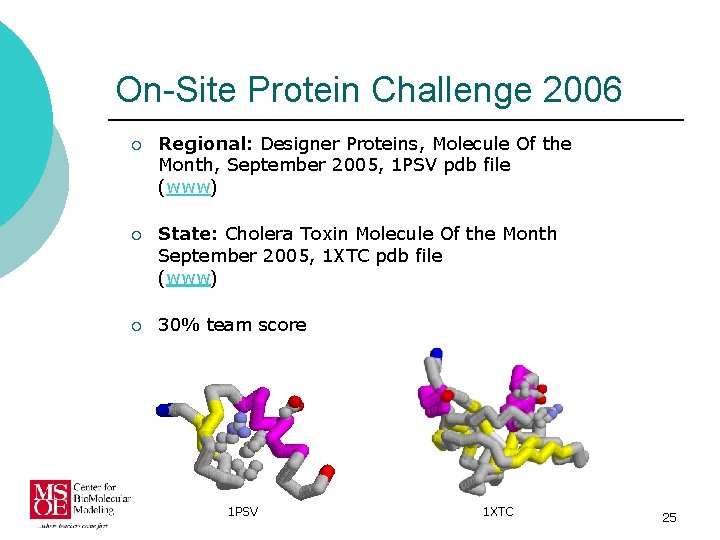
On-Site Protein Challenge 2006 ¡ Regional: Designer Proteins, Molecule Of the Month, September 2005, 1 PSV pdb file (www) ¡ State: Cholera Toxin Molecule Of the Month September 2005, 1 XTC pdb file (www) ¡ 30% team score 1 PSV 1 XTC 25
Written Exam 2006 ¡ Exam covers material in PDB file, Molecule of the Month, Ras. Mol, as well as basic concepts in protein structure and function ¡ 30% team score ¡ Wisconsin State 2006 Written Exam (www) 26
Scoring Rubrics 2006 ¡ TATA Binding Protein model (www) ¡ TATA Binding Protein written description (www) ¡ Protein folding map (www) ¡ Cholera toxin model (www) ¡ WI State written exam (www) 27
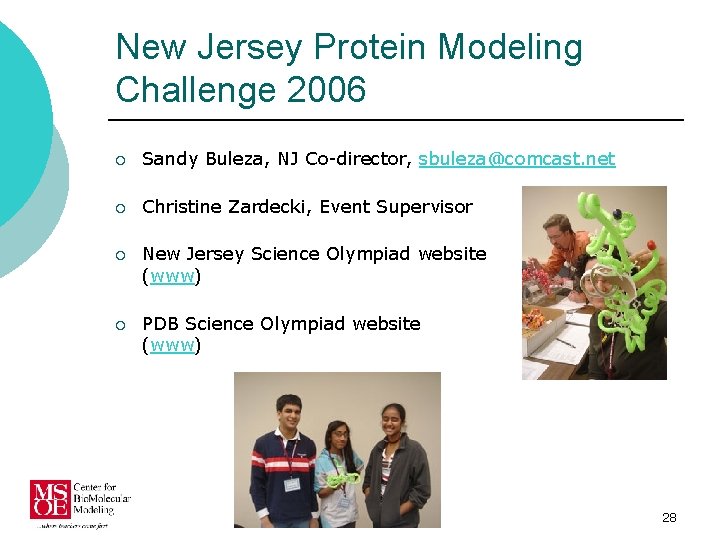
New Jersey Protein Modeling Challenge 2006 ¡ Sandy Buleza, NJ Co-director, sbuleza@comcast. net ¡ Christine Zardecki, Event Supervisor ¡ New Jersey Science Olympiad website (www) ¡ PDB Science Olympiad website (www) 28
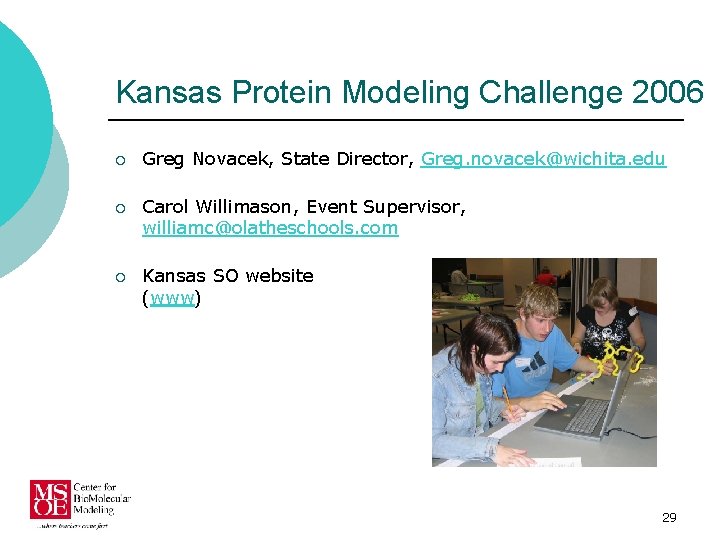
Kansas Protein Modeling Challenge 2006 ¡ Greg Novacek, State Director, Greg. novacek@wichita. edu ¡ Carol Willimason, Event Supervisor, williamc@olatheschools. com ¡ Kansas SO website (www) 29
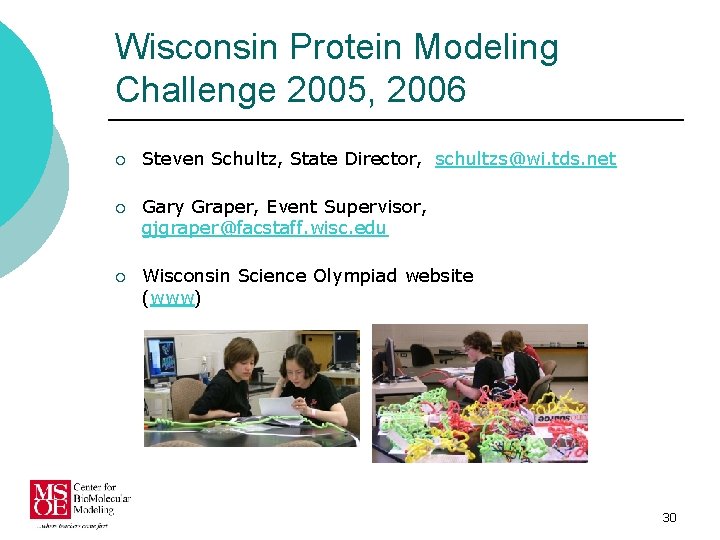
Wisconsin Protein Modeling Challenge 2005, 2006 ¡ Steven Schultz, State Director, schultzs@wi. tds. net ¡ Gary Graper, Event Supervisor, gjgraper@facstaff. wisc. edu ¡ Wisconsin Science Olympiad website (www) 30
Cost of Materials ¡ Materials for pre-built model, regional, and state competitions are approximately $50 -60 per team (all materials provided at cost by 3 D Molecular Designs) ¡ Wisconsin (2005 and 2006) sponsored by 3 D Molecular Designs (www) and MSOE (www) ¡ New Jersey (2006) sponsored by the Protein Data Bank (www) ¡ Kansas (2006) sponsored by 3 DMD, MSOE, Kansas Science Olympiad committee 31
Future Support ¡ 3 D Molecular Designs and MSOE are committed to sponsor the first National Science Olympiad Protein Modeling Challenge ¡ Center for Bio. Molecular Modeling, CBM, will work with each State Event Supervisor to identify corporate sponsors ¡ Other options: fee to each team, inclusion of cost in team registration fee, grants 32
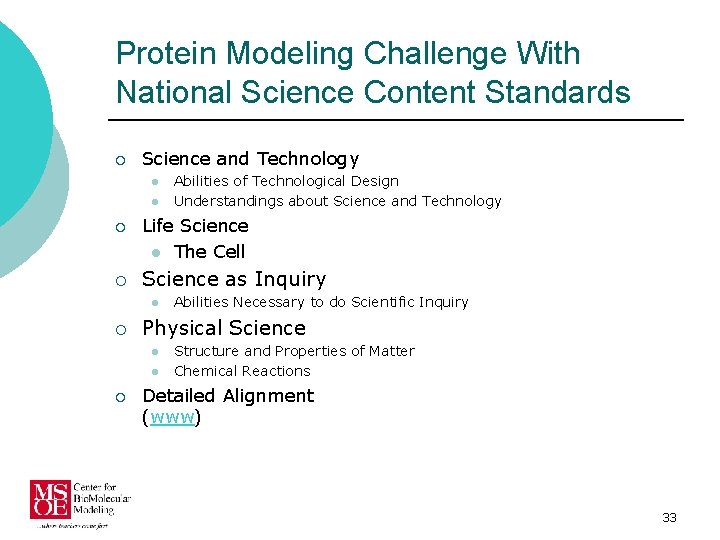
Protein Modeling Challenge With National Science Content Standards ¡ Science and Technology l l ¡ ¡ Life Science l The Cell Science as Inquiry l ¡ Abilities Necessary to do Scientific Inquiry Physical Science l l ¡ Abilities of Technological Design Understandings about Science and Technology Structure and Properties of Matter Chemical Reactions Detailed Alignment (www) 33
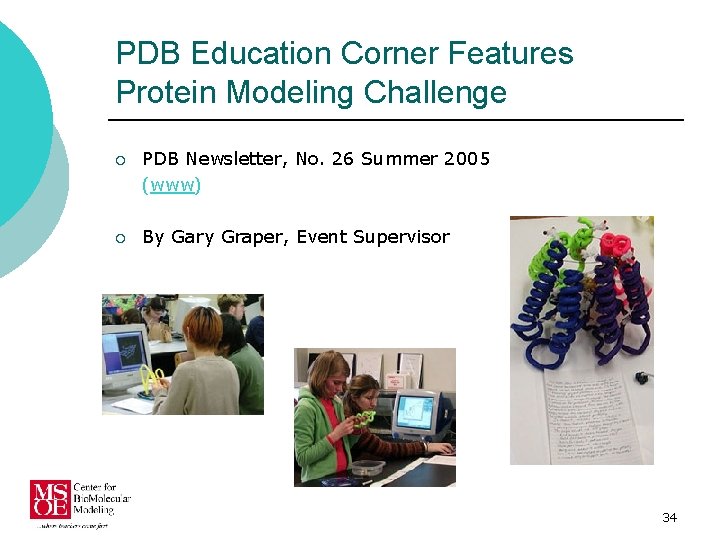
PDB Education Corner Features Protein Modeling Challenge ¡ PDB Newsletter, No. 26 Summer 2005 (www) ¡ By Gary Graper, Event Supervisor 34
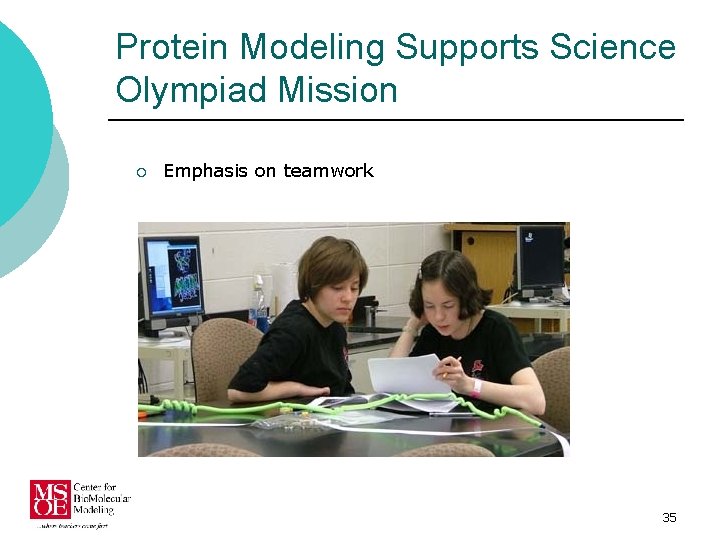
Protein Modeling Supports Science Olympiad Mission ¡ Emphasis on teamwork 35
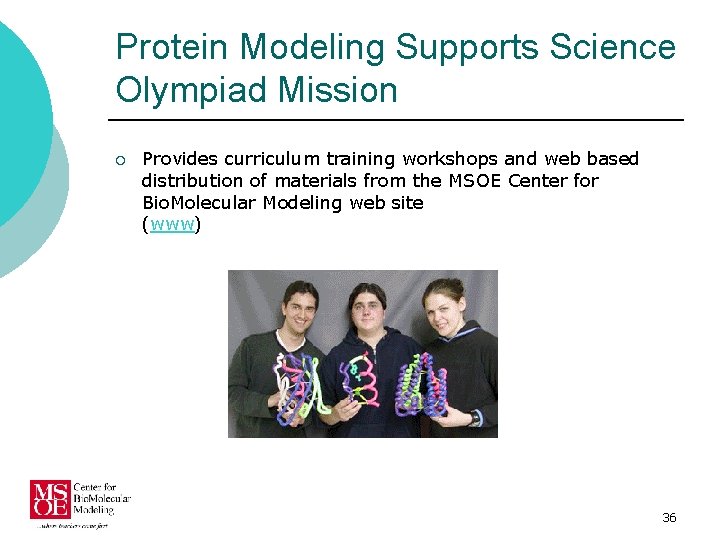
Protein Modeling Supports Science Olympiad Mission ¡ Provides curriculum training workshops and web based distribution of materials from the MSOE Center for Bio. Molecular Modeling web site (www) 36
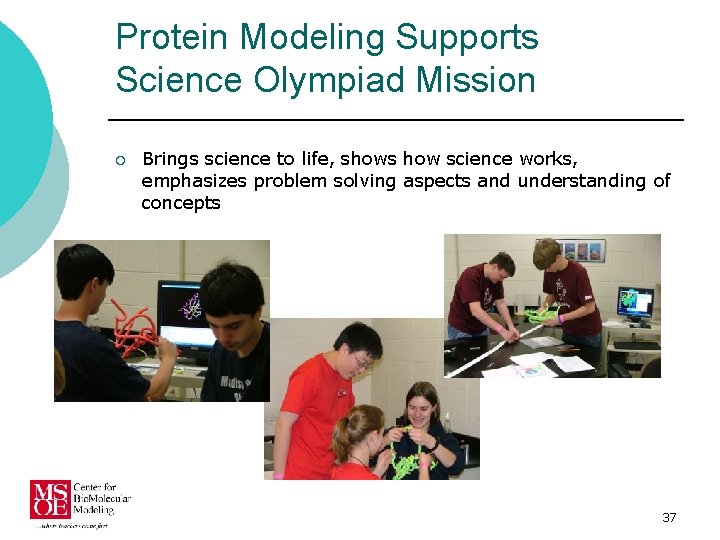
Protein Modeling Supports Science Olympiad Mission ¡ Brings science to life, shows how science works, emphasizes problem solving aspects and understanding of concepts 37
Protein Modeling Supports Science Olympiad Mission ¡ Promotes partnerships among community, businesses, industry, and education 38
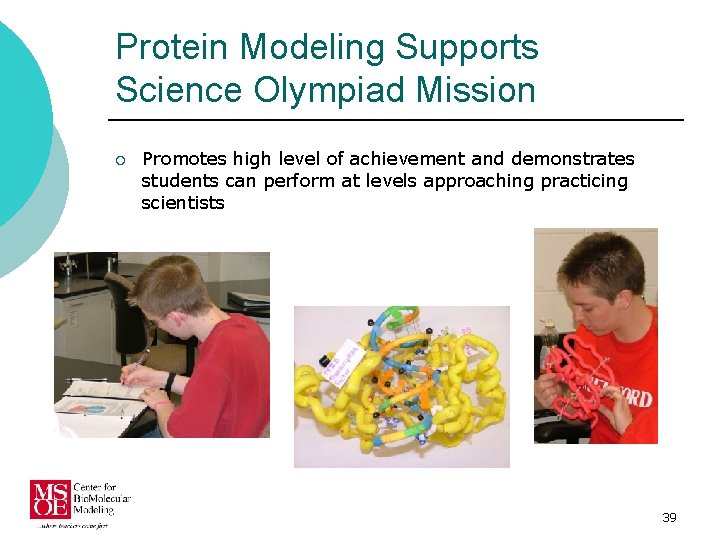
Protein Modeling Supports Science Olympiad Mission ¡ Promotes high level of achievement and demonstrates students can perform at levels approaching practicing scientists 39
CBM Programs ¡ Teacher Professional Development (www) l l l Genes, Schemes, Molecular Machines Modeling the Molecular World Molecular Stories of Research-Based Health Care ¡ SMART Teams (Students Modeling A Research Topic) (www) ¡ MSOE Model Lending Library (www) ¡ Science Olympiad Protein Modeling Challenge (www) 40
Additional Information ¡ Please contact either: l Gary Graper, gjgraper@facstaff. wisc. edu l Shannon Colton, Ph. D. , colton@msoe. edu or 414 -277 -2824 41
http: //www. rpc. msoe. edu/cbm 42