
Protein metabolism 2 Anil Gattani Oxidative Deamination Oxidative
Protein metabolism- 2 Anil Gattani
Oxidative Deamination Oxidative deamination • Removes the amino group as an ammonium ion from glutamate. • Provides -ketoglutarate for transamination. • Mainly in liver and kidney
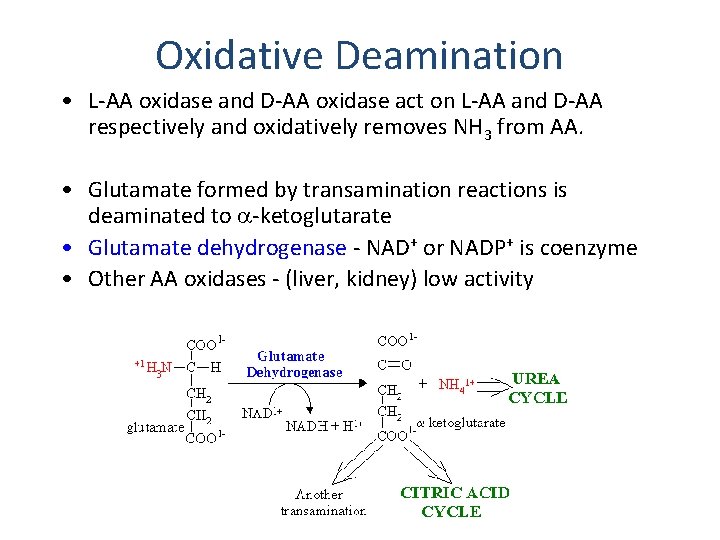
Oxidative Deamination • L-AA oxidase and D-AA oxidase act on L-AA and D-AA respectively and oxidatively removes NH 3 from AA. • Glutamate formed by transamination reactions is deaminated to -ketoglutarate • Glutamate dehydrogenase - NAD+ or NADP+ is coenzyme • Other AA oxidases - (liver, kidney) low activity
Glutamate Dehydrogenase catalyzes a major reaction that effects net removal of N from the amino acid pool. It is one of the few enzymes that can use NAD+ or NADP+ as e- acceptor. Oxidation at the -carbon is followed by hydrolysis, releasing NH 4+.
Non Oxidative Deamination A. Amino acid dehydratase- act on hydroxy AA (serine, threonine) require pyridoxal phosphate B. Histidase- on Histidine to NH 3 and urocanic acid C. Desulfhydratase- on Sulphur containing AA
Summarized above: The role of transaminases in funneling amino N to glutamate, which is deaminated via Glutamate Dehydrogenase, producing NH 4+.
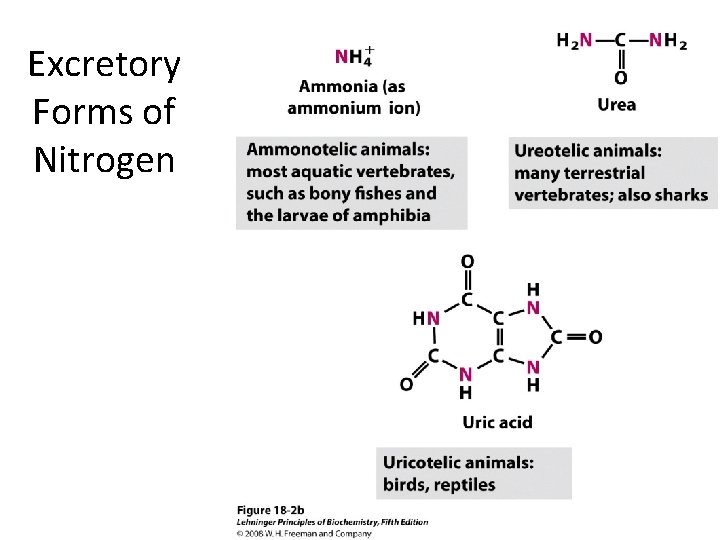
Excretory Forms of Nitrogen
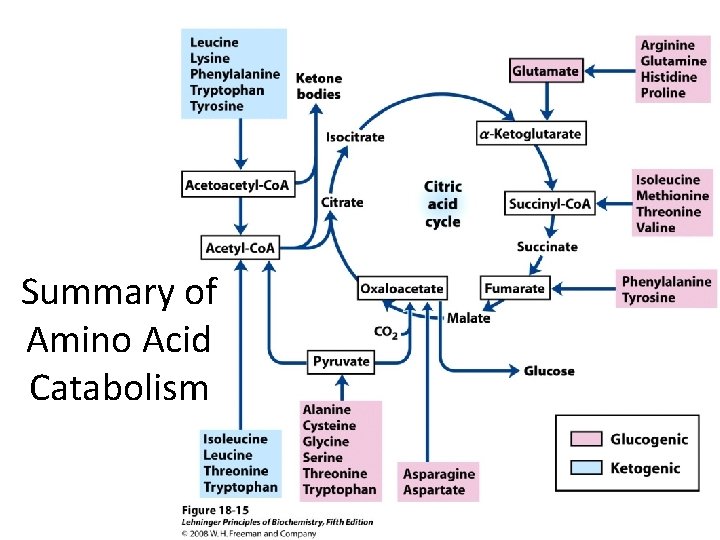
Summary of Amino Acid Catabolism
NH 3 Trasport NH 3 is toxic and should be remove Enhance amination of alpha ketogluterate to glutamate in brain leads to decreased TCA Enhance glutamine formation from glutamate leads to decreased formation of GABA Increased outflow of glutamine leads to increased entry of tryptophan result into increased serotonine concentration Glutamine is osmotically active results cerebral edema
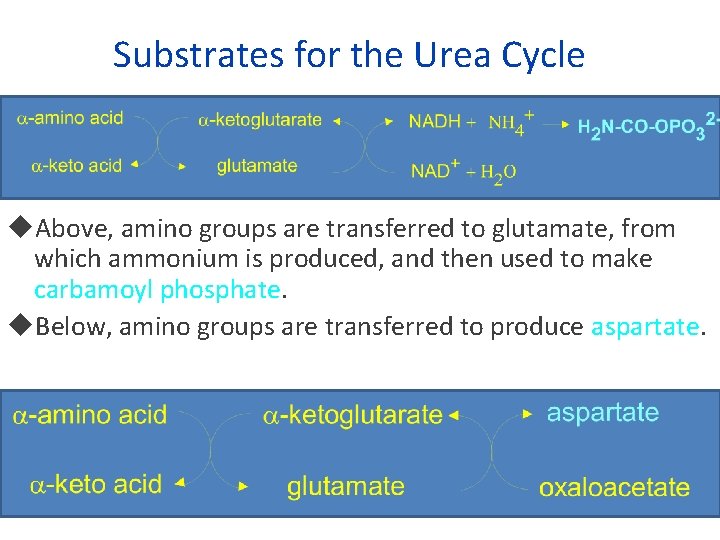
Substrates for the Urea Cycle Above, amino groups are transferred to glutamate, from which ammonium is produced, and then used to make carbamoyl phosphate. Below, amino groups are transferred to produce aspartate.
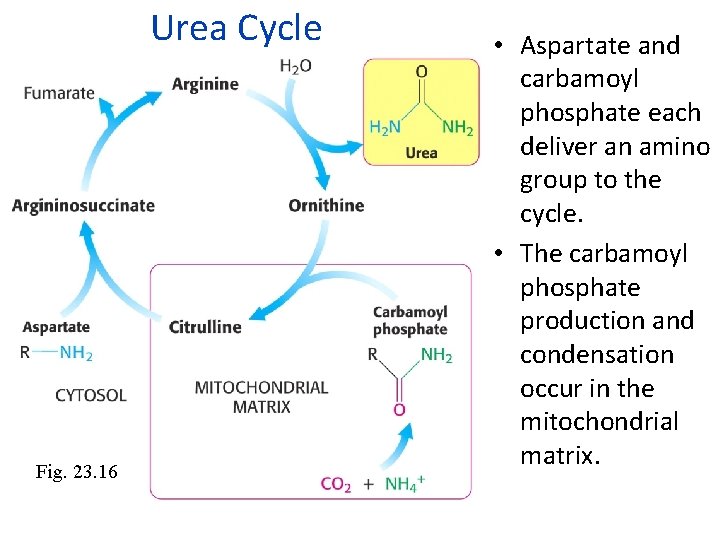
Urea Cycle Fig. 23. 16 • Aspartate and carbamoyl phosphate each deliver an amino group to the cycle. • The carbamoyl phosphate production and condensation occur in the mitochondrial matrix.
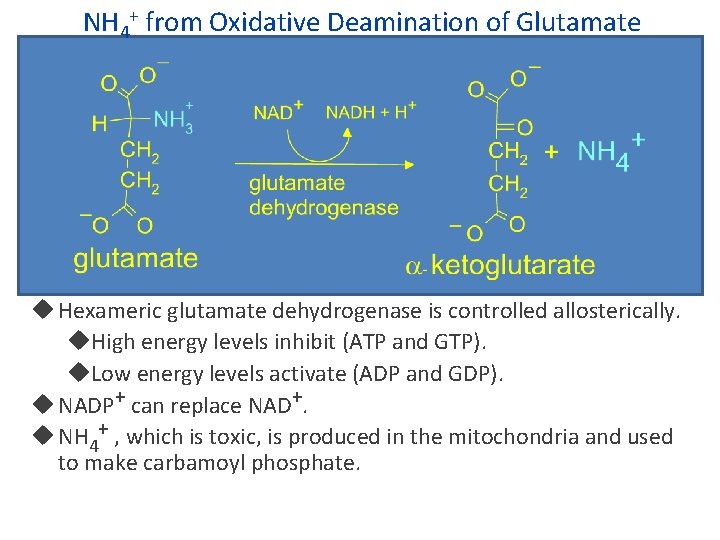
NH 4+ from Oxidative Deamination of Glutamate Hexameric glutamate dehydrogenase is controlled allosterically. High energy levels inhibit (ATP and GTP). Low energy levels activate (ADP and GDP). NADP+ can replace NAD+. NH 4+ , which is toxic, is produced in the mitochondria and used to make carbamoyl phosphate.
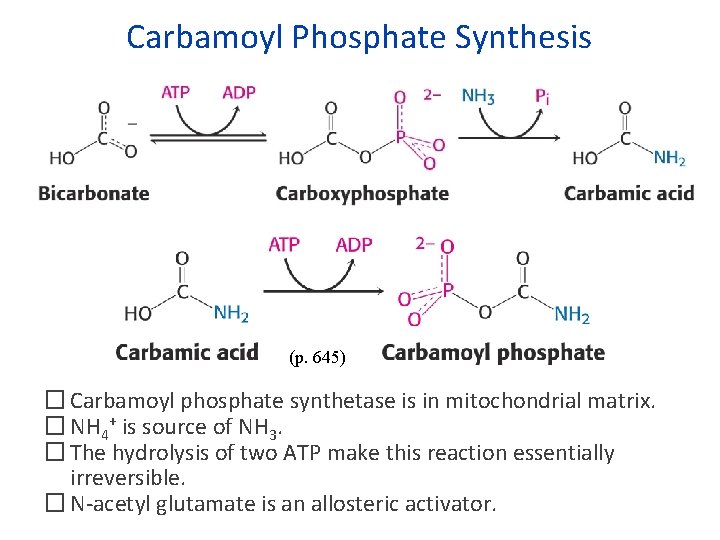
Carbamoyl Phosphate Synthesis (p. 645) � Carbamoyl phosphate synthetase is in mitochondrial matrix. � NH 4+ is source of NH 3. � The hydrolysis of two ATP make this reaction essentially irreversible. � N-acetyl glutamate is an allosteric activator.
2 ~ P used 1. ARGININOSUCCINATE SYNTHASE 2. ARGININOSUCCINASE 3. ARGINASE 4. ORNITHINE TRANSCARBAMOYLASE
Connection to Krebs Cycle Fumarate is oxidized to oxaloacetate by Krebs cycle enzymes, producing NADH. Oxaloacetate accepts an amino group instead of being condensed with acetyl Co. A.
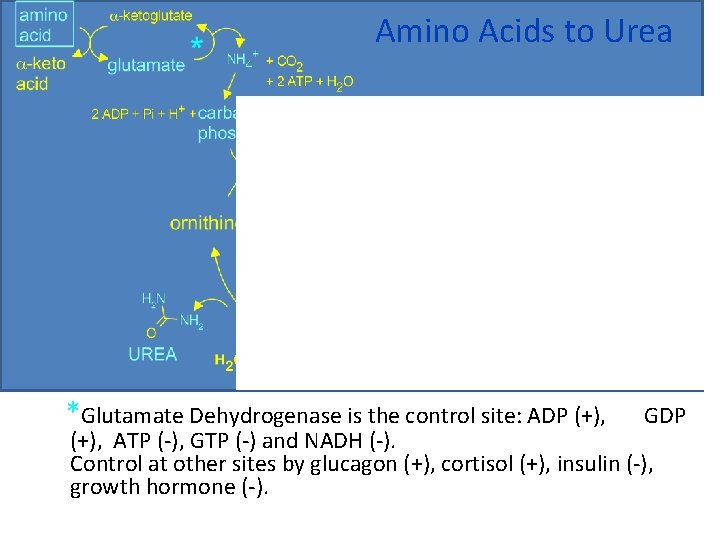
Amino Acids to Urea *Glutamate Dehydrogenase is the control site: ADP (+), GDP (+), ATP (-), GTP (-) and NADH (-). Control at other sites by glucagon (+), cortisol (+), insulin (-), growth hormone (-).
� Low dietary protein reduces need for urea cycle. Argininosuccinase Deficiency � High dietary arginine provides a path for carbamoyl phosphate and aspartate nitrogens to produce argininosuccinate, which is excreted.
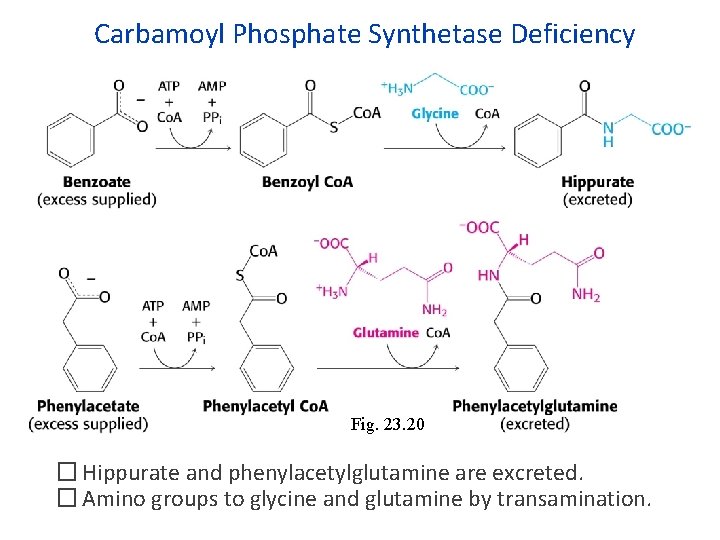
Carbamoyl Phosphate Synthetase Deficiency Fig. 23. 20 � Hippurate and phenylacetylglutamine are excreted. � Amino groups to glycine and glutamine by transamination.
- Slides: 18