
Protein Folding and Protein Threading Some slides from

- Slides: 15
Protein Folding and Protein Threading Some slides from Tolga Can, CENG 465: Introduction to Bioinformatics, Middle East Technical University, Turkey Kristen Huber, EC 697 S: Topics in Computational Biology, University of Massachusetts
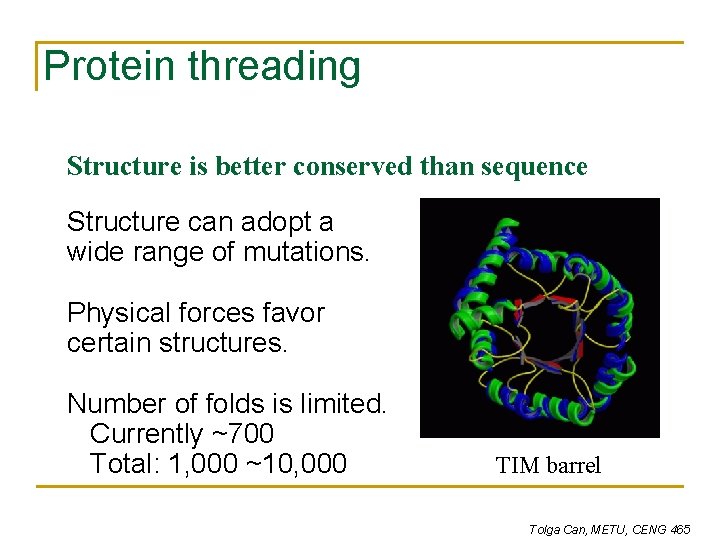
Protein threading Structure is better conserved than sequence Structure can adopt a wide range of mutations. Physical forces favor certain structures. Number of folds is limited. Currently ~700 Total: 1, 000 ~10, 000 TIM barrel Tolga Can, METU, CENG 465
Protein Threading • Basic premise The number of unique structural (domain) folds in nature is fairly small (possibly a few thousand) • Statistics from Protein Data Bank (~35, 000 structures) 90% of new structures submitted to PDB in the past three years have similar structural folds in PDB Tolga Can, METU, CENG 465
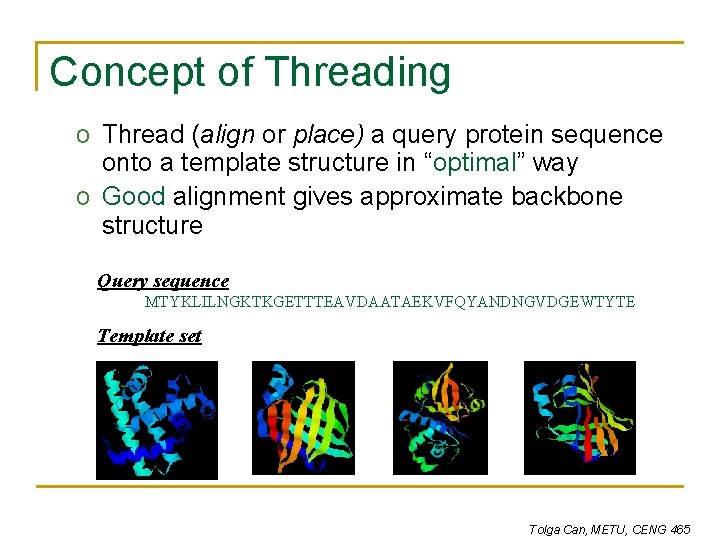
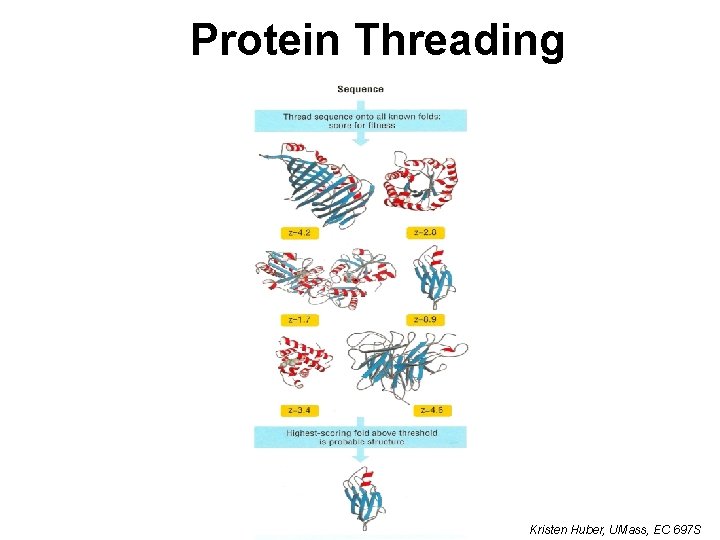
Concept of Threading o Thread (align or place) a query protein sequence onto a template structure in “optimal” way o Good alignment gives approximate backbone structure Query sequence MTYKLILNGKTKGETTTEAVDAATAEKVFQYANDNGVDGEWTYTE Template set Tolga Can, METU, CENG 465
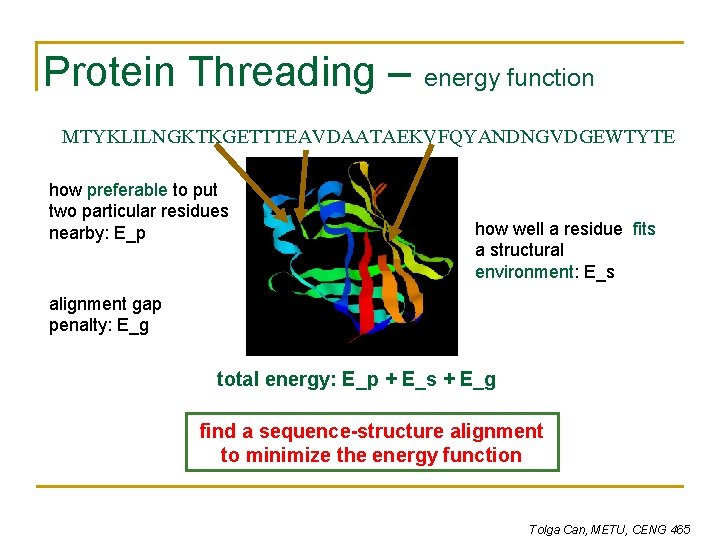
Protein Threading – energy function MTYKLILNGKTKGETTTEAVDAATAEKVFQYANDNGVDGEWTYTE how preferable to put two particular residues nearby: E_p how well a residue fits a structural environment: E_s alignment gap penalty: E_g total energy: E_p + E_s + E_g find a sequence-structure alignment to minimize the energy function Tolga Can, METU, CENG 465
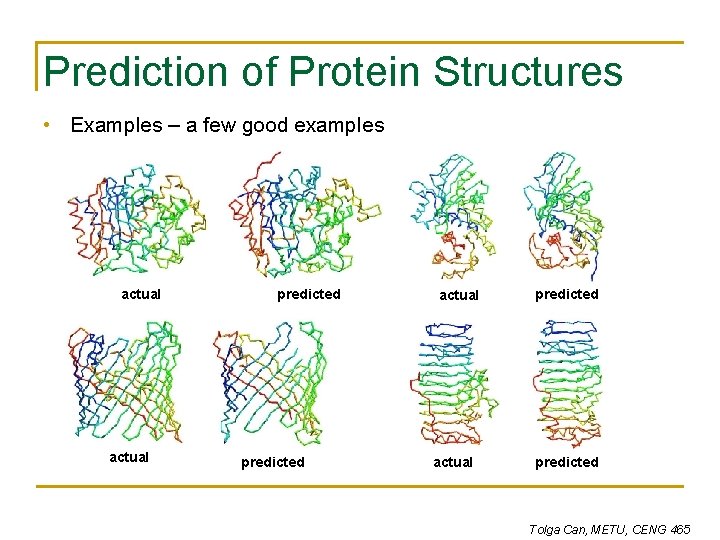
Prediction of Protein Structures • Examples – a few good examples actual predicted Tolga Can, METU, CENG 465
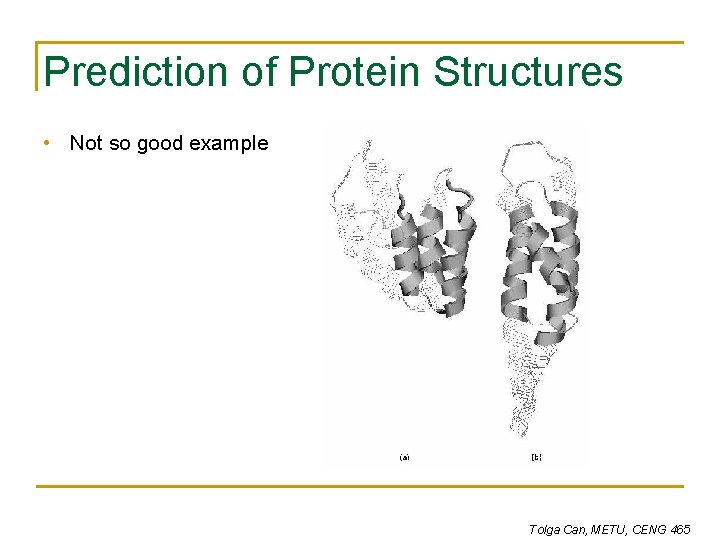
Prediction of Protein Structures • Not so good example Tolga Can, METU, CENG 465
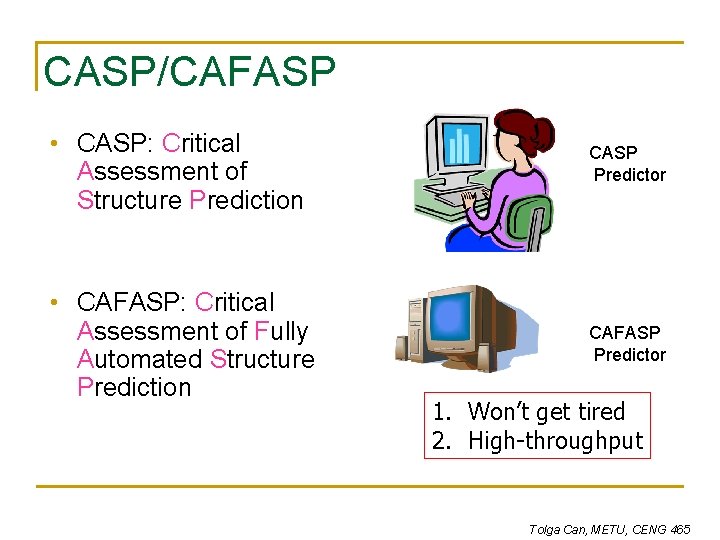
CASP/CAFASP • CASP: Critical Assessment of Structure Prediction CASP Predictor • CAFASP: Critical Assessment of Fully Automated Structure Prediction CAFASP Predictor 1. Won’t get tired 2. High-throughput Tolga Can, METU, CENG 465
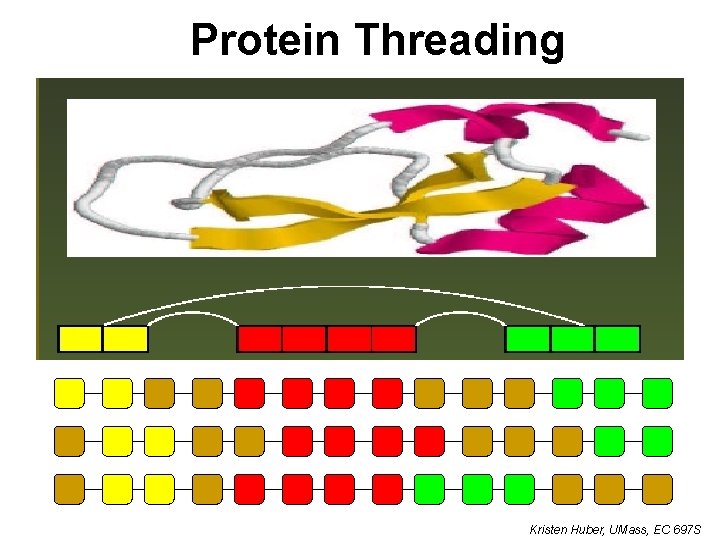
Protein Threading Kristen Huber, UMass, EC 697 S
Protein Threading Kristen Huber, UMass, EC 697 S
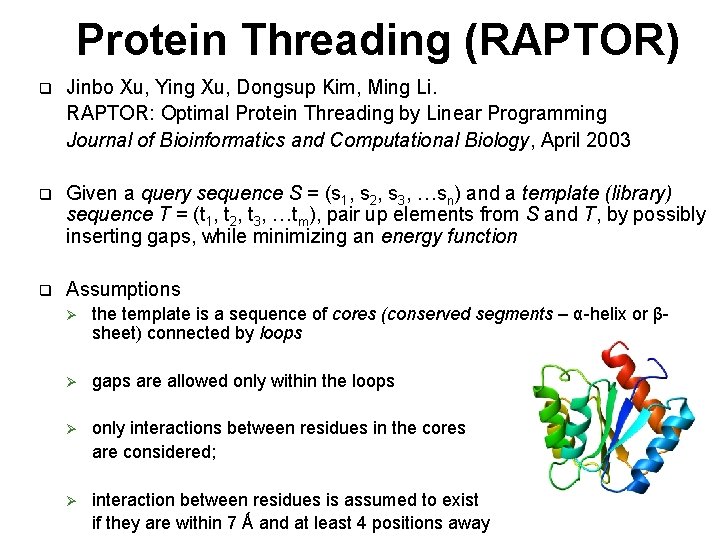
Protein Threading (RAPTOR) q Jinbo Xu, Ying Xu, Dongsup Kim, Ming Li. RAPTOR: Optimal Protein Threading by Linear Programming Journal of Bioinformatics and Computational Biology, April 2003 q Given a query sequence S = (s 1, s 2, s 3, …sn) and a template (library) sequence T = (t 1, t 2, t 3, …tm), pair up elements from S and T, by possibly inserting gaps, while minimizing an energy function q Assumptions Ø the template is a sequence of cores (conserved segments – α-helix or βsheet) connected by loops Ø gaps are allowed only within the loops Ø only interactions between residues in the cores are considered; Ø interaction between residues is assumed to exist if they are within 7 Ǻ and at least 4 positions away
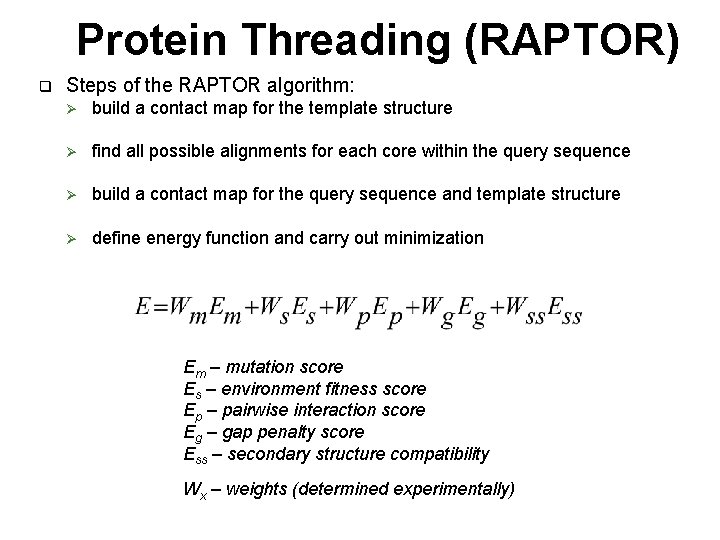
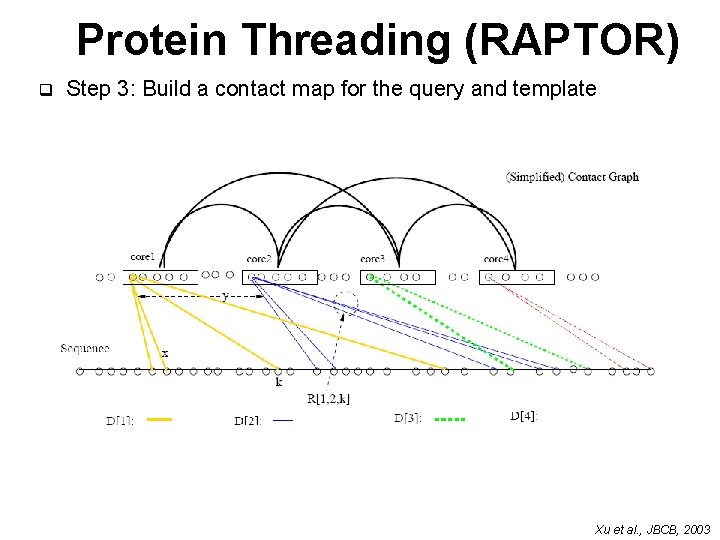
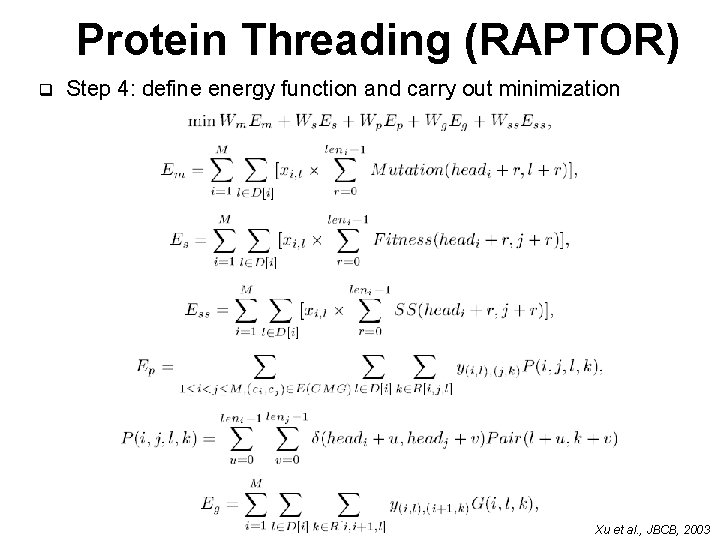
Protein Threading (RAPTOR) q Steps of the RAPTOR algorithm: Ø build a contact map for the template structure Ø find all possible alignments for each core within the query sequence Ø build a contact map for the query sequence and template structure Ø define energy function and carry out minimization Em – mutation score Es – environment fitness score Ep – pairwise interaction score Eg – gap penalty score Ess – secondary structure compatibility Wx – weights (determined experimentally)
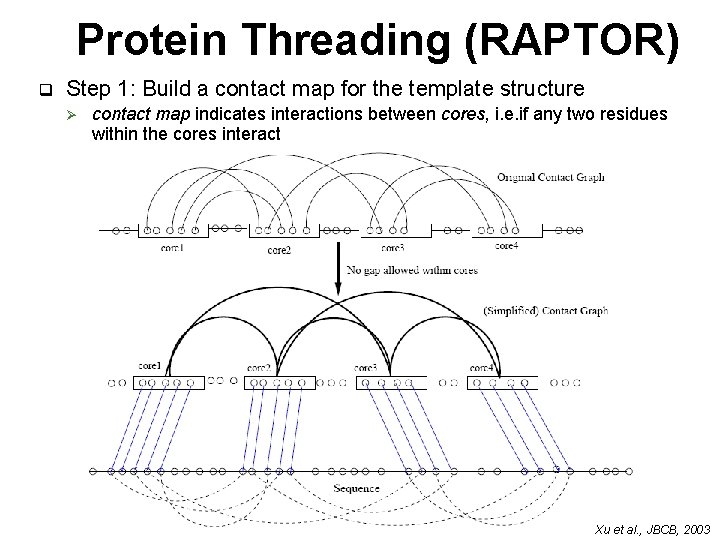
Protein Threading (RAPTOR) q Step 1: Build a contact map for the template structure Ø contact map indicates interactions between cores, i. e. if any two residues within the cores interact Xu et al. , JBCB, 2003
Protein Threading (RAPTOR) q Step 3: Build a contact map for the query and template Xu et al. , JBCB, 2003
Protein Threading (RAPTOR) q Step 4: define energy function and carry out minimization Xu et al. , JBCB, 2003