
Protein Extraction Fractionation and Identification Chapter 3 Page
- Slides: 45
Protein Extraction, Fractionation, and Identification Chapter 3 (Page 88 -104) 1
General Peptide and Protein Properties 2
1. The Range of Sizes of Peptides and Polypeptides A. As little as 2 Amino Acids (AA) to thousands; share physical/chemical properties of the AA B. Bioactivity transcends size; small peptides are important C. Proteins can consist of a single polypeptide chain or two or more noncovalently associated chains called multisubunit proteins § If consists of two or more noncovalently associated chains then called oligomeric proteins 3
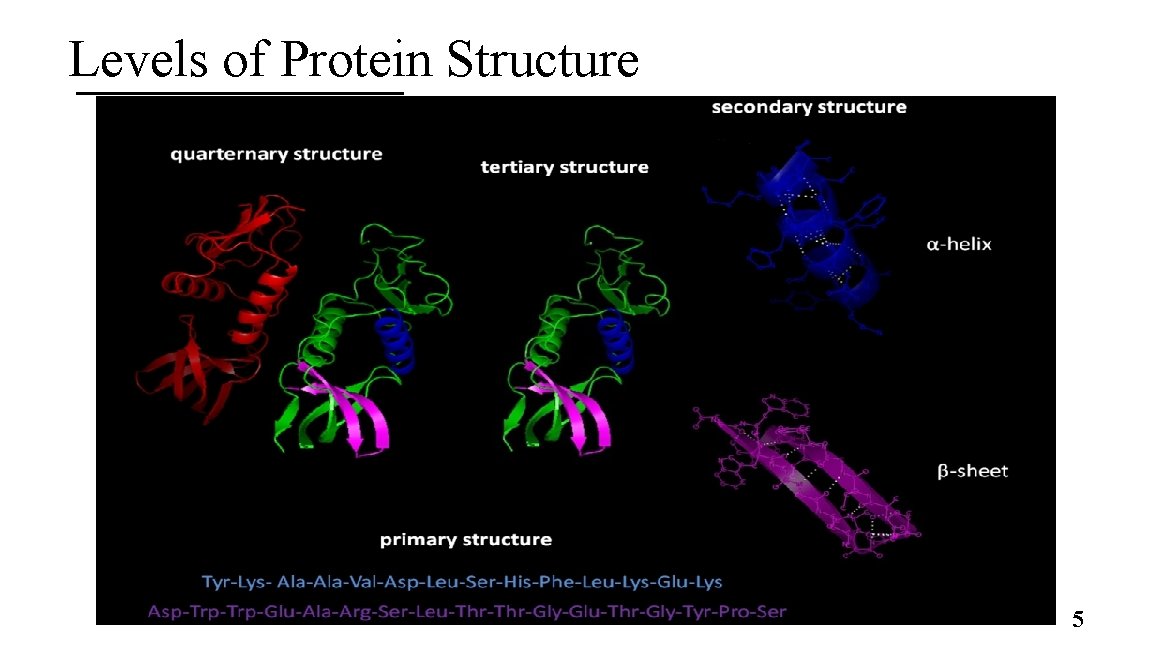
2. General Composition of Proteins A. Some proteins are only made of amino acids B. Others are conjugated proteins § Have conjugated non AA group called a prosthetic group C. The arrangement of the AA leads to 4 levels of protein structure 4
Levels of Protein Structure 5
Developing a Protein Extraction, Fractionation, and Identification Workflow 6
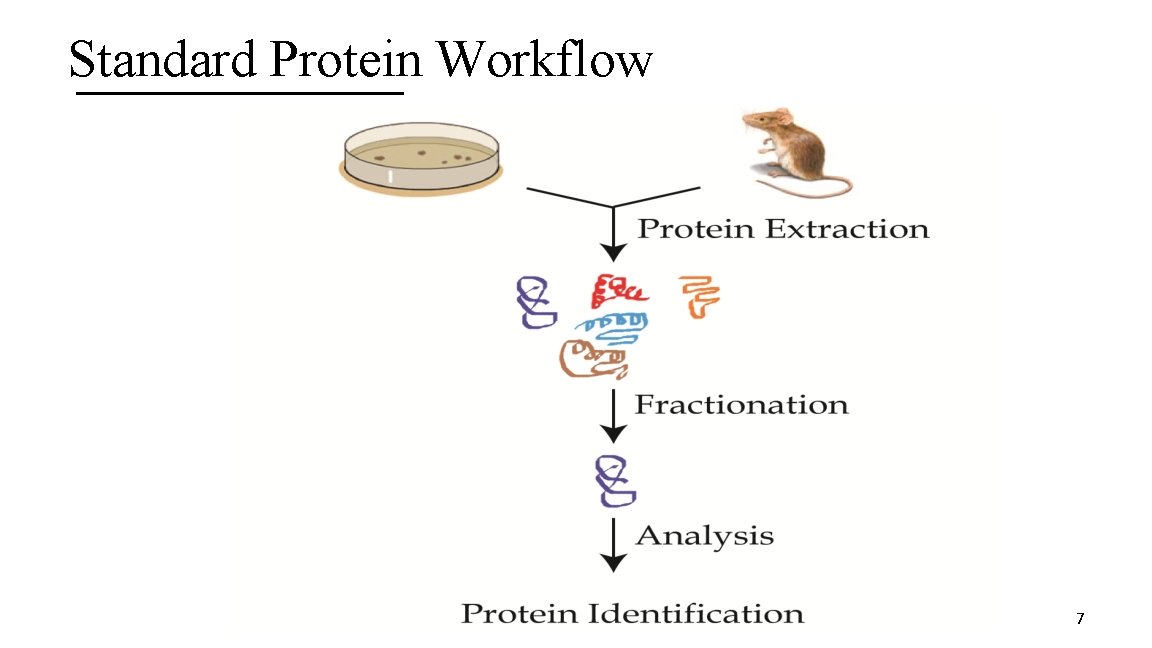
Standard Protein Workflow 7
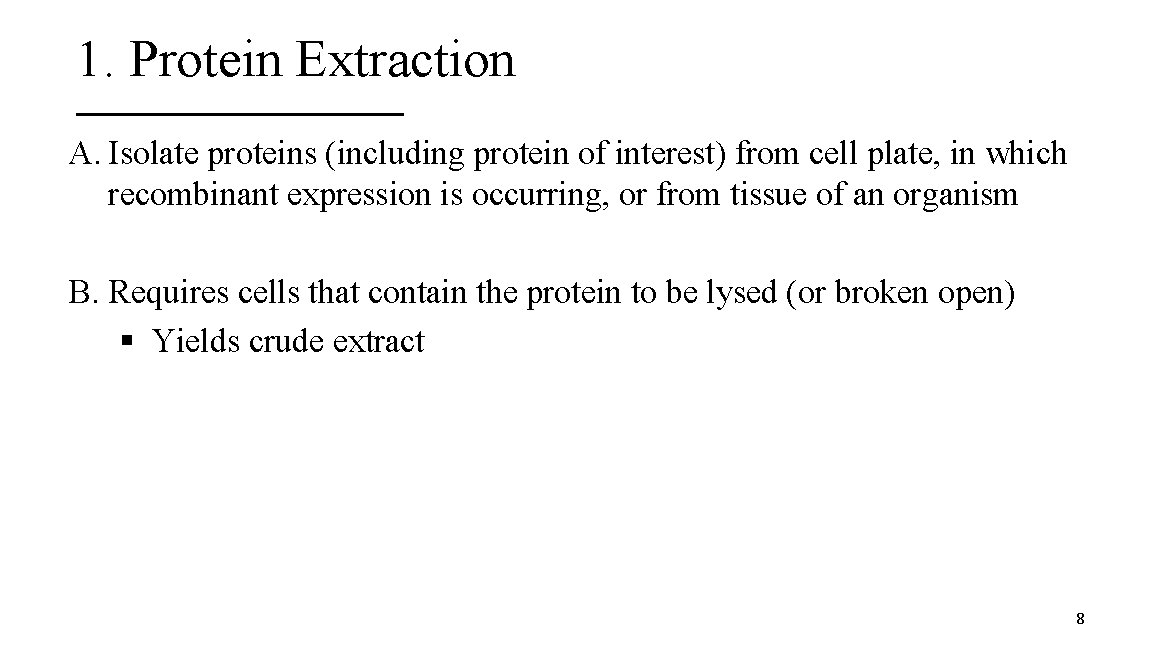
1. Protein Extraction A. Isolate proteins (including protein of interest) from cell plate, in which recombinant expression is occurring, or from tissue of an organism B. Requires cells that contain the protein to be lysed (or broken open) § Yields crude extract 8
2. Fractionation A. Use a biochemical property to purify the protein of interest B. Usually requires more than one property for high purification 9
3. Analysis A. Perform a treatment of the protein, which either maintains the protein intact or cleaved into amino acid or peptide pieces, in order to identify it or determine its AA sequence B. For unknown proteins, use sequence information to characterize them 10
Fractionation Protocols 11
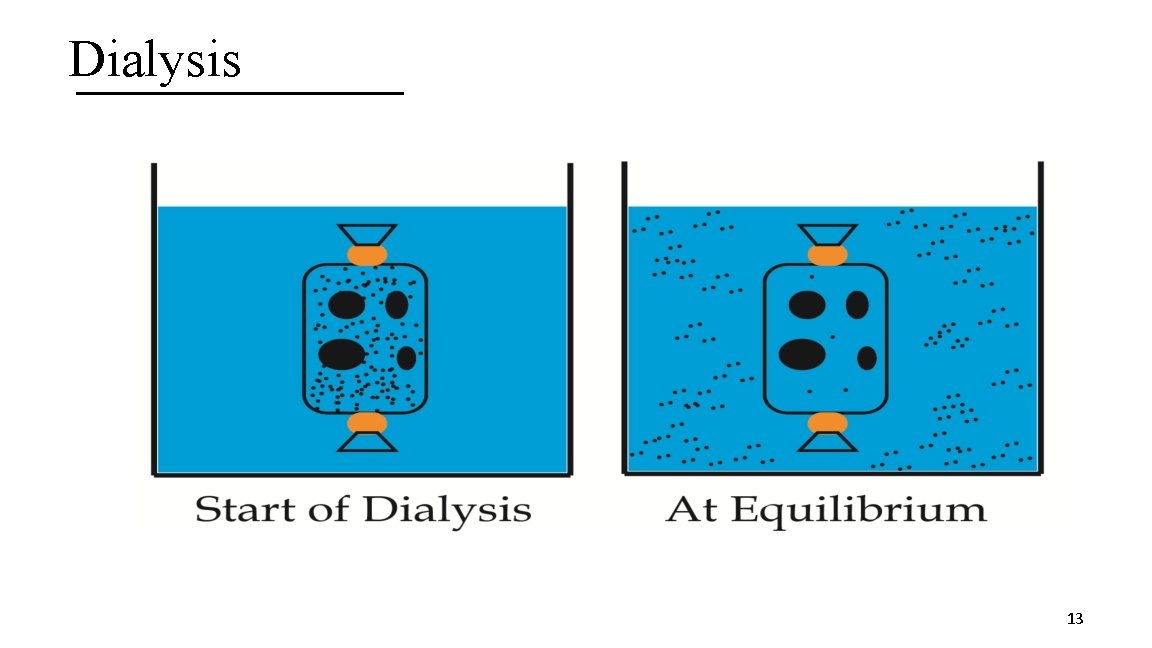
1. Dialysis A. Technique based on protein size B. Involves the use of a semipermeable membrane with a particular pore size (based on molecular weight) § Molecular weight measured in Daltons (Da); 1 Da = 1 g/mol C. Used to separate larger proteins from smaller proteins and salts or small molecules D. Used to equilibrate proteins in a desired buffer for subsequent biochemical steps 12
Dialysis 13
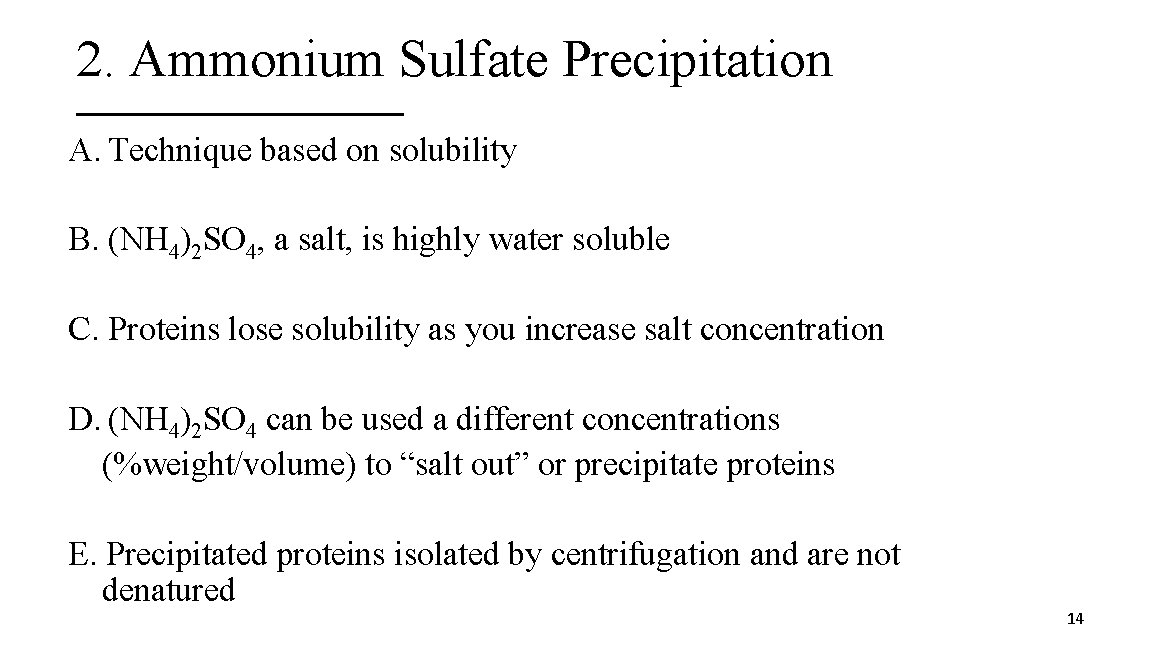
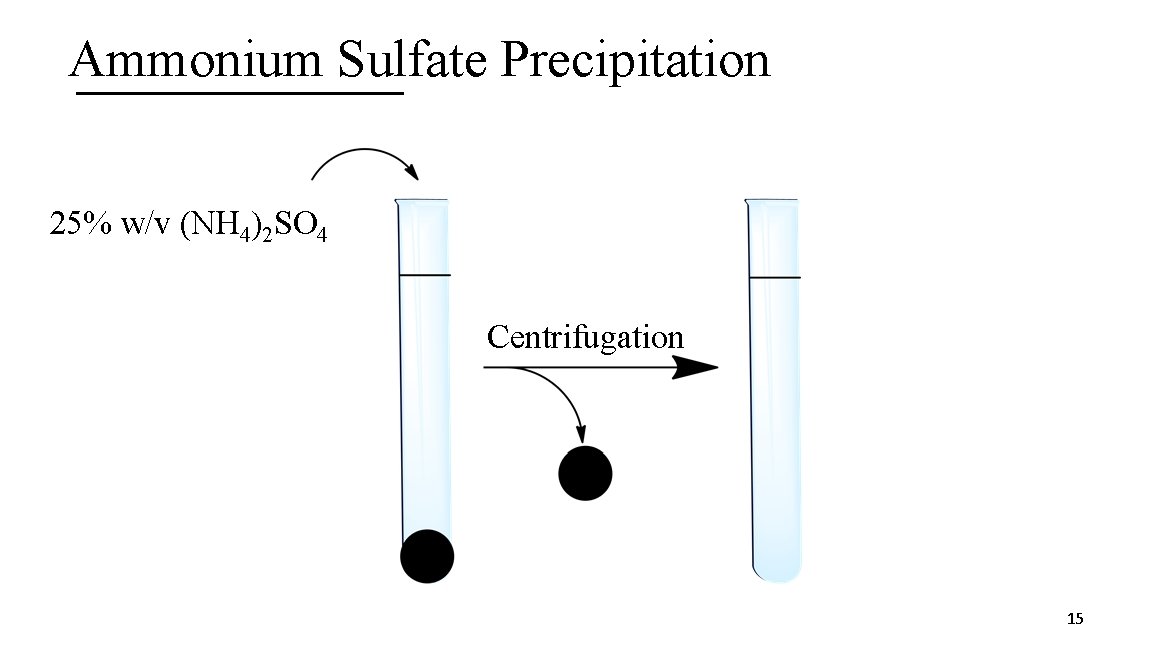
2. Ammonium Sulfate Precipitation A. Technique based on solubility B. (NH 4)2 SO 4, a salt, is highly water soluble C. Proteins lose solubility as you increase salt concentration D. (NH 4)2 SO 4 can be used a different concentrations (%weight/volume) to “salt out” or precipitate proteins E. Precipitated proteins isolated by centrifugation and are not denatured 14
Ammonium Sulfate Precipitation 25% w/v (NH 4)2 SO 4 Centrifugation 15
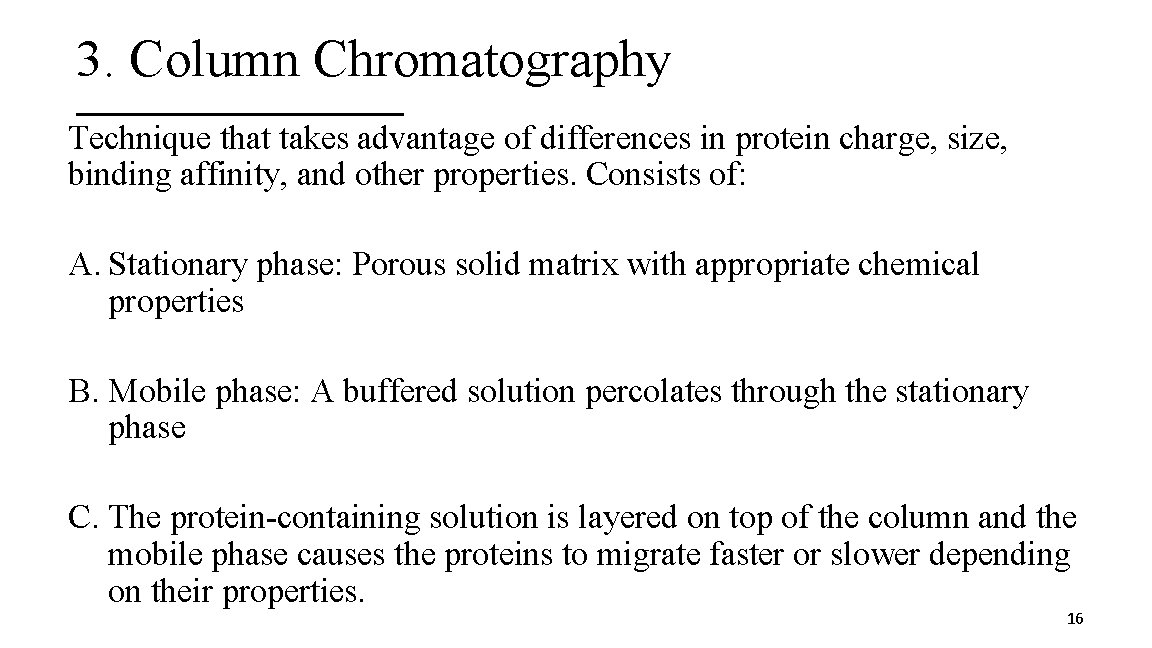
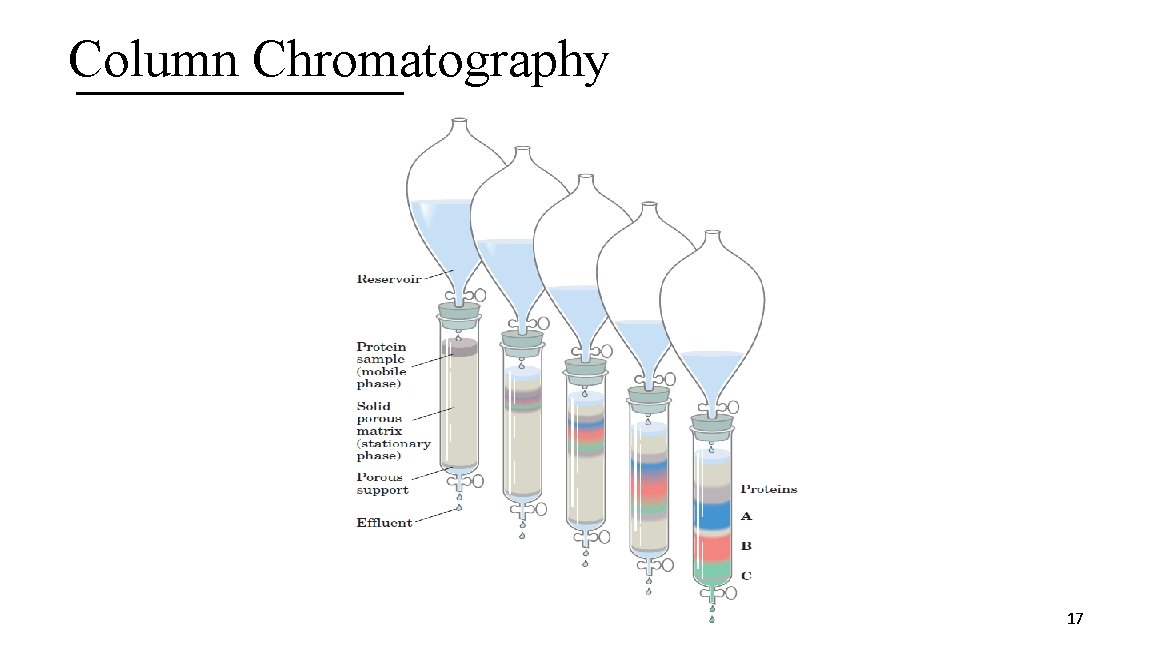
3. Column Chromatography Technique that takes advantage of differences in protein charge, size, binding affinity, and other properties. Consists of: A. Stationary phase: Porous solid matrix with appropriate chemical properties B. Mobile phase: A buffered solution percolates through the stationary phase C. The protein-containing solution is layered on top of the column and the mobile phase causes the proteins to migrate faster or slower depending on their properties. 16
Column Chromatography 17
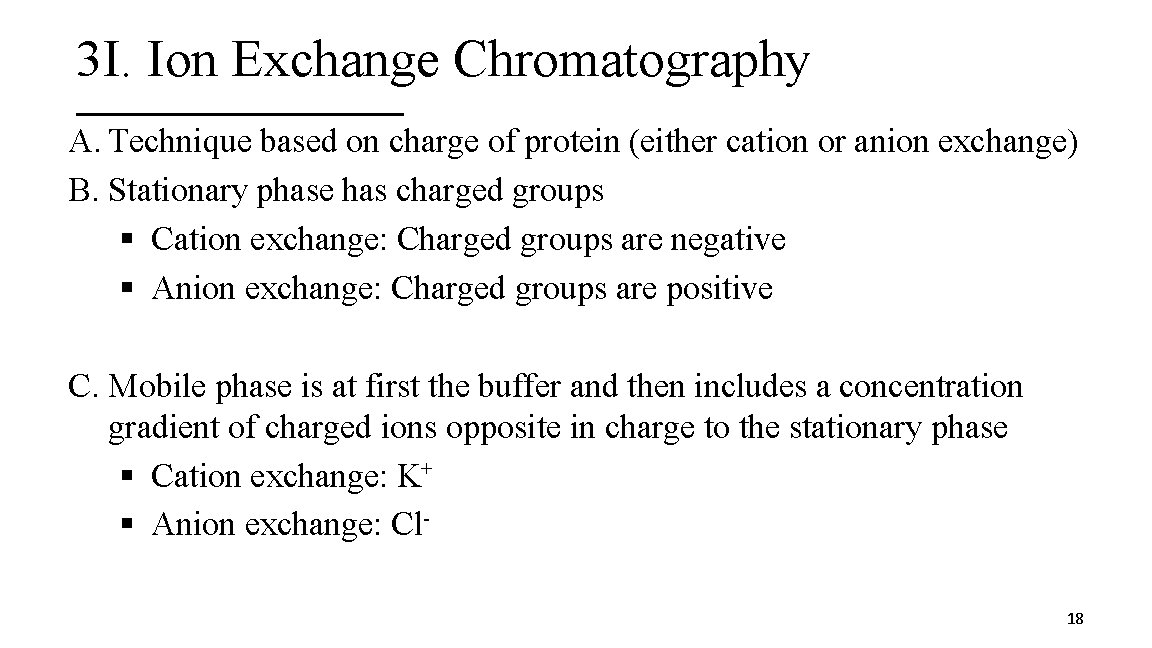
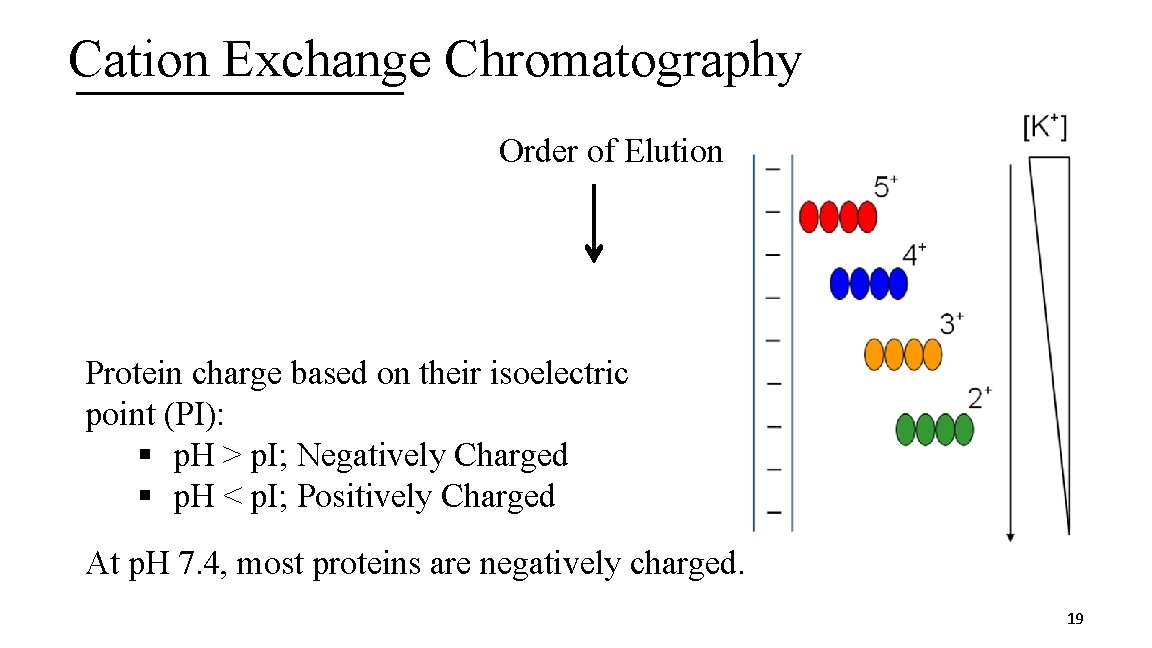
3 I. Ion Exchange Chromatography A. Technique based on charge of protein (either cation or anion exchange) B. Stationary phase has charged groups § Cation exchange: Charged groups are negative § Anion exchange: Charged groups are positive C. Mobile phase is at first the buffer and then includes a concentration gradient of charged ions opposite in charge to the stationary phase § Cation exchange: K+ § Anion exchange: Cl 18
Cation Exchange Chromatography Order of Elution Protein charge based on their isoelectric point (PI): § p. H > p. I; Negatively Charged § p. H < p. I; Positively Charged At p. H 7. 4, most proteins are negatively charged. 19
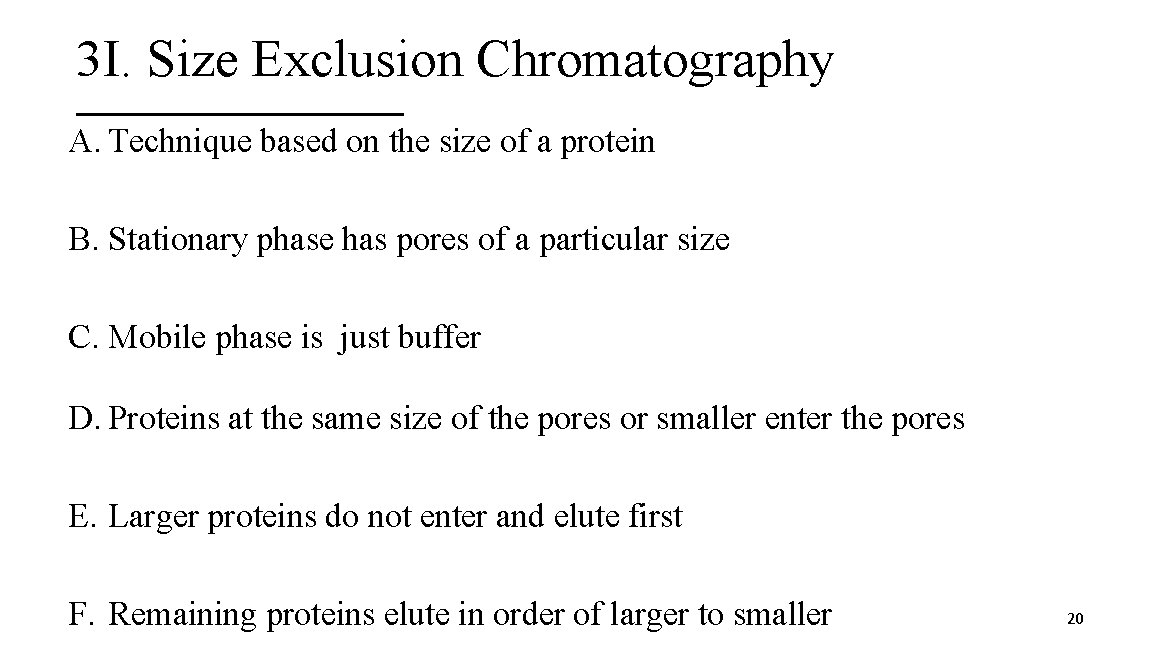
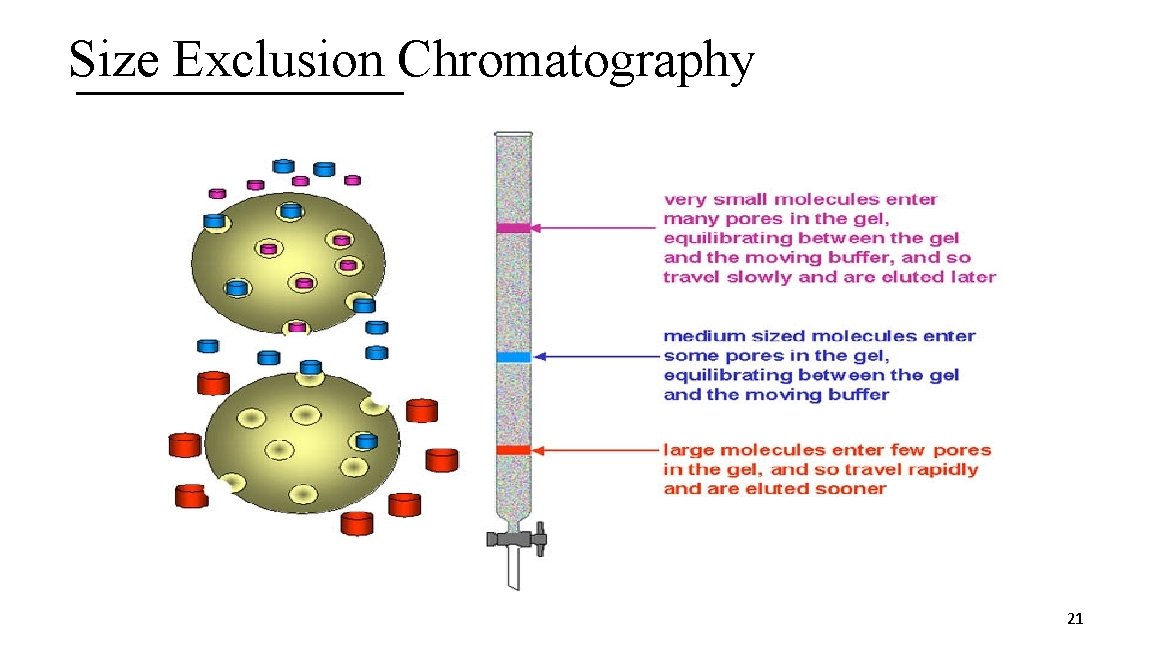
3 I. Size Exclusion Chromatography A. Technique based on the size of a protein B. Stationary phase has pores of a particular size C. Mobile phase is just buffer D. Proteins at the same size of the pores or smaller enter the pores E. Larger proteins do not enter and elute first F. Remaining proteins elute in order of larger to smaller 20
Size Exclusion Chromatography 21
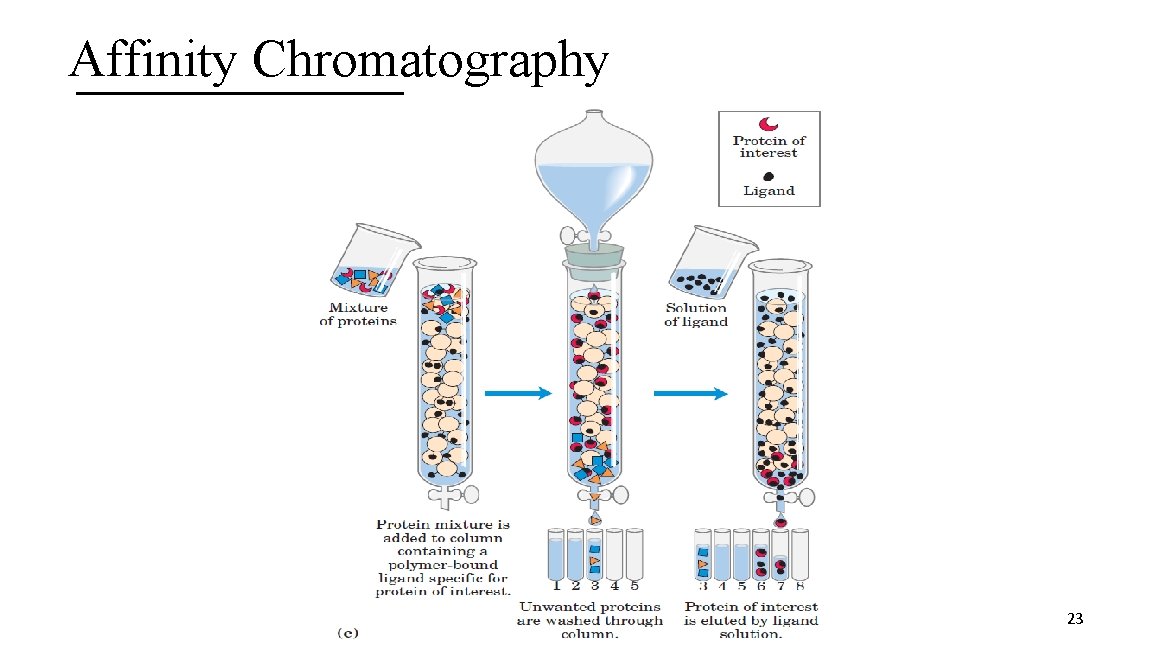
3 II. Affinity Chromatography A. Technique based on the binding affinity of the protein B. Stationary phase contains a covalently attached chemical group C. Mobile phase is buffer at first then includes a concentration gradient of an agent with affinity for the chemical group or free ligand D. Proteins with affinity for the chemical group will bind to it then elute as the concentration of the agent or free ligand in the mobile phase increases 22
Affinity Chromatography 23
Checking the Success of Fractionation 24
1. Electrophoresis Technique that involves fractionation but on a small scale. A. Based on the migration of charged proteins in an electric field B. Usually done after isolating the crude extract C. Repeated after a fractionation step 25
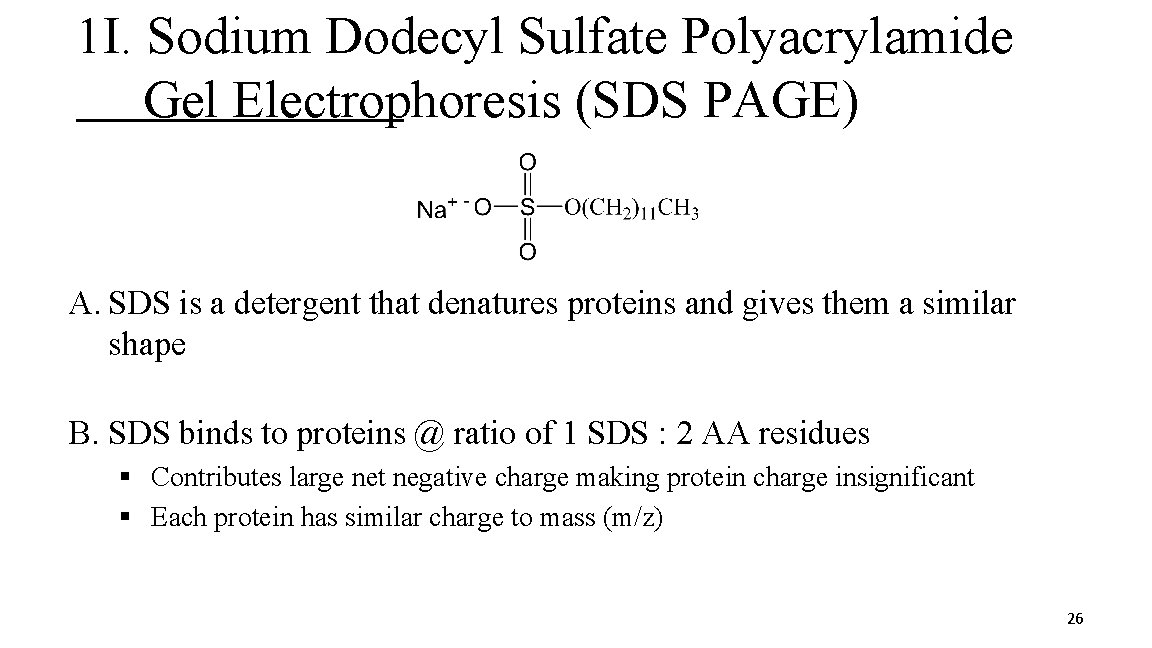
1 I. Sodium Dodecyl Sulfate Polyacrylamide Gel Electrophoresis (SDS PAGE) A. SDS is a detergent that denatures proteins and gives them a similar shape B. SDS binds to proteins @ ratio of 1 SDS : 2 AA residues § Contributes large net negative charge making protein charge insignificant § Each protein has similar charge to mass (m/z) 26
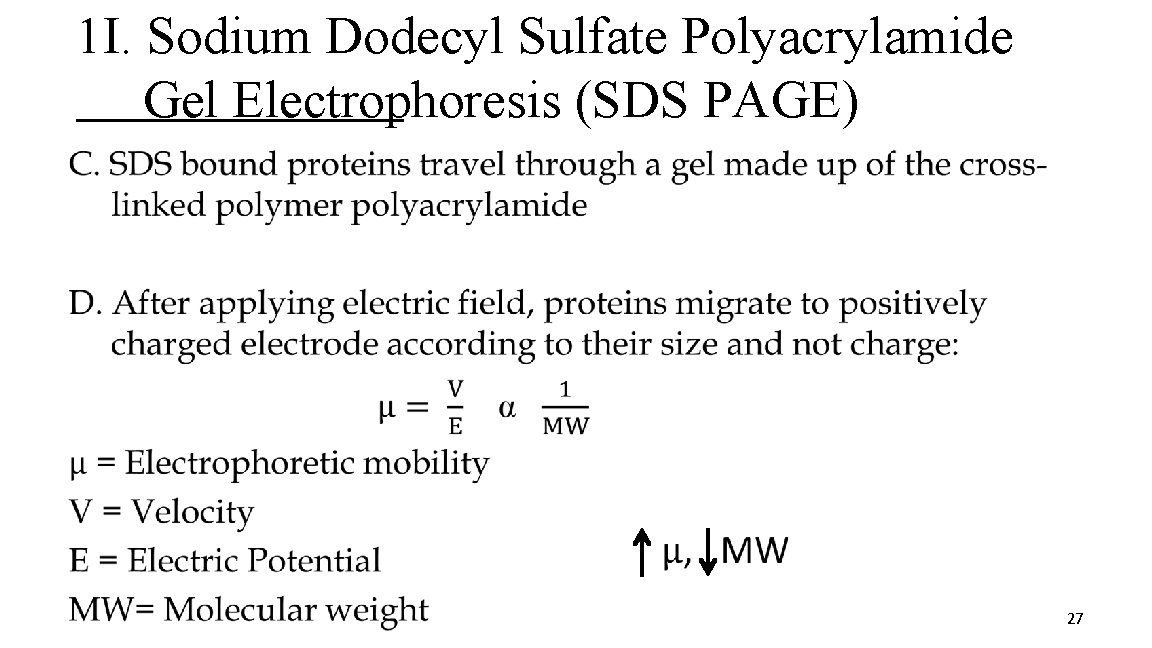
1 I. Sodium Dodecyl Sulfate Polyacrylamide Gel Electrophoresis (SDS PAGE) • 27
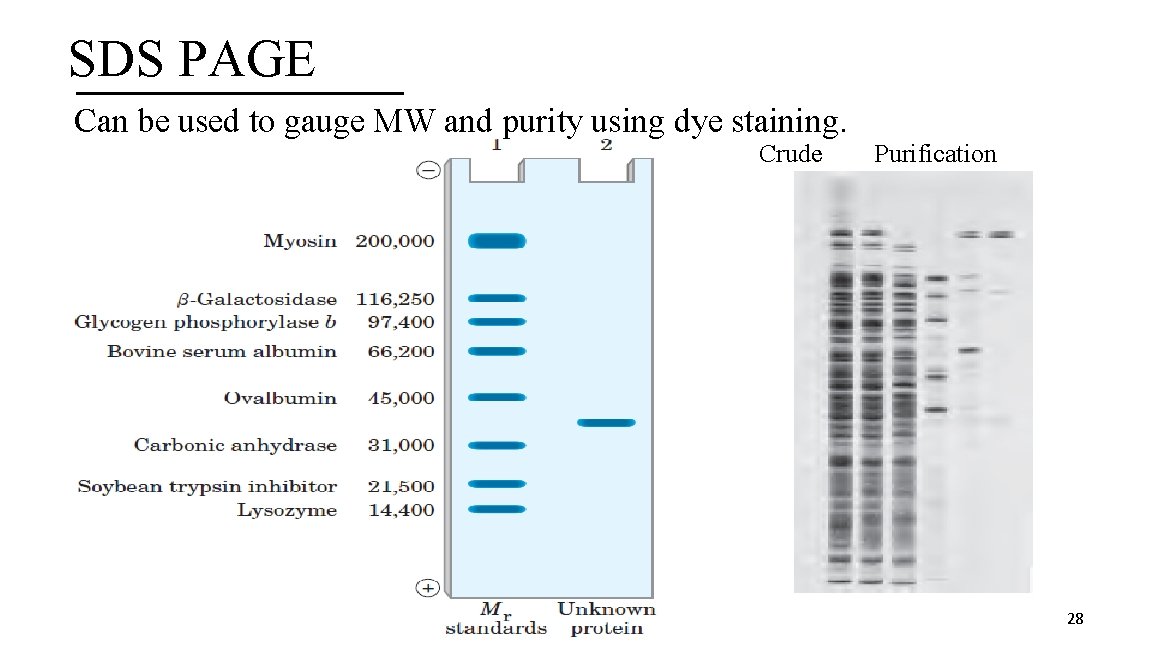
SDS PAGE Can be used to gauge MW and purity using dye staining. Crude Purification 28
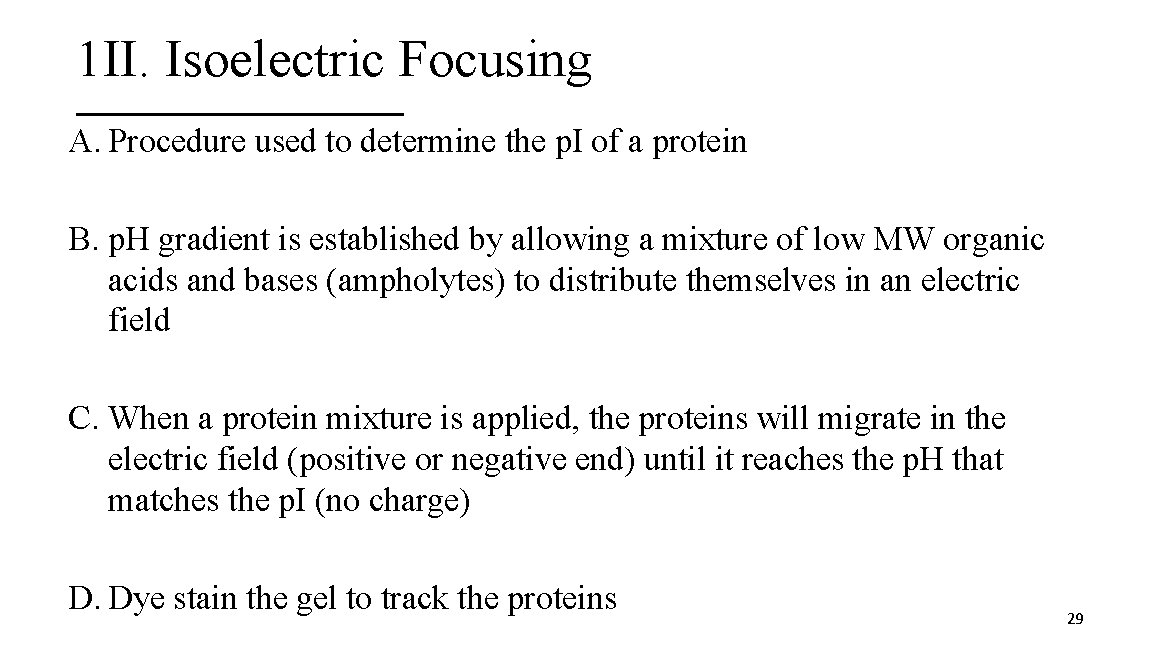
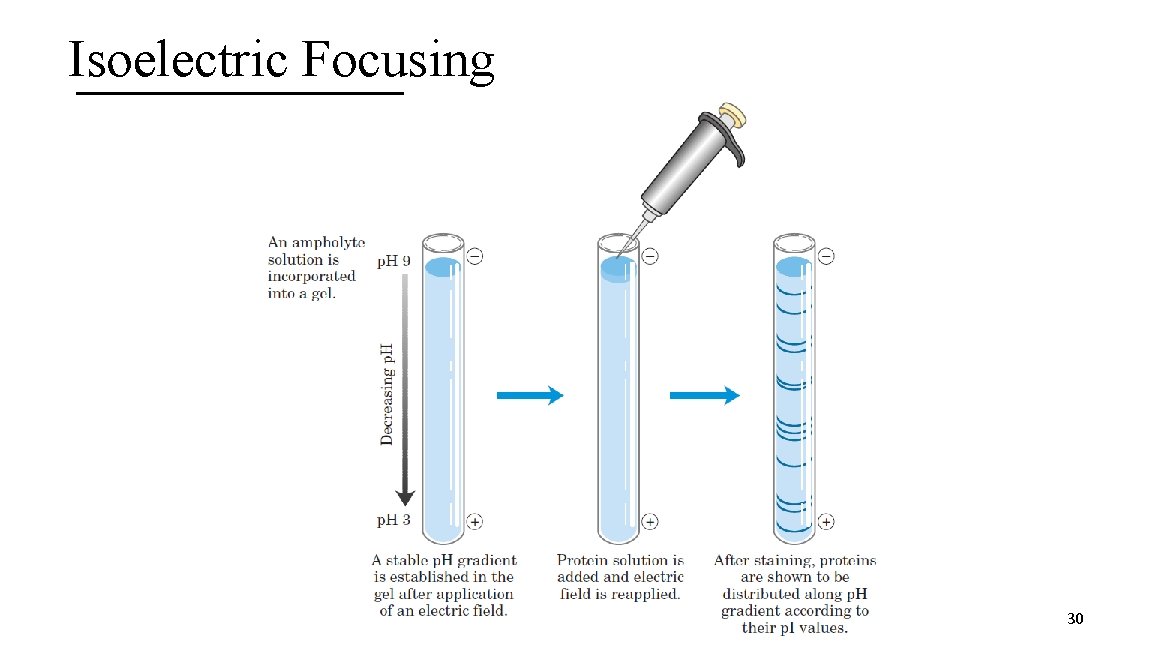
1 II. Isoelectric Focusing A. Procedure used to determine the p. I of a protein B. p. H gradient is established by allowing a mixture of low MW organic acids and bases (ampholytes) to distribute themselves in an electric field C. When a protein mixture is applied, the proteins will migrate in the electric field (positive or negative end) until it reaches the p. H that matches the p. I (no charge) D. Dye stain the gel to track the proteins 29
Isoelectric Focusing 30
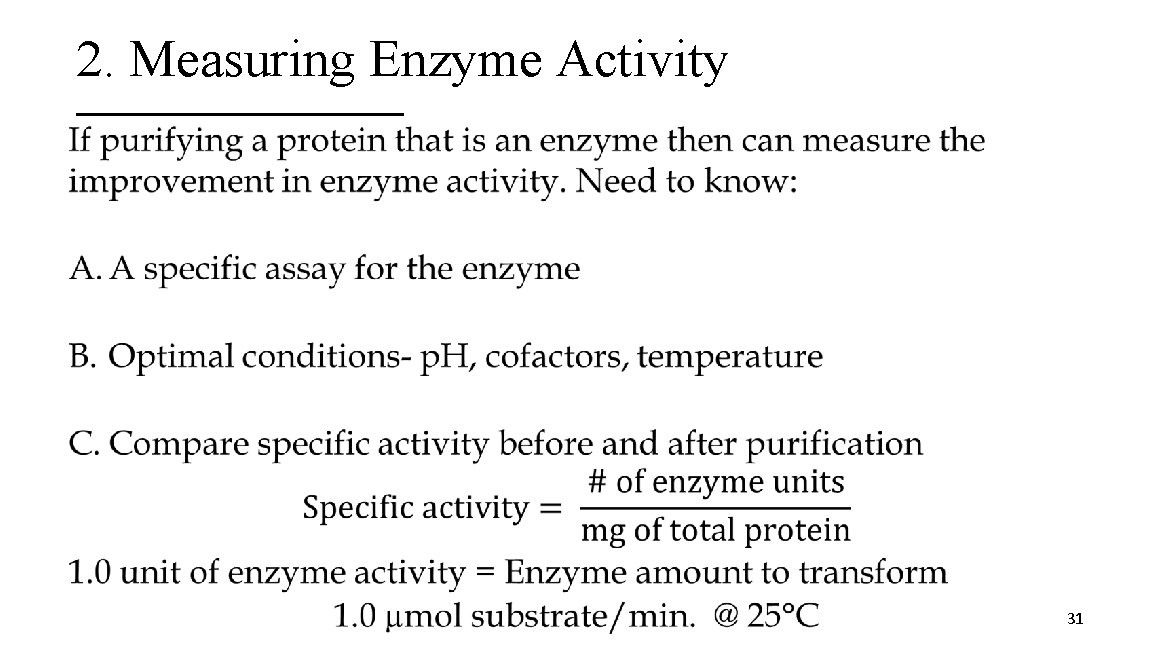
2. Measuring Enzyme Activity • 31
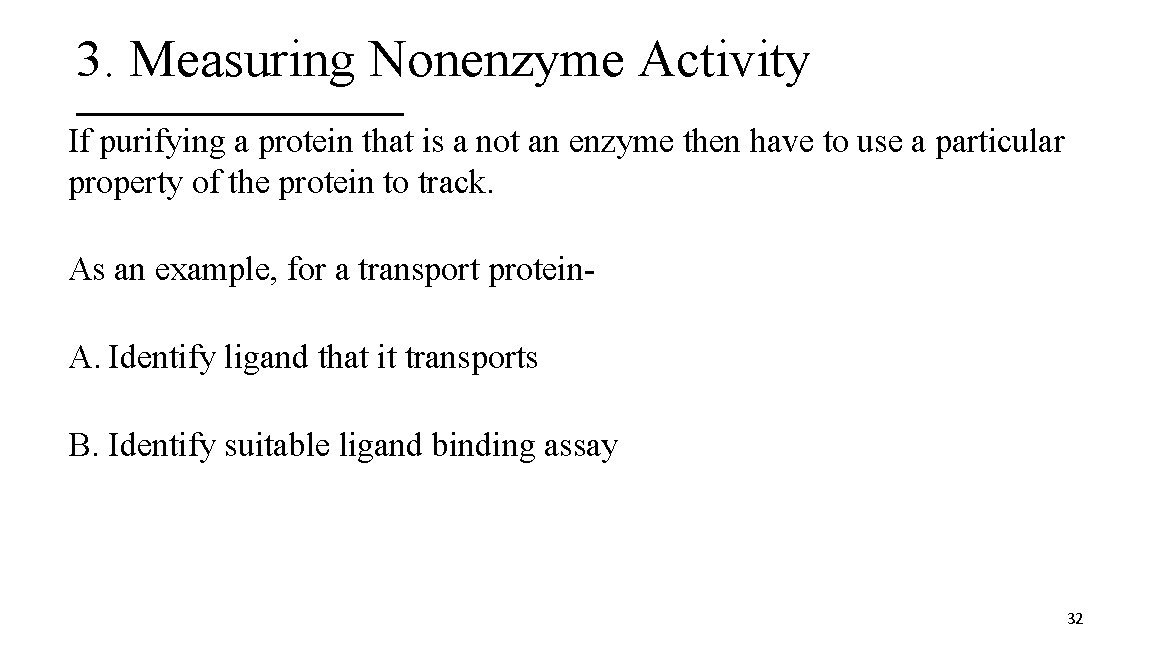
3. Measuring Nonenzyme Activity If purifying a protein that is a not an enzyme then have to use a particular property of the protein to track. As an example, for a transport protein- A. Identify ligand that it transports B. Identify suitable ligand binding assay 32
Protein Identification 33
1. Protein Identification Today The world of protein identification has greatly evolved due to the success of the Genome Project A. The genome (the set of all genes) has been sequenced for many organisms B. Many genes (segment of DNA) encode for proteins C. By sequencing the genome, the large majority of the proteome (the set of proteins) has been sequenced D. People now use genome databases for protein identification 34
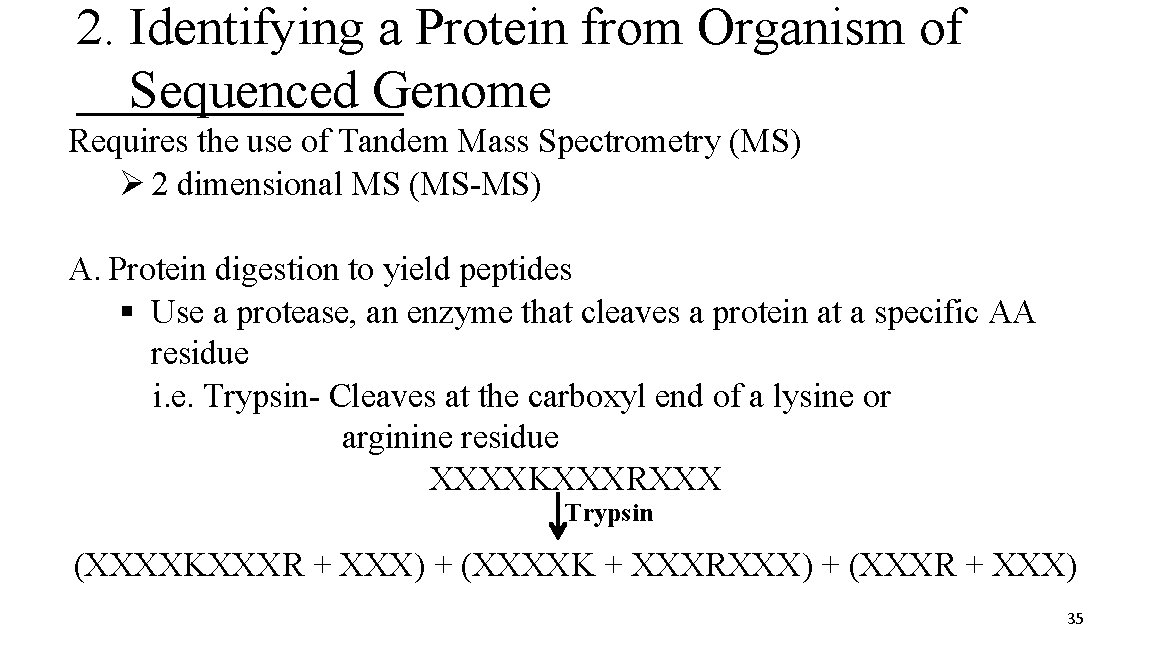
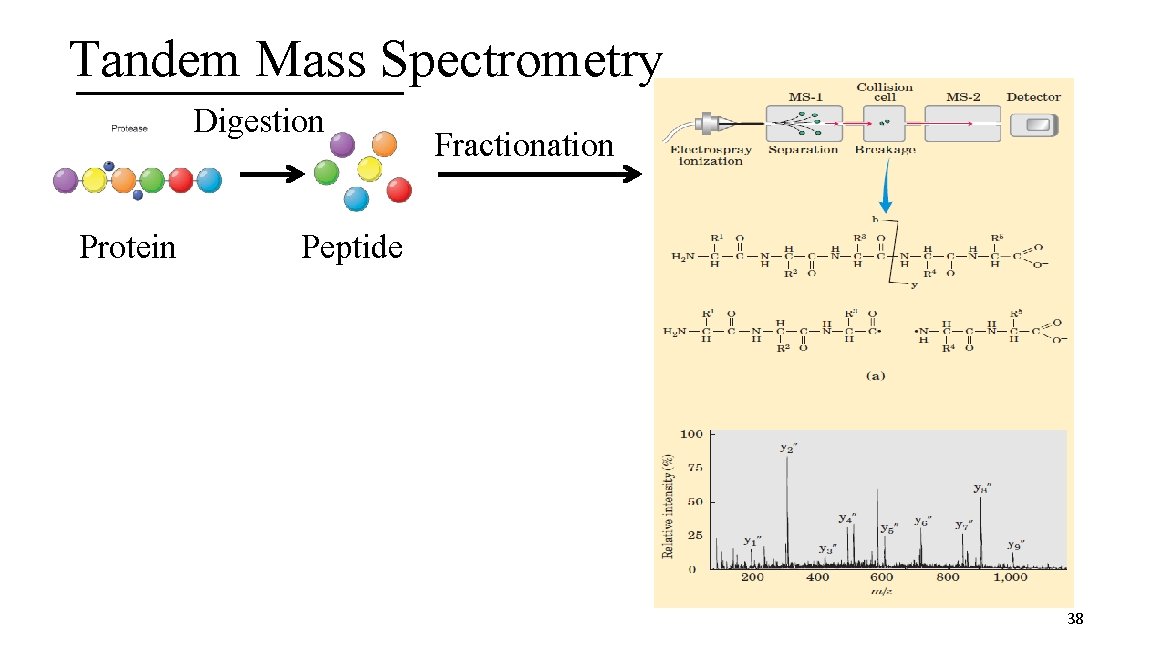
2. Identifying a Protein from Organism of Sequenced Genome Requires the use of Tandem Mass Spectrometry (MS) Ø 2 dimensional MS (MS-MS) A. Protein digestion to yield peptides § Use a protease, an enzyme that cleaves a protein at a specific AA residue i. e. Trypsin- Cleaves at the carboxyl end of a lysine or arginine residue XXXXKXXXRXXX Trypsin (XXXXKXXXR + XXX) + (XXXXK + XXXRXXX) + (XXXR + XXX) 35
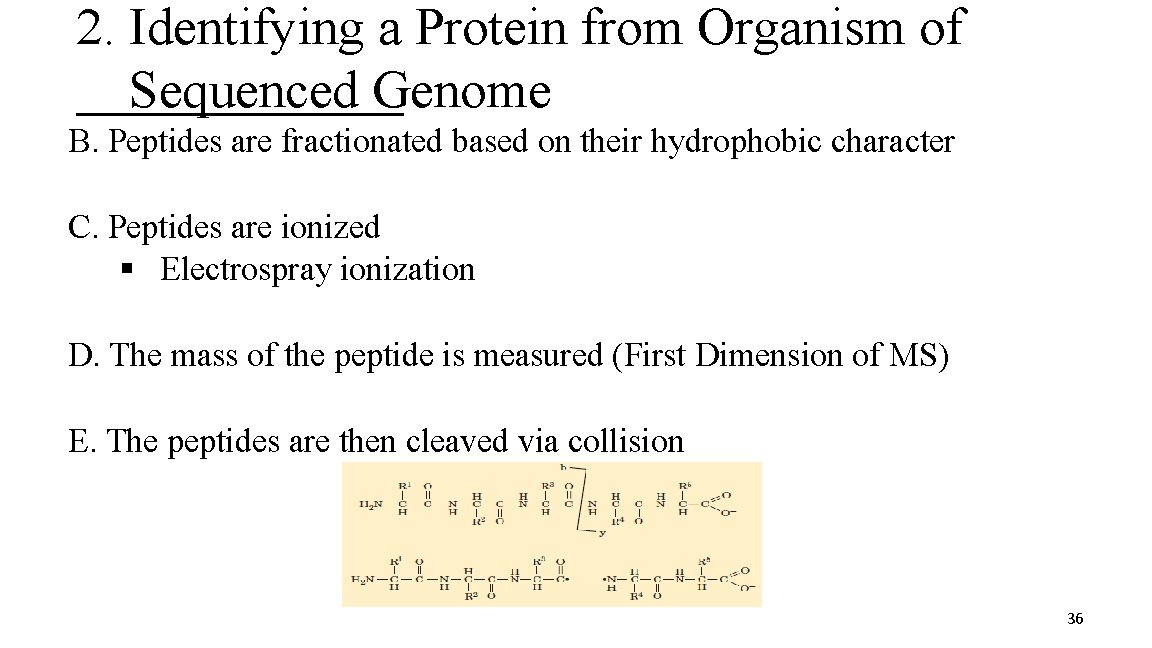
2. Identifying a Protein from Organism of Sequenced Genome B. Peptides are fractionated based on their hydrophobic character C. Peptides are ionized § Electrospray ionization D. The mass of the peptide is measured (First Dimension of MS) E. The peptides are then cleaved via collision 36
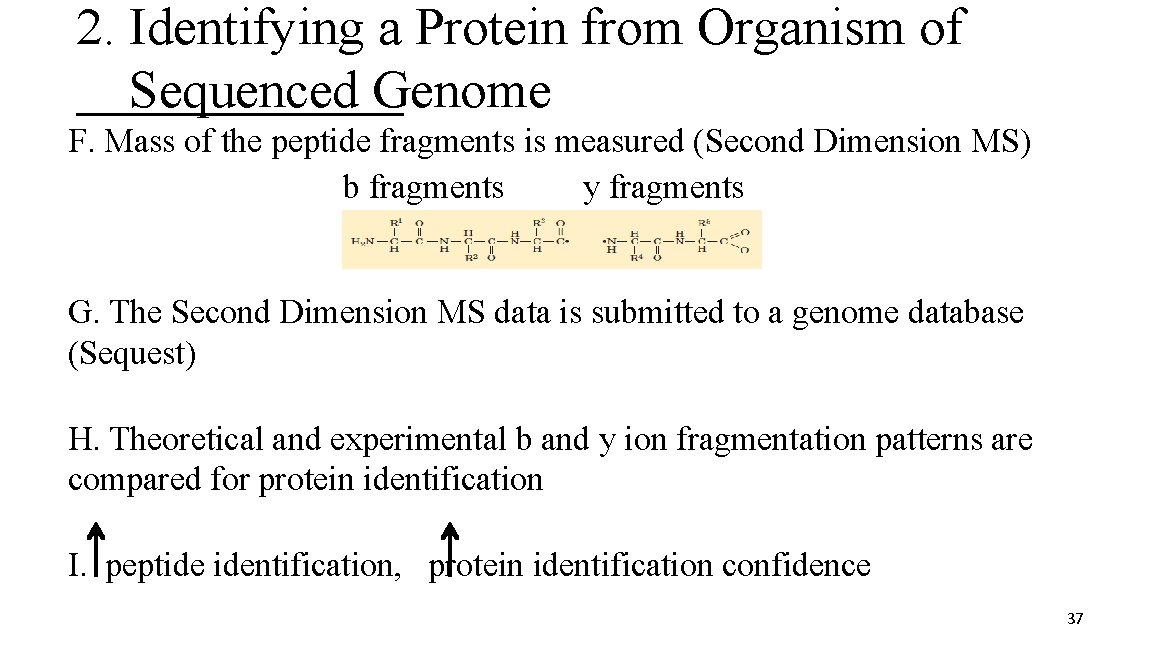
2. Identifying a Protein from Organism of Sequenced Genome F. Mass of the peptide fragments is measured (Second Dimension MS) b fragments y fragments G. The Second Dimension MS data is submitted to a genome database (Sequest) H. Theoretical and experimental b and y ion fragmentation patterns are compared for protein identification I. peptide identification, protein identification confidence 37
Tandem Mass Spectrometry Digestion Protein Fractionation Peptide 38
3. 1 Dimensional Protein MS A. No need to perform a trypsin digest B. Directly measure the mass of the intact protein by electrospray ionization C. No sequence information can be obtained D. Mass may be higher due to a post translational modification or lower due to hydrolysis E. Will only measure the mass of individual subunits for multisubunit proteins 39
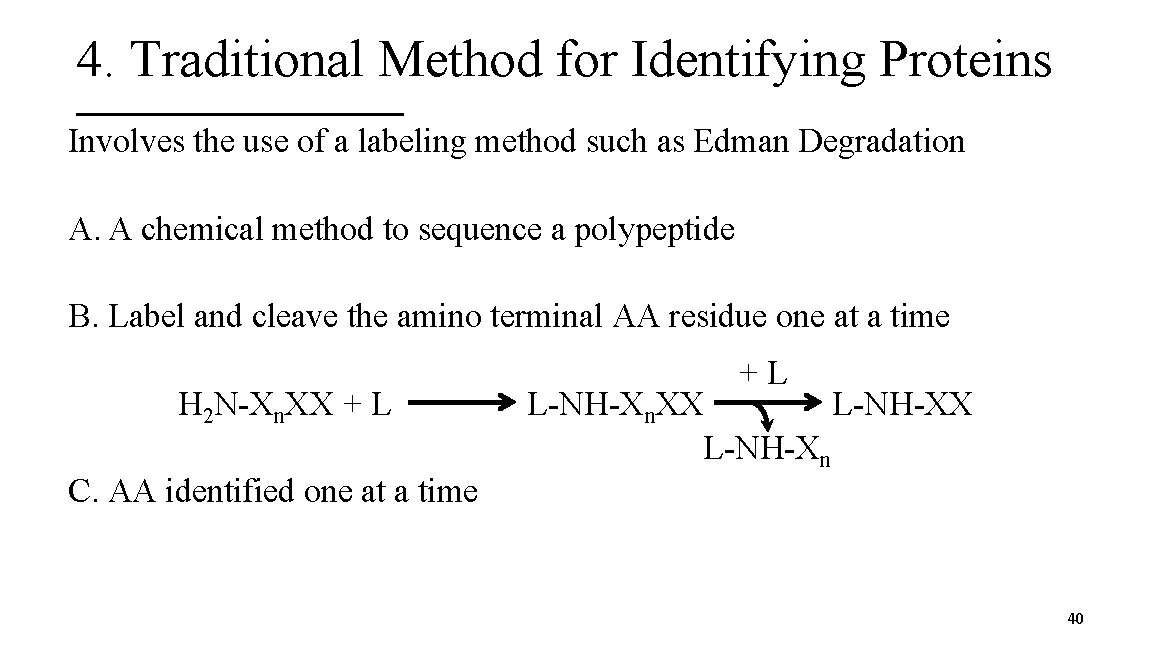
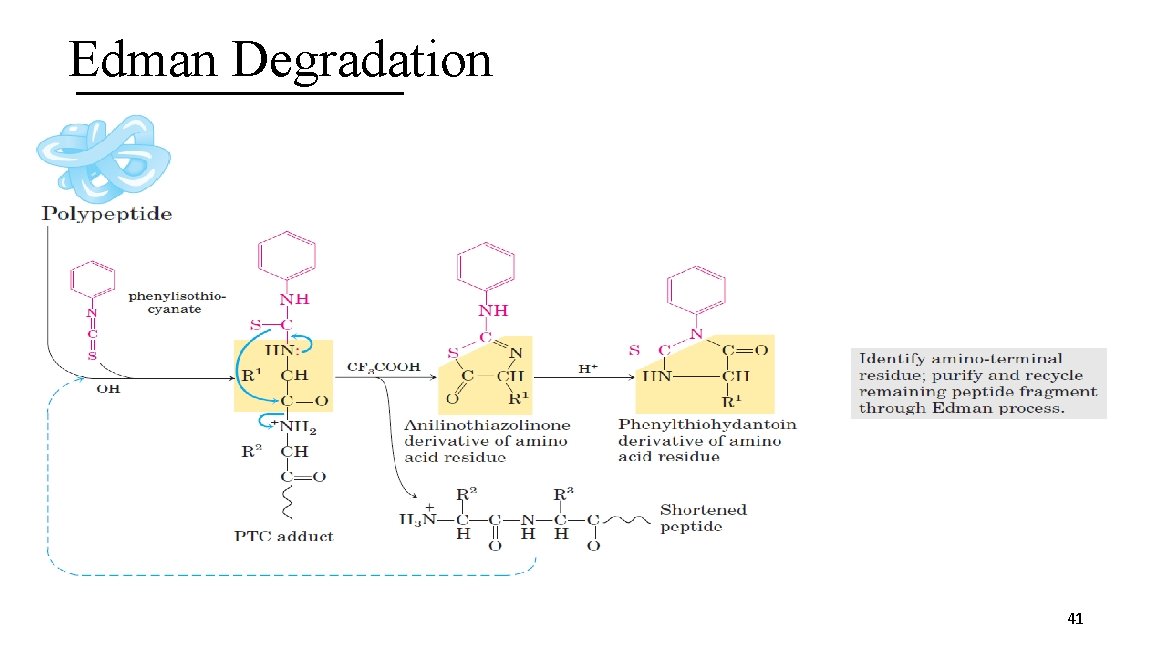
4. Traditional Method for Identifying Proteins Involves the use of a labeling method such as Edman Degradation A. A chemical method to sequence a polypeptide B. Label and cleave the amino terminal AA residue one at a time H 2 N-Xn. XX + L +L L-NH-Xn. XX L-NH-Xn C. AA identified one at a time 40
Edman Degradation 41
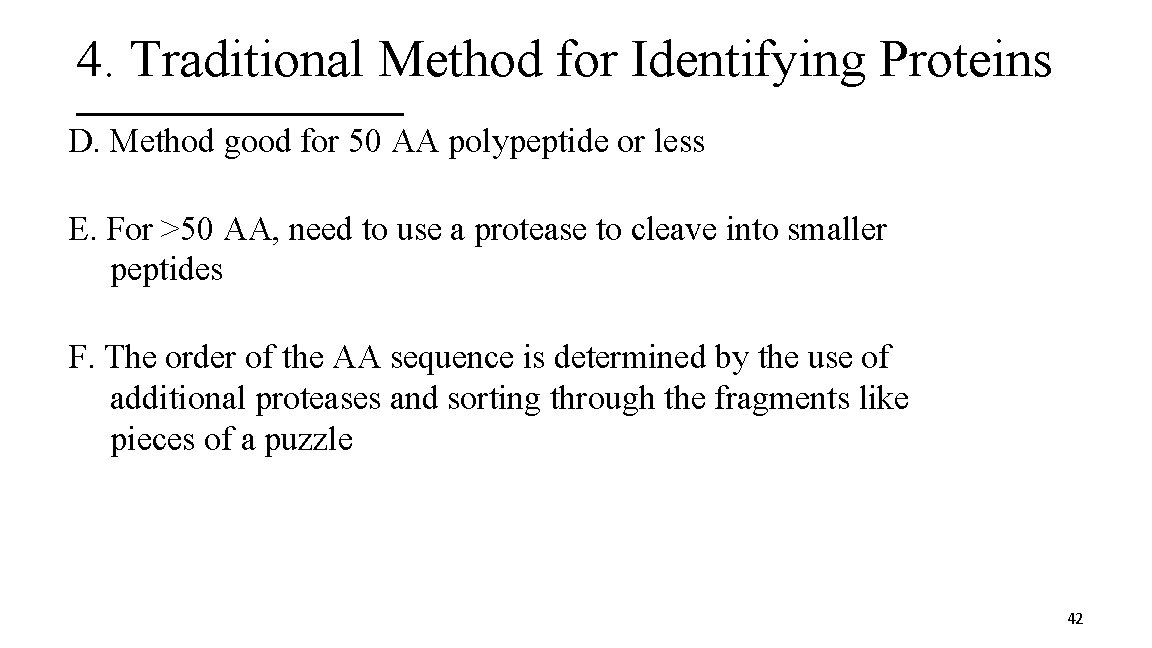
4. Traditional Method for Identifying Proteins D. Method good for 50 AA polypeptide or less E. For >50 AA, need to use a protease to cleave into smaller peptides F. The order of the AA sequence is determined by the use of additional proteases and sorting through the fragments like pieces of a puzzle 42
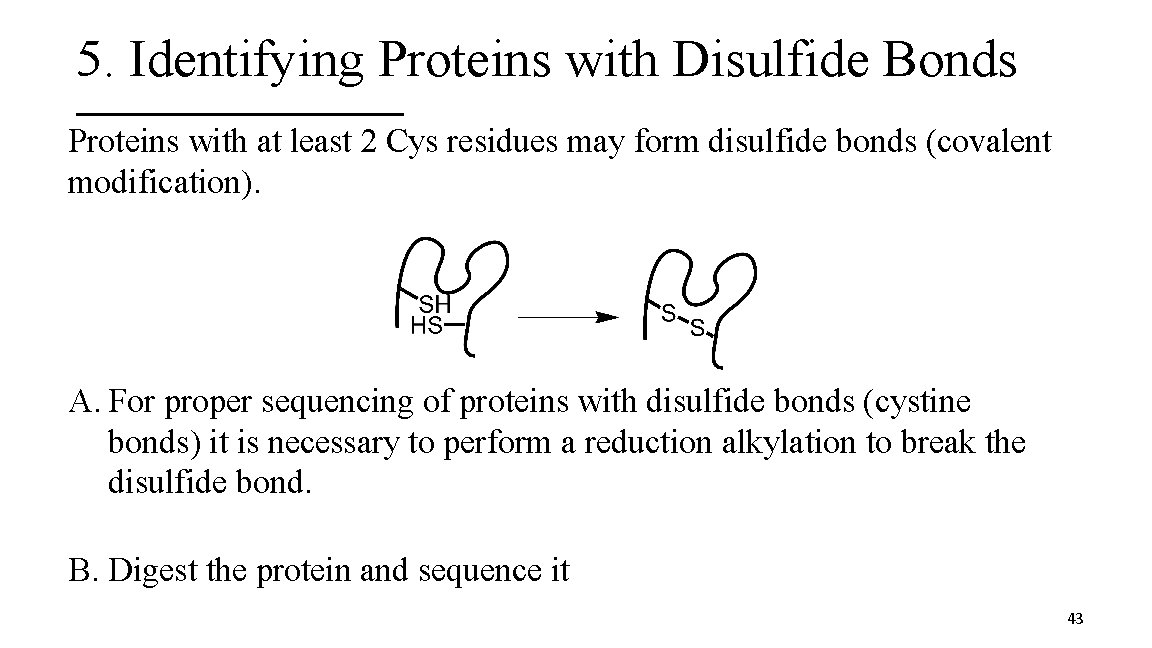
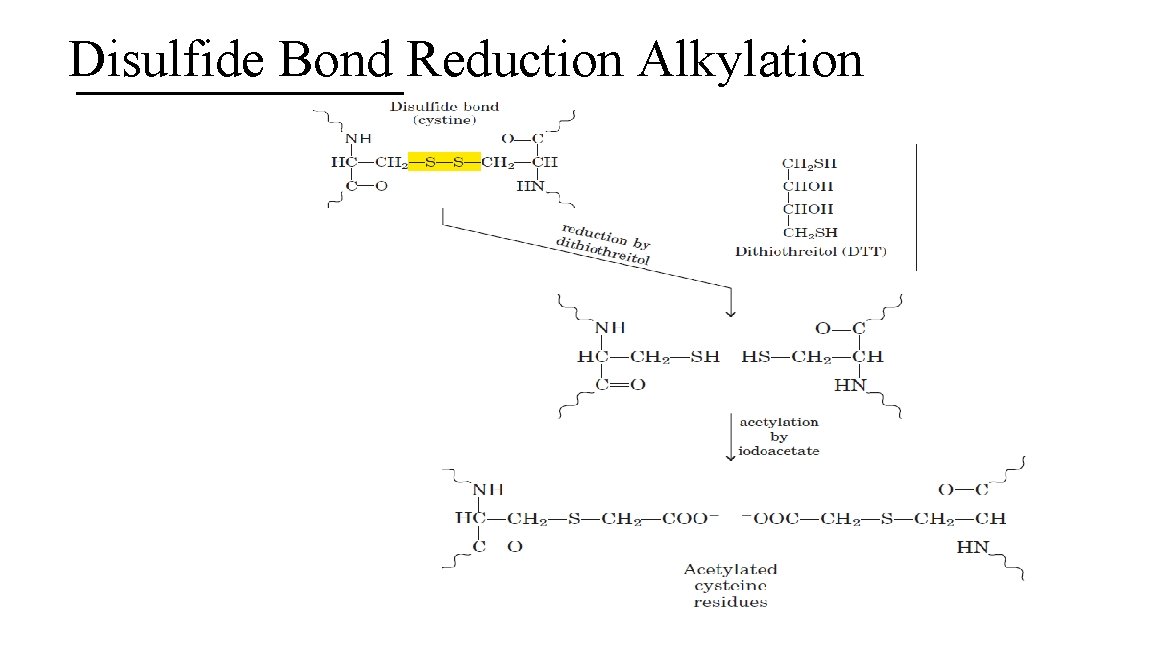
5. Identifying Proteins with Disulfide Bonds Proteins with at least 2 Cys residues may form disulfide bonds (covalent modification). A. For proper sequencing of proteins with disulfide bonds (cystine bonds) it is necessary to perform a reduction alkylation to break the disulfide bond. B. Digest the protein and sequence it 43
Disulfide Bond Reduction Alkylation 44
5. Identifying Proteins with Disulfide Bonds C. Repeat the digestion without reduction alkylation D. For each disulfide bond, two of the original peptides will be missing and a new, larger peptide will appear 45